
Client Requirements
Style, roof type, building type: Building on a slope, flat roof
Basement, floors: 1 basement, 1 ground floor, 1 upper floor
Number of people, age: 2-4
Use: Family use, work (office)
Open kitchen, kitchen island: Semi-open?
Number of dining seats: 6
Fireplace: Yes, a masonry fireplace is planned
Balcony, roof terrace: Terrace/garden accessible from the upper floor
Garage, carport: Double garage in the basement
House Design
Who created the design: Architect
Why does the design look the way it does?
The architect designed the house based on a room plan we developed, which was very well implemented with some economically sensible adjustments in the current plan. The basement includes a double garage, a utility room, and the entrance hall. On the ground floor are 2 children’s rooms, a bedroom, a large bathroom, and a storage room. The basement and ground floor are kept simple and meet our needs perfectly. Due to the slope, the living area is located on the upper floor, as well as the terrace and garden, which are accessible from there.
What is the most important/basic question about the floor plan in 130 characters?
In our opinion, the upper floor still needs some optimization.
Living Area
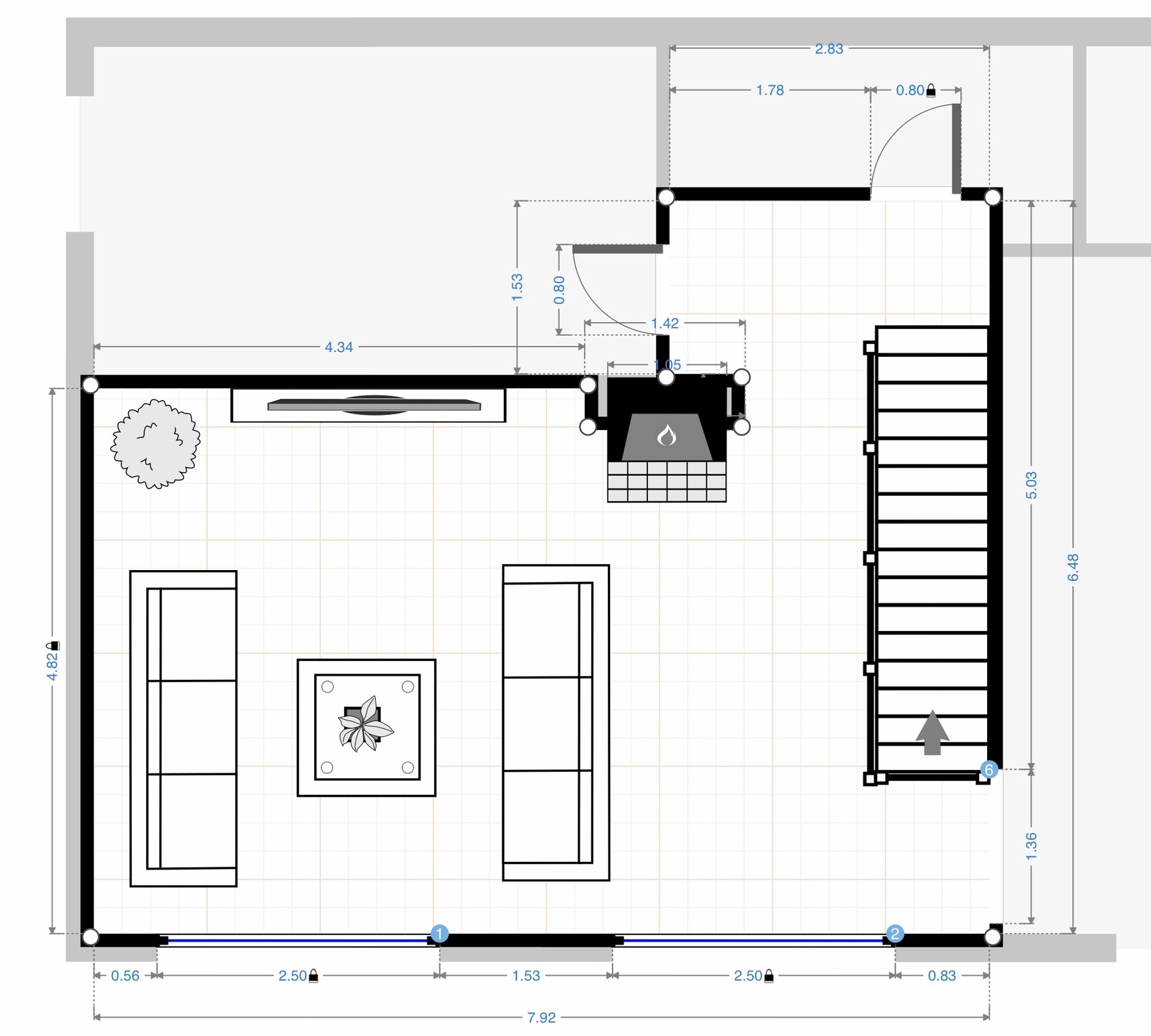
The distance from the TV wall to the exterior wall is currently 4.7 meters (15 ft 5 in). In our current apartment, it is 4.5 meters (14 ft 9 in), and we would like a bit more space here.
Bathroom
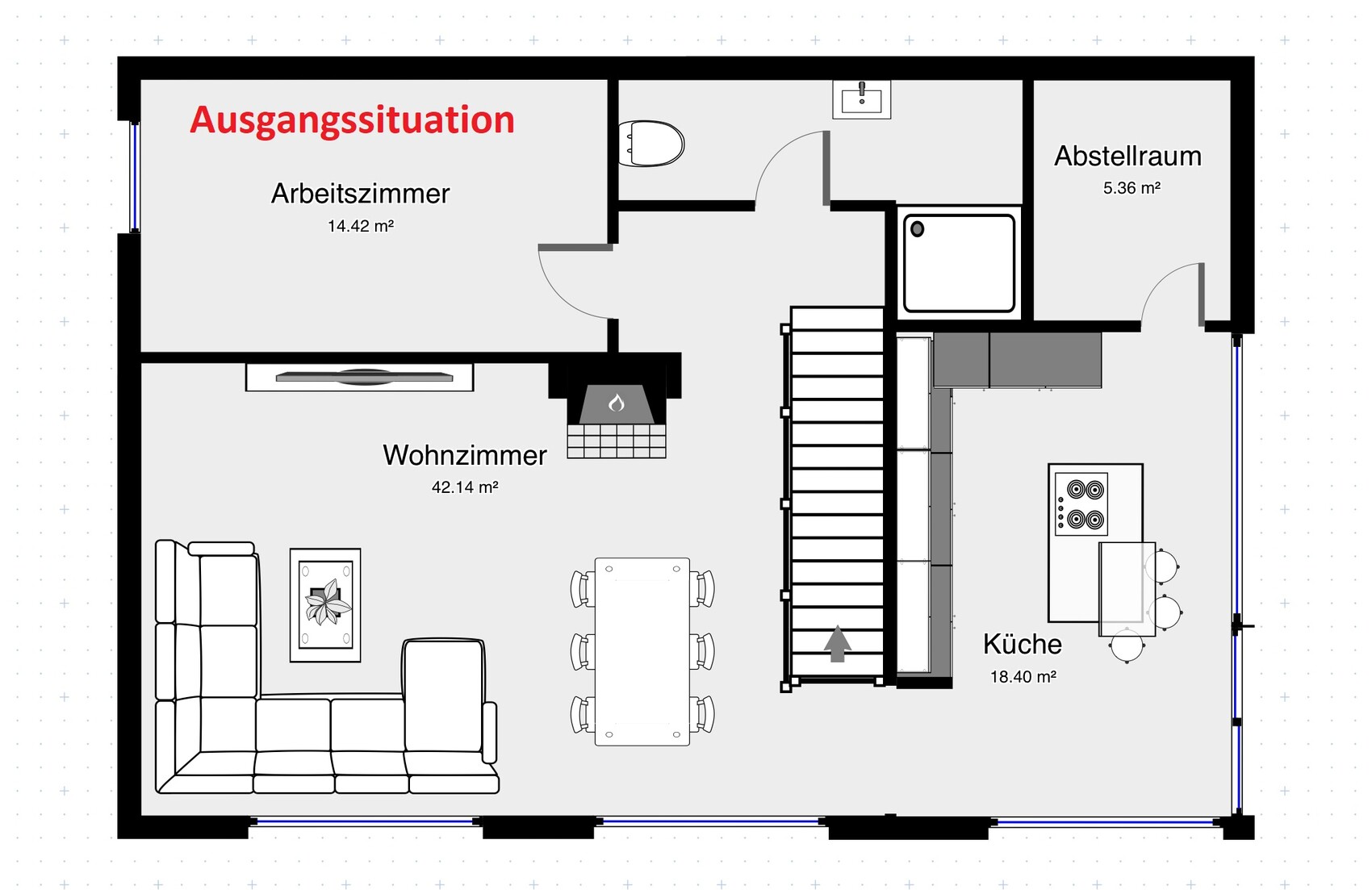
There is a second bathroom with a large shower on the upper floor. However, the shower is too large for us — the bathroom on the upper floor should be smaller and more functional (which also saves costs).
Dining Table
In the architect’s plan, the dining table is integrated into the living room. This is possible for us but not our preferred choice. We would prefer the kitchen and dining table to be separate yet still openly connected.
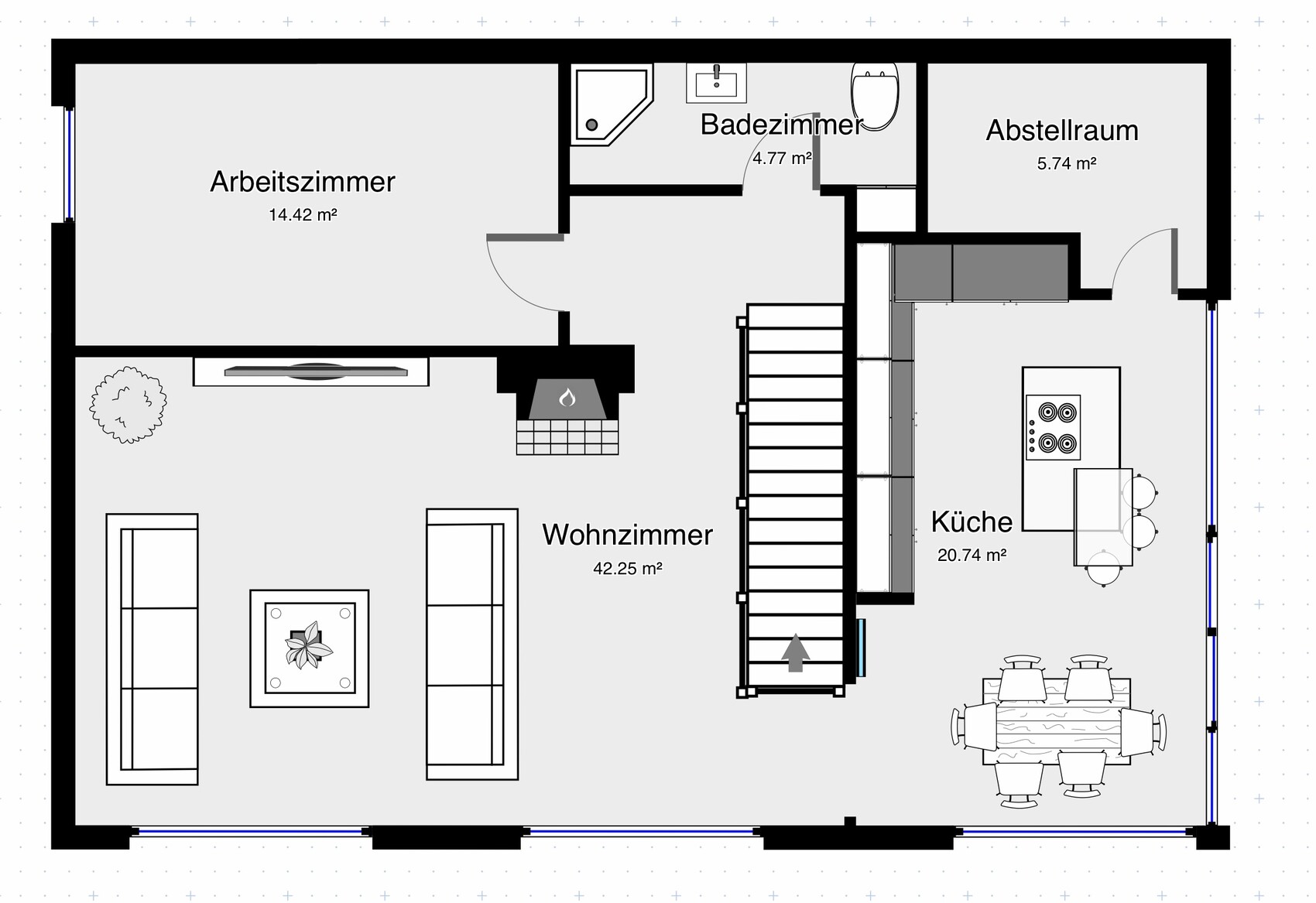
I traced the architect’s plan roughly and made some changes to the floor plans. The following adjustments were made:
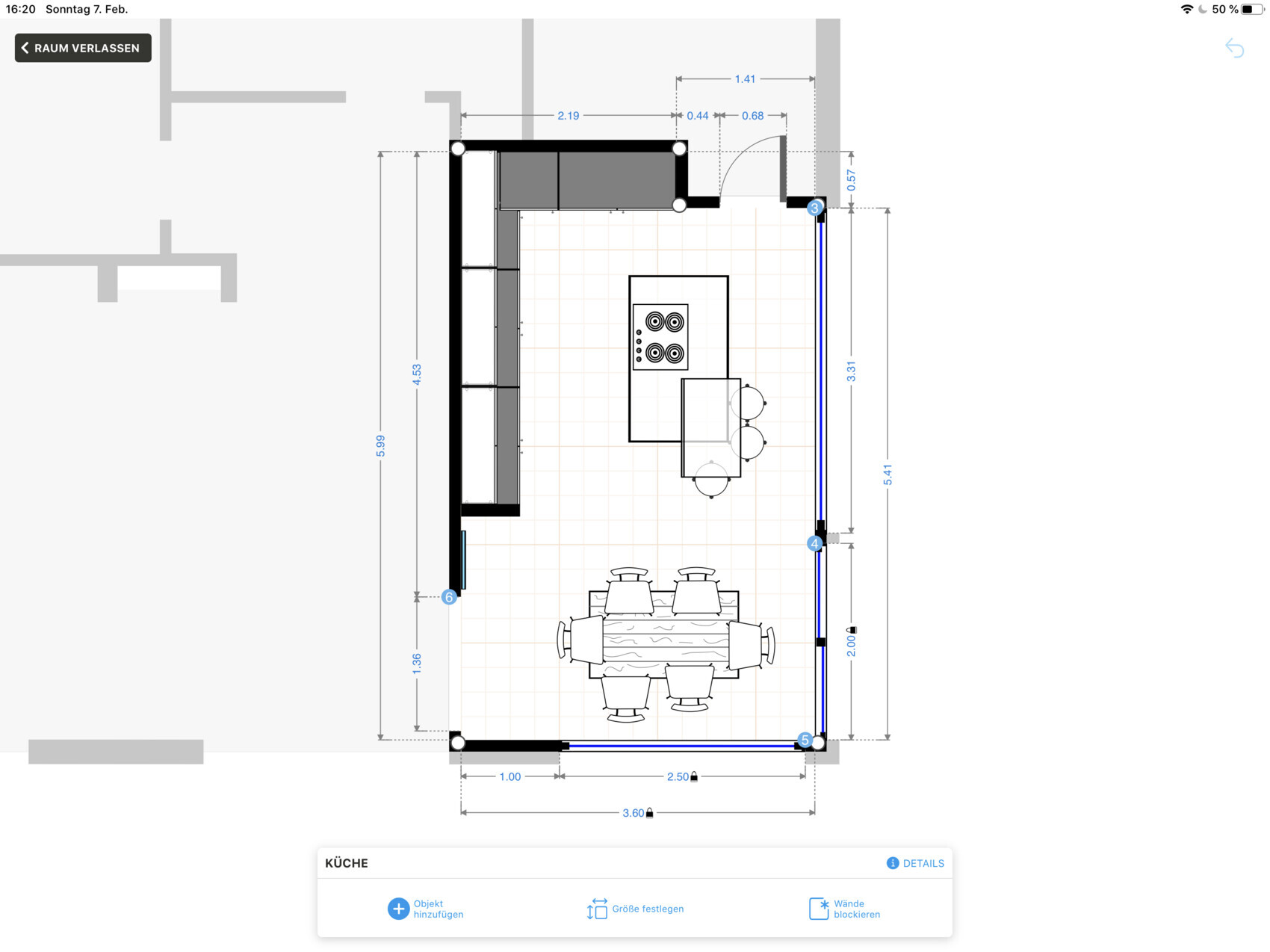
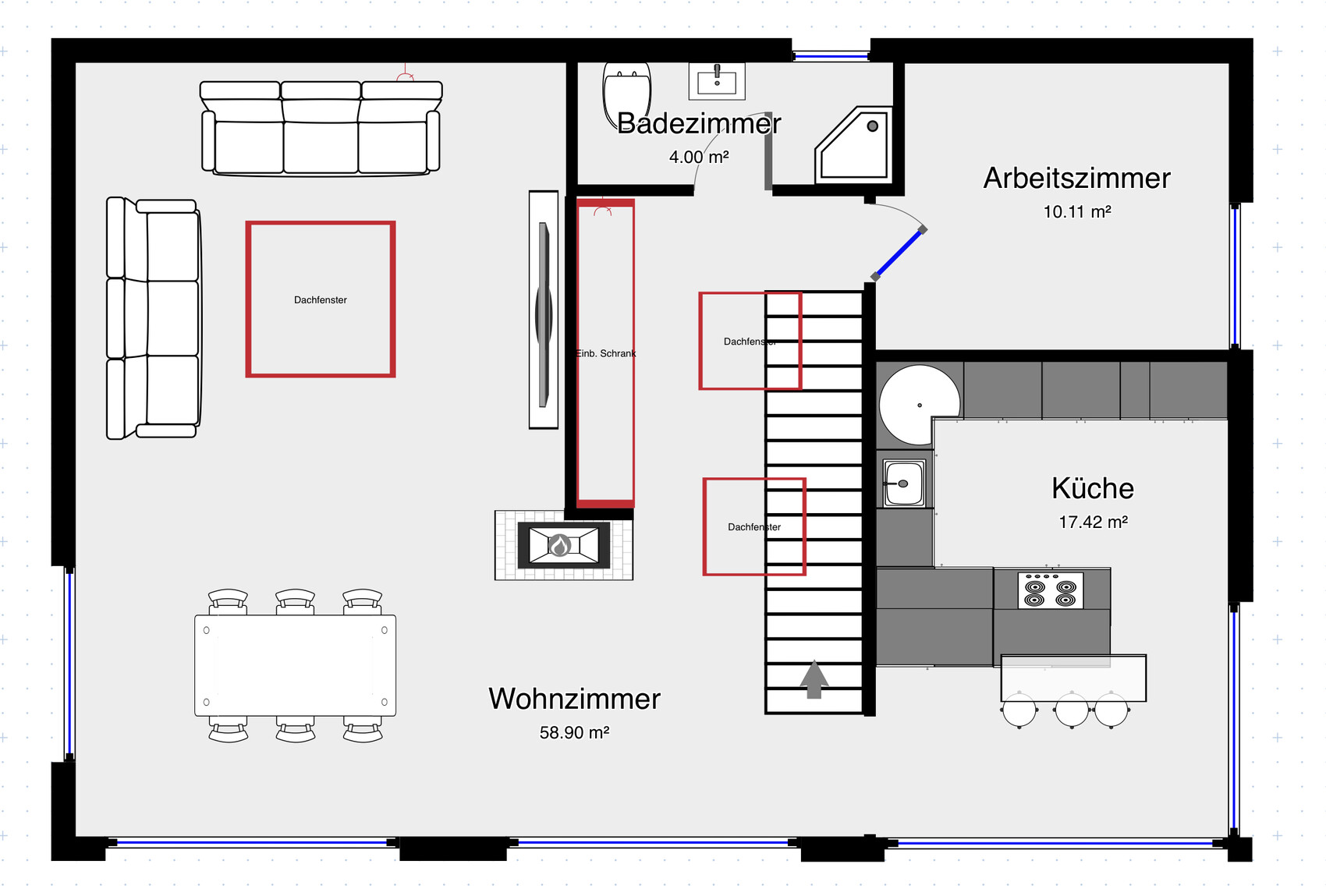
- I replaced the large shower with a corner shower and reduced the shower area, converting the remaining corner into a built-in closet. This allowed me to move the kitchen slightly forward. I adjusted the storage room accordingly. The space gained was used to move the dining table closer to the kitchen. The small corner next to the dining table and kitchen (marked with a blue line) was intended as a small cloakroom to store items like slippers or vests for quick trips to the terrace (since the main entrance is in the basement).
- I reduced the office width from 3 meters (9 ft 10 in) to 2.9 meters (9 ft 6 in) to increase the living room width to about 4.8 meters (15 ft 9 in). I might reduce the office size further? (The original office layout is no longer visible in the pictures.)
What are your thoughts?
Style, roof type, building type: Building on a slope, flat roof
Basement, floors: 1 basement, 1 ground floor, 1 upper floor
Number of people, age: 2-4
Use: Family use, work (office)
Open kitchen, kitchen island: Semi-open?
Number of dining seats: 6
Fireplace: Yes, a masonry fireplace is planned
Balcony, roof terrace: Terrace/garden accessible from the upper floor
Garage, carport: Double garage in the basement
House Design
Who created the design: Architect
Why does the design look the way it does?
The architect designed the house based on a room plan we developed, which was very well implemented with some economically sensible adjustments in the current plan. The basement includes a double garage, a utility room, and the entrance hall. On the ground floor are 2 children’s rooms, a bedroom, a large bathroom, and a storage room. The basement and ground floor are kept simple and meet our needs perfectly. Due to the slope, the living area is located on the upper floor, as well as the terrace and garden, which are accessible from there.
What is the most important/basic question about the floor plan in 130 characters?
In our opinion, the upper floor still needs some optimization.
Living Area
The distance from the TV wall to the exterior wall is currently 4.7 meters (15 ft 5 in). In our current apartment, it is 4.5 meters (14 ft 9 in), and we would like a bit more space here.
Bathroom
There is a second bathroom with a large shower on the upper floor. However, the shower is too large for us — the bathroom on the upper floor should be smaller and more functional (which also saves costs).
Dining Table
In the architect’s plan, the dining table is integrated into the living room. This is possible for us but not our preferred choice. We would prefer the kitchen and dining table to be separate yet still openly connected.
I traced the architect’s plan roughly and made some changes to the floor plans. The following adjustments were made:
- I replaced the large shower with a corner shower and reduced the shower area, converting the remaining corner into a built-in closet. This allowed me to move the kitchen slightly forward. I adjusted the storage room accordingly. The space gained was used to move the dining table closer to the kitchen. The small corner next to the dining table and kitchen (marked with a blue line) was intended as a small cloakroom to store items like slippers or vests for quick trips to the terrace (since the main entrance is in the basement).
- I reduced the office width from 3 meters (9 ft 10 in) to 2.9 meters (9 ft 6 in) to increase the living room width to about 4.8 meters (15 ft 9 in). I might reduce the office size further? (The original office layout is no longer visible in the pictures.)
What are your thoughts?
borxx schrieb:
Sorry for the quick question, but what is the disadvantage of having the windows flush with the wall surface instead of leaving a few centimeters (inches) of space to the wall?
We are also planning some windows to be "room width". Nothing. It just has to fit architecturally, technically, and structurally 🙂

borxx schrieb:
Sorry for the quick question, but what speaks against having the windows flush with the wall instead of leaving a few centimeters (inches) before the wall? Several things. Connection complications at the lintel and shutter box, future external insulation, and so on. Plus, the shadow lines of every speck of dust as the sunlight passes by.
borxx schrieb:
We are actually planning some windows to be "room width." I had a pretty good youth in the 80s, but I still wouldn’t build so retro. But that’s a matter of personal taste.
https://www.instagram.com/11antgmxde/
https://www.linkedin.com/company/bauen-jetzt/
A small update:
This has kept us thinking quite a bit over the past weeks! After a lot of back and forth and discussions with the architect and the building authority, we submitted a supplement to the building permit (there was a short separate discussion about this in another forum). In short: We received an oral approval from the authority for more height; in total, we can distribute 40cm (16 inches) extra across the floors. Now the question is how?
Currently, the floor heights are as follows:
Basement 2.4m (7 ft 10 in) (minus 8cm (3 inches) floor build-up = 2.32m (7 ft 7 in) room height), Ground floor 2.6m (8 ft 6 in) (minus 20cm (8 inches) floor build-up = 2.40m (7 ft 10 in) room height), Upper floor 2.6m (8 ft 6 in) (minus 20cm (8 inches) floor build-up = 2.40m (7 ft 10 in) room height).
I am now thinking, for example: Basement 2.5m (8 ft 2 in), Ground floor 2.7m (8 ft 10 in), Upper floor 2.8m (9 ft 2 in) or Basement 2.5m (8 ft 2 in), Ground floor 2.75m (9 ft), Upper floor 2.75m (9 ft).
What do you think?
I drew two versions. My favorite is the one with the large living and dining area and the built-in closet. The pantry had to go, but the kitchen should still offer enough potential for storage. Overall, I see advantages regarding storage space thanks to the built-in closet.

emundem schrieb:
I really like the floor plan. One question – although I might be completely mistaken: The floor build-up of 20cm (8 inches) is always missing from the average ceiling height, right? 2.6m (8 ft 6 in) room height + 0.2m (8 inches) concrete ceiling + 0.2m (8 inches) floor build-up should add up to 3.0m (9 ft 10 in) floor-to-floor height.
This has kept us thinking quite a bit over the past weeks! After a lot of back and forth and discussions with the architect and the building authority, we submitted a supplement to the building permit (there was a short separate discussion about this in another forum). In short: We received an oral approval from the authority for more height; in total, we can distribute 40cm (16 inches) extra across the floors. Now the question is how?
Currently, the floor heights are as follows:
Basement 2.4m (7 ft 10 in) (minus 8cm (3 inches) floor build-up = 2.32m (7 ft 7 in) room height), Ground floor 2.6m (8 ft 6 in) (minus 20cm (8 inches) floor build-up = 2.40m (7 ft 10 in) room height), Upper floor 2.6m (8 ft 6 in) (minus 20cm (8 inches) floor build-up = 2.40m (7 ft 10 in) room height).
I am now thinking, for example: Basement 2.5m (8 ft 2 in), Ground floor 2.7m (8 ft 10 in), Upper floor 2.8m (9 ft 2 in) or Basement 2.5m (8 ft 2 in), Ground floor 2.75m (9 ft), Upper floor 2.75m (9 ft).
What do you think?
ypg schrieb:
Take a look here: with the chimney flue and doors, you’ll need to find a compromise... and the WC window additionally, something like this.
I drew two versions. My favorite is the one with the large living and dining area and the built-in closet. The pantry had to go, but the kitchen should still offer enough potential for storage. Overall, I see advantages regarding storage space thanks to the built-in closet.
If it ends up being version 2, I would have the bathroom door open to the left toward the wall. Behind it would then be just the wall, so you’re not sitting directly facing the door. Oh, and a sink is missing there as well.
But the door solution in version 1 of the bathroom doesn’t seem quite right either. You open the door and basically stand in front of the sink, then have to squeeze past the open door to quickly get to the shower, maybe because a towel is lying there. Hmm… and always having the door behind you… maybe not ideal.
It might be better to have the door open outward since the room is wider than it is deep. Swap the shower and toilet, as well as the window and sink. That way, there might be enough space to open the door inward again.
But the door solution in version 1 of the bathroom doesn’t seem quite right either. You open the door and basically stand in front of the sink, then have to squeeze past the open door to quickly get to the shower, maybe because a towel is lying there. Hmm… and always having the door behind you… maybe not ideal.
It might be better to have the door open outward since the room is wider than it is deep. Swap the shower and toilet, as well as the window and sink. That way, there might be enough space to open the door inward again.
Version 2 would never be an option for me. The dining table is too far away and too much in the corner. In our family, with two children, the dining table is a central part of family life. I like version 1, but the table is still a bit too far from the kitchen for my taste.
Regarding ceiling height: I would keep the lower ceiling height in the basement since it is used only for storage anyway. In the living area, I would definitely increase the ceiling height, especially on the upper floor.
Regarding ceiling height: I would keep the lower ceiling height in the basement since it is used only for storage anyway. In the living area, I would definitely increase the ceiling height, especially on the upper floor.
Similar topics