
Client Requirements
Style, roof type, building type: Building on a slope, flat roof
Basement, floors: 1 basement, 1 ground floor, 1 upper floor
Number of people, age: 2-4
Use: Family use, work (office)
Open kitchen, kitchen island: Semi-open?
Number of dining seats: 6
Fireplace: Yes, a masonry fireplace is planned
Balcony, roof terrace: Terrace/garden accessible from the upper floor
Garage, carport: Double garage in the basement
House Design
Who created the design: Architect
Why does the design look the way it does?
The architect designed the house based on a room plan we developed, which was very well implemented with some economically sensible adjustments in the current plan. The basement includes a double garage, a utility room, and the entrance hall. On the ground floor are 2 children’s rooms, a bedroom, a large bathroom, and a storage room. The basement and ground floor are kept simple and meet our needs perfectly. Due to the slope, the living area is located on the upper floor, as well as the terrace and garden, which are accessible from there.
What is the most important/basic question about the floor plan in 130 characters?
In our opinion, the upper floor still needs some optimization.
Living Area
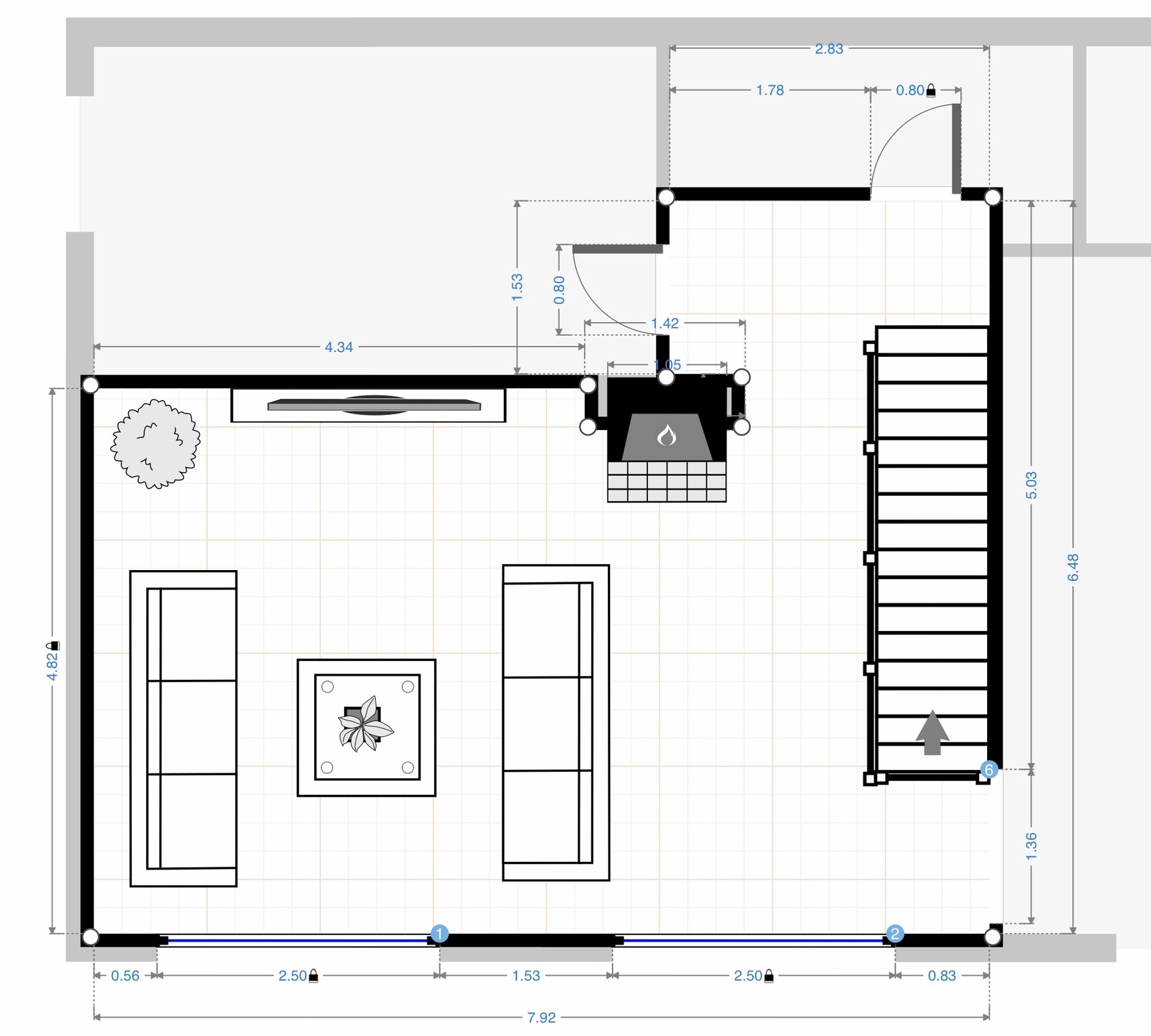
The distance from the TV wall to the exterior wall is currently 4.7 meters (15 ft 5 in). In our current apartment, it is 4.5 meters (14 ft 9 in), and we would like a bit more space here.
Bathroom
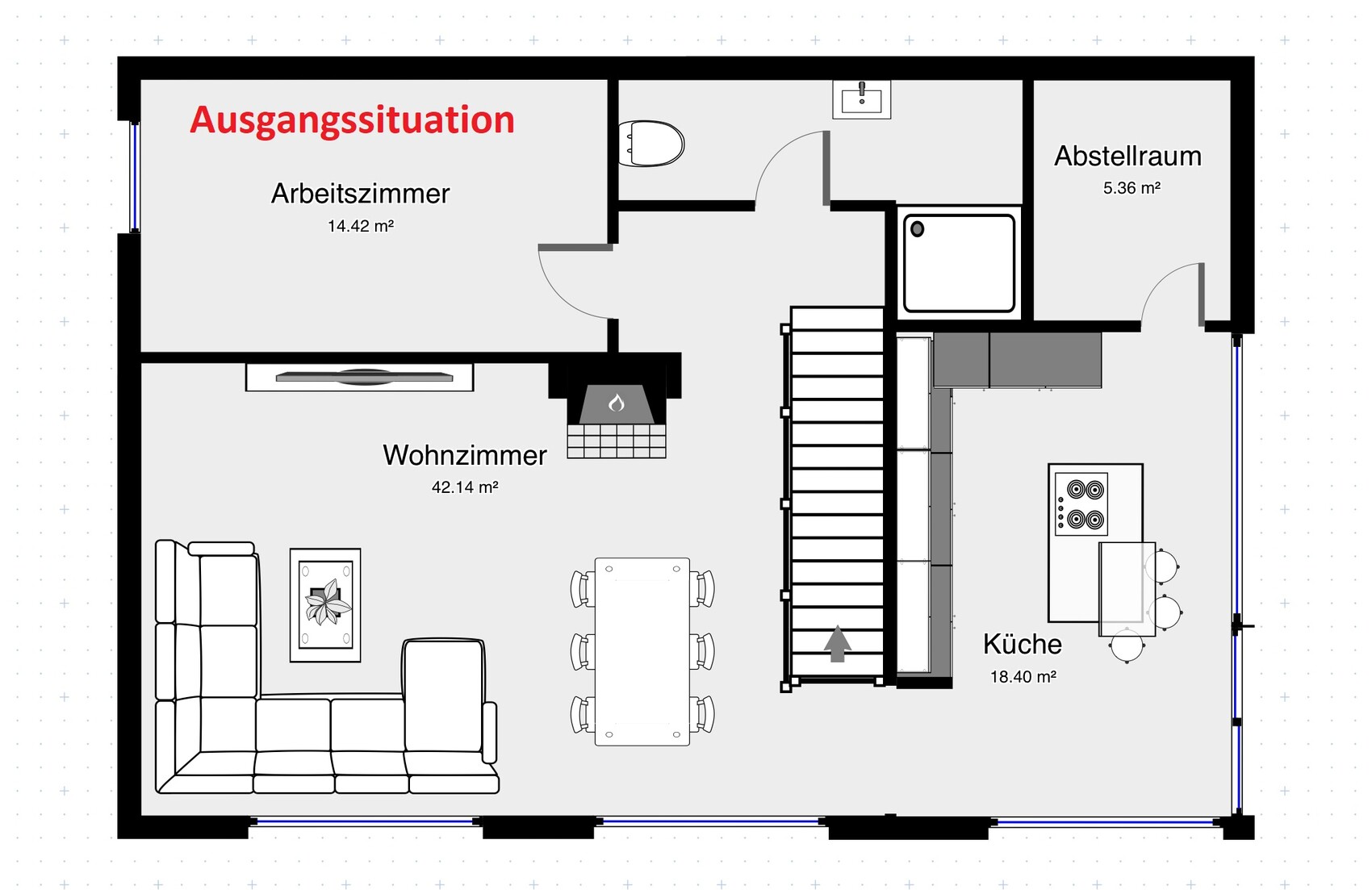
There is a second bathroom with a large shower on the upper floor. However, the shower is too large for us — the bathroom on the upper floor should be smaller and more functional (which also saves costs).
Dining Table
In the architect’s plan, the dining table is integrated into the living room. This is possible for us but not our preferred choice. We would prefer the kitchen and dining table to be separate yet still openly connected.
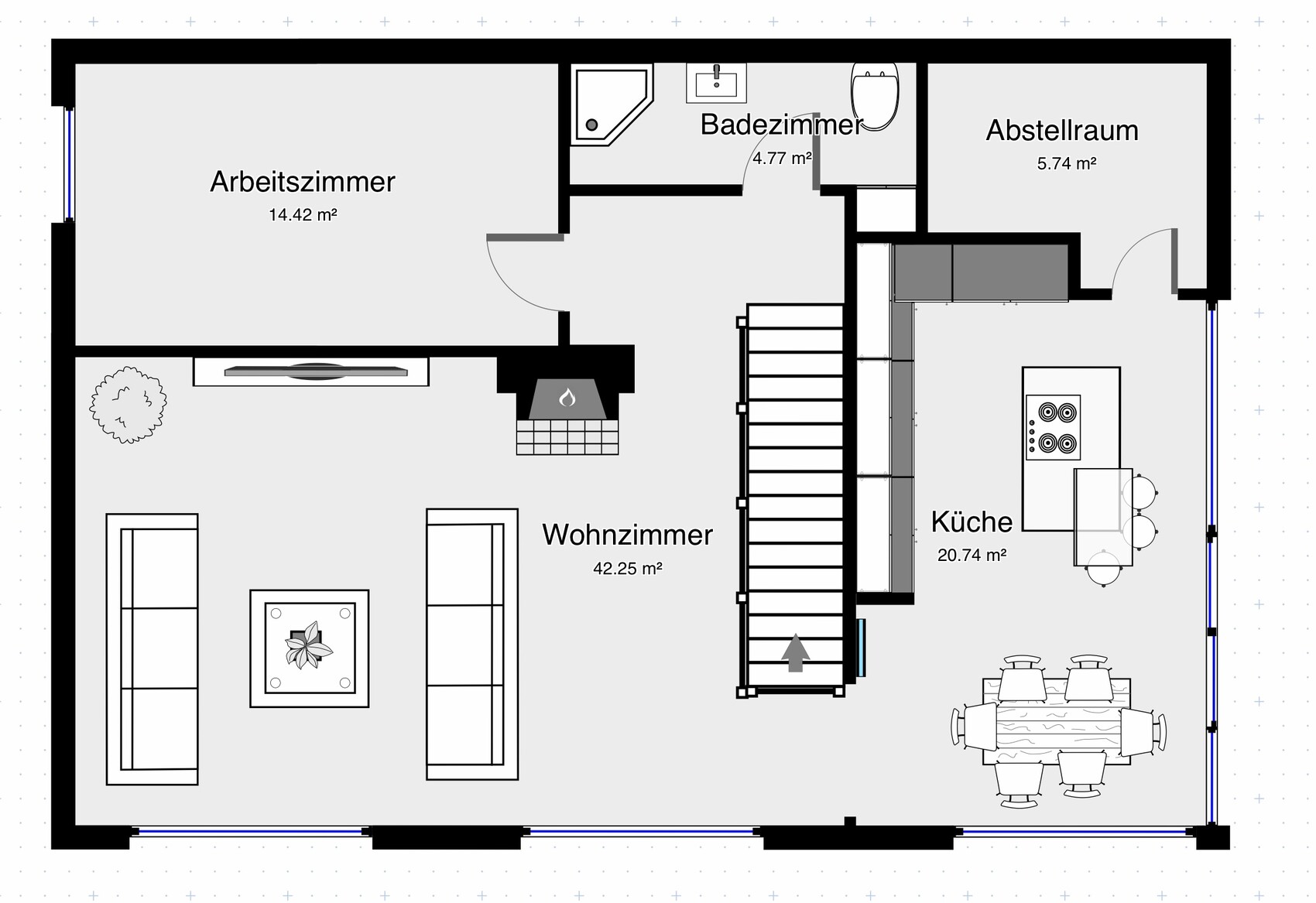
I traced the architect’s plan roughly and made some changes to the floor plans. The following adjustments were made:
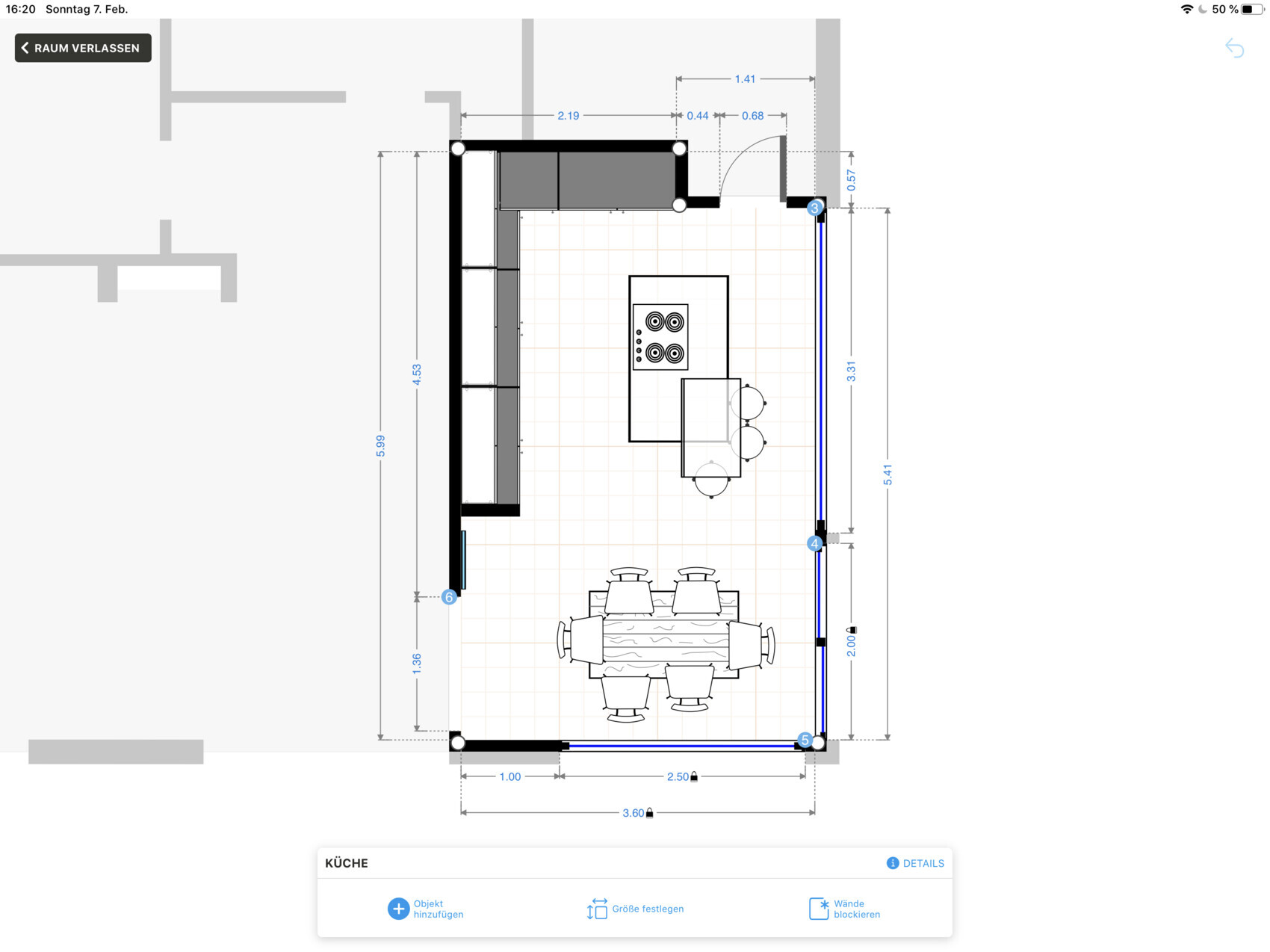
- I replaced the large shower with a corner shower and reduced the shower area, converting the remaining corner into a built-in closet. This allowed me to move the kitchen slightly forward. I adjusted the storage room accordingly. The space gained was used to move the dining table closer to the kitchen. The small corner next to the dining table and kitchen (marked with a blue line) was intended as a small cloakroom to store items like slippers or vests for quick trips to the terrace (since the main entrance is in the basement).
- I reduced the office width from 3 meters (9 ft 10 in) to 2.9 meters (9 ft 6 in) to increase the living room width to about 4.8 meters (15 ft 9 in). I might reduce the office size further? (The original office layout is no longer visible in the pictures.)
What are your thoughts?
Style, roof type, building type: Building on a slope, flat roof
Basement, floors: 1 basement, 1 ground floor, 1 upper floor
Number of people, age: 2-4
Use: Family use, work (office)
Open kitchen, kitchen island: Semi-open?
Number of dining seats: 6
Fireplace: Yes, a masonry fireplace is planned
Balcony, roof terrace: Terrace/garden accessible from the upper floor
Garage, carport: Double garage in the basement
House Design
Who created the design: Architect
Why does the design look the way it does?
The architect designed the house based on a room plan we developed, which was very well implemented with some economically sensible adjustments in the current plan. The basement includes a double garage, a utility room, and the entrance hall. On the ground floor are 2 children’s rooms, a bedroom, a large bathroom, and a storage room. The basement and ground floor are kept simple and meet our needs perfectly. Due to the slope, the living area is located on the upper floor, as well as the terrace and garden, which are accessible from there.
What is the most important/basic question about the floor plan in 130 characters?
In our opinion, the upper floor still needs some optimization.
Living Area
The distance from the TV wall to the exterior wall is currently 4.7 meters (15 ft 5 in). In our current apartment, it is 4.5 meters (14 ft 9 in), and we would like a bit more space here.
Bathroom
There is a second bathroom with a large shower on the upper floor. However, the shower is too large for us — the bathroom on the upper floor should be smaller and more functional (which also saves costs).
Dining Table
In the architect’s plan, the dining table is integrated into the living room. This is possible for us but not our preferred choice. We would prefer the kitchen and dining table to be separate yet still openly connected.
I traced the architect’s plan roughly and made some changes to the floor plans. The following adjustments were made:
- I replaced the large shower with a corner shower and reduced the shower area, converting the remaining corner into a built-in closet. This allowed me to move the kitchen slightly forward. I adjusted the storage room accordingly. The space gained was used to move the dining table closer to the kitchen. The small corner next to the dining table and kitchen (marked with a blue line) was intended as a small cloakroom to store items like slippers or vests for quick trips to the terrace (since the main entrance is in the basement).
- I reduced the office width from 3 meters (9 ft 10 in) to 2.9 meters (9 ft 6 in) to increase the living room width to about 4.8 meters (15 ft 9 in). I might reduce the office size further? (The original office layout is no longer visible in the pictures.)
What are your thoughts?
bowbow91 schrieb:
Only one ceiling per floor level is considered in the story height. The floor construction is not shown, so the room height will later result from 2.6 m (8.5 feet) minus the floor build-up. But that means the room height would then be about 2.4 m (7.9 feet) on the different floors.
ypg schrieb:
Has the building application already been submitted?
The structural calculations are probably attached as well, right? Even if your adjustments are possible, the kitchen will actually be tight. Also, the table will be in the way.
Without having pencil and paper at hand, I see options only if the staircase is moved to the left side according to the plan, which affects the lower floors, or by extending the kitchen upwards on the plan, placing the pantry where the guest WC currently is, and shifting the rest accordingly, so the living area gives up some space. This means a rotation counterclockwise.
Take a look here: with the chimney and the doors, some compromise is needed... and additionally the WC window, something like this
[ATTACH alt="B0B37150-591F-4813-9C7C-6940D2F81D65.jpeg"]57153[/ATTACH] Yes, I had thought about something along those lines as well. However, the wall next to the staircase on the right is load-bearing. The rest can still be moved without problems, at least that's how I understood the architect. I will definitely consider this and possibly review the different options with the architect next week.
emundem schrieb:
But doesn’t that mean the ceiling height in the different floors will be 2.4 m (7 ft 10 in)? Correct, approximately 2.40 m (7 ft 10 in) on the ground and first floors and about 2.30 m (7 ft 7 in) in the basement. A significantly higher ceiling height will be difficult due to the development plan. The roof eave height (measured from the reference level where the garage starts) must not exceed 8 m (26 ft 3 in). As you might notice, we are already exceeding the eave height with the parapet of the flat roof and need to apply for an exemption.

What kind of joker is this architect to plan such unrealistic dimensions everywhere? He should know from professional experience that this only causes unnecessary cutting of blocks and creates room for poor workmanship. Besides, I would no longer have the monolithic wall alignments continued into the window reveals, but instead insert wall sections about 80cm (31.5 inches) wide there (in bathroom 2 even two sections of 80cm (31.5 inches) each, otherwise the reveal is misaligned compared to the partition wall). I believe more and more young architects these days have never worked practically on construction sites. But at the very least, he should be able to spot these issues on the drawings!
https://www.instagram.com/11antgmxde/
https://www.linkedin.com/company/bauen-jetzt/
https://www.instagram.com/11antgmxde/
https://www.linkedin.com/company/bauen-jetzt/
bowbow91 schrieb:
Only the wall next to the stairs on the right side is load-bearing.But I did leave that one in place!11ant schrieb:
What kind of comedian is the architect to use these fantasy measurements everywhere? He should know from professional experience that this only leads to unnecessary cutting of bricks and sloppy workmanship.Which specific areas are you referring to? The living and dining rooms?
11ant schrieb:
By the way, I would no longer have the wall alignments continue monolithically into the window reveals but instead place wall sections about eight meters (26 feet) wide there (in bathroom 2 even two sections eight meters (26 feet) wide, otherwise the reveal is offset compared to the partition wall). I think more and more young architects nowadays have never worked practically on site. But at the very least, he should see this mistake on the drawings!I’m afraid I don’t quite follow you here 🤨 Are you generally talking about the spacing of the windows or specifically just in the bathrooms so that the reveal is not deeper than the partition wall?
ypg schrieb:
But I left them like that!Yes, that’s fine 😉
bowbow91 schrieb:
Which areas exactly do you mean? The living and dining rooms?Every single room measurement without exception, it’s consistent throughout the entire house. 667.5 / 115 / 359 instead of 663.5 / 113.5 / 363.5, 309.5 / 294.5 / 160 instead of 313.5 / 288.5 / 163.5, and the worst is 450.5 instead of 451 – the mason can’t keep up with all the cutting. An extra hour and a half every day just because the architect doesn’t understand the brick dimensions. That really shouldn’t be necessary :-( bowbow91 schrieb:
Are you generally referring to the distance of the windows?No, it’s about the alignment of the wall that runs into the reveal in the office, the storage room, the bedroom, the bathroom—but strangely not at the WC and in front of the shower. In the 1970s and 1980s that was considered modern; the builders from that era are now struggling with it when retrofitting insulation. What was a style back then has turned into design sloppiness nowadays, as mentioned above.https://www.instagram.com/11antgmxde/
https://www.linkedin.com/company/bauen-jetzt/
Similar topics