
ᐅ Floor Plan Optimization for Urban Villa + Considerations for Land Elevation
Created on: 31 Jan 2020 13:29
S
Shiny86
Plot size 492 sqm (5293 sq ft)
Slope yes
Site coverage ratio?
Floor area ratio?
Building envelope, building line, and boundary?
Boundary development?
Number of parking spaces 2
Number of floors 2
Roof type Pyramid roof, 25 degrees
Architectural style Modern urban villa
Orientation Main entrance facing north
Maximum heights/limits
Additional requirements?
Clients’ Requirements
Style, roof type, building type
Modern urban villa with pyramid roof, 25 degrees
Basement, floors 2 full floors without basement
Number of occupants 4
Open kitchen, kitchen island
Number of parking spaces 8-10
Garage
House design
Who designed it?
-Architect
What do you particularly like? Why?
Large living area, master bathroom
What don’t you like? Why?
Utility room quite small and master bedroom small, children’s room somewhat too large
Why is the design as it is now?
The architect implemented the corresponding wishes
What do you think is especially good or bad about it?
Good: large living area
I am uncertain about the half-height window sizes and the swing direction of the doors
What is the most important/basic question about the floor plan summarized in 130 characters?
What do you think about the floor plans?
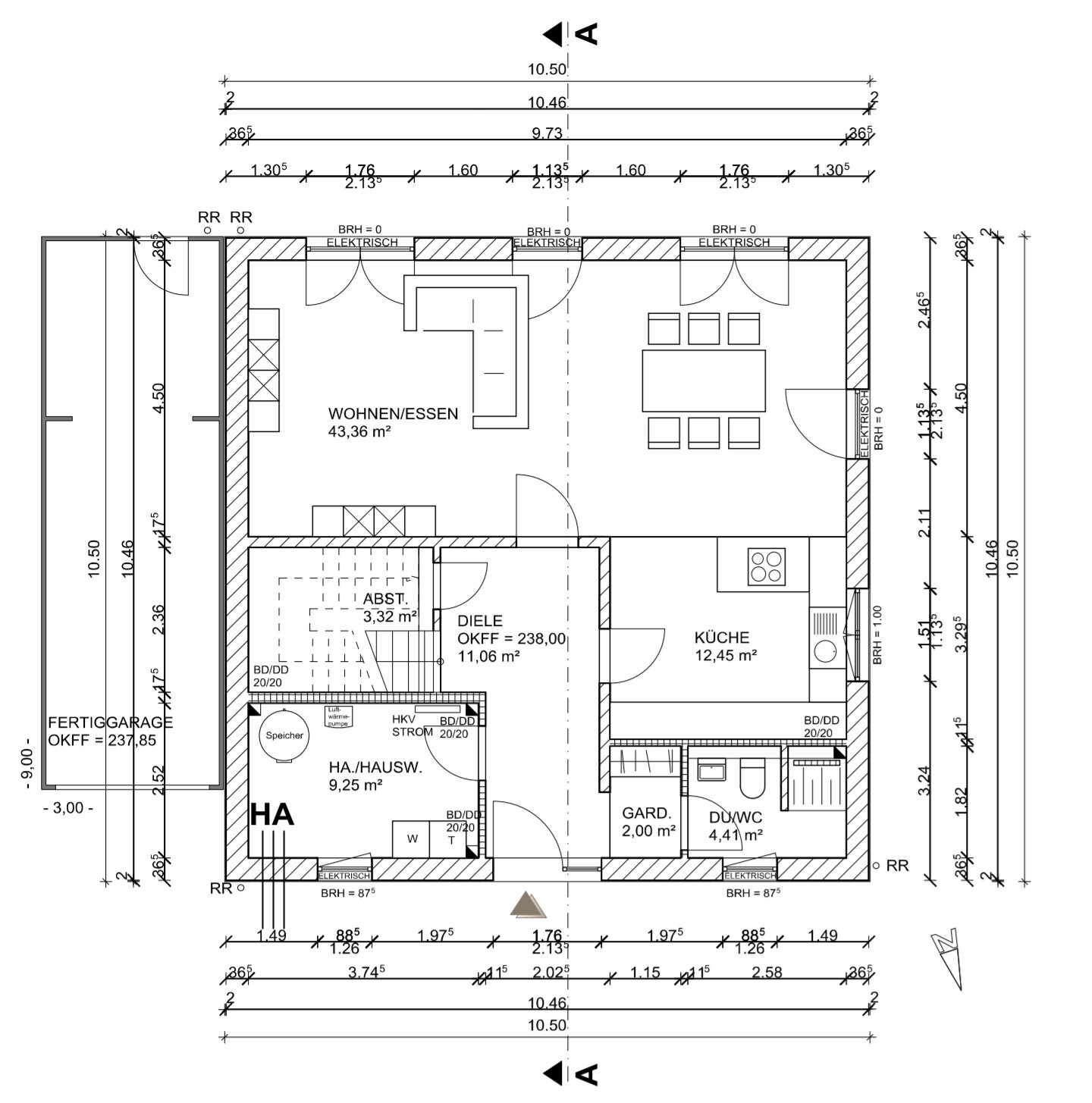
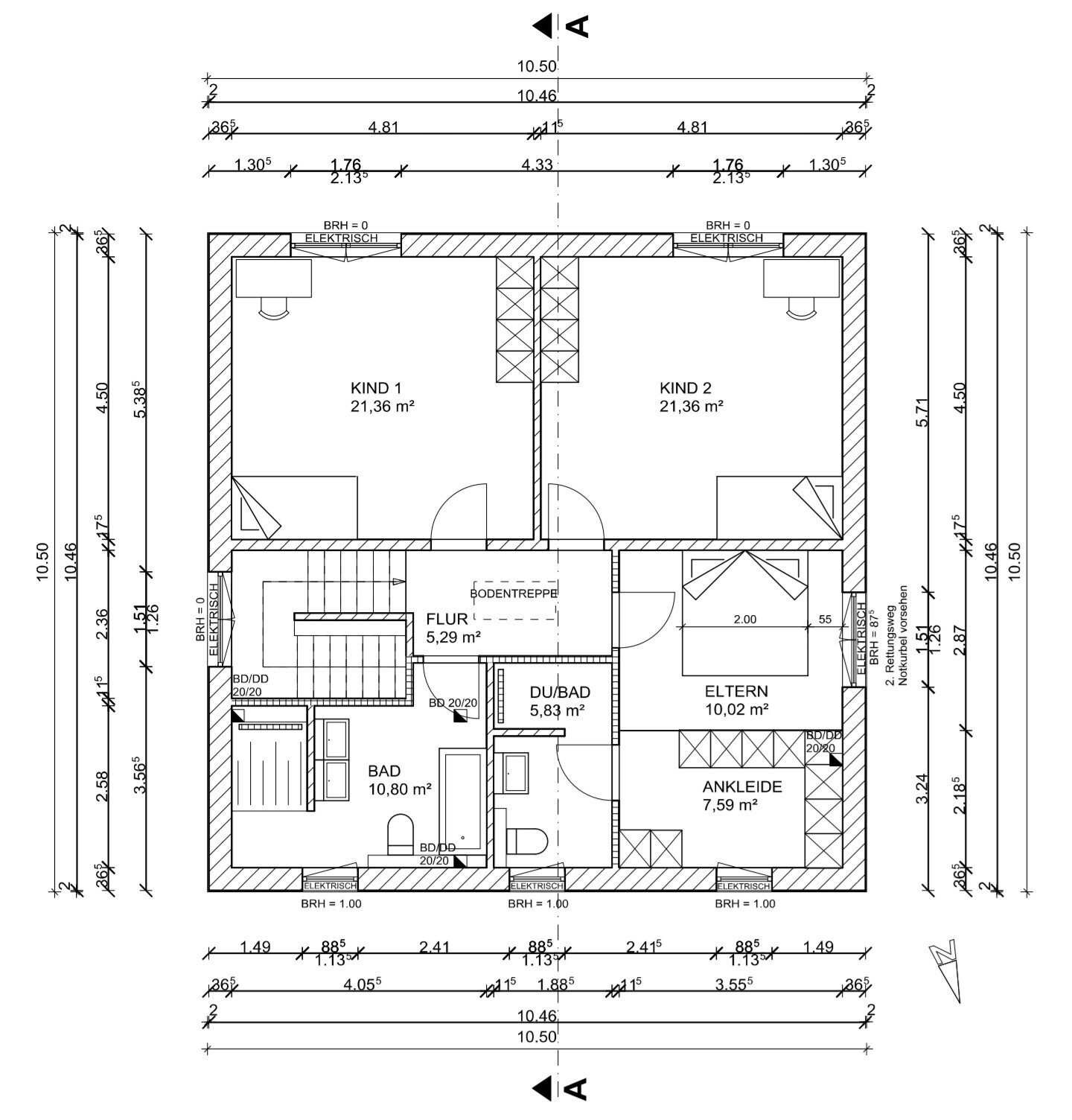
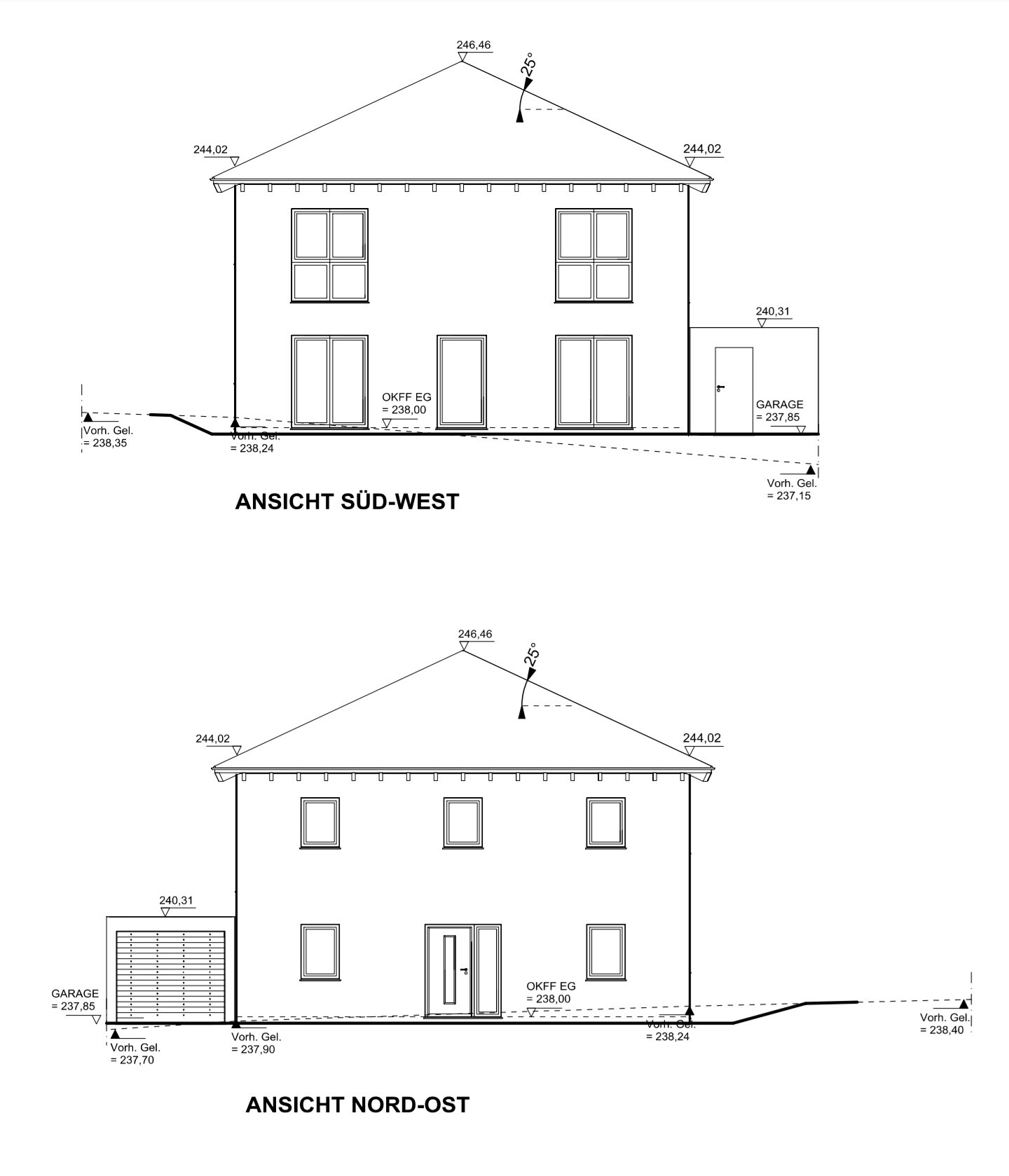
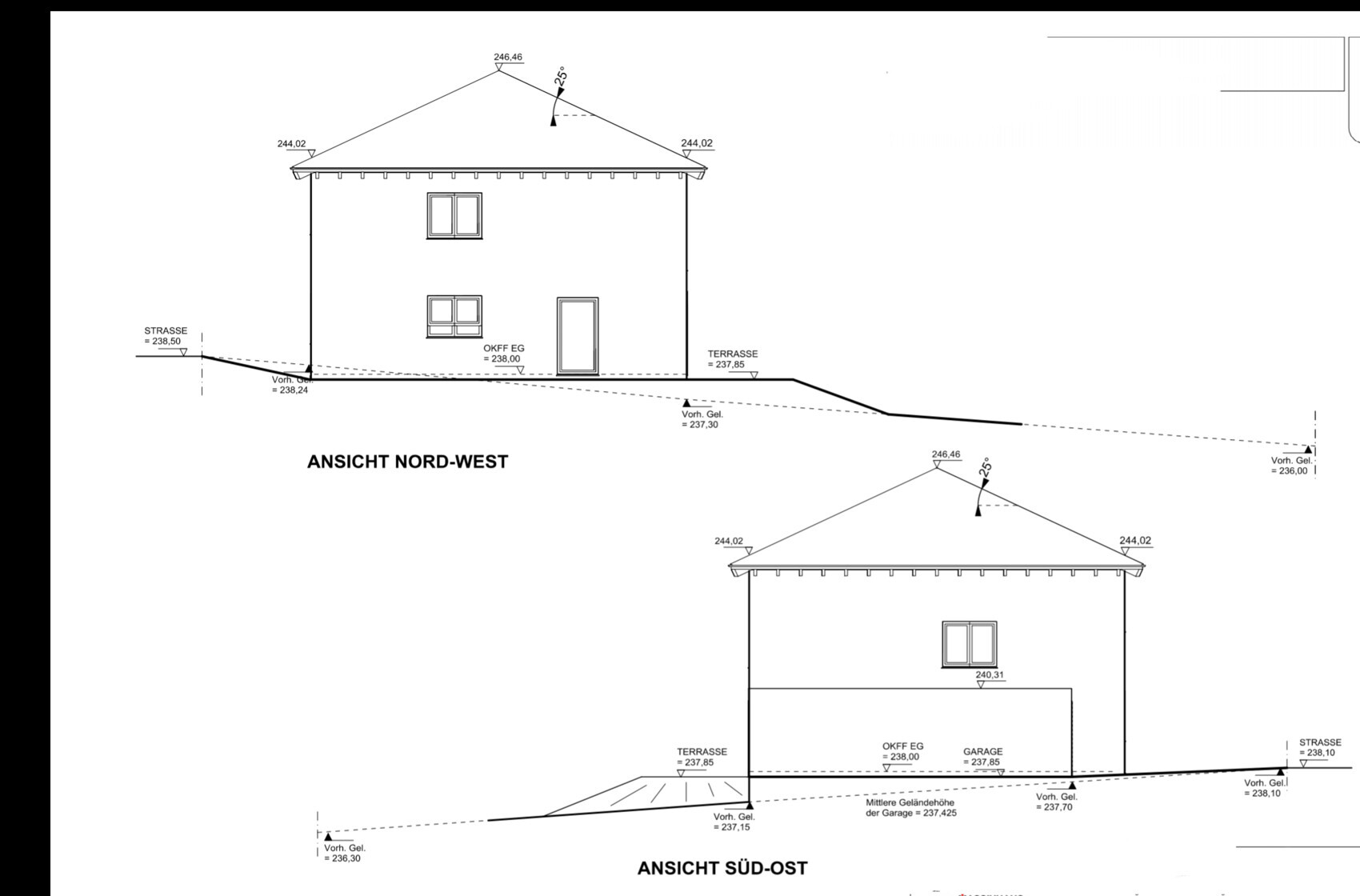
Slope yes
Site coverage ratio?
Floor area ratio?
Building envelope, building line, and boundary?
Boundary development?
Number of parking spaces 2
Number of floors 2
Roof type Pyramid roof, 25 degrees
Architectural style Modern urban villa
Orientation Main entrance facing north
Maximum heights/limits
Additional requirements?
Clients’ Requirements
Style, roof type, building type
Modern urban villa with pyramid roof, 25 degrees
Basement, floors 2 full floors without basement
Number of occupants 4
Open kitchen, kitchen island
Number of parking spaces 8-10
Garage
House design
Who designed it?
-Architect
What do you particularly like? Why?
Large living area, master bathroom
What don’t you like? Why?
Utility room quite small and master bedroom small, children’s room somewhat too large
Why is the design as it is now?
The architect implemented the corresponding wishes
What do you think is especially good or bad about it?
Good: large living area
I am uncertain about the half-height window sizes and the swing direction of the doors
What is the most important/basic question about the floor plan summarized in 130 characters?
- Where could it still be optimized? Would you recommend different window dimensions or sill heights?
- What do you think is poor or what would you do differently?
- A partition wall will be added in the walk-in closet. That would theoretically allow watching TV from the bed. I am considering a lightweight wall. I plan to place a 211cm (83 inches) Pax combination wardrobe in the closet. The closet is planned with a raw width of 218cm (86 inches). Do you think 218cm is enough for the Pax once the walls are plastered, or how wide should the rough dimensions preferably be?
- Is the hallway on the ground floor too narrow?
- Would you raise the ground level? The house would be 40cm (16 inches) below street level. If I build a terrace into the garden, it would be about 1m (3 ft) difference. You could raise only the house level, resulting in approximately 1.6m (5 ft) difference between terrace and garden. I don’t know anyone living below street level. Raising the garden would probably not be allowed without permits, and affected neighbors likely wouldn’t agree. On the sides of the house adjacent to neighbors, raising is permitted only up to certain limits. I am overwhelmed with the decision.
- Do you have any ideas for arranging the sofa differently and placing the TV sensibly? My husband doesn’t want the sofa back facing a window. I still need to get used to placing the sofa in the middle of the room.
- Is the kitchen size sufficient for a nice kitchen with an island?
What do you think about the floor plans?

Yaso2.0 schrieb:
Our general contractor specified a wall construction of 44cm (17 inches) in the building performance description. With a different construction, I could have a few more square meters with the same external dimensions. Tell us about your wall construction. But if 44 minus 36.5 equals 8.5cm (3.3 inches) more, and that would translate to significantly more than just nominal extra square footage—so much so that this additional room width would be "decisive"—then honestly, I would call that a planning error.
https://www.instagram.com/11antgmxde/
https://www.linkedin.com/company/bauen-jetzt/


11ant schrieb:
Tell me about your wall construction. But if 44 minus 36.5 equals 8.5 cm (3.3 inches) giving more than just nominal extra square meters – meaning that this additional room width would be "decisive" in any way – honestly, I would call that a planning error. It's nothing decisive, it was just an assumption on my part that it might provide more square meters without enlarging the house. It could have been possible that my general contractor planned differently for some reason.
Yaso2.0 schrieb:
It could have been that my general contractor planned differently for some reason.Unless you tell me otherwise, I suspect that the "other reasons" are just "tight deadlines": 24 cm (9.5 inches) of wall and the U-value calculator recommends 20 cm (8 inches) of insulation board for it. There are few better excuses for carelessly assembled work than the construction contractor’s business.https://www.instagram.com/11antgmxde/
https://www.linkedin.com/company/bauen-jetzt/
11ant schrieb:
Unless you tell me otherwise, I suspect that the "other reasons" are just "short cuts": 24 cm (9.5 inches) masonry and the U-value calculator suggests 20 cm (8 inches) of insulation board for that. There are no better excuses for uncaring contractors than the builder’s business. The scope of work specifies:
Facing masonry: facing bricks in NF format
Cavity wall with a total thickness of 45 cm (18 inches). The inner leaf consists of 17.5 cm (7 inches) thick aerated concrete blocks as plan bricks (0.10 W/m·K) compressive strength PP2, bonded with thin-bed mortar, according to structural drawings and calculations. 14 cm (5.5 inches) hydrophobic (water-repellent) core insulation board KDII (thermal conductivity 0.035 W/m·K) with staggered joints. Wall ties made of V4A stainless steel, 2 cm (0.8 inches) air cavity. U-value is 0.16 W/m²K. To prevent rising damp, a horizontal damp-proof course is installed beneath the first layer as a bitumen membrane G200 DD with an L-shaped damp-proof foil above it. Additionally, the base is sealed with a thick bitumen coating.
Yaso2.0 schrieb:
Facing masonry: facing bricks in NF format
Cavity wall construction with an overall thickness of 45cm (18 inches). The inner leaf consists of 17.5cm (7 inches) thick aerated concrete blocks as plan bricks (0.10 W/m∙K) compressive strength PP2, bonded with plaster mortar according to structural drawings and calculations. 14cm (5.5 inches) hydrophobized (water-repellent) core insulation board KDII (thermal conductivity 0.035 W/m∙K) with staggered joints. Wall ties made of V4A stainless steel, 2cm (0.8 inches) ventilation cavity. NF basically means approximately 11.5cm (4.5 inches) thick; as facing bricks in front of an external thermal insulation composite system (ETICS) and an air cavity, this is practically the only option. Was brick cladding your preference? – I interpret the 14cm (5.5 inches) here as a total of two layers; otherwise, mentioning staggered joints would not make sense. If you wanted a monolithic wall, I would suggest applying the facing bricks as thin brick slips and use more block thickness (30cm / 12 inches) instead; with a 36.5cm (14.5 inches) block thickness behind the facing bricks, the overall thickness difference would still be smaller – keep in mind my mantra: “use the wall construction your builder is accustomed to.”
https://www.instagram.com/11antgmxde/
https://www.linkedin.com/company/bauen-jetzt/
Similar topics