
Hello dear forum,
I would like to ask for constructive criticism on our floor plan. Please don’t hold back with your critique, everything can still be changed!
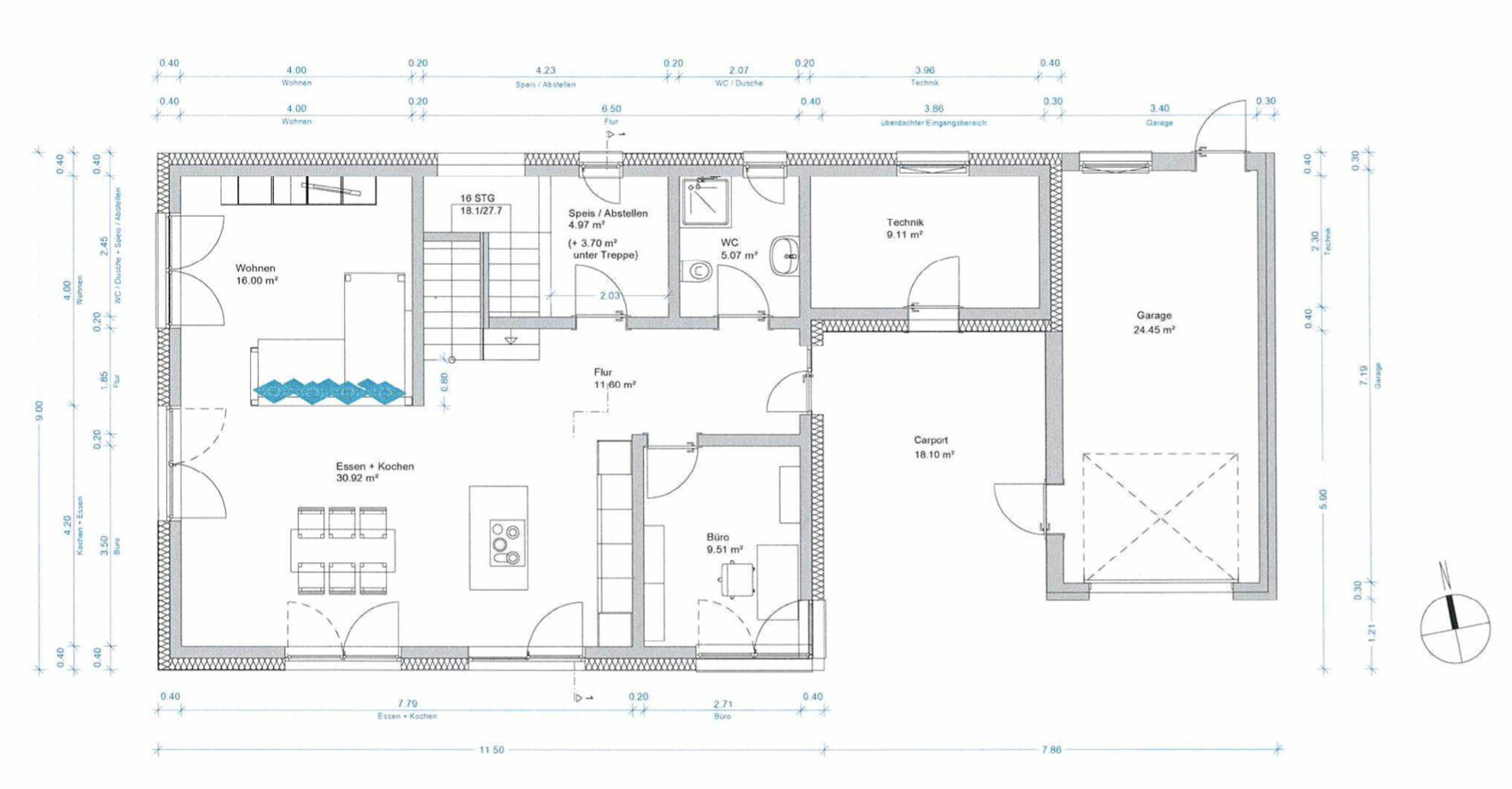
Ground Floor
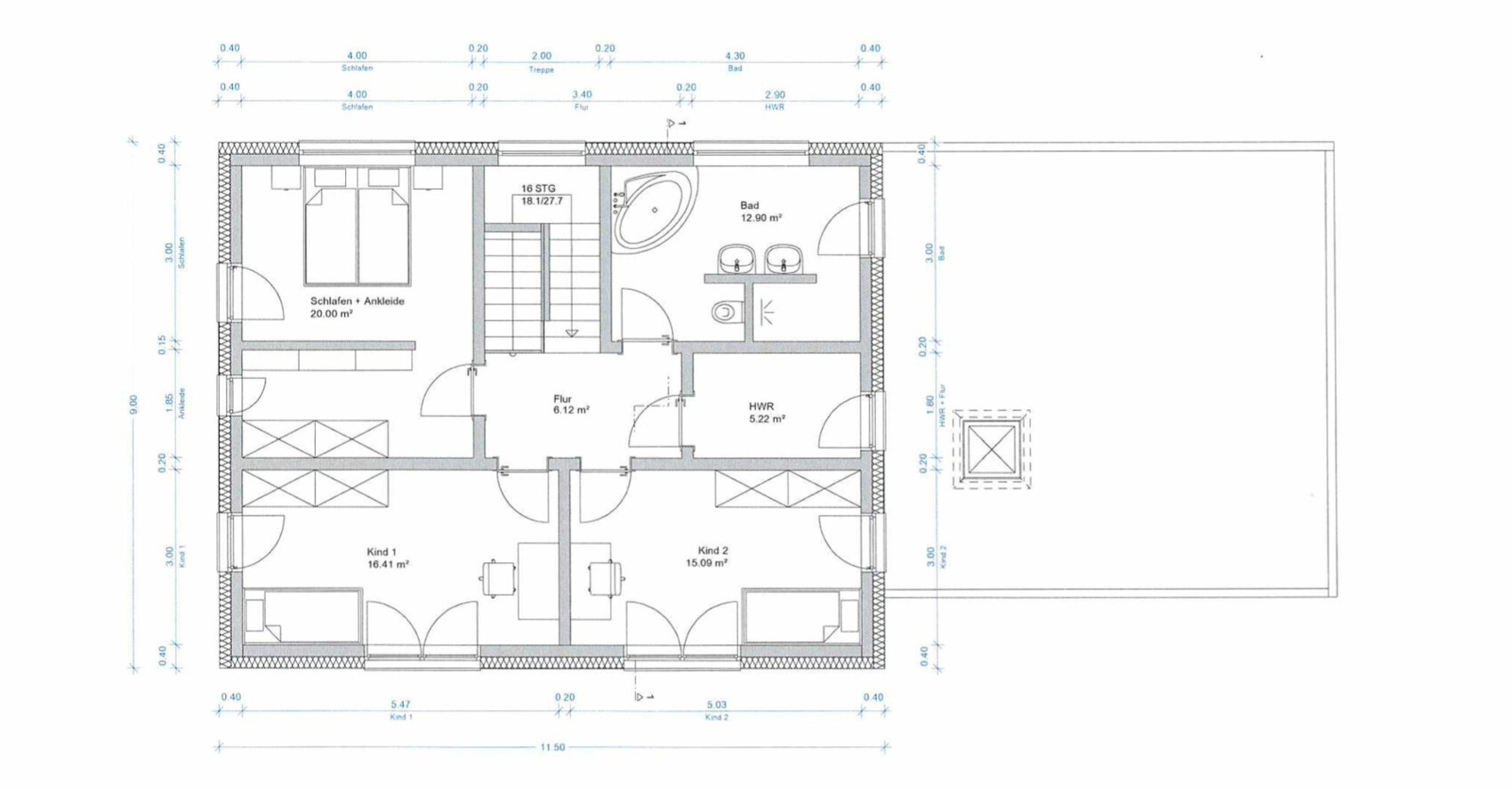
Upper Floor
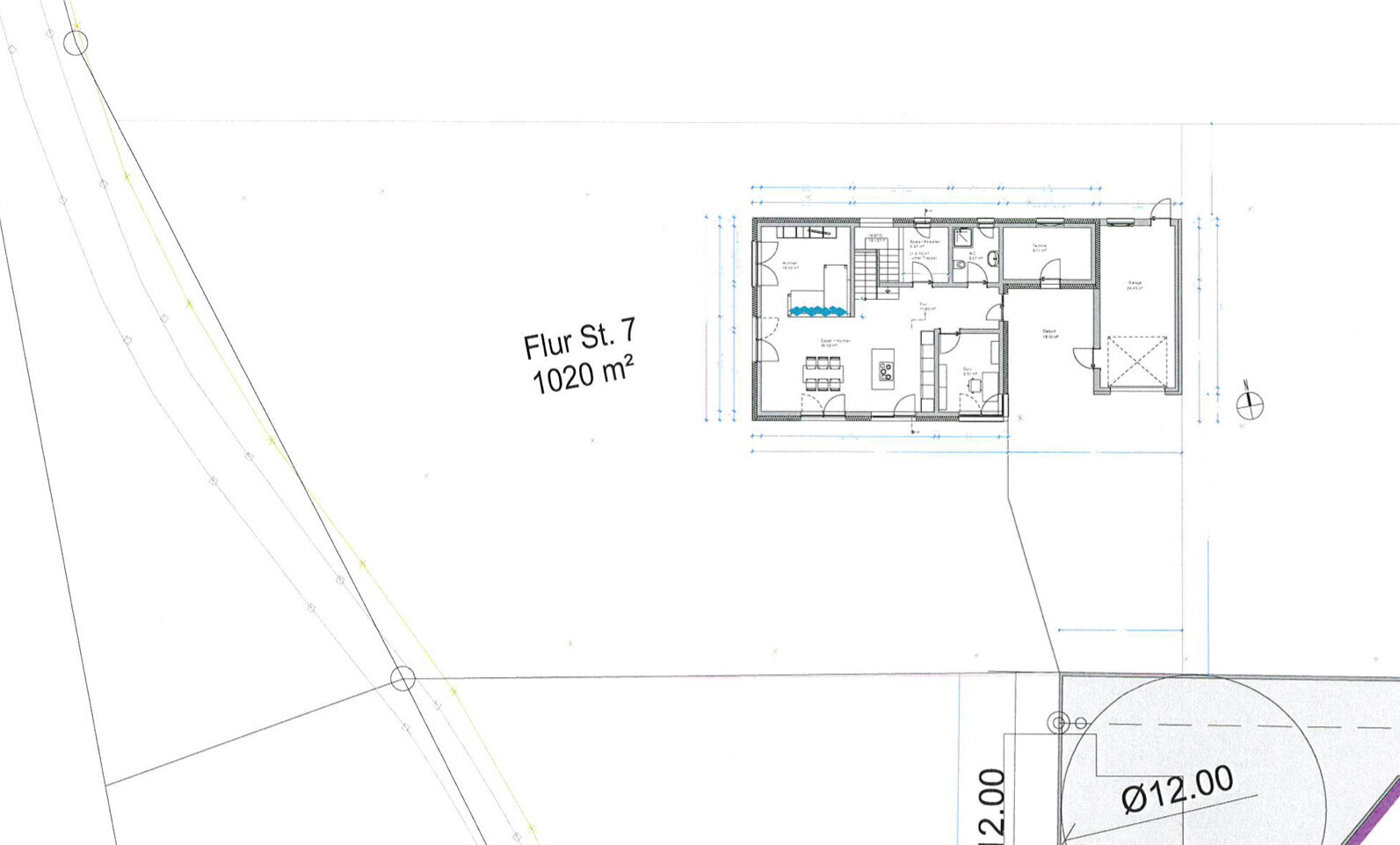
Site plan on the plot. The property is located at the end of a cul-de-sac next to the forest (forest to the west).
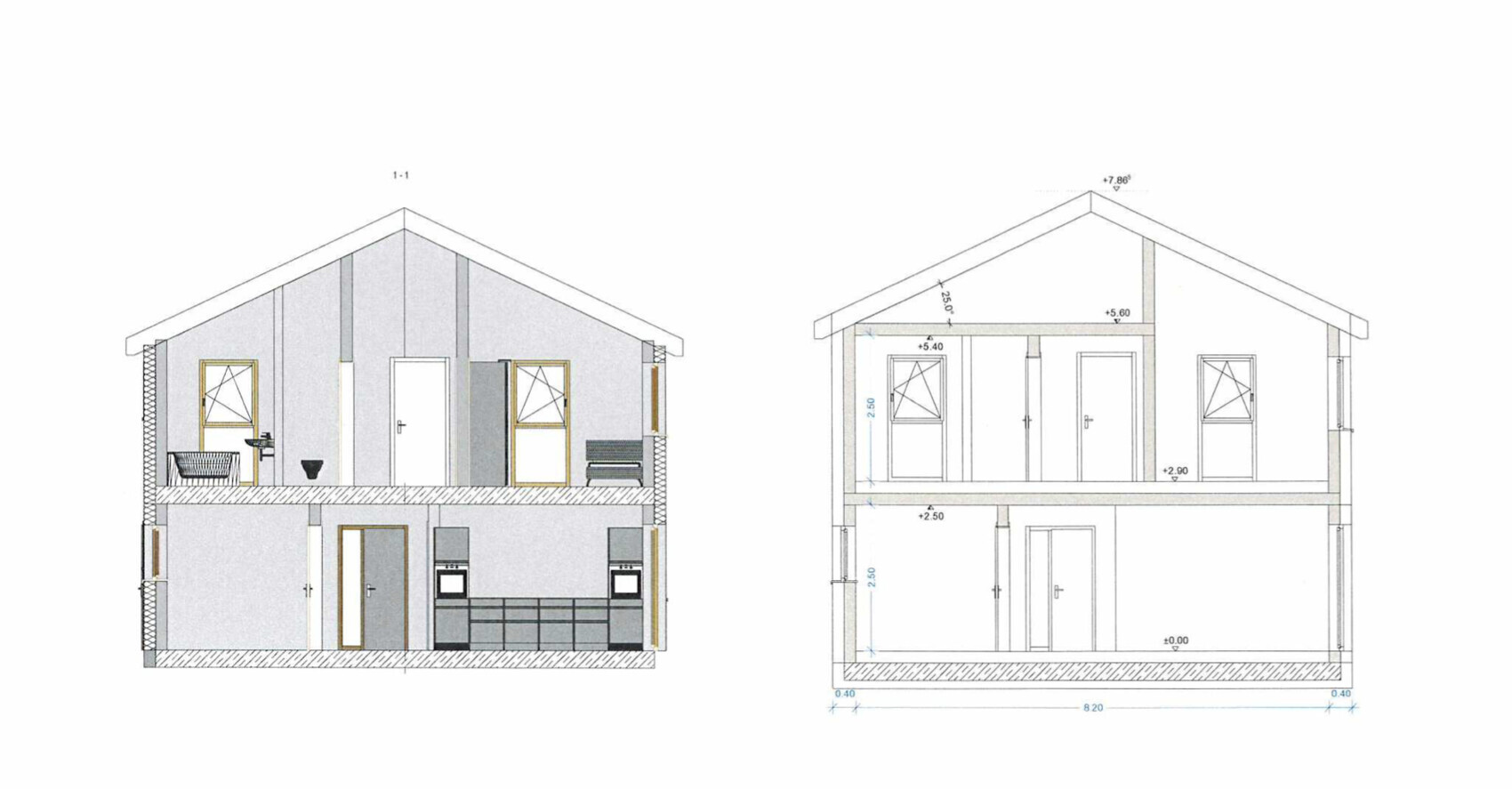
Section
Development Plan/Restrictions
Plot size: 1020 sqm (11,000 sq ft)
Slope: Gentle slope, 1 meter (3 feet) height difference over 25 meters (82 feet)
Border development: Yes, garage to the east
Number of parking spaces: 2
Number of stories: 2
Roof type: Gable roof
Style: Modern?
Orientation: Living areas face south, floor plans are almost aligned to north
Maximum height/limits: 9 meters (30 feet)
Owners’ Requirements
Style, roof type, building type: Single-family house, gable roof, KfW40 Plus standard
Basement, floors: No basement, 2 full stories
Number of occupants, age: Currently two adults, planning for two children
Space requirements ground floor and upper floor: 160 sqm (1,722 sq ft) living space
Office: Family use / home office? Wife works from home 3 out of 5 days, so an office is included
Guest stays per year: Rarely, estimated 6 times per year
Open or closed architecture: Very open on the ground floor, more closed upstairs
Open kitchen with island: Planned. The kitchen island should be larger than shown in the plans, possibly moved to the south wall to make it longer
Number of dining seats: 6
Fireplace: Not planned
Balcony, roof terrace: Not planned
Garage, carport: Currently included in plans, but due to major cost increases, we will probably omit garage and carport for now and build later ourselves. Does that make sense?
Vegetable garden, greenhouse: No vegetable garden planned, but a garden shed for tools
House Design
Designer: Architect from the general contractor
- Open living, dining, kitchen area on ground floor was a must
- Two full stories
- Technical room built as separate extension
- Utility room upstairs
- 6000-liter (1,585 gallon) cistern
- Seating window in living area
- Wrap-around terrace from south to west (to be finished later by ourselves; contractor will only do frost protection)
Price estimate by architect/planner: With garage and carport, 550,000 euros in solid wood construction made of cross-laminated timber. Includes 10 kW photovoltaic system + 10 kW storage. Earthworks included.
Personal price limit for house including fittings: Actually 520,000 euros, so a more cost-effective alternative to garage and carport is being sought
Preferred heating technology: Heat pump
If you had to give up, which details/upgrades
- Could give up: garage (see above); aluminum front door; cistern
- Cannot give up: open kitchen; technical extension, otherwise the floor plan doesn’t work
Why does the design look the way it does?
It’s a mix of many examples from various magazines. I then sketched a design in an architectural program and took it to the builder, who implemented it as shown here.
What is the most important/basic question about the floor plan summarized in 130 characters?
How should I best plan the garage/carport to later build a carport myself? Should I have the slab poured now and buy a carport kit later?
Since we’re building without a basement, I plan a garden shed. Do I also need a poured slab for the garden shed? Then it might make sense to have the builder do it now.
Is the extra cost for the aluminum front door worth it? (Plastic door 2500 euros, aluminum 5000 euros).
I’m grateful for any tips!
Thank you very much!
Best regards
I would like to ask for constructive criticism on our floor plan. Please don’t hold back with your critique, everything can still be changed!
Ground Floor
Upper Floor
Site plan on the plot. The property is located at the end of a cul-de-sac next to the forest (forest to the west).
Section
Development Plan/Restrictions
Plot size: 1020 sqm (11,000 sq ft)
Slope: Gentle slope, 1 meter (3 feet) height difference over 25 meters (82 feet)
Border development: Yes, garage to the east
Number of parking spaces: 2
Number of stories: 2
Roof type: Gable roof
Style: Modern?
Orientation: Living areas face south, floor plans are almost aligned to north
Maximum height/limits: 9 meters (30 feet)
Owners’ Requirements
Style, roof type, building type: Single-family house, gable roof, KfW40 Plus standard
Basement, floors: No basement, 2 full stories
Number of occupants, age: Currently two adults, planning for two children
Space requirements ground floor and upper floor: 160 sqm (1,722 sq ft) living space
Office: Family use / home office? Wife works from home 3 out of 5 days, so an office is included
Guest stays per year: Rarely, estimated 6 times per year
Open or closed architecture: Very open on the ground floor, more closed upstairs
Open kitchen with island: Planned. The kitchen island should be larger than shown in the plans, possibly moved to the south wall to make it longer
Number of dining seats: 6
Fireplace: Not planned
Balcony, roof terrace: Not planned
Garage, carport: Currently included in plans, but due to major cost increases, we will probably omit garage and carport for now and build later ourselves. Does that make sense?
Vegetable garden, greenhouse: No vegetable garden planned, but a garden shed for tools
House Design
Designer: Architect from the general contractor
- Open living, dining, kitchen area on ground floor was a must
- Two full stories
- Technical room built as separate extension
- Utility room upstairs
- 6000-liter (1,585 gallon) cistern
- Seating window in living area
- Wrap-around terrace from south to west (to be finished later by ourselves; contractor will only do frost protection)
Price estimate by architect/planner: With garage and carport, 550,000 euros in solid wood construction made of cross-laminated timber. Includes 10 kW photovoltaic system + 10 kW storage. Earthworks included.
Personal price limit for house including fittings: Actually 520,000 euros, so a more cost-effective alternative to garage and carport is being sought
Preferred heating technology: Heat pump
If you had to give up, which details/upgrades
- Could give up: garage (see above); aluminum front door; cistern
- Cannot give up: open kitchen; technical extension, otherwise the floor plan doesn’t work
Why does the design look the way it does?
It’s a mix of many examples from various magazines. I then sketched a design in an architectural program and took it to the builder, who implemented it as shown here.
What is the most important/basic question about the floor plan summarized in 130 characters?
How should I best plan the garage/carport to later build a carport myself? Should I have the slab poured now and buy a carport kit later?
Since we’re building without a basement, I plan a garden shed. Do I also need a poured slab for the garden shed? Then it might make sense to have the builder do it now.
Is the extra cost for the aluminum front door worth it? (Plastic door 2500 euros, aluminum 5000 euros).
I’m grateful for any tips!
Thank you very much!
Best regards

K a t j a schrieb:
Oh, in my opinion the front door is too small. The standard width is about 1 meter (3.3 feet). I have considered the layout of the element as symbolic and therefore say (informally/without notice=pointless) nothing about element dimensions that have not been specified ;-)
https://www.instagram.com/11antgmxde/
https://www.linkedin.com/company/bauen-jetzt/
11ant schrieb:
Regarding any objective objections, nothing really stands out to me here. However, I would question the concept of the "technical room in the connecting corridor" (but I wouldn’t see it as a major issue). I can’t quite follow your response regarding access to the utility room.Our technical room is adjacent to our bathroom. So, you would need to install a door from the bathroom into the technical room, which is hardly feasible. Since we will probably need to access the technical room daily, entrance from outside is still acceptable. Maybe we could also store our bicycles there.11ant schrieb:
I would probably reduce some of the interior walls to 15 cm (5.9 inches) thick (calcium silicate blocks).Wouldn’t that cause issues with sound insulation inside the house? Which walls do you think would be suitable for that?K a t j a schrieb:
- I would close off the hallway between the entrance area and kitchen with double doors. The idea is to better separate the guest bathroom from the living area and also make the office quieter for work. Also, in my opinion, the open hallway creates a somewhat uncomfortable feeling – like standing on a train platform all the time.We’ve thought about that as well. But I suspect then the kitchen and dining room would feel too cramped... I’ll reconsider that.K a t j a schrieb:
- A wraparound terrace is cool but expensive. Is it really necessary?Good idea, maybe just two smaller terraces with stepping stones in the lawn between them.K a t j a schrieb:
- I would build the garage and carport now if financially possible. The main reason is the shared roof with the technical room, which you hardly can omit. Otherwise, it’s likely those won’t be built later.The shared roof is indeed the biggest challenge. Otherwise, I would have to split the technical room, garage, and carport and end up with three different roofs.K a t j a schrieb:
- In my opinion, the windows and patio doors are still distributed somewhat randomly. I would work more intensively on the elevations. (It would be interesting to see those as well.)We will still plan the exact window placement in detail with the general contractor. Unfortunately, we’re not that far yet.K a t j a schrieb:
- I would swap the shower and toilet in the bathroom.I was actually thinking the steam from the shower could vent better out the window that way. What’s your reason for swapping them?K a t j a schrieb:
- Regarding the width of the hallway, I wouldn’t change anything. It’s wide enough in my opinion for a cabinet – I would rather move the glass panel at the door.Do you mean moving the glass element all the way up to the wall? Right now, there are only about 30 cm (12 inches) behind the door for a cabinet.K a t j a schrieb:
- Personally, I think plastic doors look ugly. We have aluminum doors and are very happy with them. I would have chosen wood as well.I wonder if it really makes a difference in everyday life. The price difference is about 3,000 euros gross. If I need to replace a plastic door after a few years and the aluminum door lasts twice as long, then the investment would be worthwhile.
Likee68 schrieb:
We had thought about that too. But I suspect the kitchen and dining area might feel too cramped... I’ll think it over again. 30 sqm (323 sq ft) too small? Hmm, others live in that size as a studio apartment. 😀
Likee68 schrieb:
Good idea, maybe just two smaller terraces with stepping stones in the grass in between. Saves money on the garage. 😉
Because...
Likee68 schrieb:
The shared roof is actually the biggest problem. Otherwise, I’d have to break up the utility room, garage, and carport, ending up with three different roofs... ... that would be unfortunate.
Likee68 schrieb:
I actually thought the bathroom steam could vent better through the window. Why would you want to swap? I don’t like it when you open the door and immediately “bump” into the person on the toilet. Especially if that person is me. But opinions on this vary a lot, and Yvonne (@ypg) always laughs at me because of it.
Likee68 schrieb:
Do you mean sliding the glass panel all the way up against the wall? At the moment, there’s only about 30 cm (12 inches) behind the door for a cabinet. Yes, for example. I would hinge the door the other way so that when opening it, you face the wardrobe directly. (Don’t worry—front door and bathroom door won’t interfere, and it’s not a problem that the front door opens in front of it since it’s usually closed.)
Plan for at least a 60 cm (24 inch) wardrobe—1 m (39 inches) for the door—and the rest for the clear glass panel.
Likee68 schrieb:
I just wonder whether it will be noticeable in daily use. For me, definitely. I think plastic looks worn and shabby after a few years. But I’ll probably get flamed by plastic door enthusiasts now.
Likee68 schrieb:
Our utility room shares a wall with our bathroom. So, a door from the bathroom to the utility room would need to be installed, which is hardly feasible. Since we will probably access the utility room daily, an outside entrance is still manageable. Maybe we can even store our bicycles there. If the guest brings a new six-pack straight from the store, that’s quite convenient, and my chimney sweep and heating technician combined come less than twice a year. However, I wouldn’t want to push bicycles or strollers through there. @WilderSueden: Don’t you have a similar setup where the utility room is an annex to the main building?
Likee68 schrieb:
Wouldn’t we then have issues with sound insulation inside the house? Which walls would you suggest for that purpose? Wherever it makes sense, but I wouldn’t do all walls oversized. Judging from the dimensions and the floor plan, I assume those are calcium silicate blocks, where 15cm (6 inches) is sufficient for interior walls, and 20cm (8 inches) for load-bearing walls is also fine. Sound insulation only has a limited correlation to mass, even though that misconception is widespread. Physics doesn’t care about opinions.
Likee68 schrieb:
I’m just wondering if it makes a noticeable difference in daily life. The gross price difference is around 3,000 euros. If I have to replace a plastic door after a few years and the aluminum door lasts twice as long, then the investment would be worthwhile. Definitely. I used to manufacture aluminum windows and later sold them, including PVC products. As an aluminum window supplier, we also handled many renovations, not just new constructions. The replacement intervals for aluminum versus PVC are roughly 40 to 15 years. Pricewise, aluminum is about 120 on the index compared to 100 for PVC at specialist dealers or about 70 at discount PVC suppliers. Aluminum discounts exist too, but I don’t recommend them. Take a look at the driver’s door panel on cars used heavily if you want to estimate the stress level of front doors compared to bathroom windows. In daily life, it will take a while before you can distinguish aluminum from PVC by sight. Even as a professional, I need reading glasses to tell the difference on products up to around three years old, since the surface quality of new PVC can be quite attractive.
https://www.instagram.com/11antgmxde/
https://www.linkedin.com/company/bauen-jetzt/
11ant schrieb:
The most sensible choices everywhere; I wouldn’t go for everything in XL size. Based on the dimensions and cross-section shown, I assumed the walls are made of sand-lime brick, where 15 cm (6 inches) thickness is probably sufficient for interior walls, and 20 cm (8 inches) is also okay for load-bearing walls. Sound insulation is only partially related to mass, even though many people believe otherwise. But physics is not impressed by that—it doesn’t follow democracy.The walls will be made of solid cross-laminated timber. The thickness varies depending on the structural requirements. Maybe we can save a bit there after the structural calculations.What provides sound insulation if not mass?
Does anyone have experience with window seats? We are considering installing the window seat in the living room as a regular window and extending the windowsill with a bench instead of building a small bay window. Does that make sense?
What do you think about a concrete staircase to save costs? I also find it visually appealing if only the stair treads are made of oak.
Likee68 schrieb:
The walls will be made of solid cross-laminated timber. [...] What do you think about a concrete staircase to save costs? I also find it visually very appealing if only the treads are made of oak. Concrete staircase in a timber house—I’ll just leave that "uncommented" ;-)
Likee68 schrieb:
What then provides sound insulation if not mass? Stiffness, and especially the structural avoidance of sound bridges. Mass helps too, but not alone. Absorption and diffusion are also beneficial. Sound that is controlled at the source does not need to be blocked during transmission.
https://www.instagram.com/11antgmxde/
https://www.linkedin.com/company/bauen-jetzt/
Similar topics