
ᐅ Floor Plan Feedback Single-Family Home 140 sqm Two Full Stories
Created on: 4 Jul 2025 16:06
M
Milka0105
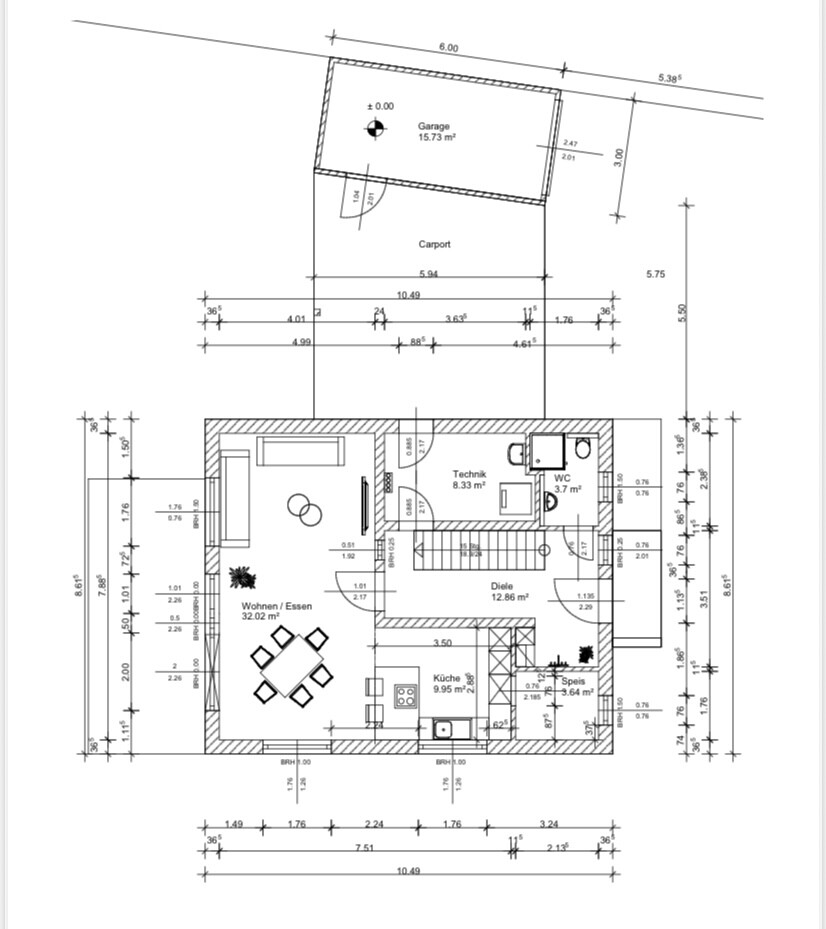
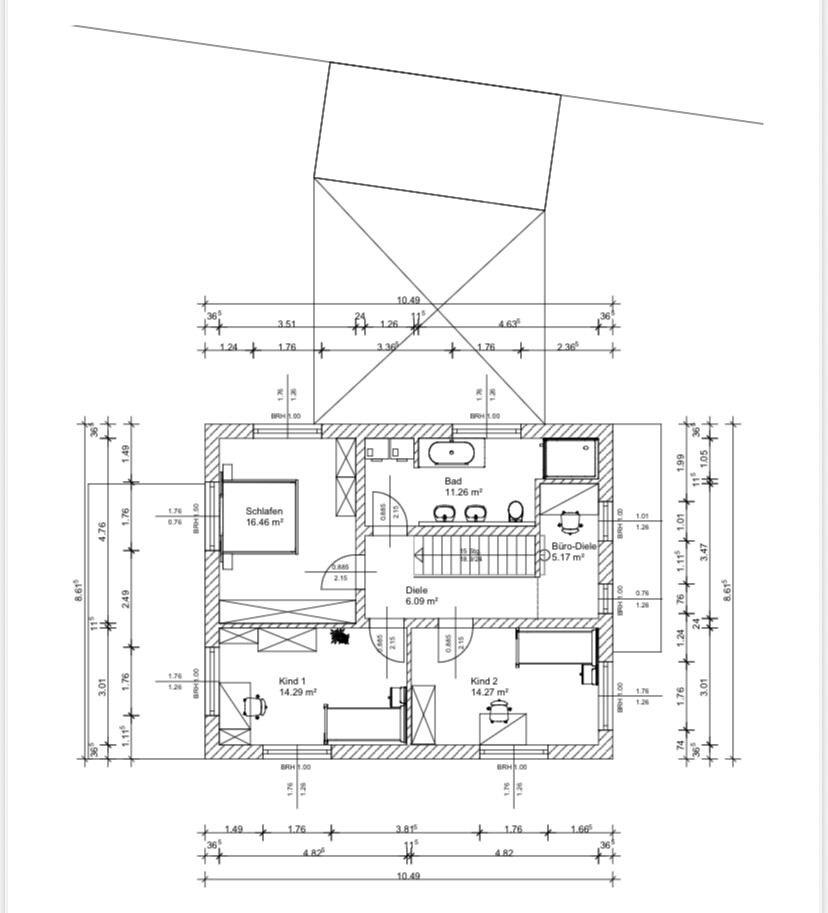
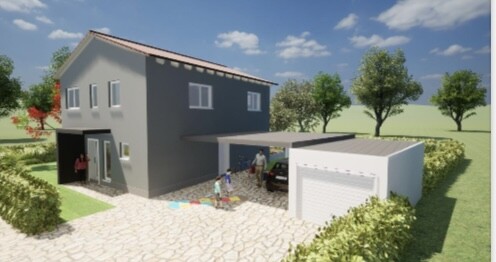
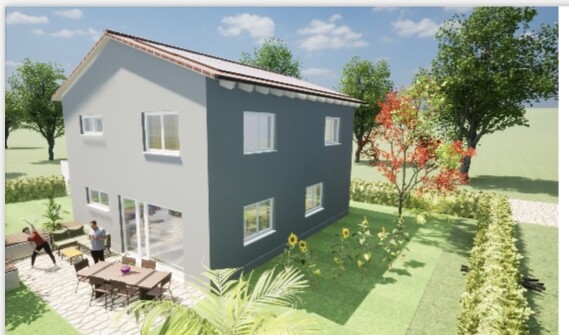
Hello everyone, following my last post about costs and so on, Ant11 suggested that I start with a floor plan here for evaluation. This plan has now existed for quite some time with a few minor adjustments, so the ideas have not changed. I’m looking forward to some feedback.
Development Plan / Restrictions
Plot size 654 sqm (7040 sq ft)
Slope no
Site occupancy index 0.4
Floor area ratio 0.8
Building setback, building line and boundary 3 m (10 ft)
Edge development only garages or carport
Number of parking spaces 2
Number of floors max 2
Roof pitch 0–48 degrees
Style single-family house
Orientation any
Maximum heights / limits 6 m (20 ft) wall and 9 m (30 ft) total
Other requirements cistern
Client Requirements
Style, roof type, building type gable roof
Basement, floors 2
Number of people, age 2 adults and potentially 2 children, currently 1
Space requirements ground floor, upper floor
Office: family use or home office? Both
Guest sleeping per year, if so guests sleep in the children’s rooms
Open kitchen, kitchen island open kitchen
Number of dining seats 1
Fireplace no
Music / stereo wall no
Balcony, roof terrace no
Garage, carport yes
Utility garden, greenhouse possible
Other wishes / special features / daily routine, also reasons why this or that should or should not be included
House Design
Who designed it:
- Initial draft by architect then adjustments with builder/architect
What do you particularly like? Why? Utility room with separate door (mudroom), large pantry
What do you dislike? Why?
Price estimate according to architect/planner: 433k
Personal price limit for the house, including fixtures: 500k
Preferred heating technology: air heat pump and central ventilation system
If you had to give up, which details / extensions
- Could you give up: if push comes to shove, the separate door for the utility room or the pantry could be omitted
- Could you not give up: guest WC with shower
Why did the design turn out the way it did? For example:
Build as small as possible but as large as necessary. The plot becomes wider toward the back.
So, this is a draft after a consultation appointment with the architect. It was then revised again with the builder.
We want a functional home that works for 2 adults and potentially 2 children (1 currently). In addition, we have a dog, but that obviously adapts too (the mudroom is also designed for this).
Home office is generally possible and planned. First, we have one child’s room reserved and intended for this purpose. Afterwards, the office niche or the bedroom upstairs. We don’t need much except a quiet place to work.
If all else fails, the pantry will become the office (possibly then accessible from the hallway).
The upstairs bathroom is somewhat elongated due to the narrow building footprint and straight staircase. The washing machine and dryer are shown upstairs and are planned to be there. There are also connections in the utility room. Otherwise, the space upstairs or downstairs will be used for storage.
I look forward to your opinions.
Development Plan / Restrictions
Plot size 654 sqm (7040 sq ft)
Slope no
Site occupancy index 0.4
Floor area ratio 0.8
Building setback, building line and boundary 3 m (10 ft)
Edge development only garages or carport
Number of parking spaces 2
Number of floors max 2
Roof pitch 0–48 degrees
Style single-family house
Orientation any
Maximum heights / limits 6 m (20 ft) wall and 9 m (30 ft) total
Other requirements cistern
Client Requirements
Style, roof type, building type gable roof
Basement, floors 2
Number of people, age 2 adults and potentially 2 children, currently 1
Space requirements ground floor, upper floor
Office: family use or home office? Both
Guest sleeping per year, if so guests sleep in the children’s rooms
Open kitchen, kitchen island open kitchen
Number of dining seats 1
Fireplace no
Music / stereo wall no
Balcony, roof terrace no
Garage, carport yes
Utility garden, greenhouse possible
Other wishes / special features / daily routine, also reasons why this or that should or should not be included
House Design
Who designed it:
- Initial draft by architect then adjustments with builder/architect
What do you particularly like? Why? Utility room with separate door (mudroom), large pantry
What do you dislike? Why?
Price estimate according to architect/planner: 433k
Personal price limit for the house, including fixtures: 500k
Preferred heating technology: air heat pump and central ventilation system
If you had to give up, which details / extensions
- Could you give up: if push comes to shove, the separate door for the utility room or the pantry could be omitted
- Could you not give up: guest WC with shower
Why did the design turn out the way it did? For example:
Build as small as possible but as large as necessary. The plot becomes wider toward the back.
So, this is a draft after a consultation appointment with the architect. It was then revised again with the builder.
We want a functional home that works for 2 adults and potentially 2 children (1 currently). In addition, we have a dog, but that obviously adapts too (the mudroom is also designed for this).
Home office is generally possible and planned. First, we have one child’s room reserved and intended for this purpose. Afterwards, the office niche or the bedroom upstairs. We don’t need much except a quiet place to work.
If all else fails, the pantry will become the office (possibly then accessible from the hallway).
The upstairs bathroom is somewhat elongated due to the narrow building footprint and straight staircase. The washing machine and dryer are shown upstairs and are planned to be there. There are also connections in the utility room. Otherwise, the space upstairs or downstairs will be used for storage.
I look forward to your opinions.
M
Milka01055 Jul 2025 13:23wiltshire schrieb:
You are basically right; they should know that. In practice, however, this attitude leads to a major mistake, because as the client, you are responsible for how the house turns out. This isn’t about control, but about risk management and the “four-eyes principle” to avoid errors. Have you never made a mistake even though you should have known better? If you accept a room that is too small without verifying yourself whether it will work or having a plausible explanation provided, then that is your responsibility. And then you get what you ordered and paid for. The complaints afterward, when things differ from the client’s expectations, are loud, and solutions to such conflicts are never satisfactory. The fatal phrase that always comes up is, “I assumed that...”. It’s better to ask one question too many than one too few, and to think for yourself—just like you do with the size of the home office. Here you can estimate how much space you need and make a confident decision. Do the same for the utility room, which you can’t properly assess without engaging with the topic.
This fundamental mistake is what causes small business owners to go bankrupt. They then say: I did not know that, my accountant handles the bookkeeping; they should have known. It doesn’t matter what someone else should have known—the entrepreneur is responsible and must bear the consequences. ypg schrieb:
Regarding the utility room: just try googling it.
[ATTACH alt="IMG_1024.jpeg"]92064[/ATTACH]
A draftsman draws placeholders; an architect may remove or relocate them with knowledge of the technical requirements. During the shell construction stage, the tradespeople and site managers determine the best places for heating systems, mechanical ventilation with heat recovery, utility connections, and the electrical panel. So a lot can still change. However, tradespeople tend to think differently and more practically from their own perspective. Pipes and cables run along walls, and between them and the equipment there needs to be space for tools used during installation and for maintenance or repairs of the pipes. I have never seen a heating unit placed on an interior wall where it needs to be dismantled. The sink is misplaced there and unnecessary if a dryer is installed above. The area between the doors is hardly useful, except as a substitute hallway. It’s more practical to have cabinet space behind the doors.
As for my advice: sofas are usually deeper than a door is wide. Incorrect measurements give a false impression of the proportions.
By the way, where is north? Thank you!
Okay, I understand from the comments: The door should open outward because it takes up too much space, and the utility room needs detailed planning to confirm that everything fits in principle. During construction, the tradespeople and installers will decide again where it makes the most sense, but it is important that everything is planned in at least once and that it works.
In general, a utility room of just under 9 square meters (about 97 square feet) should be adequate for a 140 square meter (about 1,507 square feet) house.
Removing the shower in the guest bathroom will make it slightly larger. I need to think about that.
What remains is the bathroom upstairs, which is poorly organized. I need to revisit that.
And to avoid drawing criticism again: There are certainly better and more structured floor plans overall, with different stairs, etc. However, this is a floor plan that we like in the overall context. If only 50% of it were livable, then I would consider a completely new floor plan, but as I understand it, it is livable.
The children’s rooms, bedroom, and office have not been mentioned so far and seem to be appropriately sized and arranged, or have they been ignored due to the many previous issues with the kitchen, utility room, bathroom, and cloakroom?
North is at the corner of the house in the guest bathroom. It runs basically diagonally through the house from the guest bathroom corner (north) to the dining room corner (south).
M
Milka01055 Jul 2025 13:2611ant schrieb:
Oh, so an asymmetrically divided double-leaf door with a mullion, and next to it a fixed panel?Yes, I think that's it. But maybe just simplify it by installing a window wall with a lift-and-slide door there. I somehow got confused by that door with a mullion. But practically, the other option might be better.M
Milka01055 Jul 2025 13:44ypg schrieb:
Hallway, cloakroom: so, it’s normal for rubber boots, work shoes, garden clogs, street shoes, and sneakers to be stored downstairs where they’re needed. It’s also normal to change shoes over the days. Taking street shoes upstairs—I don’t know anyone who actually does that.
So, having only one pair of “shoes” in use is not normal. Yes. I based my approach on my current living situation, and I grew up in apartments, not single-family homes.
In the past and currently, I live in a 75 sqm (810 sq ft) apartment with two adults, one baby, and one dog. The hallway is 4 sqm (43 sq ft) and serves as a connection to the bedroom, bathroom, apartment entrance, and living room door.
There’s a coat rack on the wall, with a shoe rack and a sideboard underneath. It’s easy to access all rooms from there.
Winter coats are stored in the closet after winter and switched around in summer. The same goes for winter and summer shoes.
Yes, right now I would like more space because now the child’s shoes have to be added.
That’s why the coat rack in the house is roughly twice the size just in terms of footprint. Additionally, there’s probably space under the staircase for a dresser or built-in cabinet since the stairs have closed risers.
I understand the point, and I would like to build everything bigger. But I come from a much smaller apartment and have managed so far. It just requires more effort and you have to keep things organized or put away, but it worked.
What’s the alternative? I save money on the single-family home and move into a 110–120 sqm (1,185–1,290 sq ft) apartment where the coat rack probably wouldn’t be larger either.
What I want to say is, I would gladly have 200 sqm (2,150 sq ft) with a dressing room, but I won’t be able to afford it where I live. However, I want to offer my family the luxury of a single-family home with a garden in a nice development near the forest. The house should be comfortable to live in, but also appeal to us from the inside and outside. I think if I just choose the best floor plan available, I still wouldn’t be happy because I wanted a straight staircase in terms of style.
I’m very grateful for the answers and opinions and just want to explain my thoughts on why it turned out this way.

@Milka0105 What are the dimensions of the staircase? It looks quite steep, but I can’t read the measurements right now.
I really like the idea of the asymmetrical window, I’ve seen it before and it can look very cool. It might also be more affordable than a lift-and-slide door. The latter is very expensive, unfortunately I’m speaking from experience by now.
I really like the idea of the asymmetrical window, I’ve seen it before and it can look very cool. It might also be more affordable than a lift-and-slide door. The latter is very expensive, unfortunately I’m speaking from experience by now.
Milka0105 schrieb:
I just want to share my thoughts on why it turned out this way. That’s completely fine. And the frequent posters and advisors here also understand that an original poster might not know any better or might not realize that living in a house involves different aspects like the garden, gardening, and needs or wishes that develop along with the house.
Milka0105 schrieb:
I based it on my current living situation and I also grew up in apartments, not in a detached house. That’s exactly why this forum exists — to help prospective builders become aware of certain aspects. What you make of it is your decision, of course.
What surprises me, however, is why there has been no feedback or suggestions for improvement at all. Has the building permit (planning permission) already been applied for?
Milka0105 schrieb:
I would have liked 200 sqm I wouldn’t.
Milka0105 schrieb:
I understand that point and I would like to build everything bigger. The crux or knot in your thoughts is actually that nobody is blaming you for the size or criticizing it, but there are even suggestions (like Kerstin in #15) pointing out that the way the staircase is positioned causes many functional issues. It’s not about the size, but one or two early mistakes that then trigger a domino effect.
I remind you:
Milka0105 schrieb:
We want a functioning house that works for 2 adults and potentially 2 children (1 currently). Milka0105 schrieb:
and so far I’ve survived I think we don’t need to exaggerate on equal footing when it’s about several hundred thousand dollars that you have to pay off over 30 years.
Milka0105 schrieb:
But I don’t find it too small for cooking together. There’s enough surface space for chopping. Where exactly? Okay, you managed to get some free space next to the sink by removing the door and adding a tall cabinet. (Does your wife know that she no longer gets this feature?)
The problem here is that in a kitchen, many things need to be within easy reach (knife block, common spices, half-open bottles of sparkling water, a new kitchen gadget and the coffee machine). A counter is less suitable for that; it’s more that corner space. Then you have exactly what needs to be chopped, then your cutting board, then the container where it’s going, plus other ingredients like liquids, seasonings, herbs. None of this can be optimally placed, even if only temporarily. Maybe also the cookbook or tablet with the recipe…
The space between stove and sink — that corner — barely fits a grown person. And if someone stands there, they block both sink and stove at the same time but can’t really chop properly.
And where are bowls, glasses, cups, and plates stored when brought out?
Milka0105 schrieb:
Storage options are planned in the pantry. People don’t want to go to the pantry every time for things like that. A kitchen should not be fragmented like that. It has to function with its own storage for cooking and dining utensils — without relying on the pantry. And if you have children, you also need enough storage space here for several lunchboxes and containers of all kinds and sizes, measuring cups, etc. Your family is growing and the household needs to grow with it.
I don’t want to convince or persuade you to do anything differently. It’s just a matter of raising awareness about how much needs to be readily accessible in a kitchen. And if everything has to be brought forward from the back first, you need countertop space to set things down temporarily.
familie_s schrieb:
@Milka0105 What are the dimensions of the staircase? It looks quite steep, but I can’t read the measurements right now. It should be roughly 3.70 meters (12 feet).

kbt09 schrieb:
The staircase itself could also be extended into an attic. ... I don’t remember if this question came up in this thread. I think that was in another one from yesterday.
Milka0105 schrieb:
Yes, I think that’s it. But maybe just simplify things by installing a window front with a lift-and-slide door there. I somehow got confused with the door with the mullion. But the other option might be more practical. familie_s schrieb:
I really like the idea of an asymmetrical window, I have seen it before and it can look great. And it might also be cheaper than a lift-and-slide door. The latter are very expensive, unfortunately I speak from experience nowadays. Lift-and-slide doors are outdated, no one will want them tomorrow anymore. A passing trend that has quietly died out—nothing more. Unnecessarily expensive (and heavy), yes.
Milka0105 schrieb:
In the past and currently, I live in 75 sqm (800 sq ft) with 2 adults, 1 baby, and 1 dog. The hallway is 4 sqm (43 sq ft) and serves as a connection to the bedroom, bathroom, apartment entrance, and living room door. I don’t understand why people don’t simply “draw out” their current apartment and mark the problem areas and wishes there.
Milka0105 schrieb:
I am very grateful for the answers and opinions. So why is there a lack of willingness to go back to the preliminary design phase?
https://www.instagram.com/11antgmxde/
https://www.linkedin.com/company/bauen-jetzt/
Similar topics