
ᐅ Floor Plan Feedback Single-Family Home 140 sqm Two Full Stories
Created on: 4 Jul 2025 16:06
M
Milka0105
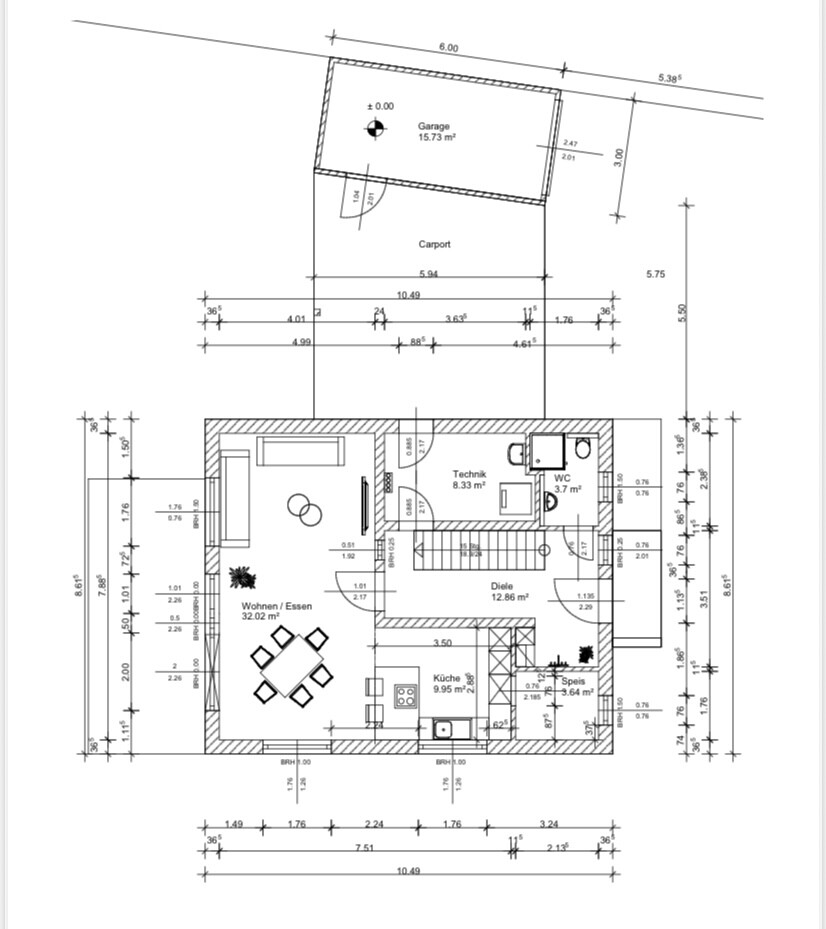
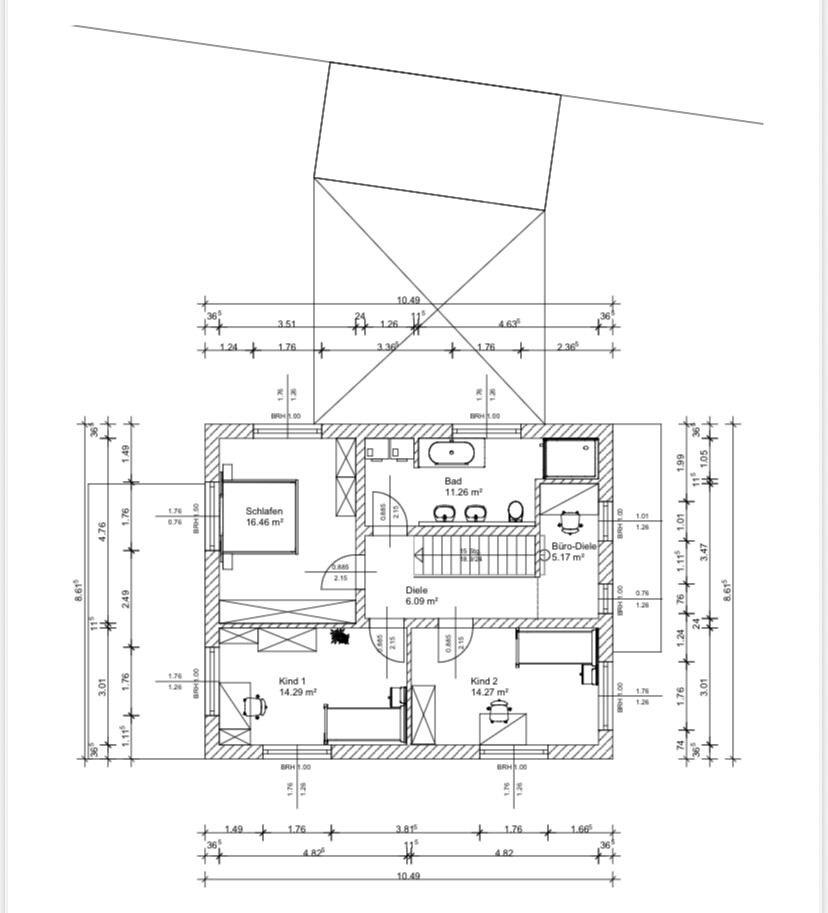
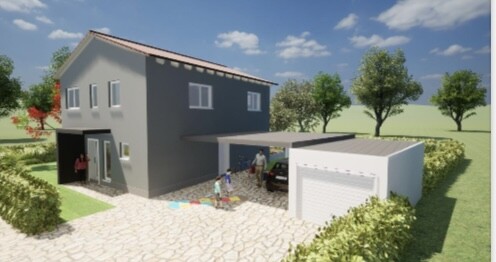
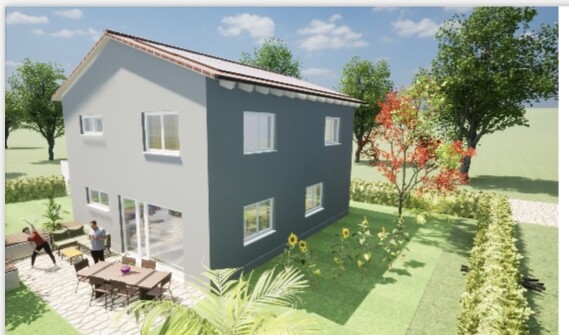
Hello everyone, following my last post about costs and so on, Ant11 suggested that I start with a floor plan here for evaluation. This plan has now existed for quite some time with a few minor adjustments, so the ideas have not changed. I’m looking forward to some feedback.
Development Plan / Restrictions
Plot size 654 sqm (7040 sq ft)
Slope no
Site occupancy index 0.4
Floor area ratio 0.8
Building setback, building line and boundary 3 m (10 ft)
Edge development only garages or carport
Number of parking spaces 2
Number of floors max 2
Roof pitch 0–48 degrees
Style single-family house
Orientation any
Maximum heights / limits 6 m (20 ft) wall and 9 m (30 ft) total
Other requirements cistern
Client Requirements
Style, roof type, building type gable roof
Basement, floors 2
Number of people, age 2 adults and potentially 2 children, currently 1
Space requirements ground floor, upper floor
Office: family use or home office? Both
Guest sleeping per year, if so guests sleep in the children’s rooms
Open kitchen, kitchen island open kitchen
Number of dining seats 1
Fireplace no
Music / stereo wall no
Balcony, roof terrace no
Garage, carport yes
Utility garden, greenhouse possible
Other wishes / special features / daily routine, also reasons why this or that should or should not be included
House Design
Who designed it:
- Initial draft by architect then adjustments with builder/architect
What do you particularly like? Why? Utility room with separate door (mudroom), large pantry
What do you dislike? Why?
Price estimate according to architect/planner: 433k
Personal price limit for the house, including fixtures: 500k
Preferred heating technology: air heat pump and central ventilation system
If you had to give up, which details / extensions
- Could you give up: if push comes to shove, the separate door for the utility room or the pantry could be omitted
- Could you not give up: guest WC with shower
Why did the design turn out the way it did? For example:
Build as small as possible but as large as necessary. The plot becomes wider toward the back.
So, this is a draft after a consultation appointment with the architect. It was then revised again with the builder.
We want a functional home that works for 2 adults and potentially 2 children (1 currently). In addition, we have a dog, but that obviously adapts too (the mudroom is also designed for this).
Home office is generally possible and planned. First, we have one child’s room reserved and intended for this purpose. Afterwards, the office niche or the bedroom upstairs. We don’t need much except a quiet place to work.
If all else fails, the pantry will become the office (possibly then accessible from the hallway).
The upstairs bathroom is somewhat elongated due to the narrow building footprint and straight staircase. The washing machine and dryer are shown upstairs and are planned to be there. There are also connections in the utility room. Otherwise, the space upstairs or downstairs will be used for storage.
I look forward to your opinions.
Development Plan / Restrictions
Plot size 654 sqm (7040 sq ft)
Slope no
Site occupancy index 0.4
Floor area ratio 0.8
Building setback, building line and boundary 3 m (10 ft)
Edge development only garages or carport
Number of parking spaces 2
Number of floors max 2
Roof pitch 0–48 degrees
Style single-family house
Orientation any
Maximum heights / limits 6 m (20 ft) wall and 9 m (30 ft) total
Other requirements cistern
Client Requirements
Style, roof type, building type gable roof
Basement, floors 2
Number of people, age 2 adults and potentially 2 children, currently 1
Space requirements ground floor, upper floor
Office: family use or home office? Both
Guest sleeping per year, if so guests sleep in the children’s rooms
Open kitchen, kitchen island open kitchen
Number of dining seats 1
Fireplace no
Music / stereo wall no
Balcony, roof terrace no
Garage, carport yes
Utility garden, greenhouse possible
Other wishes / special features / daily routine, also reasons why this or that should or should not be included
House Design
Who designed it:
- Initial draft by architect then adjustments with builder/architect
What do you particularly like? Why? Utility room with separate door (mudroom), large pantry
What do you dislike? Why?
Price estimate according to architect/planner: 433k
Personal price limit for the house, including fixtures: 500k
Preferred heating technology: air heat pump and central ventilation system
If you had to give up, which details / extensions
- Could you give up: if push comes to shove, the separate door for the utility room or the pantry could be omitted
- Could you not give up: guest WC with shower
Why did the design turn out the way it did? For example:
Build as small as possible but as large as necessary. The plot becomes wider toward the back.
So, this is a draft after a consultation appointment with the architect. It was then revised again with the builder.
We want a functional home that works for 2 adults and potentially 2 children (1 currently). In addition, we have a dog, but that obviously adapts too (the mudroom is also designed for this).
Home office is generally possible and planned. First, we have one child’s room reserved and intended for this purpose. Afterwards, the office niche or the bedroom upstairs. We don’t need much except a quiet place to work.
If all else fails, the pantry will become the office (possibly then accessible from the hallway).
The upstairs bathroom is somewhat elongated due to the narrow building footprint and straight staircase. The washing machine and dryer are shown upstairs and are planned to be there. There are also connections in the utility room. Otherwise, the space upstairs or downstairs will be used for storage.
I look forward to your opinions.

Milka0105 schrieb:
That was a preference of ours. We saw such a unit at friends' houses.
It is a wide door with an additional panel that can be opened if you want. Without a mullion in the middle. Alternatively, a lift-and-slide door. We just wanted lots of windows there for light. Oh, so an asymmetrically divided double door with an active leaf, and next to it a fixed panel?
https://www.instagram.com/11antgmxde/
https://www.linkedin.com/company/bauen-jetzt/
wiltshire schrieb:
Some building services equipment (heat pump, hot water storage tank, inverter, battery storage, etc.) comes with requirements about how much clearance is needed from the nearest object. The device dimensions alone don’t determine the space needed, similar to a kitchen layout. Especially since in the current plan, the passageway to the outside effectively turns about 2.5 sqm (27 sq ft) of the room into a hallway rather than usable room space, further limiting the available area.
Milka0105 schrieb:
How exactly would a different staircase make the kitchen larger? Could you give me an example? With the quarter-turn stairs, wouldn’t the hallway become wider, making the kitchen even narrower? Yes, especially since the straight staircase is also not planned very generously. The kitchen is on a very small footprint and with the current trend of a “pass-through in the tall cabinet wall,” there is little space between the cooktop and sink, and with a room depth of 288 cm (114 inches), there are also limited layout options. Particularly if you want to cook with children and still have space to move around.
--------------------------
Years ago, I sketched a similarly sized house that, in my opinion, might fit better. With the room layout, it is important to have a detailed plan. This example has an exterior dimension of just 849 cm (334 inches), so the 861 cm (339 inches) that the original poster has — 15 cm (6 inches) more — would certainly benefit this example as well.
Utility room – door can also open into the hallway.
Staircase – space under the stairs for pantry cabinets and vacuum cleaner/mop storage.
Office and guest room for emergencies on the ground floor.
200 cm (79 inches) of closet space.
Kitchen with sufficient space.
Seating area arranged so you can also look out the windows.
The room labeled as “dressing room” can also accommodate the washing machine, vacuum cleaner/mop storage for the upper floor, etc. It can also hold suitcases, seasonal items for the whole family, and so on.
The staircase could also be extended to a loft. … I can’t remember if this question came up earlier in the thread.
W
wiltshire5 Jul 2025 09:50Milka0105 schrieb:
ok, I’m actually hesitant to say this, but the contractor really should take this into account. Anyway, I’ll make a note of it. You’re basically right—the contractor should know this. In practice, however, this attitude leads to a fundamental mistake, because as the client, you are responsible for how the house turns out. This is not about simply monitoring the work, but about risk management and a four-eyes principle to avoid errors. Have you never made a mistake even though you should have known better? If you accept a space that is too small without questioning whether it will actually work, or without asking for a clear explanation, that responsibility lies with you. And then you get exactly what you have ordered and paid for. Complaints afterwards, when things turn out differently than the client imagined, are common, but the solutions to such conflicts are rarely satisfactory. The critical phrase that often comes up is, “I assumed that…”. It’s better to ask one time too many than too few—and think for yourself, just as you do with the size of the home office. You can assess how much space you need and make a confident decision. Do the same for the utility room, which you won’t be able to judge properly without looking into the topic.
It is this fundamental mistake that causes small contractors to suffer losses, who then say: “I didn’t know that, my accountant handles the bookkeeping, they should have known.” It doesn’t matter what someone should have known—the contractor is responsible and faces the consequences.
About the utility room: just try searching online
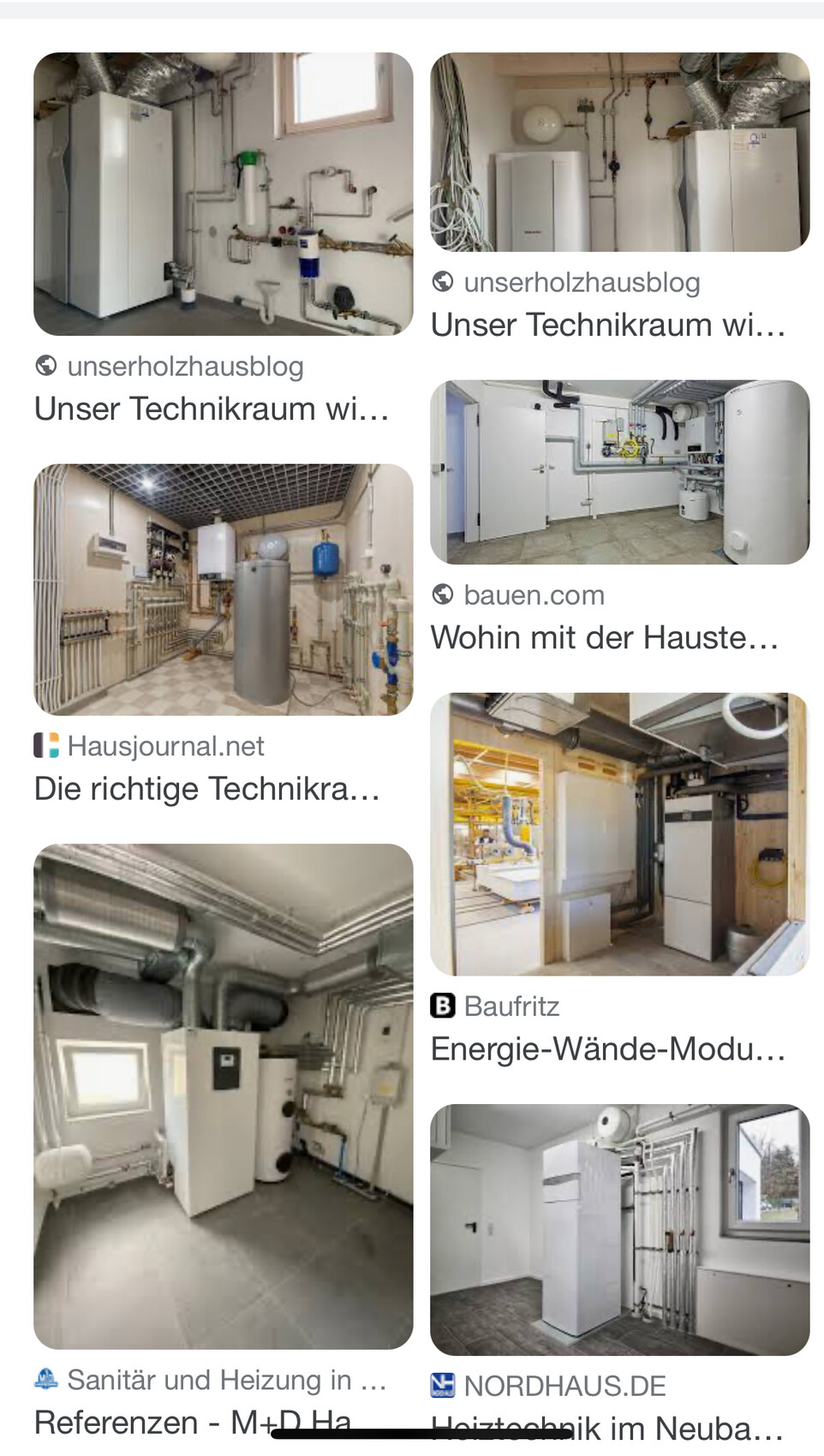
A draftsman usually adds placeholders, and an architect may remove or reposition them more wisely, based on technical knowledge. During the shell construction phase, craftsmen or site managers decide the best locations for the heating system, mechanical ventilation, connections, and electrical panel. So, a lot can still change at this stage. However, tradespeople tend to think differently and more practically. Pipes and conduits run along the walls, and there needs to be enough space between them and the equipment for tools used during installation, maintenance, or repair of the pipes. I have never seen a heating system installed on an interior wall that can be removed easily. The sink is misplaced and unnecessary if the dryer is placed above. The area between the doors is hardly useful, except perhaps as a corridor substitute. It is more practical to have cabinet space behind the doors.
Regarding my advice: sofas are generally deeper than a door is wide. Incorrect measurements give a false impression of the proportions.
By the way, where is north?
A draftsman usually adds placeholders, and an architect may remove or reposition them more wisely, based on technical knowledge. During the shell construction phase, craftsmen or site managers decide the best locations for the heating system, mechanical ventilation, connections, and electrical panel. So, a lot can still change at this stage. However, tradespeople tend to think differently and more practically. Pipes and conduits run along the walls, and there needs to be enough space between them and the equipment for tools used during installation, maintenance, or repair of the pipes. I have never seen a heating system installed on an interior wall that can be removed easily. The sink is misplaced and unnecessary if the dryer is placed above. The area between the doors is hardly useful, except perhaps as a corridor substitute. It is more practical to have cabinet space behind the doors.
Regarding my advice: sofas are generally deeper than a door is wide. Incorrect measurements give a false impression of the proportions.
By the way, where is north?
M
Milka01055 Jul 2025 12:21ypg schrieb:
I have to be honest, I’m annoyed that I even replied here. Much of this was already communicated in March, and none of it was accepted or revised. It doesn’t have to be, but repeated discussions taste as bland as reheated Vienna sausages with the wrong mustard. Okay, I don’t really know how to respond to that.
I understand that the kitchen has to meet certain dimensions, and maybe it was my fault for overlooking that the kitchen drawn in the floor plan might not match the exact measurements.
I have now planned and drawn the kitchen as it should be. And yes, the door and the window will need to be relocated.
But I don’t think it’s too small for cooking together. There is enough space for chopping, and storage options are planned in the pantry. Attached is the image without changing any kitchen dimensions, only the passageway and window have been moved.
I’m curious to hear your opinions.
Similar topics