
ᐅ Terraced Corner House Floor Plan in Development – Any Suggestions for Changes?
Created on: 20 Aug 2022 21:05
B
Bauherrin123
Hello dear forum members,
we are building an end-terrace house measuring 7 by 10 m (23 by 33 ft) without a basement. It will have 2 full floors and an attic above. Now the question is which roof we should have. I was shown a house with a 38-degree gable roof without a knee wall, which I found very nice in terms of the feeling of space. Now we have been informed that only a 35-degree gable roof is allowed for us, but with a 30 cm (12 inches) knee wall. What I didn’t realize was that our attic has a maximum height of only 63 cm (25 inches). So the attic space is very low. Now I have no basement and hardly any storage space and I’m a bit frustrated because the building permit application is now in front of me. I initially agreed that this was okay, but I would prefer a 1 m (3 ft) knee wall. The development plan only allows a maximum of 30 cm (12 inches). I’m really unsure what to choose... I don’t want to spend unnecessary money if it doesn’t make a big difference since we have a very large plot and can build storage in the garage, barn, or garden house...
What would you do?
A. 38-degree gable roof or
B. 35-degree gable roof with 30 cm (12 inches) knee wall or
C. 35-degree gable roof with 1 m (3 ft) knee wall, applying to the city office...
We would need to submit a request to the building authority to increase the knee wall to 1 m (3 ft), which would mean more effort, bureaucracy, and delays... I don’t know what it would cost or if it’s even possible, but it’s weighing on my mind because I only read online about people who built houses with a knee wall on the attic. The extra cost of $3,000–$5,000, if that’s roughly the amount, would be worth it to me if it creates nicer rooms and I get a higher attic for storage.
The second problem is that the plot is much lower than street level. We are paying an extra €10,000 to fill the plot with gravel up to street level. Now the house will be built just slightly above street level, so there will be a step at the entrance. There will be a total of 3 terraced houses, and we have the end house. In our row, two finished terraced houses from other builders are already standing next to ours. However, these are built 1 m (3 ft) above street level with 3 or 4 steps higher, so they probably look taller overall. I find this visually unappealing and also, personally, I want our house to be higher.
What are your thoughts on this?
I’m also uploading my floor plan, which I think is finished. I don’t understand how high the ceilings are; can someone tell from the plans? Inside the rooms, how high are they? And generally, do you notice anything about the floor plan?
My building permit application is ready, but I want to change it after all. It doesn’t suit me, and I’m sure it will cause trouble with the company if they have to make changes for us, but I want to be able to decide again and just need some feedback here.
Looking forward to your support!
Best regards
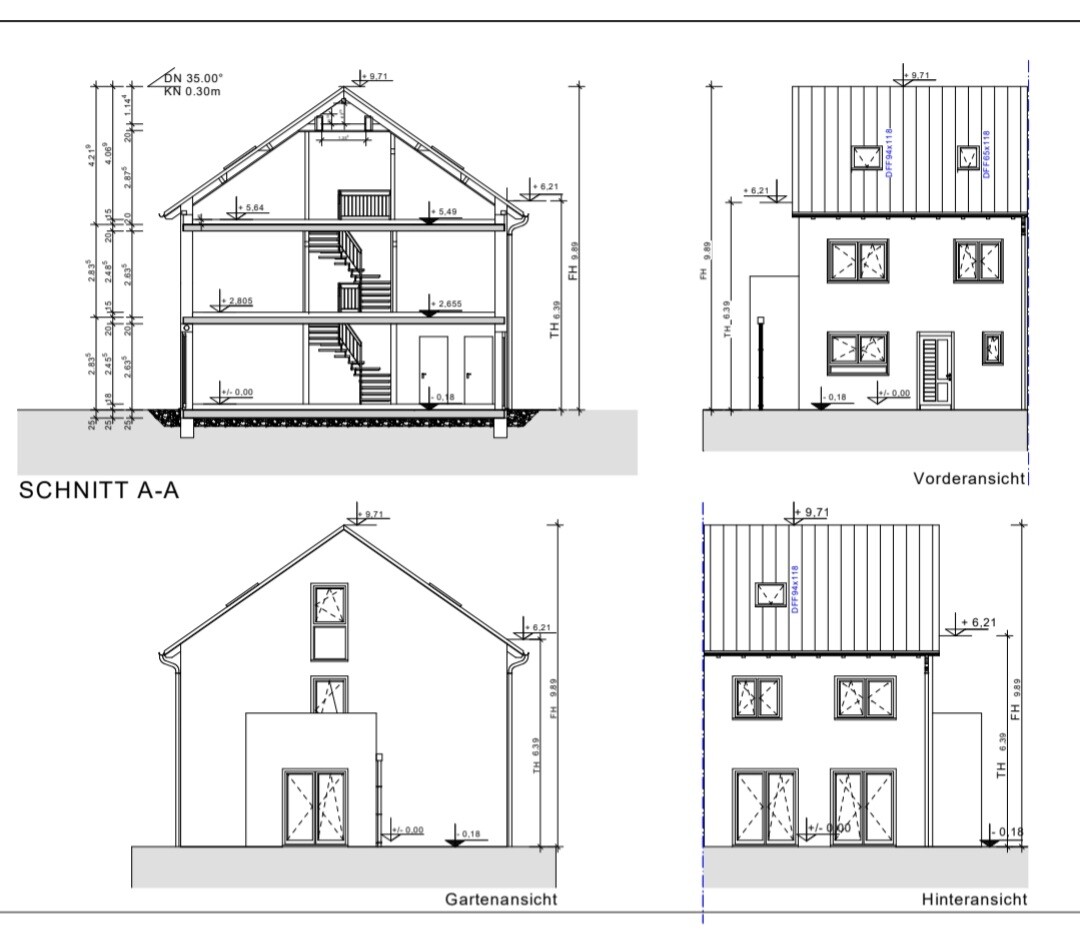
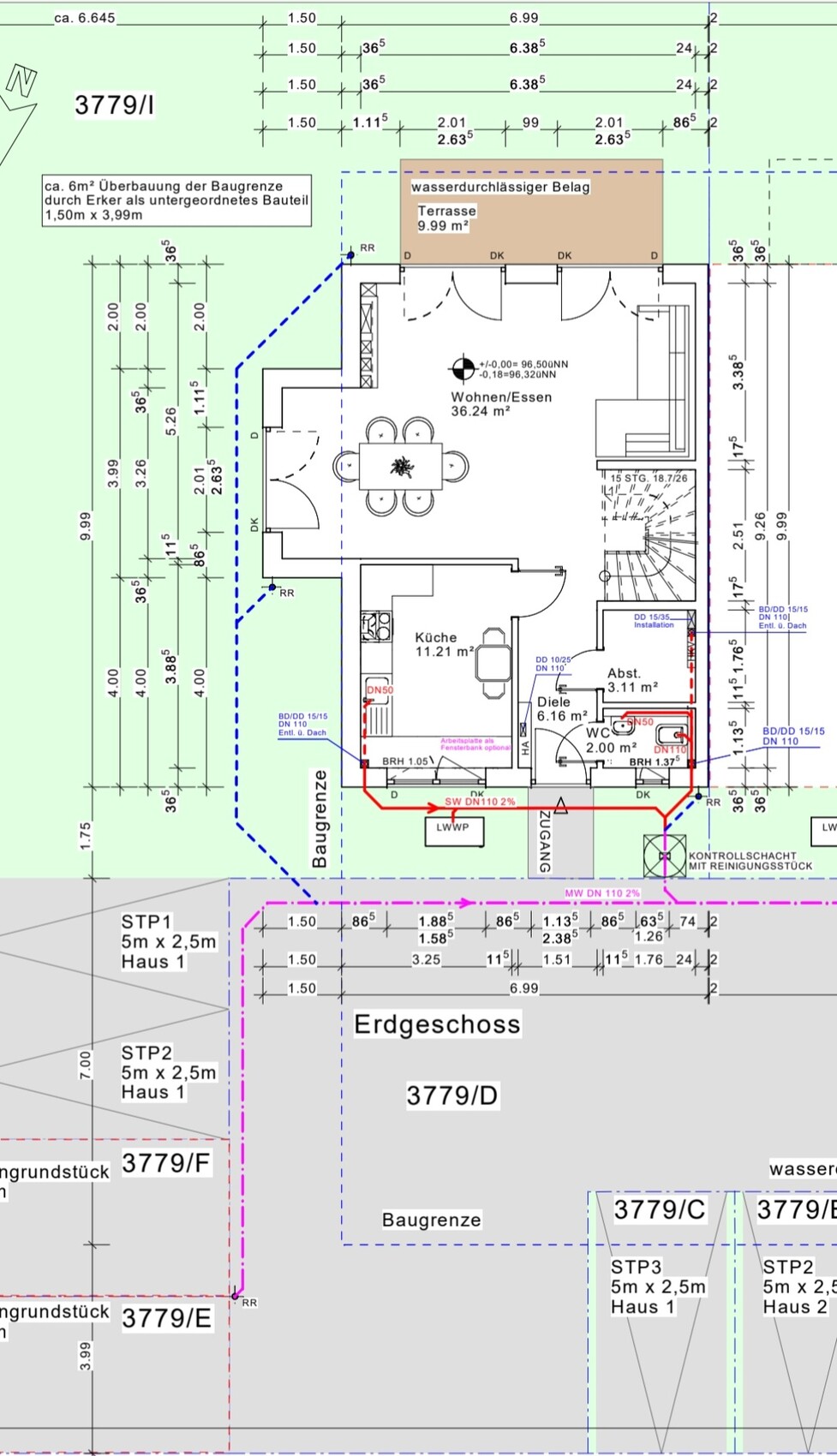
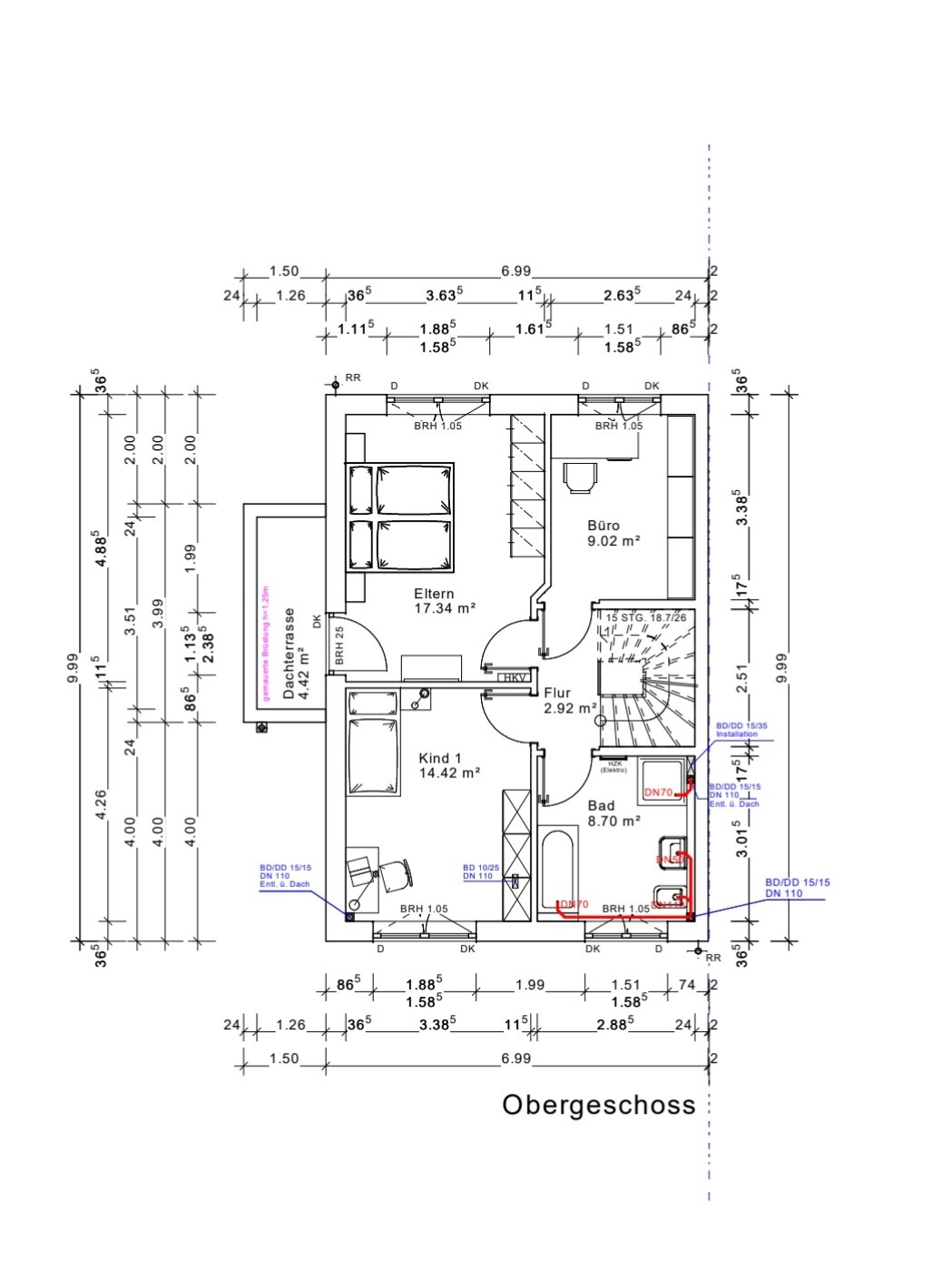
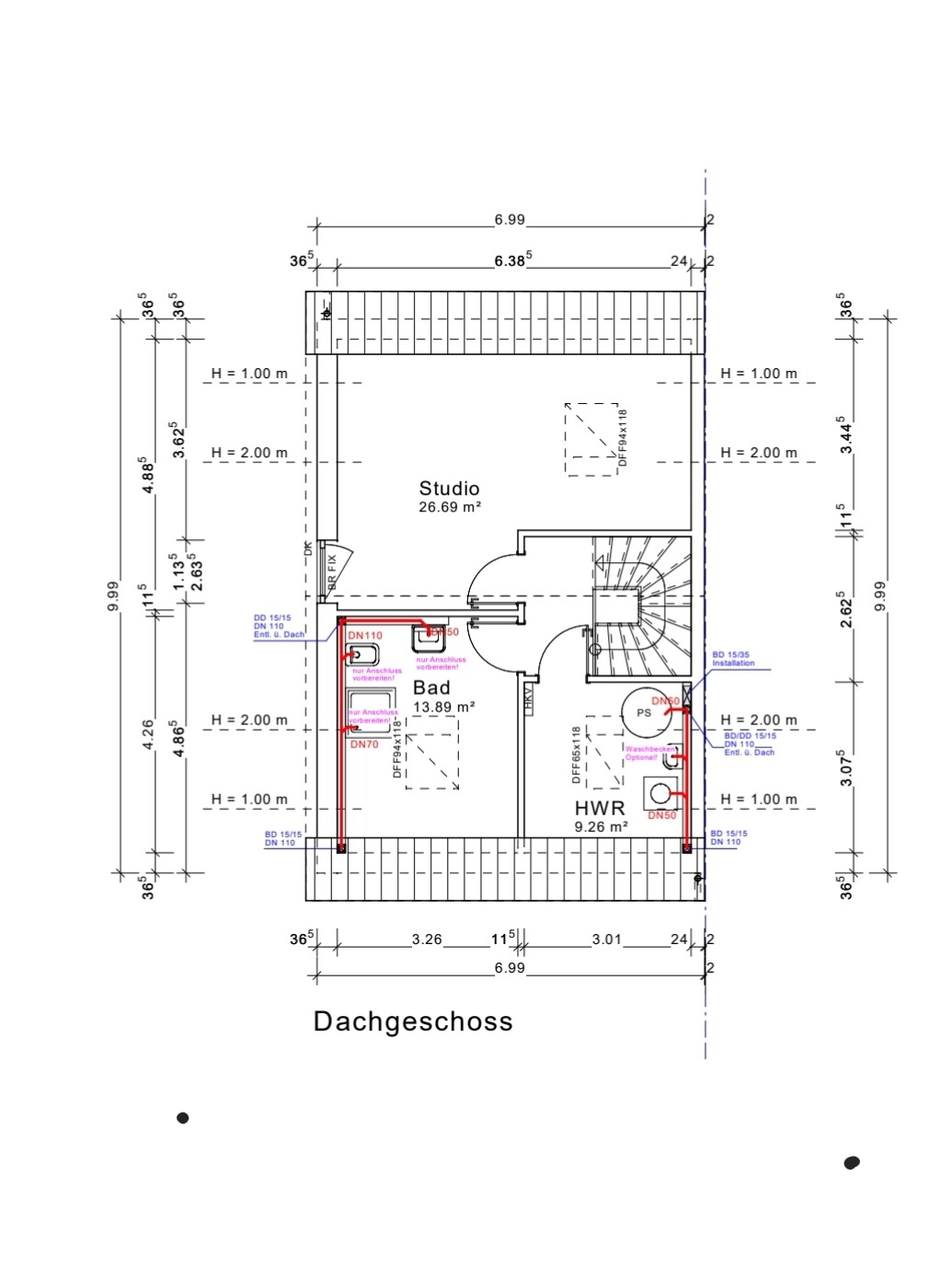
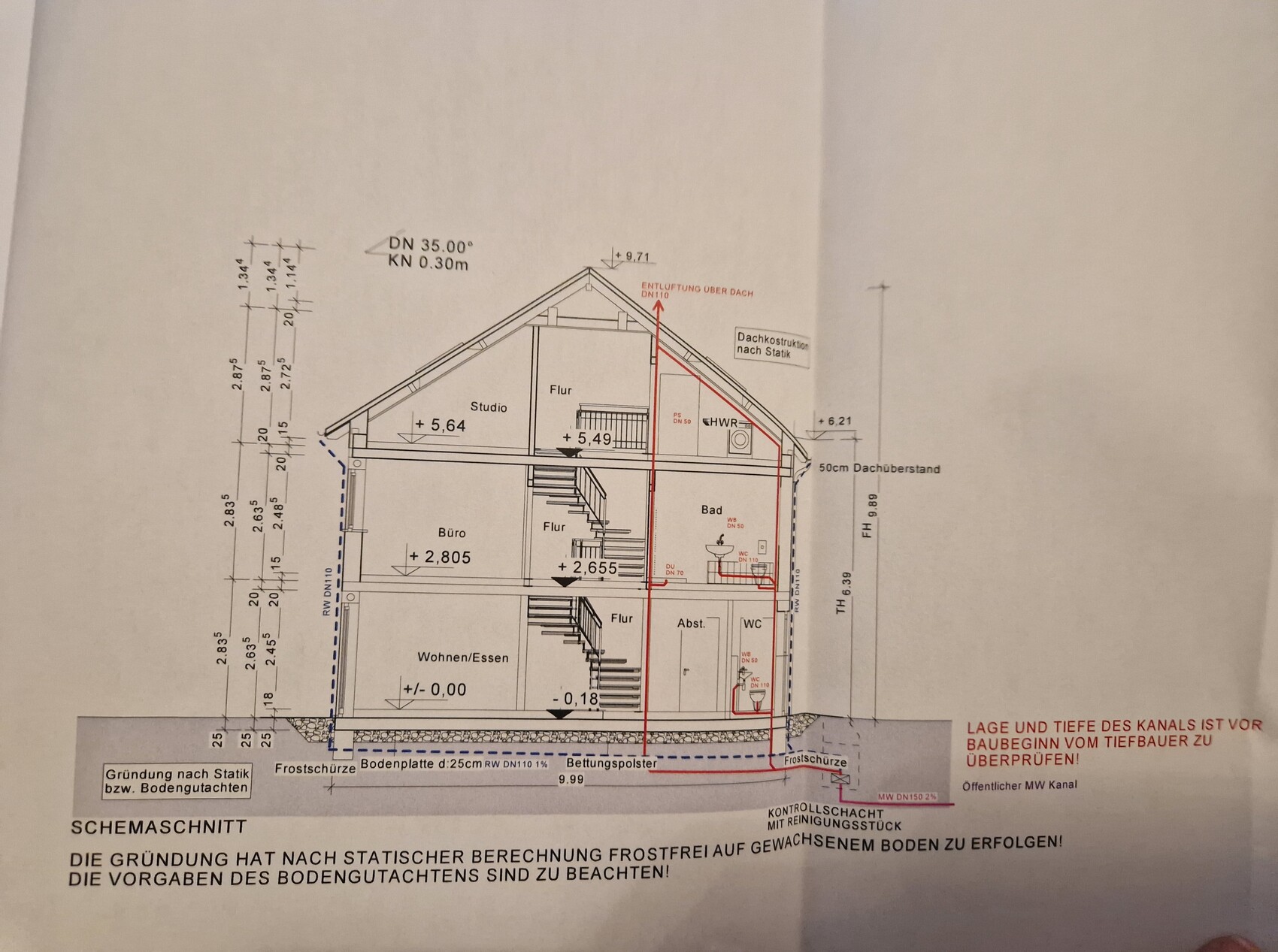
we are building an end-terrace house measuring 7 by 10 m (23 by 33 ft) without a basement. It will have 2 full floors and an attic above. Now the question is which roof we should have. I was shown a house with a 38-degree gable roof without a knee wall, which I found very nice in terms of the feeling of space. Now we have been informed that only a 35-degree gable roof is allowed for us, but with a 30 cm (12 inches) knee wall. What I didn’t realize was that our attic has a maximum height of only 63 cm (25 inches). So the attic space is very low. Now I have no basement and hardly any storage space and I’m a bit frustrated because the building permit application is now in front of me. I initially agreed that this was okay, but I would prefer a 1 m (3 ft) knee wall. The development plan only allows a maximum of 30 cm (12 inches). I’m really unsure what to choose... I don’t want to spend unnecessary money if it doesn’t make a big difference since we have a very large plot and can build storage in the garage, barn, or garden house...
What would you do?
A. 38-degree gable roof or
B. 35-degree gable roof with 30 cm (12 inches) knee wall or
C. 35-degree gable roof with 1 m (3 ft) knee wall, applying to the city office...
We would need to submit a request to the building authority to increase the knee wall to 1 m (3 ft), which would mean more effort, bureaucracy, and delays... I don’t know what it would cost or if it’s even possible, but it’s weighing on my mind because I only read online about people who built houses with a knee wall on the attic. The extra cost of $3,000–$5,000, if that’s roughly the amount, would be worth it to me if it creates nicer rooms and I get a higher attic for storage.
The second problem is that the plot is much lower than street level. We are paying an extra €10,000 to fill the plot with gravel up to street level. Now the house will be built just slightly above street level, so there will be a step at the entrance. There will be a total of 3 terraced houses, and we have the end house. In our row, two finished terraced houses from other builders are already standing next to ours. However, these are built 1 m (3 ft) above street level with 3 or 4 steps higher, so they probably look taller overall. I find this visually unappealing and also, personally, I want our house to be higher.
What are your thoughts on this?
I’m also uploading my floor plan, which I think is finished. I don’t understand how high the ceilings are; can someone tell from the plans? Inside the rooms, how high are they? And generally, do you notice anything about the floor plan?
My building permit application is ready, but I want to change it after all. It doesn’t suit me, and I’m sure it will cause trouble with the company if they have to make changes for us, but I want to be able to decide again and just need some feedback here.
Looking forward to your support!
Best regards
Bauherrin123 schrieb:
because a small dining table is still planned there. For everyday use, I want to eat in the kitchen with the children and my husband,... I find it practical!I already mentioned that for toddlers, Tripp Trapp chairs are often preferred. I don’t quite understand why a large table is planned, and then a small table about 4 meters (13 feet) away is crammed in, which also ends up being somewhat in the way.Evelin actually posted a very practical kitchen example in [URL='https://www.hausbau-forum.de/threads/grundriss-reiheneckhaus-in-planung-aenderungsvorschlaege.43992/post-591336'], where the kitchen can be separated from the dining area with a sliding door, and the Tripp Trapp chairs fit perfectly there.
Also, you would have the 240 cm (8 feet) closet in the hallway for shoes and outerwear, and the storage room could be used for everything you mentioned yourself, for example, an additional freezer, etc. In my own wardrobe, I always keep about 2 to 3 different seasonal jackets, scarves, and so on, which I select depending on the weather. For children, you might need to hang even more there, such as play pants, wind and rain gear for daycare, the regular jacket, and so forth.
Katja’s bedroom suggestion: I would recommend a bed with a mattress width of 180 cm (70 inches), so that the walkways on both sides are still comfortable, also for changing bed linen, etc.
At the bottom of the plan, make sure there is about 70 cm (28 inches) of depth available in front of the door. Pax wardrobes with sliding doors, for example, are 66 cm (26 inches) deep.
At the bottom of the plan, make sure there is about 70 cm (28 inches) of depth available in front of the door. Pax wardrobes with sliding doors, for example, are 66 cm (26 inches) deep.
B
Bauherrin12322 Aug 2022 08:47K a t j a schrieb:
As I said, enclose the space under the stairs on the ground floor. You will need it. Otherwise, there is far too little storage space.
Yes, one more thing:
[ATTACH alt="grundriss-reiheneckhaus-in-planung-aenderungsvorschlaege-591434-1.jpg"]74163[/ATTACH]
Simply make the bedroom narrower and rotate the bed. Unfortunately, I can't give you the exact measurements now. It would be useful to know precisely whether there’s still enough walking space next to the bed. Visually, I think it would work, and the 3m (10 feet) wardrobe would again be an option. However, this makes the office very small, even smaller than it already is in my plan. Then I want to remove the window where you have now positioned the bed and not place the bed by the window. This creates a large unused area, which is impractical. If we want to have children, we want to be able to place a bed there, and there is also no space for a chest of drawers or a dressing table.
So this version is not an option for me.
I’ll send you another variant that the architect sent me...
I want to swap bed and wardrobe because I prefer looking at the bed and wardrobe when entering the room. That would be possible, with the wardrobe only up to 2.5m (8 feet 2 inches) wide, which is no problem. The only issue is that the office door was very narrow.
Then have the actual clear opening width of this office door measured—not just the rough opening. Then check if you can still get a wardrobe, desk, etc., through it.
Wouldn’t it also be a sensible idea to plan the studio area in the attic as the master bedroom and arrange the three rooms on the upper floor to be roughly the same size, essentially designating that level as the children’s floor?
Wouldn’t it also be a sensible idea to plan the studio area in the attic as the master bedroom and arrange the three rooms on the upper floor to be roughly the same size, essentially designating that level as the children’s floor?
B
Bauherrin12322 Aug 2022 09:56kbt09 schrieb:
Then have the actual clear opening width of this office door measured—not the rough opening. And then check if you can still fit a wardrobe, desk, etc. through it.
Would it perhaps also be a sensible idea to plan the studio area in the attic as the master bedroom and design the three rooms on the upper floor roughly the same size, basically as a children’s floor? Yes, that’s true, but I still find it odd. She had drawn it in. The narrowest door allowed for that purpose would be 60cm (24 inches) wide or 63cm (25 inches)… I don’t remember exactly, but that would be the WC door in my apartment. Honestly, I’ve never really noticed how narrow the WC door is, but somehow I don’t want that for an office. With the narrow door, everything else is just as I want it, only the door is narrow. At the moment, there is still one alternative… just a moment, I’ll send it to you.
Although that option is similar if the door is opened inward, from someone who has already drafted it for me… with the curve… so that I know when I’m on site during construction, it will fit properly.
I don’t want to change the room layout, that it becomes the master bedroom, etc. I’m looking for the optimal solution regarding the door…

Bauherrin123 schrieb:
But this actually makes the office very small, even smaller than it already is in my plan. Um, no. The office has actually become larger.
Bauherrin123 schrieb:
Then I would like to remove the window where you’ve now placed the bed and not put the bed next to a window. This will create a large unused area, which is not practical. If we want to have children, we want to be able to put a bed there, and there’s also no space for a dresser or makeup area. Autocorrect probably interfered here. I can’t quite follow this confusing wording.
Bauherrin123 schrieb:
So this version doesn’t work for me. Okay, I understand that. 🙂
Bauherrin123 schrieb:
I’ll send you another variant that the architect sent me... I want to swap the bed and wardrobe because I prefer being able to look at the bed and wardrobe when entering the room. That would be possible, with the wardrobe up to only 250cm (98 inches) wide, which is not a problem. The only issue is that the home office door would be very narrow. Ah, the version with the small door. Probably about 66cm (26 inches) wide—she likely didn’t want to mention it. Understandable. 😉
Well, if the rooms are not to be changed, maybe the staircase could be adjusted. It’s just about one step at the stair exit, I think. The question is whether it can be branched off elsewhere. But I have a feeling that will be even more difficult...
Similar topics