
ᐅ Terraced Corner House Floor Plan in Development – Any Suggestions for Changes?
Created on: 20 Aug 2022 21:05
B
Bauherrin123
Hello dear forum members,
we are building an end-terrace house measuring 7 by 10 m (23 by 33 ft) without a basement. It will have 2 full floors and an attic above. Now the question is which roof we should have. I was shown a house with a 38-degree gable roof without a knee wall, which I found very nice in terms of the feeling of space. Now we have been informed that only a 35-degree gable roof is allowed for us, but with a 30 cm (12 inches) knee wall. What I didn’t realize was that our attic has a maximum height of only 63 cm (25 inches). So the attic space is very low. Now I have no basement and hardly any storage space and I’m a bit frustrated because the building permit application is now in front of me. I initially agreed that this was okay, but I would prefer a 1 m (3 ft) knee wall. The development plan only allows a maximum of 30 cm (12 inches). I’m really unsure what to choose... I don’t want to spend unnecessary money if it doesn’t make a big difference since we have a very large plot and can build storage in the garage, barn, or garden house...
What would you do?
A. 38-degree gable roof or
B. 35-degree gable roof with 30 cm (12 inches) knee wall or
C. 35-degree gable roof with 1 m (3 ft) knee wall, applying to the city office...
We would need to submit a request to the building authority to increase the knee wall to 1 m (3 ft), which would mean more effort, bureaucracy, and delays... I don’t know what it would cost or if it’s even possible, but it’s weighing on my mind because I only read online about people who built houses with a knee wall on the attic. The extra cost of $3,000–$5,000, if that’s roughly the amount, would be worth it to me if it creates nicer rooms and I get a higher attic for storage.
The second problem is that the plot is much lower than street level. We are paying an extra €10,000 to fill the plot with gravel up to street level. Now the house will be built just slightly above street level, so there will be a step at the entrance. There will be a total of 3 terraced houses, and we have the end house. In our row, two finished terraced houses from other builders are already standing next to ours. However, these are built 1 m (3 ft) above street level with 3 or 4 steps higher, so they probably look taller overall. I find this visually unappealing and also, personally, I want our house to be higher.
What are your thoughts on this?
I’m also uploading my floor plan, which I think is finished. I don’t understand how high the ceilings are; can someone tell from the plans? Inside the rooms, how high are they? And generally, do you notice anything about the floor plan?
My building permit application is ready, but I want to change it after all. It doesn’t suit me, and I’m sure it will cause trouble with the company if they have to make changes for us, but I want to be able to decide again and just need some feedback here.
Looking forward to your support!
Best regards
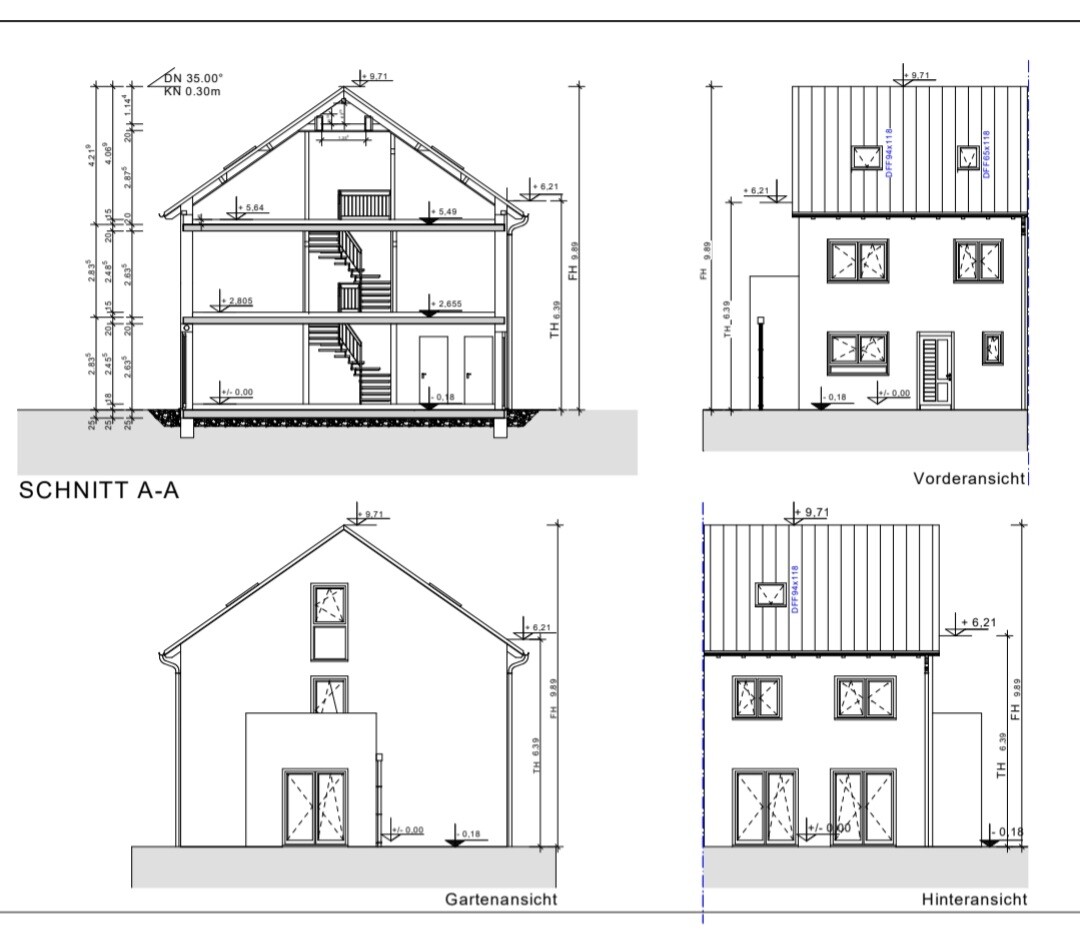
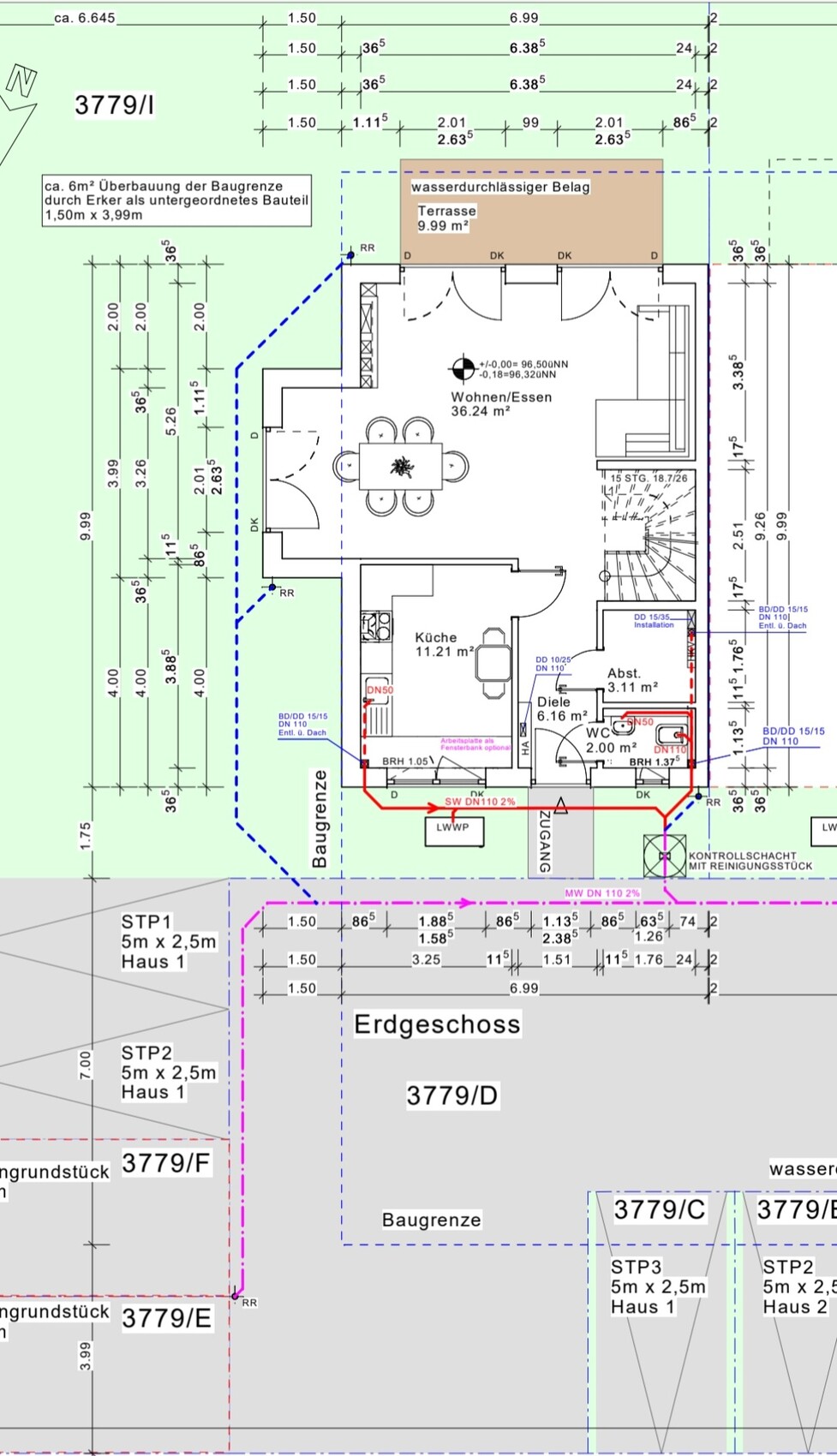
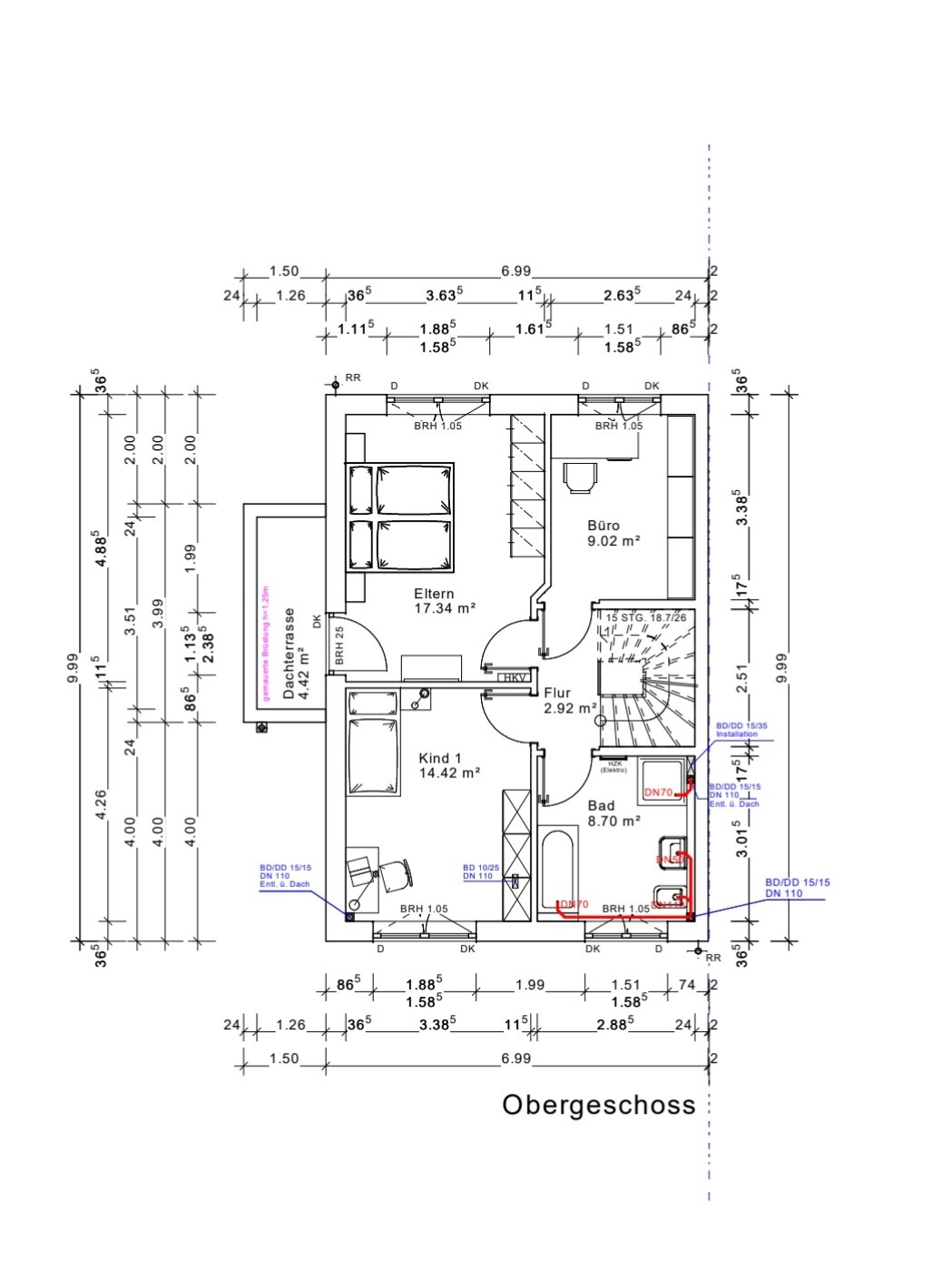
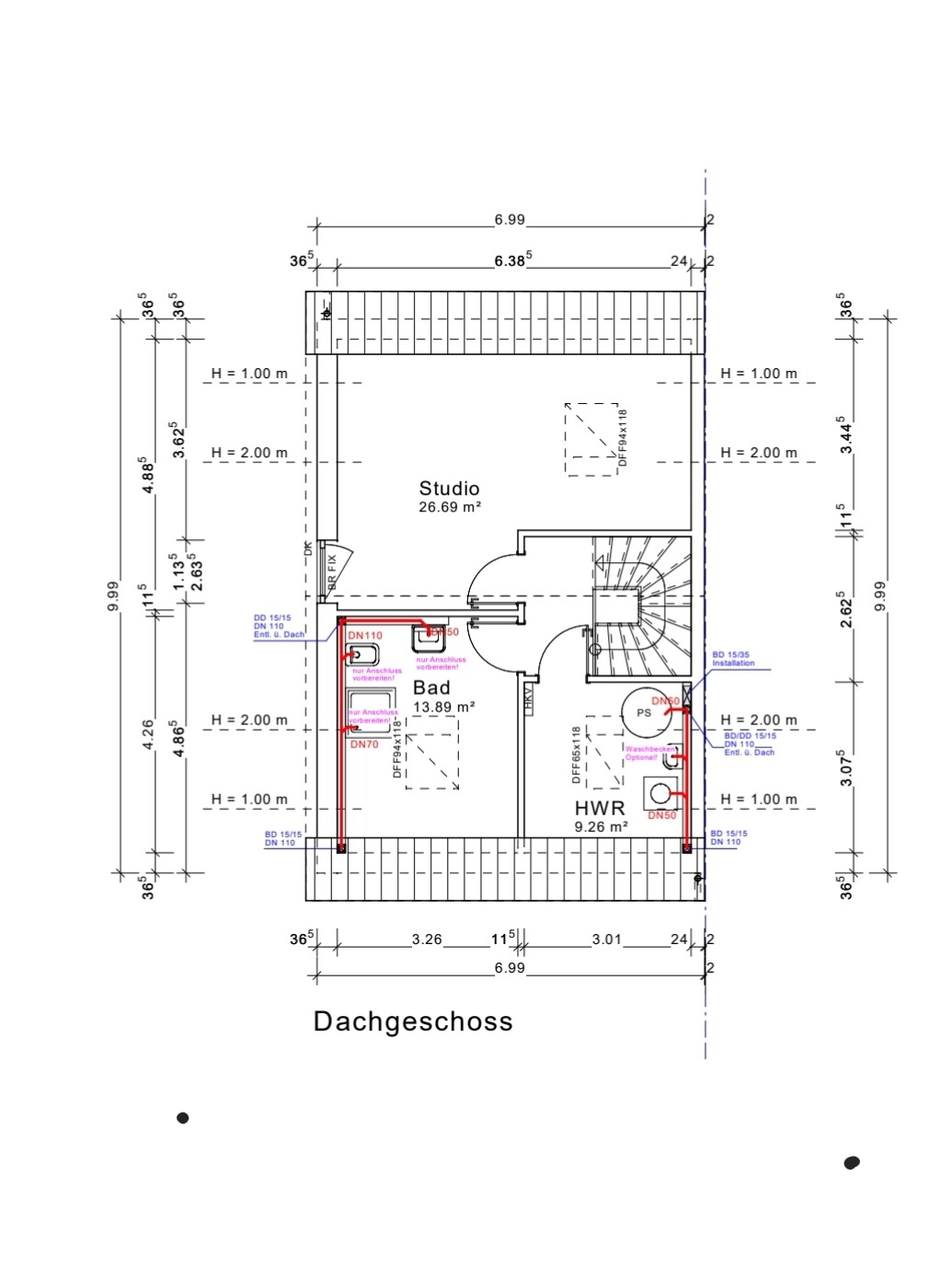
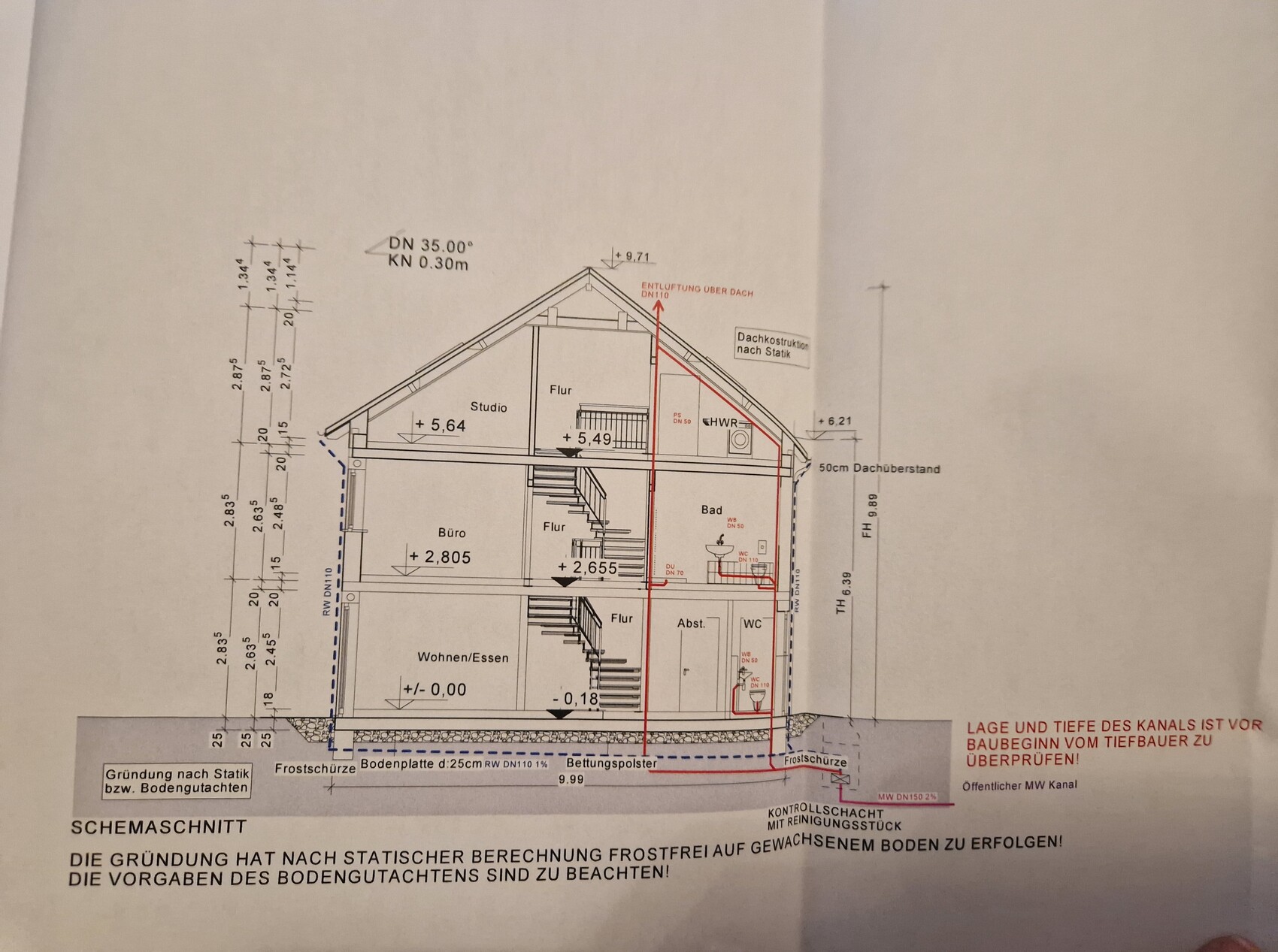
we are building an end-terrace house measuring 7 by 10 m (23 by 33 ft) without a basement. It will have 2 full floors and an attic above. Now the question is which roof we should have. I was shown a house with a 38-degree gable roof without a knee wall, which I found very nice in terms of the feeling of space. Now we have been informed that only a 35-degree gable roof is allowed for us, but with a 30 cm (12 inches) knee wall. What I didn’t realize was that our attic has a maximum height of only 63 cm (25 inches). So the attic space is very low. Now I have no basement and hardly any storage space and I’m a bit frustrated because the building permit application is now in front of me. I initially agreed that this was okay, but I would prefer a 1 m (3 ft) knee wall. The development plan only allows a maximum of 30 cm (12 inches). I’m really unsure what to choose... I don’t want to spend unnecessary money if it doesn’t make a big difference since we have a very large plot and can build storage in the garage, barn, or garden house...
What would you do?
A. 38-degree gable roof or
B. 35-degree gable roof with 30 cm (12 inches) knee wall or
C. 35-degree gable roof with 1 m (3 ft) knee wall, applying to the city office...
We would need to submit a request to the building authority to increase the knee wall to 1 m (3 ft), which would mean more effort, bureaucracy, and delays... I don’t know what it would cost or if it’s even possible, but it’s weighing on my mind because I only read online about people who built houses with a knee wall on the attic. The extra cost of $3,000–$5,000, if that’s roughly the amount, would be worth it to me if it creates nicer rooms and I get a higher attic for storage.
The second problem is that the plot is much lower than street level. We are paying an extra €10,000 to fill the plot with gravel up to street level. Now the house will be built just slightly above street level, so there will be a step at the entrance. There will be a total of 3 terraced houses, and we have the end house. In our row, two finished terraced houses from other builders are already standing next to ours. However, these are built 1 m (3 ft) above street level with 3 or 4 steps higher, so they probably look taller overall. I find this visually unappealing and also, personally, I want our house to be higher.
What are your thoughts on this?
I’m also uploading my floor plan, which I think is finished. I don’t understand how high the ceilings are; can someone tell from the plans? Inside the rooms, how high are they? And generally, do you notice anything about the floor plan?
My building permit application is ready, but I want to change it after all. It doesn’t suit me, and I’m sure it will cause trouble with the company if they have to make changes for us, but I want to be able to decide again and just need some feedback here.
Looking forward to your support!
Best regards
B
Bauherrin12323 Oct 2022 22:33kbt09 schrieb:
No, you can’t read it. Don’t you have it as a PDF? Can you read the numbers yourself? Maybe just crop out the pointed roof section as an image and upload that.
But looking at the dimension chains on the left, there can’t suddenly be 20 cm (8 inches) more, right? 😉It is a PDF though... but it doesn’t work... the outside could be the same, but inside the beams go down... or is the architect fooling me?
However, the dimension chains on the left haven’t been corrected. Now, there is 252 cm (99 inches) below the ceiling (previously 287 - 15 = 272 cm / 113 inches), but the left side still shows 287 cm (113 inches) with 134 cm (53 inches) above (=114 + 20). Please compare the two drawings again; I have posted them together in Post 148. Also, the 83 cm (33 inches) below the roof are measured rather inaccurately, and the roof currently still resembles more of a schematic drawing.
Overall, the drawing should be corrected on the left side in the dimension chains, and if I were you, I would calculate with no more than 80 cm (31 inches) at that spot under the roof.
Overall, the drawing should be corrected on the left side in the dimension chains, and if I were you, I would calculate with no more than 80 cm (31 inches) at that spot under the roof.
W
Westerwald 223 Oct 2022 23:18Finished ceiling height in the ground floor and upper floor clearly under 2.50 meters (8 ft 2 in)? Seriously? I would want at least 10 cm (4 inches) more. Would that be possible?
B
Bauherrin12323 Oct 2022 23:42I will call them tomorrow and ask for an explanation... so frustrating.
I have another question. The windowsill should be at the height of the countertop. To adjust the sill height, I’m supposed to provide the underside measurement of the countertop. I haven’t chosen the new kitchen yet. The architect says the floor is calculated with a standard thickness of 1.5cm (0.6 inches). My current kitchen is 96cm (38 inches). The countertop is just under 4cm (1.5 inches) thick. I thought I would specify 92cm (36 inches). If I choose a thinner countertop, it would be 94cm (37 inches). Anything between 94 and 96cm (37 and 38 inches) is acceptable. Still, I’m uncertain, the window sill must not be too low under any circumstances. I don’t know what to specify, do I have some flexibility... I don’t understand this at all.
Here is the architect’s explanation:
When calculating the window sill height with the countertop as the windowsill in the kitchen, we always plan for a clearance of 2–2.5cm (0.8–1 inch). This means that with a height of 92cm (36 inches) to the underside of the countertop, the window sill would be planned at 1.08m (108cm/43 inches), calculated as 90cm (35 inches) plus 18cm (7 inches) floor construction. When calculating the sill height, the height of the floor construction is also taken into account, since the sill height is given from the top edge of the floor slab. For this calculation, we use our standard floor construction. In our standard, 1.5cm (0.6 inches) is included for the finished floor.
I have another question. The windowsill should be at the height of the countertop. To adjust the sill height, I’m supposed to provide the underside measurement of the countertop. I haven’t chosen the new kitchen yet. The architect says the floor is calculated with a standard thickness of 1.5cm (0.6 inches). My current kitchen is 96cm (38 inches). The countertop is just under 4cm (1.5 inches) thick. I thought I would specify 92cm (36 inches). If I choose a thinner countertop, it would be 94cm (37 inches). Anything between 94 and 96cm (37 and 38 inches) is acceptable. Still, I’m uncertain, the window sill must not be too low under any circumstances. I don’t know what to specify, do I have some flexibility... I don’t understand this at all.
Here is the architect’s explanation:
When calculating the window sill height with the countertop as the windowsill in the kitchen, we always plan for a clearance of 2–2.5cm (0.8–1 inch). This means that with a height of 92cm (36 inches) to the underside of the countertop, the window sill would be planned at 1.08m (108cm/43 inches), calculated as 90cm (35 inches) plus 18cm (7 inches) floor construction. When calculating the sill height, the height of the floor construction is also taken into account, since the sill height is given from the top edge of the floor slab. For this calculation, we use our standard floor construction. In our standard, 1.5cm (0.6 inches) is included for the finished floor.
B
Bauherrin12323 Oct 2022 23:44Westerwald 2 schrieb:
Finished ceiling height on the ground and upper floors clearly below 2.50 meters (8 feet 2 inches)? Seriously? I would want at least 10 cm (4 inches) more. Is that possible?These are three terraced houses, so I don't think I can change that. However, I compared the plan with one from an acquaintance’s project, and in terms of spatial feeling, it’s perfect—not too low. But when I measure in my own flat, I have 2.50 meters (8 feet 2 inches), and that should be the minimum. I'm a bit puzzled though, because my acquaintance has the same house, but the ceilings seem much higher, and he even has an attic with a height of 120 cm (47 inches)... I even uploaded his construction plan and compared it with mine here... it’s the same plan, but somehow everything is higher on his side...
Similar topics