
Hello everyone,
we have received a preliminary design and a quote from our builder. I would like to get your opinion on it.
It is planned as an accessible bungalow (about 131 sqm (1410 sq ft)) with 3 bedrooms and possibly a study room. Previously, instead of the study, there was a slightly larger kitchen and a somewhat bigger living room.
My opinion:
I would make the house a bit narrower on the street side, which would make the bedroom and child’s room 1 slightly smaller. Instead, the living room and kitchen would be extended, allowing the kitchen to be a bit larger (it currently feels too small to me).
On the other side, I have the option to make the carport a bit wider. I am trying to achieve an internal width of 3.5 m (11.5 ft) for the carport (because of wheelchair access).
I will also ask the builder what price difference it would make to have a concrete ceiling with insulation instead of a wooden beam ceiling, a knee wall height of maybe 30 cm (12 inches), and a roof pitch of 40 degrees, so that it would be possible to convert the attic space in the future (maybe after 25–30 years).
I would like to have a carport for two cars parked in tandem with a storage room planned, but I want to handle the construction myself or have it done elsewhere. The builder is asking €14,000 for a single carport with storage, which I think is too expensive.
We would really appreciate your suggestions.
Thank you
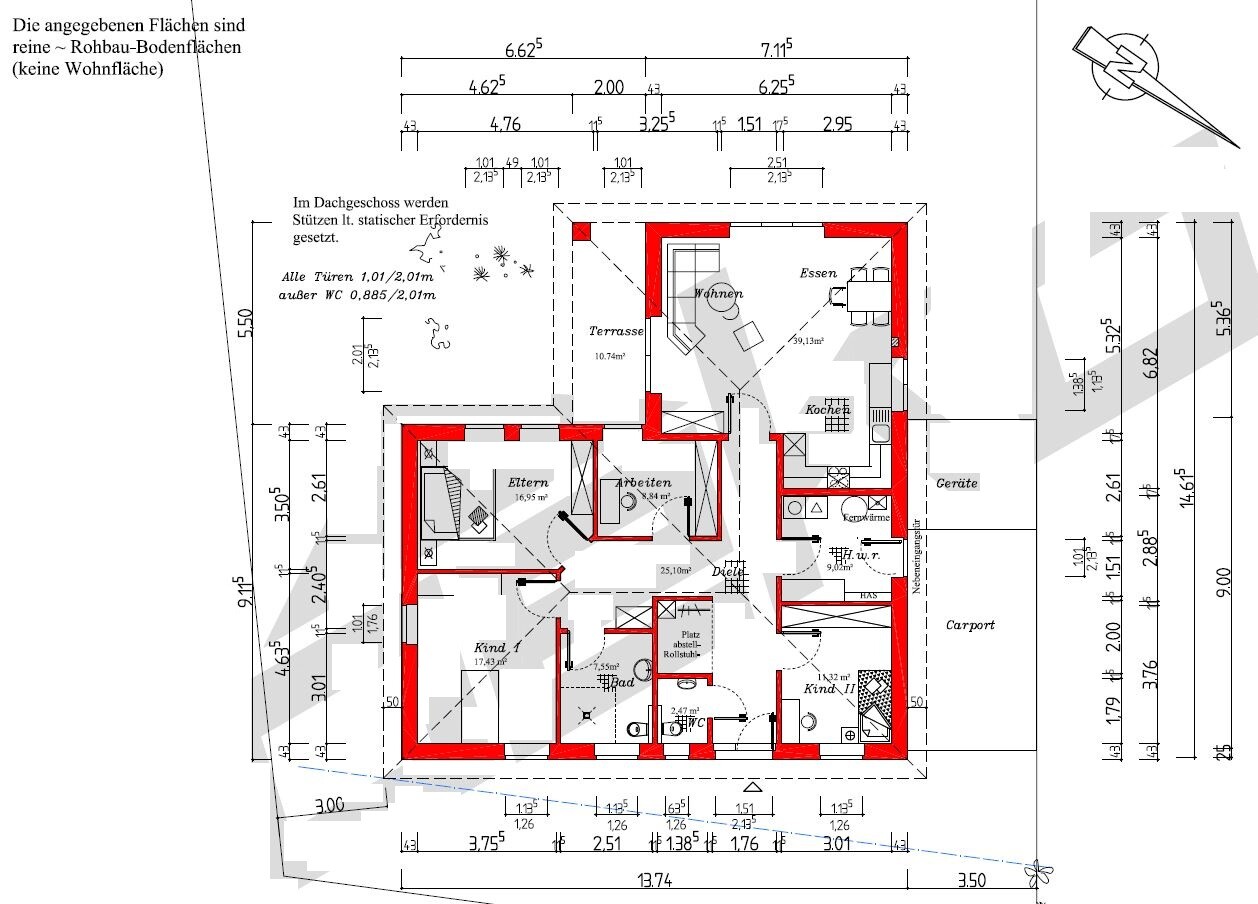

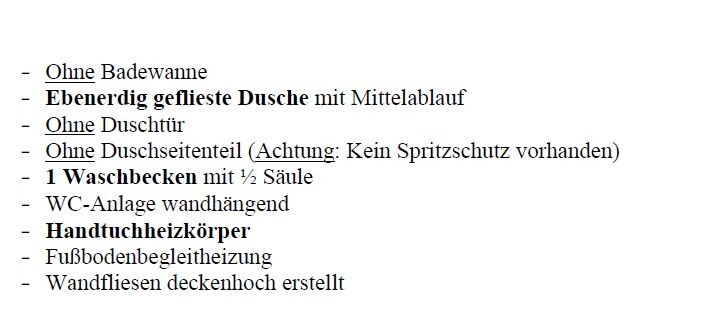
we have received a preliminary design and a quote from our builder. I would like to get your opinion on it.
It is planned as an accessible bungalow (about 131 sqm (1410 sq ft)) with 3 bedrooms and possibly a study room. Previously, instead of the study, there was a slightly larger kitchen and a somewhat bigger living room.
My opinion:
I would make the house a bit narrower on the street side, which would make the bedroom and child’s room 1 slightly smaller. Instead, the living room and kitchen would be extended, allowing the kitchen to be a bit larger (it currently feels too small to me).
On the other side, I have the option to make the carport a bit wider. I am trying to achieve an internal width of 3.5 m (11.5 ft) for the carport (because of wheelchair access).
I will also ask the builder what price difference it would make to have a concrete ceiling with insulation instead of a wooden beam ceiling, a knee wall height of maybe 30 cm (12 inches), and a roof pitch of 40 degrees, so that it would be possible to convert the attic space in the future (maybe after 25–30 years).
I would like to have a carport for two cars parked in tandem with a storage room planned, but I want to handle the construction myself or have it done elsewhere. The builder is asking €14,000 for a single carport with storage, which I think is too expensive.
We would really appreciate your suggestions.
Thank you
Nordlys schrieb:
One more thought. Our dream was originally an L-shaped house. That didn’t work out due to the budget. So now we live in a rectangular house. Since you usually spend most of your time inside rather than walking around the outside, I have to say it doesn’t make any difference from the inside whether it’s L-shaped or rectangular.We also initially considered a bungalow... The zoning plan required something different... Now I’m really glad to have an additional level: more options, more privacy (even for just one person), and living inside takes priority over “what might have been”… Everything is good, nice, great... what more could you want?
I am referring again to my post #156.
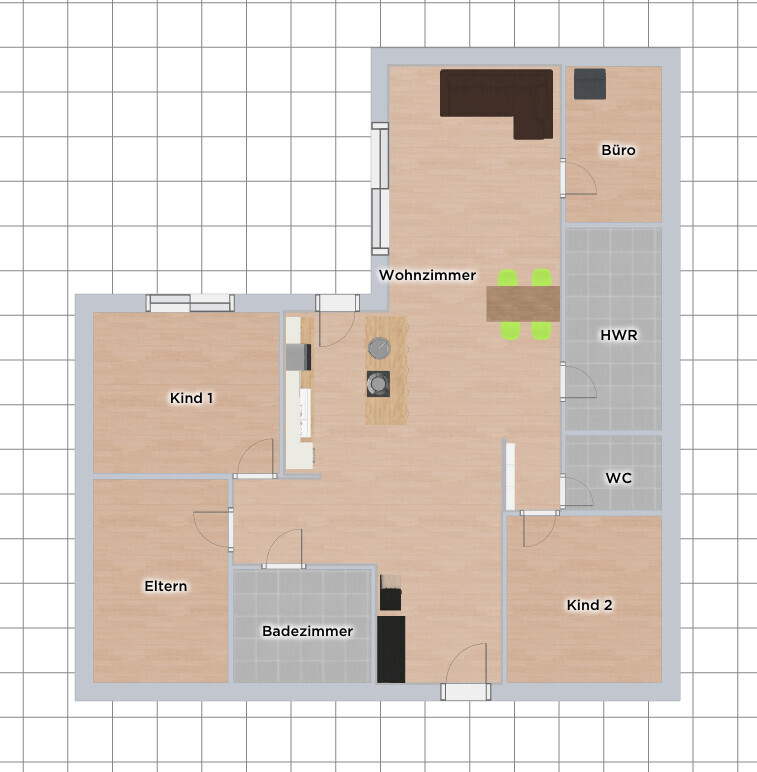
@zizzi I have redefined your angled bungalow: your exterior dimensions remain exactly the same, but with a floor plan that works better for me and is functional for your disabled child. Both options have the exact same dimensions!
1. However, I find that there is very little usable space here.
2.
There is an open living area and a private zone with a hallway that also includes a workspace.
The open kitchen has access to the large utility room and features a kitchen island, a cozy corner, and a dining area, with access to the terrace.
In the private area, there is also access to the terrace. Child 2 has the smaller bedroom here but would either have windows facing the terrace as a bonus, or the window could be placed on the end wall.
The guest WC could also accommodate a bathing option.
If you added 50cm (20 inches) to the depth of the plan, furnishing the children’s rooms would be easier. Child 2’s room currently has less than 3 meters (9 feet 10 inches) of room width.
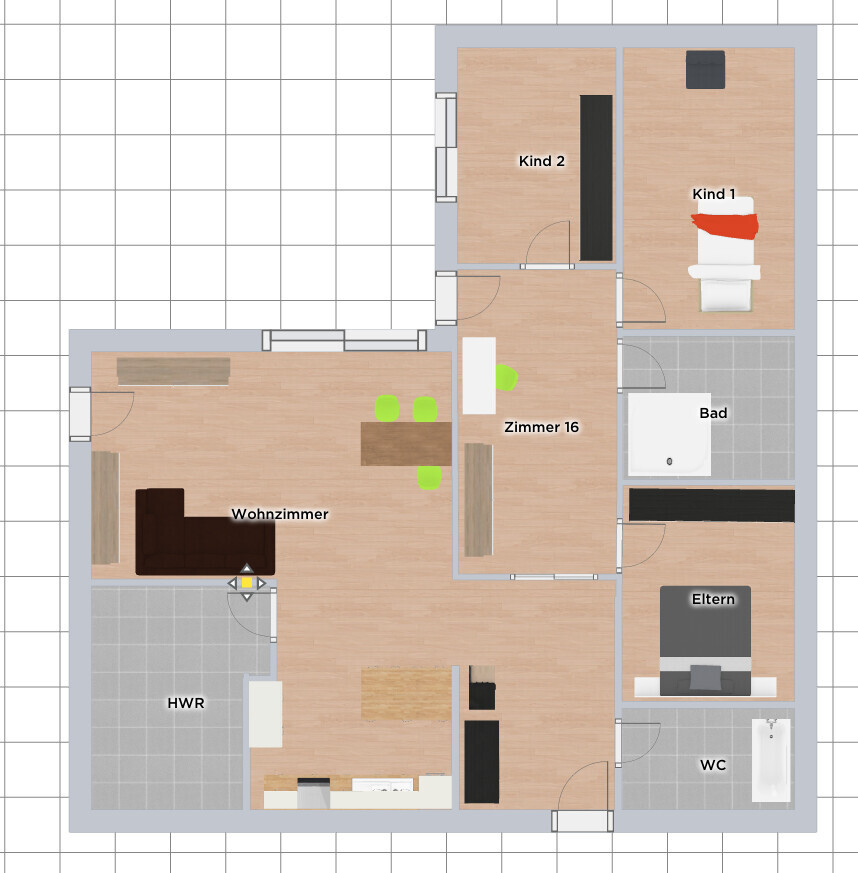
@zizzi I have redefined your angled bungalow: your exterior dimensions remain exactly the same, but with a floor plan that works better for me and is functional for your disabled child. Both options have the exact same dimensions!
1. However, I find that there is very little usable space here.
2.
There is an open living area and a private zone with a hallway that also includes a workspace.
The open kitchen has access to the large utility room and features a kitchen island, a cozy corner, and a dining area, with access to the terrace.
In the private area, there is also access to the terrace. Child 2 has the smaller bedroom here but would either have windows facing the terrace as a bonus, or the window could be placed on the end wall.
The guest WC could also accommodate a bathing option.
If you added 50cm (20 inches) to the depth of the plan, furnishing the children’s rooms would be easier. Child 2’s room currently has less than 3 meters (9 feet 10 inches) of room width.
W
winnetou7821 Oct 2017 20:12To be honest, when I see it like this, I understand again what these often criticized corridors are actually good for.
This is not meant in a negative way.
This is not meant in a negative way.
ypg schrieb:
I’m referring again to my #156
@zizzi I have redesigned your angled bungalow: your external dimensions with a layout that works better for me and suits your disabled child. Both options have exactly the same dimensions!
1. However, I’m bothered here by the limited usable space.
2.
There is an open living area and a private zone with a hallway that also includes a workspace.
Open kitchen with access to the large utility room and an island, cozy corner and dining area, access to the terrace.
In the private area there is also terrace access. Child 2 has the smaller room, but it still has windows facing the terrace as a bonus, or the window could be placed on the front side.
There would also be a bathing option in the guest toilet.
If you added 50cm (20 inches) to the plan at the top, the children’s rooms would be easier to furnish. Child 2 currently has less than 3 meters (10 feet) of room width.
ypg... thank you for your continued help and creativity.I have also sketched many plans on paper myself; there is somehow a flaw [emoji21]
Either the living room and kitchen work well but the bedrooms are awkward, or vice versa, and so on.
I think I am expecting too much; I want a bungalow that is bigger inside than outside. If I forgo the additional area (AZ), I can usually get a reasonable layout. Most likely all my expectations would be better realized on a slightly wider plot and a living area of 150-160 sq m (1,615-1,722 sq ft).
Now I have this plot available and 130-140 sq m (1,399-1,507 sq ft) is my option.
Yesterday, I discussed my expectations directly with the draftsman from the building company (until now, our contact person was an architect in the region to save trips to the headquarters) and I told her all the negative points mentioned so far (better spatial feeling in the kitchen, dining area and cozy corner – wheelchair parking – wardrobe – smooth hallway, etc.).
Let’s see what comes out now. [emoji7]
Make a list at last:
What absolutely must be included? (open hallways, sliding doors, etc.) Everything that is functionally necessary to make life easier for your son. Keep in mind that he might live with you for his entire life.
What would you like to have? Kitchen island, workspace nook, 3 children’s bedrooms, etc.
What is absolutely out of the question?
Then first create a floor plan that meets all the essential requirements. Only after that can you look at which nice-to-have features can still be incorporated.
You need to decide for yourselves: are you building the house primarily for yourselves or for your son? In your situation, you must make that decision. You cannot plan like other families do.
What absolutely must be included? (open hallways, sliding doors, etc.) Everything that is functionally necessary to make life easier for your son. Keep in mind that he might live with you for his entire life.
What would you like to have? Kitchen island, workspace nook, 3 children’s bedrooms, etc.
What is absolutely out of the question?
Then first create a floor plan that meets all the essential requirements. Only after that can you look at which nice-to-have features can still be incorporated.
You need to decide for yourselves: are you building the house primarily for yourselves or for your son? In your situation, you must make that decision. You cannot plan like other families do.
winnetou78 schrieb:
To be honest, when I see this, I realize again what these often criticized hallways are actually good for.
No offense intended.Maybe you should rather be grateful that you don’t have to build a house for a child with disabilities. Hallways can be very expensive.
@zizzi
Nowhere do I see, neither with @kbt09 nor myself, that anything is lacking or appears too small.
You dismiss the designs with generalizations as if you don’t even look at them but just immediately criticize them.
All designs are far better than those from your home builder, who simply turned a 1-meter-wide (3 ft 3 in) hallway into 1.5 meters (5 ft) and then called it accessible.
If our designs were poor or flawed, that would be worth mentioning. But you have to actually look at them first!
You complained to Kerstin that it wasn’t an L-shaped bungalow. Now it is an L-shaped bungalow with your home builder’s dimensions, and your comments are still not constructive.
Yes, it is difficult to accommodate your wishes or a family of four with disabilities on 135 m² (1,452 sq ft) — but it can be done. You just need to open your eyes and think flexibly. It doesn’t help if your family’s barriers translate into mental blocks.
Similar topics