
Hello everyone,
we have received a preliminary design and a quote from our builder. I would like to get your opinion on it.
It is planned as an accessible bungalow (about 131 sqm (1410 sq ft)) with 3 bedrooms and possibly a study room. Previously, instead of the study, there was a slightly larger kitchen and a somewhat bigger living room.
My opinion:
I would make the house a bit narrower on the street side, which would make the bedroom and child’s room 1 slightly smaller. Instead, the living room and kitchen would be extended, allowing the kitchen to be a bit larger (it currently feels too small to me).
On the other side, I have the option to make the carport a bit wider. I am trying to achieve an internal width of 3.5 m (11.5 ft) for the carport (because of wheelchair access).
I will also ask the builder what price difference it would make to have a concrete ceiling with insulation instead of a wooden beam ceiling, a knee wall height of maybe 30 cm (12 inches), and a roof pitch of 40 degrees, so that it would be possible to convert the attic space in the future (maybe after 25–30 years).
I would like to have a carport for two cars parked in tandem with a storage room planned, but I want to handle the construction myself or have it done elsewhere. The builder is asking €14,000 for a single carport with storage, which I think is too expensive.
We would really appreciate your suggestions.
Thank you
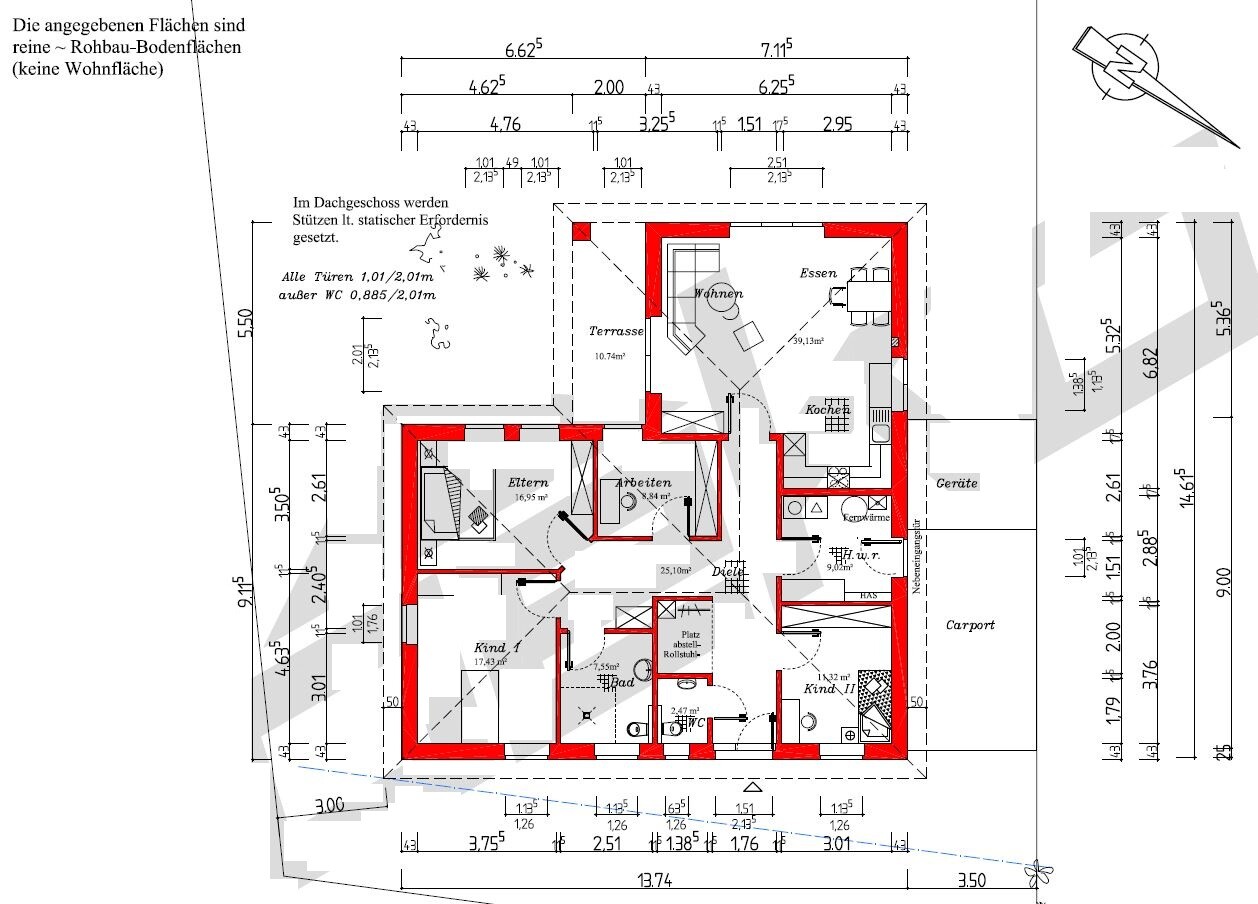

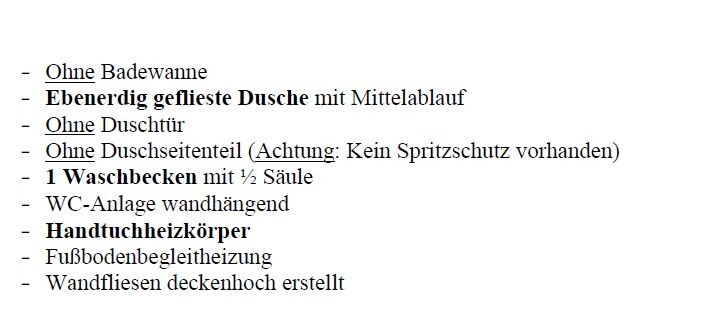
we have received a preliminary design and a quote from our builder. I would like to get your opinion on it.
It is planned as an accessible bungalow (about 131 sqm (1410 sq ft)) with 3 bedrooms and possibly a study room. Previously, instead of the study, there was a slightly larger kitchen and a somewhat bigger living room.
My opinion:
I would make the house a bit narrower on the street side, which would make the bedroom and child’s room 1 slightly smaller. Instead, the living room and kitchen would be extended, allowing the kitchen to be a bit larger (it currently feels too small to me).
On the other side, I have the option to make the carport a bit wider. I am trying to achieve an internal width of 3.5 m (11.5 ft) for the carport (because of wheelchair access).
I will also ask the builder what price difference it would make to have a concrete ceiling with insulation instead of a wooden beam ceiling, a knee wall height of maybe 30 cm (12 inches), and a roof pitch of 40 degrees, so that it would be possible to convert the attic space in the future (maybe after 25–30 years).
I would like to have a carport for two cars parked in tandem with a storage room planned, but I want to handle the construction myself or have it done elsewhere. The builder is asking €14,000 for a single carport with storage, which I think is too expensive.
We would really appreciate your suggestions.
Thank you
kbt09 schrieb:
Regarding the floor plan you like — here it is rotated so that north is at the top of the plan, like the other plans in post 141:
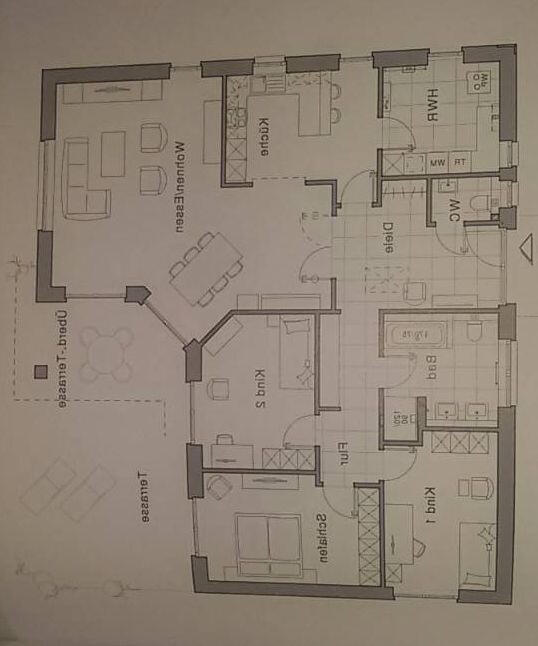
I’m afraid the house is even wider than 13.74 m (45 feet), so it won’t fit together with an accessible carport at all.
About the adjusted general contractor’s floor plan...
The living room looks worse and worse, and the furniture layout isn’t adapted at all.
Also, the new entrance situation creates unnecessary and obstructive corners in the accessible children’s room.
--------------------------
Why does it absolutely have to be an L-shaped bungalow? I think an L-shaped bungalow with around 130 sq m (1400 sq ft), 2 children’s rooms, 1 single bedroom, and 1 living room fits better, because every room should have a window, and a rectangular bungalow doesn’t have enough exterior walls.
zizzi schrieb:
I think a W-shaped bungalow with 130 sqm (1400 sq ft) and 2 bedrooms, 1 living room, and 1 dining area fits better, because every room should have a window, and with a rectangular bungalow there aren’t enough exterior walls.
I haven’t seen a rectangular bungalow where any room didn’t have a window, except for ones over 259 sqm (2790 sq ft), where sometimes a storage room has no window. You are focusing too much on the imperfect details. Of course, the conditions are not ideal, but the suggestions by Kerstin (@kbt09) make more sense and offer better quality of life than this angled bungalow in every respect. If you want a niche on the terrace, just add a privacy fence.

zizzi schrieb:
I think an L-shaped bungalow with 130 square meters (1400 square feet) and 2 children's bedrooms, 1 single bedroom, and 1 master bedroom fits better, because every room should have a window, and a rectangular bungalow doesn’t have enough exterior walls.
I have never heard or read a bigger nonsense...
How do you come to that? Most houses are rectangular, and usually, when they are detached, every room has its own window.
I’ll be a bit provocative now, but maybe it helps:
So far, the question of why it MUST be an L-shaped bungalow has not been answered.
Basically, there are no compelling reasons to choose that design—in fact, quite the opposite:
Every additional corner costs more. So: a rectangular bungalow with the same floor area is cheaper than an L-shaped bungalow. You can save even more by reducing the footprint and building two stories.
Especially if it is supposed to be an accessible, disability-friendly house, you should avoid every corner, every angle (and every wall that is not absolutely necessary). An L-shaped bungalow already has more corners than needed. Why insist on this house shape if the goal is accessibility?
In my opinion (and I am not alone here), kbt made a very good, practical suggestion. If I remember correctly, you never even addressed it. Anyway... I won’t go into it further. Instead, you came up with another variant of the suboptimal L-shaped bungalow.
I would say you are resistant to advice...
You also asked for opinions on the bungalow at Reha-Kids, so I know your son cannot control the wheelchair independently and likely will not be able to in the future. He might be able to operate it with some limitations, but he probably won’t become an experienced wheelchair user. This means: someone like him needs as straight and wide "driveways" as possible. Straight and L-shaped bungalows... well, be honest, they just don’t fit.
I’ll say it frankly: You have fixated on the L-shaped bungalow, it is your wish. Unfortunately, you have a disabled child, and now the dream house has to be adapted accordingly.
It will always be a compromise solution.
I am not blaming you for that, really not. People spend a lot of money on their own home and should be able to realize their dreams. But please be honest and say clearly: we want an L-shaped bungalow because we like it that way. We want the house designed as well as possible to be accessible.
That is okay. You are not only parents of a disabled child but also a couple with your own wishes and ideas, and you have every right to that.
But then kbt wouldn’t have needed to spend time developing a good suggestion that never had a chance anyway, because it’s not your dream house.
I would really wish that you make a clear statement here, because otherwise this becomes a farce.
Either you primarily want to build a house for your son; accessible and suitable for the next 20 years. Then say goodbye to the L-shaped bungalow and take a closer look at kbt’s design again.
Or be honest and say: we want an L-shaped bungalow because we like it so much. We want it to be adapted as best as possible to the needs of our disabled son—please help us with that.
That is a clear statement and completely fine, but then it is no longer a house with "accessible" as the top priority.

Climbee schrieb:
I have never heard or read a bigger nonsense... Nonsense, well, let’s say: simplistic reasoning. An L-shaped floor plan has more exterior walls compared to a rectangular floor plan, yes, and therefore more walls for windows, that’s clear. But every coin has two sides: where it results in greater building depth, it also leads to rooms that are not fully illuminated throughout their depth. Overall, it balances out, so the "principle advantage" is neutral.
What you definitely get "more" of with an L-shaped layout, however, is a more expensive roof. Often nearly double, especially if you want a hip roof for aesthetic reasons instead of a gable roof over a rectangular plan. A hip roof L-shape compared to a gable roof costs roughly as much more as the construction costs of the areas for the study and second child’s room — just to put it in perspective. You won’t recover that through DIY work on a carport.
https://www.instagram.com/11antgmxde/
https://www.linkedin.com/company/bauen-jetzt/
zizzi schrieb:
I think a W-shaped bungalow with 130 sqm (1400 sq ft) including 2 children's bedrooms, 1 single bedroom, and 1 master bedroom suits better, because every room should have a window, and with a rectangular bungalow there are not enough exterior walls. You can’t be serious – or can you? Show me the room in my rectangular design that doesn’t have a window.
I haven’t said much about this for a while. And the alternative design kbt is really okay. But I already understand that it has to be an L-shape. That’s fixed. I’m doing my own thing, no matter what others say. Lindenberg. Okay, I accept it and consciously take its disadvantages into account. Accessibility can also be achieved with the angle. However, it will definitely be more expensive. Of course, more expensive. What compromise are you aiming for? Affordable, L-shaped, accessible? A hipped roof—that won’t work. By the way, the house you photographed from a catalog looks quite good to me as well.
One more thought. Our dream was also an angled house at first. But that was sacrificed due to the budget. Now we live in a rectangular house. Since you mostly spend time inside rather than walking around it, I have to say, from the inside it makes no difference whether it’s L-shaped or rectangular.
Inside, it also doesn’t matter whether the windows are gray or not—you’re looking at the same garden, and gray doesn’t change that. Old Bauhaus principle: form follows function. Karsten
One more thought. Our dream was also an angled house at first. But that was sacrificed due to the budget. Now we live in a rectangular house. Since you mostly spend time inside rather than walking around it, I have to say, from the inside it makes no difference whether it’s L-shaped or rectangular.
Inside, it also doesn’t matter whether the windows are gray or not—you’re looking at the same garden, and gray doesn’t change that. Old Bauhaus principle: form follows function. Karsten
Similar topics