
ᐅ Floor plan for a detached single-family house with a gable roof, 1.5 stories – suggestions for improvements?
Created on: 17 Jul 2018 09:31
T
Tx-25
Hello. My partner and I are planning to build a house soon. This is the first draft from the planner at the construction company. The design was created based on our specifications (a hand-drawn sketch from us).
Gable roof, single-family house, no basement, 1.5 stories, currently 2 people in the household; later 3-4.
The terrace is planned to be adjacent to the kitchen and living area, mainly facing west. Do you think it would be better to have it facing south instead? Possibly wrap around the corner near the living area?
Our requirement was to have direct access from the garage/carport into the utility room, and from there directly into the kitchen.
- Is the size of the utility room sufficient? All the building services should be housed there. Additionally, the utility room should also serve as a kind of pantry. Laundry tasks will also be done there.
- What do you think about the downstairs bathroom? Showering directly in front of the window doesn’t seem ideal^^.
Gable roof, single-family house, no basement, 1.5 stories, currently 2 people in the household; later 3-4.
The terrace is planned to be adjacent to the kitchen and living area, mainly facing west. Do you think it would be better to have it facing south instead? Possibly wrap around the corner near the living area?
Our requirement was to have direct access from the garage/carport into the utility room, and from there directly into the kitchen.
- Is the size of the utility room sufficient? All the building services should be housed there. Additionally, the utility room should also serve as a kind of pantry. Laundry tasks will also be done there.
- What do you think about the downstairs bathroom? Showering directly in front of the window doesn’t seem ideal^^.

ypg schrieb:
that you have designed 130sqm (1400 sq ft) large children’s rooms in relation to the stairs, doors, and windows? I don’t see it as that problematic, more like stairs and doors indicated without scale. But it is interpretable for the contractor – after all, it’s clear enough for the original poster to feel understood by the designer and to recognize their drawing.
A layman’s drawing doesn’t need to be more than such a communication tool between the client and the designer.
https://www.instagram.com/11antgmxde/
https://www.linkedin.com/company/bauen-jetzt/
W
WilhelmRo20 Jul 2018 12:01Building a house is a serious matter.
@Tx-25, please try using "Sweet Home 3D" on Google, download it, and then design to scale:
- North is either at the top or clearly marked
- Exterior walls are 47cm (18.5 inches) thick
- Interior walls are 17cm (6.7 inches) thick
- Stairs are at least 110cm (43 inches) wide, have 15–16 steps, and each step is about 26cm (10 inches) deep
Attached is an example of how this could look. This is one of my ideas, but it is not tailored to the original poster, rather just an example for the program.
Regards
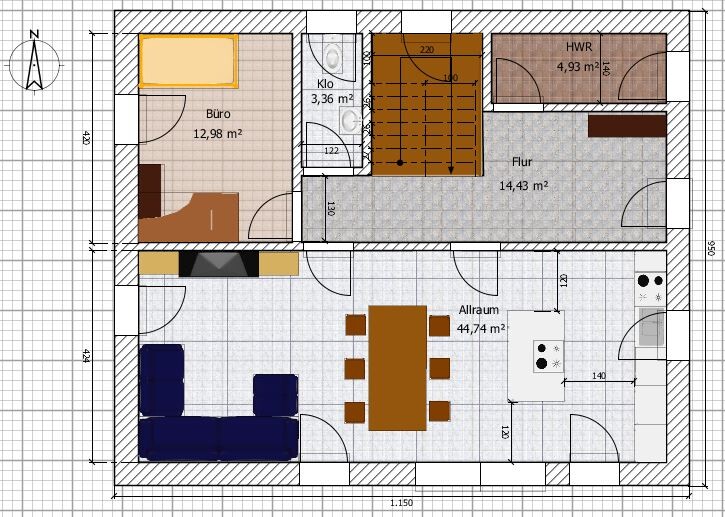
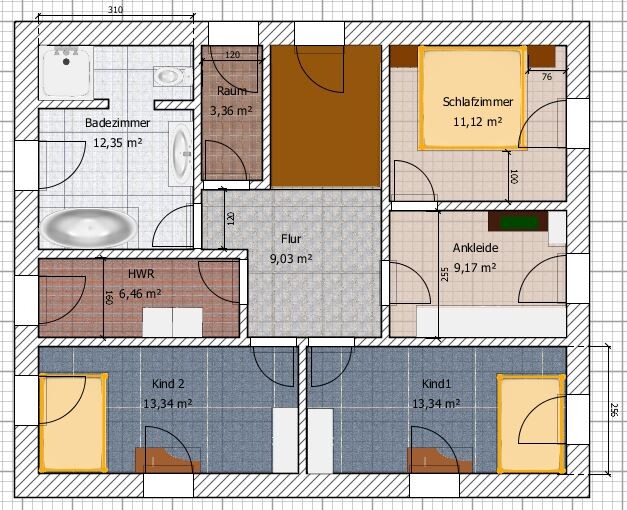
@Tx-25, please try using "Sweet Home 3D" on Google, download it, and then design to scale:
- North is either at the top or clearly marked
- Exterior walls are 47cm (18.5 inches) thick
- Interior walls are 17cm (6.7 inches) thick
- Stairs are at least 110cm (43 inches) wide, have 15–16 steps, and each step is about 26cm (10 inches) deep
Attached is an example of how this could look. This is one of my ideas, but it is not tailored to the original poster, rather just an example for the program.
Regards
WilhelmRo schrieb:
Building a house is a serious matter. In this context, it actually seems illogical to encourage a layperson to use planning software: with a hand drawing, it’s much easier for a professional to quickly recognize when the amateur planner is still a bit clumsy. Your drawings are a good example that using such software doesn’t necessarily promote a better understanding of design: your measurements are all over the place. Moreover, these programs carry the "risk" that the result appears too early as "professional" and successful—simply because of the high factor of perceived reality added through color, "precise" symbols (and possibly even 3D) in the presentation.
The worst designs (with dressing rooms where you pinch your fingers when opening the wardrobe doors, and toilets you have to back into from the door) look in clicky-colored virtual reality like only the official stamp is missing for the building permit / planning permission.
In my opinion, such advice does not do future homeowners any favors.
For the architect meeting, it is much more valuable if the client does not try to appear as a "colleague," but is happy to express themselves as a layperson, even with gestures and simple explanations. And please don’t use technical terms they don’t fully understand yet.
https://www.instagram.com/11antgmxde/
https://www.linkedin.com/company/bauen-jetzt/
W
WilhelmRo20 Jul 2018 12:5911ant schrieb:
So it’s actually illogical to encourage a layperson to use planning software: with a hand drawing, a professional can much more easily recognize when the layperson, acting as the planner, is still unsure. So basically you’re saying there shouldn’t be any threads titled like “What do you think of my floor plan?”
You would comment under every floor plan: “Go to an architect!”
Of course, a draft isn’t finished; the architect still needs to review it, but paper walls and dashed staircases don’t help either.
The software isn’t supposed to pretend professionalism; it’s meant to help visualize the whole thing.
11ant schrieb:
with walk-in closets where you pinch your fingers opening the wardrobe doors, and toilets that you have to back into from the door And that’s exactly what the program is for — so I can adjust the door orientation now without needing an “eraser.” (It’s great that these are the only small issues you found; I take that as a compliment that you didn’t find anything else except doors whose orientation can be very easily changed : )
Glad your thread is just about dismissing my post, I’m at least trying to help the original poster ; )

No, the elephant recommends sticking with pencil, graph paper, and an eraser, and I agree with him on that. You can cut out doors and other fixed elements or furniture to scale (with graph paper, a practical scale is 2 squares per real meter) and “populate” an otherwise blank floor plan, moving these pieces around easily.
At some point, I also experimented with Sweet Home, but I spent much more time accurately inputting my designs than on the actual planning and developing process. By that stage, my designs were already quite advanced, and I just wanted to see everything in 3D. It’s a nice little tool for that. Most architects use far superior software that produces more polished images (we just happened to have someone from the old school), but that’s mostly a luxury, not a necessity. Also, with Sweet Home, I noticed you have to be very careful about the sizes of individual elements provided there (doors, windows, toilets, sinks, etc.). Usually, they come only in the smallest possible version (if I remember correctly, a double bed defaults to 160cm (63 inches)). This means all elements must be adjusted accordingly, which most people don’t notice because the fiddling with the software already demands enough attention. Then you’re surprised when the design looks nice and practical visually, but you’re told: That won’t actually work! For example, if the toilet is too small, the guest bathroom on the plan looks perfectly sized. But using realistic measurements, you can only get to the toilet by climbing over it, and so on. The perfect views cause you to lose sight of the real proportions.
I’m completely on the elephant’s side: to get a feel for size and layout, the old-fashioned method with pencil and graph paper is unbeatable. For those who want something a bit more convenient and don’t want to redraw the entire floor plan for every small change, they can get a roll of tracing paper. You place it over the latest draft and can experiment with changes until it’s worth drawing a new version again.
At some point, I also experimented with Sweet Home, but I spent much more time accurately inputting my designs than on the actual planning and developing process. By that stage, my designs were already quite advanced, and I just wanted to see everything in 3D. It’s a nice little tool for that. Most architects use far superior software that produces more polished images (we just happened to have someone from the old school), but that’s mostly a luxury, not a necessity. Also, with Sweet Home, I noticed you have to be very careful about the sizes of individual elements provided there (doors, windows, toilets, sinks, etc.). Usually, they come only in the smallest possible version (if I remember correctly, a double bed defaults to 160cm (63 inches)). This means all elements must be adjusted accordingly, which most people don’t notice because the fiddling with the software already demands enough attention. Then you’re surprised when the design looks nice and practical visually, but you’re told: That won’t actually work! For example, if the toilet is too small, the guest bathroom on the plan looks perfectly sized. But using realistic measurements, you can only get to the toilet by climbing over it, and so on. The perfect views cause you to lose sight of the real proportions.
I’m completely on the elephant’s side: to get a feel for size and layout, the old-fashioned method with pencil and graph paper is unbeatable. For those who want something a bit more convenient and don’t want to redraw the entire floor plan for every small change, they can get a roll of tracing paper. You place it over the latest draft and can experiment with changes until it’s worth drawing a new version again.

Similar topics