
ᐅ Single-family house floor plan, slight hillside location, northwest orientation
Created on: 23 May 2025 18:30
K
kronos215
Hello everyone,
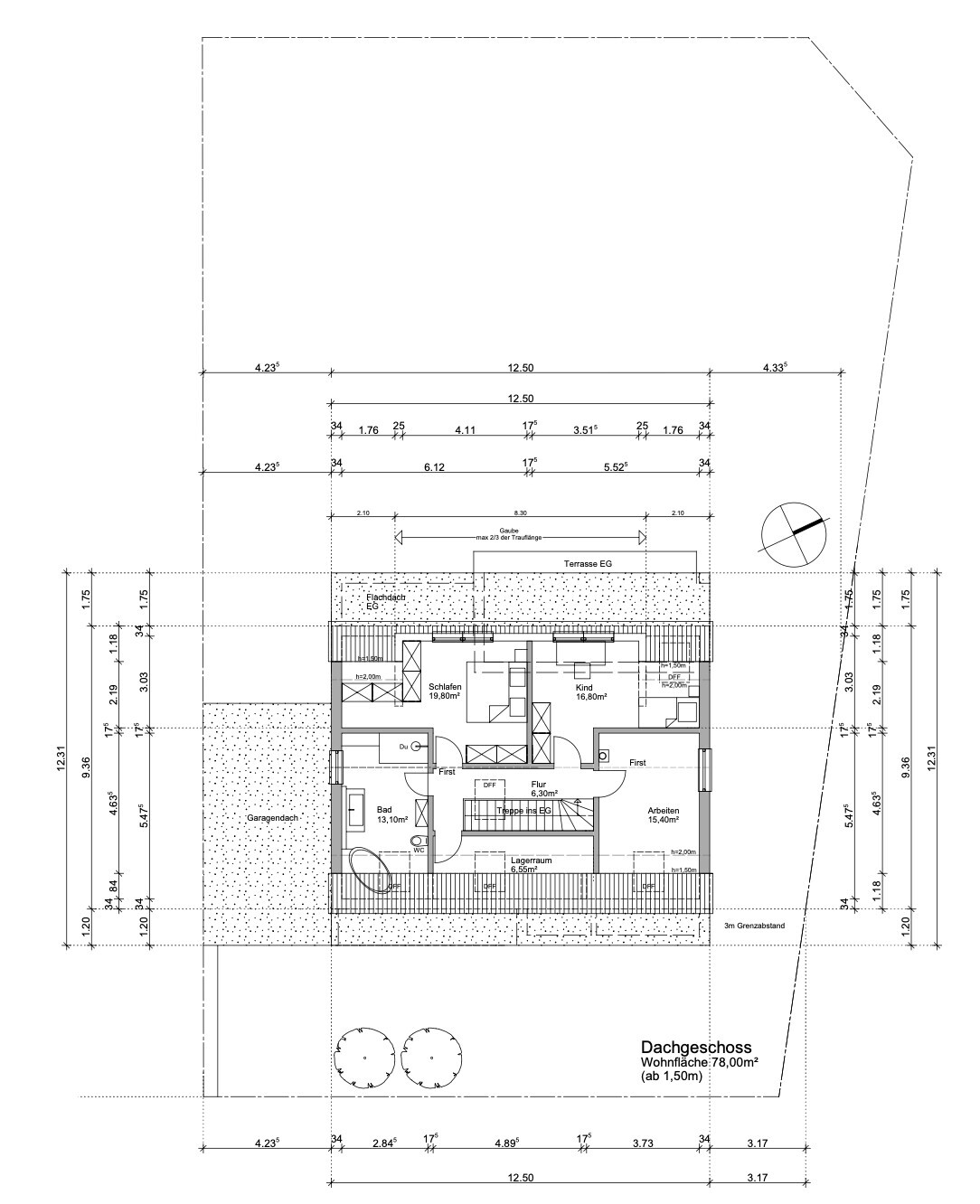
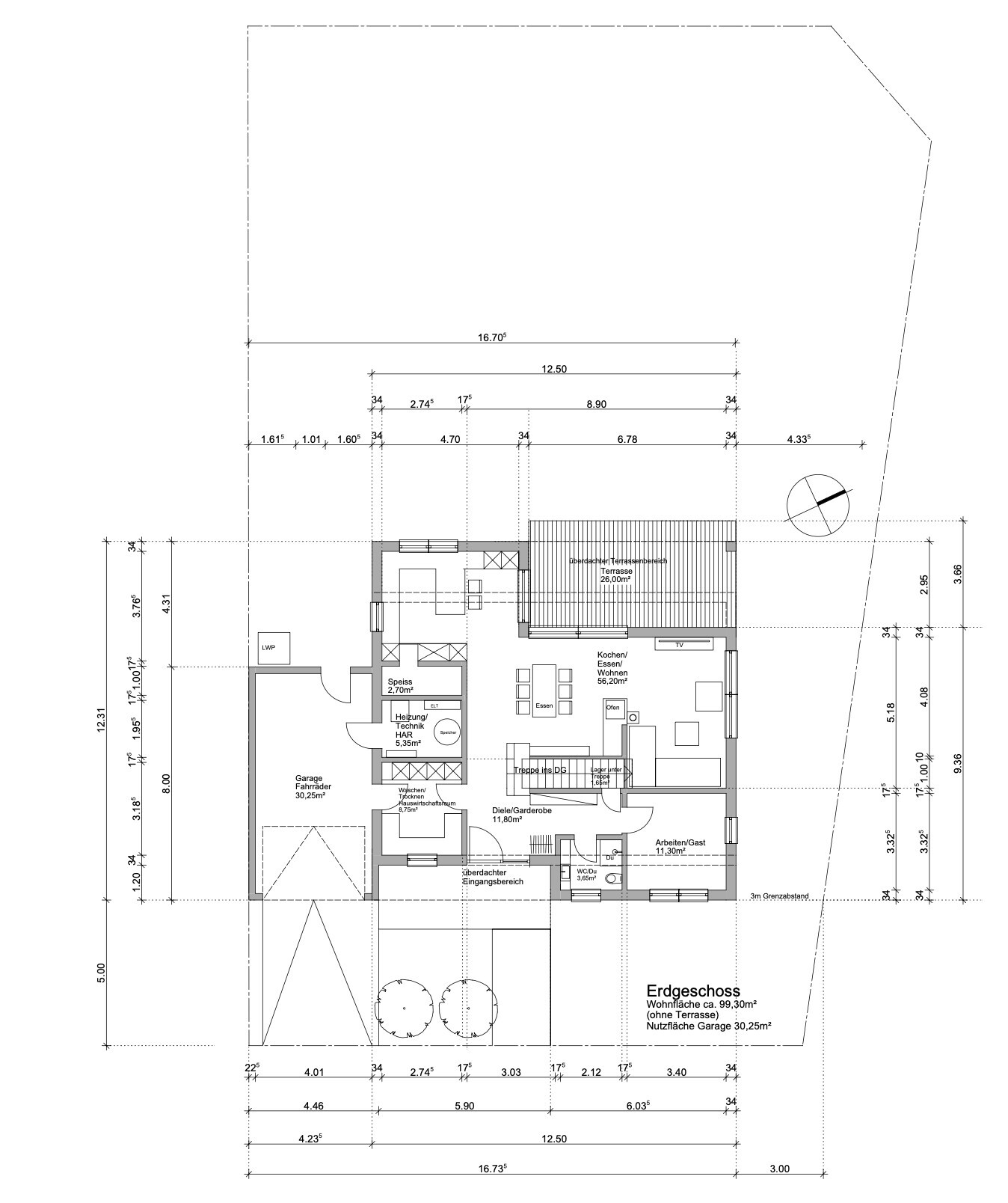
We have almost finalized our planning with the architect and would appreciate you taking a critical look at the floor plan. Afterwards, we plan to proceed with the tendering process.
We generally like the ground floor (GF) very much. However, we are considering flipping the house and making some changes to the upper floor (UF). The garage, utility room, and technical room would move to the right, and the entire house would be shifted closer to the neighbor’s hedge on the left side (3m (10 feet) distance). The living room would then be on the left. It’s unclear whether the view of the neighbor’s hedge at a 3m (10 feet) distance will be nicer. On the positive side, the house would be better oriented towards the south and would let in more sunlight. The kitchen would then be on the right, providing wind protection from the open field while still allowing sunlight to reach the terrace.
Corner plot, one neighbor on the left, fields to the back and right
Ground floor area: 99m2 (without terrace), garage 30m2
Upper floor area: 78m2 (from 1.5m (5 feet))
Development Plan / Restrictions
Plot size
approx. 750m2
Slope
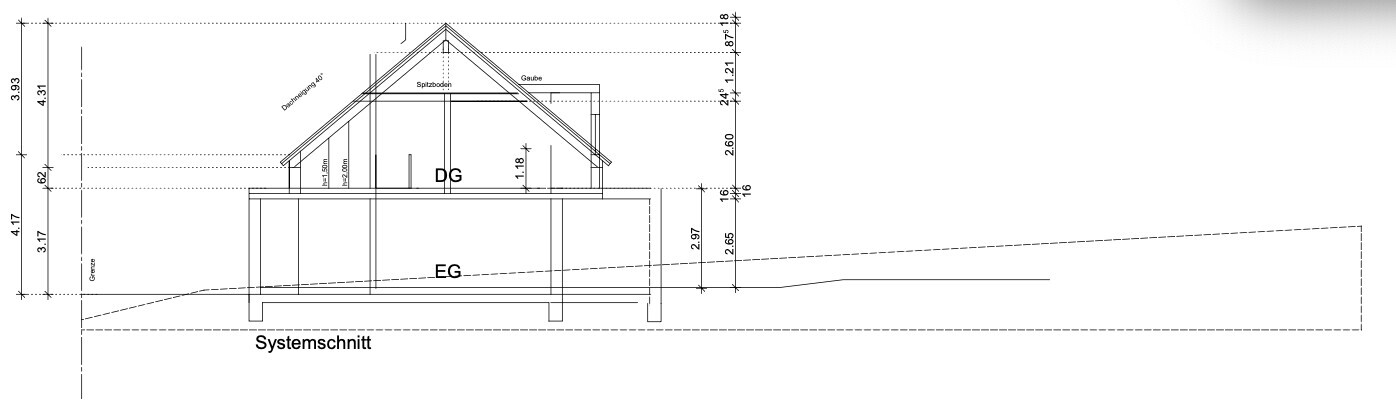
Yes, uphill on the mountain side. There is a manhole cover on the street in front of the plot and one behind it. The elevation difference between the covers is about 3m. The plot initially rises about 1m (3 feet) above the sidewalk and
Edge development
Yes, it’s a corner plot. There is a neighbor on the left side. Behind the house and to the right is a field path and fields.
Number of parking spaces
The adjacent street should provide sufficient parking spaces. A garage is also planned.
Number of stories
According to the development plan, 1.5-story houses are permitted.
Roof type
According to the development plan, only gable roofs are allowed.
Orientation
Northwest
Maximum heights / limits
According to the development plan, the house must be built exactly in this alignment
Requirements of the homeowners
Style, roof shape, building type
Country house style, gable roof (eaves facing the street), single-family home
Basement, number of floors
A basement was initially planned but was dropped due to budget. 1.5 floors are allowed and planned as per the development plan.
Number of occupants, age
Two adults, early 30s, no children yet but a child’s room is planned
Space requirements on GF, UF
GF: Garage, entrance hall, office 1, kitchen, living room, dining room, pantry, technical room, utility room, guest bathroom with shower
UF: Bedroom, child’s room, office 2, bathroom, storage room (planned due to no basement)
Office: family use or home office?
Both offices are currently needed for work.
Overnight guests per year
Very rarely or none
According to the development plan, 1.5-story houses are allowed
Somewhat open
Conservative or modern construction
Modern (?)
Open kitchen, cooking island
Open kitchen planned, cooking island desired but dropped due to space constraints
Number of dining seats
6, preferably expandable to 10
Fireplace
Desired and planned as a partition between dining and living room
Music / stereo wall
Desired; a niche in the living room works well for this
Balcony, roof terrace
Desired but dropped for budget reasons
Garage, carport
Planned; it is questionable whether the garage should instead be located on the right to avoid blocking the south side.
House design
Who is responsible for the design?
Architect
What do you particularly like? Why?
The open living and dining area. The open view of the fields.
The dormer on the upper floor.
What do you dislike? Why?
The corridor on the upper floor feels dark. Many skylights are planned (knee wall 80cm (31 inches) per development plan, gable roof with eaves facing the street).
The ground floor might also be dark. The garage is located on the south side. The windows facing the fields are towards the northeast.
Skylights block the option for photovoltaic panels and the attic space.
The storage room feels out of place.
Since a basement was initially planned, a hobby room was also considered, but this has been dropped.
The master bed is directly adjacent to the child’s room, but the bedroom must remain there.
Price estimate according to architect:
€540,000 (we find this optimistic; we expect higher costs and would thus like to make the floor plan more compact)
Personal price limit for house including fixtures and fittings:
€550,000 (all-in)
Preferred heating technology:
Heat pump
If you had to give up something, which details / expansions
-you could give up: a two-story open space was planned but removed, storage room on the upper floor (is it really necessary?), the GF could generally be smaller to save costs
-you cannot give up: large windows on the GF, open living-dining area, access to the house via garage and utility room, fireplace, pantry
Why has the design turned out this way?E.g.
Which wishes were implemented by the architect? The architect implemented the room concept well and incorporated many of his own ideas that we mostly find coherent.
What do you consider particularly good or bad about it? We like the ground floor very much; there is still potential for changes on the upper floor. We would also like another dormer above the entrance door, but this does not seem possible due to the development plan (the upper floor would become a full story if too much area is covered by dormers). The study could then be where the storage room currently is. The storage room could become a combined storage and hobby room.
We are grateful for any input and suggestions. We are particularly concerned about the south orientation. We do not want the rooms to become too dark.
We have almost finalized our planning with the architect and would appreciate you taking a critical look at the floor plan. Afterwards, we plan to proceed with the tendering process.
We generally like the ground floor (GF) very much. However, we are considering flipping the house and making some changes to the upper floor (UF). The garage, utility room, and technical room would move to the right, and the entire house would be shifted closer to the neighbor’s hedge on the left side (3m (10 feet) distance). The living room would then be on the left. It’s unclear whether the view of the neighbor’s hedge at a 3m (10 feet) distance will be nicer. On the positive side, the house would be better oriented towards the south and would let in more sunlight. The kitchen would then be on the right, providing wind protection from the open field while still allowing sunlight to reach the terrace.
Corner plot, one neighbor on the left, fields to the back and right
Ground floor area: 99m2 (without terrace), garage 30m2
Upper floor area: 78m2 (from 1.5m (5 feet))
Development Plan / Restrictions
Plot size
approx. 750m2
Slope
Yes, uphill on the mountain side. There is a manhole cover on the street in front of the plot and one behind it. The elevation difference between the covers is about 3m. The plot initially rises about 1m (3 feet) above the sidewalk and
Edge development
Yes, it’s a corner plot. There is a neighbor on the left side. Behind the house and to the right is a field path and fields.
Number of parking spaces
The adjacent street should provide sufficient parking spaces. A garage is also planned.
Number of stories
According to the development plan, 1.5-story houses are permitted.
Roof type
According to the development plan, only gable roofs are allowed.
Orientation
Northwest
Maximum heights / limits
According to the development plan, the house must be built exactly in this alignment
Requirements of the homeowners
Style, roof shape, building type
Country house style, gable roof (eaves facing the street), single-family home
Basement, number of floors
A basement was initially planned but was dropped due to budget. 1.5 floors are allowed and planned as per the development plan.
Number of occupants, age
Two adults, early 30s, no children yet but a child’s room is planned
Space requirements on GF, UF
GF: Garage, entrance hall, office 1, kitchen, living room, dining room, pantry, technical room, utility room, guest bathroom with shower
UF: Bedroom, child’s room, office 2, bathroom, storage room (planned due to no basement)
Office: family use or home office?
Both offices are currently needed for work.
Overnight guests per year
Very rarely or none
According to the development plan, 1.5-story houses are allowed
Somewhat open
Conservative or modern construction
Modern (?)
Open kitchen, cooking island
Open kitchen planned, cooking island desired but dropped due to space constraints
Number of dining seats
6, preferably expandable to 10
Fireplace
Desired and planned as a partition between dining and living room
Music / stereo wall
Desired; a niche in the living room works well for this
Balcony, roof terrace
Desired but dropped for budget reasons
Garage, carport
Planned; it is questionable whether the garage should instead be located on the right to avoid blocking the south side.
House design
Who is responsible for the design?
Architect
What do you particularly like? Why?
The open living and dining area. The open view of the fields.
The dormer on the upper floor.
What do you dislike? Why?
The corridor on the upper floor feels dark. Many skylights are planned (knee wall 80cm (31 inches) per development plan, gable roof with eaves facing the street).
The ground floor might also be dark. The garage is located on the south side. The windows facing the fields are towards the northeast.
Skylights block the option for photovoltaic panels and the attic space.
The storage room feels out of place.
Since a basement was initially planned, a hobby room was also considered, but this has been dropped.
The master bed is directly adjacent to the child’s room, but the bedroom must remain there.
Price estimate according to architect:
€540,000 (we find this optimistic; we expect higher costs and would thus like to make the floor plan more compact)
Personal price limit for house including fixtures and fittings:
€550,000 (all-in)
Preferred heating technology:
Heat pump
If you had to give up something, which details / expansions
-you could give up: a two-story open space was planned but removed, storage room on the upper floor (is it really necessary?), the GF could generally be smaller to save costs
-you cannot give up: large windows on the GF, open living-dining area, access to the house via garage and utility room, fireplace, pantry
Why has the design turned out this way?E.g.
Which wishes were implemented by the architect? The architect implemented the room concept well and incorporated many of his own ideas that we mostly find coherent.
What do you consider particularly good or bad about it? We like the ground floor very much; there is still potential for changes on the upper floor. We would also like another dormer above the entrance door, but this does not seem possible due to the development plan (the upper floor would become a full story if too much area is covered by dormers). The study could then be where the storage room currently is. The storage room could become a combined storage and hobby room.
We are grateful for any input and suggestions. We are particularly concerned about the south orientation. We do not want the rooms to become too dark.
kronos215 schrieb:
On the same page, 128 sqm (1380 sq ft) is also mentioned. I wonder where this number comes from. Yes, I saw that. I assume the 128 comes from using smaller sand-lime bricks. The house apparently belongs to a semi-detached series; the 154 model is a custom house, possibly calculated using the 160 or 180 sand-lime bricks. Or maybe they meant 228 including the basement, but I doubt that because basements are always calculated separately.
You can install a built-in wardrobe, but it’s not worth it in a room where you can only stand at the very front.

kronos215 schrieb:
The plot has an elevation difference of 3m (10 feet) over 35m (115 feet). I think a basement makes sense in this case.If the slope is reasonably even, then yes and no: having the basement 1m (3 feet) below the house footprint means the basement costs are split 50/50 between the “construction” cost center and the “avoided alternative measures” cost center.https://www.instagram.com/11antgmxde/
https://www.linkedin.com/company/bauen-jetzt/
K
kronos21527 May 2025 07:4911ant schrieb:
If reasonably even, then yes and no: 1m (3.3 ft) below the house footprint, it would be 50/50 pro/con basement, meaning half of the basement costs are allocated to the cost centers "construction" and "avoided alternative measures." Regarding the topography: the plot slopes steeply up about 1m (3.3 ft) from the sidewalk, then rises evenly by the remaining 2m (6.6 ft) in elevation towards the back of the property. The house will be positioned starting 5m (16.4 ft) from the sidewalk, so it will stand at approximately 1.5m (4.9 ft) elevation difference. The neighboring buildings are consistently at least partially basemented. However, during a brief onsite meeting in the suburb, the architect stated that a basement is not strictly necessary (also considering budget constraints).
The description of the slope of the site sounds to me like an invitation to include a basement, for example for a home office, guest room, and similar uses. And 1.5 m (5 feet) is, especially from a budget perspective, a 75% vote in favor of a basement.
https://www.instagram.com/11antgmxde/
https://www.linkedin.com/company/bauen-jetzt/
https://www.instagram.com/11antgmxde/
https://www.linkedin.com/company/bauen-jetzt/
K
kronos21525 Jun 2025 11:14After some time, I had the opportunity to roughly measure the slope of the land myself and would like your assessment regarding the implementation of a basement.
Here is a summary of the key data:
So within the building zone, we have a maximum land slope of about 70cm (28 inches), depending on the house’s depth. A building technician once informed me that installing a basement is worthwhile once the house is built on a 1m (3 feet) elevation difference. What is your assessment of the topography?
It is important to us to have as level access as possible from the terrace to the garden or down a staircase. We want to avoid having to retain the soil or sitting on a terrace below ground level—especially since the neighbors’ plots are considerably higher.
Here is a summary of the key data:
- Building zone begins 5m (16 feet) from the street
- A 1m (3 feet) slope is reached 7.5m (25 feet) from the street
- From the building zone (5m), the slope rises 50cm (20 inches) within the first 7m (23 feet)
- From the building zone (5m), the slope rises 20cm (8 inches) within the first 4m (13 feet)
- Plot depth is 35m (115 feet) in total
- Elevation difference from the street to the end of the plot is 3m (10 feet)
- Slope from the building zone is approximately linear
- The house will be about 10m (33 feet) deep from the building zone
- The plot continuously slopes upwards from the driveway at the street; it is a hillside plot
So within the building zone, we have a maximum land slope of about 70cm (28 inches), depending on the house’s depth. A building technician once informed me that installing a basement is worthwhile once the house is built on a 1m (3 feet) elevation difference. What is your assessment of the topography?
It is important to us to have as level access as possible from the terrace to the garden or down a staircase. We want to avoid having to retain the soil or sitting on a terrace below ground level—especially since the neighbors’ plots are considerably higher.
The love handles don’t care whether the neighbors saw the cream on the cake. My assessment here, rather in favor of a basement, has been confirmed. Does the terrain only slope downwards, meaning horizontally straight on the side?
On the terrace, keeping my feet dry is the main priority. Whoever shapes the terrain takes on the responsibility of proper drainage.
https://www.instagram.com/11antgmxde/
https://www.linkedin.com/company/bauen-jetzt/
On the terrace, keeping my feet dry is the main priority. Whoever shapes the terrain takes on the responsibility of proper drainage.
https://www.instagram.com/11antgmxde/
https://www.linkedin.com/company/bauen-jetzt/
Similar topics