
ᐅ Floor plan for a single-family house, 14 by 14 meters, with a limited ridge height
Created on: 6 May 2025 19:07
T
tempusfugit
Hello everyone,
a bit different and certainly very straightforward – here is our floor plan. The plot is in Brandenburg, just under 1,000 m² (10,764 sq ft). The zoning plan specifies a maximum ridge height at 34 meters above NHN (Normalhöhennull, standard elevation). The manhole cover on the street is approximately at 28.30 meters above NHN. The neighboring plot next door is accessible via a separate street (Pr).
The house itself will be built with a steel frame and prefabricated elements. The roof will be made of sandwich panels (Kingspan/Hoffmann) with a U-value of 0.15 and will be covered with solar panels (K2) on the southern side. This should hopefully reduce the sound of rain and also limit heat buildup somewhat.
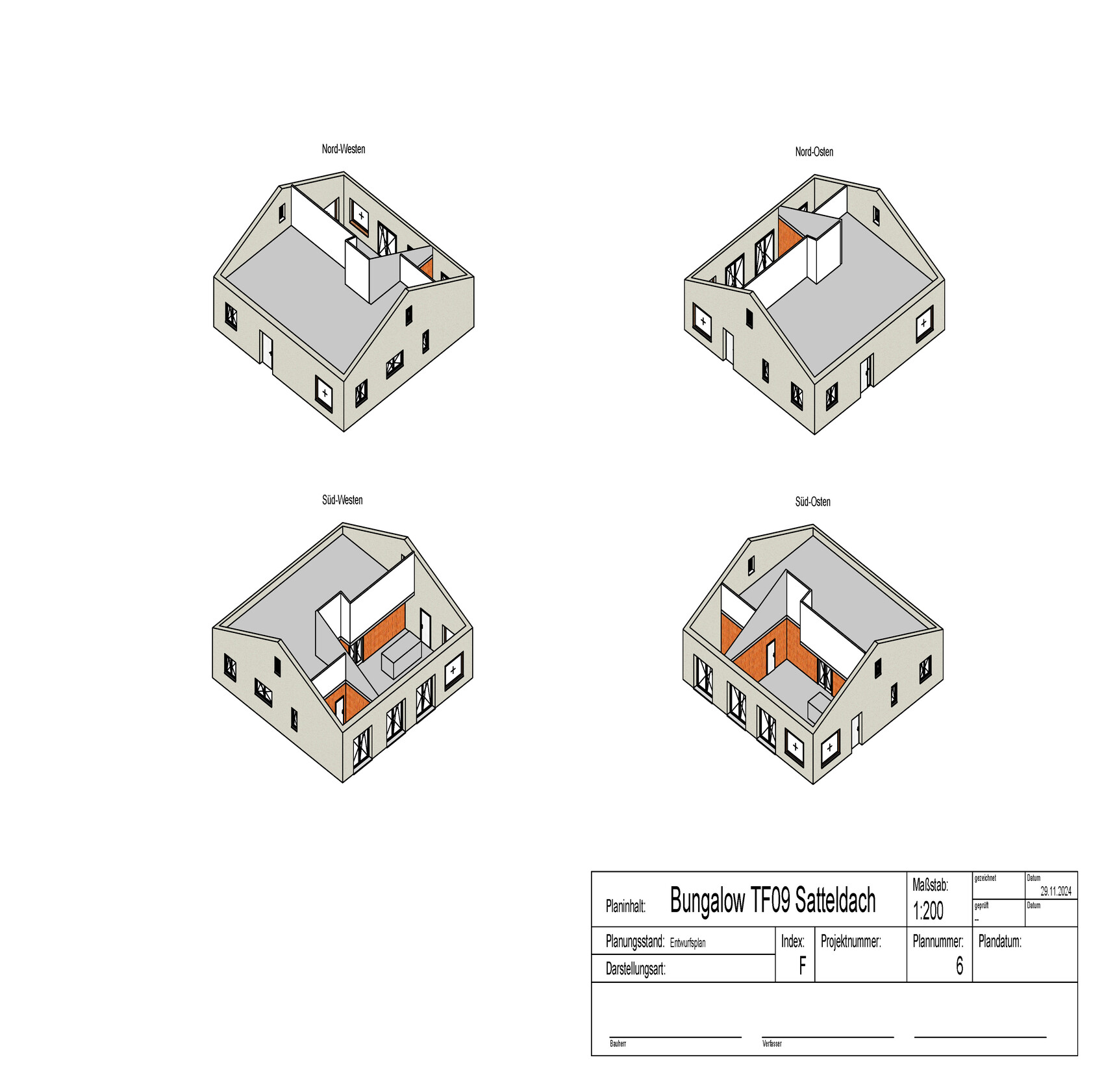
There will be a gallery, which, due to limited height, will probably serve more as storage. Possibly, at least one area with 2 m (6 ft 7 in) height could work (finished ceiling height approximately 28.5 m = 5.5 m possible ridge height; 2.8 m (9 ft 2 in) ground floor; 0.2 m (8 in) ceiling; the rest 2 m (6 ft 7 in) up to the ridge). We still need to discuss this further with the surveyor and architect to see what is feasible. Depending on that, the gallery will either be open with a railing or closed off. We still want a “proper” staircase though.
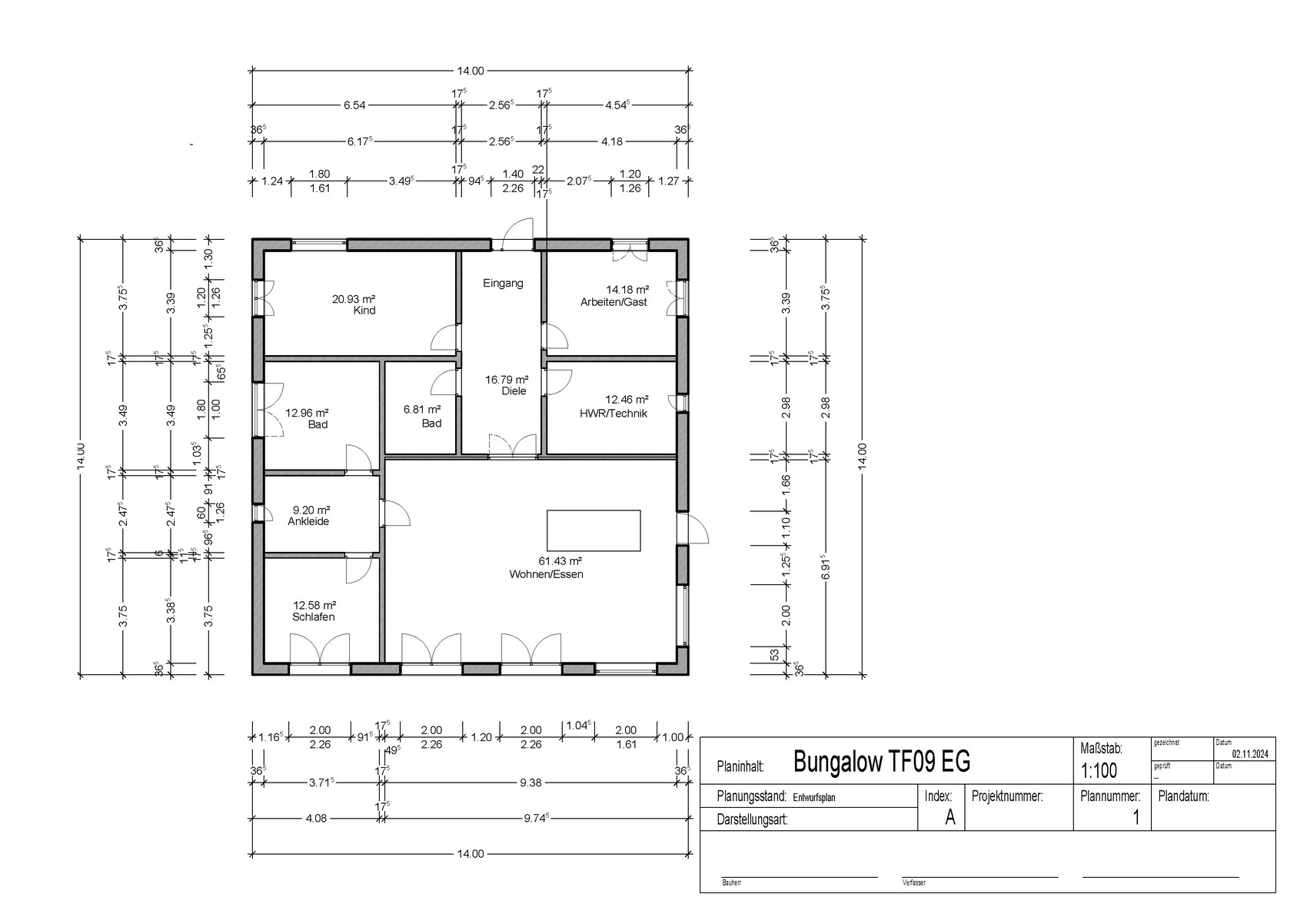
The floor plan is quite pragmatic – the bathrooms present some challenges. One has no window, and the other is square.
Zoning plan / restrictions
Plot size: approx. 1,000 m² (10,764 sq ft)
Slope: No (approx. 10 cm (4 in) drop over 40 meters)
Floor area ratio: 0.4
Plot ratio: 1 (+ gallery level)
Building envelope, setback lines: 15 x 15 m (49 x 49 ft), 3 m (10 ft) to neighboring plot, 6 m (20 ft) to street (cul-de-sac)
Edge development: Last house on the street
Number of parking spaces: 2
Number of floors: 1.5
Roof type: Gable roof, minimum 20° slope
Style: Does not matter
Orientation: South
Maximum height limits: Approx. 5.5 m (18 ft) ridge height
Homeowner requirements
Style, roof type, building type: Single-family house / bungalow
Basement, floors: No basement, ground floor + gallery level/storage space
Number and age of occupants: 3 (ages 49, 49, 14)
Room needs on ground/floor level: Living/kitchen, bedroom, child’s room, utility room, office, master bathroom, guest/teen bathroom, walk-in closet
Office: Family use and home office? Both
Guest stays per year: Weekends
Open or closed architecture: Open
Conservative or modern build: Modern
Open kitchen, kitchen island: Yes
Number of dining seats: Corner bench/table, max 6-8
Fireplace: Probably not (no suitable place, cost) — if anyone has tips for an affordable fireplace, please share
Music/stereo wall: No
Balcony, roof terrace: No
Garage, carport: No, cars (2) will probably park on the east side of the building (with charging station) or below the turning circle
Utility garden, greenhouse: No
House design
Design origin: Do-it-yourself
What we like most and why?
Affordable, no structural challenges due to steel frame construction with large-panel wall elements, wooden stud partition walls, trapezoidal profile roof panels with insulating core, structural flexibility
What we dislike and why?
Guest bathroom has no window, master bathroom is tricky because it is square, likely limited height in the attic due to gable roof and max ridge height limit (34 m above NHN compared to 28.2 m above NHN street level), difficult to find space for fireplace, driveway is structurally unusable — it was set like that during street construction.
Cost estimate by architect/planner: Shell construction 210,000
Personal budget limit for house including equipment: 350,000
Preferred heating system: Heat pump (air source)
If you had to waive some details/upgrades
- Could waive: Luxury features, KNX system (instead Shelly devices), garage, external blinds (raffstores), expensive lift-and-slide doors, elaborate garden
- Cannot waive: Central ventilation system, large living space, as much photovoltaic as possible (approx. 120 m² (1,292 sq ft) south-facing)
Why did the design end up like this?
Basically quite pragmatic, maximizing living space at low cost. A lot of self-work planned – construction time is not critical, as about 1–1.5 years until move-in.
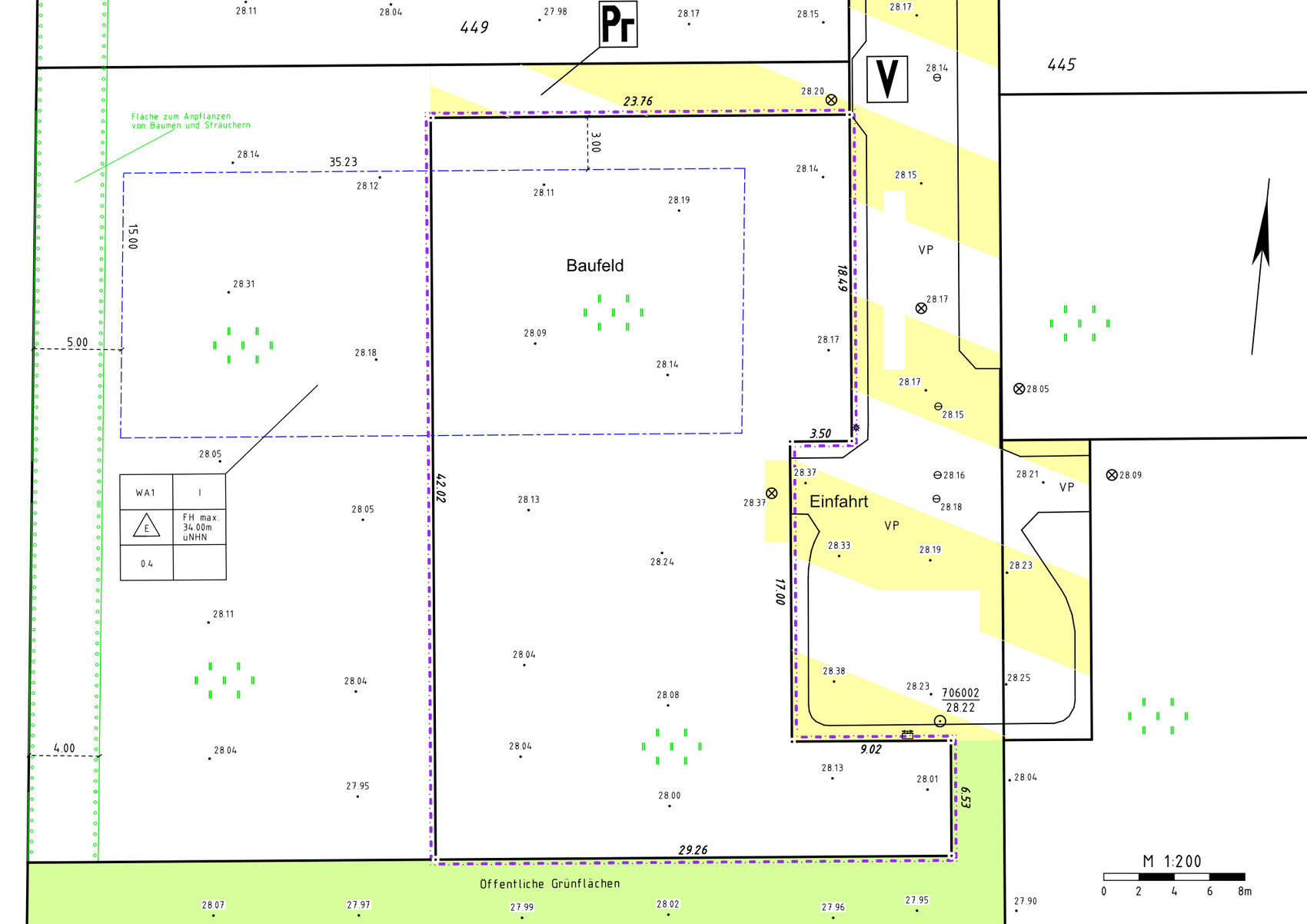
a bit different and certainly very straightforward – here is our floor plan. The plot is in Brandenburg, just under 1,000 m² (10,764 sq ft). The zoning plan specifies a maximum ridge height at 34 meters above NHN (Normalhöhennull, standard elevation). The manhole cover on the street is approximately at 28.30 meters above NHN. The neighboring plot next door is accessible via a separate street (Pr).
The house itself will be built with a steel frame and prefabricated elements. The roof will be made of sandwich panels (Kingspan/Hoffmann) with a U-value of 0.15 and will be covered with solar panels (K2) on the southern side. This should hopefully reduce the sound of rain and also limit heat buildup somewhat.
There will be a gallery, which, due to limited height, will probably serve more as storage. Possibly, at least one area with 2 m (6 ft 7 in) height could work (finished ceiling height approximately 28.5 m = 5.5 m possible ridge height; 2.8 m (9 ft 2 in) ground floor; 0.2 m (8 in) ceiling; the rest 2 m (6 ft 7 in) up to the ridge). We still need to discuss this further with the surveyor and architect to see what is feasible. Depending on that, the gallery will either be open with a railing or closed off. We still want a “proper” staircase though.
The floor plan is quite pragmatic – the bathrooms present some challenges. One has no window, and the other is square.
Zoning plan / restrictions
Plot size: approx. 1,000 m² (10,764 sq ft)
Slope: No (approx. 10 cm (4 in) drop over 40 meters)
Floor area ratio: 0.4
Plot ratio: 1 (+ gallery level)
Building envelope, setback lines: 15 x 15 m (49 x 49 ft), 3 m (10 ft) to neighboring plot, 6 m (20 ft) to street (cul-de-sac)
Edge development: Last house on the street
Number of parking spaces: 2
Number of floors: 1.5
Roof type: Gable roof, minimum 20° slope
Style: Does not matter
Orientation: South
Maximum height limits: Approx. 5.5 m (18 ft) ridge height
Homeowner requirements
Style, roof type, building type: Single-family house / bungalow
Basement, floors: No basement, ground floor + gallery level/storage space
Number and age of occupants: 3 (ages 49, 49, 14)
Room needs on ground/floor level: Living/kitchen, bedroom, child’s room, utility room, office, master bathroom, guest/teen bathroom, walk-in closet
Office: Family use and home office? Both
Guest stays per year: Weekends
Open or closed architecture: Open
Conservative or modern build: Modern
Open kitchen, kitchen island: Yes
Number of dining seats: Corner bench/table, max 6-8
Fireplace: Probably not (no suitable place, cost) — if anyone has tips for an affordable fireplace, please share
Music/stereo wall: No
Balcony, roof terrace: No
Garage, carport: No, cars (2) will probably park on the east side of the building (with charging station) or below the turning circle
Utility garden, greenhouse: No
House design
Design origin: Do-it-yourself
What we like most and why?
Affordable, no structural challenges due to steel frame construction with large-panel wall elements, wooden stud partition walls, trapezoidal profile roof panels with insulating core, structural flexibility
What we dislike and why?
Guest bathroom has no window, master bathroom is tricky because it is square, likely limited height in the attic due to gable roof and max ridge height limit (34 m above NHN compared to 28.2 m above NHN street level), difficult to find space for fireplace, driveway is structurally unusable — it was set like that during street construction.
Cost estimate by architect/planner: Shell construction 210,000
Personal budget limit for house including equipment: 350,000
Preferred heating system: Heat pump (air source)
If you had to waive some details/upgrades
- Could waive: Luxury features, KNX system (instead Shelly devices), garage, external blinds (raffstores), expensive lift-and-slide doors, elaborate garden
- Cannot waive: Central ventilation system, large living space, as much photovoltaic as possible (approx. 120 m² (1,292 sq ft) south-facing)
Why did the design end up like this?
Basically quite pragmatic, maximizing living space at low cost. A lot of self-work planned – construction time is not critical, as about 1–1.5 years until move-in.
 tempusfugit8 May 2025 10:27
Shell construction with roof and windows as well as the base slab, 35 cm (14 inches) insulation envelope similar to prefabricated house manufacturers, excluding connection costs and earthworks, and interior walls only plastered on one side. It might help to think of the construction costs from the commercial sector, as we are adopting several of these elements (sandwich roof panels, load-bearing framework, stud construction).
I am aware that this building method is not favored by many and has disadvantages, which we try to minimize as much as possible: interior stud walls double-plastered on both sides on the base slab without a screed sound bridge, a solar layer above the metal roof to reduce thermal expansion and noise emissions from rain, central ventilation to prevent mold, and so on.
I have lived for several years in the USA, Iceland, Israel, and other countries in houses built in a similar way and found it absolutely acceptable (setting aside the discrepancy between manufacturing costs and the selling prices of houses in the USA).
I am aware that this building method is not favored by many and has disadvantages, which we try to minimize as much as possible: interior stud walls double-plastered on both sides on the base slab without a screed sound bridge, a solar layer above the metal roof to reduce thermal expansion and noise emissions from rain, central ventilation to prevent mold, and so on.
I have lived for several years in the USA, Iceland, Israel, and other countries in houses built in a similar way and found it absolutely acceptable (setting aside the discrepancy between manufacturing costs and the selling prices of houses in the USA).
W
wiltshire8 May 2025 10:49It is always a good idea to take inspiration from other standards. Skeptics are justified when there are deviations from established norms. Those who provide specific feedback rather than general statements usually offer valuable information. It is worth listening carefully and reflecting before reacting defensively. Please share what the costs are.
My main concern regarding the construction method you outlined would be the noise levels inside the house—particularly the transmission of noise from the heat pump and ventilation system. Resonances caused by the building structure itself are very difficult to control afterward. Therefore, careful planning and precise assembly are essential.
My main concern regarding the construction method you outlined would be the noise levels inside the house—particularly the transmission of noise from the heat pump and ventilation system. Resonances caused by the building structure itself are very difficult to control afterward. Therefore, careful planning and precise assembly are essential.
tempusfugit8 May 2025 15:13Good point. We had also considered building the room solidly out of limestone, but for now we have calculated a wall construction that should work and meets the requirements (fire resistance, sound insulation). The product name is probably not allowed to be mentioned. However, it is a panel material filled with quartz sand.

The misconception here seems to be that the original poster believes they can save a significant amount on the shell construction. However, that’s just one part of many. The interior finishing is likely to be similar to other projects. In the end, they barely saved anything but ended up with a modest roof and questionable wall construction.
We are, of course, open to being convinced otherwise.
That’s because we’re not discussing castles in the air here.
We are, of course, open to being convinced otherwise.
tempusfugit schrieb:
Somehow, the money issue always seems to dominate.
That’s because we’re not discussing castles in the air here.

tempusfugit schrieb:
Somehow, the topic of money always seems to be dominant.After all, it’s called a “house building forum” and not a “graveyard of broken dreams.”tempusfugit schrieb:
We have the offer for the shell including the foundation slab at about 180,000 and yes, there is also an architect contract for 35,000. [...]
My main interest in this thread, however, is the floor plan and ideas that I could contribute to the further planning.I wouldn’t let my construction company push an architect contract on me; when working with an independent architect, it’s better to first engage in the discussion without bringing detailed personal input too early.tempusfugit schrieb:
There are already enough examples here in the forum showing that costs of 2,000–2,500 are reasonable if the circumstances fit: own labor, rural area, enough time, no 0% financing, etc.Regarding this, I can recall exactly one example, namely the one from @hegi___ https://www.hausbau-forum.de/threads/baubericht-einfamilienhaus-1200-eur-m.35362/tempusfugit schrieb:
Shell with roof and windows plus foundation slab, 35 cm (14 inches) envelope like prefab house manufacturers, without connection costs and earthworks, and interior walls lined on only one side. Maybe it helps to imagine construction costs from commercial construction since we are adopting several of these elements (sandwich roof panels, supporting frame, timber frame construction).In commercial construction, conditions are quite different—not only in terms of regulations. Glances from mainstream are generally good, but adaptations from “foreign” areas can also cause problems. My mentor once had a world-renowned architecture professor build a building (which works perfectly in desert countries) near the Leonberg Triangle area, where it encountered physical problems due to the climate.https://www.instagram.com/11antgmxde/
https://www.linkedin.com/company/bauen-jetzt/
tempusfugit8 May 2025 21:48
The misconception here is probably that the original poster believes they can save a lot on the shell construction. But that is only one part of many. The interior work probably won’t differ much from other projects. In the end, they hardly save anything but end up with a modest roof and a questionable wall structure.
However, we are happy to be convinced otherwise. *Sigh,* we are in the forum section "Floor Plan / Site Planning"... We have quotes for all trades that are within the regional range and have been confirmed multiple times here in the forum. According to my spreadsheet, we are currently at additional construction costs of 57,000 and technology/interior finishing costs of 138,000. Additionally, we have planned a 20% contingency and will finance only after the shell is completed. Yes, there is a lot of self-labor involved, and if necessary, there is always the option to switch to a turnkey solution, for example in case of an overseas assignment, etc.
Could you please be specific now and say what exactly is suddenly *questionable* about the wall structure? In my opinion, our construction already exceeds the typical prefabricated house standard (our setup: 12.5 mm drywall (1/2 inch), 15 mm OSB, 160 mm wood wool insulation (6 inches), 15 mm OSB, 12.5 mm drywall). Alternatively, we also had an offer to cast the walls in expanded glass, but that would be over 40% more expensive and the interior work more complicated. The local mason is rather specialized in Poroton blocks.
And what exactly is *modest* about the roof? This is common standard abroad, and we are achieving a U-value of around 0.15. Yes, it is a sandwich roof – that might not appeal to everyone in Germany, but it is a compromise used hundreds of thousands of times worldwide and works well with steel beam construction since the roof frame is already engineered. The roofer plans three fields, which have also been approved by the structural engineer. Yes, I know roofs undergo temperature fluctuations in sunlight and creak, and they also drum in rain. We are willing to risk a live test to see whether a large solar surface above the roof mitigates these effects and will gladly report back. In the worst case, it will be taken down again in a few years and moved to a farmer’s barn. It should certainly be better than roofing felt, and from outside, you only see the solar panels anyway.
Similar topics