
ᐅ Single-family house floor plan (157 sqm) on a hillside with a basement
Created on: 10 May 2026 23:43
W
WBR
Hello dear forum members,
After some time of quietly following the discussions, it is now our turn to post: our first contribution.
We are a family of four, moving back to our home region near the Bavarian Lower Main after 20 years in Swabia. We have purchased a very nice plot on a hillside above the Main valley. We now want to build our new home there.
Zoning plan / restrictions
Plot size: 600 sqm (6460 sq ft)
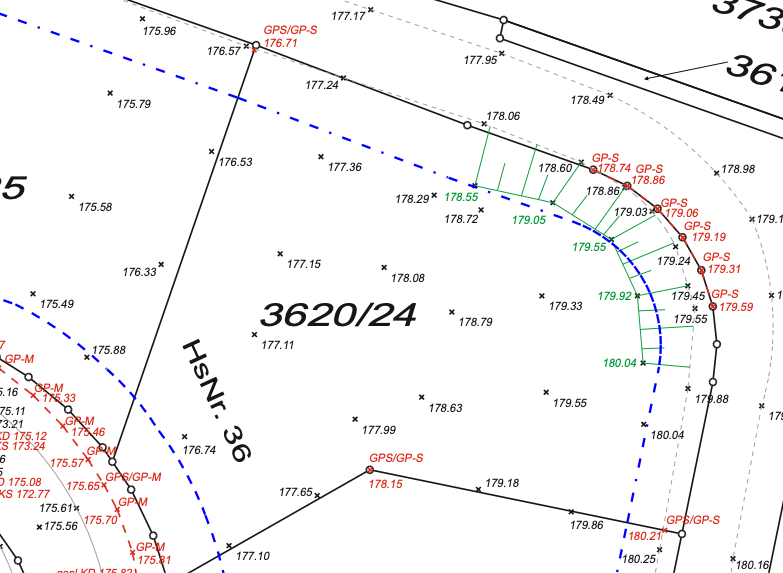
Slope: yes, approximately 12% incline from west to east, see elevation plan as PDF
Floor-area ratio: 0.4
Number of parking spaces: 2
Number of floors: 3 full floors (including basement)
Roof type: all roof shapes permitted
Orientation: see plan
Owners’ requirements
Style:
Basement, floors: basement + 2 full floors
Number of occupants, ages: 2 adults (40), 2 children (10, 7)
Space needed on ground floor and upper floor: approx. 135 sqm (1453 sq ft)
Office: home office in basement for both private and work use
Guest stays per year: about 10 overnight stays/year, on average 3-4 guests
Open or closed layout: open
Kitchen: U-shaped
Number of dining seats: 4 - 6
Fireplace: yes (for comfort + emergency heating)
Garage, carport: carport + 1 additional parking space
Garden: partly for growing food, probably terraced
Other requirements: option to later convert the upper floor into a separate living unit
House design
Planned by: us + planner of the local house-building company (individual timber frame construction)
What do you like most? Why?
Everything we wanted is included. From our perspective, good utilization of the building’s outer dimensions. The option to separate the upper floor (or basement) as an independent living unit or granny flat if needed in the future.
What don’t you like? Why?
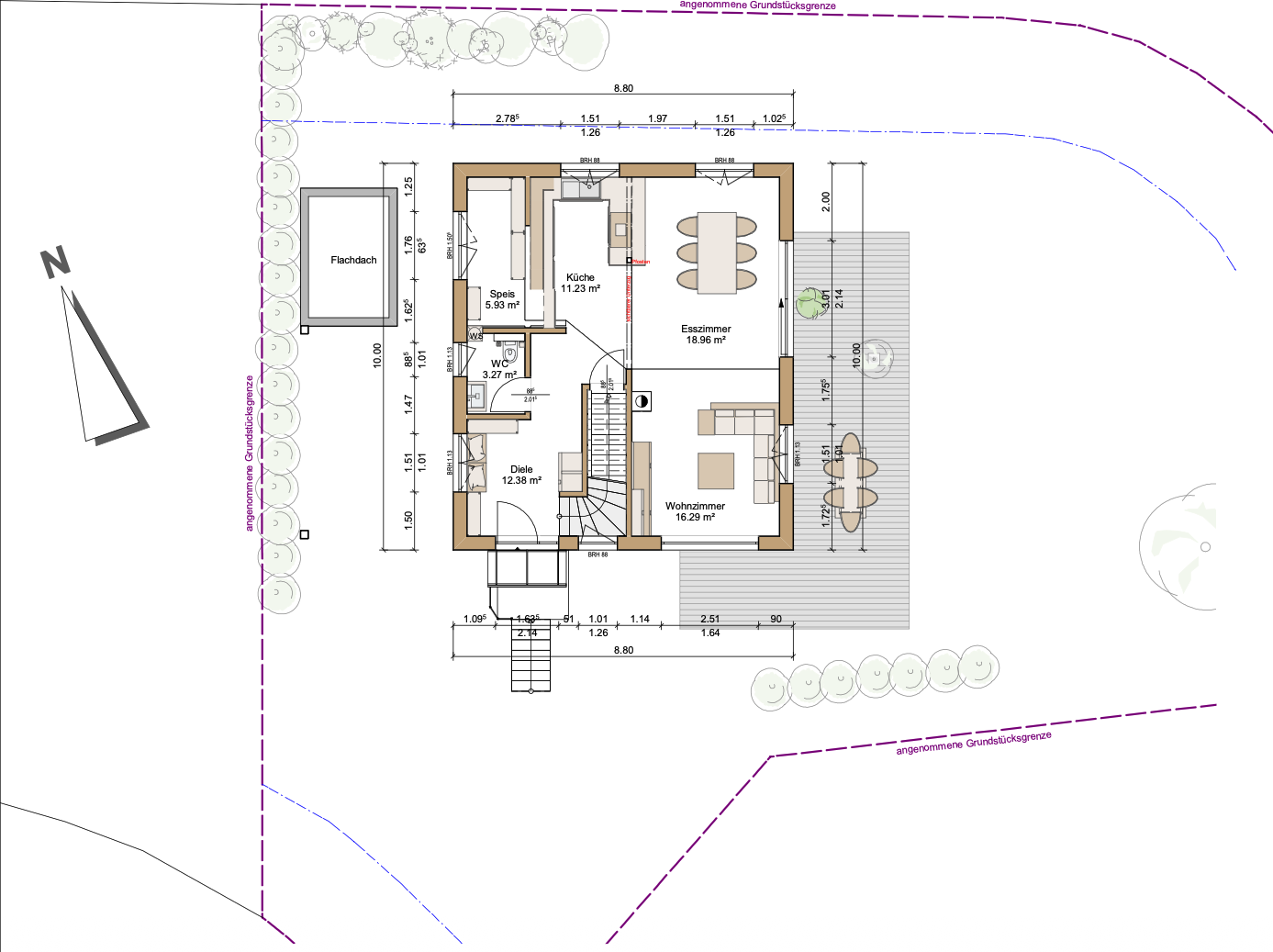
The transition from the entrance area into the kitchen/living/dining area is a bit awkward and there’s no clear separation. We are still thinking about whether/how to add a separation here and welcome any ideas.
Price estimate from architect/planner: €680,000 including additional construction costs
- House: €280k
- Basement + groundwork: €150k
- Heating & plumbing: €65k
- Electrical: €20k
- Floor and wall coverings: €40k
- Outdoor facilities: €60k
- Ventilation system: €15k
- Photovoltaics: €15k
- Carport: €15k
- Additional costs: €20k
We will do the following work ourselves: roof covering, installation of photovoltaic system & battery, wall and ceiling paneling, filling and smoothing, painting fleece & painting, flooring (except bathroom)
Preferred heating technology:
Air-to-water heat pump + underfloor heating
If you have to give up something, which details/features could you skip?
- Could skip: the fireplace/stove if absolutely necessary
- Cannot do without:
Why did the design turn out the way it did?
Originally, we planned a staircase with opposite landings along the long side of the house (this design was inspired by the “Bruckberg” house from Regnauer, which we still find visually and stylistically appealing). Then, the possibility to separate the upper floor later as an independent living unit became more important in our planning. This led us to replace the landing staircase with a quarter-turn staircase next to the front door and adjust the western part of the building accordingly.
We are happy to receive suggestions, constructive criticism, and improvement ideas!
If you need more input, we will gladly provide it!
Best regards,
WBR
After some time of quietly following the discussions, it is now our turn to post: our first contribution.
We are a family of four, moving back to our home region near the Bavarian Lower Main after 20 years in Swabia. We have purchased a very nice plot on a hillside above the Main valley. We now want to build our new home there.
Zoning plan / restrictions
Plot size: 600 sqm (6460 sq ft)
Slope: yes, approximately 12% incline from west to east, see elevation plan as PDF
Floor-area ratio: 0.4
Number of parking spaces: 2
Number of floors: 3 full floors (including basement)
Roof type: all roof shapes permitted
Orientation: see plan
Owners’ requirements
Style:
Basement, floors: basement + 2 full floors
Number of occupants, ages: 2 adults (40), 2 children (10, 7)
Space needed on ground floor and upper floor: approx. 135 sqm (1453 sq ft)
Office: home office in basement for both private and work use
Guest stays per year: about 10 overnight stays/year, on average 3-4 guests
Open or closed layout: open
Kitchen: U-shaped
Number of dining seats: 4 - 6
Fireplace: yes (for comfort + emergency heating)
Garage, carport: carport + 1 additional parking space
Garden: partly for growing food, probably terraced
Other requirements: option to later convert the upper floor into a separate living unit
House design
Planned by: us + planner of the local house-building company (individual timber frame construction)
What do you like most? Why?
Everything we wanted is included. From our perspective, good utilization of the building’s outer dimensions. The option to separate the upper floor (or basement) as an independent living unit or granny flat if needed in the future.
What don’t you like? Why?
The transition from the entrance area into the kitchen/living/dining area is a bit awkward and there’s no clear separation. We are still thinking about whether/how to add a separation here and welcome any ideas.
Price estimate from architect/planner: €680,000 including additional construction costs
- House: €280k
- Basement + groundwork: €150k
- Heating & plumbing: €65k
- Electrical: €20k
- Floor and wall coverings: €40k
- Outdoor facilities: €60k
- Ventilation system: €15k
- Photovoltaics: €15k
- Carport: €15k
- Additional costs: €20k
We will do the following work ourselves: roof covering, installation of photovoltaic system & battery, wall and ceiling paneling, filling and smoothing, painting fleece & painting, flooring (except bathroom)
Preferred heating technology:
Air-to-water heat pump + underfloor heating
If you have to give up something, which details/features could you skip?
- Could skip: the fireplace/stove if absolutely necessary
- Cannot do without:
Why did the design turn out the way it did?
Originally, we planned a staircase with opposite landings along the long side of the house (this design was inspired by the “Bruckberg” house from Regnauer, which we still find visually and stylistically appealing). Then, the possibility to separate the upper floor later as an independent living unit became more important in our planning. This led us to replace the landing staircase with a quarter-turn staircase next to the front door and adjust the western part of the building accordingly.
We are happy to receive suggestions, constructive criticism, and improvement ideas!
If you need more input, we will gladly provide it!
Best regards,
WBR
The statement that building without a basement is not possible does not mean raising the ground level and pouring a slab foundation.
There is the option of a residential lower ground floor, where living spaces are actively planned in the "basement." My basement includes living, dining, kitchen, guest bathroom, cloakroom, and building services. This way, I have one less floor than you.
Have you drawn all existing and desired furniture to scale in the floor plan? This way, you can immediately see where the problems are.
I would plan an entrance. That way, in winter, you only have one entrance to keep clear, and you know where your shoes and jackets are.
There is the option of a residential lower ground floor, where living spaces are actively planned in the "basement." My basement includes living, dining, kitchen, guest bathroom, cloakroom, and building services. This way, I have one less floor than you.
Have you drawn all existing and desired furniture to scale in the floor plan? This way, you can immediately see where the problems are.
I would plan an entrance. That way, in winter, you only have one entrance to keep clear, and you know where your shoes and jackets are.
H
hanghaus202312 May 2026 11:53This is how it works without a basement:
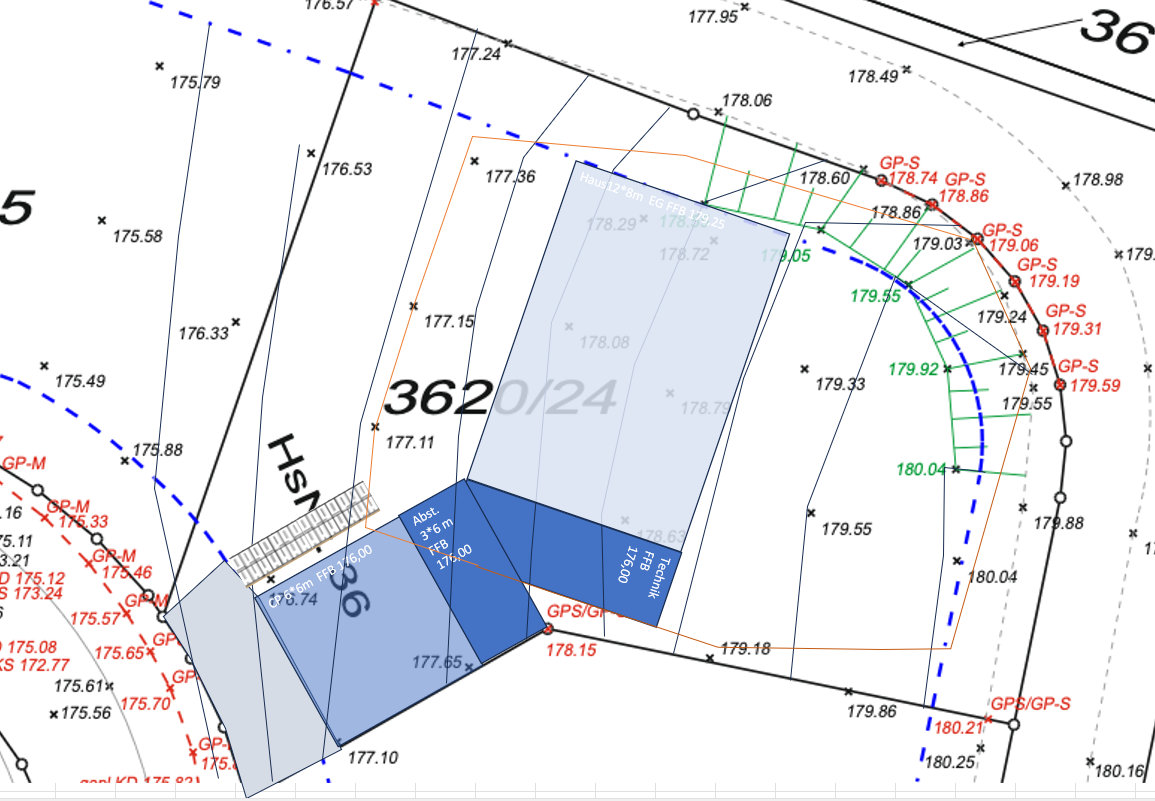
The brown line indicates the level at 179 m (587 ft), from which the terrain is sloped away. In my opinion, the fill can be up to 2 m (6.5 ft).
The brown line indicates the level at 179 m (587 ft), from which the terrain is sloped away. In my opinion, the fill can be up to 2 m (6.5 ft).
H
hanghaus202312 May 2026 12:43Alternatively with a basement and ground floor living area, as well as a partially developed pitched roof. Possibly also with a flat pitched roof or hipped roof without living space.
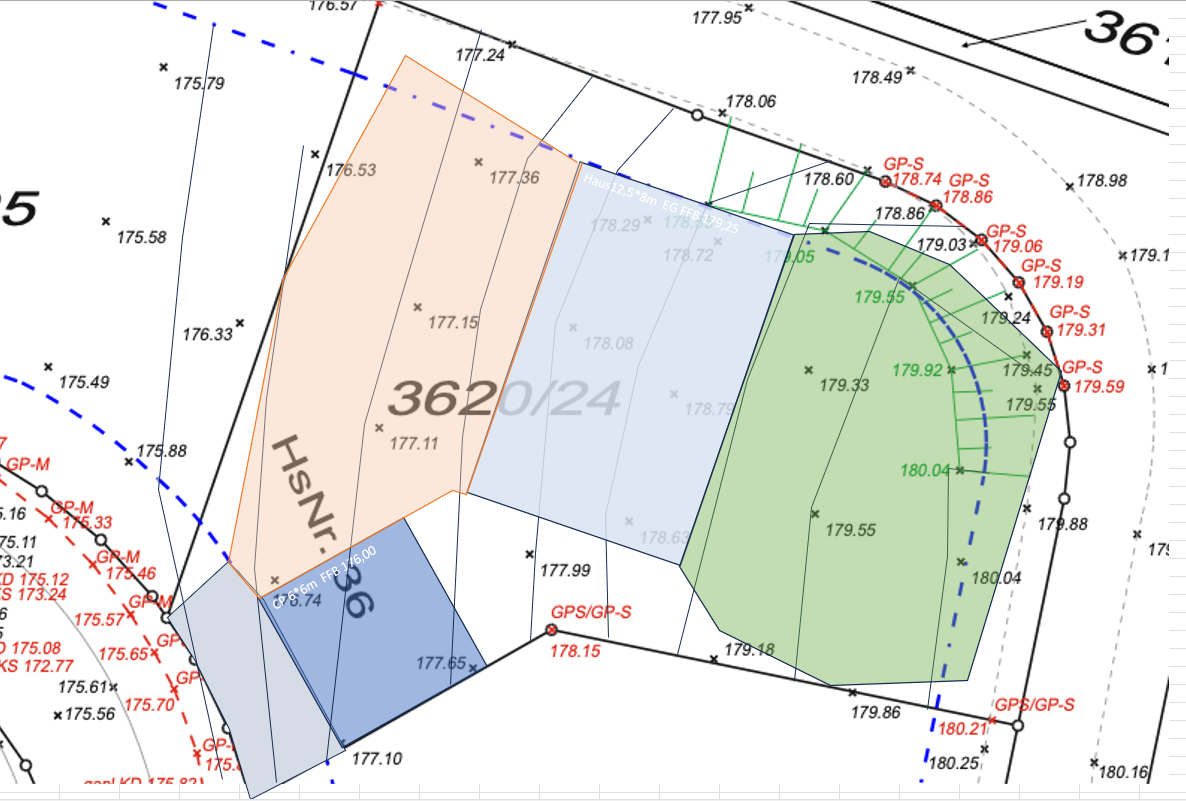
Brown lower level at 176.5m (579 feet), green at 179.5m (589 feet)
You will need a disposal site for the excavated material. Usually, the earthworks contractor requires some material to fill in elsewhere anyway.
Or something like this with elevation difference.
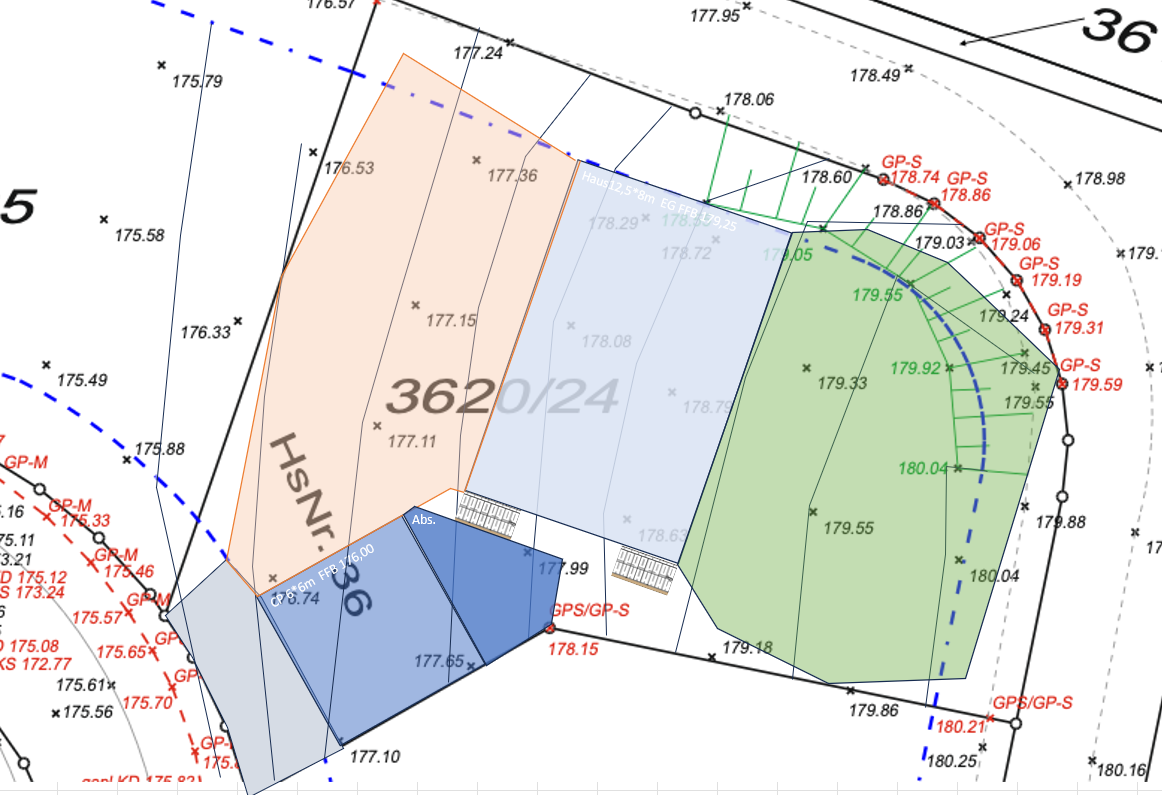
Brown lower level at 176.5m (579 feet), green at 179.5m (589 feet)
You will need a disposal site for the excavated material. Usually, the earthworks contractor requires some material to fill in elsewhere anyway.
Or something like this with elevation difference.
H
hanghaus202312 May 2026 12:51Has any of the neighbors already started building? Or have they shown you their plans?
H
hanghaus202312 May 2026 13:25Here is an alternative with a large storage room.
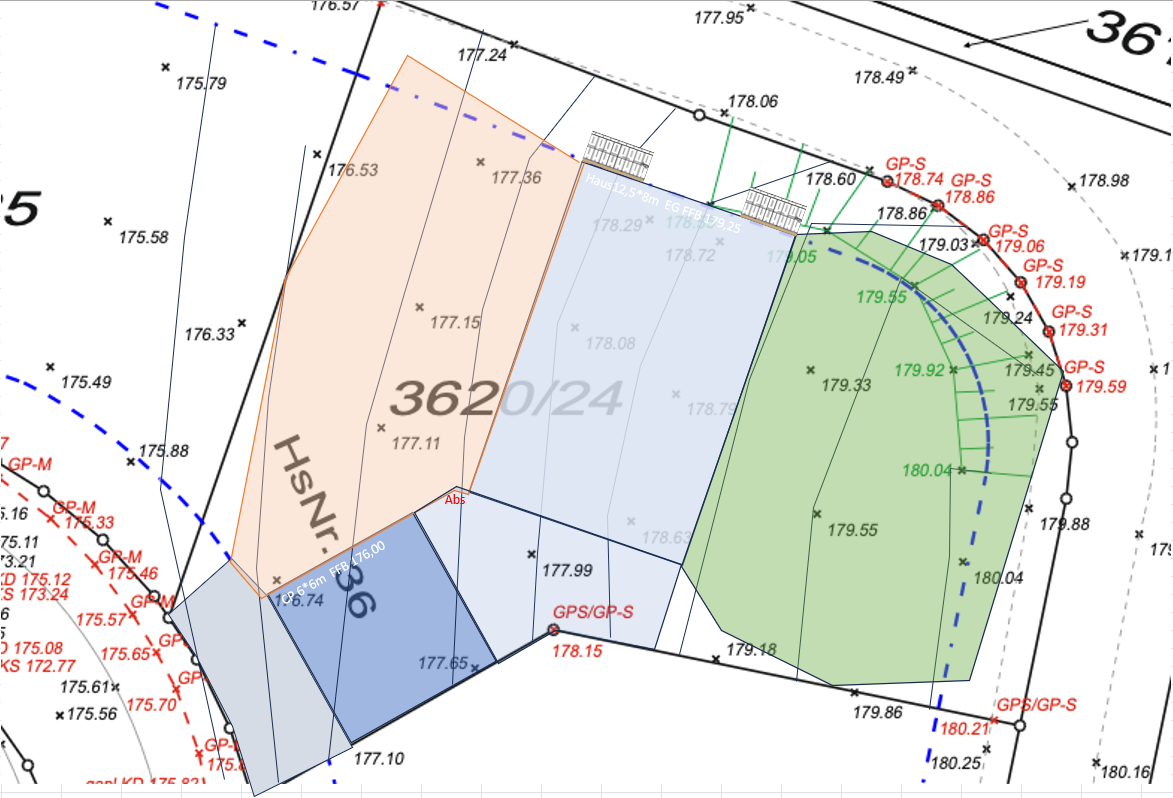
N
Noxmortana12 May 2026 22:13A few questions come to mind regarding your design:
On the upper floor:
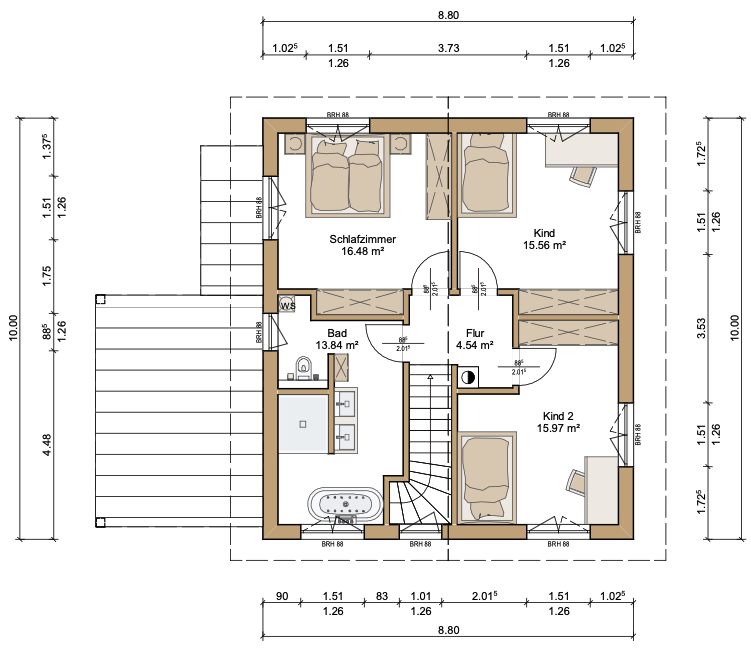
You have minimized the hallway area, which is understandable and good for the sleeping level – but if it were ever to become a separate apartment, it would still need a proper entrance area with a cloakroom or wardrobe, etc. …
Each bedroom has a built-in closet niche, which might make the rooms less flexible (since you can hardly arrange furniture in any other way than filling the niches with wardrobes – it reminds me a bit of North American built-in closets). This might already bother your children in the coming years and definitely makes dividing the space into a separate apartment difficult for me. Also, the room layout does not make it easy to use it as a one-bedroom unit: either you have a relatively large kitchen with a dining area and a relatively large living room (each in relation to the number of occupants) with only one bedroom, or you cram cooking, dining, and living into one room to have two bedrooms – who would be the target group for renting this unit?
The bathroom actually has many square meters, but it doesn’t feel spacious to me, especially the passage to the toilet, which isn’t even as wide as a door; also, the drawn bathtub seems quite small (dimensions?), but if it is made a bit larger, access to the shower could become cramped.
On the ground floor:
I don’t find the entrance area, which leads into the kitchen via three corners, very attractive. I would prefer a separation of the hallway so that there is effectively a wardrobe and entrance room – but even then, I don’t think the solution is really good, since you already write that this will probably only be the guest entrance and you’ll normally enter through the basement. Is so much space really needed for that?
In your visualized kitchen plan, the workspace seems quite limited (you usually don’t work right in corners but rather on straight sections of countertop). This would of course change if you widen the niche as intended, but then with your wish for a raised dishwasher, you still wouldn’t have a single tall cabinet for storage in the kitchen... On the other hand, the pantry is nicely spacious but in the sketch equipped with just a few shelves – how is it supposed to be used? Overall, I don’t find the kitchen well thought out, but of course, this is very dependent on individual usage patterns. Without knowing the exact room dimensions, I would consider making the peninsula longer, leaving out the corner kitchen unit in the niche, instead installing a standard door to the pantry there, and planning the rest of the wall with tall cabinets (fridge, dishwasher, possibly oven again). This would create longer straight countertop space and a bit more storage.
In the basement:
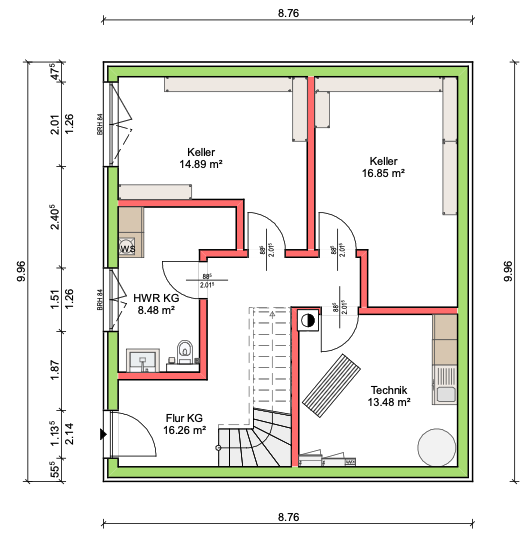
I understood the “professional” use to mean that customers would come here – then I find the toilet in the laundry room inappropriate.
The washing machine and laundry chute are located in the utility room, but the drying rack (or is that supposed to be something else???) is in the technical room – that seems too inconvenient in the long term?!
The basement entrance area, which you expect to be the “most used,” is quite narrow and has no wardrobe – so everyone walks upstairs with wet coats and dirty shoes, through the kitchen, to get to the cloakroom area to change?
You’re considering possibly accommodating elderly family members in the basement? So once climbing stairs becomes difficult, they would be completely separated from the rest of the family? With a bathroom that has no privacy because it also serves as the laundry room? To put it bluntly: is granny really that mean?
Also, using the basement when older, after the children have moved out and the upper floor is rented out, always means stairs between the sleeping area and living/kitchen – that is probably manageable for quite a while, but would you really want to “move to the basement” at that stage? Or wouldn’t you rather spread out jubilantly in the children’s rooms and pursue hobbies for which you finally have time, and enjoy the children’s frequent weekend visits? Downsizing for old age and renting out parts of the house to strangers – don’t people usually do that only when truly necessary? By then, the stairs to the basement sleeping area might already be too much...
If I were to pursue your planned basement usage further, I would suggest enlarging the entrance area since you expect it to be the main entrance and including a wardrobe (taking space from the utility room); turning the former utility room into a proper guest bathroom with a shower; and perhaps slightly enlarging the technical room and placing the drying rack and washing machine there – unfortunately, the laundry chute idea would be lost.
But overall, I see your requirements (at least as I understand them) so poorly met in the current floor plan that you might want to reconsider the above suggestions regarding a completely different layout...
On the upper floor:
You have minimized the hallway area, which is understandable and good for the sleeping level – but if it were ever to become a separate apartment, it would still need a proper entrance area with a cloakroom or wardrobe, etc. …
Each bedroom has a built-in closet niche, which might make the rooms less flexible (since you can hardly arrange furniture in any other way than filling the niches with wardrobes – it reminds me a bit of North American built-in closets). This might already bother your children in the coming years and definitely makes dividing the space into a separate apartment difficult for me. Also, the room layout does not make it easy to use it as a one-bedroom unit: either you have a relatively large kitchen with a dining area and a relatively large living room (each in relation to the number of occupants) with only one bedroom, or you cram cooking, dining, and living into one room to have two bedrooms – who would be the target group for renting this unit?
The bathroom actually has many square meters, but it doesn’t feel spacious to me, especially the passage to the toilet, which isn’t even as wide as a door; also, the drawn bathtub seems quite small (dimensions?), but if it is made a bit larger, access to the shower could become cramped.
On the ground floor:
I don’t find the entrance area, which leads into the kitchen via three corners, very attractive. I would prefer a separation of the hallway so that there is effectively a wardrobe and entrance room – but even then, I don’t think the solution is really good, since you already write that this will probably only be the guest entrance and you’ll normally enter through the basement. Is so much space really needed for that?
In your visualized kitchen plan, the workspace seems quite limited (you usually don’t work right in corners but rather on straight sections of countertop). This would of course change if you widen the niche as intended, but then with your wish for a raised dishwasher, you still wouldn’t have a single tall cabinet for storage in the kitchen... On the other hand, the pantry is nicely spacious but in the sketch equipped with just a few shelves – how is it supposed to be used? Overall, I don’t find the kitchen well thought out, but of course, this is very dependent on individual usage patterns. Without knowing the exact room dimensions, I would consider making the peninsula longer, leaving out the corner kitchen unit in the niche, instead installing a standard door to the pantry there, and planning the rest of the wall with tall cabinets (fridge, dishwasher, possibly oven again). This would create longer straight countertop space and a bit more storage.
In the basement:
I understood the “professional” use to mean that customers would come here – then I find the toilet in the laundry room inappropriate.
The washing machine and laundry chute are located in the utility room, but the drying rack (or is that supposed to be something else???) is in the technical room – that seems too inconvenient in the long term?!
The basement entrance area, which you expect to be the “most used,” is quite narrow and has no wardrobe – so everyone walks upstairs with wet coats and dirty shoes, through the kitchen, to get to the cloakroom area to change?
You’re considering possibly accommodating elderly family members in the basement? So once climbing stairs becomes difficult, they would be completely separated from the rest of the family? With a bathroom that has no privacy because it also serves as the laundry room? To put it bluntly: is granny really that mean?
Also, using the basement when older, after the children have moved out and the upper floor is rented out, always means stairs between the sleeping area and living/kitchen – that is probably manageable for quite a while, but would you really want to “move to the basement” at that stage? Or wouldn’t you rather spread out jubilantly in the children’s rooms and pursue hobbies for which you finally have time, and enjoy the children’s frequent weekend visits? Downsizing for old age and renting out parts of the house to strangers – don’t people usually do that only when truly necessary? By then, the stairs to the basement sleeping area might already be too much...
If I were to pursue your planned basement usage further, I would suggest enlarging the entrance area since you expect it to be the main entrance and including a wardrobe (taking space from the utility room); turning the former utility room into a proper guest bathroom with a shower; and perhaps slightly enlarging the technical room and placing the drying rack and washing machine there – unfortunately, the laundry chute idea would be lost.
But overall, I see your requirements (at least as I understand them) so poorly met in the current floor plan that you might want to reconsider the above suggestions regarding a completely different layout...
Similar topics