
ᐅ Floor plan for a new single-family house, 1.5 stories, 148 m² (approximately 1,593 sq ft)
Created on: 24 Aug 2020 08:33
R
Rampelzampel
Development Plan / Restrictions
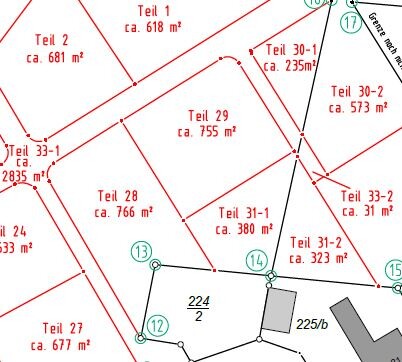
Plot size: 766m² (width at the street 20.5m (67 feet))/ No. 28, drawing oriented to the north
Slope: none
Site coverage ratio: 0.4
Floor area ratio: II
Building envelope, building line and boundary
Edge development: no
Number of parking spaces: 2
Number of stories: 1.5 or 2
Roof type: gable or hip roof
Architectural style: modern
Orientation:
Maximum heights/limits: ridge height 9.5m (31 feet), eaves height 6.5m (21 feet)
Additional requirements: rainwater infiltration on site
Homeowner Requirements
Architectural style, roof type, building type: 1.5 stories with minimum 1.60m (5 feet 3 inches) knee wall or urban villa
Basement, floors: no basement, 1.5-2 floors
Number of occupants, ages: 2 adults aged 27 and 33, 1 child planned
Space requirements ground floor, upper floor: about 75m² (800 sq ft) each
Office: family use
Guest overnight stays per year: 10
Open or closed layout: open living-dining area preferred
Conservative or modern construction: modern
Open kitchen, cooking island: yes, preferred but not mandatory
Number of dining seats: 6-8 (daily need is 4 seats)
Fireplace: no
Music/sound wall: no
Balcony or roof terrace: no
Garage, carport: 1 garage with annex, 1 carport
Kitchen garden, greenhouse: no
Further wishes/special features/daily routine, also explanations why certain things are desired or not: none
House Design
Planner: combination of builder and self-designed
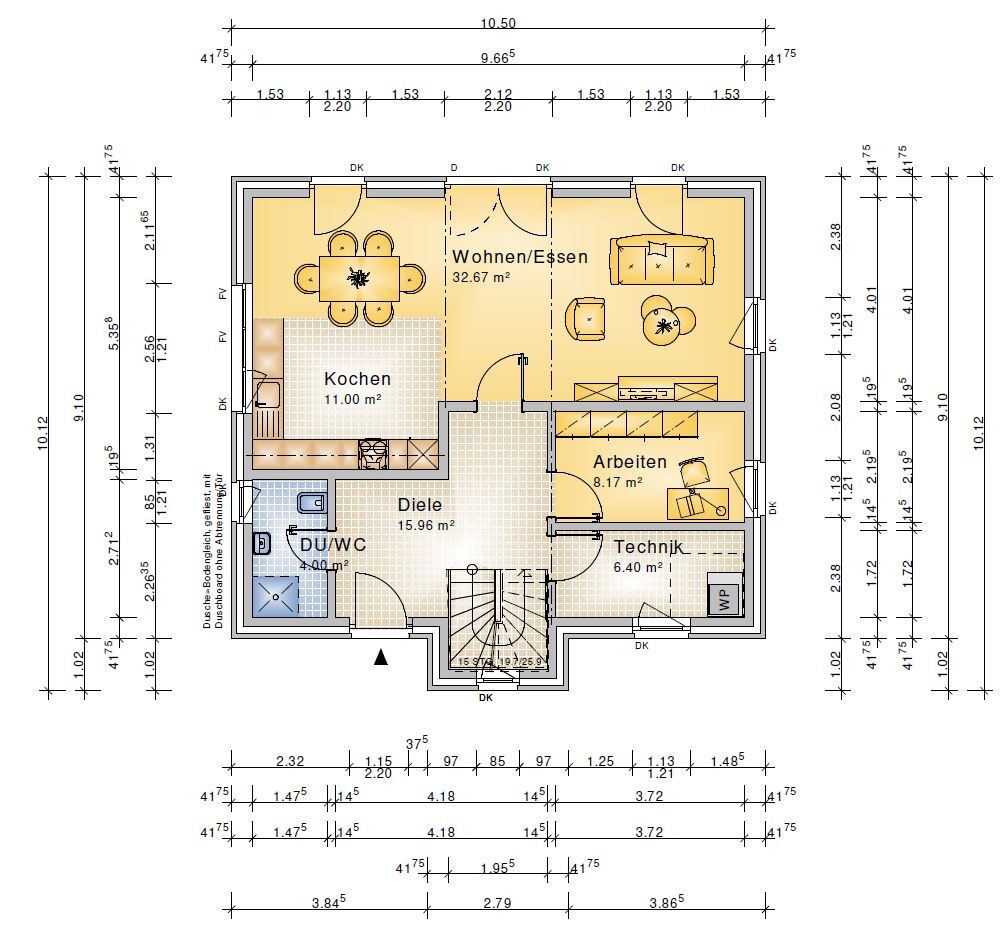
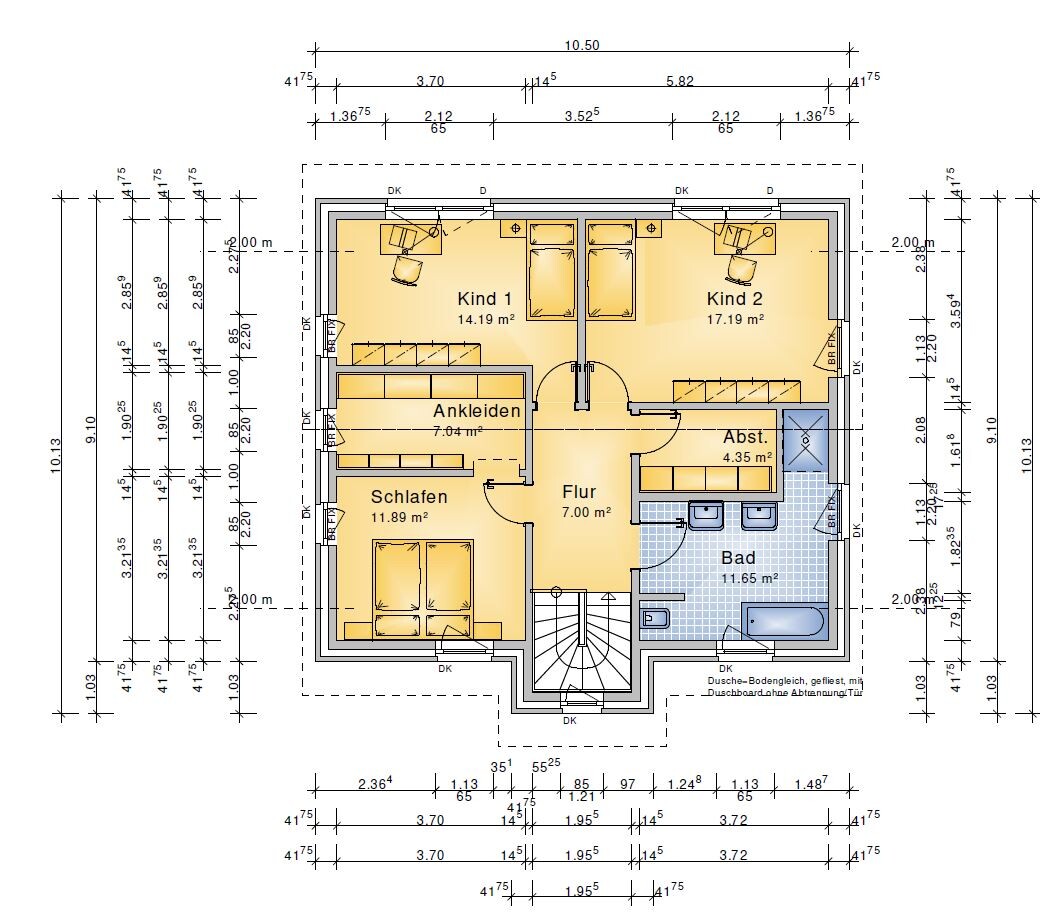
What do you particularly like? Why? We are very satisfied with the upper floor, especially regarding the room layout and sizes. An L-shape for the living-dining area on the ground floor is preferred.
What do you dislike? Why? I am still uncertain about the ground floor because the study is also intended as a guest room; it seems a bit small for that purpose, although a 1.40m (55 inch) pull-out couch would likely fit.
Cost estimate according to architect/planner: 275,000
Personal budget limit for the house, including equipment: 300,000
Preferred heating technology: air-to-water heat pump or ground-source heat pump
If you had to give up something, on which details/upgrades
- could you do without:
- could you not do without: staircase not directly at the front door, ground floor shower
Why is the design as it is now? For example:
We have visited many model homes and construction companies, sought advice, and usually returned to a floor plan like this because we wanted an additional guest/office room on the ground floor. We saw the upper floor almost exactly as drawn in a model home and only enlarged the bathroom slightly and shifted the dressing room a little.
So, I hope I’ve filled in the most important details first. I am open to any changes; as mentioned, the L-shape in the living-dining area should be maintained.
What still concerns me somewhat is the placement of the possible outdoor unit for the air-to-water heat pump, which according to the development plan must be at least 10m (33 feet) from the nearest neighbor; with the current plan it would be directly in front of the house or beside the carport.
After a long selection process and several offers, we are currently favoring Gussek Haus, Helma, and Elbe-Haus, which could realize the house roughly within the budget. The tendency currently leans towards Gussek Haus because although it is a prefab house, we like the hybrid wall and the clinker brick exterior well, and the price-performance ratio fits. But nothing is decided yet; the plot will be developed at the beginning of next year and construction will start from summer 2021.
Plot size: 766m² (width at the street 20.5m (67 feet))/ No. 28, drawing oriented to the north
Slope: none
Site coverage ratio: 0.4
Floor area ratio: II
Building envelope, building line and boundary
Edge development: no
Number of parking spaces: 2
Number of stories: 1.5 or 2
Roof type: gable or hip roof
Architectural style: modern
Orientation:
Maximum heights/limits: ridge height 9.5m (31 feet), eaves height 6.5m (21 feet)
Additional requirements: rainwater infiltration on site
Homeowner Requirements
Architectural style, roof type, building type: 1.5 stories with minimum 1.60m (5 feet 3 inches) knee wall or urban villa
Basement, floors: no basement, 1.5-2 floors
Number of occupants, ages: 2 adults aged 27 and 33, 1 child planned
Space requirements ground floor, upper floor: about 75m² (800 sq ft) each
Office: family use
Guest overnight stays per year: 10
Open or closed layout: open living-dining area preferred
Conservative or modern construction: modern
Open kitchen, cooking island: yes, preferred but not mandatory
Number of dining seats: 6-8 (daily need is 4 seats)
Fireplace: no
Music/sound wall: no
Balcony or roof terrace: no
Garage, carport: 1 garage with annex, 1 carport
Kitchen garden, greenhouse: no
Further wishes/special features/daily routine, also explanations why certain things are desired or not: none
House Design
Planner: combination of builder and self-designed
What do you particularly like? Why? We are very satisfied with the upper floor, especially regarding the room layout and sizes. An L-shape for the living-dining area on the ground floor is preferred.
What do you dislike? Why? I am still uncertain about the ground floor because the study is also intended as a guest room; it seems a bit small for that purpose, although a 1.40m (55 inch) pull-out couch would likely fit.
Cost estimate according to architect/planner: 275,000
Personal budget limit for the house, including equipment: 300,000
Preferred heating technology: air-to-water heat pump or ground-source heat pump
If you had to give up something, on which details/upgrades
- could you do without:
- could you not do without: staircase not directly at the front door, ground floor shower
Why is the design as it is now? For example:
We have visited many model homes and construction companies, sought advice, and usually returned to a floor plan like this because we wanted an additional guest/office room on the ground floor. We saw the upper floor almost exactly as drawn in a model home and only enlarged the bathroom slightly and shifted the dressing room a little.
So, I hope I’ve filled in the most important details first. I am open to any changes; as mentioned, the L-shape in the living-dining area should be maintained.
What still concerns me somewhat is the placement of the possible outdoor unit for the air-to-water heat pump, which according to the development plan must be at least 10m (33 feet) from the nearest neighbor; with the current plan it would be directly in front of the house or beside the carport.
After a long selection process and several offers, we are currently favoring Gussek Haus, Helma, and Elbe-Haus, which could realize the house roughly within the budget. The tendency currently leans towards Gussek Haus because although it is a prefab house, we like the hybrid wall and the clinker brick exterior well, and the price-performance ratio fits. But nothing is decided yet; the plot will be developed at the beginning of next year and construction will start from summer 2021.
R
Rampelzampel24 Aug 2020 11:58Right, thanks, I will include that.
Rampelzampel schrieb:
@Evolith
It’s definitely something to reconsider. Since only one child is planned, the second room upstairs could also be used as a guest room. That might only change if suddenly there are two children.
I also think a larger sofa bed in the living room could be enough for guests, or your solution with the pull-out bed in the kids’ room.Where one child is planned (it was the same for us), a second one often comes along eventually. Biology can be tricky sometimes. But that means you have a guest room available for the first few years. After that, you’ll have to figure things out. There are plenty of options for this. However, I wouldn’t compromise the house design for it. Plan your ideal layout and then see at the end if small adjustments can integrate a nice guest area.
I would also initially ignore the bedroom on the ground floor. If you ever reach a point where you really can’t manage the stairs, you probably won’t be able to manage the household either. If it works, great, but don’t plan around it creatively.
W
Wintersonne24 Aug 2020 13:43@Wintersonne
It’s true that on one side the depth is quite limited. The question is, do you really need a window in the walk-in closet? Or maybe you could reduce the size of the window. The longer side should definitely have cabinets at least 60-70cm (24-28 inches) deep, while on the other side, 40cm (16 inches) deep units might be enough for smaller items.
If you have open shelves, you’ll probably end up covering or shading the window anyway to protect from fading caused by sunlight. Mold shouldn’t be a problem if you have proper ventilation.
I don’t think you’re likely to use the study as a bedroom in the future. It still contains your wardrobes and the storage room upstairs, which you’ll need to access from time to time. Also, you have cleaning supplies, ladder, ironing board, and so on stored there because the utility room is so small. Where would all that go now? A stairlift might be a better solution. If one of you becomes bedridden or has mobility issues, having a bed in the living room might be sufficient for the time being.
If you combine the study and utility room, you’ll also gain space for storage, ironing, etc. That space will fill up quickly.
And if you’re really only going to have one child, it would be a shame to have the upstairs room left unused.
It’s true that on one side the depth is quite limited. The question is, do you really need a window in the walk-in closet? Or maybe you could reduce the size of the window. The longer side should definitely have cabinets at least 60-70cm (24-28 inches) deep, while on the other side, 40cm (16 inches) deep units might be enough for smaller items.
If you have open shelves, you’ll probably end up covering or shading the window anyway to protect from fading caused by sunlight. Mold shouldn’t be a problem if you have proper ventilation.
I don’t think you’re likely to use the study as a bedroom in the future. It still contains your wardrobes and the storage room upstairs, which you’ll need to access from time to time. Also, you have cleaning supplies, ladder, ironing board, and so on stored there because the utility room is so small. Where would all that go now? A stairlift might be a better solution. If one of you becomes bedridden or has mobility issues, having a bed in the living room might be sufficient for the time being.
If you combine the study and utility room, you’ll also gain space for storage, ironing, etc. That space will fill up quickly.
And if you’re really only going to have one child, it would be a shame to have the upstairs room left unused.
R
Rampelzampel24 Aug 2020 13:53Okay, thanks for the tips. I will discuss this again, and I think she will agree that having a bedroom downstairs later on isn’t necessarily needed. The problem then is where to put the PC/desk in case of working from home again. So maybe a small home office downstairs after all, or reduce the size of the kids’ rooms and add another room upstairs? Or would it get too cramped up there? How big do you think the utility room should be? About 10m² (108 sq ft)? If I could be sure there will only be one child, it would be a bit easier. But as Evolith mentioned, biology is unpredictable, and both our families have some history regarding twins.
P
pagoni202024 Aug 2020 17:52The size of the utility room depends on what you plan to use it for. Is it just for laundry, or do you also want storage space, household chores, etc.? You should consider your own needs carefully.
In general, the entrance hall seems quite large compared to the rest of the floor space. You could, for example, reduce it by 2-3 m² (20-30 sq ft) and add that to the small room so it would qualify more clearly as a proper "room," or use the extra space for a small pantry. You could then possibly separate this area with lightweight construction and use or open it as needed, without major alterations.
Above all, you should enter the actual dimensions of the furniture and so on, to check if the windows are positioned correctly.
A child's room larger than 17 m² (180 sq ft) is not necessarily better; bigger doesn’t always mean more comfortable.
Perhaps something could be done on the ground floor around the staircase/entrance to prevent the hallway from taking up too much space.
In general, the entrance hall seems quite large compared to the rest of the floor space. You could, for example, reduce it by 2-3 m² (20-30 sq ft) and add that to the small room so it would qualify more clearly as a proper "room," or use the extra space for a small pantry. You could then possibly separate this area with lightweight construction and use or open it as needed, without major alterations.
Above all, you should enter the actual dimensions of the furniture and so on, to check if the windows are positioned correctly.
A child's room larger than 17 m² (180 sq ft) is not necessarily better; bigger doesn’t always mean more comfortable.
Perhaps something could be done on the ground floor around the staircase/entrance to prevent the hallway from taking up too much space.
Rampelzampel schrieb:
The toilet arrangement works for us as is. However, the toilet must at least have its front edge on the 2-meter line (6.6 feet). So it would need to be rotated and then placed without a privacy partition.
What the hallway has too much of, is missing elsewhere. Please read the pinned posts. My neighbor has a single-story bungalow with about 6 square meters (65 square feet) of utility room space, which barely fits a shelf for batteries, roasting pans, and three cans. Dryer stacked on the washing machine... I don’t see how laundry for a whole family fits there.
Rampelzampel schrieb:
The problem then is where to put the PC/desk if there is a return to working from home. So maybe a small study downstairs, or reduce the size of the kids’ bedrooms and add another room upstairs? Or will that make things too cramped upstairs? I would suggest considering a different house design. Which plot is it on your site plan?
Similar topics