
ᐅ Floor plan of a two-story single-family house with approximately 160 square meters of living space
Created on: 27 May 2025 12:30
B
BetaVersion
Hello everyone,
We are still at the beginning of our building project but are already working on a possible floor plan to clarify our ideas. We would, of course, be interested in your feedback and suggestions for improvement. Below you will find the questionnaire completed to the best of our knowledge and attached are our drafts.
Development Plan / Restrictions
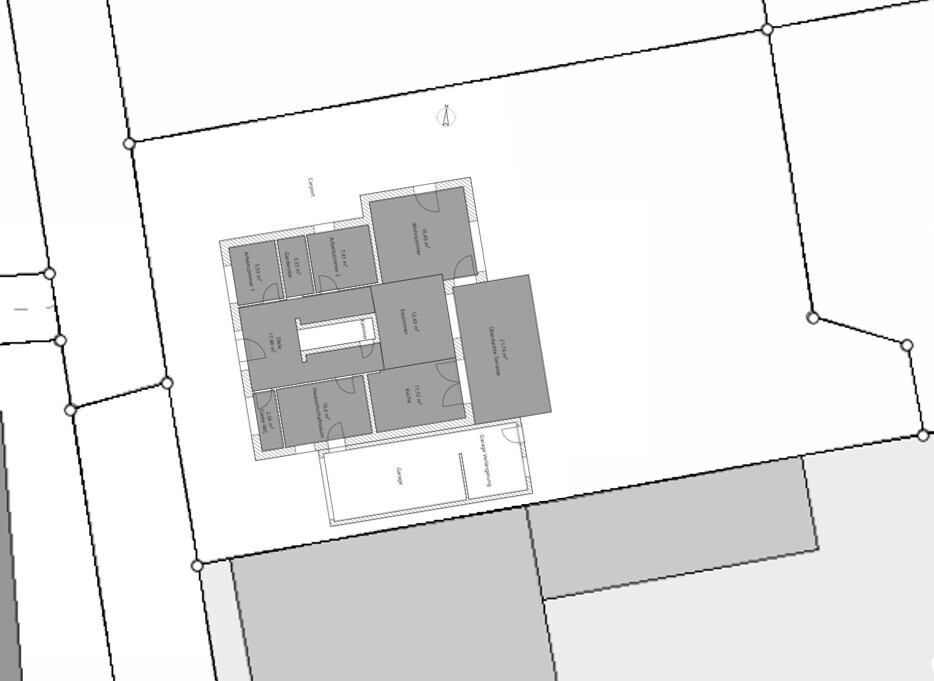
Plot size: 566 square meters (approx. 19 x 29 m (62 x 95 ft), see attachment)
The development plan follows § 34 of the Building Code.
The boundary building regulations follow common standards (i.e., a maximum of 9 m (30 ft) on one boundary and no more than 15 m (49 ft) in total on all boundaries).
A 9 m (30 ft) long garage is planned on the right side to conceal a commercial hall.
On the left side, a masonry carport with a canopy extending to the front door will be built.
Currently, we prefer the town villa architectural style but could also consider Bauhaus.
The plot mainly faces east.
Requirements of the homeowners
The project is intended for two adults and two children.
Two full stories are planned without a basement.
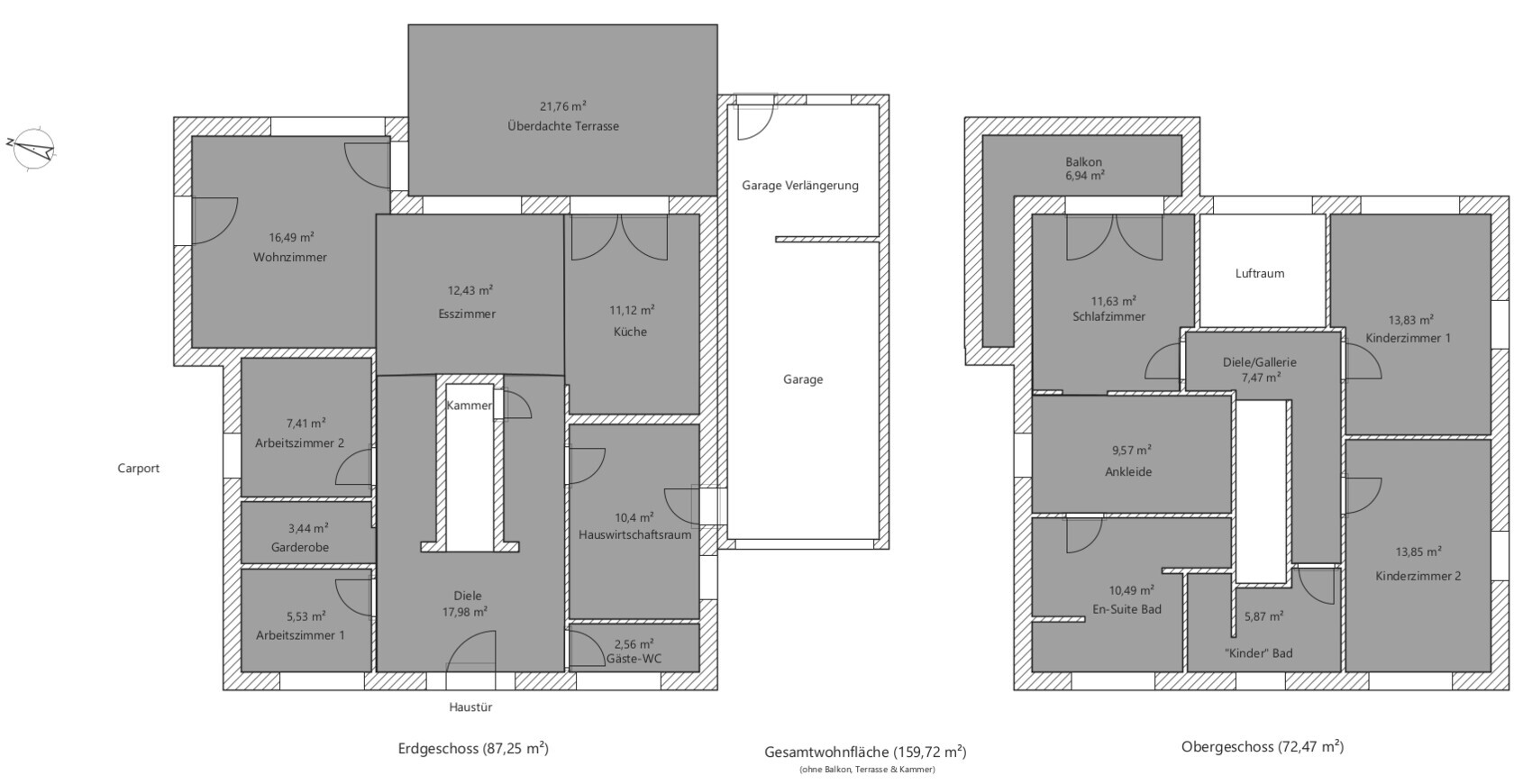
Space requirements on the ground floor: open living/dining/kitchen area; two small offices for working from home; utility room including heating/technical equipment; guest WC; cloakroom
Space requirements on the upper floor: two children’s rooms, a small bathroom, bedroom, walk-in closet, en-suite bathroom
Above the dining area, we would like to create an open void/gallery. We prefer an open, modern design.
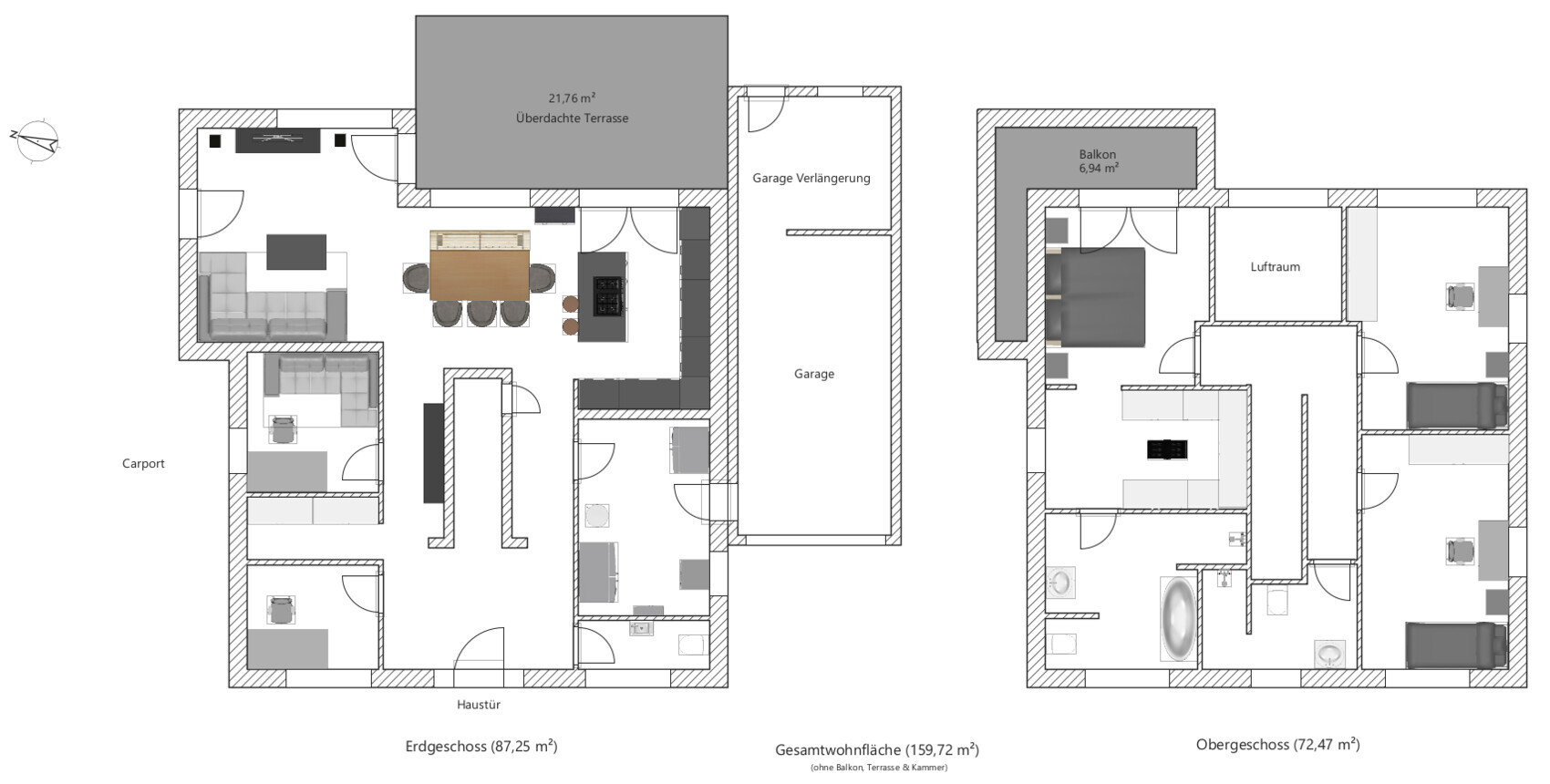
The kitchen should be open and feature a cooking island with a stove.
The sofa in the living room should be oriented to face the open living/dining/kitchen area as well as the garden.
A small balcony accessible from the bedroom is planned above the offset living room.
House Design
As a basis for planning, we used a sample floor plan from a construction company and adapted it to our preferences.
What do we especially like? Why? The open layout combining living, dining, and kitchen areas, oriented toward the garden. We are aware that this open design with an entrance hall and open void involves some sound transmission.
What do we not like? Why? The bedroom is planned relatively small but includes an adjacent walk-in closet. Laundry must be done on the ground floor in the utility room, although the wardrobes are on the upper floor.
Preferred heating system: geothermal or air-source heat pump
If you had to give up something, which details/structures
- Could you give up: balcony; passage from utility room to garage; cloakroom (if integrated into the hallway)
- Could not give up: offset living room (to avoid a simple rectangular box), open void
We are especially interested in your absolute no-gos or critical points where you think we might strongly regret something later. If you need any additional information, please let us know.
Many thanks in advance!
Best regards,
BetaVersion
Floor plan on plot:
Floor plan:
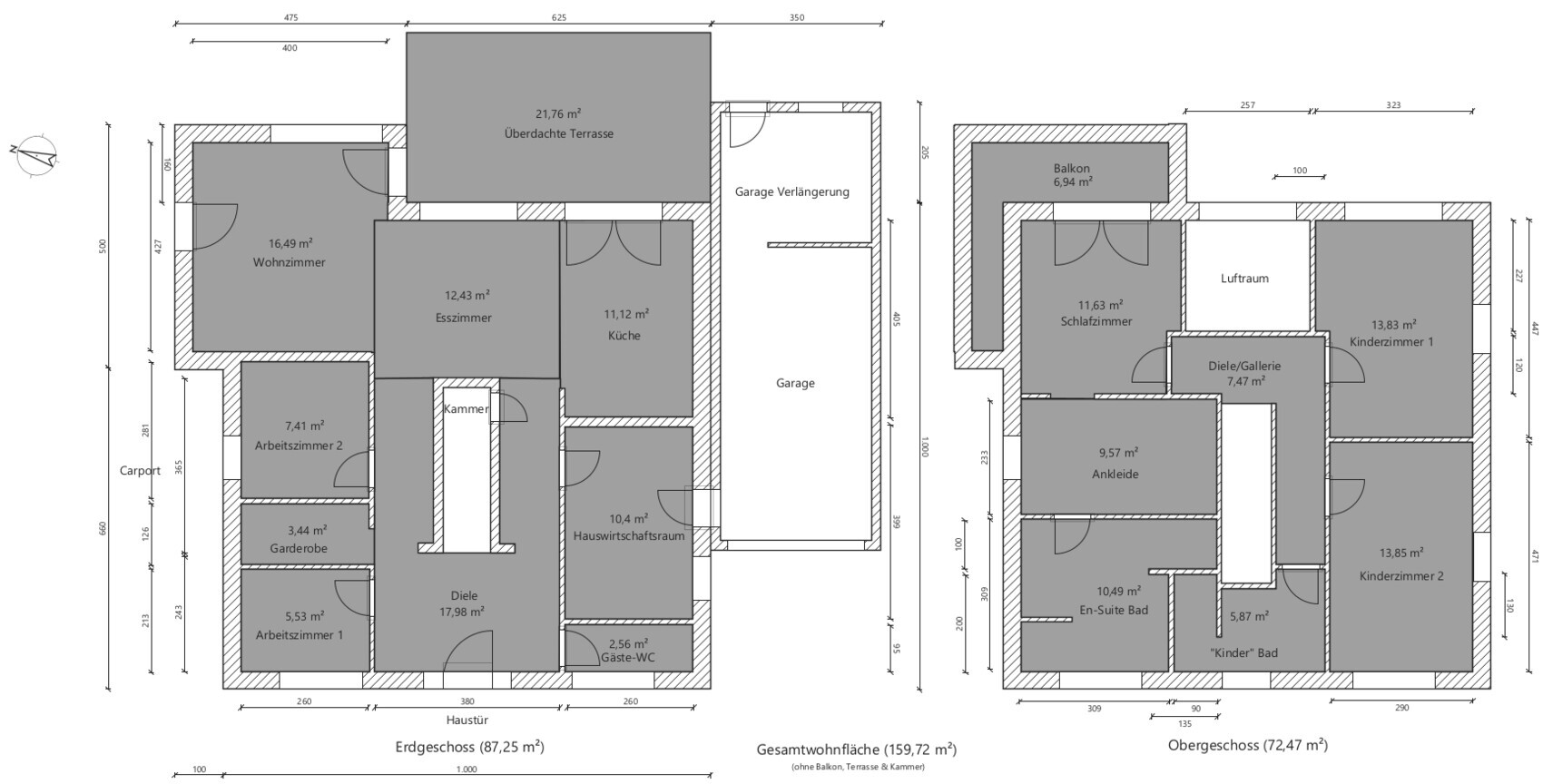
Floor plan with dimensions:
Floor plan with furniture:
We are still at the beginning of our building project but are already working on a possible floor plan to clarify our ideas. We would, of course, be interested in your feedback and suggestions for improvement. Below you will find the questionnaire completed to the best of our knowledge and attached are our drafts.
Development Plan / Restrictions
Plot size: 566 square meters (approx. 19 x 29 m (62 x 95 ft), see attachment)
The development plan follows § 34 of the Building Code.
The boundary building regulations follow common standards (i.e., a maximum of 9 m (30 ft) on one boundary and no more than 15 m (49 ft) in total on all boundaries).
A 9 m (30 ft) long garage is planned on the right side to conceal a commercial hall.
On the left side, a masonry carport with a canopy extending to the front door will be built.
Currently, we prefer the town villa architectural style but could also consider Bauhaus.
The plot mainly faces east.
Requirements of the homeowners
The project is intended for two adults and two children.
Two full stories are planned without a basement.
Space requirements on the ground floor: open living/dining/kitchen area; two small offices for working from home; utility room including heating/technical equipment; guest WC; cloakroom
Space requirements on the upper floor: two children’s rooms, a small bathroom, bedroom, walk-in closet, en-suite bathroom
Above the dining area, we would like to create an open void/gallery. We prefer an open, modern design.
The kitchen should be open and feature a cooking island with a stove.
The sofa in the living room should be oriented to face the open living/dining/kitchen area as well as the garden.
A small balcony accessible from the bedroom is planned above the offset living room.
House Design
As a basis for planning, we used a sample floor plan from a construction company and adapted it to our preferences.
What do we especially like? Why? The open layout combining living, dining, and kitchen areas, oriented toward the garden. We are aware that this open design with an entrance hall and open void involves some sound transmission.
What do we not like? Why? The bedroom is planned relatively small but includes an adjacent walk-in closet. Laundry must be done on the ground floor in the utility room, although the wardrobes are on the upper floor.
Preferred heating system: geothermal or air-source heat pump
If you had to give up something, which details/structures
- Could you give up: balcony; passage from utility room to garage; cloakroom (if integrated into the hallway)
- Could not give up: offset living room (to avoid a simple rectangular box), open void
We are especially interested in your absolute no-gos or critical points where you think we might strongly regret something later. If you need any additional information, please let us know.
Many thanks in advance!
Best regards,
BetaVersion
Floor plan on plot:
Floor plan:
Floor plan with dimensions:
Floor plan with furniture:
B
BetaVersion27 May 2025 18:16Thank you for sharing your experiences.
Regarding the bay window, we might still look into the costs – we’re quite curious about it.
@wiltshire it seems you may have mixed up the directions in our case, East and West. Still, thanks for your thoughts on this. I guess that in the home offices the lights would probably be on anyway; that’s how it currently is in my home office (east-facing), and even at work, the sensor often turns on because the daylight frequently isn’t sufficient – despite a large glass front. The bedroom would get morning sun, and the en-suite would get evening sun. One of the workrooms would likely be available quite often for the kids to do their homework.
@11ant What exactly do you mean by your “note about the justified suspicion of adopted setback areas”?
@haydee thanks for your suggestion about the utility room on the upper floor – that would definitely be helpful. But wouldn’t two showers for four people already be somewhat comfortable?
Best regards
BetaVersion
Regarding the bay window, we might still look into the costs – we’re quite curious about it.
@wiltshire it seems you may have mixed up the directions in our case, East and West. Still, thanks for your thoughts on this. I guess that in the home offices the lights would probably be on anyway; that’s how it currently is in my home office (east-facing), and even at work, the sensor often turns on because the daylight frequently isn’t sufficient – despite a large glass front. The bedroom would get morning sun, and the en-suite would get evening sun. One of the workrooms would likely be available quite often for the kids to do their homework.
@11ant What exactly do you mean by your “note about the justified suspicion of adopted setback areas”?
@haydee thanks for your suggestion about the utility room on the upper floor – that would definitely be helpful. But wouldn’t two showers for four people already be somewhat comfortable?
Best regards
BetaVersion
W
wiltshire27 May 2025 18:47BetaVersion schrieb:
In our case, the cardinal directions east and west were switched. Yeah, I realize that. It’s what happens when you’re sitting lazily in front of the computer. For the bedroom and bathroom, it definitely makes more sense. We get the morning sun through a window (we actually chose a round one for this purpose) shining directly onto our bed. It’s wonderful, and if it’s too bright too early, there’s a curtain you just shouldn’t forget to close the night before (analog house).
Regarding the bay window price: around 7 sqm (75 sq ft) it’s roughly 20,000 euros. Whether that’s "too expensive" depends somewhat on your financial flexibility. These little extras add up. If it’s something you really want and the budget feels a bit tight, I’d recommend building the bay window now and postponing the carport construction to spread out the financial burden. You can’t add the bay window later. If your home financing is stretched to the limit, forget about the bay window.
M
MachsSelbst27 May 2025 19:2210m² (108 sq ft) for a children's room might be enough if the kids are only there on weekends. Otherwise, at least 12m² (129 sq ft), preferably 14-15m² (150-161 sq ft). Anything above 18m² (194 sq ft) is probably excessive.
10m² (108 sq ft) nowadays feels like cramped living conditions...
But then 12m² (129 sq ft) for a walk-in closet... sure.
10m² (108 sq ft) nowadays feels like cramped living conditions...
But then 12m² (129 sq ft) for a walk-in closet... sure.
haydee schrieb:
Others can explain more about §34. It is not a free pass.The best approach with §34 is to look at the street layout from an aerial view to see how the neighbors have built. You need to align with them based on certain parameters.However, I have to say that first, the staircase on the ground floor (GF) is not identical to the staircase on the upper floor (UF): on the GF, it is supposed to be 243 cm (96 inches) away from the exterior wall, but upstairs it is about 170 cm (67 inches) or less. This is actually quite easy to see at first glance. Also, the "important" load-bearing walls running parallel to the stairs do not line up vertically. This can be done with additional structural effort or by using lightweight walls upstairs. Just a note.
BetaVersion schrieb:
We are aware that the open design with an open hallway and void space results in a certain amount of sound transmission.BetaVersion schrieb:
We prefer an open, modern style of construction.But I don’t think you really realize what you have actually drawn here?!
You have a corridor that is dark, and apart from the front door, there is no natural light. The two long corridors beside the staircase are over 3 meters (10 feet) long. This is a masterclass in failing to create openness. They remain just two long, narrow corridors that completely redefine the word “open.”
There is nothing modern about such narrow, tunnel-like spaces. Our old farmhouses were designed like this. Although their stairs are positioned more to one side, doubling them like you did does not improve the situation.
Now look at the upper floor: while the standard house your plan is based on at least has one side of the staircase with an open railing, you have walls on both sides. This creates a third narrow corridor—something you definitely don’t want if you aim for openness.
The real headline is the void space: it is enclosed by walls on the upper floor (not so in the reference house). This prevents loud noise upstairs, but the hallway gets no benefit from natural light at all—it simply has none.
So it can be said: the first impression is gloomy and enclosed by walls. The walls serve no useful purpose, they just elongate the building and create a cramped feeling.
You also don’t miss any mistakes: garage on the south side at the same height as the house, but then with an overhang on the terrace to block light again. Carport placed on the opposite corner... You really leave no trap unstepped.
BetaVersion schrieb:
We are particularly interested in your no-gos or critical points where you think we might strongly regret them later.Well, if openness is so important to you, then you will regret this house. Definitely!BetaVersion schrieb:
What do you like most? Why? The open design.Here we are again. Maybe it was careless that you drew it this way. But it would really be a tragedy if a general contractor agrees to build exactly like this, then you submit it for building permit/planning permission, and only at the shell construction stage do you recognize your own disaster, for which you are responsible.About the house/plot itself: in my opinion, the house shape is wrong. For this elongated plot with east orientation, a narrow, elongated house would be more appropriate. A double garage or combination building in the southwest corner, so that the house’s “ugly” wall faces the plot boundary and allows sunlight to enter the house. You can cover or green the ugly wall on your own property—it’s not rocket science.
This way, air and light get into the house, even in winter, and that creates openness.
If you then add a window that lights living spaces from the west, you achieve enough openness. A centrally positioned staircase that acts like a barrier is again counterproductive. It blocks light instead of allowing it through.
Or you locate the garage in the northwest and create a building design with a mix of one- and two-story volumes, integrating the garage so there is enough south-facing space.
A house doesn’t become Bauhaus-style just because it has a simple cube shape. I assume you like modern flat-roof houses. But their aesthetic doesn’t come merely from the cube shape, rather through offsets, overhangs, and the interplay of one- and two-story volumes that visually form a cohesive unit.
P.S. I count just under 90 m² (970 sq ft) on the ground floor. What was the budget again?
N
nordanney27 May 2025 19:59MachsSelbst schrieb:
A 10m² (108ft²) children's room might be okay if the kids are only there on weekends. Otherwise, at least 12m² (130ft²), preferably 14-15m² (150-160ft²). Anything above 18m² (190ft²) is already excessive.
10m² (108ft²) nowadays is basically like keeping them in a cage... No. What exactly do you mean by "nowadays standards"? For me, standards mean happy children. And they don’t measure their happiness in square meters, but in a happy childhood, family, and friendships.
Playing is very different today than it was in my time. Small children are only like before for a few years (but nowadays they have much more toys).
P.S. There used to be a DIN standard that specified 8.5m² (91ft²) for a children’s room. Unbelievable by today’s standards, especially since surveys show parents nowadays prefer 16-20m² (170-215ft²) for their child’s room.
B
BetaVersion27 May 2025 20:35Good evening again and thank you for all your contributions.
@ypg Unfortunately, our drawing is a bit unclear, sorry. The air space towards the gallery should, of course, remain open or only be separated by a railing, and the right wall of the staircase on the upper floor should only be half-height—similar to the original floor plan. This way, there is naturally much more daylight in the upper hallway. By the way, the first three steps of the staircase on the ground floor extend into the entrance hall, which is why the stairs on the ground and upper floors appear offset. We thought that by opening up the two "tubes" on the ground floor, they would at least be brighter than in the original floor plan, where the entrance area is separated by two doors.
At the moment, we prefer the city villa style over the Bauhaus style, which additionally allows for storage space in the attic. The size of the walk-in closet is currently based more on the overall layout of the upper floor. Does anyone have any ideas on how the children’s rooms could be made larger while reducing the size of the parent area? After all, children’s clothing would also be stored in the walk-in closet (for example, winter clothes during summer), so the children’s rooms could have more space on the other side.
Have a nice evening, everyone!
@ypg Unfortunately, our drawing is a bit unclear, sorry. The air space towards the gallery should, of course, remain open or only be separated by a railing, and the right wall of the staircase on the upper floor should only be half-height—similar to the original floor plan. This way, there is naturally much more daylight in the upper hallway. By the way, the first three steps of the staircase on the ground floor extend into the entrance hall, which is why the stairs on the ground and upper floors appear offset. We thought that by opening up the two "tubes" on the ground floor, they would at least be brighter than in the original floor plan, where the entrance area is separated by two doors.
At the moment, we prefer the city villa style over the Bauhaus style, which additionally allows for storage space in the attic. The size of the walk-in closet is currently based more on the overall layout of the upper floor. Does anyone have any ideas on how the children’s rooms could be made larger while reducing the size of the parent area? After all, children’s clothing would also be stored in the walk-in closet (for example, winter clothes during summer), so the children’s rooms could have more space on the other side.
Have a nice evening, everyone!
Similar topics