
ᐅ Floor plan of a detached single-family house approximately 200 m² with two separate living units
Created on: 23 Feb 2023 23:30
T
ThomasMagmar
Preliminary note: This is not a specific building project, but it is something that may happen in the future if possible. Many of my friends have recently built houses and are currently in the process, but for myself it will still take some time. However, since I am quite interested in the subject and have skills in 3D design, I have started to think about how my "dream house" should look. I am fully aware that the floor plan may still change due to the location.
Therefore, I don’t need comments about how planning like this in advance doesn’t make sense. My goal is to see what is roughly possible and reasonable or not, and to gain more experience.
Development plan / restrictions Not available
Client requirements
Style, roof shape, building type: Modern, gable roof, future-oriented
Basement, floors: No basement, 2 floors + attic area for storage
Number of occupants, age: 2 adults + 2 children
Space requirement on ground floor and upper floor: Approximately 90m² (970 sq ft) each
Office: Family use or home office? Yes
Occasional guests per year: Possible but not planned
Open or closed architecture: Rather closed
Conservative or modern construction: Mixed
Open kitchen, kitchen island: Partly, no
Number of dining seats: 2 with couch ^^
Fireplace: No
Music / stereo wall: Probably
Balcony, roof terrace: Yes, yes
Garage, carport: Garage
Utility garden, greenhouse: Possibly garden shed
If possible, the garden should face south, among other reasons because photovoltaics will be used.
House design
Who planned it: Do-it-yourself with Inventor!
What do you especially like: The use of the house for several life phases
What do you dislike? Why? More difficult / expensive utility connections, presumed costs ^^
Price estimate according to architect / planner: Own estimate 600k without land
Personal price limit for the house including equipment: Currently unclear
Preferred heating technology: Air-to-water heat pump
If you have to give up certain details / expansions
- Can give up: Large utility room, changing room
- Cannot give up: Terrace
Why did the design turn out the way it is? For example:
I tried to create a floor plan that keeps the house practical for different stages of life. Both the ground floor and the upper floor can be used as independent apartments with minor modifications, for example when the children are not yet there, when they move out, or if the marriage should break down. Depending on the situation, either one floor or both can be rented out. The garage and utility room remain accessible to both floors. In addition, features such as photovoltaics, KNX (home automation system), empty conduits etc. should prepare the house for the future.
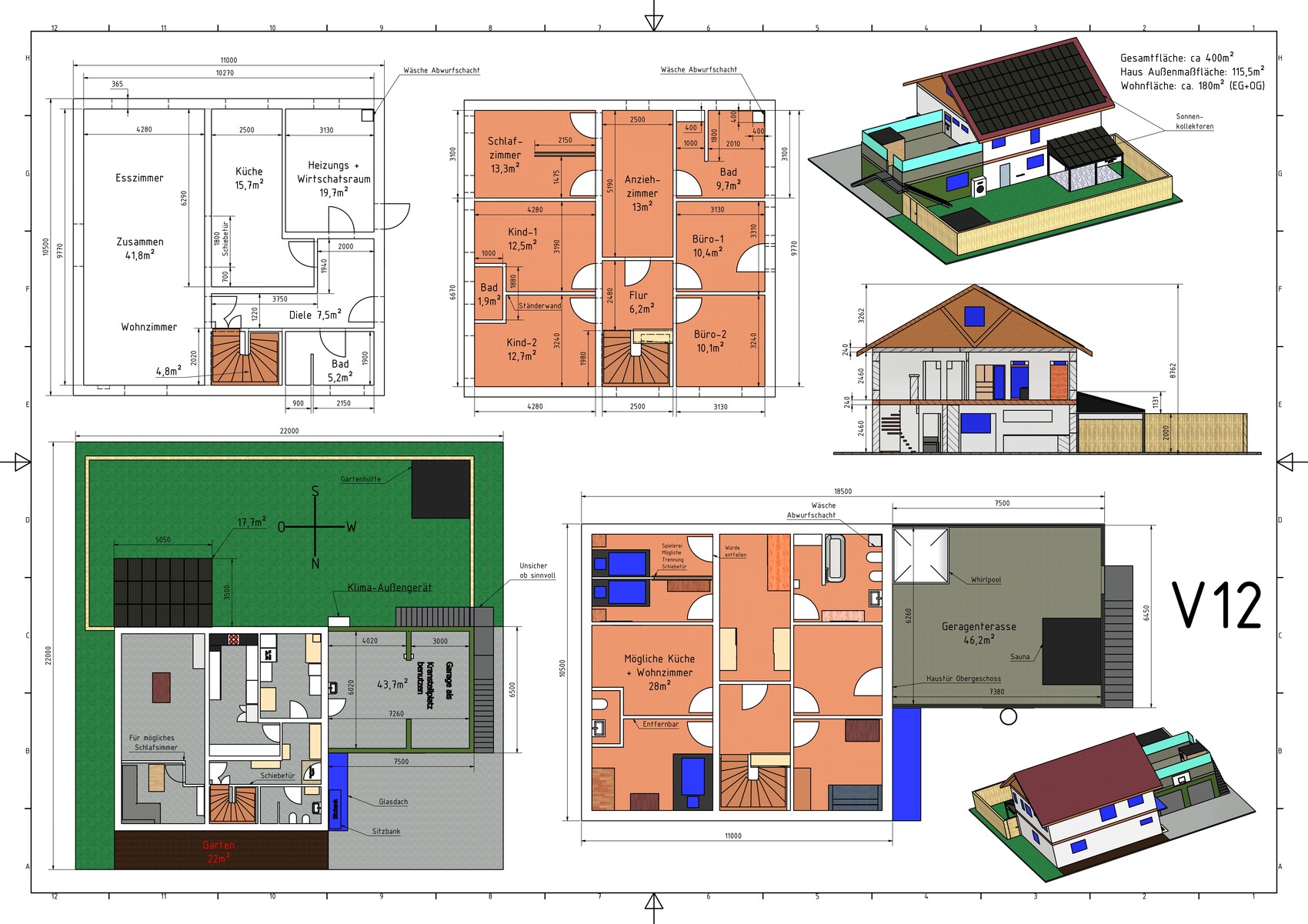
Therefore, I don’t need comments about how planning like this in advance doesn’t make sense. My goal is to see what is roughly possible and reasonable or not, and to gain more experience.
Development plan / restrictions Not available
Client requirements
Style, roof shape, building type: Modern, gable roof, future-oriented
Basement, floors: No basement, 2 floors + attic area for storage
Number of occupants, age: 2 adults + 2 children
Space requirement on ground floor and upper floor: Approximately 90m² (970 sq ft) each
Office: Family use or home office? Yes
Occasional guests per year: Possible but not planned
Open or closed architecture: Rather closed
Conservative or modern construction: Mixed
Open kitchen, kitchen island: Partly, no
Number of dining seats: 2 with couch ^^
Fireplace: No
Music / stereo wall: Probably
Balcony, roof terrace: Yes, yes
Garage, carport: Garage
Utility garden, greenhouse: Possibly garden shed
If possible, the garden should face south, among other reasons because photovoltaics will be used.
House design
Who planned it: Do-it-yourself with Inventor!
What do you especially like: The use of the house for several life phases
What do you dislike? Why? More difficult / expensive utility connections, presumed costs ^^
Price estimate according to architect / planner: Own estimate 600k without land
Personal price limit for the house including equipment: Currently unclear
Preferred heating technology: Air-to-water heat pump
If you have to give up certain details / expansions
- Can give up: Large utility room, changing room
- Cannot give up: Terrace
Why did the design turn out the way it is? For example:
I tried to create a floor plan that keeps the house practical for different stages of life. Both the ground floor and the upper floor can be used as independent apartments with minor modifications, for example when the children are not yet there, when they move out, or if the marriage should break down. Depending on the situation, either one floor or both can be rented out. The garage and utility room remain accessible to both floors. In addition, features such as photovoltaics, KNX (home automation system), empty conduits etc. should prepare the house for the future.
T
ThomasMagmar24 Feb 2023 12:58kbt09 schrieb:
You have preset opinions and don’t really want to experiment with floor plans, but have already fallen in love with your layout. You can tell from comments like
And, what’s the point of a children’s toilet that would also need two unmarked entrances if the rest has to go through the master bathroom? Better to have a centrally located, easily accessible bathroom for all upstairs residents. Especially since the toilet drain would end up in the living room 😉
If the entrance is just a dresser, where are coats and such supposed to go, especially for a household of four with children?
Regarding the drawings... there are standard drawing conventions:
- Tall cabinets shown as boxes with a cross
- Wall cabinets as boxes with a diagonal line
- Dressers, etc., simply boxes
Stairs... a few centimeters here, a few centimeters there... with a two-unit plan, you also have to remember that beds, sofas, and so on will be carried upstairs. It’s better to plan a bit generously on a sketch than too tight.The doors of the children’s bathroom would open toward the partition wall between the two rooms.
Theoretically, office 2 and the bathroom could be swapped, but that wouldn’t only have advantages either.
Can you speak from experience (from others) whether this is so disruptive (in terms of noise or odor) that it is definitely to be avoided? It’s not like the toilet flush is being used continuously.
I will make sure to add these drawing conventions to the floor plan.
For larger furniture and so on upstairs, I already have a separate entrance via the balcony.
T
ThomasMagmar24 Feb 2023 13:09kbt09 schrieb:
I'm out of this ... sorry, but I can't and don't want to understand your approaches. Especially since this is all theoretical because there is no plot of land.Okay, no problem, and thanks anyway for your comments. That’s why I mentioned in advance that there is no plot of land yet. Those who find this too "theoretical," as you say, are welcome to ignore the thread. However, some may still find interesting discussions or ideas here.
ThomasMagmar schrieb:
Thanks in advance for the response, the first one that doesn’t just feel like pure "destruction" to me 🙂 Perhaps @mayglow should clarify that their post is not intended as a dismissive "you can keep it."
@ThomasMagmar Just realize that a "nicer" comment among 10 "destructive" ones doesn’t automatically mean: "great, go ahead."
The design is and remains poor, even with some room changes. The location of the staircase alone makes it impossible for this to be a two-family house.
There is no point in sugarcoating or justifying it here. These are ill-thought-out experiments.
I’m out.
C
Costruttrice24 Feb 2023 13:14ThomasMagmar schrieb:
I would need to test somehow how much noise could actually be caused by it in practice.We once had a walk-in closet with a sliding door in the bedroom, custom-made by a carpenter. Because we have different waking times, we thought it would be nice to quietly pick out clothes in the morning and get dressed after showering. But even the sliding door made noise, despite a track on the floor and a damper at the end. The loudest noise was when the door was pulled the last bit to fully close it. It didn’t help much; you could still hear everything inside the closet that you would hear without the door, just slightly muffled.
We could have invested the money for the custom work better elsewhere.

Furnish the dressing room, which, if I’m correct, should also include the wardrobe. Consider where you will stand to get dressed and the pathways, for example, if someone wants to get to the bathroom. Even though the room is so large, it doesn’t work for me. I would rather opt for a bathroom that is easily accessible for everyone.
Regarding the bedroom setup: a mattress gives way, so sliding a door over it won’t provide a satisfactory solution. Either there will be a gap when you lie down, or the mechanism will jam when you’re not on it, or it will rattle when you turn around. Eventually, the bed will need to be replaced, and then the height won’t fit anymore. My conclusion is: it might have seemed like a fun idea at first, but it’s impractical. Bringing in and assembling a double bed there will be challenging, if possible at all. I also find the short wall unappealing because it creates a cramped feeling. To minimize disruption, you planned a dressing room for changing clothes, and if someone wants to sleep separately, a completely separate space is definitely more comfortable.
About the kitchen and window: Keep in mind that you won’t benefit if the window is hidden behind cabinets. It’s not impossible to set up a kitchen on 2.50 m (8 feet) width, as row houses often do. But here you’re talking about a 200 m² (2,150 sq ft) dream house with all possibilities open, right? It’s also a bit odd to have a narrow hallway next to the kitchen passage like that.
Please, please don’t fall too in love with the current floor plan. I simply don’t believe all the described problems can be fixed by moving a wall 10 cm (4 inches). It probably isn’t structurally feasible either. Neither the upper floor nor the ground floor seems quite right, neither as a two-unit solution nor as one single dwelling.
Regarding “what happens after 10 years”: Option A) one or both children stay longer in the house than expected. Option B) parents find a new hobby and appreciate the extra space. Option C) you find a solution by then and clearly understand what space you actually need. Option D) you move again to something smaller. Option E) you try to keep a few areas adaptable in mind (e.g., a separable stairway) but don’t design everything around uncertain future demands. You could also consider planning smaller now, focusing on what you need currently without always keeping “if this part is separated, then a kitchen could go here” in mind.
Regarding the bedroom setup: a mattress gives way, so sliding a door over it won’t provide a satisfactory solution. Either there will be a gap when you lie down, or the mechanism will jam when you’re not on it, or it will rattle when you turn around. Eventually, the bed will need to be replaced, and then the height won’t fit anymore. My conclusion is: it might have seemed like a fun idea at first, but it’s impractical. Bringing in and assembling a double bed there will be challenging, if possible at all. I also find the short wall unappealing because it creates a cramped feeling. To minimize disruption, you planned a dressing room for changing clothes, and if someone wants to sleep separately, a completely separate space is definitely more comfortable.
About the kitchen and window: Keep in mind that you won’t benefit if the window is hidden behind cabinets. It’s not impossible to set up a kitchen on 2.50 m (8 feet) width, as row houses often do. But here you’re talking about a 200 m² (2,150 sq ft) dream house with all possibilities open, right? It’s also a bit odd to have a narrow hallway next to the kitchen passage like that.
Please, please don’t fall too in love with the current floor plan. I simply don’t believe all the described problems can be fixed by moving a wall 10 cm (4 inches). It probably isn’t structurally feasible either. Neither the upper floor nor the ground floor seems quite right, neither as a two-unit solution nor as one single dwelling.
Regarding “what happens after 10 years”: Option A) one or both children stay longer in the house than expected. Option B) parents find a new hobby and appreciate the extra space. Option C) you find a solution by then and clearly understand what space you actually need. Option D) you move again to something smaller. Option E) you try to keep a few areas adaptable in mind (e.g., a separable stairway) but don’t design everything around uncertain future demands. You could also consider planning smaller now, focusing on what you need currently without always keeping “if this part is separated, then a kitchen could go here” in mind.
Similar topics