
ᐅ Floor plan of a detached single-family house approximately 200 m² with two separate living units
Created on: 23 Feb 2023 23:30
T
ThomasMagmar
Preliminary note: This is not a specific building project, but it is something that may happen in the future if possible. Many of my friends have recently built houses and are currently in the process, but for myself it will still take some time. However, since I am quite interested in the subject and have skills in 3D design, I have started to think about how my "dream house" should look. I am fully aware that the floor plan may still change due to the location.
Therefore, I don’t need comments about how planning like this in advance doesn’t make sense. My goal is to see what is roughly possible and reasonable or not, and to gain more experience.
Development plan / restrictions Not available
Client requirements
Style, roof shape, building type: Modern, gable roof, future-oriented
Basement, floors: No basement, 2 floors + attic area for storage
Number of occupants, age: 2 adults + 2 children
Space requirement on ground floor and upper floor: Approximately 90m² (970 sq ft) each
Office: Family use or home office? Yes
Occasional guests per year: Possible but not planned
Open or closed architecture: Rather closed
Conservative or modern construction: Mixed
Open kitchen, kitchen island: Partly, no
Number of dining seats: 2 with couch ^^
Fireplace: No
Music / stereo wall: Probably
Balcony, roof terrace: Yes, yes
Garage, carport: Garage
Utility garden, greenhouse: Possibly garden shed
If possible, the garden should face south, among other reasons because photovoltaics will be used.
House design
Who planned it: Do-it-yourself with Inventor!
What do you especially like: The use of the house for several life phases
What do you dislike? Why? More difficult / expensive utility connections, presumed costs ^^
Price estimate according to architect / planner: Own estimate 600k without land
Personal price limit for the house including equipment: Currently unclear
Preferred heating technology: Air-to-water heat pump
If you have to give up certain details / expansions
- Can give up: Large utility room, changing room
- Cannot give up: Terrace
Why did the design turn out the way it is? For example:
I tried to create a floor plan that keeps the house practical for different stages of life. Both the ground floor and the upper floor can be used as independent apartments with minor modifications, for example when the children are not yet there, when they move out, or if the marriage should break down. Depending on the situation, either one floor or both can be rented out. The garage and utility room remain accessible to both floors. In addition, features such as photovoltaics, KNX (home automation system), empty conduits etc. should prepare the house for the future.
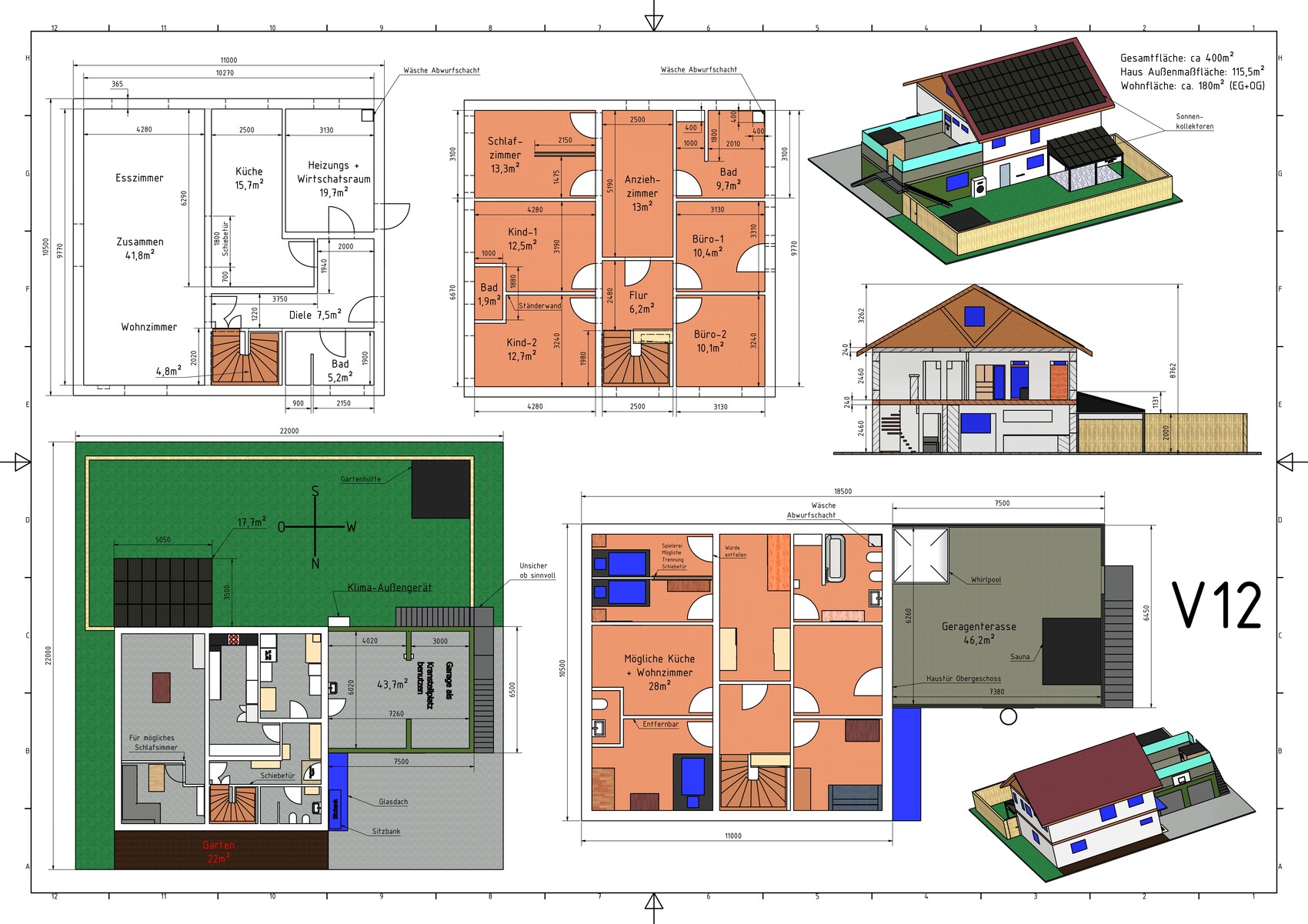
Therefore, I don’t need comments about how planning like this in advance doesn’t make sense. My goal is to see what is roughly possible and reasonable or not, and to gain more experience.
Development plan / restrictions Not available
Client requirements
Style, roof shape, building type: Modern, gable roof, future-oriented
Basement, floors: No basement, 2 floors + attic area for storage
Number of occupants, age: 2 adults + 2 children
Space requirement on ground floor and upper floor: Approximately 90m² (970 sq ft) each
Office: Family use or home office? Yes
Occasional guests per year: Possible but not planned
Open or closed architecture: Rather closed
Conservative or modern construction: Mixed
Open kitchen, kitchen island: Partly, no
Number of dining seats: 2 with couch ^^
Fireplace: No
Music / stereo wall: Probably
Balcony, roof terrace: Yes, yes
Garage, carport: Garage
Utility garden, greenhouse: Possibly garden shed
If possible, the garden should face south, among other reasons because photovoltaics will be used.
House design
Who planned it: Do-it-yourself with Inventor!
What do you especially like: The use of the house for several life phases
What do you dislike? Why? More difficult / expensive utility connections, presumed costs ^^
Price estimate according to architect / planner: Own estimate 600k without land
Personal price limit for the house including equipment: Currently unclear
Preferred heating technology: Air-to-water heat pump
If you have to give up certain details / expansions
- Can give up: Large utility room, changing room
- Cannot give up: Terrace
Why did the design turn out the way it is? For example:
I tried to create a floor plan that keeps the house practical for different stages of life. Both the ground floor and the upper floor can be used as independent apartments with minor modifications, for example when the children are not yet there, when they move out, or if the marriage should break down. Depending on the situation, either one floor or both can be rented out. The garage and utility room remain accessible to both floors. In addition, features such as photovoltaics, KNX (home automation system), empty conduits etc. should prepare the house for the future.
H
hanghaus202324 Feb 2023 10:15The room layout should be created first before making a 3D drawing. Your views are visually overwhelming.
As a general rule, the plot should be oriented towards the north, and the floor plans aligned accordingly.
Being able to use a 3D program should not lead you to believe you can design a house on your own.
As a general rule, the plot should be oriented towards the north, and the floor plans aligned accordingly.
Being able to use a 3D program should not lead you to believe you can design a house on your own.

Just some random points.
Keep in mind that you usually plan with rough structural dimensions. A 1m (3 ft) wide toilet room will feel very cramped once you factor in the necessary clearances.
Regarding the kitchen: look at where natural light currently comes into the room. I also feel our townhouse kitchen could be brighter and less cramped. Do you not cook much?
You often place the doors right up against the corners. Check if you want to leave enough space behind them for a cabinet or storage.
Have you looked into sliding doors anywhere? Proper sliding doors usually require at least as much space on the side where the door slides into. Alternatively, there are folding doors. The question is whether they are really practical or attractive in the places you’re currently planning. It seems to me that sliding doors are your go-to solution for flexibility and tight corners. I would have some doubts about that.
In the bedroom, I don’t quite understand your concept. A sliding door between two single beds, and if you want to cuddle, you leave it open and push the beds together? Or am I misunderstanding the idea? I think practically there will be a standard approach: either the door is always open or always closed if you prefer separate sleeping areas. Personally, I would plan a regular shared bedroom and put a sofa bed or similar as an alternative option in one of the offices.
Instead of trying to plan the perfect layout for every life stage, it might make more sense to create a solid plan for the next 10 years.
Keep in mind that you usually plan with rough structural dimensions. A 1m (3 ft) wide toilet room will feel very cramped once you factor in the necessary clearances.
Regarding the kitchen: look at where natural light currently comes into the room. I also feel our townhouse kitchen could be brighter and less cramped. Do you not cook much?
You often place the doors right up against the corners. Check if you want to leave enough space behind them for a cabinet or storage.
Have you looked into sliding doors anywhere? Proper sliding doors usually require at least as much space on the side where the door slides into. Alternatively, there are folding doors. The question is whether they are really practical or attractive in the places you’re currently planning. It seems to me that sliding doors are your go-to solution for flexibility and tight corners. I would have some doubts about that.
In the bedroom, I don’t quite understand your concept. A sliding door between two single beds, and if you want to cuddle, you leave it open and push the beds together? Or am I misunderstanding the idea? I think practically there will be a standard approach: either the door is always open or always closed if you prefer separate sleeping areas. Personally, I would plan a regular shared bedroom and put a sofa bed or similar as an alternative option in one of the offices.
Instead of trying to plan the perfect layout for every life stage, it might make more sense to create a solid plan for the next 10 years.
T
ThomasMagmar24 Feb 2023 10:53hanghaus2023 schrieb:
You should create the room layout first before making a 3D drawing. Your views are painful to look at.
Usually, the property should be oriented towards the north, and then the floor plans aligned accordingly.
Being able to operate a 3D program shouldn’t make you think you can design a house yourself. I completely disagree. A 3D program is used to visualize your ideas to others. And this is exactly where mistakes can already be corrected in advance. It is also clear that a more detailed plan using appropriate software must be created later and approved by an architect. However, when it comes to the rough room layout, I don’t see that as necessary. It’s about what makes (no) sense and what just isn’t feasible.
I have no idea what you mean by your orientation. I chose the cardinal directions so that the terrace is on the south side, as well as the solar panels. The street could theoretically be either on the north side (running west to east) or the east side (running north to south). As mentioned before, I am fully aware that there are regulations to be followed on a property like this.
PS: I have no tolerance for remarks like "painful to look at."
Well, there are a few points where it’s advisable to get informed first:
- Garages can usually be built right up to the property boundary, but the use of the area on top of the garage must comply with the 3m (10 feet) setback rule... so a fence or similar barrier should be installed to prevent entering the 3m (10 feet) distance to the neighboring property.
- Stairs... there is a stair layout overview at https://www.hausbau-forum.de/threads/grundriss-planung-unbedingt-vor-beitrag-erstellung-lesen.11714/ with some minimum dimensions.
- Utility rooms should always be planned facing the street or positioned so that no other building parts block the entire supply line. This should at least be avoided.
- Hallways—yes, they should probably be space-saving, but they should also be designed so that larger items can be carried around the corner and to maintain a certain welcoming atmosphere in the house.
- Children’s bathroom... just a toilet or what? Where are the kids supposed to shower? Generally, when planning bathrooms, consider built-up walls for toilet wastewater pipes, etc., and also take into account the floor below.
- Kitchen... it’s worth putting some thought into the planning here as well. It’s always practical to have access from the kitchen to the garden or barbecue area.
- Regarding stair location and room layout upstairs, I don’t see how a separate apartment with its own entrance can be sensibly separated there. A door directly at the first stair step is rather unsafe.
- Closets, etc.—it’s unpleasant to enter a house or room and have a tall closet immediately next to the entrance door. It reduces the feeling of space.
- Closets... rooms should be designed so that doors don’t open into the corners of a room if possible. About 70cm (27.5 inches) distance from the wall is nicer, then a full closet row fits on the wall behind the door (like in your upstairs rooms), otherwise you often end up facing a tall closet again.
- So... study floor plans, follow the threads here, and learn from them 😉
- Garages can usually be built right up to the property boundary, but the use of the area on top of the garage must comply with the 3m (10 feet) setback rule... so a fence or similar barrier should be installed to prevent entering the 3m (10 feet) distance to the neighboring property.
- Stairs... there is a stair layout overview at https://www.hausbau-forum.de/threads/grundriss-planung-unbedingt-vor-beitrag-erstellung-lesen.11714/ with some minimum dimensions.
- Utility rooms should always be planned facing the street or positioned so that no other building parts block the entire supply line. This should at least be avoided.
- Hallways—yes, they should probably be space-saving, but they should also be designed so that larger items can be carried around the corner and to maintain a certain welcoming atmosphere in the house.
- Children’s bathroom... just a toilet or what? Where are the kids supposed to shower? Generally, when planning bathrooms, consider built-up walls for toilet wastewater pipes, etc., and also take into account the floor below.
- Kitchen... it’s worth putting some thought into the planning here as well. It’s always practical to have access from the kitchen to the garden or barbecue area.
- Regarding stair location and room layout upstairs, I don’t see how a separate apartment with its own entrance can be sensibly separated there. A door directly at the first stair step is rather unsafe.
- Closets, etc.—it’s unpleasant to enter a house or room and have a tall closet immediately next to the entrance door. It reduces the feeling of space.
- Closets... rooms should be designed so that doors don’t open into the corners of a room if possible. About 70cm (27.5 inches) distance from the wall is nicer, then a full closet row fits on the wall behind the door (like in your upstairs rooms), otherwise you often end up facing a tall closet again.
- So... study floor plans, follow the threads here, and learn from them 😉
Hmm... I’m not going to explain the basics of design, including the importance and understanding of building codes, to someone who thinks they can design houses. This is a planning thread, where such knowledge should be assumed.
A floor plan that needs to be explained to someone involved in design is usually not functional. I find your explanations about daily routines or behavioral patterns somewhat odd: good planning means, for example, that every resident can reach the main bathroom quickly without practically having to place a "toilet in the room."
A bedroom is legally considered a living space and is therefore subject to regulations, whether you see it that way or not.
A hallway is an important element in a house to connect different areas.
Even if you don’t see it that way, it is possible to design a room to be bright and functional by maintaining correct wall proportions, positioning windows so that even the far corner receives some daylight, routing plumbing sensibly from the upper floor to the ground floor, separating areas without using awkward walls, avoiding door collisions, and ensuring sliding doors operate smoothly.
Experimenting is helpful and good, but please don’t try to present ignorance or childish approaches as functional and suitable for everyday use. Approach the topic realistically and, above all, with self-reflection… ideally, start with some self-study on design while searching for a plot of land...
A floor plan that needs to be explained to someone involved in design is usually not functional. I find your explanations about daily routines or behavioral patterns somewhat odd: good planning means, for example, that every resident can reach the main bathroom quickly without practically having to place a "toilet in the room."
A bedroom is legally considered a living space and is therefore subject to regulations, whether you see it that way or not.
A hallway is an important element in a house to connect different areas.
Even if you don’t see it that way, it is possible to design a room to be bright and functional by maintaining correct wall proportions, positioning windows so that even the far corner receives some daylight, routing plumbing sensibly from the upper floor to the ground floor, separating areas without using awkward walls, avoiding door collisions, and ensuring sliding doors operate smoothly.
Experimenting is helpful and good, but please don’t try to present ignorance or childish approaches as functional and suitable for everyday use. Approach the topic realistically and, above all, with self-reflection… ideally, start with some self-study on design while searching for a plot of land...
C
Costruttrice24 Feb 2023 11:14ThomasMagmar schrieb:
When separating the bedroom (and also the toilet in the children's bedrooms – I will address this later), I am not sure myself whether this makes sense or not. My main reason is to avoid waking up my partner, whether someone gets up earlier, is sick, or if the baby monitor wakes only one of them. Just because you plan a sliding door between two beds, it doesn’t reduce disturbances for the other person compared to having no door. A sliding door does not block sound.
What added value do you expect from a children’s bathroom without a shower?
I also find it odd that a walk-in closet is planned to be larger than a child’s bedroom. Of course, you could argue that 12sqm (130 sq ft) is enough because it was sufficient for you. But in a new build with so much space, you should really be able to get more out of it. Or do your friends all build like that too?
In my opinion, 600k will not be enough for the project either.
Similar topics