
ᐅ Suggestions for Floor Plan Improvements for a Single-Family House on a South-Facing Slope
Created on: 5 Feb 2023 20:02
I
Indahaus
Hello everyone,
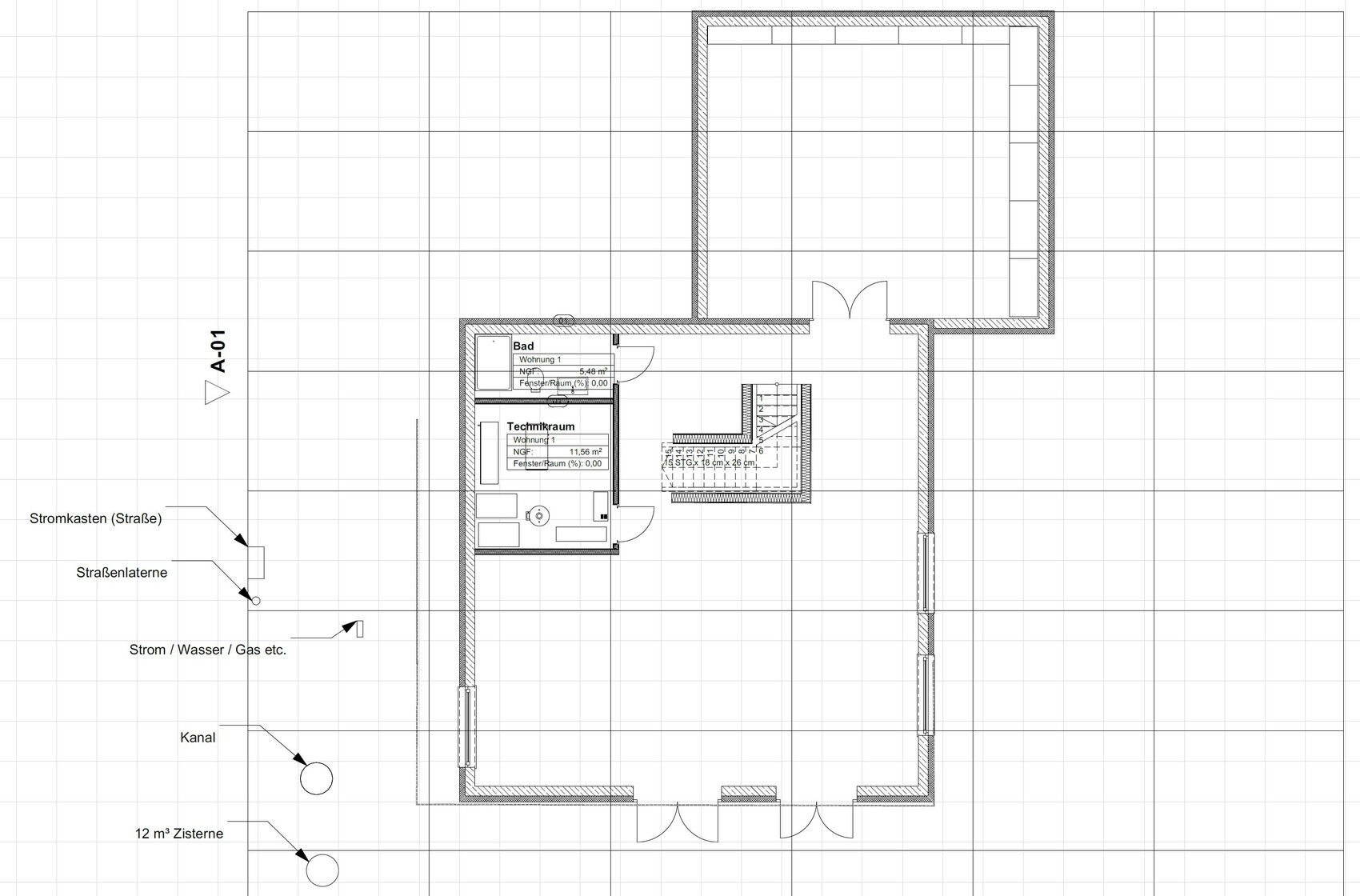
after purchasing the plot in February last year, which was fully serviced by the end of last year, we have been gathering inspiration and planning ever since. Despite rising costs and interest rates, we are excited about building our house, including some DIY work.
Development Plan / Restrictions
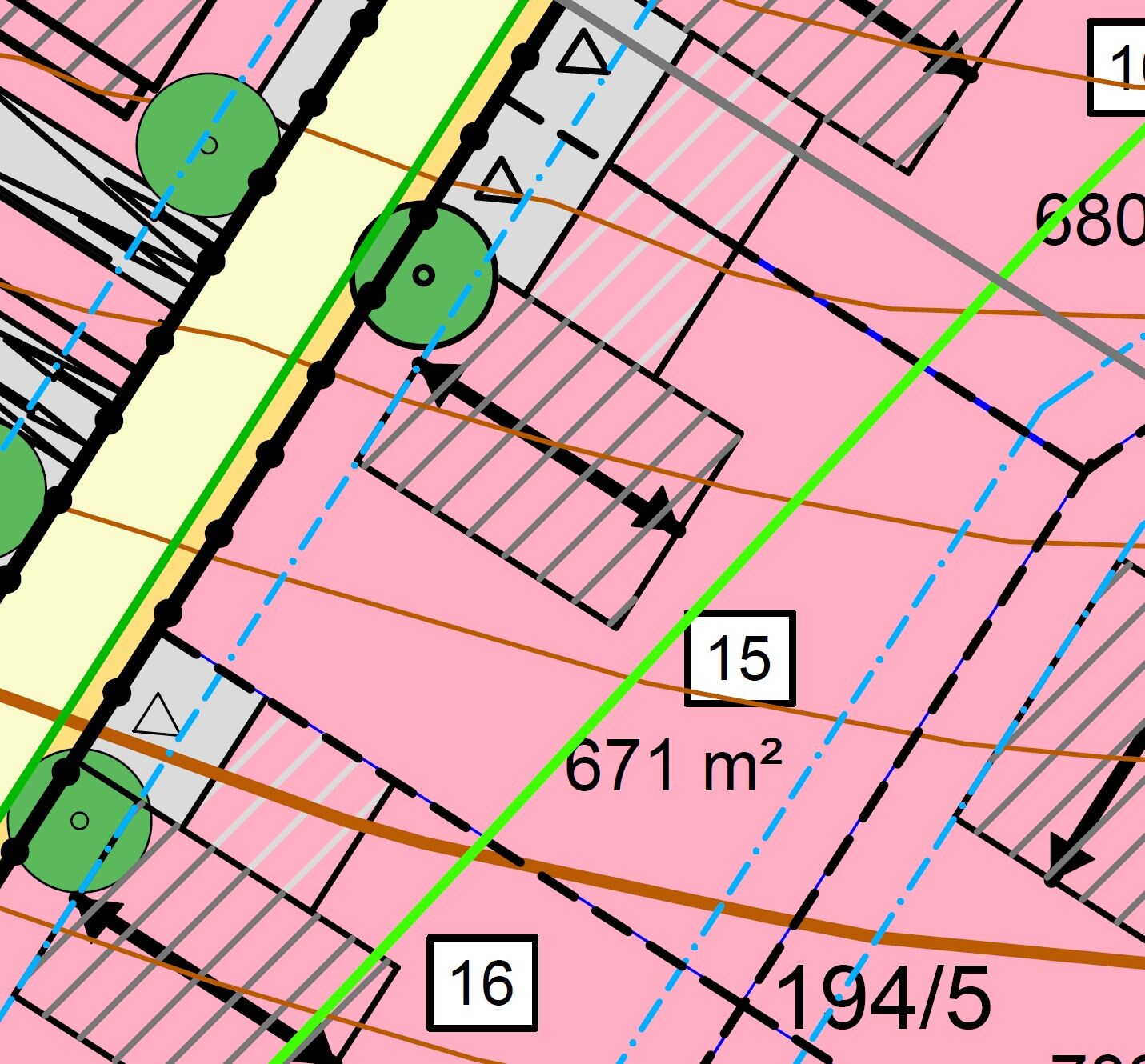
Plot size: 669 m² (7200 sq ft approx.)
Slope: South-facing slope, 3.90 m (12.8 ft) diagonal (approx. 7.3° incline at the street side)
Site occupancy index: 0.4
Floor area ratio: 0.7
Building window, building line and boundary: 3 meters (10 ft) or setback areas
Edge development: garage
Number of parking spaces: two per dwelling unit in front of garages, minimum 5 meters (16 ft)
Number of stories: 3 full stories (basement, ground floor, upper floor)
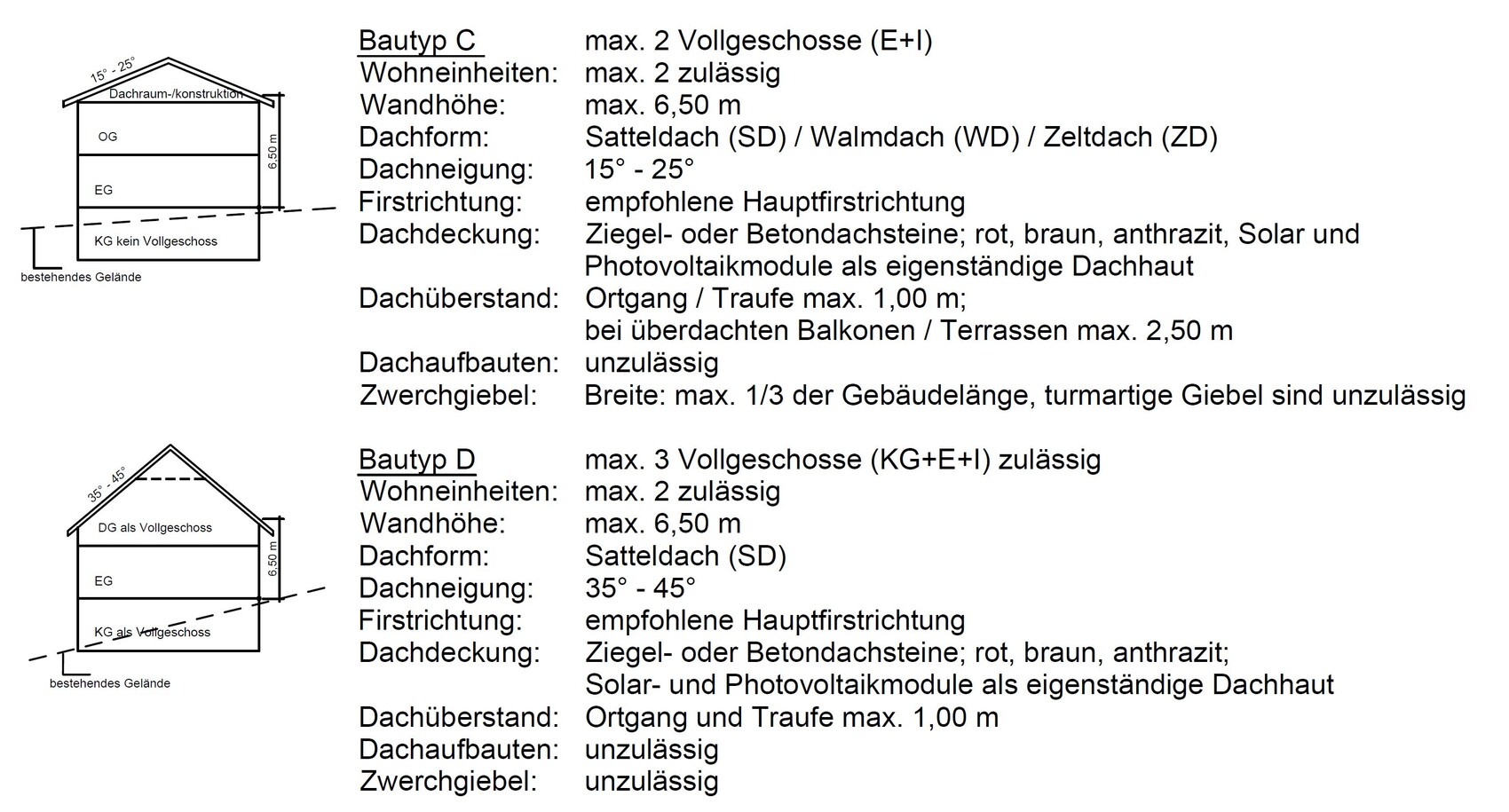
Roof style: gable roof with 35° to 45° pitch (if basement is not a full floor, then 15° to 25°)
Architectural style
Orientation: see draft sketch
Maximum heights / limits: wall height 6.50 m (21.3 ft) measured from finished floor level of the ground floor to the junction of wall and exterior roof surface
Additional requirements: garage roof as flat roof with green roofing, at least 40% photovoltaic panels
Homeowners’ Requirements
Style, roof type, building type: no decision yet on wood or masonry (affordable ecological)
Basement, floors: 2 plus basement suitable as living space
Number of occupants, age: 2 persons, both 26 years old
Space requirements on ground and upper floors: see draft sketch
Office: family use or home office? home office
Overnight guests per year: few
Open or closed architecture: rather open
Conservative or modern design: rather modern
Open kitchen, kitchen island: both desired
Number of dining seats: 8, preferably extendable
Fireplace: would be nice but too expensive
Music/Stereo wall: no
Balcony, roof terrace: roof terrace on garage for drying laundry, terrace, balcony-like at living/dining/kitchen area but with garden access
Garage, carport: double garage (possibly added later)
Utility garden, greenhouse: yes (greenhouse not planned at least for now)
Further wishes / special features / daily routine, please also reasons for inclusion or exclusion
House Design
Source of planning: do-it-yourself
What do you particularly like? Why? no bay windows, no spiral stairs, enough space in entrance area, access garage-house in entrance area, access garage roof/laundry room on the upper floor, level access to ground floor on north side and basement on south side, sight lines
What don’t you like? Why? staircase not located near living area, small main bathroom
Cost estimate according to architect/planner: not obtained yet
Personal price limit for house including fittings:
Preferred heating system: heat pump (underfloor heating possibly combined with cooled ceiling)
If you had to give up something, on which details/extensions
-you can give up: efficient sqm (unused areas), basement under garage or terrace
-you cannot give up: basement with large hobby workshop
Why is the design as it is now? For example:
Standard design from planner? No
Which wishes from the architect were implemented? No architect, we tried to implement our wishes ourselves on a compact footprint without feeling cramped
What makes it, in your view, particularly good or bad?
What is the most important/fundamental question about the floor plan in 130 characters?
Do you have any suggestions for improvement? What would bother you? Any tips on doing things similarly but more cost-effectively?
The basement plan is not finalized yet. In addition to utility rooms, storage, possibly a bathroom (for quick cleaning and a potential future granny flat), a space-intensive hobby needs to be accommodated here. We are considering adding a basement under the garage or terrace or both. If you have any preliminary tips or rough cost estimates, please share.
If you need further information, just ask.
Thank you all!
Indahaus

after purchasing the plot in February last year, which was fully serviced by the end of last year, we have been gathering inspiration and planning ever since. Despite rising costs and interest rates, we are excited about building our house, including some DIY work.
Development Plan / Restrictions
Plot size: 669 m² (7200 sq ft approx.)
Slope: South-facing slope, 3.90 m (12.8 ft) diagonal (approx. 7.3° incline at the street side)
Site occupancy index: 0.4
Floor area ratio: 0.7
Building window, building line and boundary: 3 meters (10 ft) or setback areas
Edge development: garage
Number of parking spaces: two per dwelling unit in front of garages, minimum 5 meters (16 ft)
Number of stories: 3 full stories (basement, ground floor, upper floor)
Roof style: gable roof with 35° to 45° pitch (if basement is not a full floor, then 15° to 25°)
Architectural style
Orientation: see draft sketch
Maximum heights / limits: wall height 6.50 m (21.3 ft) measured from finished floor level of the ground floor to the junction of wall and exterior roof surface
Additional requirements: garage roof as flat roof with green roofing, at least 40% photovoltaic panels
Homeowners’ Requirements
Style, roof type, building type: no decision yet on wood or masonry (affordable ecological)
Basement, floors: 2 plus basement suitable as living space
Number of occupants, age: 2 persons, both 26 years old
Space requirements on ground and upper floors: see draft sketch
Office: family use or home office? home office
Overnight guests per year: few
Open or closed architecture: rather open
Conservative or modern design: rather modern
Open kitchen, kitchen island: both desired
Number of dining seats: 8, preferably extendable
Fireplace: would be nice but too expensive
Music/Stereo wall: no
Balcony, roof terrace: roof terrace on garage for drying laundry, terrace, balcony-like at living/dining/kitchen area but with garden access
Garage, carport: double garage (possibly added later)
Utility garden, greenhouse: yes (greenhouse not planned at least for now)
Further wishes / special features / daily routine, please also reasons for inclusion or exclusion
House Design
Source of planning: do-it-yourself
What do you particularly like? Why? no bay windows, no spiral stairs, enough space in entrance area, access garage-house in entrance area, access garage roof/laundry room on the upper floor, level access to ground floor on north side and basement on south side, sight lines
What don’t you like? Why? staircase not located near living area, small main bathroom
Cost estimate according to architect/planner: not obtained yet
Personal price limit for house including fittings:
Preferred heating system: heat pump (underfloor heating possibly combined with cooled ceiling)
If you had to give up something, on which details/extensions
-you can give up: efficient sqm (unused areas), basement under garage or terrace
-you cannot give up: basement with large hobby workshop
Why is the design as it is now? For example:
Standard design from planner? No
Which wishes from the architect were implemented? No architect, we tried to implement our wishes ourselves on a compact footprint without feeling cramped
What makes it, in your view, particularly good or bad?
What is the most important/fundamental question about the floor plan in 130 characters?
Do you have any suggestions for improvement? What would bother you? Any tips on doing things similarly but more cost-effectively?
The basement plan is not finalized yet. In addition to utility rooms, storage, possibly a bathroom (for quick cleaning and a potential future granny flat), a space-intensive hobby needs to be accommodated here. We are considering adding a basement under the garage or terrace or both. If you have any preliminary tips or rough cost estimates, please share.
If you need further information, just ask.
Thank you all!
Indahaus
Indahaus schrieb:
A basement under the garage can be sensible, especially on a slope, considering the soil conditions, as far as we know so far. Whether adding a basement under the garage makes sense, I prefer not to judge here. The slope itself faces mostly south, in the middle of the property.
Indahaus schrieb:
The plan for the basement is not finalized yet. It should be! That is a major cost factor.
Your desired three floors including a finished basement and possibly a granny flat seem unrealistic with the given budget. I get the impression you are designing your dream home on your own without considering that one floor can cost around €200,000 (approx. $220,000). Even the rooftop terrace on the basement is a cost and structural weak point in the construction.
Your plot naturally allows for a lower ground floor, but you don’t have to use the full height. That all costs a considerable amount of money. Also, some of your rooms are quite narrow, such as the living room and the kids’ rooms above, which are at the minimum acceptable width resembling narrow corridors. Therefore, you would need to increase the footprint.
I would first try to allocate comfortable living space for the mandatory rooms, then check if your budget allows for more.
Indahaus schrieb:
Price estimate according to architect/planner: not obtained yet Yes, the project is doomed to fail if you don’t know the cost per square meter.
Indahaus schrieb:
Number of parking spaces: at least two per dwelling unit in front of garages, minimum 5 meters Where will your tenants park? Should they block your garage? They need separate parking spaces without blocking other cars. Parking spaces where cars are trapped are officially not allowed.
Indahaus schrieb:
Number of dining seats: 8, preferably extendable 70 cm (28 inches) width per chair and seat…
Indahaus schrieb:
What do you consider particularly good or bad about it? Planning a granny flat does not align here. That needs to be integrated from the start, just like how the basement will be used.
Personally, I would not want to offer a tenant in a granny flat access to my garden while enjoying my leisure time on a fenced deck myself.
Therefore, since the site coverage ratio allows it, I would plan a slightly larger footprint, a residential basement, and bedrooms on the upper floor. No granny flat, I do not see one here.
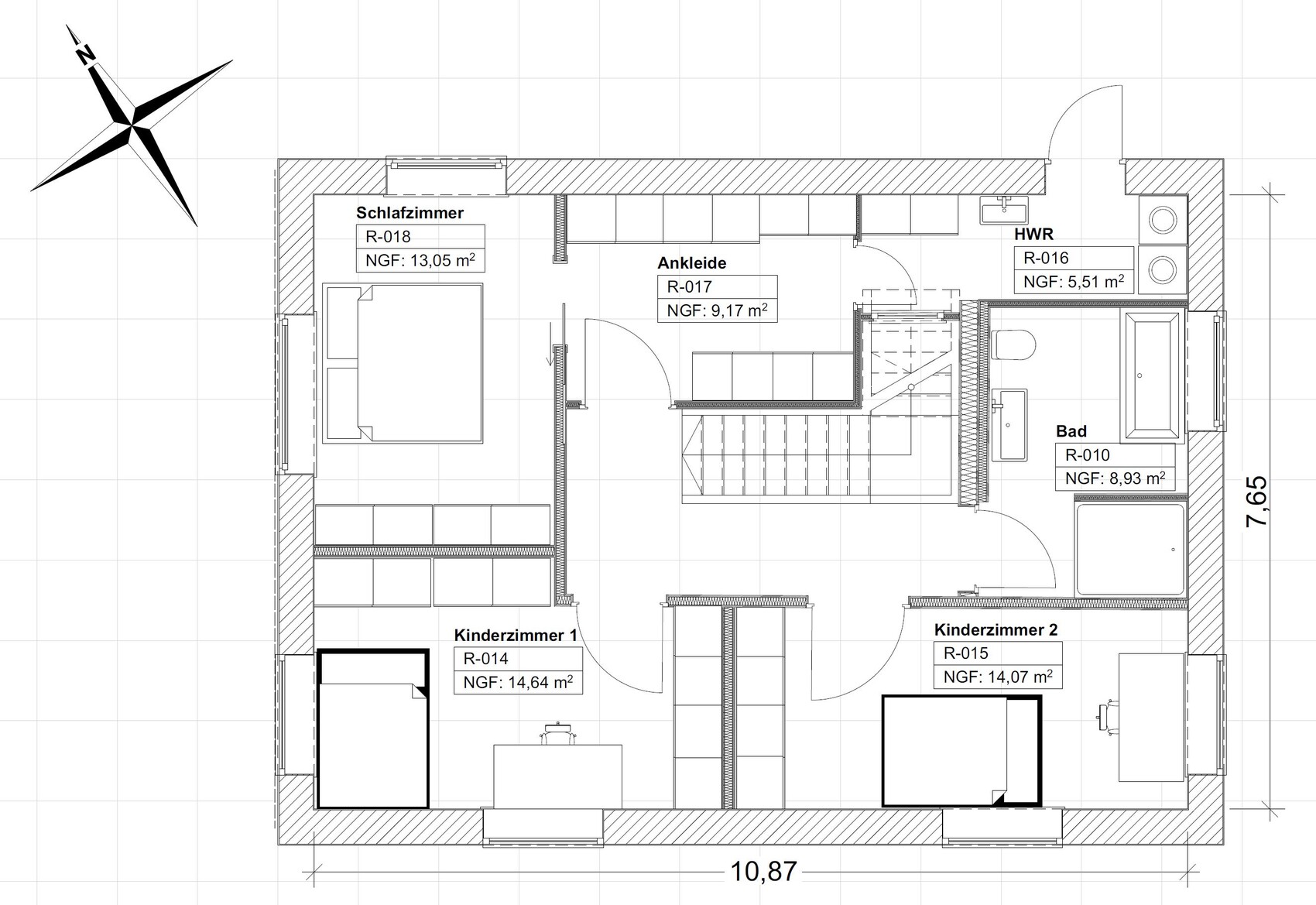
The staircase to the bedrooms starts from an unattractive, cramped corridor opposite the garage door. The door opens the wrong way; the other way around it would compete with the stair landing.
The staircase feels too short. Maybe the ceiling thickness hasn’t been accounted for properly or something similar.
The layout of the common room is a joke – far too narrow. What is the sofa’s sitting depth? I would at least double that. The dining table alone already makes the space too tight. There would be no room for a fireplace.
I had wider children’s rooms in a 1970s terraced house than shown here.
The bathroom is quite small, too – in a custom-built home for four people, I would consider it 2–4 square meters (21–43 square feet) too small.
Overall, the comfort seems to be located in the unplanned basement rather than the living space, which all looks quite cramped compared to the intended floor area.
Indahaus schrieb:
Do you have any tips on how to achieve similar things but cheaper? One good aspect: the kids’ rooms have nice natural light orientation; the utility room on the upper floor is generally a good idea. The rest is nothing special and rather poorly executed.
First of all, thank you all for your interest and numerous responses. We will try to address some points in more detail to explain our thoughts on the current planning.
We find stairs with irregular step shapes very uncomfortable and have therefore deliberately chosen a staircase with straight steps. Both of our parents have difficulties climbing stairs. In terms of space consumption, we see some advantages with the L-shaped staircase compared to, for example, a straight staircase (very long, requires a lot of hallway space) or a U-shaped staircase with landing (1 m² (11 sq ft) less). Also, the shape means the entrance area does not feel as cramped as in some houses where the spiral staircase starts directly next to the front door.
It is often the case in houses with a straight staircase that the living area is visually separated from the dining area by the stairs, which we do not like, as you can then hear everything from the kitchen and dining room but cannot actively participate in the conversation. We prefer a combined cooking, living, and dining area.
Basically, we have tried to plan as barrier-free as possible within the given space — most doorways have a clear passage width of at least 90 cm (35 inches). Besides the doors, the staircase is one of the biggest obstacles in the house, so it should ideally have a straight walking surface.
Good to hear something positive for a change.
In fact, the staircase has already limited our design considerably, and during planning, we realized that a straight staircase is not so easy. Summarizing the responses, the clear opinion seems to be to discard the current design entirely and aim for a new plan. Maybe someone could give us a suggestion with one of the mentioned staircase types without irregular steps, proposing a better positioning within a house of comparable footprint.
Allthewayup schrieb:
[...]The position of the staircase is inconvenient, which results in all the rooms on the upper floor being impractically laid out.[...] Rearranging the furniture is practically impossible in these spaces. A rectangular floor plan is actually the most efficient to design with a half-turn staircase placed as centrally as possible along one of the long sides of the house. It may not be spectacular but it is efficient.
We find stairs with irregular step shapes very uncomfortable and have therefore deliberately chosen a staircase with straight steps. Both of our parents have difficulties climbing stairs. In terms of space consumption, we see some advantages with the L-shaped staircase compared to, for example, a straight staircase (very long, requires a lot of hallway space) or a U-shaped staircase with landing (1 m² (11 sq ft) less). Also, the shape means the entrance area does not feel as cramped as in some houses where the spiral staircase starts directly next to the front door.
It is often the case in houses with a straight staircase that the living area is visually separated from the dining area by the stairs, which we do not like, as you can then hear everything from the kitchen and dining room but cannot actively participate in the conversation. We prefer a combined cooking, living, and dining area.
Basically, we have tried to plan as barrier-free as possible within the given space — most doorways have a clear passage width of at least 90 cm (35 inches). Besides the doors, the staircase is one of the biggest obstacles in the house, so it should ideally have a straight walking surface.
K a t j a schrieb:If you mean the children’s rooms feel too narrow and elongated, what room proportions would you recommend? What minimum depth would you suggest?
The house lacks depth. The children’s rooms and living room are too narrow.
ypg schrieb:Of course, that is a point we have also identified. As an alternative, we considered designing the basement’s exterior dimensions to match those of the ground floor and constructing a terrace as a steel structure. However, I believe the costs depend heavily on the construction method regardless of whether it is a projecting basement or a steel structure.
Just the roof terrace on the basement alone is a cost and weakness factor in the house construction.
ypg schrieb:There is still access and parking space planned in the garden. If the basement apartment is not rented out, it would be intended as a parking space for a trailer.
Where are your tenants allowed to park? Should they block you in the garage? They need separate parking spaces without blocking another car. Enclosed parking spaces are officially not allowed.
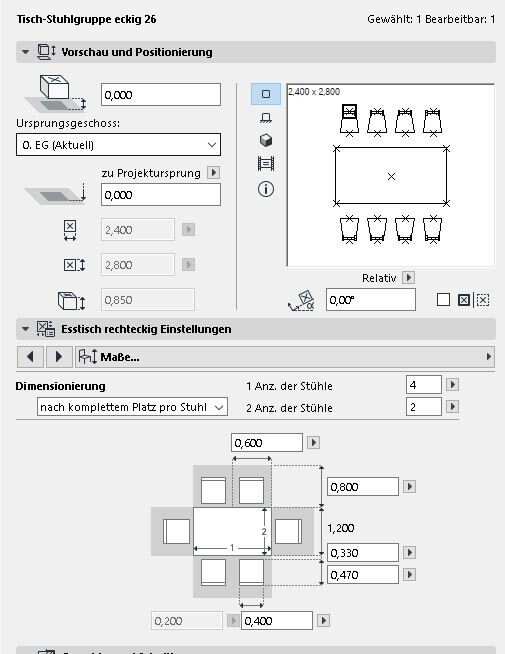
ypg schrieb:Thanks for the suggestion. We will check that again. The planning software suggests a total length of 2.4 m (8 feet) for 8 seats (see picture). What table dimensions would you recommend so that 8 people can sit comfortably? The table width is generously set at 1.2 m (47 inches), so there should be enough space behind it to pass through; if not, the sideboard can be omitted.
70 cm (28 inches) width for a chair and a place…
ypg schrieb:That would certainly be a logical option with lower costs, but this is only considered a last resort because of the desired workshop space, which would not fit there. We will provide preliminary plans for the basement at the appropriate time so the required space can be better assessed. (Currently, about 80 m² (860 sq ft) are used in another house.)
I would therefore, since the floor area ratio allows it, plan for a slightly larger footprint, a walk-out basement, and place the bedrooms on the upper floor. No basement apartment, as I don’t see that.
ypg schrieb:Our idea was: (15 steps with a rise of 18.1 cm (7.1 inches) and tread of 26 cm (10.2 inches)) plus (18.5 cm (7.3 inches) to the top of the floor finish) = 290 cm (9 ft 6 in) floor-to-floor height. We will review this again. A 300 cm (9 ft 10 in) floor-to-floor height might be better, but room height depends heavily on the floor and ceiling construction.
The staircase seems too short to me
ypg schrieb:That was a standard sofa from the software — seat depth listed as 55 cm (22 inches). My mistake for not checking more closely. I have adjusted it to an overall depth of 100 cm (39 inches), which matches our current sofa.
What is the seat depth of the sofa?
ypg schrieb:
Here’s something good: kids’ rooms have good natural light orientation, and a utility room on the upper floor also makes sense. The rest is nothing special and rather poorly implemented.
Good to hear something positive for a change.
Allthewayup schrieb:
This is a typical design where the living space is planned around the staircase.
In fact, the staircase has already limited our design considerably, and during planning, we realized that a straight staircase is not so easy. Summarizing the responses, the clear opinion seems to be to discard the current design entirely and aim for a new plan. Maybe someone could give us a suggestion with one of the mentioned staircase types without irregular steps, proposing a better positioning within a house of comparable footprint.
H
hanghaus20236 Feb 2023 11:08I am first trying to determine the positioning on the plot. The terrain slope is 12.5%.
With a house width of 9m (30 feet), that results in a height difference of 1.125m (3.7 feet). Is a basement already worthwhile in this case?
I don’t see a practical full basement solution here, only with significant effort for earthworks and retaining walls.
Is there a reference point for the height of the ground floor?
Are terrain modifications allowed?
What are the dimensions of the plot?
With a house width of 9m (30 feet), that results in a height difference of 1.125m (3.7 feet). Is a basement already worthwhile in this case?
I don’t see a practical full basement solution here, only with significant effort for earthworks and retaining walls.
Is there a reference point for the height of the ground floor?
Are terrain modifications allowed?
What are the dimensions of the plot?
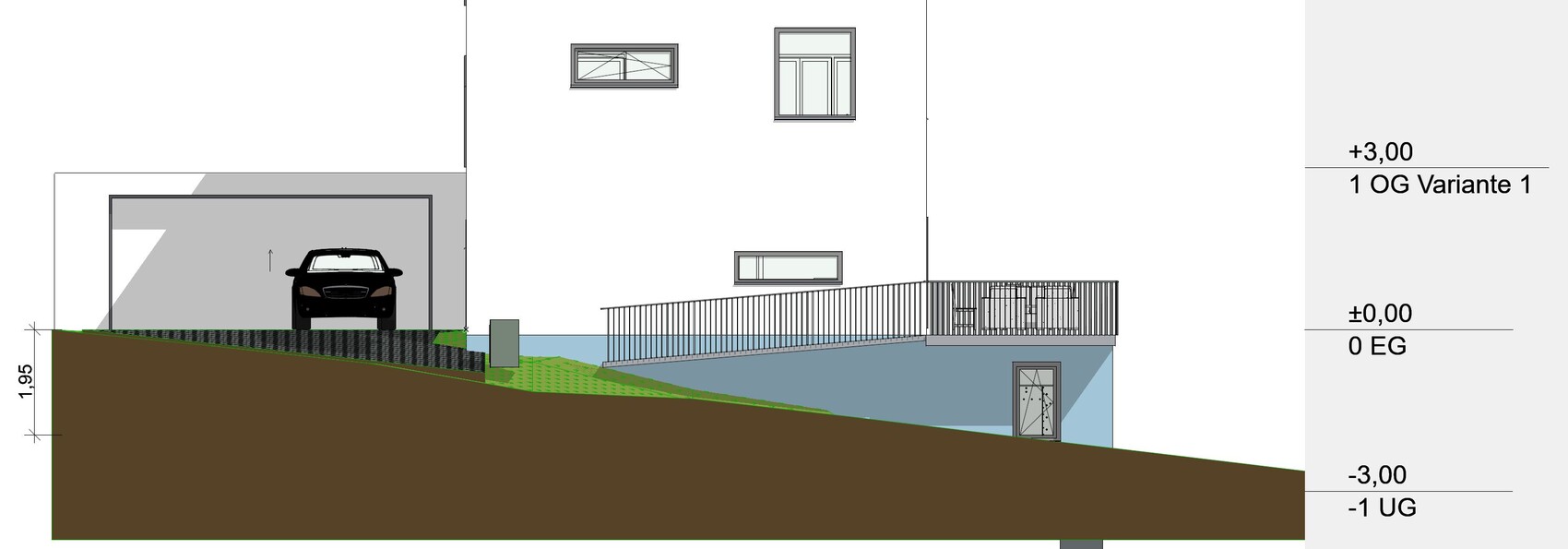
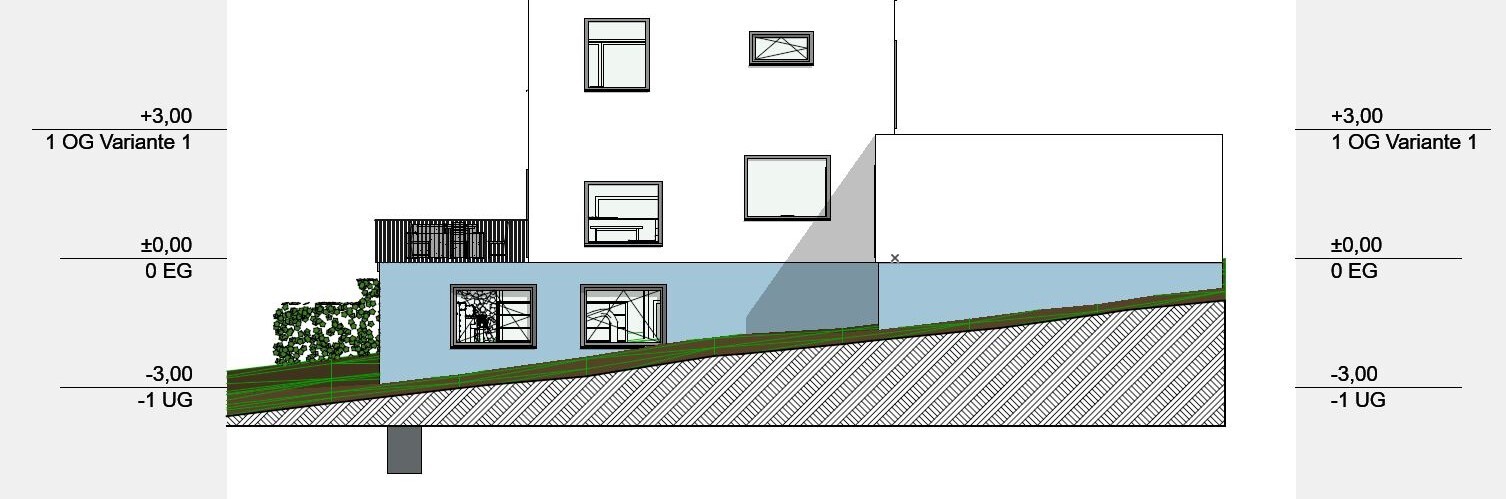
Exactly, the terrain slope is approximately 12.5% (which only applies along the street). Viewed diagonally, it is somewhat steeper. Considering the length of the garage (total 16 m (52.5 ft)), there is already a height difference of 205 cm (6 ft 9 in). The height of the ground floor is intended to be approximately at the level of the highest point of the plot (3.9 m (12.8 ft) above the lowest point of the plot). Adding a basement under the cellar would result in less earthwork required on the eastern side of the plot. I have attached a screenshot of an east-facing view including the original terrain.
Regarding earthworks, the following two points from the development plan apply:
Garages that lie below the level of access roads may, after filling the original terrain (maximum 2.00 m (6 ft 7 in)) up to the level of the access road, have an additional wall height of up to 3.00 m (9 ft 10 in). The average wall height is set at 5.50 m (18 ft).
The FFOK (design ground floor level) of the structural facilities must be aligned with the level of the respective access road (reference point = highest point in the access area). A height difference of up to 0.5 m (1 ft 8 in) is allowed for plots below the access road level, and up to 1.0 m (3 ft 3 in) for plots and multi-family residential buildings as well as mixed-use areas above the access road level.
The dimensions of the plot are a width of 24.95 m (81.9 ft) (along the street) and a depth of 27.2 m (89.2 ft). The plot should be considered rectangular.
Regarding earthworks, the following two points from the development plan apply:
Garages that lie below the level of access roads may, after filling the original terrain (maximum 2.00 m (6 ft 7 in)) up to the level of the access road, have an additional wall height of up to 3.00 m (9 ft 10 in). The average wall height is set at 5.50 m (18 ft).
The FFOK (design ground floor level) of the structural facilities must be aligned with the level of the respective access road (reference point = highest point in the access area). A height difference of up to 0.5 m (1 ft 8 in) is allowed for plots below the access road level, and up to 1.0 m (3 ft 3 in) for plots and multi-family residential buildings as well as mixed-use areas above the access road level.
The dimensions of the plot are a width of 24.95 m (81.9 ft) (along the street) and a depth of 27.2 m (89.2 ft). The plot should be considered rectangular.
SoL schrieb:
Is the 650k purely for the house (that could be realistic) or does it include the entire project like earthworks, slope stabilization, etc.?
If it’s the latter: redesign, downsize. Please respond to that.
Because what you’re planning is technically all possible, but considering the scale of the project, you’ll definitely need a very deep pocket.
You are planning one floor too many for the budget.
The basement will be removed,
the ground floor will be moved to the lower ground floor with direct access to the garden,
the issue of having a terrace above the basement is resolved,
the top floor will be moved to the ground floor.
The basement will be removed,
the ground floor will be moved to the lower ground floor with direct access to the garden,
the issue of having a terrace above the basement is resolved,
the top floor will be moved to the ground floor.
Similar topics