
Hello everyone,
Based on the attached floor plan ideas from construction companies, we have developed and drawn our own floor plan. Before we take the next step with a designer or builder, we would like to hear your opinions.
Thank you very much
Dennis
Development Plan / Restrictions
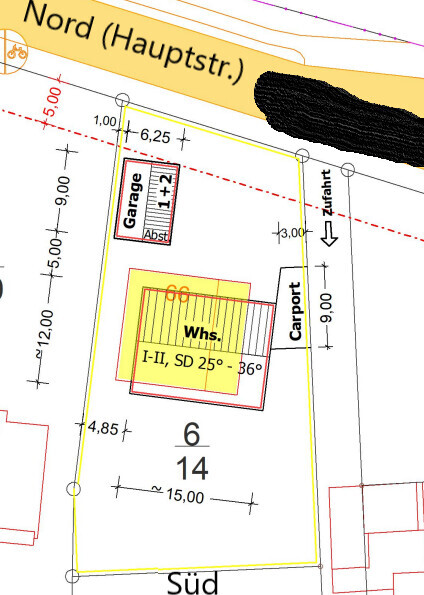
Plot size: 1206 m² (12,978 sq ft)
Slope: Height difference from south (terrace) to north (street) is about 2–3 m (6.5–10 ft). By the way, who usually conducts a height survey? Is this typically done as part of the soil survey?
The building project must comply with §34 BauG (“Building Code”) to “fit in” with the surroundings. The building authority would like a “green strip” on the north side—the pre-application for approval has been submitted regarding this. Consent from the neighbors has been obtained.
Facing-brick bungalow with a gable roof, long side oriented south/north
Garage with space for 2 vehicles and a storage room
Carport next to the bungalow
What is the most important / fundamental question about the floor plan, summarized in 130 characters?
- How can traffic areas be minimized practically in a bungalow while keeping all rooms accessible?
- Why do example bungalows often have L-shaped or corner layouts? Aren't these more expensive unnecessarily?
- How is the floor plan regarding noise from the street to the north and within the house itself?
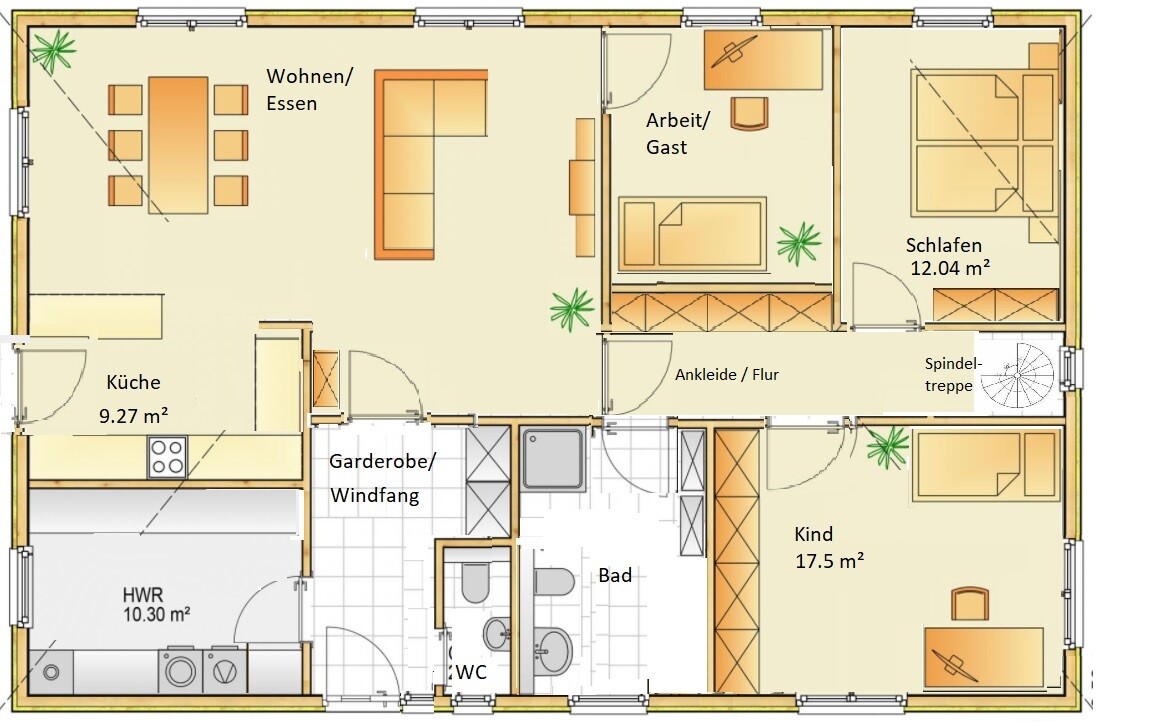
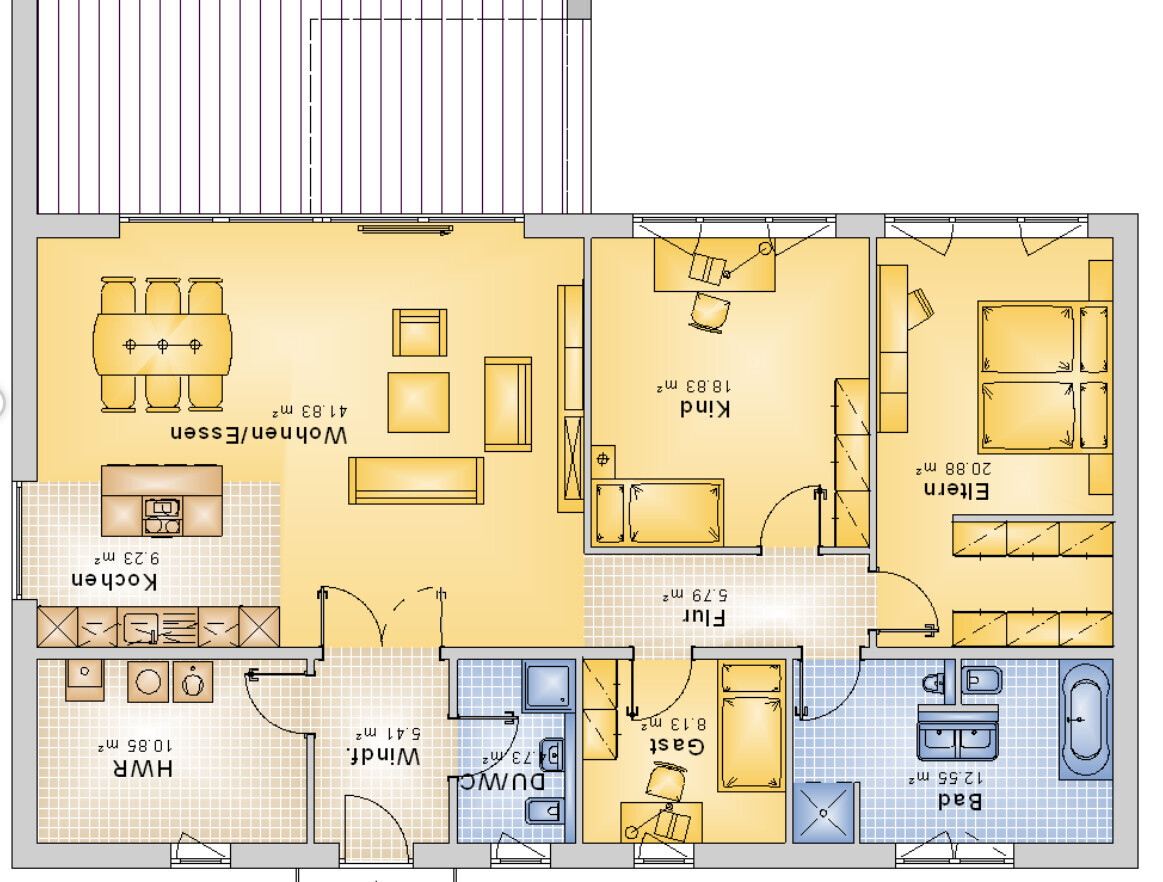
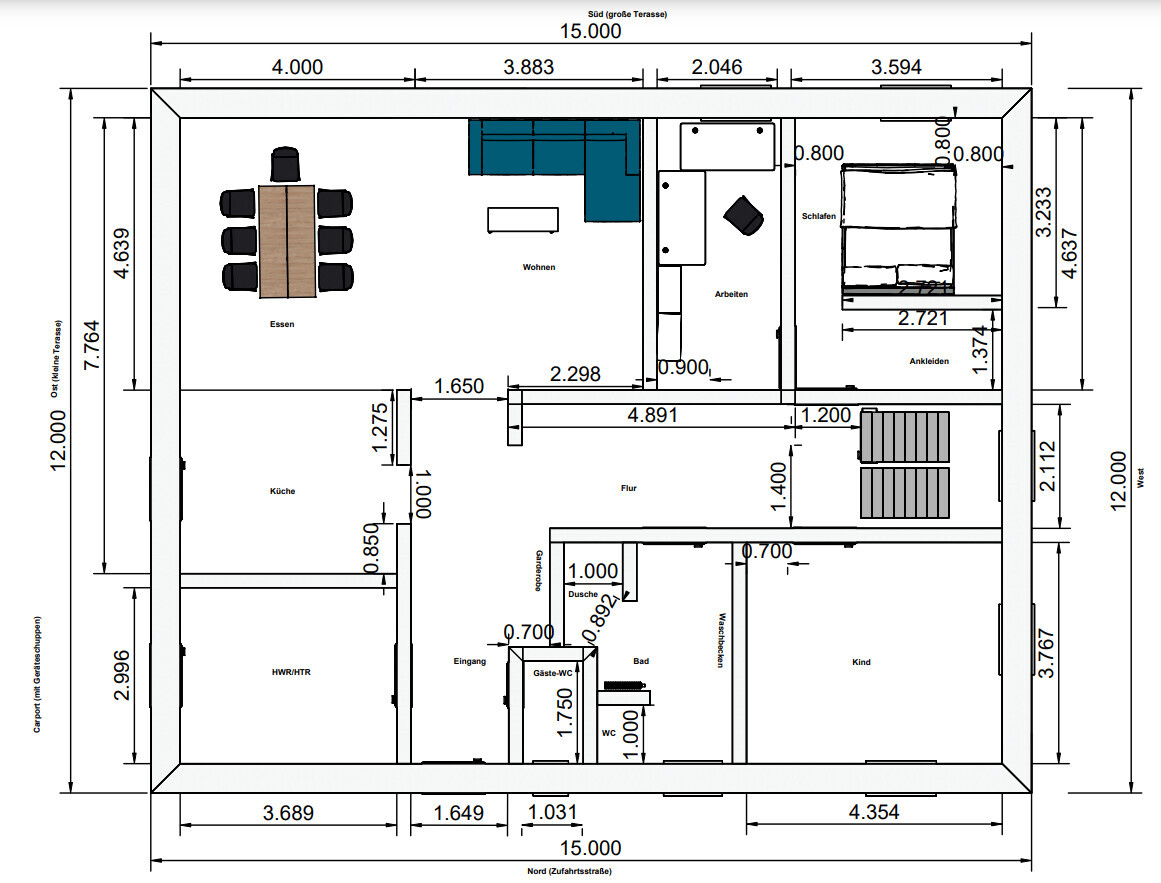
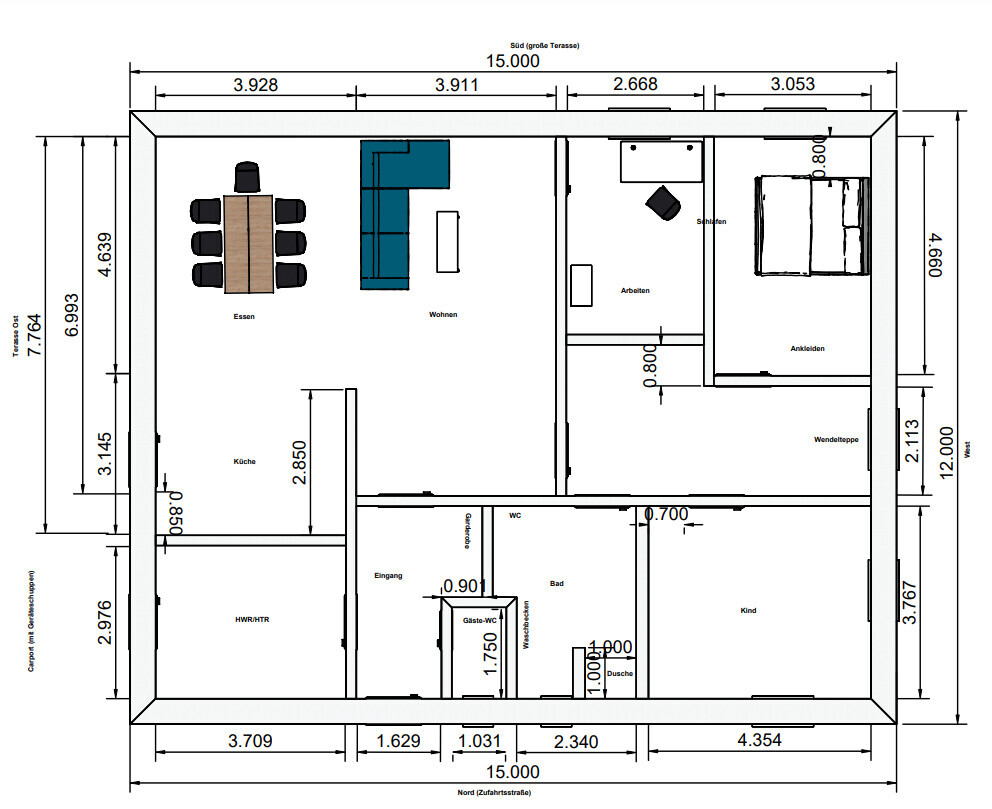
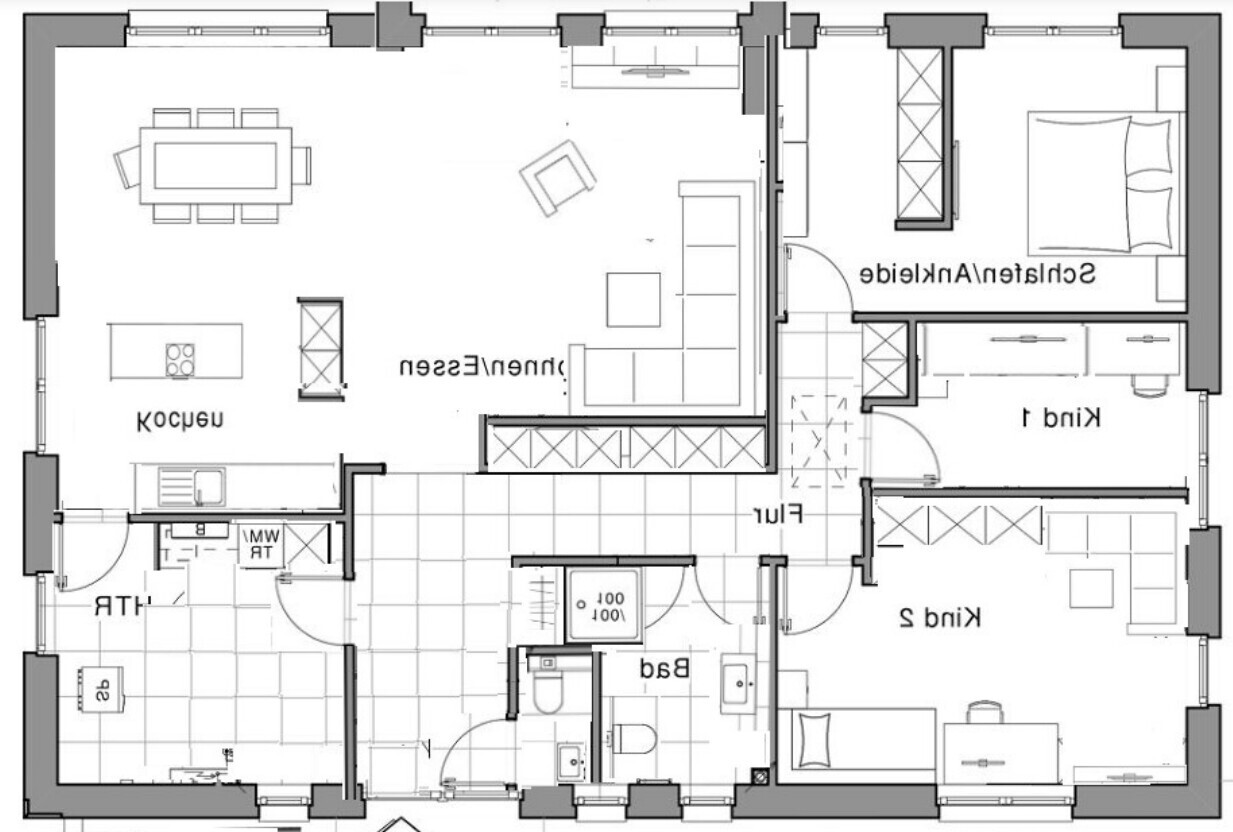
Based on the attached floor plan ideas from construction companies, we have developed and drawn our own floor plan. Before we take the next step with a designer or builder, we would like to hear your opinions.
Thank you very much
Dennis
Development Plan / Restrictions
Plot size: 1206 m² (12,978 sq ft)
Slope: Height difference from south (terrace) to north (street) is about 2–3 m (6.5–10 ft). By the way, who usually conducts a height survey? Is this typically done as part of the soil survey?
The building project must comply with §34 BauG (“Building Code”) to “fit in” with the surroundings. The building authority would like a “green strip” on the north side—the pre-application for approval has been submitted regarding this. Consent from the neighbors has been obtained.
Facing-brick bungalow with a gable roof, long side oriented south/north
Garage with space for 2 vehicles and a storage room
Carport next to the bungalow
What is the most important / fundamental question about the floor plan, summarized in 130 characters?
- How can traffic areas be minimized practically in a bungalow while keeping all rooms accessible?
- Why do example bungalows often have L-shaped or corner layouts? Aren't these more expensive unnecessarily?
- How is the floor plan regarding noise from the street to the north and within the house itself?
P
Pinkiponk11 Jan 2022 09:18Ruth+Dennis schrieb:
- Why are L-shaped or corner bungalows always shown as examples? Aren't they unnecessarily more expensive?I don’t know if there is a universally valid answer, but for me personally, the reason might be that a bungalow without an L-shape or corners can quickly look like a simple shed or garage. Maybe that’s why.Whether an L-shape or corner actually makes the bungalow unnecessarily expensive, I’m not sure. As far as I know, it mainly comes down to the larger footprint (foundation slab) and the larger roof area.
I thought so. It doesn’t work for you.
The space requirement is similar to a wheelchair, that is, if you move forward with the device. Naturally, a person using a walker is much more mobile.
The turning area for a walker is at least 1.2 m x 1.2 m (4 ft x 4 ft) compared to a wheelchair, which requires 1.5 m x 1.5 m (5 ft x 5 ft).
The DIN standard specifies a clear door width of at least 80 cm (31.5 inches). If the hallway is straight and the walker is standard width (there are also wider ones), this can work.
If you take your first floor plan, it is not possible to get from the living area to the bathroom with a walker.
The bedroom is too narrow to get to the bed with a walker. Often stepping backward or sideways is more difficult than a single step or 20 straight steps forward. Grab bars next to the toilet (reinforce the wall structure as needed), more space in the shower—perhaps a medical transport chair is the safer option instead of carefully walking over a wet floor.
It’s incredible how much space is suddenly needed; for example, next to the bed, the medical transport chair or walker, plus the assistant helping the person get from bed to bathroom, putting on socks, etc. At the dining table, the chair can no longer be pulled back just 30 cm (12 inches) to sit down; now it has to be turned 90 degrees because sidestepping is no longer possible. The 100 cm (39 inches) between the wall and table edge is no longer comfortable.
The reality is often much more demanding than what is marketed as age-friendly or accessible in brochures. Unfortunately, older people have very different impairments, so there is no one-size-fits-all solution.
What I meant: please mark on the plan where the house is located and add a north arrow to your preferred floor plan.
How steep is the slope in the building area?
Consider placing the children’s and workrooms under the roof.
Then try to move away from the builder’s scope of work description, and the quality management should focus on your wishes.
What should the kitchen be like, what should it include?
How large should the dining area be?
What living room furniture?
What makes you different from others? Closet space in the bedroom? Shoe collection, model railway, sewing table, bookshelves, inherited farmhouse cabinet you want to showcase, etc.
Go through your daily routine.
What bothers you about your current living situation, what do you wish for?
Space in the wardrobe for the sports bag, etc.
The space requirement is similar to a wheelchair, that is, if you move forward with the device. Naturally, a person using a walker is much more mobile.
The turning area for a walker is at least 1.2 m x 1.2 m (4 ft x 4 ft) compared to a wheelchair, which requires 1.5 m x 1.5 m (5 ft x 5 ft).
The DIN standard specifies a clear door width of at least 80 cm (31.5 inches). If the hallway is straight and the walker is standard width (there are also wider ones), this can work.
If you take your first floor plan, it is not possible to get from the living area to the bathroom with a walker.
The bedroom is too narrow to get to the bed with a walker. Often stepping backward or sideways is more difficult than a single step or 20 straight steps forward. Grab bars next to the toilet (reinforce the wall structure as needed), more space in the shower—perhaps a medical transport chair is the safer option instead of carefully walking over a wet floor.
It’s incredible how much space is suddenly needed; for example, next to the bed, the medical transport chair or walker, plus the assistant helping the person get from bed to bathroom, putting on socks, etc. At the dining table, the chair can no longer be pulled back just 30 cm (12 inches) to sit down; now it has to be turned 90 degrees because sidestepping is no longer possible. The 100 cm (39 inches) between the wall and table edge is no longer comfortable.
The reality is often much more demanding than what is marketed as age-friendly or accessible in brochures. Unfortunately, older people have very different impairments, so there is no one-size-fits-all solution.
What I meant: please mark on the plan where the house is located and add a north arrow to your preferred floor plan.
How steep is the slope in the building area?
Consider placing the children’s and workrooms under the roof.
Then try to move away from the builder’s scope of work description, and the quality management should focus on your wishes.
What should the kitchen be like, what should it include?
How large should the dining area be?
What living room furniture?
What makes you different from others? Closet space in the bedroom? Shoe collection, model railway, sewing table, bookshelves, inherited farmhouse cabinet you want to showcase, etc.
Go through your daily routine.
What bothers you about your current living situation, what do you wish for?
Space in the wardrobe for the sports bag, etc.

I assume accessibility is good to have just in case, but not necessary right now.
Our architect said that as long as no one needs it, it’s considered a luxury, convenience, and quality of life.
(And a great wheelchair race track for the grandchildren).
@Ruth+Dennis,
stand on the plot and think about it:
we want the view from the living room,
we want the view from the kitchen,
this far should the bedroom be,
this far can be the office/guest room,
there should be a children’s room.
Create a living concept for yourselves and only present your favorite floor plan here,
otherwise everyone will be discussing a different one.
Our architect said that as long as no one needs it, it’s considered a luxury, convenience, and quality of life.
(And a great wheelchair race track for the grandchildren).
@Ruth+Dennis,
stand on the plot and think about it:
we want the view from the living room,
we want the view from the kitchen,
this far should the bedroom be,
this far can be the office/guest room,
there should be a children’s room.
Create a living concept for yourselves and only present your favorite floor plan here,
otherwise everyone will be discussing a different one.
Nida35a schrieb:
I assume accessibility features are for all possible cases and not yet necessary.
Our architect said that as long as no one needs them, they are a luxury, convenience, and quality of life. That’s right. Building for every contingency is VERY expensive.
At 40, you usually don’t plan for it yet because you’re still about 30 years away from needing it. However, if there is already some frailty, then a bungalow is a good option. A bungalow is generally age-appropriate because it has no stairs. It can also meet the same requirements for all age groups, whether 30 or 70, namely accessibility, functionality, comfort, and fulfillment of personal needs.
These are standard demands for any house construction.
Ruth+Dennis schrieb:
Personal price limit for the house, including fixtures: under or low 300,000€ would be good To put it simply: extras that transform a functional, age-appropriate house into an accessible or barrier-free one cost what will push your budget beyond 300,000€.
So you are already on the right track by choosing to build a nice bungalow.
I can’t really add anything more because the posts are so confusing and I simply don’t have the time to invest more into something that often only gets half-answered.
Accessibility, in the case desired here, is affordable as long as the floor area is large enough. Wide doors, reinforced installations for lifts, power supply for the lift integrated into the stairwall, a stairwall stable enough to support the lift (not applicable here), no step at the entrance, and a sliding door with a low threshold (note: avoid the very flat ones designed specifically for wheelchairs, as they are very expensive and usually unnecessary for the target age group) are the costs incurred now.
Building extra large and exceeding the budget is not the goal.
To stay with the bungalow example: the bedroom is too small – move into the larger children’s room.
Is the turning radius sufficient? No additional costs.
Most electrical outlets are installed at light switch height – this was cost-neutral for us.
A large sofa is replaced by two reclining chairs with lift assistance, creating more space in the open living area.
Bathrooms adapted for walkers (rollators) don’t necessarily need to be large, as the shower is often planned to serve as the turning area.
Building extra large and exceeding the budget is not the goal.
To stay with the bungalow example: the bedroom is too small – move into the larger children’s room.
Is the turning radius sufficient? No additional costs.
Most electrical outlets are installed at light switch height – this was cost-neutral for us.
A large sofa is replaced by two reclining chairs with lift assistance, creating more space in the open living area.
Bathrooms adapted for walkers (rollators) don’t necessarily need to be large, as the shower is often planned to serve as the turning area.

Pinkiponk schrieb:
Whether an L-shape or a corner makes the bungalow unnecessarily expensive, I don’t know. You didn’t listen to me very well. Especially with the popular hip roof, every floor plan deviation that the roof structure has to accommodate makes the house more expensive.
https://www.instagram.com/11antgmxde/
https://www.linkedin.com/company/bauen-jetzt/
Similar topics