
I
Irrelefant1 Nov 2017 15:33Hello everyone!
We are currently planning our semi-detached house as a single-family home. We have put a lot of thought into the floor plan and, after some trial and error, have found a layout on paper that we really like.
Our building plot measures 12x10 meters (39x33 feet), of which we are using 10x10 meters (33x33 feet). The other half of the semi-detached house might also be built by us, possibly using the full plot there to create two living units (if that’s allowed). The planning for this, if you can call it that yet, is still at a very early stage.
We would greatly appreciate ideas and suggestions for improvement. After spending one or two days almost exclusively looking at floor plans and clicking around in the planner, it’s easy to overlook something. Also, any points or details we might have missed due to our lack of experience are very welcome!
Attached are some images showing the floor plan and site location. I did some basic image editing, hoping it roughly illustrates what we mean 🙂
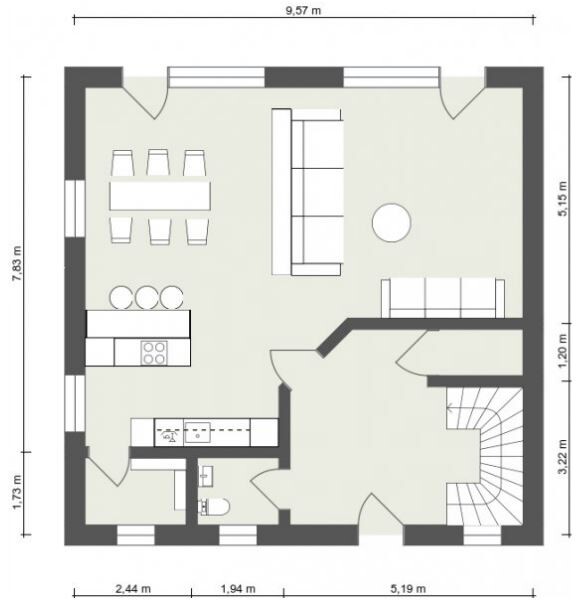

Unfortunately, all dimensions are measured from the center of the walls. I designed the exterior walls to be 43cm (17 inches) thick and the interior walls 24cm (9.5 inches).
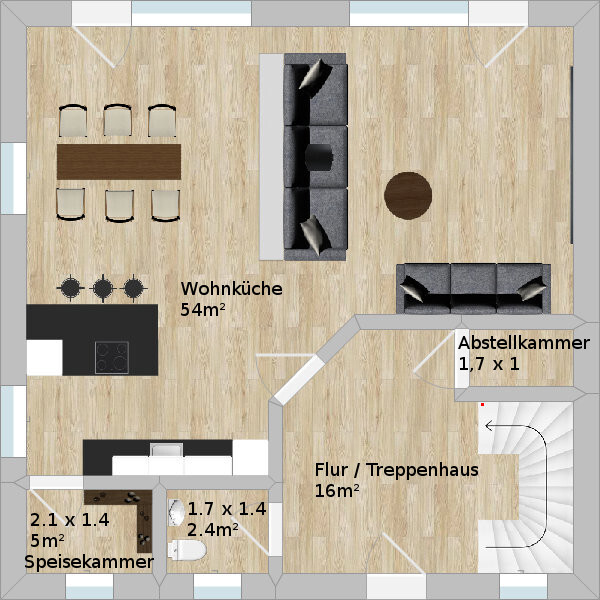
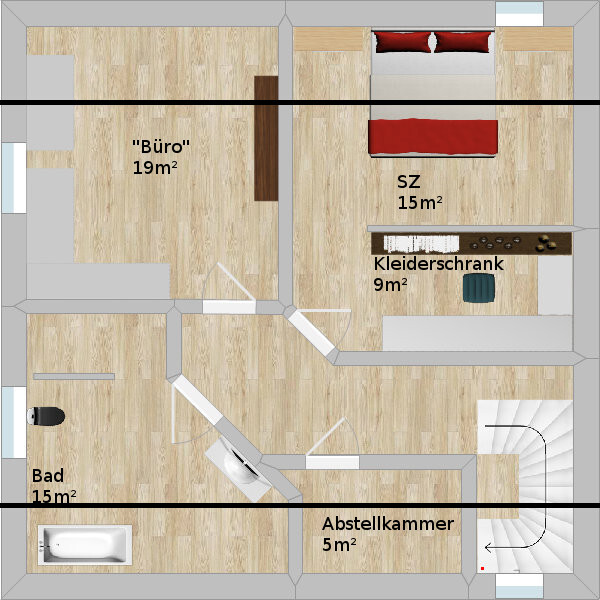
Here, I marked the square meters and roughly how we imagine furnishing the rooms. The black line on the upper floor indicates the 2-meter (6.5 feet) height limit due to the roof slope. The windows shown there are intended to be skylights, although the design software doesn’t support that.
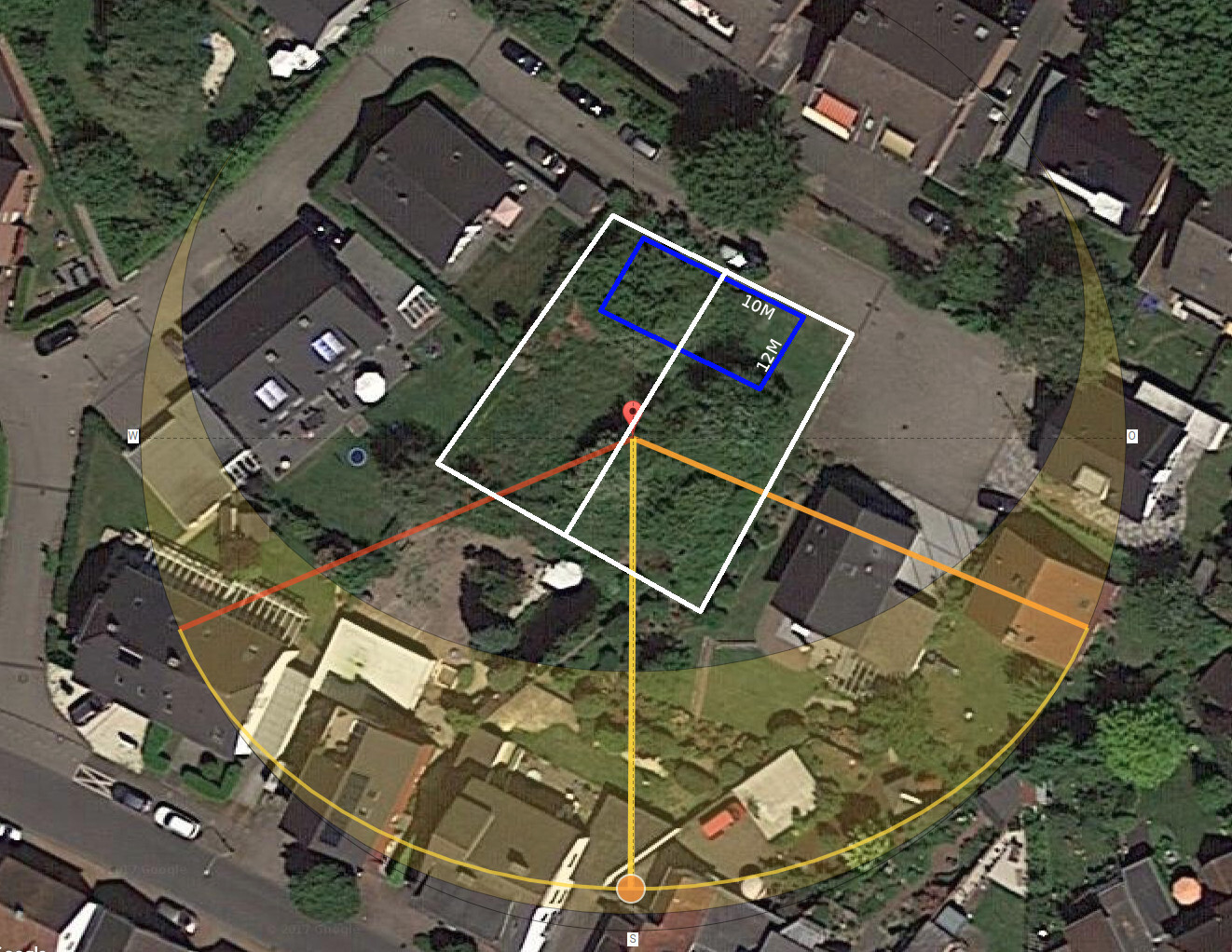
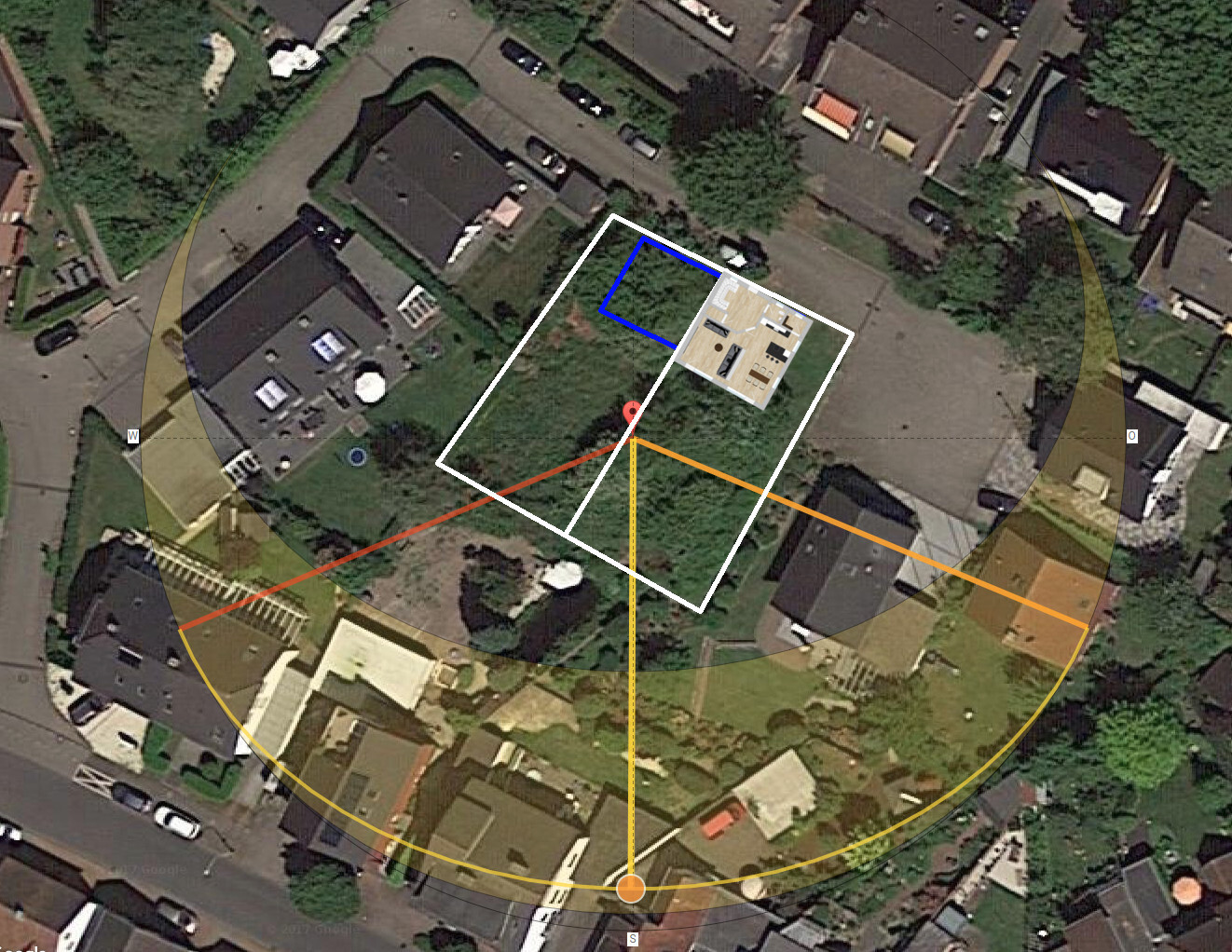
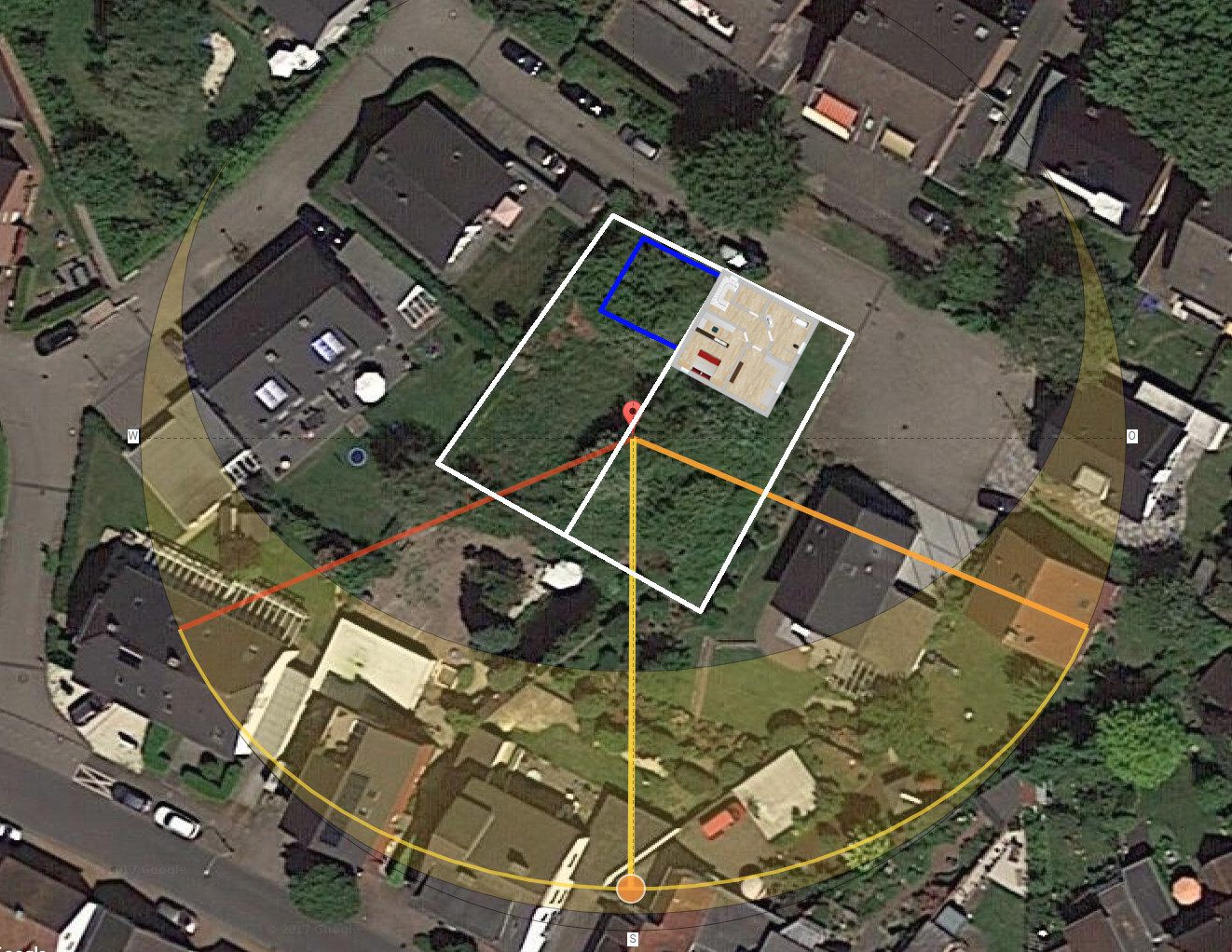
And here is the location with sun path and building plot indicated.
I would also like to ask a few technical questions:
In the house we currently rent, the water pipes are damaged, and it looks like the kitchen and bathroom will have to be completely opened up to replace the pipes (from the basement to the attic; there is only one water pipe for the whole house). This won’t be an immediate concern in a new build, but since I plan to live there until then, I would like to avoid destroying the entire house later on. The rooms with water connections are stacked vertically. Is there any reason (building regulations, experience) why water pipes shouldn’t be routed upstairs through the pantry, running up the wall behind drywall and a suspended ceiling?
I also want to use a KNX system. No matter whom I ask, the first advice is always to plan for a system bigger than initially needed. Since I am generally very interested in technology and like home automation, the need to expand will likely arise. My idea was to install all electrical wiring behind a suspended ceiling, which would also be convenient for the planned ventilation system. Regarding prefabricated houses, I have heard of an installation layer—basically an extra drywall layer in front of the outer wall—that also provides additional sealing and insulation. That would obviously be beneficial for future electrical expansions. Is something like this also useful in solid construction (masonry) houses? I read about someone using it to achieve a higher energy efficiency rating (similar to KfW levels), but it was unclear if it was a prefab or solid house. Does anyone have experience with this?
Thanks very much for your feedback!
Development plan / restrictions
Plot size: approx. 430m² (4628 sq ft)
Slope: no
Site coverage ratio: 0.4
Floor area ratio: 0.5
Building plot: see attachment, marked in blue
Setback: 3m (10 feet) clearance to the street, is there some flexibility within the building plot?
Number of parking spaces: 1-2 planned beside/in front of the house
Number of floors: 1.5
Roof type: gable roof, 40° pitch (specified)
Orientation: see attachment
Maximum height/building limits: max 2 full stories
Client requirements
Style, roof shape, building type: not too modern, gable roof 40°, semi-detached single-family house
Cellar, floors: 1.5 floors with cellar
Number of occupants, age: 2 people, around 30 years old
Ground floor room needs: open-plan kitchen-living-dining area, toilet, some storage space
Upper floor room needs: bedroom, bathroom with shower and bathtub, office/hobby room
Office: family use, occasional home office
Guests per year: none
Open or closed architecture: rather open
Conservative or modern construction: we are in the middle, like an open living area but separate bedrooms and bathrooms. No shower in the bedroom or bed in the bathroom or things like that :-)
Open kitchen, kitchen island: yes, a cooking counter is planned. See attachments for details
Number of dining seats: 1.5 (including seating at cooking counter)
Fireplace: none initially, possibly added later
Music / projection wall: we currently have a projector and screen in the living room and want to keep that
Balcony, roof terrace: not planned
Garage, carport: possibly a carport
Utility garden, greenhouse: no
Other wishes / special features: mechanical ventilation, KNX
House design
Who designed it: DIY
What do you particularly like? Why?
- Open living area – short distances – bright
What do you dislike? Why?
- Bathroom – concerns about the sloping roof above the bathtub and sink
Cost estimate by architect/planner: We are not at that stage yet. We wanted to finalise our floor plan wishes first before starting detailed planning. We’d be grateful for any cost estimates you might provide!
Personal budget for house including fittings: Could 300,000€ be realistic?
Preferred heating technology: geothermal heat pump
If you had to give up something, which details or extensions?
Hard to say. We haven’t found anything we’d say “we can do without.” The hallway/staircase doesn’t need to be very large. Room sizes can generally be adjusted.
Why does the design look like it does now? What makes it particularly good or bad to you?
We have looked through many catalogs and took a lot of inspiration from them. This led to the decision for an open kitchen-living area and the functional arrangement of floors (ground floor: “public” area for visitors, upper floor: private area where only we belong 😉 )
Currently, we have a large sofa facing the projector screen, which we really like, so we included it in the floor plan again.
Also, our relatively large dining table fits well there now. At the moment, we hardly use it because our kitchen is at the other end of the apartment, so it’s easier to stay at the small kitchen table.
What is the most important or basic question about the floor plan in 130 characters or less?
We are looking for ideas and suggestions, especially about things we might have missed or would do differently with experience.
We are currently planning our semi-detached house as a single-family home. We have put a lot of thought into the floor plan and, after some trial and error, have found a layout on paper that we really like.
Our building plot measures 12x10 meters (39x33 feet), of which we are using 10x10 meters (33x33 feet). The other half of the semi-detached house might also be built by us, possibly using the full plot there to create two living units (if that’s allowed). The planning for this, if you can call it that yet, is still at a very early stage.
We would greatly appreciate ideas and suggestions for improvement. After spending one or two days almost exclusively looking at floor plans and clicking around in the planner, it’s easy to overlook something. Also, any points or details we might have missed due to our lack of experience are very welcome!
Attached are some images showing the floor plan and site location. I did some basic image editing, hoping it roughly illustrates what we mean 🙂
Unfortunately, all dimensions are measured from the center of the walls. I designed the exterior walls to be 43cm (17 inches) thick and the interior walls 24cm (9.5 inches).
Here, I marked the square meters and roughly how we imagine furnishing the rooms. The black line on the upper floor indicates the 2-meter (6.5 feet) height limit due to the roof slope. The windows shown there are intended to be skylights, although the design software doesn’t support that.
And here is the location with sun path and building plot indicated.
I would also like to ask a few technical questions:
In the house we currently rent, the water pipes are damaged, and it looks like the kitchen and bathroom will have to be completely opened up to replace the pipes (from the basement to the attic; there is only one water pipe for the whole house). This won’t be an immediate concern in a new build, but since I plan to live there until then, I would like to avoid destroying the entire house later on. The rooms with water connections are stacked vertically. Is there any reason (building regulations, experience) why water pipes shouldn’t be routed upstairs through the pantry, running up the wall behind drywall and a suspended ceiling?
I also want to use a KNX system. No matter whom I ask, the first advice is always to plan for a system bigger than initially needed. Since I am generally very interested in technology and like home automation, the need to expand will likely arise. My idea was to install all electrical wiring behind a suspended ceiling, which would also be convenient for the planned ventilation system. Regarding prefabricated houses, I have heard of an installation layer—basically an extra drywall layer in front of the outer wall—that also provides additional sealing and insulation. That would obviously be beneficial for future electrical expansions. Is something like this also useful in solid construction (masonry) houses? I read about someone using it to achieve a higher energy efficiency rating (similar to KfW levels), but it was unclear if it was a prefab or solid house. Does anyone have experience with this?
Thanks very much for your feedback!
Development plan / restrictions
Plot size: approx. 430m² (4628 sq ft)
Slope: no
Site coverage ratio: 0.4
Floor area ratio: 0.5
Building plot: see attachment, marked in blue
Setback: 3m (10 feet) clearance to the street, is there some flexibility within the building plot?
Number of parking spaces: 1-2 planned beside/in front of the house
Number of floors: 1.5
Roof type: gable roof, 40° pitch (specified)
Orientation: see attachment
Maximum height/building limits: max 2 full stories
Client requirements
Style, roof shape, building type: not too modern, gable roof 40°, semi-detached single-family house
Cellar, floors: 1.5 floors with cellar
Number of occupants, age: 2 people, around 30 years old
Ground floor room needs: open-plan kitchen-living-dining area, toilet, some storage space
Upper floor room needs: bedroom, bathroom with shower and bathtub, office/hobby room
Office: family use, occasional home office
Guests per year: none
Open or closed architecture: rather open
Conservative or modern construction: we are in the middle, like an open living area but separate bedrooms and bathrooms. No shower in the bedroom or bed in the bathroom or things like that :-)
Open kitchen, kitchen island: yes, a cooking counter is planned. See attachments for details
Number of dining seats: 1.5 (including seating at cooking counter)
Fireplace: none initially, possibly added later
Music / projection wall: we currently have a projector and screen in the living room and want to keep that
Balcony, roof terrace: not planned
Garage, carport: possibly a carport
Utility garden, greenhouse: no
Other wishes / special features: mechanical ventilation, KNX
House design
Who designed it: DIY
What do you particularly like? Why?
- Open living area – short distances – bright
What do you dislike? Why?
- Bathroom – concerns about the sloping roof above the bathtub and sink
Cost estimate by architect/planner: We are not at that stage yet. We wanted to finalise our floor plan wishes first before starting detailed planning. We’d be grateful for any cost estimates you might provide!
Personal budget for house including fittings: Could 300,000€ be realistic?
Preferred heating technology: geothermal heat pump
If you had to give up something, which details or extensions?
Hard to say. We haven’t found anything we’d say “we can do without.” The hallway/staircase doesn’t need to be very large. Room sizes can generally be adjusted.
Why does the design look like it does now? What makes it particularly good or bad to you?
We have looked through many catalogs and took a lot of inspiration from them. This led to the decision for an open kitchen-living area and the functional arrangement of floors (ground floor: “public” area for visitors, upper floor: private area where only we belong 😉 )
Currently, we have a large sofa facing the projector screen, which we really like, so we included it in the floor plan again.
Also, our relatively large dining table fits well there now. At the moment, we hardly use it because our kitchen is at the other end of the apartment, so it’s easier to stay at the small kitchen table.
What is the most important or basic question about the floor plan in 130 characters or less?
We are looking for ideas and suggestions, especially about things we might have missed or would do differently with experience.
I
Irrelefant1 Nov 2017 16:37Hello ypg,
The technical room and laundry will be in the basement.
There are no children planned; if there are, the office will also move to the basement. I probably should have mentioned that 🙂
Any other information? What did I miss? 😉
Thanks in advance!
The technical room and laundry will be in the basement.
There are no children planned; if there are, the office will also move to the basement. I probably should have mentioned that 🙂
Any other information? What did I miss? 😉
Thanks in advance!
Irrelefant schrieb:
Any other information? What did I miss? 😉
Thanks already!Sorry, but the questionnaire you completed wasn’t published online yet when I wrote this 🙂
ypg schrieb:
Sorry, but the questionnaire you completed wasn’t published online yet when I wrote that 🙂 Let’s just say: the questionnaire doesn’t appear on Tapatalk [emoji848]
Hmm... take a look at your "open" kitchen/dining/living floor plan as it is furnished. What stands out? It looks like three furniture showrooms placed side by side 😉.
Personally, I would probably keep the kitchen and dining areas together and make the sofa/projector area more private, especially to prevent the evening west sun from constantly shining onto the projection screen.
I share your concerns about the bathtub and sink. How tall are you?
If the neighboring half is intended to accommodate two residential units... first check with the building authority whether that is even allowed, and then consider how to design the attic apartment, especially regarding a balcony or similar features, and most importantly, parking spaces. Because that would quickly add up to four cars.
Also, think again about the roof design. Would it make more sense to go for two full stories? Is a 40° pitch for the gable roof mandatory, or is a shallower slope allowed?
Another thing I noticed: although there is 16 sqm (172 sq ft) of hallway space on the ground floor, I see very limited options for a coat rack or shoe cabinet.
Personally, I would probably keep the kitchen and dining areas together and make the sofa/projector area more private, especially to prevent the evening west sun from constantly shining onto the projection screen.
I share your concerns about the bathtub and sink. How tall are you?
If the neighboring half is intended to accommodate two residential units... first check with the building authority whether that is even allowed, and then consider how to design the attic apartment, especially regarding a balcony or similar features, and most importantly, parking spaces. Because that would quickly add up to four cars.
Also, think again about the roof design. Would it make more sense to go for two full stories? Is a 40° pitch for the gable roof mandatory, or is a shallower slope allowed?
Another thing I noticed: although there is 16 sqm (172 sq ft) of hallway space on the ground floor, I see very limited options for a coat rack or shoe cabinet.
Similar topics