
ᐅ Floor Plan & House Positioning Single-Family Home with a Curved Layout
Created on: 6 Mar 2020 23:33
H
hausnrplus25
Hello dear forum members,
we have tried to prepare the questionnaire and the attachments carefully and thoroughly.
If there are still any open questions – please feel free to ask.
We appreciate your time in considering our building project and welcome constructive criticism, ideas, and suggestions =)
Development plan / restrictions
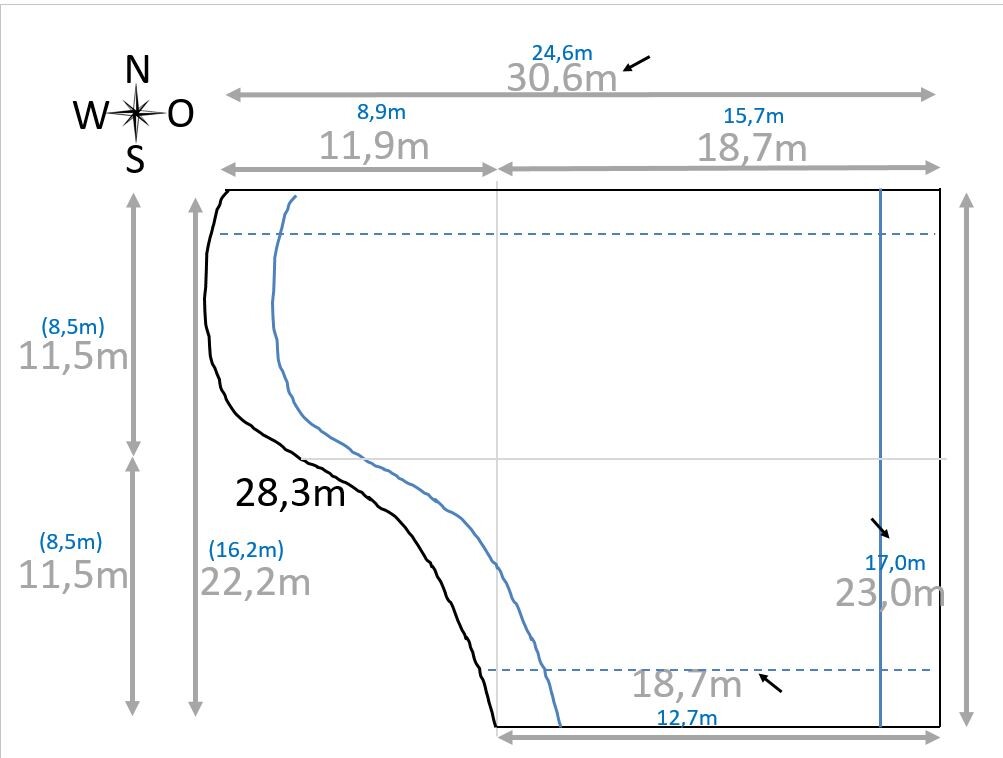
Plot size: 610m² (6565 sq ft)
Slope: no
Floor area ratio: 0.3 (exceeding this is possible through fully greened roof surfaces)
Building envelope, building line and boundary: 3m (10 ft) building boundary on west and east sides, detached building
Number of storeys: 1 full storey
Additional requirements: soundproofing (noise level category II)
Client requirements
Style, roof type, building type: classic detached house / somewhat country house style; preferably with a third gable; timber frame construction; gable roof
Basement, storeys: no basement; 1.5 storeys (currently ground floor approx. 95m² (1023 sq ft) + utility room); current knee wall height 1.00m (3 ft 3 in) → would like to increase to 1.10–1.15m (3 ft 7 in – 3 ft 9 in) actual height
Number and age of inhabitants: currently 2 adults, 0 children; planning for 1–2 children
Space requirements on ground floor and upper floor:
Ground floor: cloakroom, utility room (also a “craft corner”), office (see below), kitchen (see below) with small pantry, guest WC with shower (size/possibility for a closet → should later be a children’s bathroom), living room and dining room (family focal point for meals and e.g. game nights with friends)
Upper floor: bedroom, walk-in closet (separate room), 2 children’s rooms (approximately equal size), bathroom with shower and bathtub and toilet behind sliding door, storage room with washer/dryer
Office: family use or home office?: desk, PC, files etc.
Number of overnight guests per year: very rare (1–2 times a year)
Open or closed architecture: rather closed, but without feeling cramped
Open kitchen, cooking island: closed kitchen → preferably short routes to dining room and terrace; preferably U- or G-shaped kitchen, or L-shaped with island
Number of dining seats: fixed 4 seats, extendable to 6–8 desired (also space for a larger table for occasional special gatherings)
Fireplace: desired, but uncertain if space and budget will allow; if yes, then a classic fireplace on a wall, preferably not as a room divider
Garage, carport: double carport desired
Utility garden, greenhouse: classic low-maintenance family garden
Other wishes / special features / daily routine, including reasons why something should or should not be: we want a closed staircase with a landing;
we prefer a slightly more complex layout, sometimes an angled wall, as it feels cozier (we don’t like everything square, open, and white);
we want a house for our future family with plenty of storage space and practicality; it should naturally look good inside and out, but it is primarily for use, not a design piece;
covered house entrance;
optimize plot area for house and garden, minimize front garden;
use cardinal directions/sun positions sensibly
House design
Who created the design: combination of DIY (room plan / partial room arrangement / staircase preference) and design by preferred house company (house exterior dimensions / staircase location / partial room arrangement)
What do you particularly like? Why?: rooms, orientation of rooms, staircase / use of stairwell
What do you not like? Why?: unsure about the route from kitchen to dining room/terrace; size of some rooms
Estimated cost according to architect/planner: €370,000 (approx. $400,000) including carport, turnkey (excluding extra costs for site work, exterior landscaping, plastering and flooring (tiles included))
Preferred heating system: currently air-to-water heat pump (monobloc with outdoor unit) with underfloor heating and mechanical ventilation with heat recovery; photovoltaics undecided
If you had to give up details / expansions:
- What could you live without? potentially an internal staircase
- What can you not give up? we would not be open to suggestions on this point and would not participate in the project otherwise; but basically the design mostly meets all our must-have wishes; bedroom access via a walk-in closet is not acceptable for us → so two separate accesses
What is the most important/basic question about the floor plan in 130 characters?
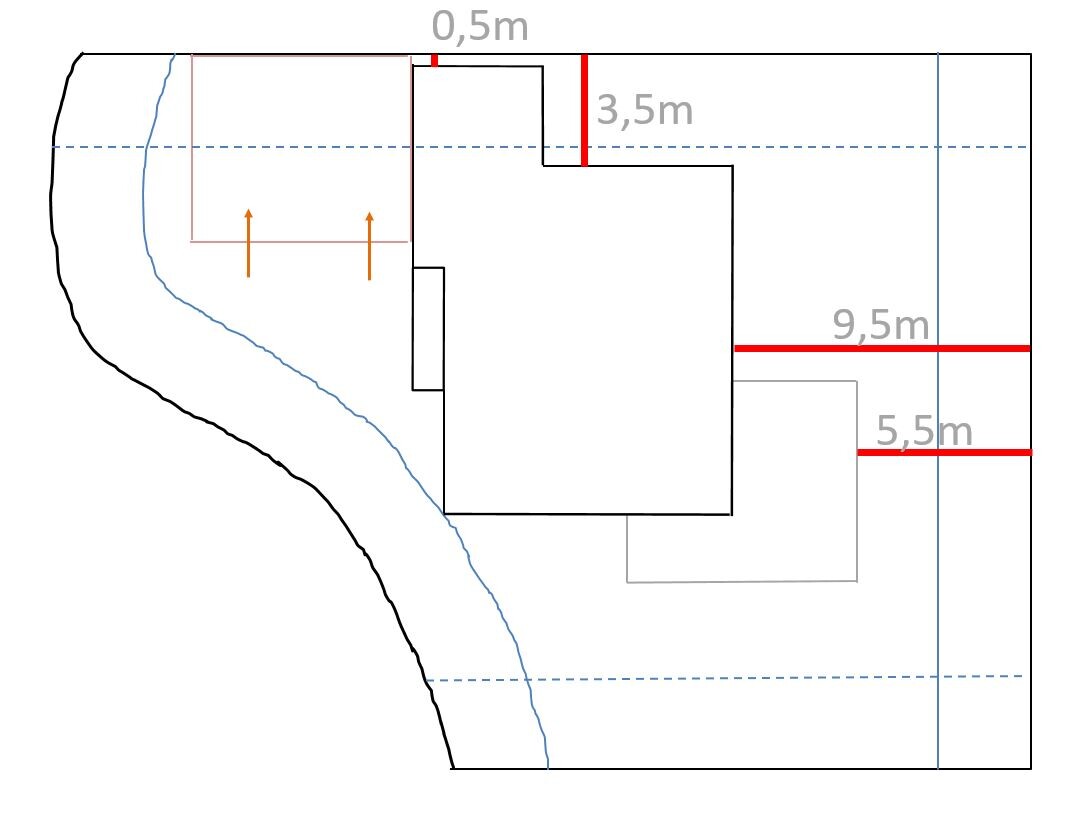
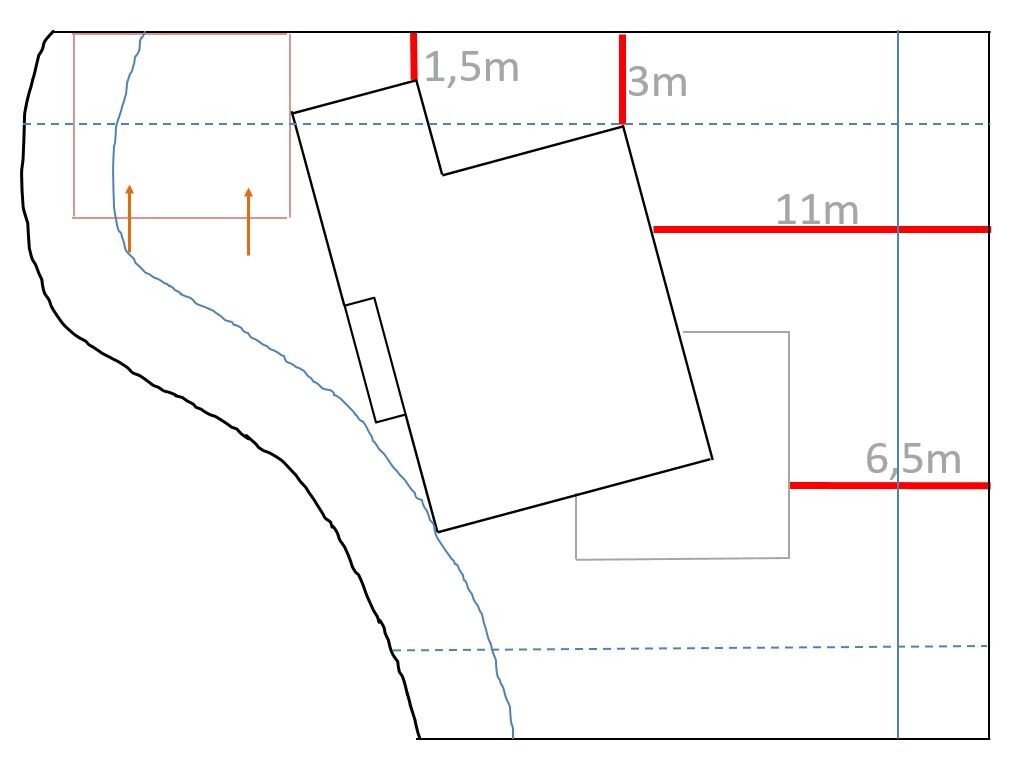
House positioning? (allow only 0.5m (1 ft 8 in) space to neighbor to the north with utility room? House would be about 3.5m (11 ft 6 in) away, so office windows under carport? Or carport offset from house? Or angled placement but then cardinal directions regarding floor plan change? Any other ideas?)
Knee wall height?
Room sizes? → we feel everything is a little tight, or does it just look like that in drawings? We want a cozy, homely house without huge entrance or open gallery, but it should not feel cramped...
Price estimate?
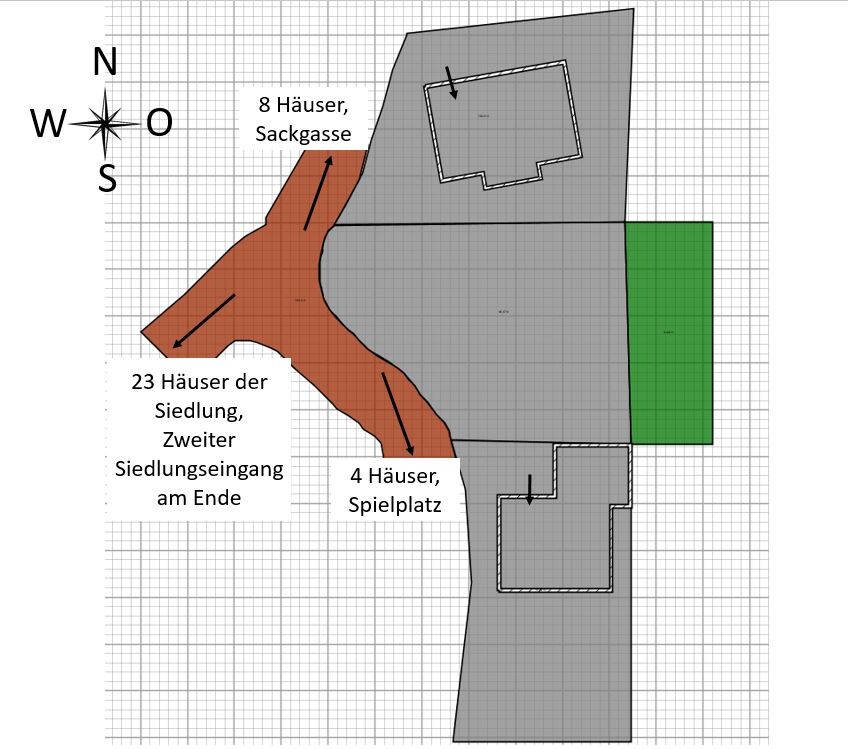
PS: arrows indicate that plot boundaries are slightly angled, no slope; blue = building boundaries; all plans are oriented north
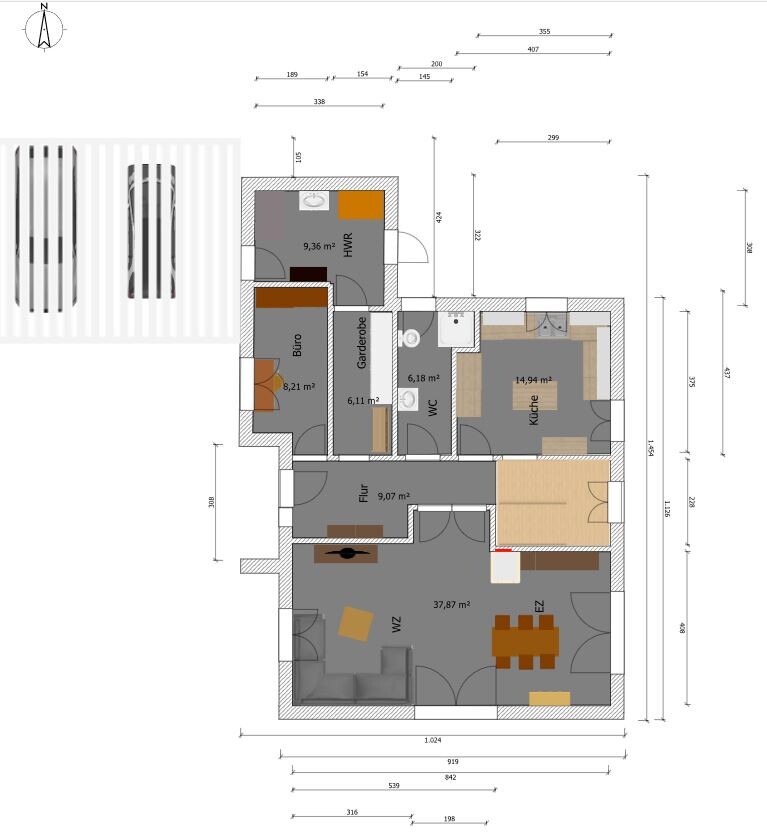
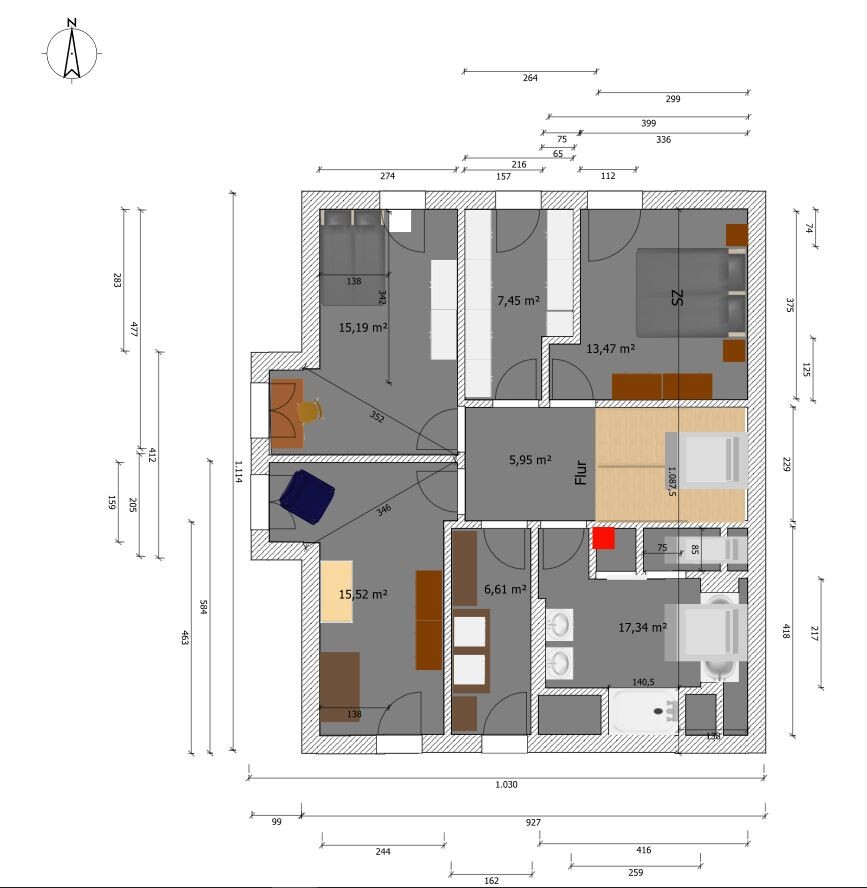
we have tried to prepare the questionnaire and the attachments carefully and thoroughly.
If there are still any open questions – please feel free to ask.
We appreciate your time in considering our building project and welcome constructive criticism, ideas, and suggestions =)
Development plan / restrictions
Plot size: 610m² (6565 sq ft)
Slope: no
Floor area ratio: 0.3 (exceeding this is possible through fully greened roof surfaces)
Building envelope, building line and boundary: 3m (10 ft) building boundary on west and east sides, detached building
Number of storeys: 1 full storey
Additional requirements: soundproofing (noise level category II)
Client requirements
Style, roof type, building type: classic detached house / somewhat country house style; preferably with a third gable; timber frame construction; gable roof
Basement, storeys: no basement; 1.5 storeys (currently ground floor approx. 95m² (1023 sq ft) + utility room); current knee wall height 1.00m (3 ft 3 in) → would like to increase to 1.10–1.15m (3 ft 7 in – 3 ft 9 in) actual height
Number and age of inhabitants: currently 2 adults, 0 children; planning for 1–2 children
Space requirements on ground floor and upper floor:
Ground floor: cloakroom, utility room (also a “craft corner”), office (see below), kitchen (see below) with small pantry, guest WC with shower (size/possibility for a closet → should later be a children’s bathroom), living room and dining room (family focal point for meals and e.g. game nights with friends)
Upper floor: bedroom, walk-in closet (separate room), 2 children’s rooms (approximately equal size), bathroom with shower and bathtub and toilet behind sliding door, storage room with washer/dryer
Office: family use or home office?: desk, PC, files etc.
Number of overnight guests per year: very rare (1–2 times a year)
Open or closed architecture: rather closed, but without feeling cramped
Open kitchen, cooking island: closed kitchen → preferably short routes to dining room and terrace; preferably U- or G-shaped kitchen, or L-shaped with island
Number of dining seats: fixed 4 seats, extendable to 6–8 desired (also space for a larger table for occasional special gatherings)
Fireplace: desired, but uncertain if space and budget will allow; if yes, then a classic fireplace on a wall, preferably not as a room divider
Garage, carport: double carport desired
Utility garden, greenhouse: classic low-maintenance family garden
Other wishes / special features / daily routine, including reasons why something should or should not be: we want a closed staircase with a landing;
we prefer a slightly more complex layout, sometimes an angled wall, as it feels cozier (we don’t like everything square, open, and white);
we want a house for our future family with plenty of storage space and practicality; it should naturally look good inside and out, but it is primarily for use, not a design piece;
covered house entrance;
optimize plot area for house and garden, minimize front garden;
use cardinal directions/sun positions sensibly
House design
Who created the design: combination of DIY (room plan / partial room arrangement / staircase preference) and design by preferred house company (house exterior dimensions / staircase location / partial room arrangement)
What do you particularly like? Why?: rooms, orientation of rooms, staircase / use of stairwell
What do you not like? Why?: unsure about the route from kitchen to dining room/terrace; size of some rooms
Estimated cost according to architect/planner: €370,000 (approx. $400,000) including carport, turnkey (excluding extra costs for site work, exterior landscaping, plastering and flooring (tiles included))
Preferred heating system: currently air-to-water heat pump (monobloc with outdoor unit) with underfloor heating and mechanical ventilation with heat recovery; photovoltaics undecided
If you had to give up details / expansions:
- What could you live without? potentially an internal staircase
- What can you not give up? we would not be open to suggestions on this point and would not participate in the project otherwise; but basically the design mostly meets all our must-have wishes; bedroom access via a walk-in closet is not acceptable for us → so two separate accesses
What is the most important/basic question about the floor plan in 130 characters?
House positioning? (allow only 0.5m (1 ft 8 in) space to neighbor to the north with utility room? House would be about 3.5m (11 ft 6 in) away, so office windows under carport? Or carport offset from house? Or angled placement but then cardinal directions regarding floor plan change? Any other ideas?)
Knee wall height?
Room sizes? → we feel everything is a little tight, or does it just look like that in drawings? We want a cozy, homely house without huge entrance or open gallery, but it should not feel cramped...
Price estimate?
PS: arrows indicate that plot boundaries are slightly angled, no slope; blue = building boundaries; all plans are oriented north

hausnrplus25 schrieb:
Where the wood comes from definitely has an impact on the ecological footprint, but in general, it is simply a renewable resource.I walk through forests every week, admittedly only in Rhineland-Palatinate and North Rhine-Westphalia, but the climate is basically the same elsewhere in Germany. For years, the majority of the harvested timber has come from trees felled due to wind damage. Before one can claim, without turning a blind eye, that structural timber has regrown, the forests need about six to eight decades to recover. What has been harvested in recent years is of excellent quality, suitable for solid and laminated beams, and floods the market with fibers and pellets. So, there is plenty of solid wood (in the sense of pressed small wood) available in Germany, but most of the sawn timber probably has to come from imported exploitation. At a certain level of “consistency,” you have to either create your own ecological halo—or be willing to replace some of your naivety with reality.https://www.instagram.com/11antgmxde/
https://www.linkedin.com/company/bauen-jetzt/
 hausnrplus2510 Mar 2020 16:33
Why do I feel like I have to justify myself again?!
We are not naive or out of touch with reality. Just a gut feeling. Period. New constructions are quite unecological anyway, demolishing buildings is too, producing bricks as well, deforestation too, and driving cars, by the way, as well.....
That’s why I didn’t want to respond in the first place. I know how forum dynamics work.
Once we have a new floor plan, we’ll be happy to get back in touch!
We are not naive or out of touch with reality. Just a gut feeling. Period. New constructions are quite unecological anyway, demolishing buildings is too, producing bricks as well, deforestation too, and driving cars, by the way, as well.....
That’s why I didn’t want to respond in the first place. I know how forum dynamics work.
Once we have a new floor plan, we’ll be happy to get back in touch!
hausnrplus25 schrieb:
Why do I get the feeling I have to justify myself again?!Secondly, you don’t need to justify yourself for anything, and first of all, I always write with the invisible dozen or so readers in mind, who statistically correspond to one visible participant. So you alone were not meant when I pointed out a handful of facts:1. Wood is renewable, yes, but not overnight.
2. Sustainable forestry also means processing what is available in years when harvesting causes damage, instead of bringing forward the logging of future years just to meet demand.
3. Wood only grows as whole trees. That means no one can expect to get only the premium parts (and just leave thinning wood aside because it’s not thick enough). Ecological wood demand always includes using the “cut-off” material as well – which is a win-win for products like glued laminated timber and cross-laminated timber, for example, because of stability advantages. Genuine “eco” thinking always involves deep reflection on these connections. You can never say that enough, and it’s not meant to offend anyone.
https://www.instagram.com/11antgmxde/
https://www.linkedin.com/company/bauen-jetzt/
Similar topics