
ᐅ Floor plan for a "mid-sized tiny house" / single-family home of just under 100 square meters
Created on: 22 Oct 2020 23:29
H
Holzhäuschen
Alright, here it goes.
I’m a little bit nervous about the reactions
(the tiny house idea is a joke, there won’t be one)
Development Plan / Restrictions
Plot size: 589 sqm (6,340 sq ft)
Slope: -
Floor area ratio (FAR): 0.4
Building coverage ratio: -
Building line, boundary and setbacks: 3 m (10 ft) distance from neighbors, no further restrictions
Edge development: -
Number of parking spaces: -
Number of floors: 2
Roof shape: -
Architectural style: -
Orientation: -
Maximum height / limits: 10 m (33 ft)
Owners’ Requirements
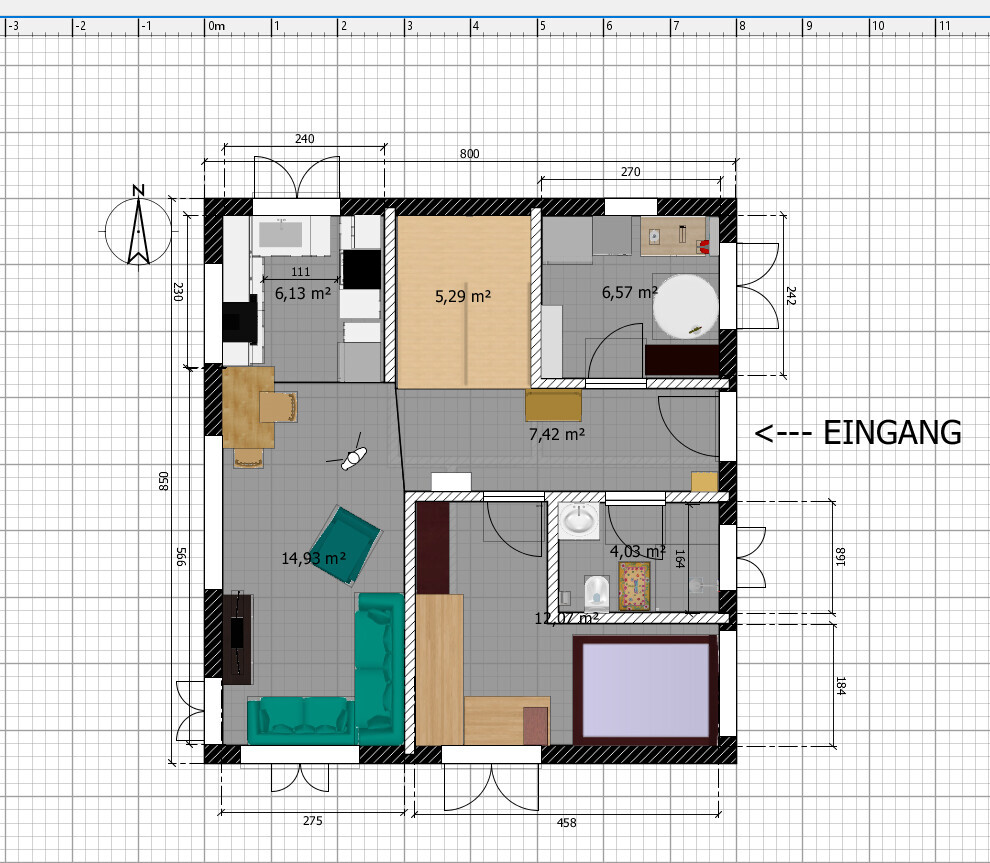
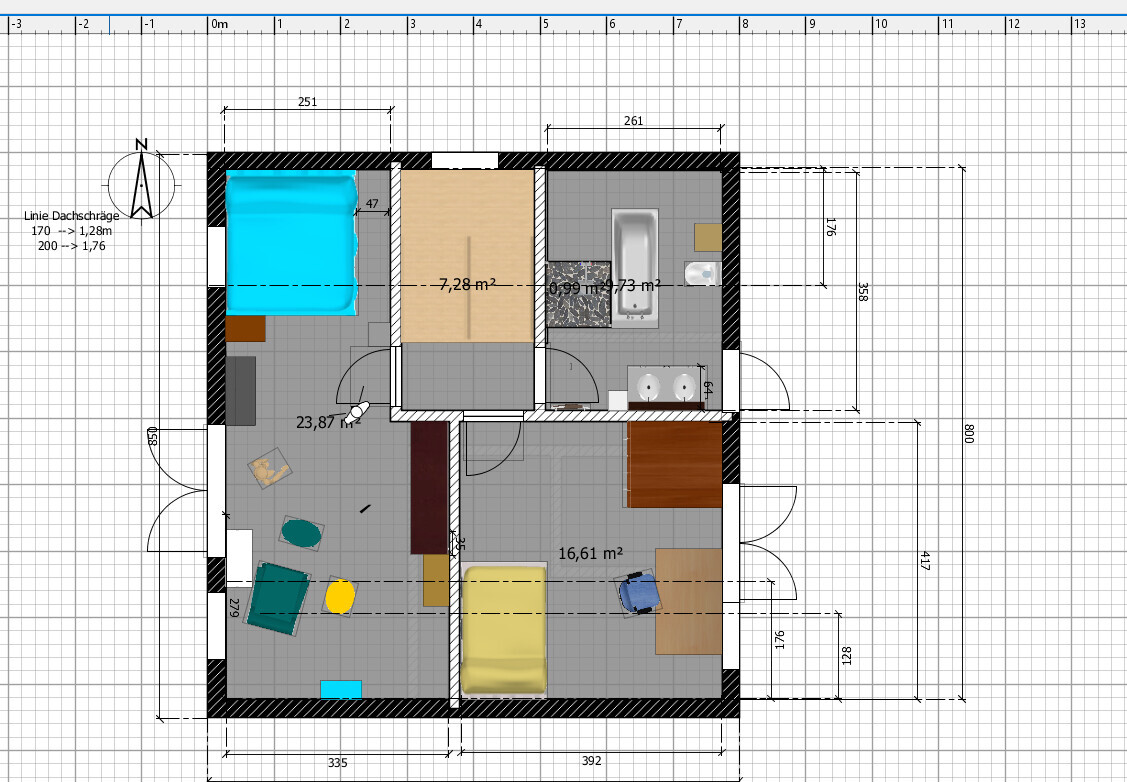
Style, roof shape, building type: Wood house with combined block wall, gable facing east/west, so roof on the shorter 8 m (26 ft) side (8 x 8.5 m (26 x 28 ft))
Basement, floors: No basement. One and a half stories
Number of occupants, ages: 2 people, aged 35 and 36
Space needs on ground floor and upper floor: Ground floor could be a bit larger than planned but is okay as is; upper floor is good
Office: Family use or home office? Partly home office
Guest stays per year: About 10, mostly several weeks at a time
Open or closed architecture: Open
Conservative or modern construction method: Wood? Not sure what’s meant
Open kitchen, kitchen island: Open kitchen yes, island no
Number of dining seats: 2 seats, table is foldable to 4
Fireplace: No
Music / stereo wall: Small speakers
Balcony, roof terrace: No
Garage, carport: Maybe a carport later, not initially
Productive garden, greenhouse: Productive garden yes, greenhouse later
Additional wishes / special features / daily routine, including reasons for choices or exclusions:
One occupant has a chronic illness and is unable to work, spending a lot of time at home; the other works partly from home.
The lower room has a bed for guests and is also used as a craft room / private office.
Both have their own separate rooms; not a couple but shared housing.
House Design
Planner: Designed by me, privately, without prior experience
- Do-it-yourself: Yes.
What do you like most? Why? Bed placed under the sloping ceiling with a roof window; another roof window in the bathroom upstairs.
Laundry room and bathroom on east/north side, living areas face southwest or southeast.
Cozy living room, do not want it too large.
Lower room is for guests to have their own space, potentially usable as a bedroom in case of injury or disability.
What do you dislike? Why? Bathroom and kitchen planning not completed yet.
Initially, we wanted the laundry room next to the kitchen, but it works like this as well.
Cost estimate from architect/planner: 260,000
Personal budget limit for house including fittings: Some flexibility
Preferred heating system: Currently planned is an air-to-water heat pump, still gathering information
If you had to give up on some details or expansions:
- Can you live without: Already quite compact
- Can you not live without:
Why is the design the way it is? Example:
First own attempt, please be kind.
It’s not yet perfect, first rough floor plan.
Windows, bathroom and kitchen furniture arrangements are not finalized.
Stair size is estimated; leaning towards a half-landing stair.
What is the most important/basic question about the floor plan in 130 characters?
Are there better solutions based on orientation?
Any general issues or mistakes I might have overlooked?
I’m a little bit nervous about the reactions
(the tiny house idea is a joke, there won’t be one)
Development Plan / Restrictions
Plot size: 589 sqm (6,340 sq ft)
Slope: -
Floor area ratio (FAR): 0.4
Building coverage ratio: -
Building line, boundary and setbacks: 3 m (10 ft) distance from neighbors, no further restrictions
Edge development: -
Number of parking spaces: -
Number of floors: 2
Roof shape: -
Architectural style: -
Orientation: -
Maximum height / limits: 10 m (33 ft)
Owners’ Requirements
Style, roof shape, building type: Wood house with combined block wall, gable facing east/west, so roof on the shorter 8 m (26 ft) side (8 x 8.5 m (26 x 28 ft))
Basement, floors: No basement. One and a half stories
Number of occupants, ages: 2 people, aged 35 and 36
Space needs on ground floor and upper floor: Ground floor could be a bit larger than planned but is okay as is; upper floor is good
Office: Family use or home office? Partly home office
Guest stays per year: About 10, mostly several weeks at a time
Open or closed architecture: Open
Conservative or modern construction method: Wood? Not sure what’s meant
Open kitchen, kitchen island: Open kitchen yes, island no
Number of dining seats: 2 seats, table is foldable to 4
Fireplace: No
Music / stereo wall: Small speakers
Balcony, roof terrace: No
Garage, carport: Maybe a carport later, not initially
Productive garden, greenhouse: Productive garden yes, greenhouse later
Additional wishes / special features / daily routine, including reasons for choices or exclusions:
One occupant has a chronic illness and is unable to work, spending a lot of time at home; the other works partly from home.
The lower room has a bed for guests and is also used as a craft room / private office.
Both have their own separate rooms; not a couple but shared housing.
House Design
Planner: Designed by me, privately, without prior experience
- Do-it-yourself: Yes.
What do you like most? Why? Bed placed under the sloping ceiling with a roof window; another roof window in the bathroom upstairs.
Laundry room and bathroom on east/north side, living areas face southwest or southeast.
Cozy living room, do not want it too large.
Lower room is for guests to have their own space, potentially usable as a bedroom in case of injury or disability.
What do you dislike? Why? Bathroom and kitchen planning not completed yet.
Initially, we wanted the laundry room next to the kitchen, but it works like this as well.
Cost estimate from architect/planner: 260,000
Personal budget limit for house including fittings: Some flexibility
Preferred heating system: Currently planned is an air-to-water heat pump, still gathering information
If you had to give up on some details or expansions:
- Can you live without: Already quite compact
- Can you not live without:
Why is the design the way it is? Example:
First own attempt, please be kind.
It’s not yet perfect, first rough floor plan.
Windows, bathroom and kitchen furniture arrangements are not finalized.
Stair size is estimated; leaning towards a half-landing stair.
What is the most important/basic question about the floor plan in 130 characters?
Are there better solutions based on orientation?
Any general issues or mistakes I might have overlooked?


Holzhäuschen schrieb:
Number of people, age 2, 35 and 36 There are only 2 people.
Holzhäuschen schrieb:
Shared flat, not a couple The floor plan is quite complicated, and the hallway is disproportionately large. Take a look at Schwörerhaus’s "prefabricated house for 2 people," plan E 20-118.3. There, there would be an office on the upper floor, and more open space downstairs...
Or check out floor plans of small terraced or semi-detached houses, which often have a small footprint and integrate the staircase into the dining or living area.
H
hampshire23 Oct 2020 09:08In a tiny house concept, the usual scales for standard houses become irrelevant. Building a small house is much more challenging in terms of design thinking than building a large house. Good reference points are large motorhomes or other tiny houses. In your design, I see an approach that miniaturizes a "normal" house, which will not work well because too much space is lost to corridors and similar areas.
In a shared living arrangement, I would first consider the following:
A few thoughts on saving space:
Of course, the house is too small by normal standards. These standards are already challenged by the tiny house approach itself. Such a small house is inseparably linked to a lifestyle concept, which must be established first. Distant acquaintances of ours have been living on the road about 300 days a year in a not very large motorhome for a long time and love it.
In a shared living arrangement, I would first consider the following:
- What is important to whom? (order, cleanliness, quiet, socializing & friends, eating, relaxing, retreat, work, privacy, garden, temperature, pets, comfort, hobbies...)
- What contributes to a long-term functioning shared household?
- What strengthens relationships/friendships and what threatens them?
- What are the daily routines?
- What are the differences in daily life between the seasons, and what are the consequences?
- ...
A few thoughts on saving space:
- Entrance to the shared living room as suggested by @Tolentino – but only if no one is a cleanliness fanatic
- Alternatively, an entrance through the utility/ laundry room as a "dirt lock" – proven useful on wet days and my personal favorite
- Living space with integrated circulation areas instead of separate corridors and stairs
- Built-in furniture to save wall space
- Extending living space outdoors when the weather permits
Of course, the house is too small by normal standards. These standards are already challenged by the tiny house approach itself. Such a small house is inseparably linked to a lifestyle concept, which must be established first. Distant acquaintances of ours have been living on the road about 300 days a year in a not very large motorhome for a long time and love it.

Hello,
I don’t see a tiny house (with special space concepts) in the plan, but rather a "small standard house."
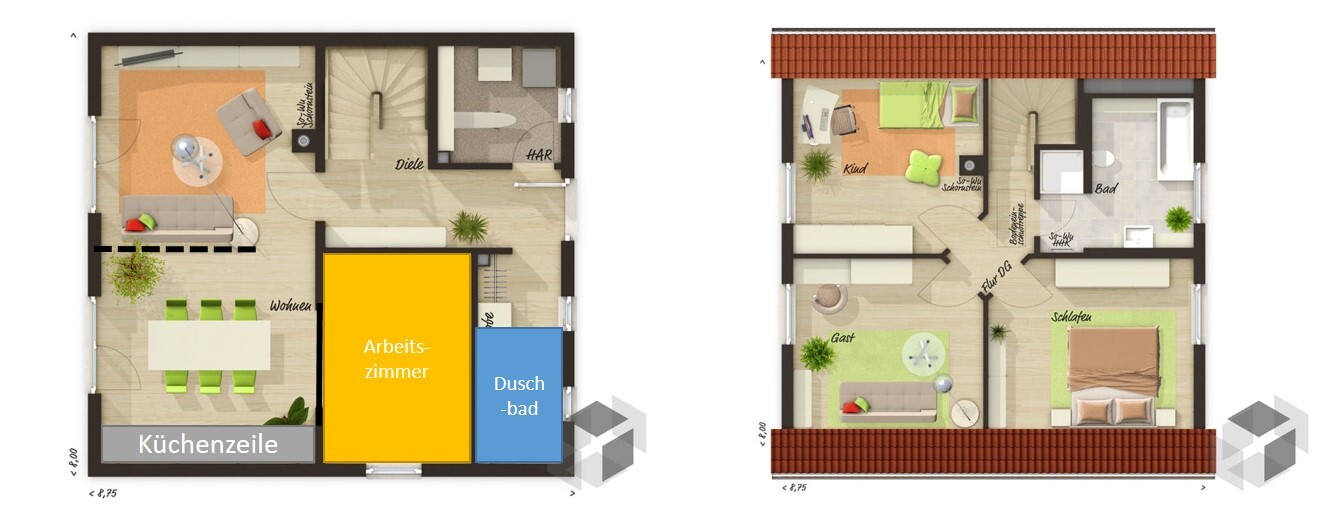
Based on the Town & Country 100 (8.0m x 8.75m [26 ft 3 in x 28 ft 9 in]), I’ve made an adjustment for you. There is even an additional room upstairs, so that each resident has a bedroom (I read that as 3 people: 2 adults, not a couple, plus 1 toddler).
If the admittedly very open kitchen area on the ground floor isn’t to your liking, the kitchen can be separated as a combined kitchen and living area (including dining table) with a partition wall (dashed line).
To reach 8.5m (28 ft) in width, the living room and upstairs children’s and guest rooms may have to give up 0.25m (10 inches) if necessary. I think the living room would still be wider than in your original floor plan.
I don’t see a tiny house (with special space concepts) in the plan, but rather a "small standard house."
Based on the Town & Country 100 (8.0m x 8.75m [26 ft 3 in x 28 ft 9 in]), I’ve made an adjustment for you. There is even an additional room upstairs, so that each resident has a bedroom (I read that as 3 people: 2 adults, not a couple, plus 1 toddler).
If the admittedly very open kitchen area on the ground floor isn’t to your liking, the kitchen can be separated as a combined kitchen and living area (including dining table) with a partition wall (dashed line).
To reach 8.5m (28 ft) in width, the living room and upstairs children’s and guest rooms may have to give up 0.25m (10 inches) if necessary. I think the living room would still be wider than in your original floor plan.
Similar topics