
After having annoyed some of you with my clever advice before, here is the ultimate chance for revenge!
Our story has been a bit complicated from the start. There is still space for a smaller single-family house on my parents’ property. We wanted to take advantage of that opportunity.
So last April, I went to the local planning department to ask what we needed to consider, whether it was even possible, and so on.
The answer was: no problem, it fits perfectly with our municipality’s current infill development concept. We just need to respect the required setback distances and Section 34, the compatibility requirement.
That sounded encouraging!
From the beginning, we were set on building a wooden house (solid wood or timber frame, a final decision will come later), so we started looking around to find a suitable builder. After several meetings with different providers, we chose a timber house builder from the Allgäu region. It just felt right personally, and a friend of mine had already built with him and was very satisfied. He then recommended his trusted in-house architect, because they work well together. We thought, “never change a winning team,” and he was nice, so the planning started.
Unfortunately, that was our first mistake because when building under Section 34 and if you don’t want to exactly replicate a 1970s-style house (like the surrounding development), it’s wise not to choose just any architect. You need one who’s willing to engage with the planning office.
That’s a good tip for everyone building under Section 34!
After two rejected preliminary building applications (the first one already had incorrect setback distances, something an architect really should know...), we ended the cooperation with the architect. The result of this six-month ordeal: we can build there, but not the way currently proposed to us (the knee wall height is too low, and the pitched roof too steep).
For us, the project was shelved for the time being. We didn’t want to spend money on a house design we didn’t like at all.
Then we met another architect at a topping-out ceremony, who is well known for getting the maximum out of the planning office and who just shook his head when we told him our story (this is just the very short version!).
Long story short: we decided to give it another try with this architect.
My partner and I had already developed a fairly precise layout concept; but the new architect didn’t want to look at it. He asked us what our must-haves were, what was necessary, what would be nice, and what could be, and then took a look at the site.
A few weeks later, he presented his layout – and, surprise! – it was very similar to ours! A great idea from him was to share my mother’s driveway, which reduces traffic paths on the property. We hadn’t thought of that, of course, and it’s fantastic!
Basically, he mirrored our design 180°, added an open space (which I had marked as a nice-to-have) above the dining area, and now we are in the concept planning phase.
Before submitting another (possibly unsuccessful) preliminary application, our new architect will work closely with the planning office in advance, so things like setback distances will be settled prior to submission.
So I can’t say anything final yet about the knee wall height we will achieve, nor which roof style it will ultimately be (the planning office currently wants a 31° gable roof, but we would prefer a flat or shed roof – so we still have to find a compromise *smile*).
But we are allowed to build there, and the setback distances are mostly fixed (the architect thinks we can move the house a bit further back, let’s see... I’m not fully convinced yet, but that would be great).
What I would like to discuss here is the layout concept.
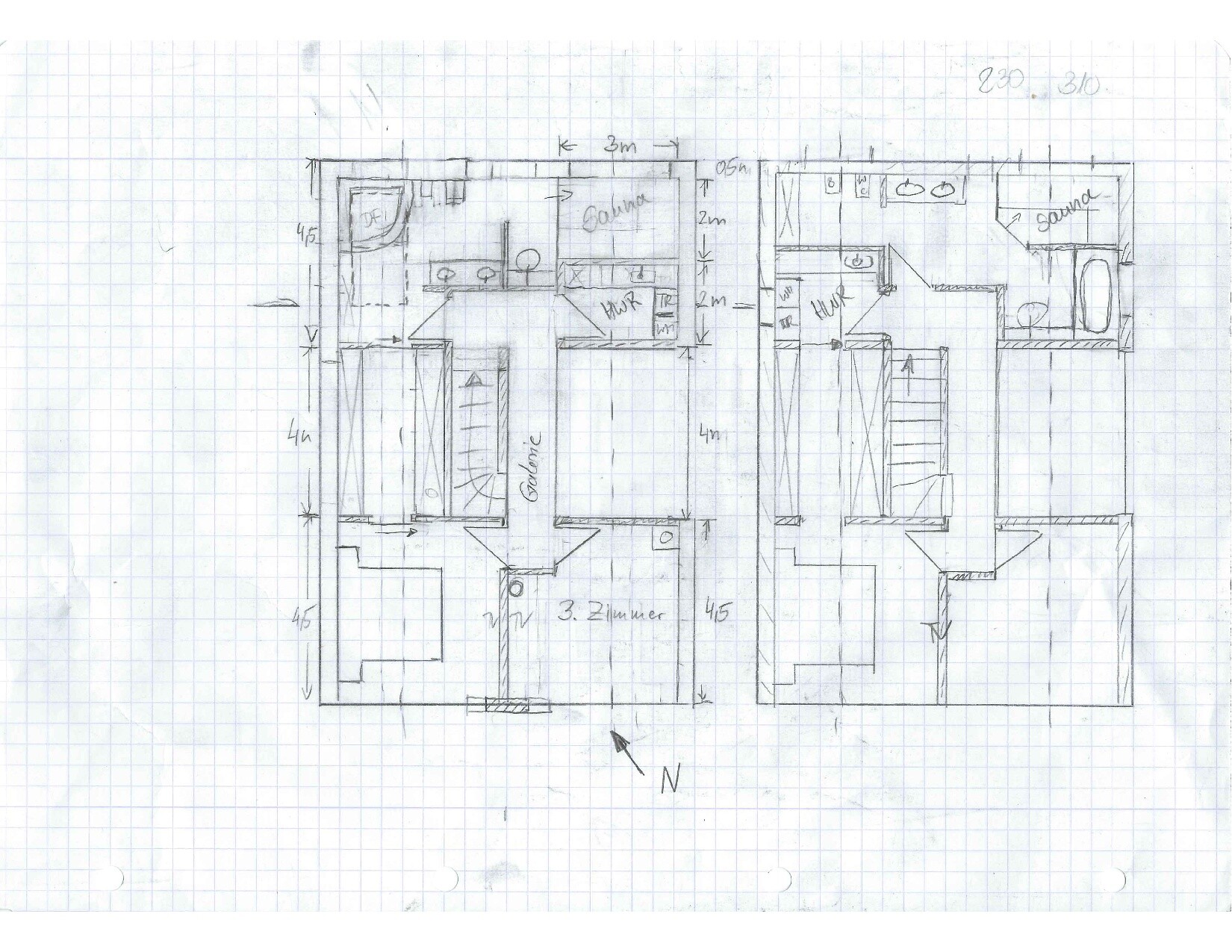
Our main challenges were our large bed (2.30 x 2.30 meters [7 ft 6 in x 7 ft 6 in] with nightstands each 0.45 x 0.45 meters [1 ft 6 in x 1 ft 6 in]) and our vision of a beautiful large bathroom with a sauna, plus a practical utility room on the upper floor.
Otherwise, here are our answers to the standard questionnaire:
Zoning/Restrictions
Plot size: approx. 312 sqm (3355 sq ft) for our house; the total property is 1200 sqm (12,917 sq ft) and will not be subdivided
Slope: slight from north to south, elevation difference approx. 1 m (3 ft)
Site coverage ratio: none, only Section 34 applies (surrounding development ranges from 0.28 to 0.35)
Floor area ratio: none, only Section 34
Building envelope, building line, boundary line: only limited by mandatory setback distances
Boundary development: allowed up to 15 m (49 ft), max. 12 m (39 ft) on one side (need to verify this more precisely)
Number of parking spaces: 2 (as required by the municipality)
Number of floors: ground floor and upper floor without attic space, visible roof structure
Roof form: still open; we don’t want a classic gable roof, at least we want an offset gable roof
Style: modern
Orientation: southeast
Maximum height/limits: ?
Other requirements: Section 34
Homeowner requirements
Style, roof form, building type: modern single-family house, roof form doesn’t matter as long as it’s not a classic gable roof
Basement, floors: basement yes!
Number of occupants, ages: 2 adults, no children
Room needs on ground/upper floor:
Ground floor: guest toilet, kitchen, dining, living, entrance area, pantry
Upper floor: sleeping, multifunctional room (office, guest, music), utility room for washer/dryer, walk-in closet, bathroom
Office: family use or home office? Home office; used irregularly
Number of overnight guests per year: well... probably more if we have the opportunity for guests (currently difficult), but probably less than 10
Open or closed architecture: open!!!
Traditional or modern construction: modern
Open kitchen, kitchen island: kitchen island
Number of dining seats: large dining table 3 x 1.30 m (10 ft x 4 ft 3 in) planned, for 8–12 seats
Fireplace: wood stove
Music/stereo wall: no, stereo system is integrated in living room cabinet
Balcony, rooftop terrace: no
Garage, carport: carport; fortunately no room for a garage
Utility garden, greenhouse: small greenhouse shared with my mother, but it might end up on her side (her garden must give way to our building project), raised bed, also probably together with my mother
Other wishes/special features/daily routine/explanations for preferences: it is important for us that the house is bright and filled with light everywhere.
House design
Who designed it: architect and us
What do you like most? Why?: We basically like almost everything
What don’t you like? Why?: The bathroom gave us a lot of headaches; below you will see two layouts for the upper floor with different bathroom variants. In one, the utility room is located in the southeast, which isn’t necessary to give it such a nice spot. In the second layout, the utility room is in the northwest, but you have to go through it from the walk-in closet and don’t get to the bathroom directly. We find that acceptable because we prefer the bathroom layout of this variant better. If anyone has the ultimate bathroom idea, i.e. the all-in-one perfect bathroom, please share!
Price estimate according to architect/planner: 2,500 €/sqm (232 $/sq ft)
Personal price limit for the house, including fittings: 500,000 € (without land, which we already own)
Preferred heating technology: photovoltaic with water tank (we prefer underfloor heating with water, not electric), heat exchanger. Not final yet. Our architect is also an energy consultant, so we will work on this in more detail.
If you had to give up certain details/extensions, which ones?
- Can give up: open space over the dining area
- Cannot give up: large kitchen, large bathroom with sauna (and for the shower, NO glass that always has to be cleaned)
Why did the design turn out like it did?
Our building envelope is relatively limited due to the small lot, so there wasn’t much room for variation. Our room requirements were also clear; the rest was: where do I want bright rooms, where can it be darker?
What do you think makes it particularly good or bad?
We like the open spatial concept and the gallery.
A few more remarks:
There is no detailed basement plan yet, only a very vague sketch. The technical room will probably be located under the kitchen. Alternatively, under the guest toilet.
The main terrace is planned on the southeast side, i.e. from the dining area. In front of the living room, there will also be a small side terrace for relaxing.
Parking spaces will likely be in the southeast corner, one parallel to the street and one leading into the property.
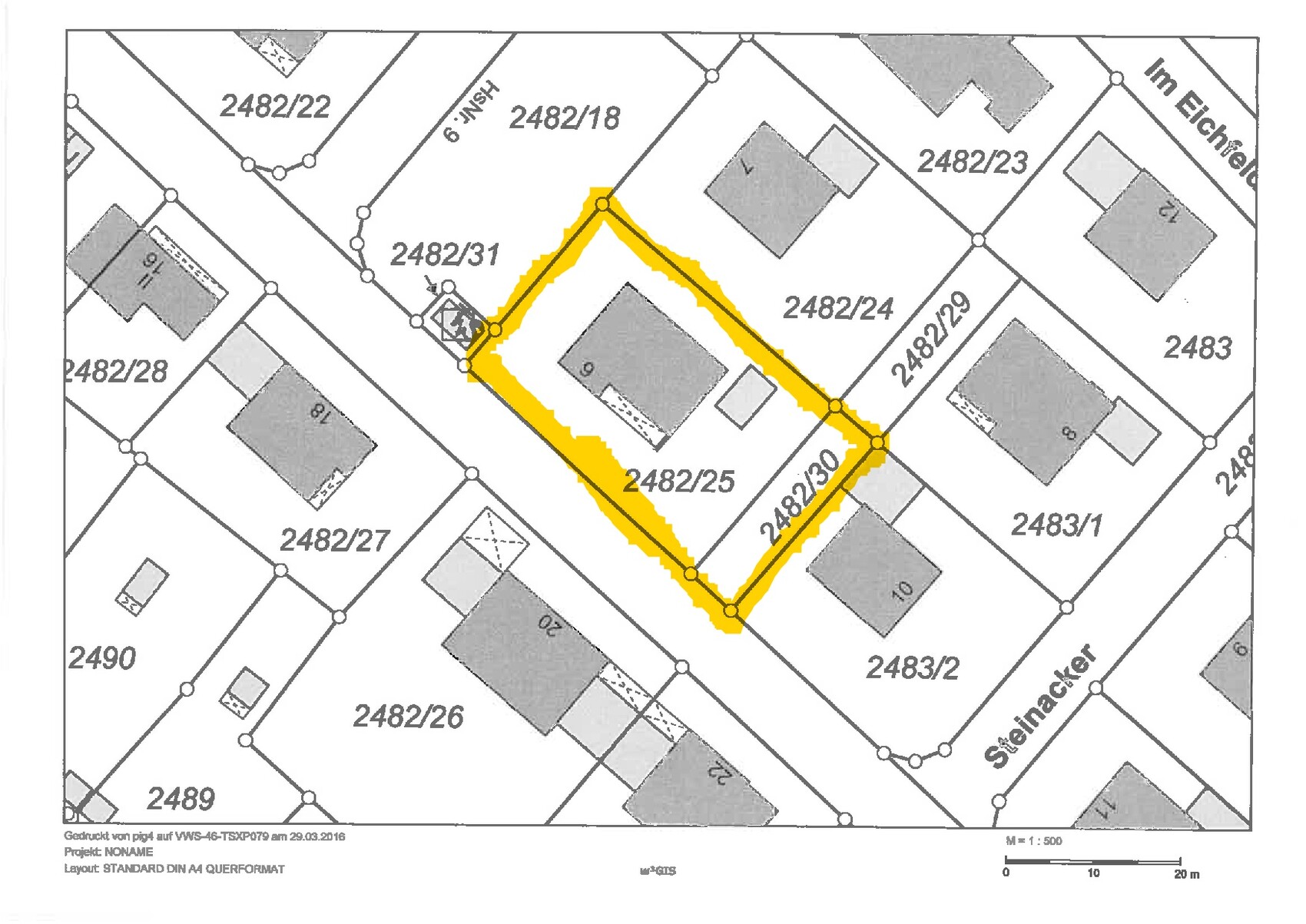
On the site plan, you see the entire property outlined in yellow, including the existing buildings. It consists of two cadastral parcels.
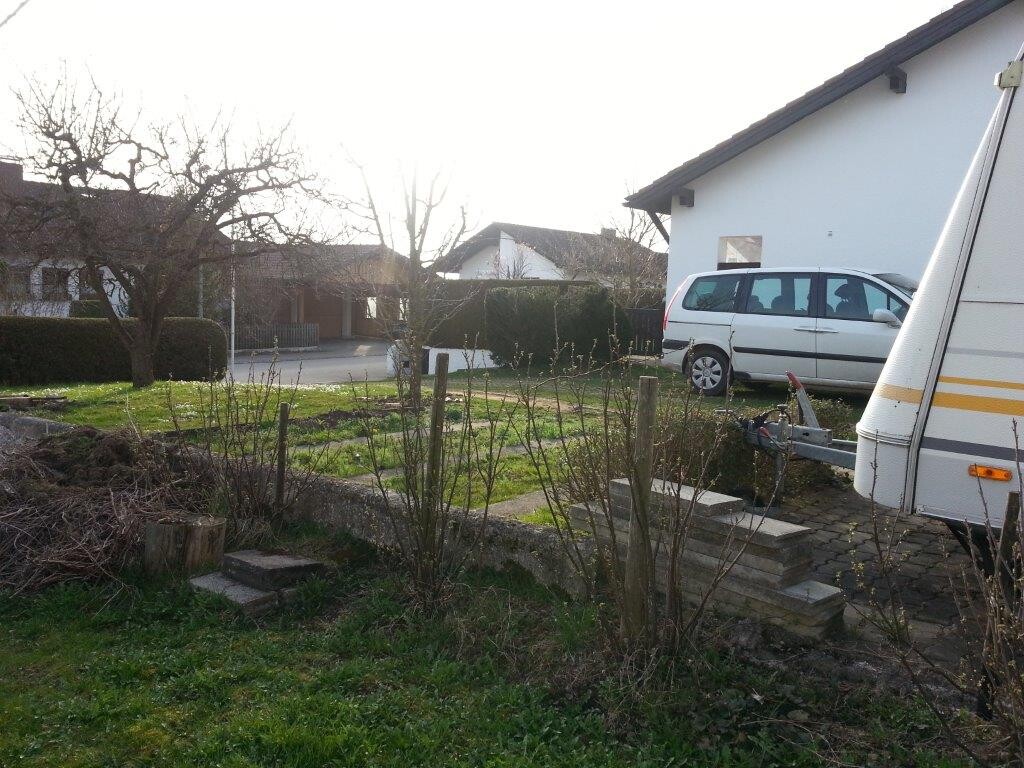
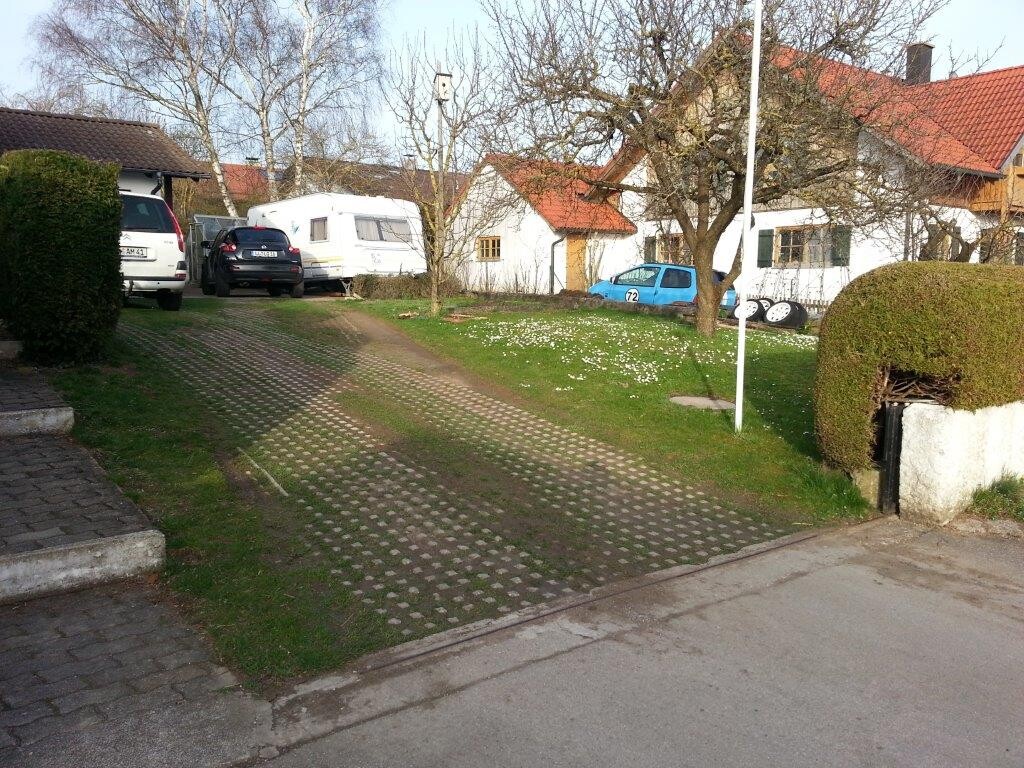
I also added two pictures of the property to give an impression of the slope.
For those who made it this far: RESPECT!!!!
And many thanks!
If you have any questions: just ask!
Our story has been a bit complicated from the start. There is still space for a smaller single-family house on my parents’ property. We wanted to take advantage of that opportunity.
So last April, I went to the local planning department to ask what we needed to consider, whether it was even possible, and so on.
The answer was: no problem, it fits perfectly with our municipality’s current infill development concept. We just need to respect the required setback distances and Section 34, the compatibility requirement.
That sounded encouraging!
From the beginning, we were set on building a wooden house (solid wood or timber frame, a final decision will come later), so we started looking around to find a suitable builder. After several meetings with different providers, we chose a timber house builder from the Allgäu region. It just felt right personally, and a friend of mine had already built with him and was very satisfied. He then recommended his trusted in-house architect, because they work well together. We thought, “never change a winning team,” and he was nice, so the planning started.
Unfortunately, that was our first mistake because when building under Section 34 and if you don’t want to exactly replicate a 1970s-style house (like the surrounding development), it’s wise not to choose just any architect. You need one who’s willing to engage with the planning office.
That’s a good tip for everyone building under Section 34!
After two rejected preliminary building applications (the first one already had incorrect setback distances, something an architect really should know...), we ended the cooperation with the architect. The result of this six-month ordeal: we can build there, but not the way currently proposed to us (the knee wall height is too low, and the pitched roof too steep).
For us, the project was shelved for the time being. We didn’t want to spend money on a house design we didn’t like at all.
Then we met another architect at a topping-out ceremony, who is well known for getting the maximum out of the planning office and who just shook his head when we told him our story (this is just the very short version!).
Long story short: we decided to give it another try with this architect.
My partner and I had already developed a fairly precise layout concept; but the new architect didn’t want to look at it. He asked us what our must-haves were, what was necessary, what would be nice, and what could be, and then took a look at the site.
A few weeks later, he presented his layout – and, surprise! – it was very similar to ours! A great idea from him was to share my mother’s driveway, which reduces traffic paths on the property. We hadn’t thought of that, of course, and it’s fantastic!
Basically, he mirrored our design 180°, added an open space (which I had marked as a nice-to-have) above the dining area, and now we are in the concept planning phase.
Before submitting another (possibly unsuccessful) preliminary application, our new architect will work closely with the planning office in advance, so things like setback distances will be settled prior to submission.
So I can’t say anything final yet about the knee wall height we will achieve, nor which roof style it will ultimately be (the planning office currently wants a 31° gable roof, but we would prefer a flat or shed roof – so we still have to find a compromise *smile*).
But we are allowed to build there, and the setback distances are mostly fixed (the architect thinks we can move the house a bit further back, let’s see... I’m not fully convinced yet, but that would be great).
What I would like to discuss here is the layout concept.
Our main challenges were our large bed (2.30 x 2.30 meters [7 ft 6 in x 7 ft 6 in] with nightstands each 0.45 x 0.45 meters [1 ft 6 in x 1 ft 6 in]) and our vision of a beautiful large bathroom with a sauna, plus a practical utility room on the upper floor.
Otherwise, here are our answers to the standard questionnaire:
Zoning/Restrictions
Plot size: approx. 312 sqm (3355 sq ft) for our house; the total property is 1200 sqm (12,917 sq ft) and will not be subdivided
Slope: slight from north to south, elevation difference approx. 1 m (3 ft)
Site coverage ratio: none, only Section 34 applies (surrounding development ranges from 0.28 to 0.35)
Floor area ratio: none, only Section 34
Building envelope, building line, boundary line: only limited by mandatory setback distances
Boundary development: allowed up to 15 m (49 ft), max. 12 m (39 ft) on one side (need to verify this more precisely)
Number of parking spaces: 2 (as required by the municipality)
Number of floors: ground floor and upper floor without attic space, visible roof structure
Roof form: still open; we don’t want a classic gable roof, at least we want an offset gable roof
Style: modern
Orientation: southeast
Maximum height/limits: ?
Other requirements: Section 34
Homeowner requirements
Style, roof form, building type: modern single-family house, roof form doesn’t matter as long as it’s not a classic gable roof
Basement, floors: basement yes!
Number of occupants, ages: 2 adults, no children
Room needs on ground/upper floor:
Ground floor: guest toilet, kitchen, dining, living, entrance area, pantry
Upper floor: sleeping, multifunctional room (office, guest, music), utility room for washer/dryer, walk-in closet, bathroom
Office: family use or home office? Home office; used irregularly
Number of overnight guests per year: well... probably more if we have the opportunity for guests (currently difficult), but probably less than 10
Open or closed architecture: open!!!
Traditional or modern construction: modern
Open kitchen, kitchen island: kitchen island
Number of dining seats: large dining table 3 x 1.30 m (10 ft x 4 ft 3 in) planned, for 8–12 seats
Fireplace: wood stove
Music/stereo wall: no, stereo system is integrated in living room cabinet
Balcony, rooftop terrace: no
Garage, carport: carport; fortunately no room for a garage
Utility garden, greenhouse: small greenhouse shared with my mother, but it might end up on her side (her garden must give way to our building project), raised bed, also probably together with my mother
Other wishes/special features/daily routine/explanations for preferences: it is important for us that the house is bright and filled with light everywhere.
House design
Who designed it: architect and us
What do you like most? Why?: We basically like almost everything
What don’t you like? Why?: The bathroom gave us a lot of headaches; below you will see two layouts for the upper floor with different bathroom variants. In one, the utility room is located in the southeast, which isn’t necessary to give it such a nice spot. In the second layout, the utility room is in the northwest, but you have to go through it from the walk-in closet and don’t get to the bathroom directly. We find that acceptable because we prefer the bathroom layout of this variant better. If anyone has the ultimate bathroom idea, i.e. the all-in-one perfect bathroom, please share!
Price estimate according to architect/planner: 2,500 €/sqm (232 $/sq ft)
Personal price limit for the house, including fittings: 500,000 € (without land, which we already own)
Preferred heating technology: photovoltaic with water tank (we prefer underfloor heating with water, not electric), heat exchanger. Not final yet. Our architect is also an energy consultant, so we will work on this in more detail.
If you had to give up certain details/extensions, which ones?
- Can give up: open space over the dining area
- Cannot give up: large kitchen, large bathroom with sauna (and for the shower, NO glass that always has to be cleaned)
Why did the design turn out like it did?
Our building envelope is relatively limited due to the small lot, so there wasn’t much room for variation. Our room requirements were also clear; the rest was: where do I want bright rooms, where can it be darker?
What do you think makes it particularly good or bad?
We like the open spatial concept and the gallery.
A few more remarks:
There is no detailed basement plan yet, only a very vague sketch. The technical room will probably be located under the kitchen. Alternatively, under the guest toilet.
The main terrace is planned on the southeast side, i.e. from the dining area. In front of the living room, there will also be a small side terrace for relaxing.
Parking spaces will likely be in the southeast corner, one parallel to the street and one leading into the property.
On the site plan, you see the entire property outlined in yellow, including the existing buildings. It consists of two cadastral parcels.
I also added two pictures of the property to give an impression of the slope.
For those who made it this far: RESPECT!!!!
And many thanks!
If you have any questions: just ask!

The moon keeps me awake....
What you’re seeing here is the first draft, created by a drafter based on the architect’s sketches; I consider revisions here completely normal.
We actually like the spatial concept itself quite a bit.
So, we need to realize our space requirements within the given shell.
If you're already telling me to crumple the plans, then constructive—and feasible—suggestions for better planning would be great!
Just complaining doesn’t get me anywhere... I will not crumple the plans but will try, with my limited creativity, to make the best out of the situation (and this is exactly why I sought support here; I can’t change the conditions themselves).
Apparently, I have no chance to get the solution from you in the form of a magic one-size-fits-all idea.
Too bad! I would have been curious.
11ant schrieb:“Crumpling the plans” isn’t really a constructive comment, sorry. Unfortunately, the “shell” is quite restricted by the existing setback requirements. If we had free rein, it wouldn’t be a house with a gable roof. But that’s just not possible. The 35° roof pitch doesn’t excite us either; the building authority would allow a flatter pitch, but then the 2m (6.5 ft) setback line moves even further inward and we lose even more space. These are the compromises we have to accept.
Where do you see “Bauhaus” style in a dormer with a shallow pitched shed roof (or a crossbeam made of two of those)?
What you’re seeing here is the first draft, created by a drafter based on the architect’s sketches; I consider revisions here completely normal.
We actually like the spatial concept itself quite a bit.
So, we need to realize our space requirements within the given shell.
If you're already telling me to crumple the plans, then constructive—and feasible—suggestions for better planning would be great!
Just complaining doesn’t get me anywhere... I will not crumple the plans but will try, with my limited creativity, to make the best out of the situation (and this is exactly why I sought support here; I can’t change the conditions themselves).
Apparently, I have no chance to get the solution from you in the form of a magic one-size-fits-all idea.
Too bad! I would have been curious.

And, a definite "yes": in some cases, it is better to seek solutions through reengineering rather than patching things up with temporary fixes.
I didn’t mean this economically for my energy spent on complaining, but rather for your energy to focus on finding solutions.
The length of your list of dissatisfactions is a clear sign to any experienced diagnostician: “medication won’t solve this, surgery is needed.” I know patients prefer pills over unpleasant procedures. But that is not the doctor’s fault.
If you see that the tail is longer than the dog, you can of course say: “oh, you painted a nice picture there. Come on, add a speech bubble with ‘Woof, woof!’.” I didn’t realize you would prefer it to be more pleasant.
That’s why I rather said: “this has probably become more like a squirrel than a dog. If you want it to be a dog, you better paint it again.”
Crumpling up a plan may sound harsh. But when you are stuck in a dead end, turning around helps much more than accelerating or shifting gears (except the reverse). Every chiropractic success begins with a cry of pain.
Your planning had advanced so far that—even laypersons can see from the restless building structure—the geometric squaring does not lead into a stable condition. A newly built house that already shows more bulges than an old extension is not acceptable. Even the “cross” alone shows that somewhere something wants to be squeezed improperly from sideways to lengthwise.
Therefore, my advice is to “start over.” The best way is to turn your list of defects into a list of foundational assumptions to question. That means you ask for each point: “Is this a requirement that stands in the way of my goal?”
1) boring facade: this can hardly go along with a restless building structure;
3) knee wall height 1.07 m (3.5 feet): how was this determined? Is it measured from the finished floor buildup to an effective 1.00 m (3.3 feet)? Otherwise, why? A higher knee wall would mean moving the house back by half a centimeter for every centimeter increased, right?
4) kitchen drawn incorrectly: should not happen with professionals, or conversation results weren’t properly heard;
5) I understand avoiding the existing garage with the basement excavation. What I’m missing (or maybe overlooked): what would the optimal basement look like if the garage didn’t have to be considered?
9 and 10) clear communication issues between client and planner. The wall next to the stairs can hardly be blamed on the property. Someone wasn’t listening.
Requirements from the development plan or building permit/planning permission cannot be deprioritized. But the planner’s listening skills must be improved, and you need to assess which wishes can be compromised. I would preferably check those that create obstacles first. A wardrobe still needs depth for hanging clothes. If nothing can be changed about the knee wall, the placement must be reconsidered. If you do this trapped in a “fixed” floor plan, you might not get anywhere. So: everything back to the beginning.
https://www.instagram.com/11antgmxde/
https://www.linkedin.com/company/bauen-jetzt/
I didn’t mean this economically for my energy spent on complaining, but rather for your energy to focus on finding solutions.
The length of your list of dissatisfactions is a clear sign to any experienced diagnostician: “medication won’t solve this, surgery is needed.” I know patients prefer pills over unpleasant procedures. But that is not the doctor’s fault.
If you see that the tail is longer than the dog, you can of course say: “oh, you painted a nice picture there. Come on, add a speech bubble with ‘Woof, woof!’.” I didn’t realize you would prefer it to be more pleasant.
That’s why I rather said: “this has probably become more like a squirrel than a dog. If you want it to be a dog, you better paint it again.”
Crumpling up a plan may sound harsh. But when you are stuck in a dead end, turning around helps much more than accelerating or shifting gears (except the reverse). Every chiropractic success begins with a cry of pain.
Your planning had advanced so far that—even laypersons can see from the restless building structure—the geometric squaring does not lead into a stable condition. A newly built house that already shows more bulges than an old extension is not acceptable. Even the “cross” alone shows that somewhere something wants to be squeezed improperly from sideways to lengthwise.
Therefore, my advice is to “start over.” The best way is to turn your list of defects into a list of foundational assumptions to question. That means you ask for each point: “Is this a requirement that stands in the way of my goal?”
1) boring facade: this can hardly go along with a restless building structure;
3) knee wall height 1.07 m (3.5 feet): how was this determined? Is it measured from the finished floor buildup to an effective 1.00 m (3.3 feet)? Otherwise, why? A higher knee wall would mean moving the house back by half a centimeter for every centimeter increased, right?
4) kitchen drawn incorrectly: should not happen with professionals, or conversation results weren’t properly heard;
5) I understand avoiding the existing garage with the basement excavation. What I’m missing (or maybe overlooked): what would the optimal basement look like if the garage didn’t have to be considered?
9 and 10) clear communication issues between client and planner. The wall next to the stairs can hardly be blamed on the property. Someone wasn’t listening.
Requirements from the development plan or building permit/planning permission cannot be deprioritized. But the planner’s listening skills must be improved, and you need to assess which wishes can be compromised. I would preferably check those that create obstacles first. A wardrobe still needs depth for hanging clothes. If nothing can be changed about the knee wall, the placement must be reconsidered. If you do this trapped in a “fixed” floor plan, you might not get anywhere. So: everything back to the beginning.
https://www.instagram.com/11antgmxde/
https://www.linkedin.com/company/bauen-jetzt/
A higher knee wall is not possible because the existing building is not only the garage but also a house, and this does not comply with the setback requirements. That’s why we are using a gable roof with a low knee wall.
Last night, I didn’t just complain here, but also looked for solutions:
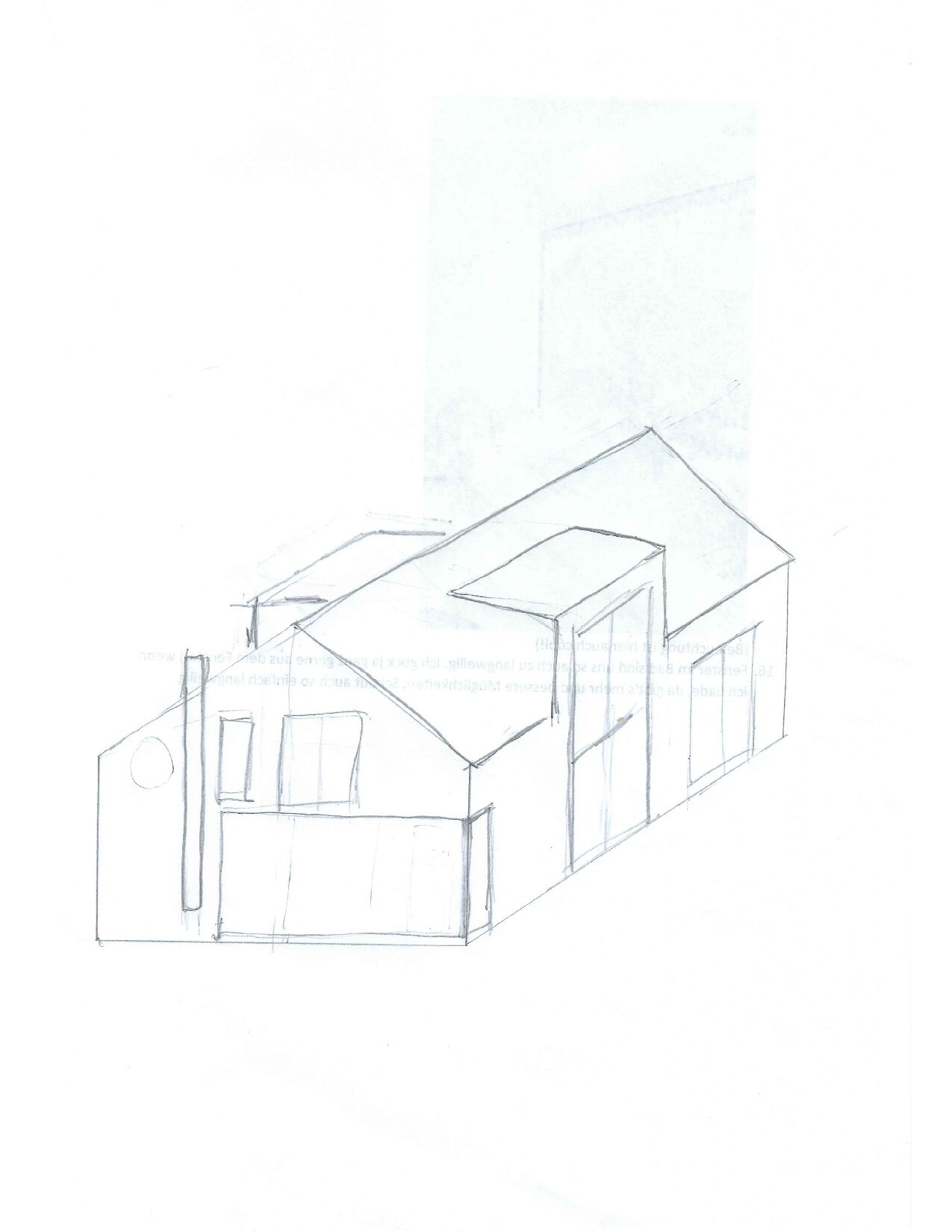
These are: after moving the staircase about 40cm (16 inches) to the west, we have more space in the dining area, so we can reduce the “bump.” This means going back to a purely rectangular building shape with only lean-to dormers, and not just for the open space above the dining area—the dressing room will also get this dormer again. This allows the doors to be shifted further to the left (west), making the dressing room optimally usable.
The basement was originally planned to be the same size as the house. While we do need a basement, it doesn’t have to be that large, so we decided to reduce its size. This preserves my mother’s garage and saves us costs.
We don’t have a development plan; the only restrictions are from the setback requirements. Without these, we could even build a flat-roofed bungalow.
Check the building location: no, the plot is family-owned, so we are getting it for free.
Find another plot: nearly impossible here (very few new building zones are released, and if so, they are unaffordable).
We are grateful to have access to a free building plot, so we have to make concessions elsewhere. Within these limitations, we are simply trying to find the best solution for us.
I personally see adjustments after the first design draft as normal rather than a sign to give up entirely.
Last night, I didn’t just complain here, but also looked for solutions:
These are: after moving the staircase about 40cm (16 inches) to the west, we have more space in the dining area, so we can reduce the “bump.” This means going back to a purely rectangular building shape with only lean-to dormers, and not just for the open space above the dining area—the dressing room will also get this dormer again. This allows the doors to be shifted further to the left (west), making the dressing room optimally usable.
The basement was originally planned to be the same size as the house. While we do need a basement, it doesn’t have to be that large, so we decided to reduce its size. This preserves my mother’s garage and saves us costs.
We don’t have a development plan; the only restrictions are from the setback requirements. Without these, we could even build a flat-roofed bungalow.
Check the building location: no, the plot is family-owned, so we are getting it for free.
Find another plot: nearly impossible here (very few new building zones are released, and if so, they are unaffordable).
We are grateful to have access to a free building plot, so we have to make concessions elsewhere. Within these limitations, we are simply trying to find the best solution for us.
I personally see adjustments after the first design draft as normal rather than a sign to give up entirely.
Climbee schrieb:
Check the location: no, the plot is family-owned, so we get it for free.That wasn’t about the plot itself. It referred to the placement of the cabinet, which needs to be moved elsewhere if there isn’t enough depth remaining where the ceiling height is sufficient. A dormer (in this case more precisely a cross-gable) naturally solves this too — acting somewhat like a partial knee wall.
Climbee schrieb:
I personally see adjustments after the first design draft as quite normal rather than a sign to give up entirely...You must have a different threshold than I do for deciding at how many critical points one switches from making adjustments to starting over from scratch.
https://www.instagram.com/11antgmxde/
https://www.linkedin.com/company/bauen-jetzt/
Now I am a bit too tired for specific suggestions. So, for now just this: I find the house quite successful, even very much so within these conditions. My proposal to completely rethink everything was not because I disliked anything essential, but rather because of the length of your own list of points of dissatisfaction.
I don’t find anything boring here; it’s just that the clarity of the floor plan gets a bit lost due to the requirement of the surrounding buildings with pitched roofs.
I am not happy with the bathroom at all – but as I said, this is an early opinion without an alternative design. I don’t understand the trend of equipping guest toilets—even when there is no guest room nearby—with showers.
What I find odd in the floor plan are the patio doors: it looks as if one slides next to the terrace, and the other almost where the first one opens (?) – but in the elevation view, it looks completely “normal”...
https://www.instagram.com/11antgmxde/
https://www.linkedin.com/company/bauen-jetzt/
I don’t find anything boring here; it’s just that the clarity of the floor plan gets a bit lost due to the requirement of the surrounding buildings with pitched roofs.
I am not happy with the bathroom at all – but as I said, this is an early opinion without an alternative design. I don’t understand the trend of equipping guest toilets—even when there is no guest room nearby—with showers.
What I find odd in the floor plan are the patio doors: it looks as if one slides next to the terrace, and the other almost where the first one opens (?) – but in the elevation view, it looks completely “normal”...
https://www.instagram.com/11antgmxde/
https://www.linkedin.com/company/bauen-jetzt/
Also a night owl *g*
Shower in the guest bathroom: it might initially just be planned as a possibility, with a built-in closet installed instead. The idea behind this is that if someone ever becomes in need of care and unable to walk, the west side of the living room can be separated off, a door can be added to the entrance area, and then a care room can be set up on the ground floor, or it would at least be possible to live on one level in an emergency (that’s why we will also discuss the door width to the guest bathroom again).
Also, we sometimes have guests who stay “on behalf” of others, and I don’t necessarily want them using my bathroom (especially since I sometimes walk around naked directly from the bedroom). So right now, we are still considering whether to install the shower on the ground floor immediately (for the guest reason) or to keep it as an option for the future (if the care situation occurs or we decide we do want the shower for guests).
I still need to take another look at the patio doors. I believe folding doors are currently planned to the east side, and sliding doors to the front.
We have a meeting with the architect this afternoon, so we’ll see what comes out of that.
Shower in the guest bathroom: it might initially just be planned as a possibility, with a built-in closet installed instead. The idea behind this is that if someone ever becomes in need of care and unable to walk, the west side of the living room can be separated off, a door can be added to the entrance area, and then a care room can be set up on the ground floor, or it would at least be possible to live on one level in an emergency (that’s why we will also discuss the door width to the guest bathroom again).
Also, we sometimes have guests who stay “on behalf” of others, and I don’t necessarily want them using my bathroom (especially since I sometimes walk around naked directly from the bedroom). So right now, we are still considering whether to install the shower on the ground floor immediately (for the guest reason) or to keep it as an option for the future (if the care situation occurs or we decide we do want the shower for guests).
I still need to take another look at the patio doors. I believe folding doors are currently planned to the east side, and sliding doors to the front.
We have a meeting with the architect this afternoon, so we’ll see what comes out of that.
Similar topics