
ᐅ Floor plan for a single-family house with 200 m² living area, including a 75 m² granny flat / accessory apartment, a 140 m² basement, and a 56 m² garage
Created on: 12 Sep 2022 17:07
K
Koehler
Hello everyone,
I am planning to build a house. I might receive a share of the plot from my mother if she gets her own apartment (accessory dwelling unit) on the property (our relationship is excellent so far). In any case, there should be two separate units on one plot. (Yes, financing might be challenging…)
Zoning Plan/Restrictions (Requests from the Building Authority as there is no zoning plan)
Plot size: approx. 1050 m² (given in exchange for mandatory accessory dwelling unit on the plot)
Slope: no
Site coverage ratio: no zoning plan
Floor area ratio: no zoning plan
Building setback lines, building line, property boundary: no zoning plan, but the building authority requests at least 3 meters (10 feet) setback from the street
Edge construction: maximum 9.0 m (30 feet) for garages up to 3.0 m (10 feet) height
Number of parking spaces: 2
Number of storeys: one-story with a converted attic (2/3 of the lower floor may be max. 2.30 m (7.5 feet) high)
Roof type: building inquiry was for a gable roof with two small dormers
Architectural style: no specifications
Orientation: no specifications
Maximum height/limits: 9.0 m (30 feet)
Other requirements: residential building should not be larger
Homeowners’ Requirements
Architectural style, roof type, building type: hipped roof up to 2.3 m (7.5 feet) line at approx. 35°, above 2.3 m (7.5 feet) line between 10° and 22°
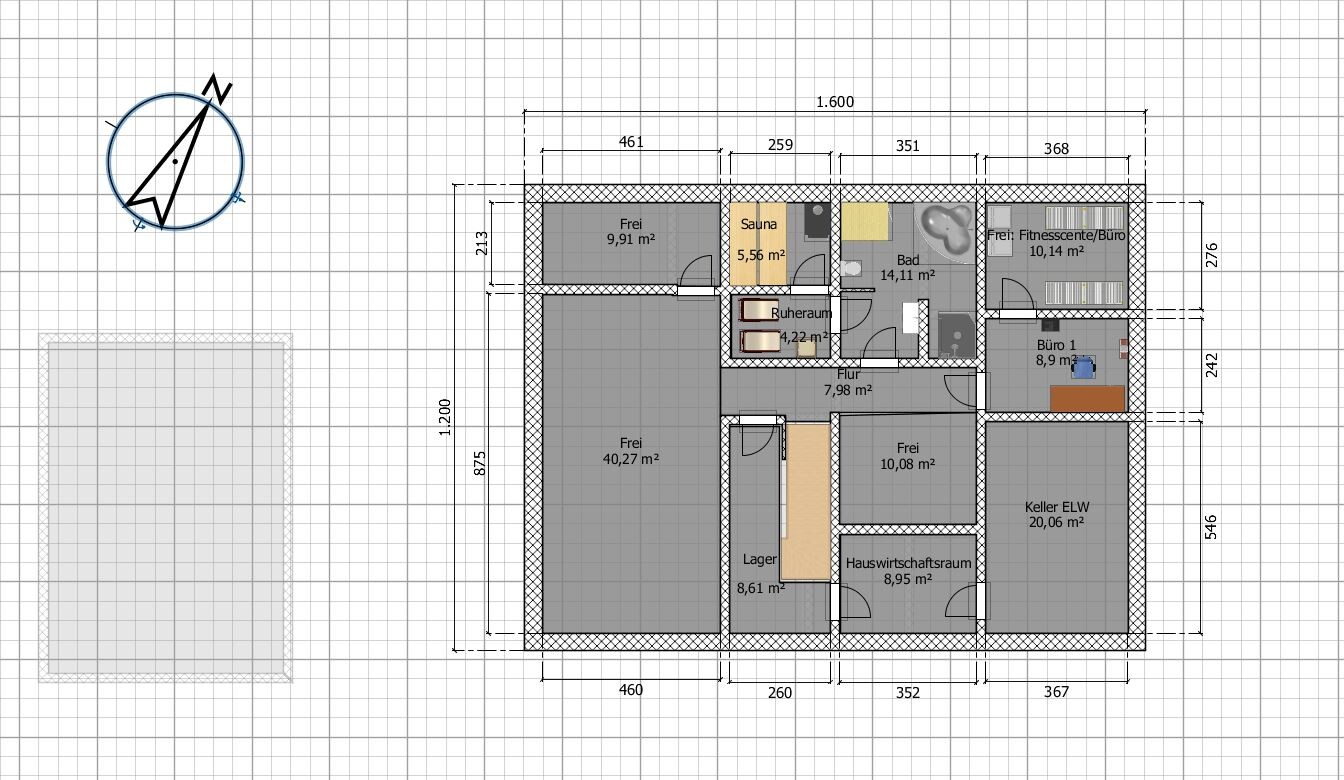
Basement, storeys: one-story with finished attic (wish: basement with bathtub)
Number of people, ages: currently 1+1 persons, 34 (me) and mother 58 (in the accessory dwelling)
Room requirements on ground floor, upper floor: main apartment 200 m² (2150 sq. ft.) + accessory dwelling 75 m² (807 sq. ft.)
Office: family use or home office? both home offices
Overnight guests per year: sometimes 2 adults + 2 children
Open or closed architecture: open plan
Traditional or modern design: rather modern design
Open kitchen, kitchen island: both units with open kitchen and kitchen island
Number of dining seats: 6 in main unit + 4 in accessory dwelling
Fireplace: yes, in both units
Sound/music wall: no
Balcony, roof terrace: not necessary
Garage, carport: (optional) garage only; no garage or carport for accessory dwelling
Utility garden, greenhouse: none
Other wishes/special features/daily routine, including reasons for certain choices:
House Design
Who designed the plan: do-it-yourself (myself)
What do you especially like? Why? Most walls overlap each other
What do you dislike? Why? Utility room and living room in the accessory dwelling because the living room is too small and the utility room too large
Estimated cost according to architect/planner: not yet available
Personal maximum budget for the house, including equipment: (total) 700,000 plus significant own work and family involvement
Preferred heating technology: fireplace and natural gas (available in the street)
If you had to give up, which details/extensions
-you can give up: 1. fully finished basement 2. garage 3. basement rough construction 4. pantry 5. kitchen island 6. indoor sauna 7. completed children’s room with bathroom 8. full upper floor finish
-you cannot give up: fireplace in both apartments
Why did the design turn out the way it did? For example:
Standard design from the architect? No
Which wishes were implemented by the architect?
My apartment:
Accessory apartment:
Additional wishes:
A mix of ideas from various magazines…
What do you think is particularly good or bad about it?
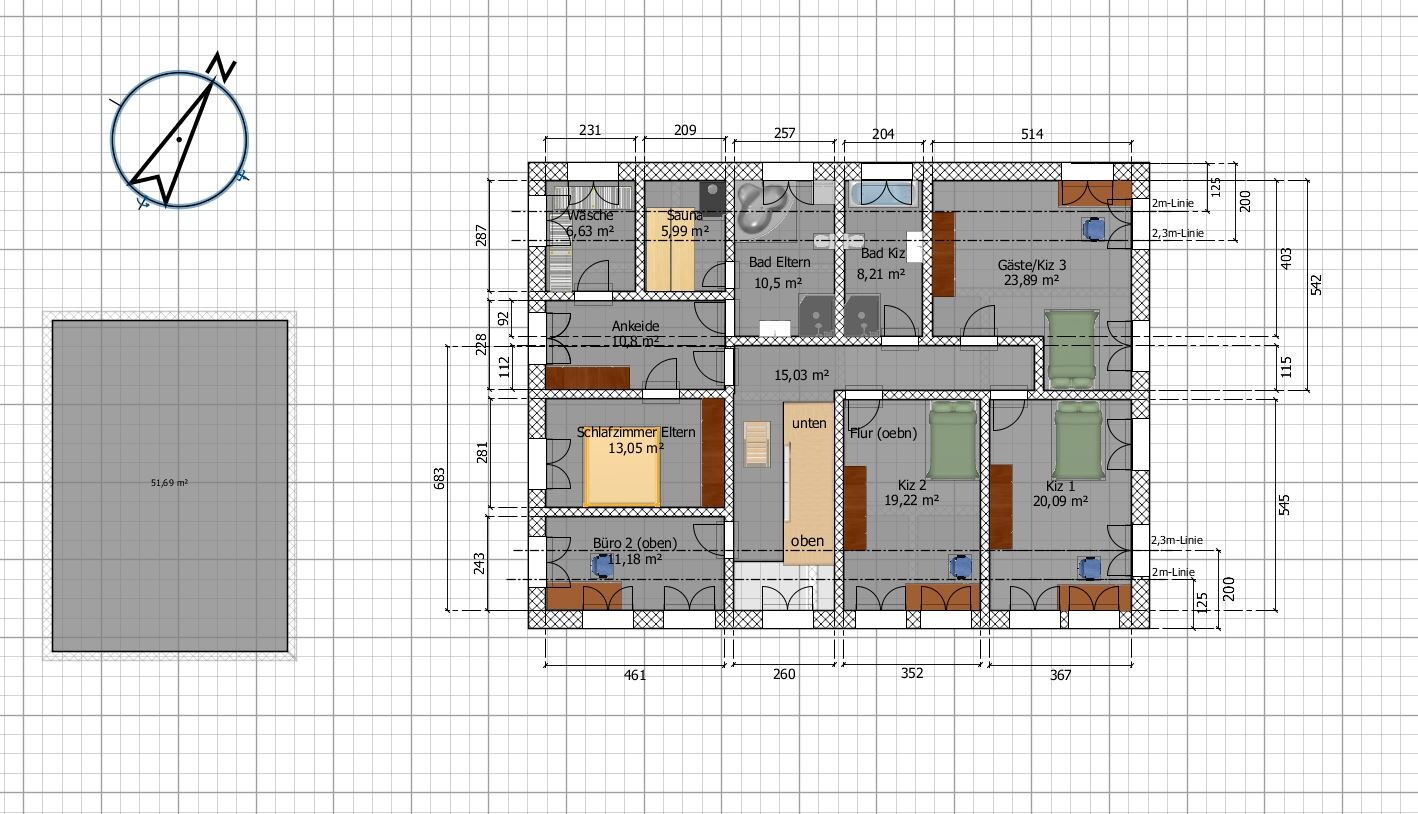
Good: bedroom and laundry room upstairs so laundry does not have to be carried through the entire apartment, no costly skylights
All bathrooms have windows
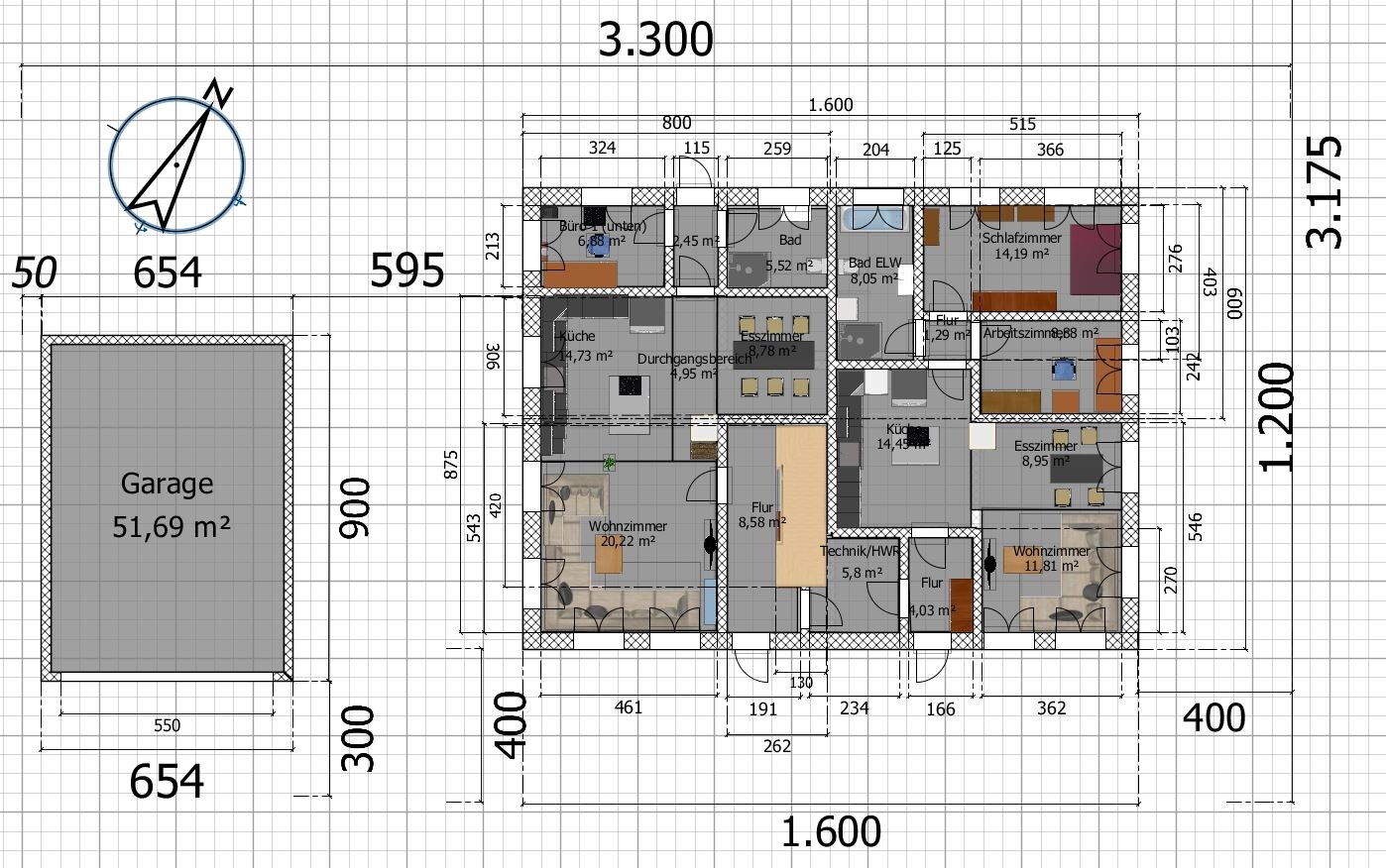
Bad: utility room is too large and living room in accessory apartment too small
What is the most important/basic question about the floor plan, summed up in 130 characters?
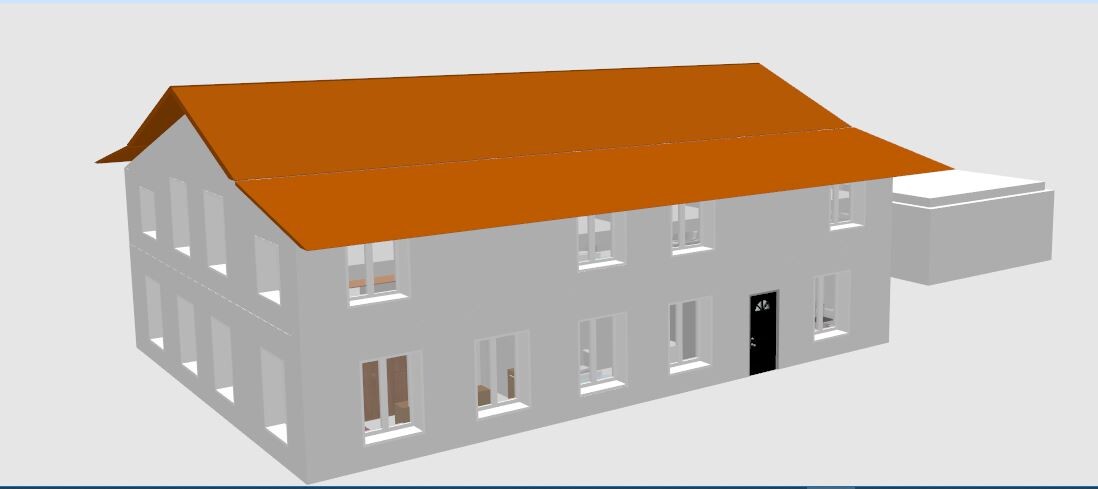
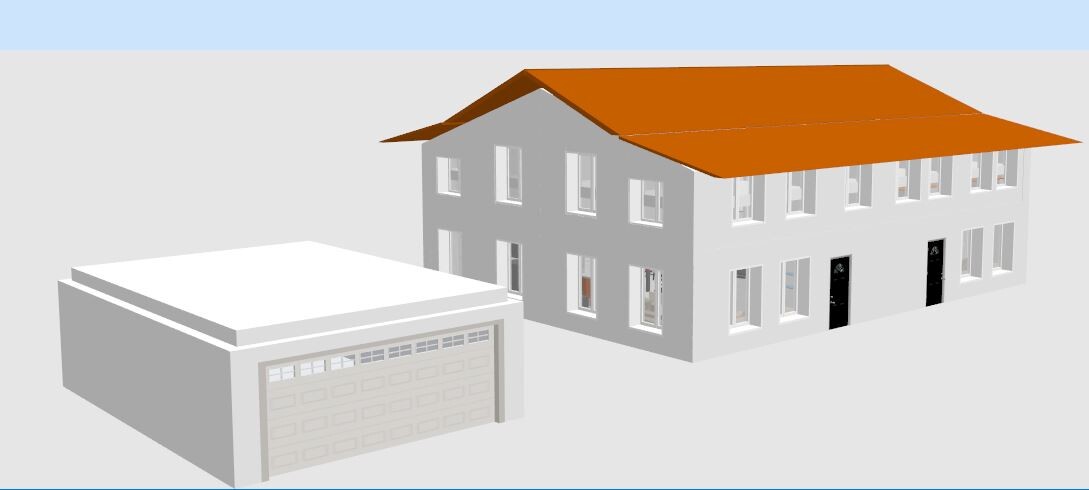
I am planning to build a house. I might receive a share of the plot from my mother if she gets her own apartment (accessory dwelling unit) on the property (our relationship is excellent so far). In any case, there should be two separate units on one plot. (Yes, financing might be challenging…)
Zoning Plan/Restrictions (Requests from the Building Authority as there is no zoning plan)
Plot size: approx. 1050 m² (given in exchange for mandatory accessory dwelling unit on the plot)
Slope: no
Site coverage ratio: no zoning plan
Floor area ratio: no zoning plan
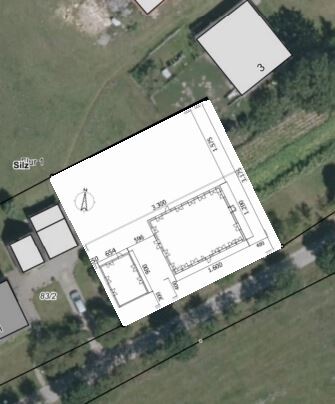
Building setback lines, building line, property boundary: no zoning plan, but the building authority requests at least 3 meters (10 feet) setback from the street
Edge construction: maximum 9.0 m (30 feet) for garages up to 3.0 m (10 feet) height
Number of parking spaces: 2
Number of storeys: one-story with a converted attic (2/3 of the lower floor may be max. 2.30 m (7.5 feet) high)
Roof type: building inquiry was for a gable roof with two small dormers
Architectural style: no specifications
Orientation: no specifications
Maximum height/limits: 9.0 m (30 feet)
Other requirements: residential building should not be larger
Homeowners’ Requirements
Architectural style, roof type, building type: hipped roof up to 2.3 m (7.5 feet) line at approx. 35°, above 2.3 m (7.5 feet) line between 10° and 22°
Basement, storeys: one-story with finished attic (wish: basement with bathtub)
Number of people, ages: currently 1+1 persons, 34 (me) and mother 58 (in the accessory dwelling)
Room requirements on ground floor, upper floor: main apartment 200 m² (2150 sq. ft.) + accessory dwelling 75 m² (807 sq. ft.)
Office: family use or home office? both home offices
Overnight guests per year: sometimes 2 adults + 2 children
Open or closed architecture: open plan
Traditional or modern design: rather modern design
Open kitchen, kitchen island: both units with open kitchen and kitchen island
Number of dining seats: 6 in main unit + 4 in accessory dwelling
Fireplace: yes, in both units
Sound/music wall: no
Balcony, roof terrace: not necessary
Garage, carport: (optional) garage only; no garage or carport for accessory dwelling
Utility garden, greenhouse: none
Other wishes/special features/daily routine, including reasons for certain choices:
- No skylights
- Solar panels later
House Design
Who designed the plan: do-it-yourself (myself)
What do you especially like? Why? Most walls overlap each other
What do you dislike? Why? Utility room and living room in the accessory dwelling because the living room is too small and the utility room too large
Estimated cost according to architect/planner: not yet available
Personal maximum budget for the house, including equipment: (total) 700,000 plus significant own work and family involvement
Preferred heating technology: fireplace and natural gas (available in the street)
If you had to give up, which details/extensions
-you can give up: 1. fully finished basement 2. garage 3. basement rough construction 4. pantry 5. kitchen island 6. indoor sauna 7. completed children’s room with bathroom 8. full upper floor finish
-you cannot give up: fireplace in both apartments
Why did the design turn out the way it did? For example:
Standard design from the architect? No
Which wishes were implemented by the architect?
My apartment:
- Parents’ bedroom (one door only) + dressing room + private bathroom (shower + [optional large bathtub])
- 3 children’s rooms (min. 15 m² (160 sq. ft.)) each with separate bathroom (shower + [optional bathtub])
- 2 offices
- Living room (min. 20 m² (215 sq. ft.)) with fireplace
- Kitchen (min. 15 m² (160 sq. ft.)) + [optional kitchen island]
- Dining room for 5 people
- Bathroom downstairs + [optional shower]
- 1 sauna inside (or outside)
Accessory apartment:
- Standard layout with office
Additional wishes:
- An extra room/hallway must be located between bathroom and living spaces
- All rooms with windows (at least the bathrooms)
- Laundry room (upstairs)
- Garden access (north side)
- More light/open space in entrance area
- Pantry
A mix of ideas from various magazines…
What do you think is particularly good or bad about it?
Good: bedroom and laundry room upstairs so laundry does not have to be carried through the entire apartment, no costly skylights
All bathrooms have windows
Bad: utility room is too large and living room in accessory apartment too small
What is the most important/basic question about the floor plan, summed up in 130 characters?
- Any fundamental mistakes in the plan?
- Can the utility room be moved to the attic (not the converted attic)?
- Garage directly on the property line?
- Is (partial) basement with bathtub and/or garage financially feasible?

K a t j a schrieb:
Completely adding a basement is not common for houses that have such a large footprint. Anyone who needs to save money on the basement should ask themselves if their budget matches their size expectations. If a large house fits with someone’s income or assets, they can "fill" the basement with investment wines if needed.
st3lli83 schrieb:
Hmm, just upfront. I probably have less than 10% of the building/planning knowledge of my predecessors here. But maybe my opinion helps you anyway (sort of from an outsider’s perspective 🙂 )
To me, the floor plans look like a maze, sorry for the expression.
From the moment you enter the house, all I see are doors?! I start in a small hallway with stairs -> 2 doors. Then comes the first bigger “room” with a living and dining area. Read your description again very slowly, and maybe you’ll realize for yourself: you have unconsciously uncovered the secret of the design. This house isn’t meant to be a real house at all, but an adventure game. Before opening every door, you have to craft a weapon. Passing through the door then either gives you points or costs you a life—depending on whether there’s a zombie in the next room or not *LOL* *JUST KIDDING*
https://www.instagram.com/11antgmxde/
https://www.linkedin.com/company/bauen-jetzt/
11ant schrieb:
This is not meant to be a real house, but rather an adventure game. Haha…
At least here the walls are stacked properly.
The sequence of daily life and routines is missing, combined with a precise separation of functional rooms, which is generally avoided nowadays.
But that’s not a problem if the person isn’t an architect. We’ve seen worse drawings around here, like Sims houses 😉
The original poster is not the first single person to plan and build a single-family home. I don’t see that as a problem and know several people who have done it.
Even for an existing family of five, the design is quite generous in terms of the number of rooms and unused basement spaces. I would reduce that a bit in this area. With three children, work, house, and garden, there isn’t much time left for undisturbed hobbies in the basement.
I would plan the mother’s granny flat with barrier-free access. That’s quite feasible nowadays without a hospital or nursing home feel.
Overall, it really comes across like playing Tetris poorly.
Create a room program and have an architect plan it.
Better to have a smaller house with less self-construction work.
You can’t plan for every eventuality. Usually, two children’s rooms and one guest/study room will work well enough.
In an emergency, you can extend or remodel later.
Even for an existing family of five, the design is quite generous in terms of the number of rooms and unused basement spaces. I would reduce that a bit in this area. With three children, work, house, and garden, there isn’t much time left for undisturbed hobbies in the basement.
I would plan the mother’s granny flat with barrier-free access. That’s quite feasible nowadays without a hospital or nursing home feel.
Overall, it really comes across like playing Tetris poorly.
Create a room program and have an architect plan it.
Better to have a smaller house with less self-construction work.
You can’t plan for every eventuality. Usually, two children’s rooms and one guest/study room will work well enough.
In an emergency, you can extend or remodel later.
ypg schrieb:
Again: YOU can only have a single-story, so you need dormer windows to provide light to the middle windows. What you have drawn is a two-story.I understood it as if two-thirds of the floor is below 2.3m (7.5 feet), it doesn’t count as a full story. Is this measurement taken from the exterior edge or from the interior edge, interior dimension, or usable floor area? 2m (south below 2.3m) + 2m (north below 2.3m) = 4m of 12m are below 2.3m, so exactly two-thirds are above 2.3m and, therefore, it should meet the requirement. 😕
ypg schrieb:
Well… step out of your apartment comfort zone: the dining area replaces the lounge area, since you don’t need daylight when watching TV. Southern daylight can even be counterproductive. Children who mainly stay in the dining area need daylight for playing and crafting at the large table. And more than 115cm (45 inches) width to access the garden. Besides, other household members also use the path to the garden, so 115cm (45 inches) can be called a bottleneck. Additionally, children playing in the garden should be observable for a few years from inside over the main living area (kitchen).Thanks for this tip about switching the rooms; I hadn’t thought about that before. This is already the third correct hint about an error in my floor plan—thank you very much for that. Exactly this kind of advice and suggestions were what I had hoped for.The width of 115cm (45 inches) is completely fine for me, and I kindly ask again: how wide should a corridor be? According to DIN 18040-2, an accessible corridor should be 120cm (47 inches) wide, and I have almost fully complied with this requirement.
ypg schrieb:
Children playing in the garden should be observable from inside over the living area (kitchen) for a few years.Thanks for that hint, which Gregor_K kindly already gave me — it has been incorporated. 🙂ypg schrieb:
So you also forgot the chimney flues at the top? 😉Thanks, that’s the fourth mistake in my design. I thought about it at some point but unfortunately forgot both times in the current version. 🙁 I will remember it in the new draft.Costruttrice schrieb:
But your main closet is in the bedroom because the dressing room has so many doors that it cannot be used for its intended purpose, or only a 2.5m (8 feet) closet fits inside. For me, it’s a walk-through room and poorly designed.The main closet is in the dressing room (my closet is currently 90cm (35 inches) wide and contained everything, and it could be split in half). Then the second person had a 2m (79 inches) closet for themselves. The secondary closet in the bedroom is for bed linens, towels, blankets, etc. Where is my mistake here?Costruttrice schrieb:
Personally, for me, this is not logically planned but just crammed in somehow. But if you like it that way and it’s your dream house, then it’s fine.What exactly do you mean? For example: - That the bathrooms are stacked?
- That all rooms have windows?
- The location of the garage in relation to the house? I tried many options, but counter-proposals all were worse for us.
- The size ratio of the children’s rooms to the house?
Maybe you can give better advice based on the new drafts and the helpfulness of the other users?
st3lli83 schrieb:
The same pattern with the separate apartment (circled in red): why is the door positioned there? A 1m² (11 sq ft) corridor made up only of doors?! Somehow, you create unnecessarily small rooms and corridors with 100 doors. Every guest will get lost.
I imagine a guest asking where the toilet is: 1 door right, then 2 left, then in the corridor clockwise the 3rd door on the right, then into another corridor and the door opposite. Of course this is exaggerated, but I hope you get my point.This is so the bathroom smells don’t spread throughout the whole house, which everyone I know does. The room size is admittedly a bit small, but every extra square meter there means less space elsewhere.Your simplicity helped me a lot. 🙂
st3lli83 schrieb:
I imagine a guest asking where the toilet is: 1 door right, then 2 left, then in the corridor clockwise the 3rd door on the right, then into another corridor and the door opposite. Of course this is exaggerated, but I hope you get my point.I understand your points much better than others, especially that you focus only on the floor plan, which helps me a lot. Thank you very much for that. Based on your comment about too many small rooms, I combined the two small corridors into one. I also removed the office downstairs and moved it upstairs. 🙂st3lli83 schrieb:
You are basically building a small apartment (condo) of around 65m² (700 sq ft) for potential children! Amazing.
The dressing room is completely poorly planned. Again, it’s like a maze. You come up the stairs into a nice big corridor, then enter the dressing room, which somehow becomes the next central point as from there you access four other rooms... As others have said already, in your case this is no longer a dressing room but more like a walk-through room or corridor.Thank you for that too. I realized that having four rooms means at least one too many, so the laundry room was removed in favor of a slightly larger dressing room. I also thought the children’s rooms were too big, but since only the number of rooms had been discussed so far, I didn’t have any feedback on the size. I have now reduced the children’s rooms somewhat. Due to the sloped ceilings, they will only be about 12m² to 14m² (129 to 150 sq ft) in size, as shown in the new draft.st3lli83 schrieb:
The basement is pretty much the same: doors, doors, doors... you create walk-through rooms everywhere. From the hallway to the storage room, then to the utility room, then to the basement room.
Even as a layperson, I have never seen anything like this. I have seen many floor plans and tried to understand them since we built a house ourselves and reviewed several general contractors. Unfortunately, nothing fits here.
Additional points:
- Why 2 saunas?!
- Relaxation rooms, fitness rooms, about 10 bathrooms, 100 doors, etc. I’ve seen many smaller floor plans here in the forum with much higher budgets.
I have zero experience in planning, as I said, but some idea of costs. THERE’S NO WAY this will work with $700k (or euro equivalent). Even without the basement, the budget won’t be enough.
Sorry for the harsh criticism. But this has nothing to do with serious planning. It sounds like “I’m just creating the world as I like it.”The basement was only included as an idea or example and added as a question. K A T J A has already strongly discouraged me from that (wishful thinking and cost estimate). 😉ypg schrieb:
But it’s not a problem if someone isn’t an architect. We’ve seen much worse drawings here, such as Sims houses. 😉Thank you for your encouraging words.haydee schrieb:
The original poster is not the first single person planning and building a single-family home. I don’t find that a problem and know several who have done it.
Even for a family of five, the planning is generous regarding the number of rooms and free basement spaces. I would reduce that somewhat. With 3 children, work, house, and garden, there isn’t much time left for uninterrupted hobbies in the basement.
I would design the mother’s separate apartment as barrier-free. That’s quite feasible now without hospital or nursing home vibes.
The whole thing really feels like poorly played Tetris.
Create a room program and have an architect plan it.
Better smaller and less self-construction.
You can’t plan for every eventuality. Usually, two children’s rooms and one guest/workroom will fit just fine. You can always extend and remodel later. Thanks to you too for your feedback. I have planned it to be a bit more accessible. 🙂K a t j a schrieb:
How far along is the architect? Are they authorized to produce construction drawings?She only started last year, but as far as I understand, her boss will handle this later. Whether she will do it herself is not 100% certain yet. She wants to have a draft first and then decide, and that’s why I’m here on the forum.K a t j a schrieb:
You want to do the electrical wiring yourself on 400m² (4300 sq ft) and probably the garage too? Have you ever done that much electrical work on your own? Is someone helping? You also want to do all masonry and painting yourself. How many years have you planned for construction?I was an industrial electrician and have helped with building houses many times. Next year I planned 25 days of vacation plus 22 overtime hours and 14 flex-time days (my employer is not happy about this...). The house should be mostly ready so I can live downstairs by spring the year after next. 🙂 If the building authority woman causes trouble again, of course nothing will happen. 🙄
Koehler schrieb:
I understood it as if two-thirds of the floor are under 2.3m (7.5 ft), then it is not considered a full storey. It’s actually the other way around: the non-full storey in the attic may only have this height on less than two-thirds of the ground floor’s area.
Koehler schrieb:
I combined the two small corridors into one corridor now, The real qualitative improvement happens in the details. It’s better if you go to an architect with just a room program—nothing more! Or are you trying to use the forum to refine your design to a stamp-worthy level (or to get a discount on fees by doing some ‘preliminary work’)?
Please don’t take the question the wrong way: do you know @Hitokiri-1978 personally?
https://www.instagram.com/11antgmxde/
https://www.linkedin.com/company/bauen-jetzt/

Koehler schrieb:
I used to work as an industrial electrician and have often been involved in house construction. Next year, I have planned 25 days of vacation + 22 overtime hours + 14 flexitime days just for this project (my employer is not happy about it...).
So roughly 42 days for masonry and electrical work? I’m usually in favor of encouraging young enthusiasts, but this looks doubtful to me. Building such a large house—even with occasional help from friends—I would estimate more like 6 to 7 months, assuming you keep your day job.
Similar topics