
ᐅ Floor plan for a single-family house with 200 m² living area, including a 75 m² granny flat / accessory apartment, a 140 m² basement, and a 56 m² garage
Created on: 12 Sep 2022 17:07
K
Koehler
Hello everyone,
I am planning to build a house. I might receive a share of the plot from my mother if she gets her own apartment (accessory dwelling unit) on the property (our relationship is excellent so far). In any case, there should be two separate units on one plot. (Yes, financing might be challenging…)
Zoning Plan/Restrictions (Requests from the Building Authority as there is no zoning plan)
Plot size: approx. 1050 m² (given in exchange for mandatory accessory dwelling unit on the plot)
Slope: no
Site coverage ratio: no zoning plan
Floor area ratio: no zoning plan
Building setback lines, building line, property boundary: no zoning plan, but the building authority requests at least 3 meters (10 feet) setback from the street
Edge construction: maximum 9.0 m (30 feet) for garages up to 3.0 m (10 feet) height
Number of parking spaces: 2
Number of storeys: one-story with a converted attic (2/3 of the lower floor may be max. 2.30 m (7.5 feet) high)
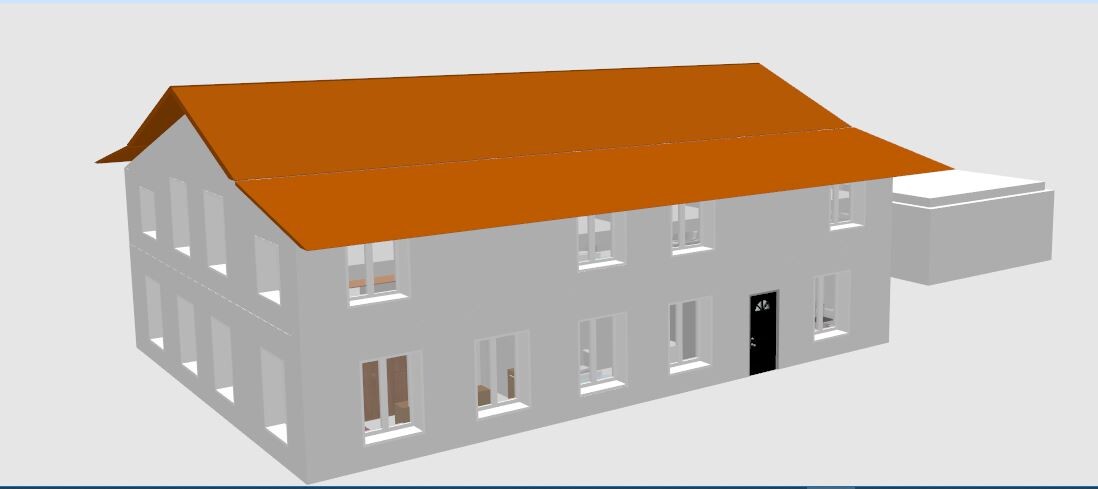
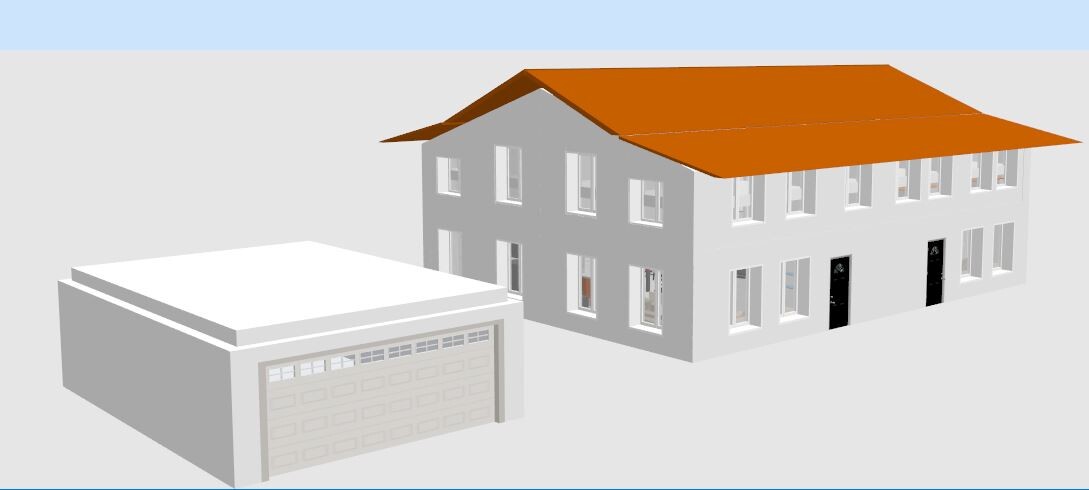
Roof type: building inquiry was for a gable roof with two small dormers
Architectural style: no specifications
Orientation: no specifications
Maximum height/limits: 9.0 m (30 feet)
Other requirements: residential building should not be larger
Homeowners’ Requirements
Architectural style, roof type, building type: hipped roof up to 2.3 m (7.5 feet) line at approx. 35°, above 2.3 m (7.5 feet) line between 10° and 22°
Basement, storeys: one-story with finished attic (wish: basement with bathtub)
Number of people, ages: currently 1+1 persons, 34 (me) and mother 58 (in the accessory dwelling)
Room requirements on ground floor, upper floor: main apartment 200 m² (2150 sq. ft.) + accessory dwelling 75 m² (807 sq. ft.)
Office: family use or home office? both home offices
Overnight guests per year: sometimes 2 adults + 2 children
Open or closed architecture: open plan
Traditional or modern design: rather modern design
Open kitchen, kitchen island: both units with open kitchen and kitchen island
Number of dining seats: 6 in main unit + 4 in accessory dwelling
Fireplace: yes, in both units
Sound/music wall: no
Balcony, roof terrace: not necessary
Garage, carport: (optional) garage only; no garage or carport for accessory dwelling
Utility garden, greenhouse: none
Other wishes/special features/daily routine, including reasons for certain choices:
House Design
Who designed the plan: do-it-yourself (myself)
What do you especially like? Why? Most walls overlap each other
What do you dislike? Why? Utility room and living room in the accessory dwelling because the living room is too small and the utility room too large
Estimated cost according to architect/planner: not yet available
Personal maximum budget for the house, including equipment: (total) 700,000 plus significant own work and family involvement
Preferred heating technology: fireplace and natural gas (available in the street)
If you had to give up, which details/extensions
-you can give up: 1. fully finished basement 2. garage 3. basement rough construction 4. pantry 5. kitchen island 6. indoor sauna 7. completed children’s room with bathroom 8. full upper floor finish
-you cannot give up: fireplace in both apartments
Why did the design turn out the way it did? For example:
Standard design from the architect? No
Which wishes were implemented by the architect?
My apartment:
Accessory apartment:
Additional wishes:
A mix of ideas from various magazines…
What do you think is particularly good or bad about it?
Good: bedroom and laundry room upstairs so laundry does not have to be carried through the entire apartment, no costly skylights
All bathrooms have windows
Bad: utility room is too large and living room in accessory apartment too small
What is the most important/basic question about the floor plan, summed up in 130 characters?
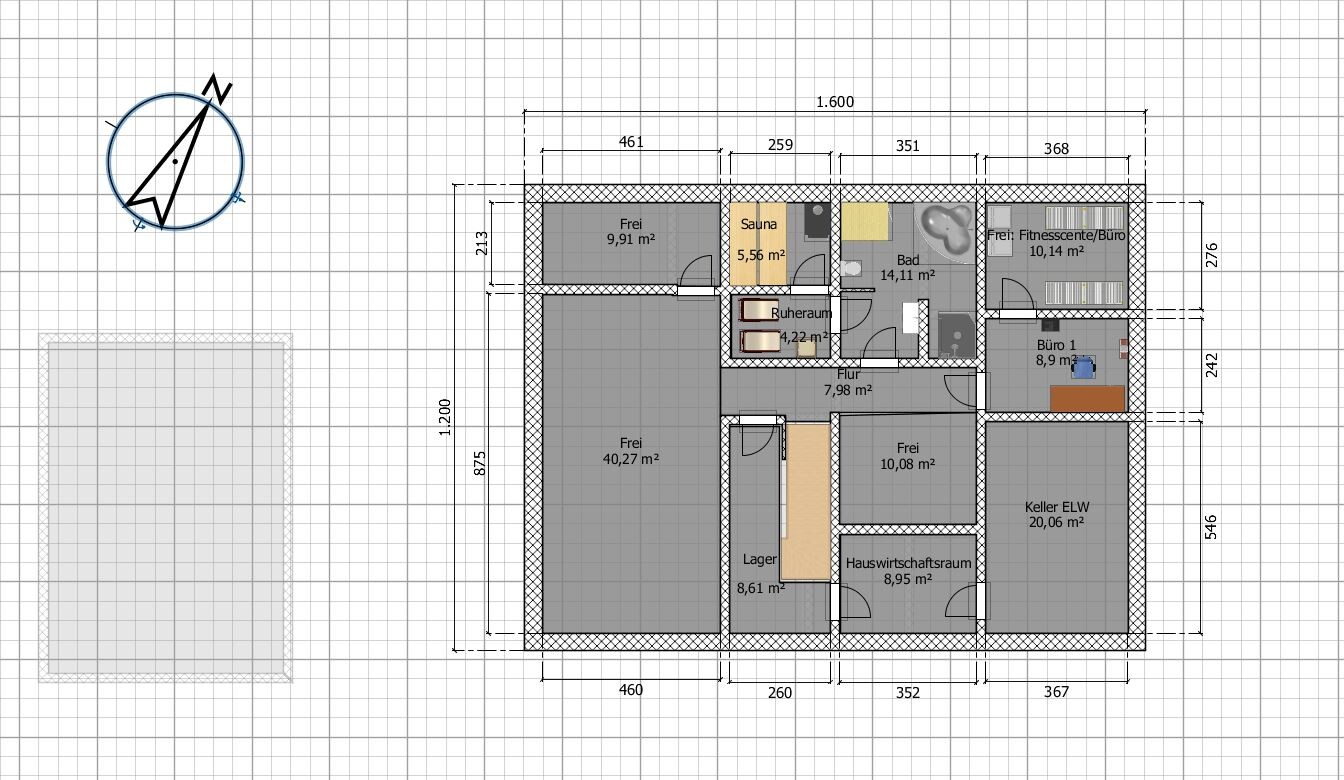
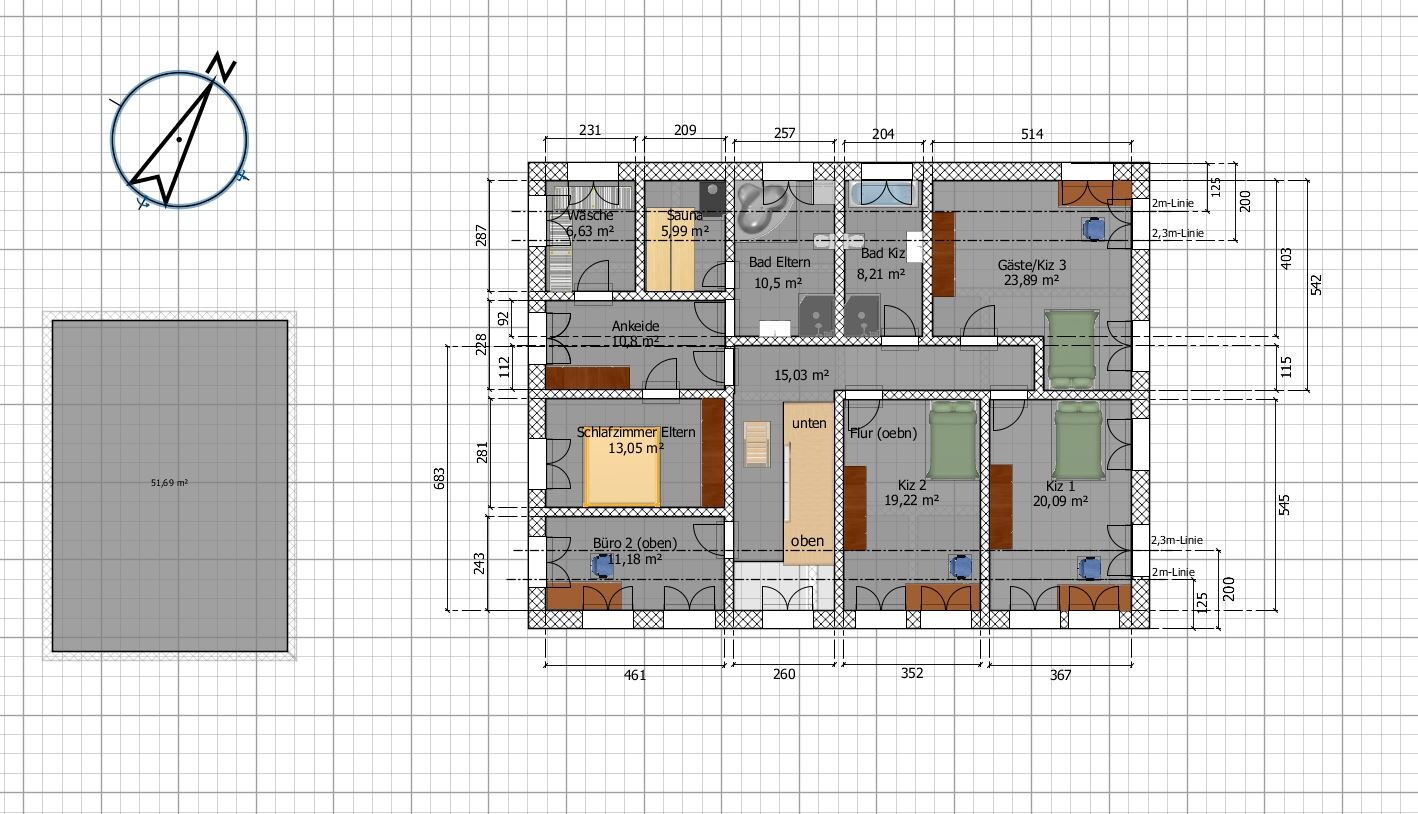
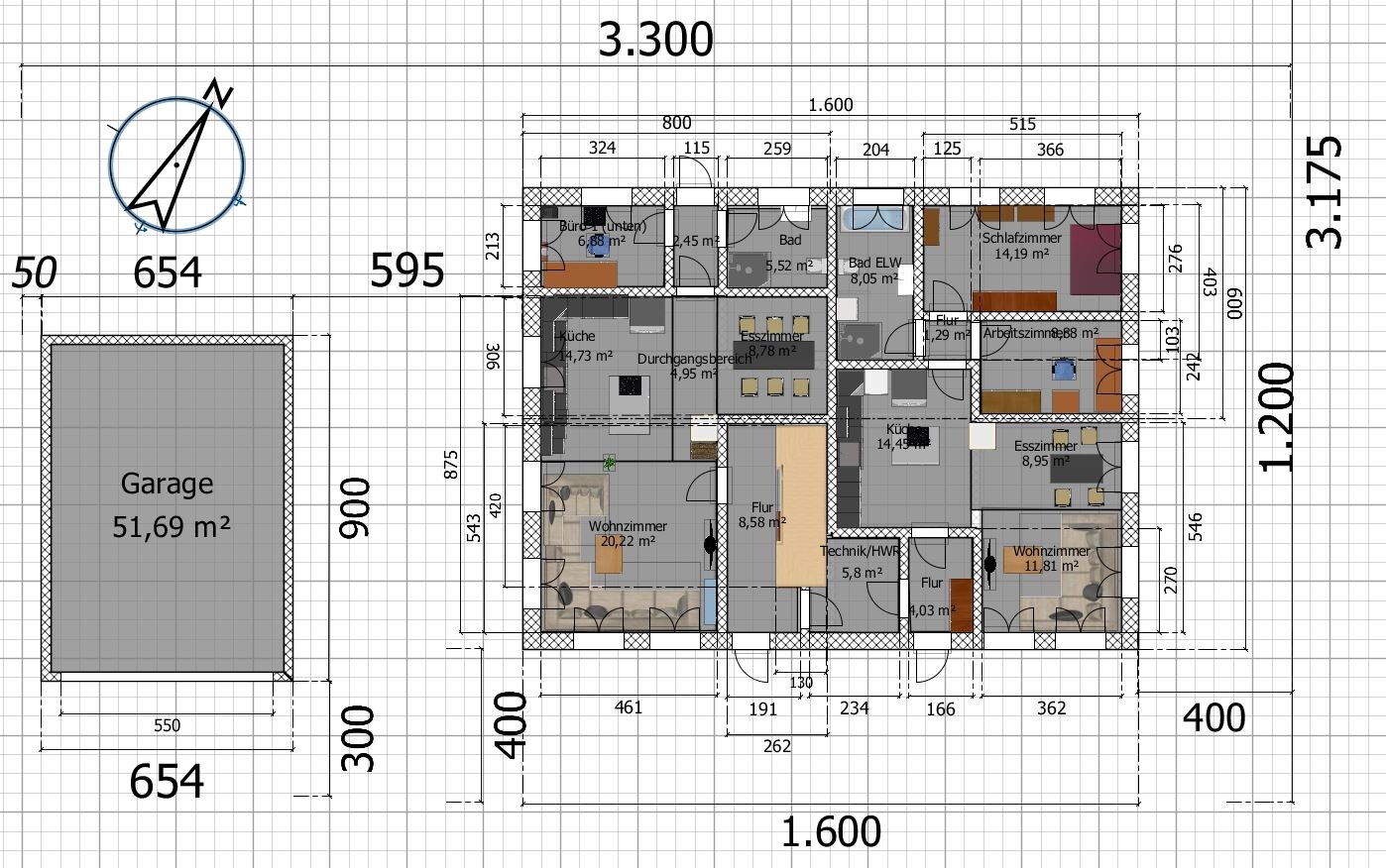
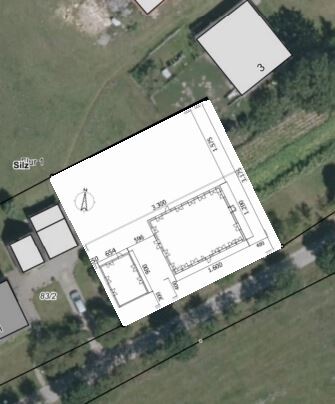
I am planning to build a house. I might receive a share of the plot from my mother if she gets her own apartment (accessory dwelling unit) on the property (our relationship is excellent so far). In any case, there should be two separate units on one plot. (Yes, financing might be challenging…)
Zoning Plan/Restrictions (Requests from the Building Authority as there is no zoning plan)
Plot size: approx. 1050 m² (given in exchange for mandatory accessory dwelling unit on the plot)
Slope: no
Site coverage ratio: no zoning plan
Floor area ratio: no zoning plan
Building setback lines, building line, property boundary: no zoning plan, but the building authority requests at least 3 meters (10 feet) setback from the street
Edge construction: maximum 9.0 m (30 feet) for garages up to 3.0 m (10 feet) height
Number of parking spaces: 2
Number of storeys: one-story with a converted attic (2/3 of the lower floor may be max. 2.30 m (7.5 feet) high)
Roof type: building inquiry was for a gable roof with two small dormers
Architectural style: no specifications
Orientation: no specifications
Maximum height/limits: 9.0 m (30 feet)
Other requirements: residential building should not be larger
Homeowners’ Requirements
Architectural style, roof type, building type: hipped roof up to 2.3 m (7.5 feet) line at approx. 35°, above 2.3 m (7.5 feet) line between 10° and 22°
Basement, storeys: one-story with finished attic (wish: basement with bathtub)
Number of people, ages: currently 1+1 persons, 34 (me) and mother 58 (in the accessory dwelling)
Room requirements on ground floor, upper floor: main apartment 200 m² (2150 sq. ft.) + accessory dwelling 75 m² (807 sq. ft.)
Office: family use or home office? both home offices
Overnight guests per year: sometimes 2 adults + 2 children
Open or closed architecture: open plan
Traditional or modern design: rather modern design
Open kitchen, kitchen island: both units with open kitchen and kitchen island
Number of dining seats: 6 in main unit + 4 in accessory dwelling
Fireplace: yes, in both units
Sound/music wall: no
Balcony, roof terrace: not necessary
Garage, carport: (optional) garage only; no garage or carport for accessory dwelling
Utility garden, greenhouse: none
Other wishes/special features/daily routine, including reasons for certain choices:
- No skylights
- Solar panels later
House Design
Who designed the plan: do-it-yourself (myself)
What do you especially like? Why? Most walls overlap each other
What do you dislike? Why? Utility room and living room in the accessory dwelling because the living room is too small and the utility room too large
Estimated cost according to architect/planner: not yet available
Personal maximum budget for the house, including equipment: (total) 700,000 plus significant own work and family involvement
Preferred heating technology: fireplace and natural gas (available in the street)
If you had to give up, which details/extensions
-you can give up: 1. fully finished basement 2. garage 3. basement rough construction 4. pantry 5. kitchen island 6. indoor sauna 7. completed children’s room with bathroom 8. full upper floor finish
-you cannot give up: fireplace in both apartments
Why did the design turn out the way it did? For example:
Standard design from the architect? No
Which wishes were implemented by the architect?
My apartment:
- Parents’ bedroom (one door only) + dressing room + private bathroom (shower + [optional large bathtub])
- 3 children’s rooms (min. 15 m² (160 sq. ft.)) each with separate bathroom (shower + [optional bathtub])
- 2 offices
- Living room (min. 20 m² (215 sq. ft.)) with fireplace
- Kitchen (min. 15 m² (160 sq. ft.)) + [optional kitchen island]
- Dining room for 5 people
- Bathroom downstairs + [optional shower]
- 1 sauna inside (or outside)
Accessory apartment:
- Standard layout with office
Additional wishes:
- An extra room/hallway must be located between bathroom and living spaces
- All rooms with windows (at least the bathrooms)
- Laundry room (upstairs)
- Garden access (north side)
- More light/open space in entrance area
- Pantry
A mix of ideas from various magazines…
What do you think is particularly good or bad about it?
Good: bedroom and laundry room upstairs so laundry does not have to be carried through the entire apartment, no costly skylights
All bathrooms have windows
Bad: utility room is too large and living room in accessory apartment too small
What is the most important/basic question about the floor plan, summed up in 130 characters?
- Any fundamental mistakes in the plan?
- Can the utility room be moved to the attic (not the converted attic)?
- Garage directly on the property line?
- Is (partial) basement with bathtub and/or garage financially feasible?

Koehler schrieb:
Can I really write it this plainly? In my field, that would be sent back because nothing is specified: At the very least, I would have thought I need to state the minimum size for each room, whether or not it includes a bathtub.That’s heading in the right direction, but it can definitely be more detailed. A list of all the rooms on the ground floor and the upper floor works well. You can then add specific requirements behind each room. For example, for the bedroom: bed is at least 2m wide (6.6 ft), or the wardrobe must be at least 250 x 60cm (98 x 24 inches). Children’s room not less than 13sqm (140 sq ft), and so on. Also things like “large window front in the living room” or “no spiral staircase” – list everything. It can take a while to gather all the details.
Koehler schrieb:
If she has a senior handicap, she has to move somewhere else and she knows that. Hopefully, she can live reasonably well there on the rent. Well, this thread is developing much more positively than the one with the idiot and the north-facing roof. Quite encouraging!
The quoted statement is a big misconception. If she has a handicap, assisted living is the option to consider. And the most affordable form of that exceeds any possible rent. You should consider discussing inheritance, gifts, and the right of residence or usufruct, or seek advice on these matters.
i_b_n_a_n schrieb:
Well, this thread is developing much more positively than the one with the stubborn guy and the north-facing shed roof. Very encouraging!Yes, I agree. Very pleasant discussion with us 🙂Koehler schrieb:
“TK” and the “M.”
TK = technology? M = mobility?TK stands for Technik (technology or technical room), T for terrace, and M, those are two inverted V’s indicating parking spaces. It was just an example drawing made for you when you were still planning without a terrace and parallel entrances on the south side.
Koehler schrieb:
At least I thought I had to write down the minimum size for each room,No. For example: 12 sqm (130 sq ft) can be well arranged as 3 x 4 meters (10 x 13 feet), but can also be awkward if designed as 2 x 6 meters (6.5 x 20 feet). Also, all rooms should be reasonably adjusted in proportion to the budget by a professional. For a household of five people, for instance, the kitchen or open-plan living area will be larger, while bedrooms might be smaller. For a senior resident, the kitchen might be smaller, and the bedroom larger.
Note: this is all of course because the square meters of the house must be tailored to the budget. If you calculate roughly 3000 €/sqm (about 280 $/sq ft), you should be aware that your number of rooms will be limited, and probably the fireplace and sauna will need to wait.
Koehler schrieb:
whether with or without a bathtub.The bathtub is implicitly included in the architect’s definition of “family” 😉Koehler schrieb:
Do you submit the previous documents to the building authority? The site plan? The answered questions to the authority? Or do you just describe the plot – its size and so on?Wait for the first meeting. It would be good if you mention the positive preliminary building approval on an existing plot.Koehler schrieb:
Do the companies know at what height the roof must start? I can’t find anything.Does the baker know how to bake rolls?
Koehler schrieb:
I would love to build a two-story house, but apparently that’s not possible. Because the two residential barns (to the north and east) are not being considered. In the end, only three buildings were used for comparison, and the next large residential building is 3. The other large buildings aren’t either. If that last sentence ever made any sense, it must have lost it by now. Without a decent aerial photo, I don’t have a clear idea of the situation – but it certainly reads as if the municipality has rather arbitrary ideas about which surroundings should be included in the contextual assessment. There may be various legal opinions on that, but the municipality cannot simply pick and choose freely.
Koehler schrieb:
Dear Sir or Madam,
My mother and I want to build a house together on one plot. [...]
Best regards
[...] At least I thought I had to specify how large each room should be at minimum, I don’t understand: which “Santa Claus” are you even planning to send this wish list to? You need an architect, and you don’t get one by cold-contacting them with a letter. Starting off with “Dear Sir or Madam” is wrong in any case; when dealing with detached houses, it’s better to approach small offices with just one licensed professional.
https://www.instagram.com/11antgmxde/
https://www.linkedin.com/company/bauen-jetzt/
Not everyone with a disability automatically needs assisted living or a nursing home. There is a wide gray area where, for example, a senior may need help in the morning but otherwise manages reasonably well if the environment is suitable.
And yes, those details are enough. Just stating the square meters is pointless. Your walk-in closet is huge, but you can fit the required wardrobe space into half that area. However, if you want to include your shoe collection, or have a large chest of drawers as an island in the middle, a dressing table, or an armchair (as seen in movies), you need to specify that. Square meters alone don’t say anything about usability or the feeling of the space.
You need to explain what you want. You don’t want square meters; you want living comfort. You want certain rooms, and you want to accommodate specific items there. Hobby room? Yes, but which hobby? Gaming or painting? Dark or extremely bright without glare?
And yes, those details are enough. Just stating the square meters is pointless. Your walk-in closet is huge, but you can fit the required wardrobe space into half that area. However, if you want to include your shoe collection, or have a large chest of drawers as an island in the middle, a dressing table, or an armchair (as seen in movies), you need to specify that. Square meters alone don’t say anything about usability or the feeling of the space.
You need to explain what you want. You don’t want square meters; you want living comfort. You want certain rooms, and you want to accommodate specific items there. Hobby room? Yes, but which hobby? Gaming or painting? Dark or extremely bright without glare?
Koehler schrieb:
Dear Sir or Madam,
My mother and I want to build a house together on a plot of land. I have noticed that you are active here again—how is your own project progressing?
https://www.instagram.com/11antgmxde/
https://www.linkedin.com/company/bauen-jetzt/
Similar topics