
ᐅ Floor Plan for a 200 sqm Urban Villa – Are Our Requirements Feasible?
Created on: 13 Jul 2020 14:14
E
ECE-2021
Hello everyone,
I’m a bit overwhelmed with our floor plan and keep running into the same problems...
The main issue is probably how to integrate a straight staircase from the ground floor to the upper floor, and how we would have to modify or extend the hallway to fit such a staircase without "breaking up" the other rooms.
Development plan / Restrictions
Plot size: 1005 m² (0.25 acres)
Slope: no
Site coverage ratio: according to neighboring developments
Floor area ratio: according to neighboring developments
Building envelope, building line, and boundary: according to neighboring developments
Edge development: no
Number of parking spaces: double / large garage planned
Number of stories: 2
Roof type: hipped roof
Style: urban villa
Orientation: street facing northeast, plot extends sideways toward west-northwest, garden planned all around southwest / west-northwest
Client requirements
Style, roof type, building type: urban villa with hipped roof
Basement, floors: basement + ground floor + upper floor
Number of occupants, ages: 2 adults + young child (3)
Office: home office?
Closed architecture
Closed kitchen, kitchen island
Fireplace
Balcony
Garage
House design
Who designed the plan:
- Option 1: planner from a construction company (not yet an architect)
- Option 2: do-it-yourself
What do you particularly like? Why?
Overall, the floor plan is good and was implemented largely according to our ideas.
What do you dislike? Why?
We would prefer a straight staircase. According to a staircase calculator tool, it would require a length of 3.70 m (12 ft).
From research, this might be rather uncomfortable and therefore unrealistic.
We would be willing to extend the hallway for the straight staircase if necessary.
Symmetry, especially in the front view of the house, is very important to us, so we want to keep the type of front door as is.
The awkward corner in the upper hallway is not very appealing (bedroom / office).
Furthermore, the hallway window was initially placed in the child’s bedroom, but that will be changed so there is natural light in the upper floor hallway.
I’m also wondering if the chimney flue on the upper floor can still be routed freely, possibly offset within the ceiling/floor. Or does it have to go straight up from the ground floor fireplace? Because then it would end up right in the middle of the upper floor hallway.
If you have to give up something, which details or fittings could you do without?
- Could you compromise on: I’m open to suggestions for now
- Cannot compromise on: ideally the straight staircase
What do you think makes it particularly good or bad?
See differences between our design and the construction company’s plan
- straight staircase instead of quarter-turn
- kitchen recessed
- window in the hallway instead of in the child’s room
- ideally no hallway obstruction on the upper floor
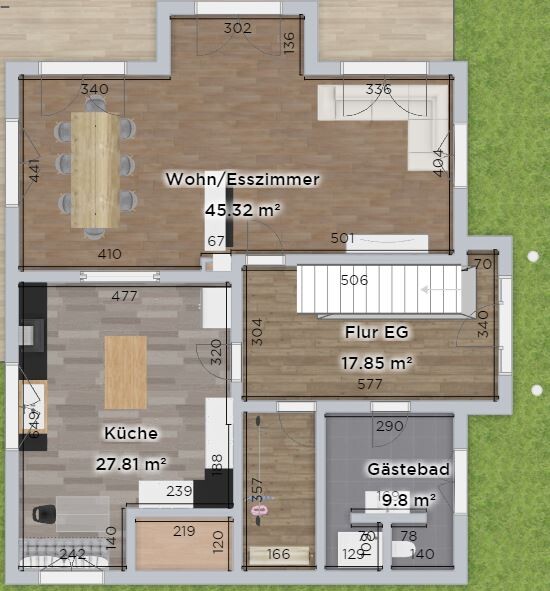
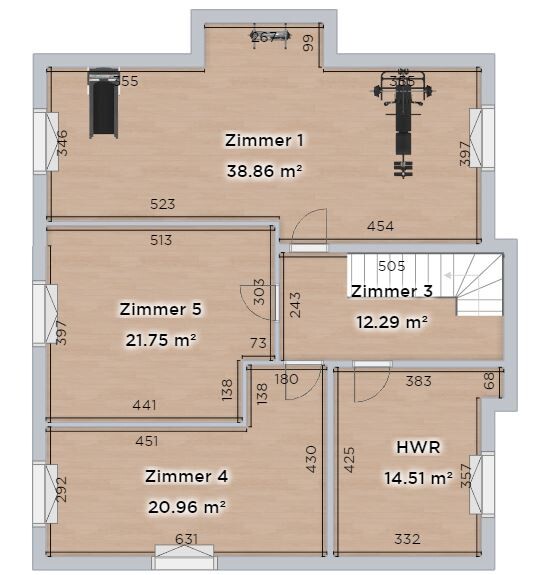
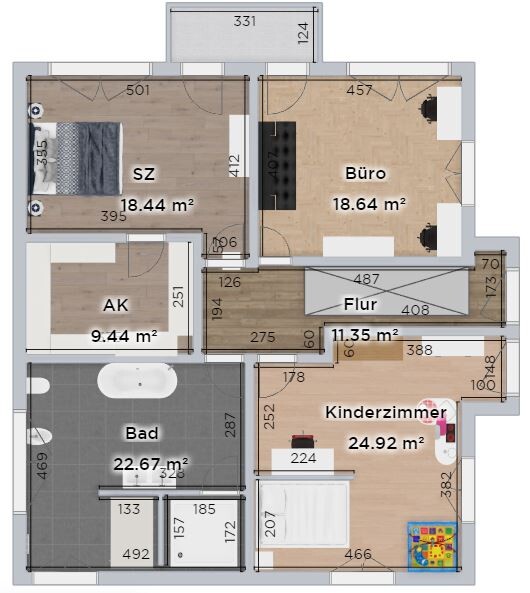
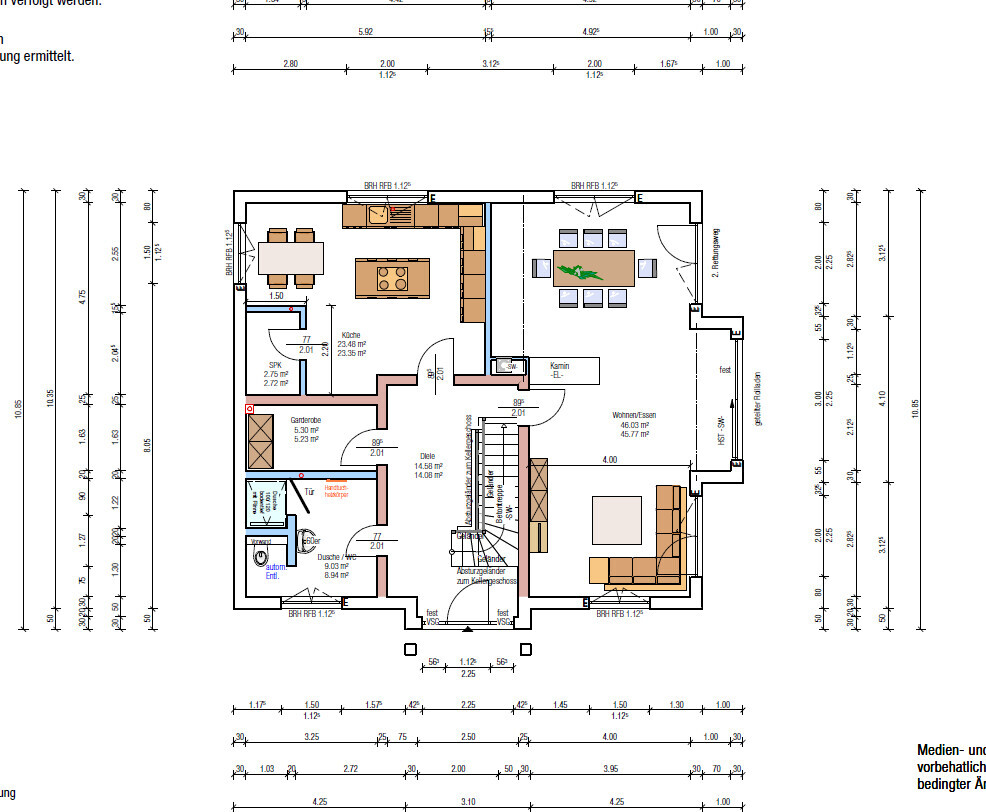
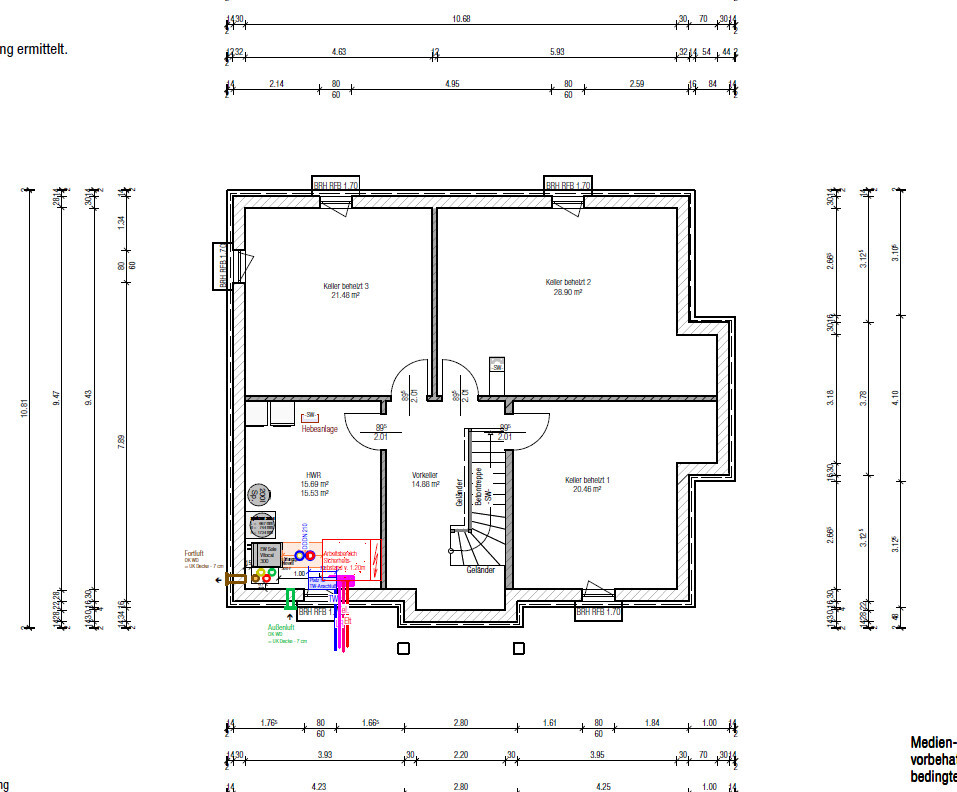
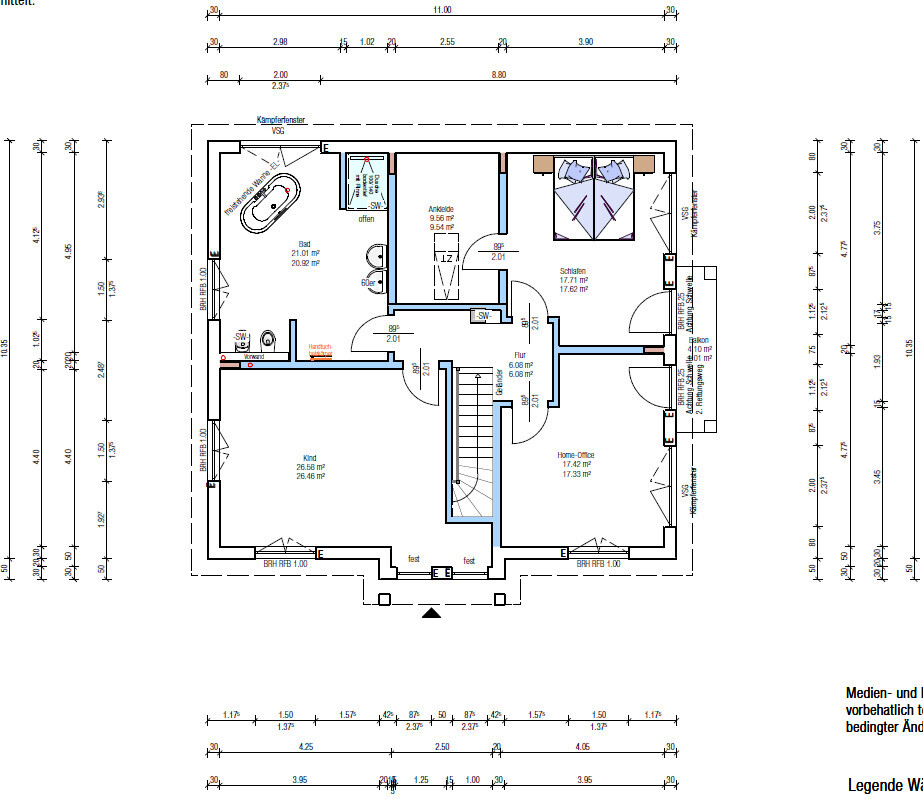
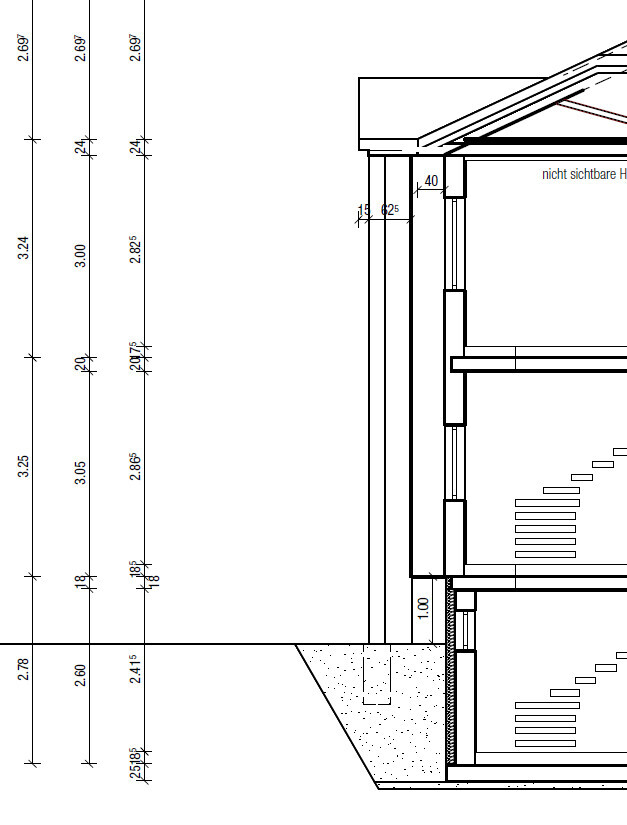
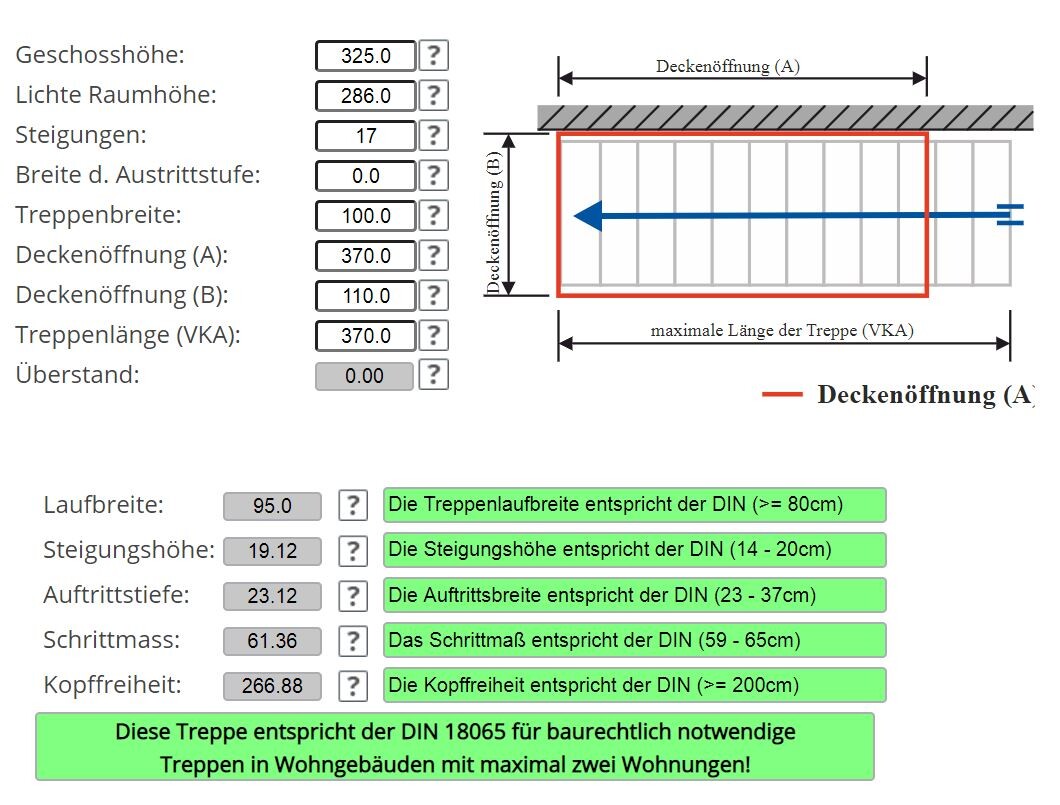
I’m a bit overwhelmed with our floor plan and keep running into the same problems...
The main issue is probably how to integrate a straight staircase from the ground floor to the upper floor, and how we would have to modify or extend the hallway to fit such a staircase without "breaking up" the other rooms.
Development plan / Restrictions
Plot size: 1005 m² (0.25 acres)
Slope: no
Site coverage ratio: according to neighboring developments
Floor area ratio: according to neighboring developments
Building envelope, building line, and boundary: according to neighboring developments
Edge development: no
Number of parking spaces: double / large garage planned
Number of stories: 2
Roof type: hipped roof
Style: urban villa
Orientation: street facing northeast, plot extends sideways toward west-northwest, garden planned all around southwest / west-northwest
Client requirements
Style, roof type, building type: urban villa with hipped roof
Basement, floors: basement + ground floor + upper floor
Number of occupants, ages: 2 adults + young child (3)
Office: home office?
Closed architecture
Closed kitchen, kitchen island
Fireplace
Balcony
Garage
House design
Who designed the plan:
- Option 1: planner from a construction company (not yet an architect)
- Option 2: do-it-yourself
What do you particularly like? Why?
Overall, the floor plan is good and was implemented largely according to our ideas.
What do you dislike? Why?
We would prefer a straight staircase. According to a staircase calculator tool, it would require a length of 3.70 m (12 ft).
From research, this might be rather uncomfortable and therefore unrealistic.
We would be willing to extend the hallway for the straight staircase if necessary.
Symmetry, especially in the front view of the house, is very important to us, so we want to keep the type of front door as is.
The awkward corner in the upper hallway is not very appealing (bedroom / office).
Furthermore, the hallway window was initially placed in the child’s bedroom, but that will be changed so there is natural light in the upper floor hallway.
I’m also wondering if the chimney flue on the upper floor can still be routed freely, possibly offset within the ceiling/floor. Or does it have to go straight up from the ground floor fireplace? Because then it would end up right in the middle of the upper floor hallway.
If you have to give up something, which details or fittings could you do without?
- Could you compromise on: I’m open to suggestions for now
- Cannot compromise on: ideally the straight staircase
What do you think makes it particularly good or bad?
See differences between our design and the construction company’s plan
- straight staircase instead of quarter-turn
- kitchen recessed
- window in the hallway instead of in the child’s room
- ideally no hallway obstruction on the upper floor

Well, I don’t think your initial design is very good, but it can be easily improved: reduce the size of the guest bathroom (even if the shower stays, the bathroom can be smaller!), shift it towards the wall next to the kitchen, and place an open space right by the entrance to serve as a cloakroom. This isn’t a big deal, and anyone entering through the door just takes a step to the left to get out of the circulation area within the cloakroom.
pagoni2020 schrieb:
Oh dear, what are we reading here? .......It’s hardly surprising when he’s just coming home from hunting with a wild boar on his back. Just because the lady of the house has to briefly put down her nail polish and get up from the sofa to properly store the hunter’s shoe?
Today’s problems…..the hallwaysHaha, these stereotypes here
Luckily, the honorable husband is the tidy one in the family and can put away my shoes that I’ve tossed in the corner
Climbee schrieb:
Well, I don't really like your original draft, but it could be improved quite easily: reduce the size of the guest bathroom (even if the shower stays, the bathroom can be smaller!), move it to the wall next to the kitchen, and right at the entrance create an open space (!) for a coat area. It’s not a big deal, and anyone entering the door just takes a step to the left and is out of the traffic area in the coat space.In principle, yes, but that still doesn't really solve the staircase problem. Even with a quarter-turn staircase, the space between the door and the stairs is very tight.P
pagoni202014 Jul 2020 11:09ECE-2021 schrieb:
The hallway is really getting to me ECE-2021 schrieb:
I don’t really have anything against an IKEA kitchen.
Apart from minor details, I’m quite happy with ours.
Still, I’m not keen on moving such a kitchen, since it consists of so many individual parts. The base cabinets (carcass) at IKEA aren’t made in one piece like with other manufacturers, so they tend to suffer more during a move.
As I said, this is our IKEA kitchen in gloss white…
Only the handles were a bad choice.
They annoy me; I’m always catching on them with everything. That has changed by now with handles and so on; plus you can use any handles you like. We’ve moved once already and will move again soon. The cabinets are no longer disassembled but transported as single units. I was really surprised at how well that worked—provided the person handling it works carefully. That’s always a prerequisite in any trade. The carcass is typically screwed together at the factory with comparable manufacturers, but the practical result is probably not much different; I don’t think the carcass itself would be the problem. More likely if you want something different or have specific requirements for designs, sizes, etc.
What bothered us with various kitchen suppliers was the lack of transparency—jumping between price options, hidden costs, and so on. Kitchen construction is still deliberately kept opaque, so no one can easily compare.
It is manageable—there is a book by two experts online about this—but it takes a lot of time. For me, IKEA works; we enjoy being able to design within this framework and are often pleasantly surprised by the results when combining it with other elements.
But discussions about kitchens can go on endlessly and everyone’s right—or not. It needs to fit individually.
Words like good, better, move, etc., are often used like phrases and don’t match our actual experience.
pagoni2020 schrieb:
The cabinets are no longer delivered disassembled but as single units. I was really surprised how well it fit together, but that’s because it was done by someone who works neatly.Ah, that naturally makes a big difference.Unfortunately, you can’t always tell in advance whether someone works well or not, and as a layperson, some mistakes only become obvious when it’s too late. For example, holes were simply drilled into our dishwasher to hang the decorative panel instead of using the mounting rails. Now we have a perforated dishwasher.
Our Ikea kitchen is only 3 years old and fits so well in this apartment that we hope to simply sell it to the next tenant.
Climbee schrieb:
Right at the entrance, an open space (!) as a coatroom.By the way, my husband dreams of a coatroom hidden behind a mirror that can be opened. An enclosed space always keeps things a bit tidier, following the "out of sight, out of mind" principle. But I see that it would obviously be more practical if it’s open. Maybe a compromise can be found.Similar topics