
ᐅ Floor plan for two semi-detached houses – wide and narrow or square-shaped
Created on: 1 Feb 2022 23:26
S
smartsurfer85
Currently, there is a single-family house on the plot, built in 1961. The long-term tenant recently passed away. Since a full renovation of the existing house seems too expensive and complex to me, I would like to have a complete semi-detached house built instead, consisting of two mirrored halves.
I plan to keep one half of the semi-detached house and rent it out. The second half I either want to rent out as well or sell—either immediately after completion if the project costs exceed my financial means, or later (for example, after 10 years).
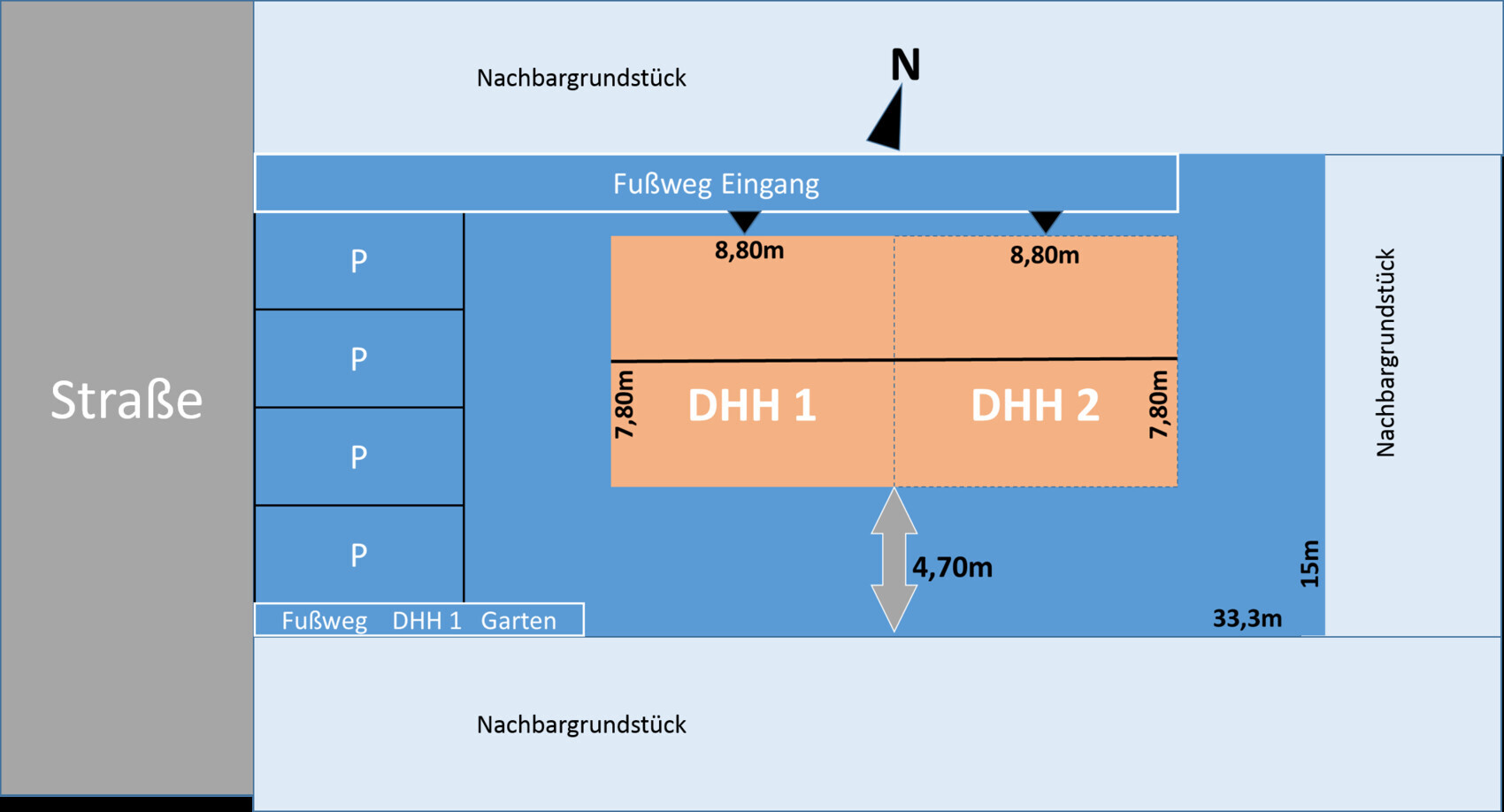
The plot is rather long and narrow, so standard floor plans do not fit directly. The usual semi-detached house layouts tend to be “long and narrow” rather than “wide and short” or “square.” A wider layout does not necessarily seem better for usable rooms. How much larger than 8.80m x 7.80m (29 ft x 26 ft) should each half be? (Dimensions taken from the plot with some distance left for garden space toward neighbors, positioning the building volume accordingly; there is no strict need to adhere exactly to these, it's simply a starting point.)
Since I have no clear idea of the required minimum size yet, I started designing a basic floor plan.
I also want to use this draft to compare prices from different general contractors.
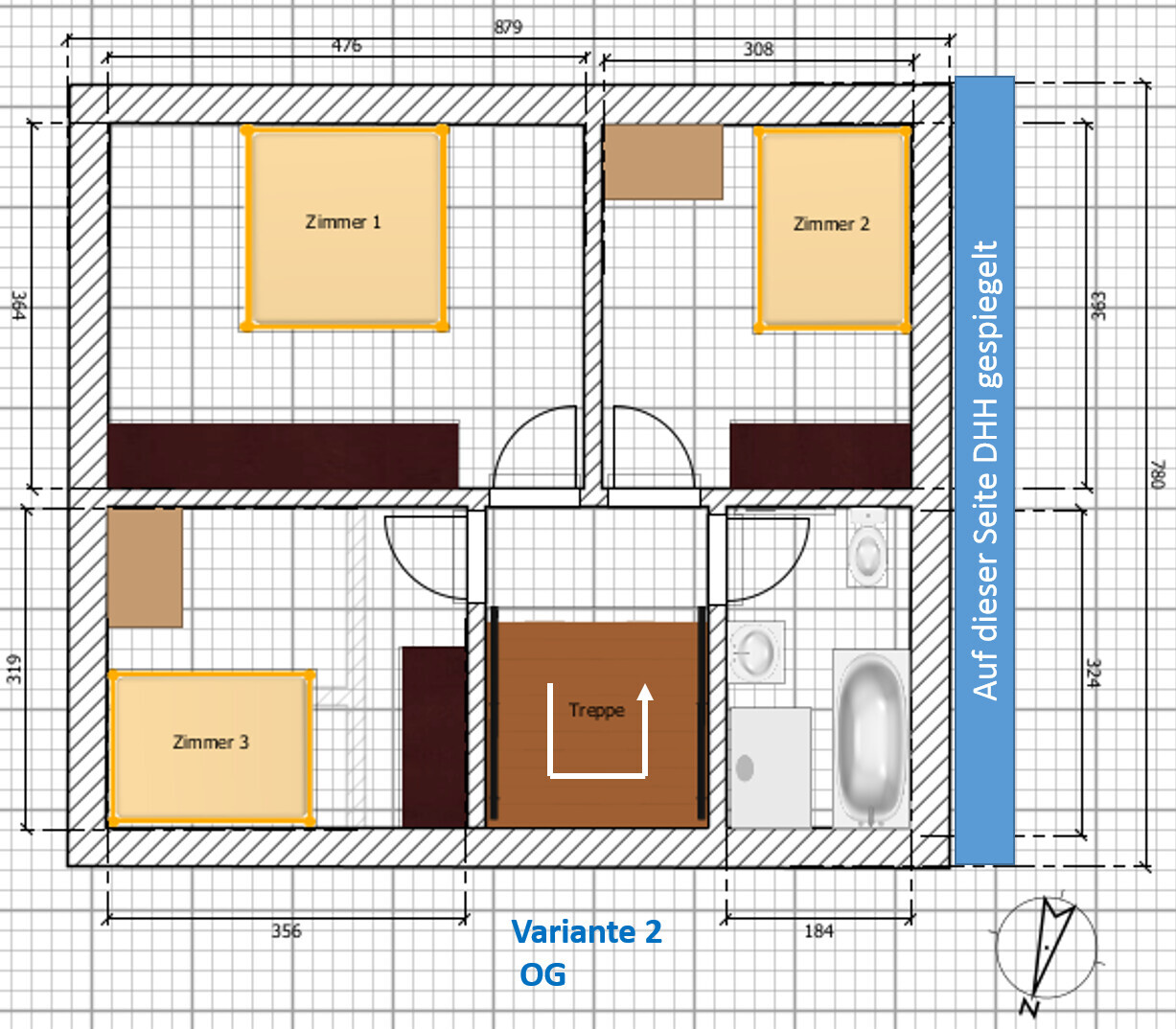
I generated two different variants (plans for the ground floor, upper floor, and attic are still pending).
What improvements can be made? Do you have any other ideas?
Site sketch: plot (dark blue) with planned parking spaces, pathway, and building volume
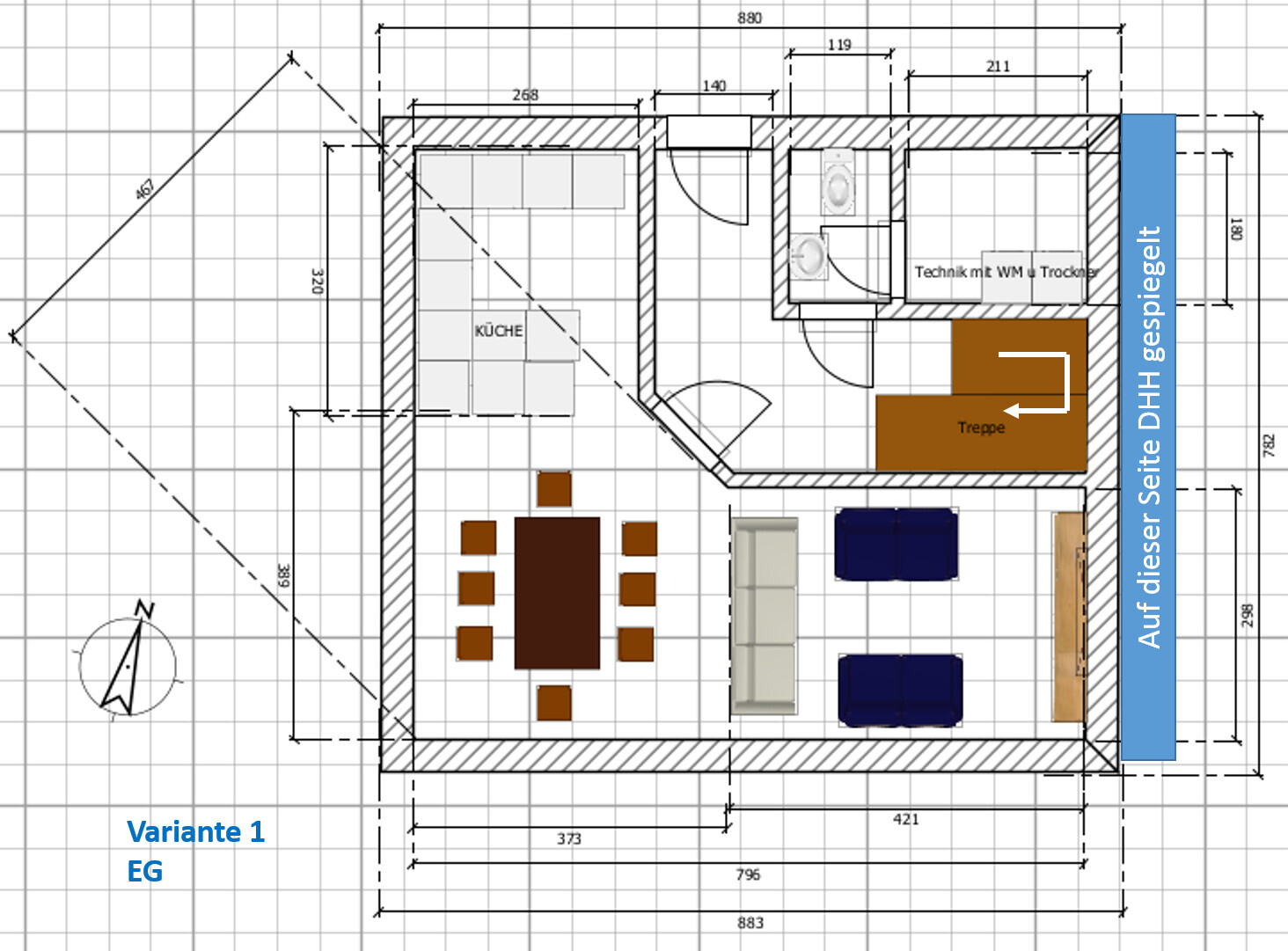
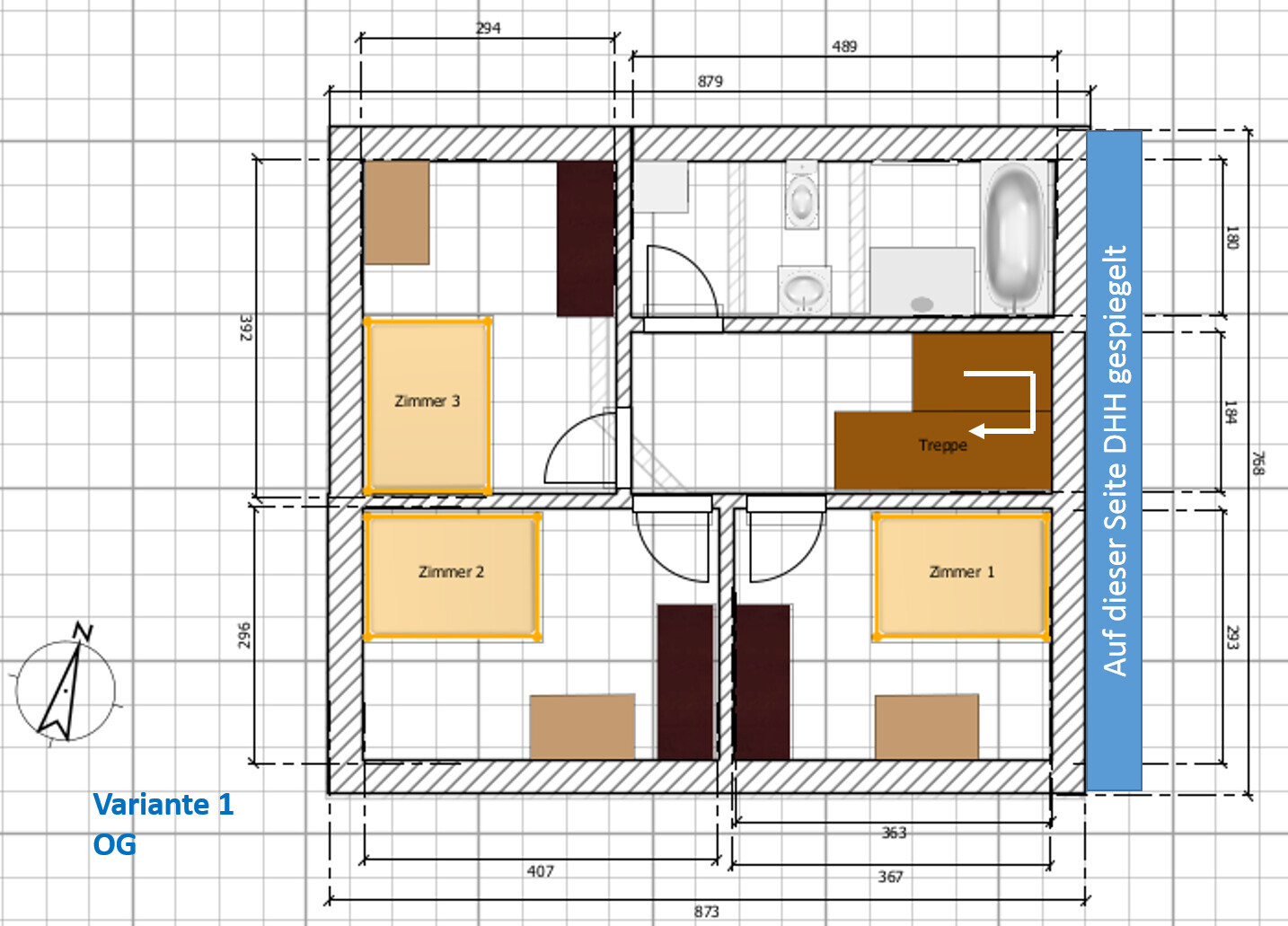
Variant 1:
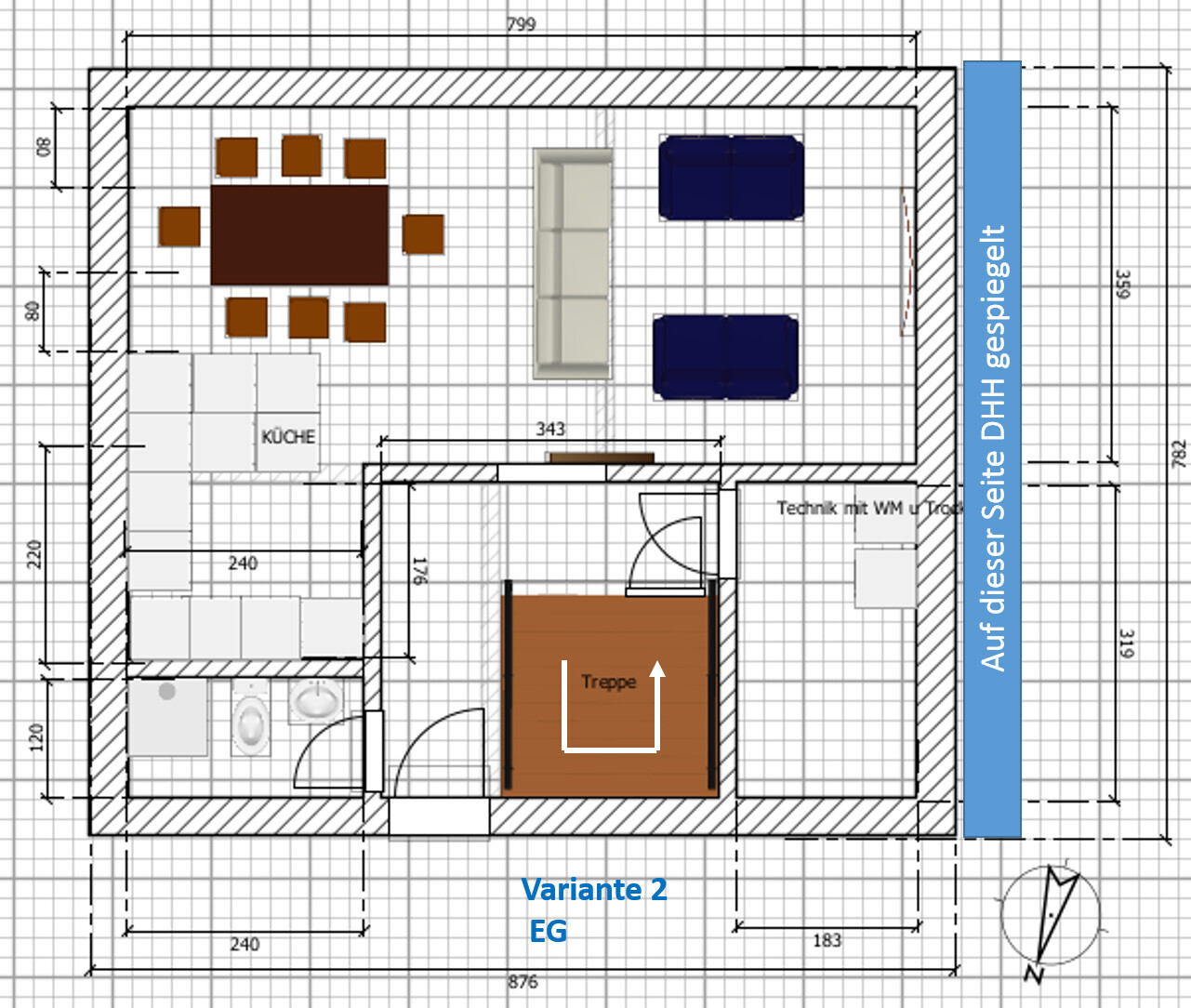
Variant 2:
Plot size: 499m² (5373 sq ft)
Slope: No
Floor area ratio: §34 Baugesetzbuch (Building Code)
Plot ratio: §34 Baugesetzbuch (Building Code)
Building envelope, building line, and boundary lines
Edge construction: 2.5m (8 ft) setback from the property line
Number of parking spaces: 2 per semi-detached half = 4 total
Number of storeys: 2
Roof type: Gable roof
Style: Classic
Orientation: North
Maximum heights/restrictions
Further requirements
Client Requirements
Style, roof type, building type: Solid construction
Basement, storeys: Preferably no basement for cost reasons; ground floor, upper floor, and attic
Number of occupants, age: Target group is a family with 1–3 children
Space requirements for ground floor, upper floor, attic: approx. 120–150m² (1290–1615 sq ft)
Office: For family use or home office? Home office, 1–2 offices
Guest bedrooms per year:
Open or closed architecture: Open
Conservative or modern construction: Conservative
Open kitchen, kitchen island: Yes
Number of dining seats: 6–8
Fireplace: No
Music / stereo wall: No
Balcony, roof terrace: No
Garage, carport: Possibly carport
Garden for vegetables, greenhouse: No
Other requests / special details / daily routine, including reasons why this or that should or should not be included: Simple floor plan to reduce costs, garden area preferably facing south with about 4.70m (15.5 ft) to potentially minimal 4m (13 ft) distance to neighbors to allow good use of a terrace.
House Design
Planned by:
- Do-it-yourself: Yes
What do you particularly like? Why? Variant 1: Living/dining on the ground floor allows better use of space; Variant 2: room layout on the upper floor offers better usable rooms.
What do you not like? Why? Variant 1: Utility room on the ground floor is accessible only through the guest bathroom.
Price estimate according to architect/planner: Unknown so far; floor plan serves as a basis for price inquiries.
Personal price limit for house including fixtures: –
Preferred heating technology: Air source heat pump
If you had to give up something, which details or upgrades?
- Can give up: Bay window, basement
- Cannot give up: Utility room on the ground floor
Why is the design the way it currently is?
Based on examples of semi-detached houses, which are usually “long and narrow,” while here “short and wide” / “square” is needed. An additional challenge is accommodating technical rooms without a basement.
What is the most important / fundamental question about the floor plan summarized in 130 characters?
Size optimization: The current exterior dimensions of 8.80m x 7.80m (29 ft x 26 ft) seem really tight. How much larger, and with which layout variant (1, 2, or completely different)?
I plan to keep one half of the semi-detached house and rent it out. The second half I either want to rent out as well or sell—either immediately after completion if the project costs exceed my financial means, or later (for example, after 10 years).
The plot is rather long and narrow, so standard floor plans do not fit directly. The usual semi-detached house layouts tend to be “long and narrow” rather than “wide and short” or “square.” A wider layout does not necessarily seem better for usable rooms. How much larger than 8.80m x 7.80m (29 ft x 26 ft) should each half be? (Dimensions taken from the plot with some distance left for garden space toward neighbors, positioning the building volume accordingly; there is no strict need to adhere exactly to these, it's simply a starting point.)
Since I have no clear idea of the required minimum size yet, I started designing a basic floor plan.
I also want to use this draft to compare prices from different general contractors.
I generated two different variants (plans for the ground floor, upper floor, and attic are still pending).
What improvements can be made? Do you have any other ideas?
Site sketch: plot (dark blue) with planned parking spaces, pathway, and building volume
Variant 1:
Variant 2:
Plot size: 499m² (5373 sq ft)
Slope: No
Floor area ratio: §34 Baugesetzbuch (Building Code)
Plot ratio: §34 Baugesetzbuch (Building Code)
Building envelope, building line, and boundary lines
Edge construction: 2.5m (8 ft) setback from the property line
Number of parking spaces: 2 per semi-detached half = 4 total
Number of storeys: 2
Roof type: Gable roof
Style: Classic
Orientation: North
Maximum heights/restrictions
Further requirements
Client Requirements
Style, roof type, building type: Solid construction
Basement, storeys: Preferably no basement for cost reasons; ground floor, upper floor, and attic
Number of occupants, age: Target group is a family with 1–3 children
Space requirements for ground floor, upper floor, attic: approx. 120–150m² (1290–1615 sq ft)
Office: For family use or home office? Home office, 1–2 offices
Guest bedrooms per year:
Open or closed architecture: Open
Conservative or modern construction: Conservative
Open kitchen, kitchen island: Yes
Number of dining seats: 6–8
Fireplace: No
Music / stereo wall: No
Balcony, roof terrace: No
Garage, carport: Possibly carport
Garden for vegetables, greenhouse: No
Other requests / special details / daily routine, including reasons why this or that should or should not be included: Simple floor plan to reduce costs, garden area preferably facing south with about 4.70m (15.5 ft) to potentially minimal 4m (13 ft) distance to neighbors to allow good use of a terrace.
House Design
Planned by:
- Do-it-yourself: Yes
What do you particularly like? Why? Variant 1: Living/dining on the ground floor allows better use of space; Variant 2: room layout on the upper floor offers better usable rooms.
What do you not like? Why? Variant 1: Utility room on the ground floor is accessible only through the guest bathroom.
Price estimate according to architect/planner: Unknown so far; floor plan serves as a basis for price inquiries.
Personal price limit for house including fixtures: –
Preferred heating technology: Air source heat pump
If you had to give up something, which details or upgrades?
- Can give up: Bay window, basement
- Cannot give up: Utility room on the ground floor
Why is the design the way it currently is?
Based on examples of semi-detached houses, which are usually “long and narrow,” while here “short and wide” / “square” is needed. An additional challenge is accommodating technical rooms without a basement.
What is the most important / fundamental question about the floor plan summarized in 130 characters?
Size optimization: The current exterior dimensions of 8.80m x 7.80m (29 ft x 26 ft) seem really tight. How much larger, and with which layout variant (1, 2, or completely different)?

smartsurfer85 schrieb:
In my experience around here, the agenda is "creating living space," and the district office often overrules the local council, the technical committee, etc., especially in cases under Section 34. It feels like building is permitted wherever possible.
That might be true, but it might not be. I don’t think your impression is sufficient to assess the buildability. From the surrounding area, it appears the floor area ratio (FAR) is approximately 0.4. In my opinion, agreeing to such a significant violation compared to neighboring properties is questionable. You would save everyone a lot of time and effort if you submitted a simple preliminary building inquiry to briefly check your project. Floor plans are not required yet, and to my knowledge, it is also free if you do it yourself.smartsurfer85 schrieb:
By any chance, do you have a floor plan as an example or a reference from an online provider? No, why?
Even a Flair 110 (or similar), in your case, since you find it difficult to visualize and plan, take the Flair 113 with a dormer/gable roof, and place them side by side—it would even work on this plot as a semi-detached house. Standard houses of this size can almost always be adapted as semi-detached houses with only minor adjustments.
You are your own worst advisor.
You should be clear whether you are building for yourself or for others. The first option does not exclude having a rental/sale unit. The second option practically excludes a separate apartment as a main residence with single-family house standards.
kbt09 schrieb:
Includes wall plaster and railing. .. assuming the original poster even included the step from the ceiling. I doubt it.
K a t j a schrieb:
I don’t find your intuition sufficient to assess the buildability. Exactly. There isn’t even any sense of feasibility here. And building under Section 34 does not mean unlimited height and footprint. Quite the opposite!
smartsurfer85 schrieb:
Before I go to a planner/project manager… I want to have an idea of what I want or what I consider possible. Sorry, but I’m afraid you have little understanding of what’s possible or feasible.
First, the facts have to be laid out. Only then can you consider how to realize and include your own wishes.
smartsurfer85 schrieb:
60 sqm (645 sq ft) in the attic would be sufficient, right? I see a) no 60 sqm (645 sq ft), b) many “corners” that simply don’t work with the roof: toilet, closet, washbasin, dining table, and kitchen… this just won’t work! And two staircases plus a stairwell for a small apartment of barely 50 sqm (538 sq ft).
And if, as you say, the infrastructure is very poor, then I don’t even see a target group for this apartment that doesn’t really offer much.
smartsurfer85 schrieb:
As mentioned before, the planning is on hold, so clearly nothing has progressed. It would be clear if you started with the construction process—i.e., contacting the building authority/planning permission office, talks with an architect, and then come back here with facts.
In my opinion, the architect (or construction manager) as a professional should already be involved so that the non-expert communication with the building authority does not pave the way beyond the limits of buildability. With this narrow lot and the circumstances, every square meter of living/land area should be maximized using the minimum parking space calculation, and that requires the expertise of a professional.
Similar topics