
ᐅ Floor Plan Single-Family Home 165 sqm First Draft – Architect Dissatisfied
Created on: 27 Oct 2024 14:06
K
Kirschsaftlady
Hello everyone,
since we are not completely satisfied with the first draft from our architect and find it difficult to translate our wishes into a design ourselves, or because some things might even be incompatible, we would appreciate suggestions and tips.
Development Plan / Restrictions
Plot size: 954 sqm (10,270 sq ft)
Slope: approximately 1 m (3.3 ft) downward from the street along the entire length
Floor-space index (FSI): 0.4
Building envelope, building line, and boundary: see architect’s plan
There is a development plan, but all exceptions we want have been approved without issues or have already been permitted for our street.
Client Requirements
Style, roof shape, building type: gable roof, single-family house, possibly with a bay window
Basement, floors: slab-on-grade, 2 full stories with a sufficiently high knee wall, small storage space under the roof
Number of occupants, age: currently 2 adults and one toddler, planning for an additional child
Space requirements on ground floor (GF) and upper floor (UF):
GF: combined utility and technical room, entrance area, cloakroom niche, guest bathroom with shower, office, open living-dining-kitchen area. Pantry, storage under the stairs
UF: 2 children’s rooms at least 15 sqm (160 sq ft) each, master bedroom with walk-in closet, family bathroom with walk-in shower and double sinks, hallway with daylight and preferably space for a chair or a small table for a sewing machine
Office: family use or home office? Home office nearly daily
Guests per year: hardly any
Open or closed layout: semi-open
Conservative or modern construction: modern
Open kitchen, cooking island: semi-open (visually screened) with attached island
Number of dining seats: 6
Fireplace: no
Music/speaker wall: no
Balcony, roof terrace: no
Garage, carport: either a double garage or a garage with carport
Additional wishes:
Stairs either straight or with a landing, not spiral
Living-dining-kitchen area should not be arranged in a single line without privacy screens, all areas with a view into the garden
Prefer an additional access from the garage/carport through the utility room
Master bedroom oriented top left on the plan, bed with a view out of a floor-to-ceiling window into the garden. Preferred access to the bedroom through the dressing room or the dressing room behind the wall behind the bed (headboard).
Prefer children’s rooms not adjoining the master bedroom wall-to-wall
I will link a plan of a kitchen we really liked in a show house
Prefer the stairs to be naturally lit
Living room at least as large as in the current plan
House Design
Designed by: architect
What do you particularly like? Why? The ground floor, except kitchen and dining area, especially the living room, is well separated and without direct view into the kitchen. The dining area feels somewhat cramped; the kitchen should be wider rather than longer, as currently the attached island looks lost.
What do you dislike? Why? Kitchen and dining area, walk-in closet cramped in a niche, bathroom too large, upper floor hallway without windows. Window areas in the master bedroom and also in the dining-kitchen area too large, cloakroom niche too small.
Price estimate according to architect/planner: none yet, a discussion about the design is still pending.
Personal budget limit for the house including fittings: excluding the plot, with all additional costs, survey, and soil report, we still have a budget of 600,000. It will be a prefabricated house, possibly painting and partial flooring done by ourselves, landscaping also mainly DIY and not immediately.
Preferred heating system: air-to-water heat pump with photovoltaic system
If you have to give up on certain details/extensions:
-can you do without: children’s room next to the master bedroom, storage and office could move upstairs if necessary, utility and technical rooms separated, second access not mandatory, pantry access directly from kitchen as well as from utility room not mandatory, bay window not essential as long as it doesn’t make the layout too open
-can’t you do without: stair shape, room layout, bedroom location, “semi-open” living-dining-kitchen area, cloakroom integrated into a niche
Why is the design the way it is?
There was an on-site meeting where brainstorming on paper followed. The current draft more or less resulted from this, but it was not yet final with dimensions and sizes, so for example, the problem with the kitchen and dining area was not visible. We communicated the negative points about the upper floor on site and actually expected a new alternative afterward.
I think all relevant information is included above; I’m happy to provide more if needed.
The dining table does not have to be directly in front of the kitchen; the focus is solely on the kitchen layout itself.
Thanks in advance for all your tips!
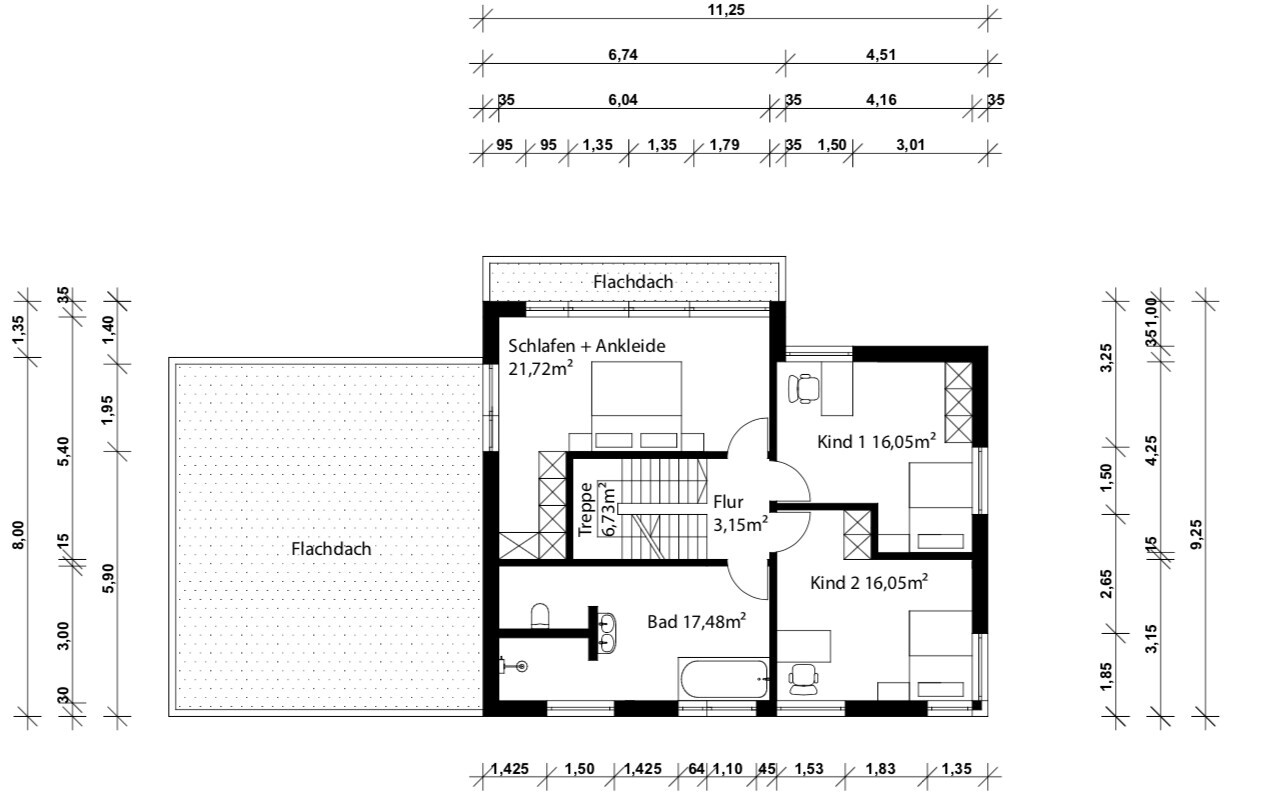
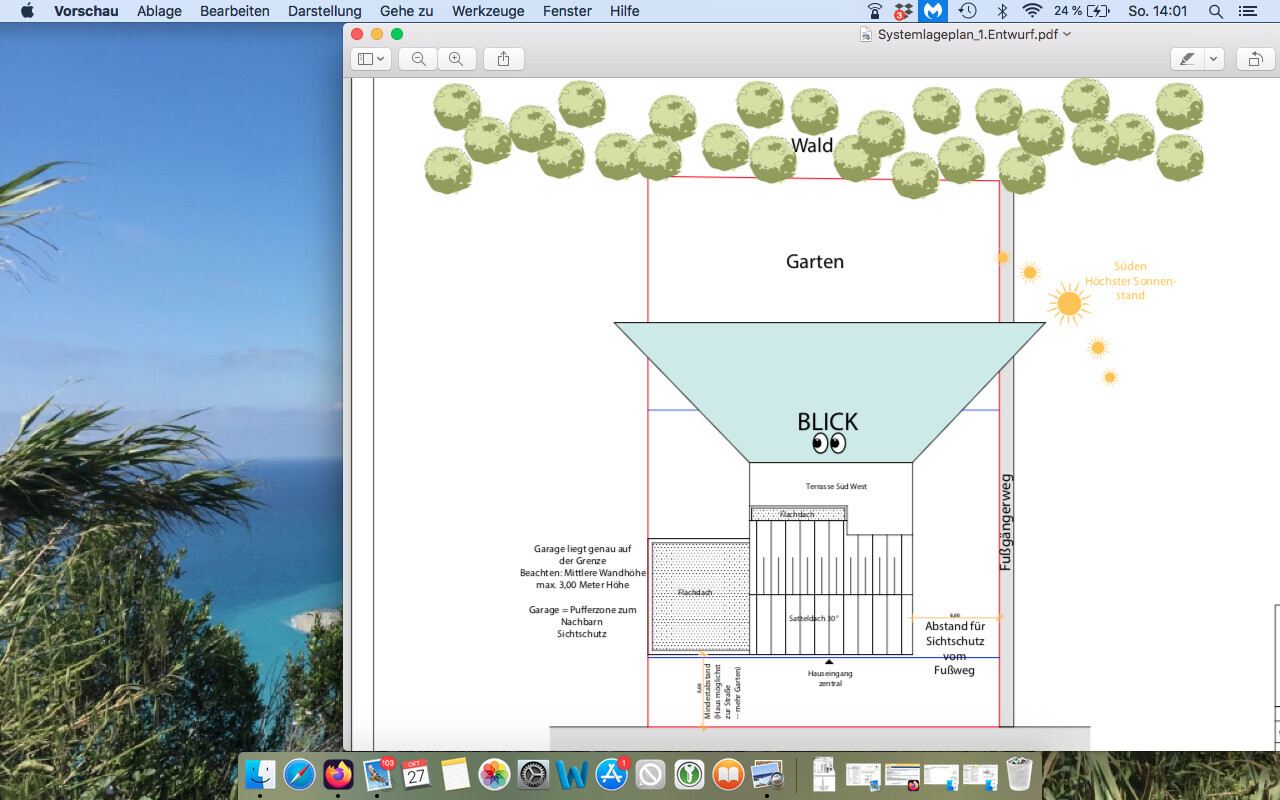
since we are not completely satisfied with the first draft from our architect and find it difficult to translate our wishes into a design ourselves, or because some things might even be incompatible, we would appreciate suggestions and tips.
Development Plan / Restrictions
Plot size: 954 sqm (10,270 sq ft)
Slope: approximately 1 m (3.3 ft) downward from the street along the entire length
Floor-space index (FSI): 0.4
Building envelope, building line, and boundary: see architect’s plan
There is a development plan, but all exceptions we want have been approved without issues or have already been permitted for our street.
Client Requirements
Style, roof shape, building type: gable roof, single-family house, possibly with a bay window
Basement, floors: slab-on-grade, 2 full stories with a sufficiently high knee wall, small storage space under the roof
Number of occupants, age: currently 2 adults and one toddler, planning for an additional child
Space requirements on ground floor (GF) and upper floor (UF):
GF: combined utility and technical room, entrance area, cloakroom niche, guest bathroom with shower, office, open living-dining-kitchen area. Pantry, storage under the stairs
UF: 2 children’s rooms at least 15 sqm (160 sq ft) each, master bedroom with walk-in closet, family bathroom with walk-in shower and double sinks, hallway with daylight and preferably space for a chair or a small table for a sewing machine
Office: family use or home office? Home office nearly daily
Guests per year: hardly any
Open or closed layout: semi-open
Conservative or modern construction: modern
Open kitchen, cooking island: semi-open (visually screened) with attached island
Number of dining seats: 6
Fireplace: no
Music/speaker wall: no
Balcony, roof terrace: no
Garage, carport: either a double garage or a garage with carport
Additional wishes:
Stairs either straight or with a landing, not spiral
Living-dining-kitchen area should not be arranged in a single line without privacy screens, all areas with a view into the garden
Prefer an additional access from the garage/carport through the utility room
Master bedroom oriented top left on the plan, bed with a view out of a floor-to-ceiling window into the garden. Preferred access to the bedroom through the dressing room or the dressing room behind the wall behind the bed (headboard).
Prefer children’s rooms not adjoining the master bedroom wall-to-wall
I will link a plan of a kitchen we really liked in a show house
Prefer the stairs to be naturally lit
Living room at least as large as in the current plan
House Design
Designed by: architect
What do you particularly like? Why? The ground floor, except kitchen and dining area, especially the living room, is well separated and without direct view into the kitchen. The dining area feels somewhat cramped; the kitchen should be wider rather than longer, as currently the attached island looks lost.
What do you dislike? Why? Kitchen and dining area, walk-in closet cramped in a niche, bathroom too large, upper floor hallway without windows. Window areas in the master bedroom and also in the dining-kitchen area too large, cloakroom niche too small.
Price estimate according to architect/planner: none yet, a discussion about the design is still pending.
Personal budget limit for the house including fittings: excluding the plot, with all additional costs, survey, and soil report, we still have a budget of 600,000. It will be a prefabricated house, possibly painting and partial flooring done by ourselves, landscaping also mainly DIY and not immediately.
Preferred heating system: air-to-water heat pump with photovoltaic system
If you have to give up on certain details/extensions:
-can you do without: children’s room next to the master bedroom, storage and office could move upstairs if necessary, utility and technical rooms separated, second access not mandatory, pantry access directly from kitchen as well as from utility room not mandatory, bay window not essential as long as it doesn’t make the layout too open
-can’t you do without: stair shape, room layout, bedroom location, “semi-open” living-dining-kitchen area, cloakroom integrated into a niche
Why is the design the way it is?
There was an on-site meeting where brainstorming on paper followed. The current draft more or less resulted from this, but it was not yet final with dimensions and sizes, so for example, the problem with the kitchen and dining area was not visible. We communicated the negative points about the upper floor on site and actually expected a new alternative afterward.
I think all relevant information is included above; I’m happy to provide more if needed.
The dining table does not have to be directly in front of the kitchen; the focus is solely on the kitchen layout itself.
Thanks in advance for all your tips!
Kirschsaftlady schrieb:
We have not worked with an architect yet, so we don’t know what kind of sketch to expect or how it should look. Exterior walls, window locations, dimensions, and doors should be clearly visible at a glance.

ypg schrieb:
You should be able to clearly see the exterior walls, window positions, dimensions, and doors at a glance. Well, there are barely any visible dimensions (although he obviously must have some hidden somewhere, since the square meter figures have to come from somewhere), no positions either, and in my opinion, it is very clear that the prankster doesn’t care about any of it (unless the continuous band of windows wrapping around two corners in the form of two gable walls and one eave side is not meant seriously). If he did care, he probably wouldn’t be an architect, but rather a brilliant structural engineer in league with the devil.
https://www.instagram.com/11antgmxde/
https://www.linkedin.com/company/bauen-jetzt/
I will recap my post #59:
https://www.instagram.com/11antgmxde/
https://www.linkedin.com/company/bauen-jetzt/
11ant schrieb:The last sentence was a warning, not a recommendation for action! I see the path of correction as failed, and a second attempt at correction is not worth hoping for. Therefore, in my opinion, you should now take the route of a termination agreement.
You are clients! (A client pays and orders, which is a fundamental difference from someone making a request). Be clear about what you want and communicate it:
EITHER a correction of the work, meaning the architect should maintain their fee entitlement but must provide an acceptable equivalent in return
OR agree on acknowledging the failed attempt, part ways amicably, and settle on a reasonable compensation for the work done (which in my opinion was poor). After all, you now have to invest money in a different planning approach.
The option "hope and be surprised" only exists if you are willing to move from the client role into the victim role!
11ant schrieb:So, for example, come to me or colleague Beuler (or Zink or Freyermuth, if their focus on wooden houses does not bother you), and 1. formulate the difference between your wishes and the architect’s proposals and 2. send out and work on an orientation inquiry to suitable providers. If I handle one, researching appropriate "catalog" building proposals is part of it. With the result, you then 3. go (ideally accompanied) to a builder, without trying another shot in the dark.
I think creating an alternative design is good. However, I would not try to develop it further but only use it for a short series of very specific purposes:
A. To show the difference between the architect’s design and your requirements/wishes;
B. As a benchmark or template for searching suitable proven building concepts / catalog homes;
C. For an orientation inquiry (> "setting the course"), I can gladly prepare such a comparison for you based on the architect’s design, your alternative design, and a comparison of both.
[...] I see you probably continuing with an independent building consultant (construction method neutral, this can be another architect, likely also paid according to HOAI, or myself). I have already mentioned three of my colleagues (Beuler, Zink, and Freyermuth, unfortunately all focused on prefabricated houses) several times (see forum search), and this list is by no means exhaustive.
https://www.instagram.com/11antgmxde/
https://www.linkedin.com/company/bauen-jetzt/