
ᐅ Preliminary floor plan design for a 220 m² single-family house
Created on: 20 Jun 2017 22:41
R
R.Hotzenplotz
Hello!
We have already gone through several plans with our architect and I think we are almost there, about to start the detailed planning phase. Before that, I’m looking forward to getting feedback from other users.
Development plan/restrictions: §34 – two full stories
Plot size: 1,085m² (1,1679 yd²)
Basement, floors – 2 full stories plus partial basement
Number of people, ages – 3 people (37, 34, 1, second child planned)
Space requirements on ground floor and upper floor – the requirement was that bedrooms and the study should be about 17m² (183 ft²) each; the entire house should be approximately 220m² (2,368 ft²)
Office: family use
Guests per year: 1
Open or closed architecture: closed
Traditional or modern design: modern
Open kitchen, kitchen island – no open kitchen, but yes to a kitchen island
Number of dining seats – 6
Fireplace – yes
Music/stereo wall – TV wall
Balcony, roof terrace – balcony
Garage, carport – large garage
Additional wishes/special features/daily routines, preferably with reasons why certain things should or should not be included – everyone should be able to sleep as undisturbed as possible in their bedrooms, even if other family members are awake. The husband is sometimes up as early as 4 a.m. Otherwise, watching TV in the evening should be possible without disturbing those sleeping upstairs.
House design
Who created the design:
- Architect (freelancer for a general contractor)
What do you like most? Why?
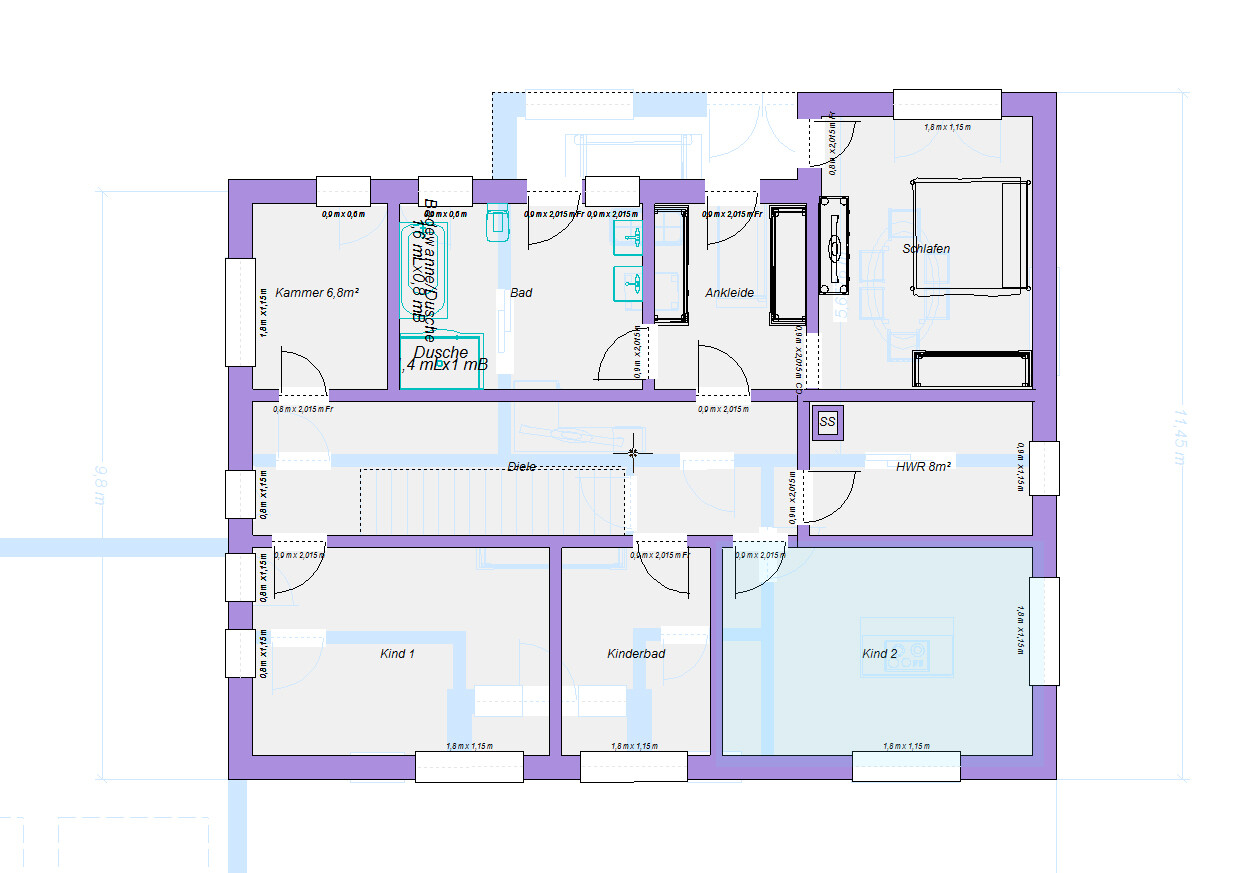
The upper floor with well-sized rooms and the location of the rooms exactly where they should be (only the washroom area we would still like to move to the outer right corner so that you don’t have to pass it every time you use the toilet). On the ground floor, the access through an airlock, the kitchen, and the dining area with the study next to it are especially liked.
Also appreciated is that after adjustments, the study now faces the garden instead of the street.
What don’t you like? Why?
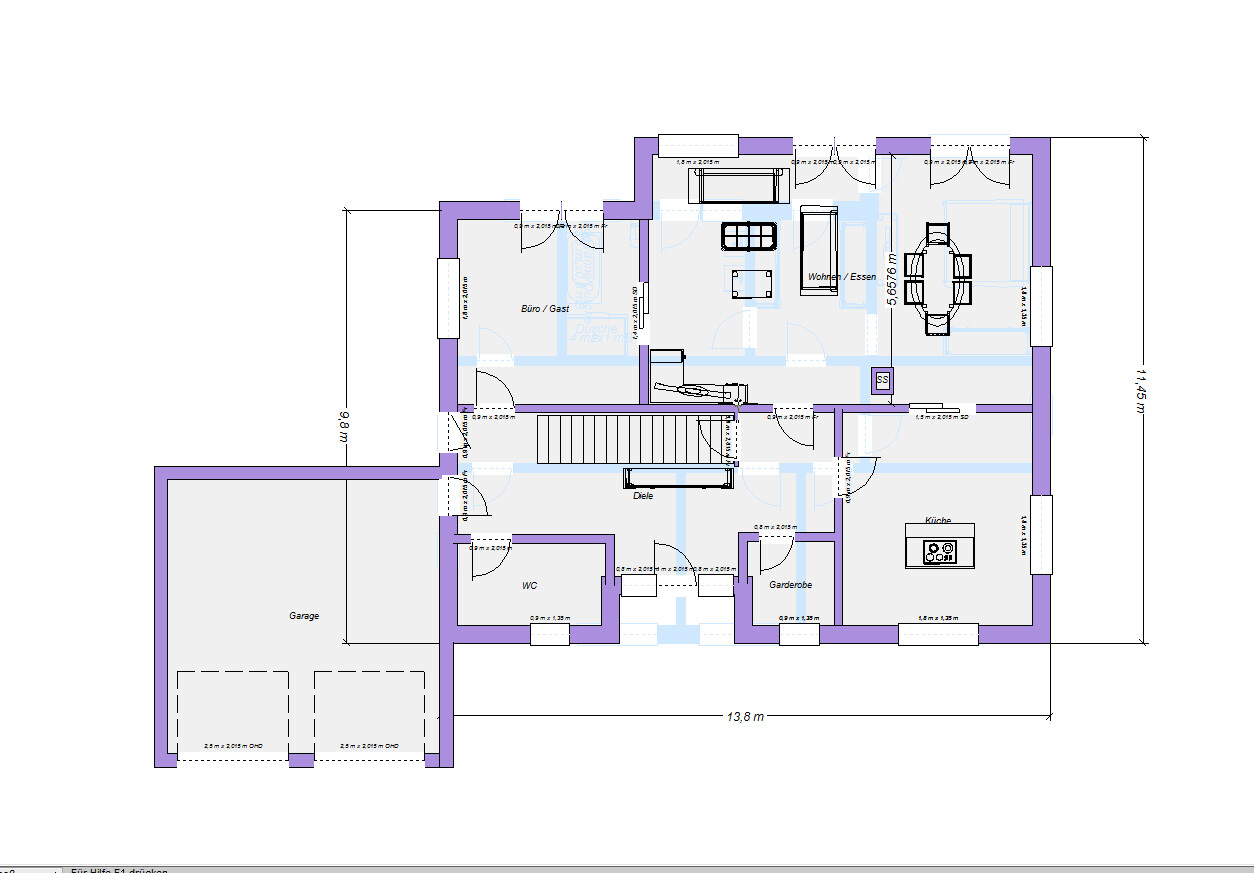
We originally wanted the distance from wall to wall where the sofa and TV stand is to be about 6.40m (21 ft) (large screen & surround system), but so far only 5.69m (19 ft) has been realized.
Laundry room as described.
Kitchen larger in square meters than needed; the approx. 3m² (32 ft²) could theoretically be used well in the living area.
Price estimate according to architect/planner:
720,000 euros (including construction incidentals)
Personal price limit for the house, including equipment:
800,000 euros
Preferred heating technology:
Gas
If you have to give up on something, which details/features can you do without?
- Can do without:
Technical systems like controlled residential ventilation
- Cannot do without:
Space (except for the kitchen)
Why is the design the way it is now? For example:
Is this a standard design from the planner?
The architect has largely implemented our wishes; the only issue is the living room situation.
What makes it particularly good or bad in your opinion?
Patient, quick to implement, has already gotten to know us well.
No negative points.
Do you notice any other points that might not fit or that we should consider, which we might have overlooked?
In the basement, the room currently labeled as home cinema might possibly be used as one medium- to long-term. For the foreseeable future, it will be a storage room.
We have already gone through several plans with our architect and I think we are almost there, about to start the detailed planning phase. Before that, I’m looking forward to getting feedback from other users.
Development plan/restrictions: §34 – two full stories
Plot size: 1,085m² (1,1679 yd²)
Basement, floors – 2 full stories plus partial basement
Number of people, ages – 3 people (37, 34, 1, second child planned)
Space requirements on ground floor and upper floor – the requirement was that bedrooms and the study should be about 17m² (183 ft²) each; the entire house should be approximately 220m² (2,368 ft²)
Office: family use
Guests per year: 1
Open or closed architecture: closed
Traditional or modern design: modern
Open kitchen, kitchen island – no open kitchen, but yes to a kitchen island
Number of dining seats – 6
Fireplace – yes
Music/stereo wall – TV wall
Balcony, roof terrace – balcony
Garage, carport – large garage
Additional wishes/special features/daily routines, preferably with reasons why certain things should or should not be included – everyone should be able to sleep as undisturbed as possible in their bedrooms, even if other family members are awake. The husband is sometimes up as early as 4 a.m. Otherwise, watching TV in the evening should be possible without disturbing those sleeping upstairs.
House design
Who created the design:
- Architect (freelancer for a general contractor)
What do you like most? Why?
The upper floor with well-sized rooms and the location of the rooms exactly where they should be (only the washroom area we would still like to move to the outer right corner so that you don’t have to pass it every time you use the toilet). On the ground floor, the access through an airlock, the kitchen, and the dining area with the study next to it are especially liked.
Also appreciated is that after adjustments, the study now faces the garden instead of the street.
What don’t you like? Why?
We originally wanted the distance from wall to wall where the sofa and TV stand is to be about 6.40m (21 ft) (large screen & surround system), but so far only 5.69m (19 ft) has been realized.
Laundry room as described.
Kitchen larger in square meters than needed; the approx. 3m² (32 ft²) could theoretically be used well in the living area.
Price estimate according to architect/planner:
720,000 euros (including construction incidentals)
Personal price limit for the house, including equipment:
800,000 euros
Preferred heating technology:
Gas
If you have to give up on something, which details/features can you do without?
- Can do without:
Technical systems like controlled residential ventilation
- Cannot do without:
Space (except for the kitchen)
Why is the design the way it is now? For example:
Is this a standard design from the planner?
The architect has largely implemented our wishes; the only issue is the living room situation.
What makes it particularly good or bad in your opinion?
Patient, quick to implement, has already gotten to know us well.
No negative points.
Do you notice any other points that might not fit or that we should consider, which we might have overlooked?
In the basement, the room currently labeled as home cinema might possibly be used as one medium- to long-term. For the foreseeable future, it will be a storage room.

R.Hotzenplotz schrieb:
I really don’t like the strict separation between the bathroom / dressing area and the bedroom. Especially not the dressing room that you have to walk through the bathroom to get to. The idea of accessing the entire master area through one door is better. I fully agree with your last sentence, but not entirely with the first part. I undress before using the bathroom and then get dressed afterward, so changing clothes is more closely related to personal care than to sleeping. It’s just that we’re used to it the other way around, because the wardrobes are usually in the bedroom. So if you have to decide between the two options: 1. dressing room attached to the bathroom or 2. dressing room attached to the bedroom, I would strongly recommend option 1.
By the way, I think Kaho’s designs are very good and at least worth considering as inspiration.
And there’s one more thing I have to say:
For me and most people here, bright and sunlit rooms are desirable and pleasant. I would rather lower a blind for watching TV than live in a dark living room. It seems you see it differently, which is fine—I don’t have to understand it, I just accept it.
But you keep referring to the valuable leather sofa. Just a little food for thought: how long do you keep a sofa? And how long do you keep a house?
Think about it…
What I mean is: yes, it’s possible that existing furniture isn’t a perfect fit for a new home, but personally, I’d rather know how I want to live in the house. For that reason, I’d be willing to live for a few years with less-than-ideal furniture. You replace furniture much faster than a house (by the way: we have the same problem with our sofa. It fits perfectly in our current apartment but not quite in the future living room. But we already know how we want the new setup to be, so for now, we’ll live with an interim solution).
And personally, I would never want to turn into a cave dweller just because the sofa can’t get any light. My furniture has to keep up with my life. Yes, you can see they’ve been used—but that’s exactly why I bought them.
But that’s just my personal view.
I just had to get that off my chest.
R
R.Hotzenplotz23 Jul 2017 12:01Climbee schrieb:
And one more thing I need to get off my chest:
For me and most people here, bright and sun-filled rooms are desirable and pleasant. I’d rather pull down a blind to watch TV than live in a dark living room. It seems you see it differently, which is fine; I don’t have to understand it, I just accept it.
But you always refer to the precious leather sofa. Here’s a little thought: how long do you keep a sofa? How long do you keep a house? I know we see this differently than most, and that’s not a problem. Nothing else except watching TV is really done in the living area. Nobody sits in glaring light. I can’t recall a time when we sat on the couch without watching TV. The space isn’t used any other way.
I will clarify on Monday how much potential cost savings the basement might offer. The objection raised by 11ant regarding the exterior walls will, of course, be taken into account. Partial basement versus full basement would look roughly like this (see attached files). The labeling and detailed layout would still change for the partial basement, for example, no hobby room anymore… I need to ask how big the cost difference is. I’m hoping it’s more than €20,000 (euros) with a difference in area between 80m² (861 square feet) and 128.62m² (1,385 square feet) of basement. The 80m² basement was originally estimated at €950 per m² (€76,000). The full basement is not listed separately but included in the overall calculation. I will inquire about that.
The plan now is:
- Optimize the basement
- Optimize the roof terrace (now that the bedroom is likely moving to the right, next to the utility room, a balcony covering these two rooms should be sufficient. However, I believe the builder said this doesn’t make much difference cost-wise since the floor where the balcony would continue to the left is already part of the current architecture. So it would only save a bit on balcony railing and floor tiles.)
- We won’t experiment with the house’s footprint and dimensions in this first adjustment step until we know where we stand after the changes. The comments about the utility room etc. were clear, so I’ll take that to mean we leave it as is for now. Of course, the hallway and kitchen could be a bit smaller; but that would entail other issues if the basic idea of style and symmetry is to be preserved (thanks @11ant; valuable feedback from you!).
---> If we can’t work it out, then unfortunately we’ll have to start over from scratch. That could mean a smaller house footprint, and perhaps including the utility room in a now possibly more suitable full basement. I’m not sure if that will work, as my wife really wants the utility room upstairs. We’ll see…
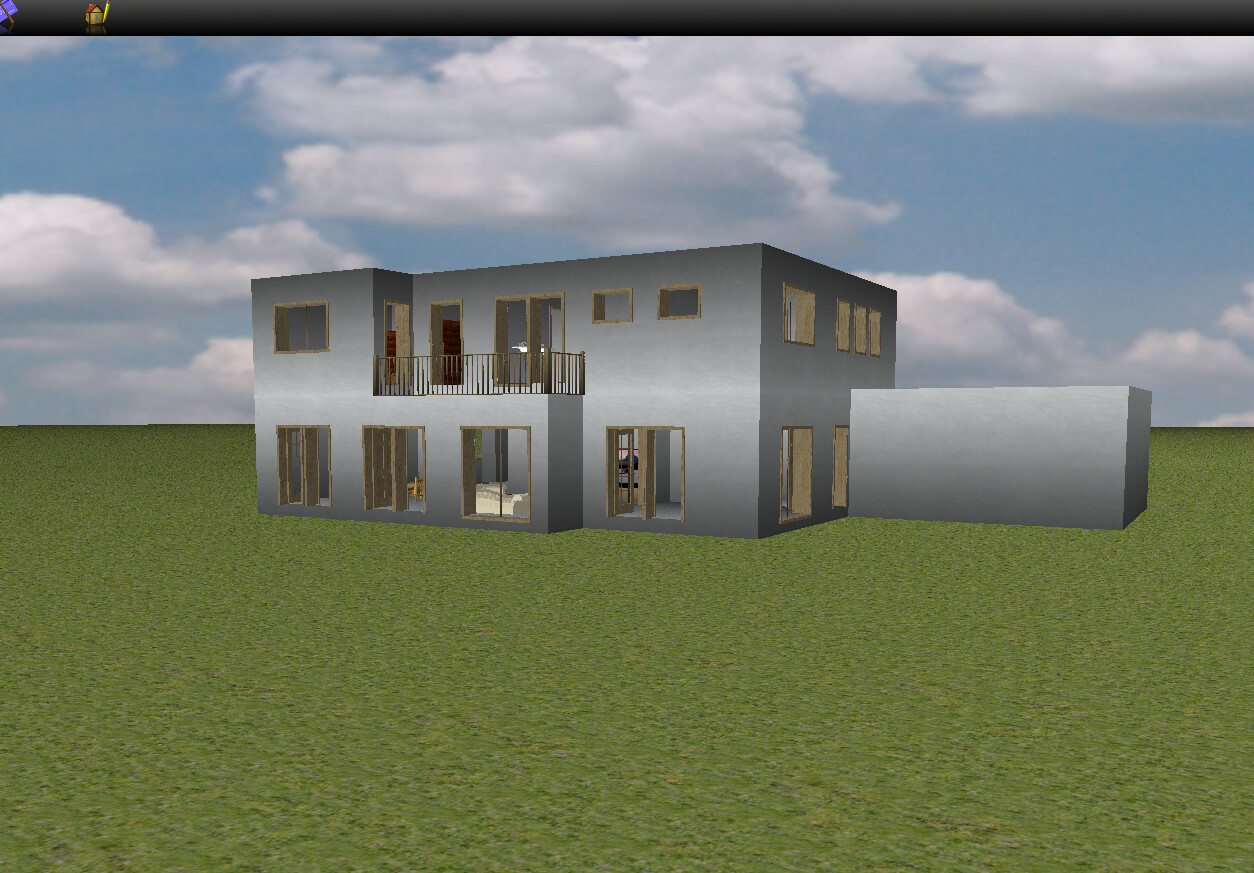
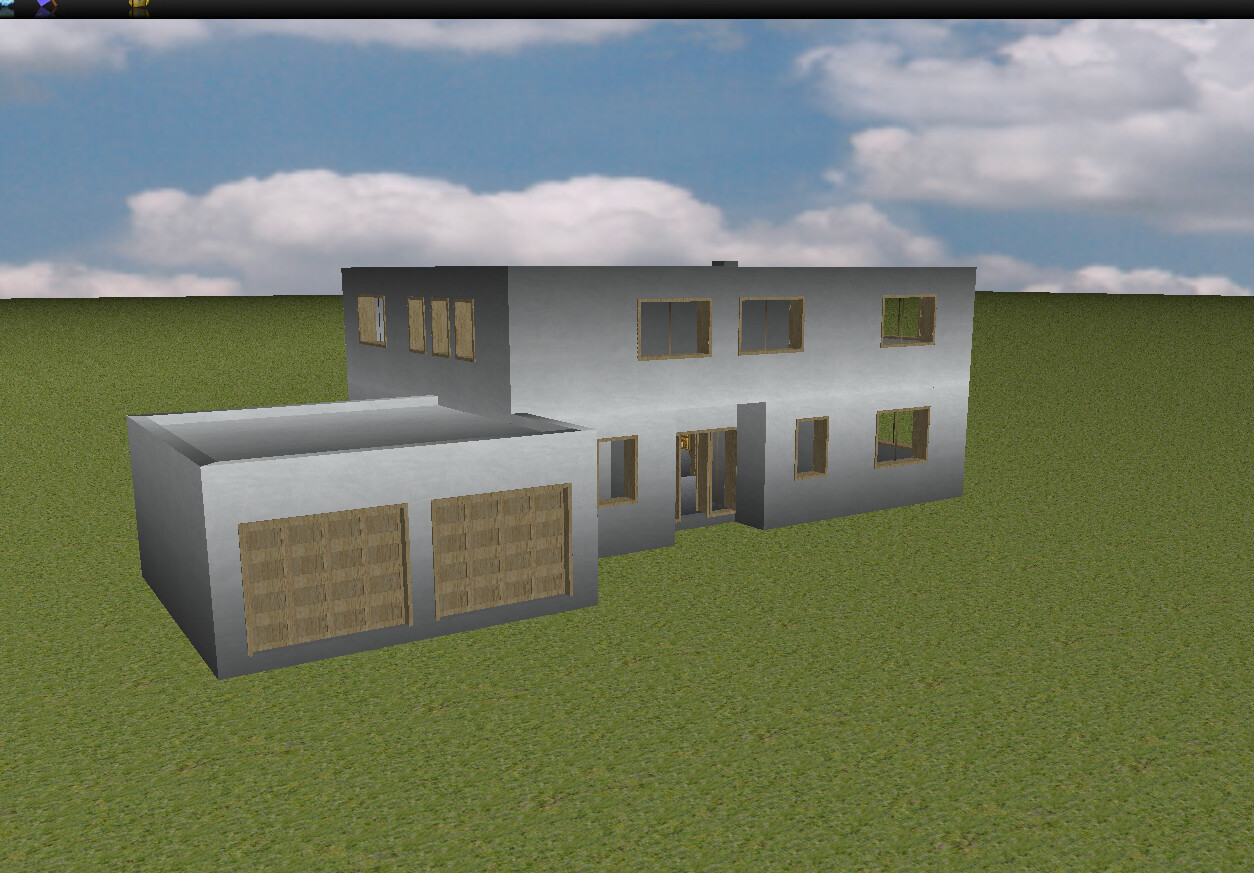
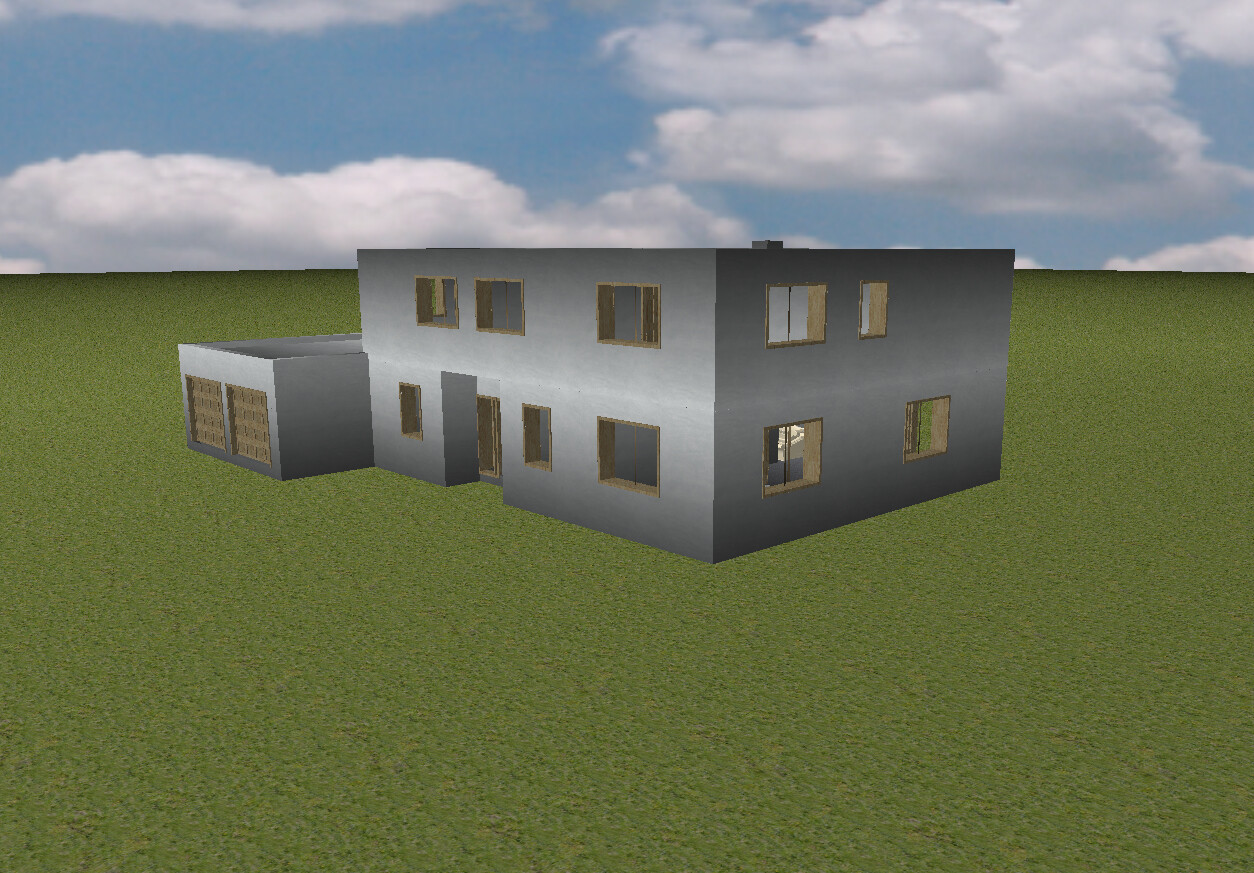
Is the general consensus here that a hip roof doesn’t work? Because the house looks too much like Bauhaus style without the hip roof? I’ve received many strong warnings about flat roofs. People say you shouldn’t rely on claims that flat roofs no longer have waterproofing problems after a few years. It’s definitely the more expensive option long-term. I wouldn’t oppose a flat roof (though it costs €6,000 more than the hip roof…), but the preference for the flat roof has seriously declined since, after the structural revision, the roof overhang above the children’s room centered over the front door was removed. The exterior wall of the children's room being flush with the “roof overhang” just doesn’t look right to us. It simply looks like a block!
I have attached a comparison of both looks again. The first look is perfect; the second is really unacceptable. This detail is an absolute dealbreaker for us! The builder says the old design is not structurally feasible.

Yes, the orientation of the living room towards the sun is not important to him at all. Since this has now been emphasized several times, I think we just have to accept it.
If you think about it, the architect has already implemented many of your wishes. I don’t believe that another architect would deliver a drastically different result given the many specifications that are basically already fixed. In that respect, I wouldn’t write off the current one or expect miracles from a new one. But of course, I could be wrong. Sometimes a completely new concept leads to dropping some of the existing requirements, who knows.
Where I still see potential is if you remain open to all types of stairs. The straight staircase is quite limiting. Spiral or curved ones, in my opinion, are much nicer and more flexible. I hope you’ll show us what the brainstorming comes up with. We’re definitely curious.
Attached are the rooms swapped on the upper floor.
If you think about it, the architect has already implemented many of your wishes. I don’t believe that another architect would deliver a drastically different result given the many specifications that are basically already fixed. In that respect, I wouldn’t write off the current one or expect miracles from a new one. But of course, I could be wrong. Sometimes a completely new concept leads to dropping some of the existing requirements, who knows.
Where I still see potential is if you remain open to all types of stairs. The straight staircase is quite limiting. Spiral or curved ones, in my opinion, are much nicer and more flexible. I hope you’ll show us what the brainstorming comes up with. We’re definitely curious.
Attached are the rooms swapped on the upper floor.
R.Hotzenplotz schrieb:
...The contractor says the old design is structurally not feasible.Really? The structure will collapse just because of a 20cm (8 inch) larger roof overhang? I have no background in structural engineering, but that doesn’t make any sense, does it? Put a lid on a box. Whether the lid extends 5 or 10 cm (2 or 4 inches) beyond the edges, it doesn’t just fall off. But I guess it must be true if he says so.R
R.Hotzenplotz23 Jul 2017 14:01kaho674 schrieb:
If you think about it, the architect has already incorporated many of your wishes. I don’t believe any other architect would produce a drastically different result given all the requirements that are basically already fixed. So I wouldn’t demonize the current one or expect miracles from a new one. But of course, I could be wrong. Sometimes a completely new concept can even lead to discarding some requirements — who knows.I see it the same way. I have held back my perhaps partially justified criticism here and have also made clear that we already have a number of requirements. I am aware that an architect can only design what is developed together with the client. So I have no criticism regarding the spatial program or similar aspects, perhaps just some refinement. Until midweek, I always felt very well supported. No follow-up work or changes seemed too much trouble or caused any raised eyebrows. We worked through things together patiently and attentively.
Well, now there’s the setback that clarifying structural aspects between the independent architect working for the company and the general contractor (GC) should perhaps have happened more regularly... frustrating... but certainly no reason to throw everything overboard. That’s exactly how I see it. Even though the impression now is that coordination there might generally need improvement. And that I now have to go over the pending, not just minor, details with a completely different architect instead of the one we originally chose — that will take some getting used to. Well, he is employed by the GC and will probably now have to figure out how to incorporate everything into the GC’s program so that it becomes feasible...
It’s also not like we only spoke with two architects or GCs beforehand. We spoke with three independent architects and three GCs and then deliberately chose this provider. I don’t believe that working with someone else would produce a better plan. Everywhere the budget combined with our wishes was at least viewed as borderline, and other providers proposed two to three draft designs that, despite several discussions, were always far from what we wanted (sender and receiver problem). Even with independent architects working with individual trades, we never had the confidence to pursue that route, nor did anyone signal that they were the right person for us. One even openly advised me that given the local market situation and the shortage of skilled workers, he would recommend that I build a single-family home with a GC, even if he wouldn’t get the contract...
It will work out. Yes, we have many requirements, but we are also willing to compromise where others are not. Overall, this will definitely lead to a result. You just must not lose your cool and have to remain persistent. If things like the changed setback versus no setback at the front become bothersome, I have to make that clear and demand a different solution. To be honest: this detail alone is more important to us than whether it’s possible to iron clothes in the utility room or in another room upstairs. We would not want such a bulky structure on the front of the house for that reason. The hip roof solution would allow it, but if it becomes a flat roof, that would definitely not be possible. The hip roof option wasn’t well received here in the end. Visually, I would prefer the flat roof, but durability is also a factor. And that’s the key — to distinguish where you are willing to compromise and where not.
kaho674 schrieb:
Where I still see potential is if you remain open to all staircase types. A straight staircase is quite limiting. Spiral or curved ones are, in my opinion, much nicer and more flexible. I hope you will show us what your brainstorming yields. We are naturally curious.I have now printed all your drafts and am reviewing them calmly. The little one is asleep, and I have time. Out of respect, I will, of course, update you on the result. Naturally, I will post here later what is finally realized. I am extremely grateful for the numerous suggestions. Regarding stair types, there is openness.
Speaking of stairs, the GC simply reduced the carefully planned stair width from 1.10m (3 ft 7 in) back to the standard 1m (3 ft 3 in) from the architect’s plan. He said that will be more than enough! The same with the 1m (3 ft 3 in) corridor that was actually planned at 1.40m (4 ft 7 in). I can almost accept the corridor because upstairs there is only the railing on one side, so it feels fairly open. But is a staircase only 1m (3 ft 3 in) wide really sufficient? I know it has been stated here that it’s enough, but I have serious reservations. We have 1.10m (3 ft 7 in) here, and even then, several bulky items have already hit the wall.
kaho674 schrieb:
Really? The whole thing collapses structurally because of 20cm (8 inches) more roof overhang? I have no idea about structural engineering, but that doesn’t seem plausible, does it? Put a lid on a box. Whether the lid extends 5 or 10 cm (2 or 4 inches), it doesn’t fall off because of that. But I guess it must be so if he says it is.I don’t quite believe that either. The problem is, you can’t reduce the kids’ room at the back to regain the overhang that way. Then the room would become a real corridor. That is no option.
Without having read the last two pages or looked back at the floor plans, I’ll just mention that yesterday I thought you could easily reduce the width of the house by about one meter (3 feet) on both sides without any loss. In the upper floor, instead of placing the rooms side to side, they could be arranged deeper, which would eliminate the full-width balcony projection.
Then you end up with huge protrusions in the masonry, even though you are already using a different facade design for variation. It feels like overdoing it.
Personally, I would have also incorporated the existing building into the project.
Regarding the living room – some people like sunlight, others need it less. That’s the common thinking since the sun influences many things in the body, including mood. To understand this, one probably has to be a bit older and have experienced "mood swings." So, everyone has to find out for themselves. Good advice is often not well received.
Still, I would say the living room takes on a different role once children are in the picture. The projector will eventually become too complicated, or the sofa will turn into a lounging spot with chocolate crumbs... But leather can be wiped clean!
Then you end up with huge protrusions in the masonry, even though you are already using a different facade design for variation. It feels like overdoing it.
Personally, I would have also incorporated the existing building into the project.
Regarding the living room – some people like sunlight, others need it less. That’s the common thinking since the sun influences many things in the body, including mood. To understand this, one probably has to be a bit older and have experienced "mood swings." So, everyone has to find out for themselves. Good advice is often not well received.
Still, I would say the living room takes on a different role once children are in the picture. The projector will eventually become too complicated, or the sofa will turn into a lounging spot with chocolate crumbs... But leather can be wiped clean!
Similar topics