
ᐅ Floor Plan Discussion: Single-Family Home with Separate Apartment as a Multi-Generational House on a North-Facing Slope
Created on: 23 Nov 2022 22:06
G
g.gygax
Hello everyone,
I have been a silent reader here for some time. Now that we have finally secured a plot in our preferred location, we have started planning our multigenerational house (single-family home plus a 3-room secondary apartment). Unfortunately, the very small building envelope makes the planning difficult from our perspective, so I would like to present the current design here for discussion to get suggestions and tips.
Here is the list of questions:
Development Plan / Restrictions
Plot size: approx. 575sqm (approx. 23x25m (75x82ft)), access road on the north side, sidewalk and, at some distance, a street on the east side, neighboring buildings to the south and west sides
Slope: slight northeast slope, the terrain rises from the northeast corner of the plot to the southwest corner (approx. 34m (112ft)) by around 2.2m (7ft)
Site coverage ratio: not explicitly stated in the development plan
Floor area ratio: not explicitly stated in the development plan
Building envelope, building line, and boundary: building line on the north side with a 5m (16ft) setback from the road; building line for the garage on the east side right at the plot boundary; building envelope for the house is 9x12m (29x39ft), for the garage the building envelope on the east side is directly extended 3-3.6m (10-12ft) (slightly angled) to the boundary.
Edge development
Number of parking spaces: according to parking regulations, we need 4 (including space in front of the garage), but we could manage with 2-3
Number of floors: basement level plus 2 full floors
Roof type: gable roof with 15-20° pitch
Architectural style: so far, we have liked the country house style best, but we are flexible
Orientation: ridge line running east-west, rotated about 20° (clockwise) toward the west
Maximum height/limits: wall height from basement floor to roof surface 9.20m (30ft)
Other requirements: KfW40+ standard is mandatory, dormers are not permitted
Homeowner Requirements
Style, roof type, building type: see above
Basement, floors: see above
Number of occupants, ages: main house 2 adults + 2 children; secondary apartment 2 adults (should also be rentable, e.g. for 2 adults + 1 child)
Space needs on ground floor (GF) and upper floor (UF):
GF: living/dining/kitchen + guest toilet + pantry/laundry room;
UF: 2 children’s rooms + master bedroom + family bathroom;
GF or UF: office + guest room (preferably 2 separate rooms) + second bathroom (or shower in guest WC);
Basement: living/dining/kitchen + master bedroom + child’s room/office + bathroom + storage room;
Basement or GF: entrance hall for main house (with a "dirt trap")
Office: family use or home office? Home office for 2 people (4-5 days/week + 2-3 days/week)
Overnight guests per year: 2-3 times per year a “long-term guest” staying for several weeks (therefore preferably a separate guest room), plus 4-6 times per year “weekend guests”
Open or closed architecture: basically more open, but with possible retreat areas
Conservative or modern construction: no preference
Open kitchen, kitchen island: kitchen open to dining area, living room acoustically separated or separable, kitchen island optional
Number of dining seats: 8
Fireplace: yes
Music or stereo wall: no, but a bookshelf wall
Balcony, roof terrace: due to terrain, balcony at ground floor level as a substitute for a terrace
Garage, carport: single garage is sufficient
Utility garden, greenhouse: utility garden
Other requests / special features / daily routine, also reasons for or against certain elements:
The secondary apartment should be barrier-free (walker accessibility), larger sliding or double door to the living room: basically, we like an open living/dining/kitchen area, but occasionally it would be good to have some quiet in the living room while someone else is busy in the kitchen. Roof = ceiling on UF (at least for the children’s rooms), ceiling height on GF preferably a bit higher (approx. 2.70m (9ft)). The "dirt trap" in the entrance area, i.e., a hallway separated by a door from the living area, so that one does not have to pass through it again after entering and taking off shoes (e.g., on the way to the UF or to the toilet).
House Design
Who designed it: planner from a builder friend based on our sketches (they will not build the house due to distance)
What do you like most and why? Layout and number of rooms, orientation of rooms (light and street noise), kitchen with terrace access
What do you not like and why? Entrance area and stairs between basement and GF feel too convoluted and cramped, the fireplace I would like near the stairs to UF so the heat can rise + fireplace on the north side of the roof (due to photovoltaics), basement storage room too small
Price estimate according to architect/planner: not yet available
Personal price limit for the house, including equipment: 650,000 € (besides landscaping, except possibly necessary retaining walls, we can initially do without it)
Preferred heating technology: mandatory connection to district heating
If you have to give up, which details or features
- can you do without: separate office and guest room, increased floor height, connecting walkway between terraces on the ground floor
- cannot do without: secondary apartment, barrier-free living
Why is the design the way it is now? For example:
We estimated the minimum sizes for each room and arranged the rooms based on the surroundings (slope, light incidence, view, street noise). These drawings were adopted nearly 1:1 by the planner.
The sticking point from our perspective (and the planner’s too) is the entrance area, the stairs from basement to GF, and the upper hallway; these still don’t quite fit.
What is the most important basic question about the floor plan, summed up in 130 characters?
Do you have suggestions or ideas for the entrance area, the stairs from basement to GF, and the upper hallway so that the rest can stay roughly as is, or should we rethink the entire plan? General feedback on the planning?
Thank you in advance for your feedback! If I forgot any information, please ask.

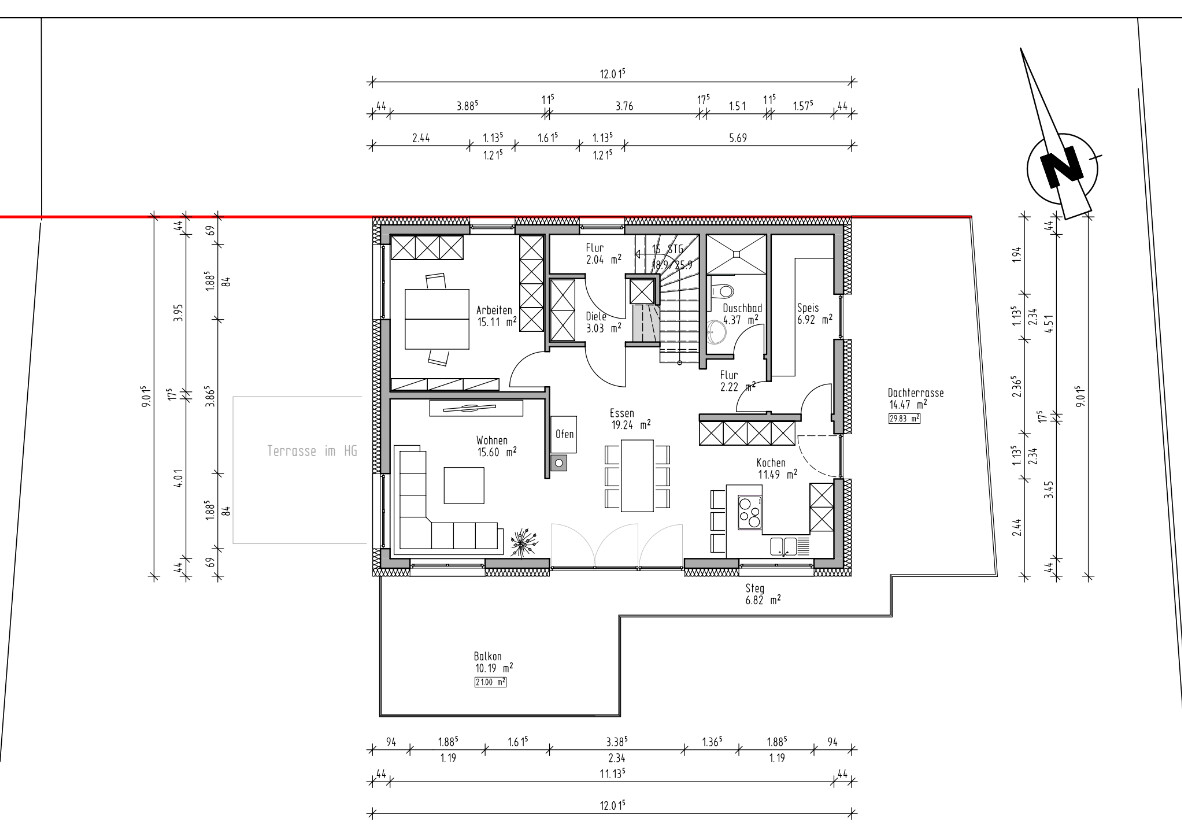
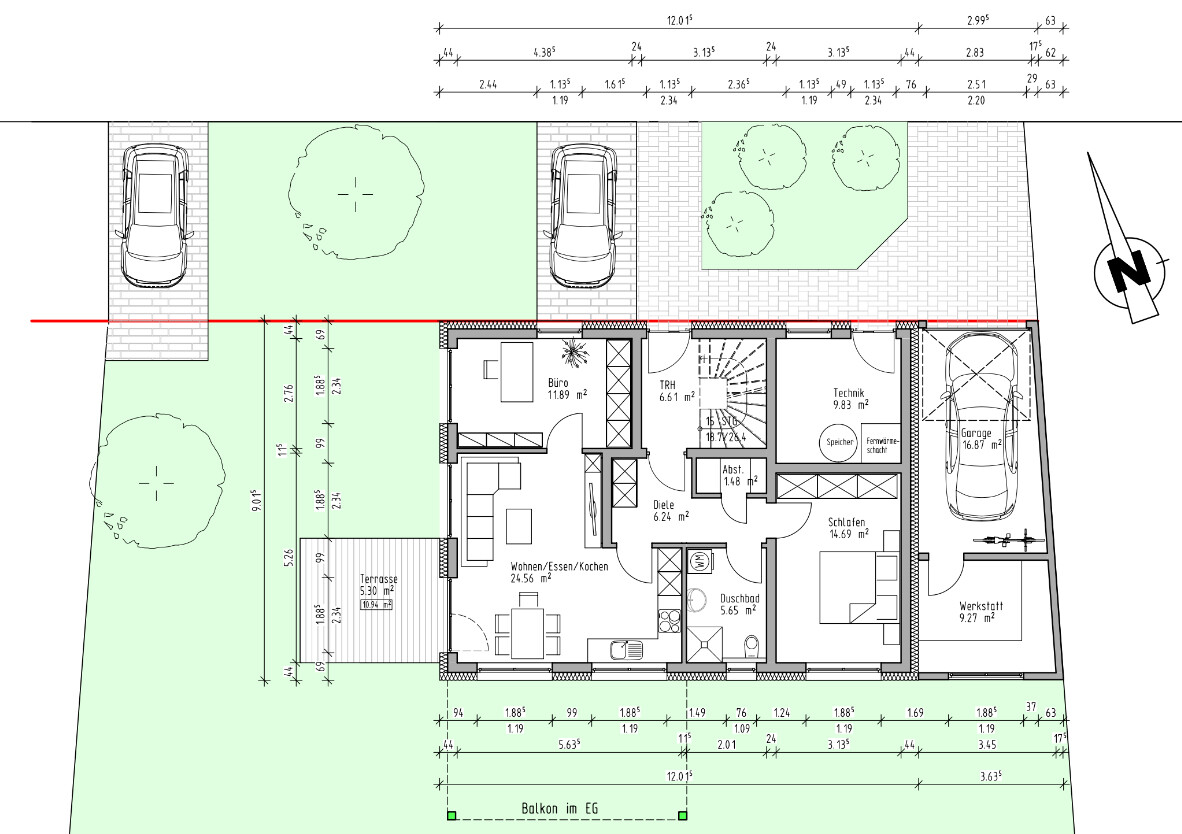
I have been a silent reader here for some time. Now that we have finally secured a plot in our preferred location, we have started planning our multigenerational house (single-family home plus a 3-room secondary apartment). Unfortunately, the very small building envelope makes the planning difficult from our perspective, so I would like to present the current design here for discussion to get suggestions and tips.
Here is the list of questions:
Development Plan / Restrictions
Plot size: approx. 575sqm (approx. 23x25m (75x82ft)), access road on the north side, sidewalk and, at some distance, a street on the east side, neighboring buildings to the south and west sides
Slope: slight northeast slope, the terrain rises from the northeast corner of the plot to the southwest corner (approx. 34m (112ft)) by around 2.2m (7ft)
Site coverage ratio: not explicitly stated in the development plan
Floor area ratio: not explicitly stated in the development plan
Building envelope, building line, and boundary: building line on the north side with a 5m (16ft) setback from the road; building line for the garage on the east side right at the plot boundary; building envelope for the house is 9x12m (29x39ft), for the garage the building envelope on the east side is directly extended 3-3.6m (10-12ft) (slightly angled) to the boundary.
Edge development
Number of parking spaces: according to parking regulations, we need 4 (including space in front of the garage), but we could manage with 2-3
Number of floors: basement level plus 2 full floors
Roof type: gable roof with 15-20° pitch
Architectural style: so far, we have liked the country house style best, but we are flexible
Orientation: ridge line running east-west, rotated about 20° (clockwise) toward the west
Maximum height/limits: wall height from basement floor to roof surface 9.20m (30ft)
Other requirements: KfW40+ standard is mandatory, dormers are not permitted
Homeowner Requirements
Style, roof type, building type: see above
Basement, floors: see above
Number of occupants, ages: main house 2 adults + 2 children; secondary apartment 2 adults (should also be rentable, e.g. for 2 adults + 1 child)
Space needs on ground floor (GF) and upper floor (UF):
GF: living/dining/kitchen + guest toilet + pantry/laundry room;
UF: 2 children’s rooms + master bedroom + family bathroom;
GF or UF: office + guest room (preferably 2 separate rooms) + second bathroom (or shower in guest WC);
Basement: living/dining/kitchen + master bedroom + child’s room/office + bathroom + storage room;
Basement or GF: entrance hall for main house (with a "dirt trap")
Office: family use or home office? Home office for 2 people (4-5 days/week + 2-3 days/week)
Overnight guests per year: 2-3 times per year a “long-term guest” staying for several weeks (therefore preferably a separate guest room), plus 4-6 times per year “weekend guests”
Open or closed architecture: basically more open, but with possible retreat areas
Conservative or modern construction: no preference
Open kitchen, kitchen island: kitchen open to dining area, living room acoustically separated or separable, kitchen island optional
Number of dining seats: 8
Fireplace: yes
Music or stereo wall: no, but a bookshelf wall
Balcony, roof terrace: due to terrain, balcony at ground floor level as a substitute for a terrace
Garage, carport: single garage is sufficient
Utility garden, greenhouse: utility garden
Other requests / special features / daily routine, also reasons for or against certain elements:
The secondary apartment should be barrier-free (walker accessibility), larger sliding or double door to the living room: basically, we like an open living/dining/kitchen area, but occasionally it would be good to have some quiet in the living room while someone else is busy in the kitchen. Roof = ceiling on UF (at least for the children’s rooms), ceiling height on GF preferably a bit higher (approx. 2.70m (9ft)). The "dirt trap" in the entrance area, i.e., a hallway separated by a door from the living area, so that one does not have to pass through it again after entering and taking off shoes (e.g., on the way to the UF or to the toilet).
House Design
Who designed it: planner from a builder friend based on our sketches (they will not build the house due to distance)
What do you like most and why? Layout and number of rooms, orientation of rooms (light and street noise), kitchen with terrace access
What do you not like and why? Entrance area and stairs between basement and GF feel too convoluted and cramped, the fireplace I would like near the stairs to UF so the heat can rise + fireplace on the north side of the roof (due to photovoltaics), basement storage room too small
Price estimate according to architect/planner: not yet available
Personal price limit for the house, including equipment: 650,000 € (besides landscaping, except possibly necessary retaining walls, we can initially do without it)
Preferred heating technology: mandatory connection to district heating
If you have to give up, which details or features
- can you do without: separate office and guest room, increased floor height, connecting walkway between terraces on the ground floor
- cannot do without: secondary apartment, barrier-free living
Why is the design the way it is now? For example:
We estimated the minimum sizes for each room and arranged the rooms based on the surroundings (slope, light incidence, view, street noise). These drawings were adopted nearly 1:1 by the planner.
The sticking point from our perspective (and the planner’s too) is the entrance area, the stairs from basement to GF, and the upper hallway; these still don’t quite fit.
What is the most important basic question about the floor plan, summed up in 130 characters?
Do you have suggestions or ideas for the entrance area, the stairs from basement to GF, and the upper hallway so that the rest can stay roughly as is, or should we rethink the entire plan? General feedback on the planning?
Thank you in advance for your feedback! If I forgot any information, please ask.
As soon as a much-discussed development plan is mentioned here, the original poster benches themselves and quietly exits their own thread. Looks like I really hit the mark there.
It’s a shame for @g.gygax, of course, that they won’t be able to get any advice on designs this way.
It’s a shame for @g.gygax, of course, that they won’t be able to get any advice on designs this way.
ypg schrieb:
Actually, that is how it works when two sections are fully underground and two sections are entirely above ground level with a standard story height. Of course, it also depends on the federal state, the reference point for measurements, and how tall the walk-out basement really is. But generally speaking, your neighbors have the typical basement with an average of 140cm (55 inches) exposed, which, with your described data and general assumptions, is not considered a full story. That’s different from your case, where more than two-thirds or three-quarters are visible. This kind of calculation is possible and obviously cannot be determined by just looking.
Now, when quoting you, you cut off the second part about the east and west sides: only one side is entirely underground. Two are completely above ground, and one is half above and half below ground. With a normal story height, that does not average out to 140cm (55 inches).
ypg schrieb:
No. Otherwise, they would allow a three-story building. A walk-out basement will most likely be the one allowed to have about 140cm (55 inches) showing on average. Personally, I even doubt that living areas are permitted in the walk-out basement! But let’s not assume the worst now.The neighbors definitely have living spaces (and in some cases even a granny flat) in the walk-out basement. I would be surprised if they are all doing it illegally.
ypg schrieb:
No, this is calculated. It’s not sometimes one way or the other. A full story is defined by law (depending on the state building code). Attic stories are not mentioned because only full stories are regulated. Accordingly, the roof must be constructed so that it is not considered a full story. Alternatively, the development plan might specify, for example, two stories plus an attic. Even then, the attic must not count as a full story by calculation.
And likely, the same applies to a walk-out basement: a two-story building plus a walk-out basement that cannot be a full story.
What I wanted to say is that in many of the development plans I have reviewed during the last months and years while looking for land, it was often the case that the attic could legally be built so it counts as a full story. Yet, the development plans almost always stated II + attic or I + attic. Sometimes it was separately noted that attics may count as full stories, but not always.
Therefore, not every level counted as a full story legally is also included as such in the number of full stories stated in the development plan.
ypg schrieb:
A basement can legally count as a full story. That is correct. But legally, there is no definition for a walk-out basement.Exactly, and that’s why a walk-out basement cannot be considered a full story?
ypg schrieb:
A given wall height of, for example, 9.30 meters (30 feet 6 inches) does not mean that three stories are allowed or that 9.30 meters (30 feet 6 inches) of wall must be visible. You are allowed to build into the slope. You are also allowed to build a walk-out basement. But, in all likelihood, it will not be allowed to count as a full story.
You interpret things the way you want them.
Just share the development plan here.
Then look here: https://www.hausbau-forum.de/threads/bebauungsplan-vom-architekt-nicht-eingehalten-konsequenz.33978/
And here, for example, with Pfaffenhofen, what they mean by specifying “two stories plus walk-out basement” is very clear. It shows that for a sloped plot, the basement may only partially (half or 140cm (55 inches) on average) be visible.
[ATTACH alt="337DF587-2344-4D50-8F78-B8CD77E64666.jpeg"]76576[/ATTACH]Then I’ll ask boldly the opposite question: Is it possible to build the walk-out basement so it’s not considered a full story?
The floor-to-ceiling height is specified in the development plan. So, I cannot dig the walk-out basement deeper into the ground. The development plan does not require raising the terrain, but it shows the natural terrain. However, raising the terrain up to a maximum of 2 meters (6 feet 6 inches) is allowed.
The full story definition here in Bavaria is: Basement levels count as full stories if the underside of the ceiling averages at least 1.20 meters (47 inches) above the natural or defined ground surface.
That means, to ensure the walk-out basement is not a full story based on natural terrain, I would have to build a crawl space with a maximum clear height of about 1.6m to 1.7m (63 to 67 inches).
If the walk-out basement is built with standing height, the only way to avoid it being classified as a full story would be to raise the ground level. But does that count as “defined ground surface”?
And even the maximum permitted fill is limited by the development plan. With the allowed 2 meters (6 feet 6 inches) fill, most of the south side would be underground. Still, due to setback and slope angle requirements, the first 4-5 meters (13 to 16 feet) on the boundary cannot be filled.
I cannot raise ground on the north side, or I lose access to my garage and entrance. Also, due to garage, entrance, driveway, and again setback and slope angle requirements, only very limited raising might be possible. On the east, I cannot raise ground because of mandatory boundary building regulations; the terrain height there is dictated by the neighboring property. On the west, I need a slope from the height on the south side down to the north side. Roughly estimating, the clear room height in the walk-out basement cannot exceed about 2.1m to 2.2m (83 to 87 inches), or else the basement would again be considered a full story. Plus, the fills would be higher than the boundary ground level, creating an earth mound on the property in which the basement sits.
For already developed properties, it’s not different, but none of those have obviously lower ceiling heights in the walk-out basement. Do you think they are all violating the development plan?
Regarding the example plan: yes, with a maximum story height of 2.8m (9 feet 2 inches), the walk-out basements with your 1.4m (55 inches) rule would not be full stories. Do the 1.4m (55 inches) regulations apply in Baden-Württemberg? Or North Rhine-Westphalia?
In Bavaria, the 1.2m (47 inches) rule applies. That would mean the walk-out basements in the illustration, if built with normal clear ceiling heights (from 2.4m (7 feet 10 inches) upwards), would be full stories. But looking at the height data, the story height depicted is actually 3m (9 feet 10 inches), right?
ypg schrieb:
And very importantly: I would definitely advise you to call your local authority and ask what exactly they consider a walk-out basement, or how they interpret what you are allowed to build.
Just a reminder: I don’t care personally and have no disadvantage whether or not you build. But if I were you, I would be too cautious to plan based on my uncertain understanding. Everything indicates you are assuming incorrect facts here, even though you are very guarded with information in this thread.Don’t worry, I will do that. But I can hardly imagine they would say I can only build a crawl space as a walk-out basement or that I have to create an earth mound on the property to hide the basement.
g.gygax schrieb:
Then I'll boldly ask a counter-question:g.gygax schrieb:
Don’t worry, I won’t do that.You are confusing a forum with an all-knowing dictionary and crystal ball! If you respond with sarcastic remarks instead of informative answers, you won’t achieve anything.Similar topics