
ᐅ Floor Plan Discussion: Single-Family Home with Separate Apartment as a Multi-Generational House on a North-Facing Slope
Created on: 23 Nov 2022 22:06
G
g.gygax
Hello everyone,
I have been a silent reader here for some time. Now that we have finally secured a plot in our preferred location, we have started planning our multigenerational house (single-family home plus a 3-room secondary apartment). Unfortunately, the very small building envelope makes the planning difficult from our perspective, so I would like to present the current design here for discussion to get suggestions and tips.
Here is the list of questions:
Development Plan / Restrictions
Plot size: approx. 575sqm (approx. 23x25m (75x82ft)), access road on the north side, sidewalk and, at some distance, a street on the east side, neighboring buildings to the south and west sides
Slope: slight northeast slope, the terrain rises from the northeast corner of the plot to the southwest corner (approx. 34m (112ft)) by around 2.2m (7ft)
Site coverage ratio: not explicitly stated in the development plan
Floor area ratio: not explicitly stated in the development plan
Building envelope, building line, and boundary: building line on the north side with a 5m (16ft) setback from the road; building line for the garage on the east side right at the plot boundary; building envelope for the house is 9x12m (29x39ft), for the garage the building envelope on the east side is directly extended 3-3.6m (10-12ft) (slightly angled) to the boundary.
Edge development
Number of parking spaces: according to parking regulations, we need 4 (including space in front of the garage), but we could manage with 2-3
Number of floors: basement level plus 2 full floors
Roof type: gable roof with 15-20° pitch
Architectural style: so far, we have liked the country house style best, but we are flexible
Orientation: ridge line running east-west, rotated about 20° (clockwise) toward the west
Maximum height/limits: wall height from basement floor to roof surface 9.20m (30ft)
Other requirements: KfW40+ standard is mandatory, dormers are not permitted
Homeowner Requirements
Style, roof type, building type: see above
Basement, floors: see above
Number of occupants, ages: main house 2 adults + 2 children; secondary apartment 2 adults (should also be rentable, e.g. for 2 adults + 1 child)
Space needs on ground floor (GF) and upper floor (UF):
GF: living/dining/kitchen + guest toilet + pantry/laundry room;
UF: 2 children’s rooms + master bedroom + family bathroom;
GF or UF: office + guest room (preferably 2 separate rooms) + second bathroom (or shower in guest WC);
Basement: living/dining/kitchen + master bedroom + child’s room/office + bathroom + storage room;
Basement or GF: entrance hall for main house (with a "dirt trap")
Office: family use or home office? Home office for 2 people (4-5 days/week + 2-3 days/week)
Overnight guests per year: 2-3 times per year a “long-term guest” staying for several weeks (therefore preferably a separate guest room), plus 4-6 times per year “weekend guests”
Open or closed architecture: basically more open, but with possible retreat areas
Conservative or modern construction: no preference
Open kitchen, kitchen island: kitchen open to dining area, living room acoustically separated or separable, kitchen island optional
Number of dining seats: 8
Fireplace: yes
Music or stereo wall: no, but a bookshelf wall
Balcony, roof terrace: due to terrain, balcony at ground floor level as a substitute for a terrace
Garage, carport: single garage is sufficient
Utility garden, greenhouse: utility garden
Other requests / special features / daily routine, also reasons for or against certain elements:
The secondary apartment should be barrier-free (walker accessibility), larger sliding or double door to the living room: basically, we like an open living/dining/kitchen area, but occasionally it would be good to have some quiet in the living room while someone else is busy in the kitchen. Roof = ceiling on UF (at least for the children’s rooms), ceiling height on GF preferably a bit higher (approx. 2.70m (9ft)). The "dirt trap" in the entrance area, i.e., a hallway separated by a door from the living area, so that one does not have to pass through it again after entering and taking off shoes (e.g., on the way to the UF or to the toilet).
House Design
Who designed it: planner from a builder friend based on our sketches (they will not build the house due to distance)
What do you like most and why? Layout and number of rooms, orientation of rooms (light and street noise), kitchen with terrace access
What do you not like and why? Entrance area and stairs between basement and GF feel too convoluted and cramped, the fireplace I would like near the stairs to UF so the heat can rise + fireplace on the north side of the roof (due to photovoltaics), basement storage room too small
Price estimate according to architect/planner: not yet available
Personal price limit for the house, including equipment: 650,000 € (besides landscaping, except possibly necessary retaining walls, we can initially do without it)
Preferred heating technology: mandatory connection to district heating
If you have to give up, which details or features
- can you do without: separate office and guest room, increased floor height, connecting walkway between terraces on the ground floor
- cannot do without: secondary apartment, barrier-free living
Why is the design the way it is now? For example:
We estimated the minimum sizes for each room and arranged the rooms based on the surroundings (slope, light incidence, view, street noise). These drawings were adopted nearly 1:1 by the planner.
The sticking point from our perspective (and the planner’s too) is the entrance area, the stairs from basement to GF, and the upper hallway; these still don’t quite fit.
What is the most important basic question about the floor plan, summed up in 130 characters?
Do you have suggestions or ideas for the entrance area, the stairs from basement to GF, and the upper hallway so that the rest can stay roughly as is, or should we rethink the entire plan? General feedback on the planning?
Thank you in advance for your feedback! If I forgot any information, please ask.

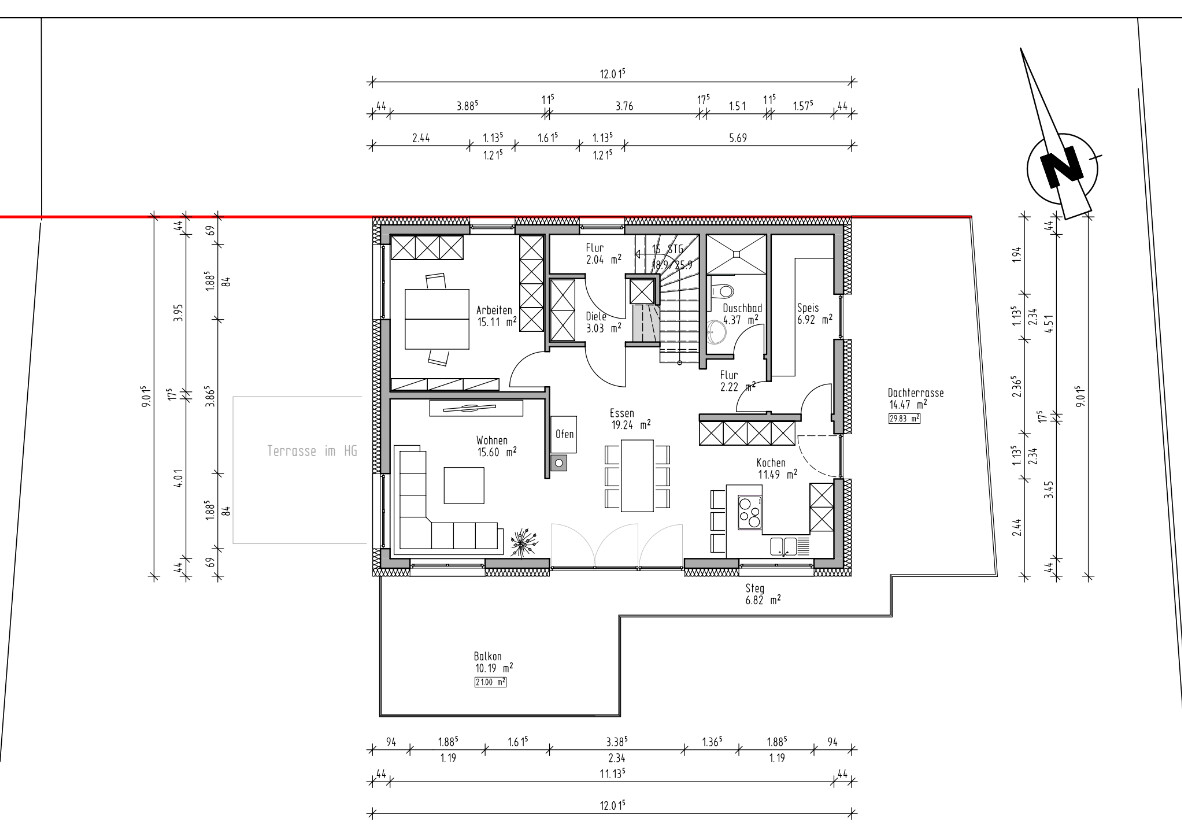
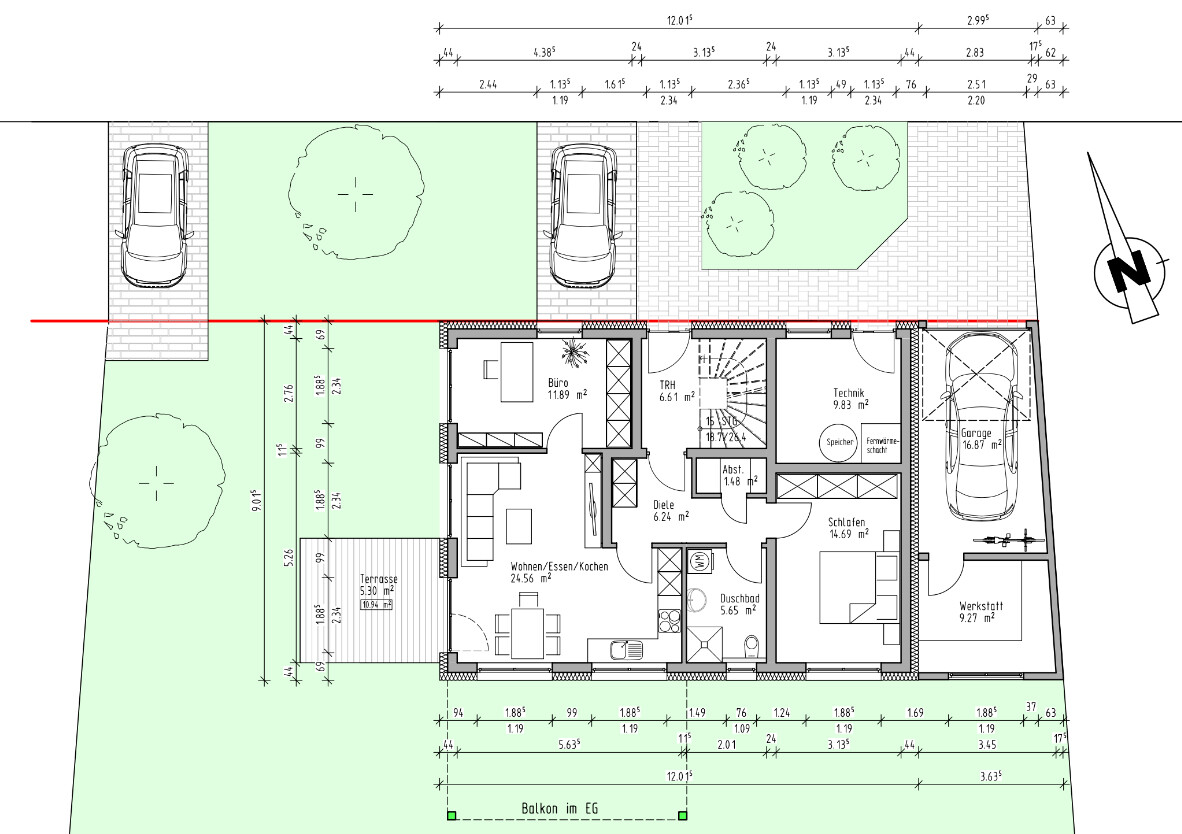
I have been a silent reader here for some time. Now that we have finally secured a plot in our preferred location, we have started planning our multigenerational house (single-family home plus a 3-room secondary apartment). Unfortunately, the very small building envelope makes the planning difficult from our perspective, so I would like to present the current design here for discussion to get suggestions and tips.
Here is the list of questions:
Development Plan / Restrictions
Plot size: approx. 575sqm (approx. 23x25m (75x82ft)), access road on the north side, sidewalk and, at some distance, a street on the east side, neighboring buildings to the south and west sides
Slope: slight northeast slope, the terrain rises from the northeast corner of the plot to the southwest corner (approx. 34m (112ft)) by around 2.2m (7ft)
Site coverage ratio: not explicitly stated in the development plan
Floor area ratio: not explicitly stated in the development plan
Building envelope, building line, and boundary: building line on the north side with a 5m (16ft) setback from the road; building line for the garage on the east side right at the plot boundary; building envelope for the house is 9x12m (29x39ft), for the garage the building envelope on the east side is directly extended 3-3.6m (10-12ft) (slightly angled) to the boundary.
Edge development
Number of parking spaces: according to parking regulations, we need 4 (including space in front of the garage), but we could manage with 2-3
Number of floors: basement level plus 2 full floors
Roof type: gable roof with 15-20° pitch
Architectural style: so far, we have liked the country house style best, but we are flexible
Orientation: ridge line running east-west, rotated about 20° (clockwise) toward the west
Maximum height/limits: wall height from basement floor to roof surface 9.20m (30ft)
Other requirements: KfW40+ standard is mandatory, dormers are not permitted
Homeowner Requirements
Style, roof type, building type: see above
Basement, floors: see above
Number of occupants, ages: main house 2 adults + 2 children; secondary apartment 2 adults (should also be rentable, e.g. for 2 adults + 1 child)
Space needs on ground floor (GF) and upper floor (UF):
GF: living/dining/kitchen + guest toilet + pantry/laundry room;
UF: 2 children’s rooms + master bedroom + family bathroom;
GF or UF: office + guest room (preferably 2 separate rooms) + second bathroom (or shower in guest WC);
Basement: living/dining/kitchen + master bedroom + child’s room/office + bathroom + storage room;
Basement or GF: entrance hall for main house (with a "dirt trap")
Office: family use or home office? Home office for 2 people (4-5 days/week + 2-3 days/week)
Overnight guests per year: 2-3 times per year a “long-term guest” staying for several weeks (therefore preferably a separate guest room), plus 4-6 times per year “weekend guests”
Open or closed architecture: basically more open, but with possible retreat areas
Conservative or modern construction: no preference
Open kitchen, kitchen island: kitchen open to dining area, living room acoustically separated or separable, kitchen island optional
Number of dining seats: 8
Fireplace: yes
Music or stereo wall: no, but a bookshelf wall
Balcony, roof terrace: due to terrain, balcony at ground floor level as a substitute for a terrace
Garage, carport: single garage is sufficient
Utility garden, greenhouse: utility garden
Other requests / special features / daily routine, also reasons for or against certain elements:
The secondary apartment should be barrier-free (walker accessibility), larger sliding or double door to the living room: basically, we like an open living/dining/kitchen area, but occasionally it would be good to have some quiet in the living room while someone else is busy in the kitchen. Roof = ceiling on UF (at least for the children’s rooms), ceiling height on GF preferably a bit higher (approx. 2.70m (9ft)). The "dirt trap" in the entrance area, i.e., a hallway separated by a door from the living area, so that one does not have to pass through it again after entering and taking off shoes (e.g., on the way to the UF or to the toilet).
House Design
Who designed it: planner from a builder friend based on our sketches (they will not build the house due to distance)
What do you like most and why? Layout and number of rooms, orientation of rooms (light and street noise), kitchen with terrace access
What do you not like and why? Entrance area and stairs between basement and GF feel too convoluted and cramped, the fireplace I would like near the stairs to UF so the heat can rise + fireplace on the north side of the roof (due to photovoltaics), basement storage room too small
Price estimate according to architect/planner: not yet available
Personal price limit for the house, including equipment: 650,000 € (besides landscaping, except possibly necessary retaining walls, we can initially do without it)
Preferred heating technology: mandatory connection to district heating
If you have to give up, which details or features
- can you do without: separate office and guest room, increased floor height, connecting walkway between terraces on the ground floor
- cannot do without: secondary apartment, barrier-free living
Why is the design the way it is now? For example:
We estimated the minimum sizes for each room and arranged the rooms based on the surroundings (slope, light incidence, view, street noise). These drawings were adopted nearly 1:1 by the planner.
The sticking point from our perspective (and the planner’s too) is the entrance area, the stairs from basement to GF, and the upper hallway; these still don’t quite fit.
What is the most important basic question about the floor plan, summed up in 130 characters?
Do you have suggestions or ideas for the entrance area, the stairs from basement to GF, and the upper hallway so that the rest can stay roughly as is, or should we rethink the entire plan? General feedback on the planning?
Thank you in advance for your feedback! If I forgot any information, please ask.
haydee schrieb:
The standard says 1.2. I have a friend whose walker barely fits.
Also, you’re planning now, but what if that’s not enough and, for example, a wheelchair is needed temporarily until a splint or something is applied.
Future rentals.
Apartments suitable for wheelchair users are rare.
Often, those additional 30 cm just require clever thinking.I agree with you about the living areas. It’s usually just a matter of the right furniture there. But in the bathroom and hallway, those 30 cm take up a significant amount of otherwise unused space.
Sunshine387 schrieb:
To clarify for you: A bungalow is not cheaper or more expensive than a detached house, since you need fewer load-bearing walls, but the structural engineering for three floors is obviously much more demanding. So it balances out. Unfortunately, you’ve picked the absolute worst time to build right now (high interest rates and very high construction costs). I fully agree with the others: 240 m² x 3000€ per m² = 720,000€ + 100,000€ additional construction costs + at least 50,000€ for the slope comes to about 870,000€. And that is actually an optimistic estimate. Even if you don’t want exterior landscaping, what about grass, terrace, driveway, retaining blocks? All that costs a lot. And additional construction costs are often forgotten by home purchase advisors: building permit / planning permission, surveying, soil report (which can bring nasty surprises on a slope), tree removal, setup of construction access road, removal or replacement of soil, foundation slab, utility connection fees (electricity, water, sewage, telephone, etc.), construction water and electricity, insurance. You see, it all adds up and you will likely end up around 900,000€. If it is a few thousand less, consider yourself lucky. But better to budget more than less. We just want to warn you about that. Because if I understand you correctly, the house only works financially if your parents chip in. (Are you tearing down their house?) Then you have a double responsibility not to drive them into financial ruin (to put it bluntly). That is why the financial question is the most important. If it’s not feasible, you should plan a new layout with 180 m². With a clever room arrangement, you should still fit your needs well.We are aware that the timing is unfortunate. We hope the prices will ease somewhat in the future. From what we hear, many construction companies have had good profit margins in recent years, but the order books for next year look thin. So there could be some potential for price reductions. We don’t have to start building immediately.
Could you perhaps break down the 100,000€ additional construction costs more precisely? Until now, I haven’t really estimated that high.
We actually plan to do most of the landscaping ourselves. For the driveway, crushed stone will suffice at first; paving can be done later. After moving in, we’ll likely have more financial flexibility. Retaining blocks are only needed next to the terrace of the accessory apartment, about 3-4 m long and 1 m (3 ft) high, and then another 4-5 m tapering from 1 m. That should be manageable at a reasonable cost.
I haven’t researched the costs for building permit / planning permission, surveying, or soil reports yet. What should we expect to pay for these?
Fortunately, we don’t need tree removal or a construction access road. The excavation material can be reused on-site for backfilling.
We have always included the foundation slab and a full concrete basement with footing in the quotes so far.
Utility connection fees have been included in the land purchase price, so they are accounted for. Thanks to flat-rate fees for certain connection lengths—which our current plan does not exceed—they are fairly predictable.
Construction water, construction electricity, and insurance have not been on my radar so far. What kind of costs come with those?
We are not tearing down the parents’ house. They have sold their house and want to use the proceeds to buy a senior-friendly apartment. So without the accessory apartment, that money will go toward another three-room apartment.
xMisterDx schrieb:
At Town & Country, you can currently get the Flair 152 RE for 300,000 EUR in basic configuration. But that’s not KfW40+ standard, just EnEV2022-compliant. Scaling that up to your 240 m² means about 480,000 EUR for the basic house. But you won’t get it at that price, because you don’t have a standard floor plan that you can just submit to the building authority.
Then you want:
Garage with utility room + 25,000 EUR
Slope foundation, retaining, drainage + 50,000 EUR
KfW40+ instead of EnEV2022 + 50,000 EUR (I’m being conservative)
RC2-class windows planned? + 15,000 EUR
Now you’re well over 600,000 EUR—and you don’t yet have utility connections, construction period interest, a garden (which you will have to fence in soon), or interior finishes.
Just two kitchens will easily cost 25,000 EUR. Painting 20,000, flooring 20,000.
Regarding the accessory apartment:
You said it’s for the grandparents. Do they need a 12 m² office?
Does it have to be a garage? The south-facing roof terrace should be enough; why add another on the east side?
10 m² for the utility room but the washer and dryer are in the main bathroom? The main bathroom is, in my opinion, large but awkwardly shaped.
Large gallery but no place to put a closet.
15 m² office is also generous. If both of you work from home, sharing a room probably won’t work anyway.
7 m² pantry... 21,000 EUR for a storage room even though you have a 10 m² utility room AND a pretty large kitchen...
I would also skip the shower in the guest WC. Guests will use the main bathroom anyway since it’s on the upper floor.
I also think the guest room is unnecessary, but that’s a matter of taste. The 10 m³ room costs 30,000 EUR plus interest, stands empty 90% of the year, and still has to be heated.
180 m² with an accessory apartment is unrealistic if you want a dedicated office for working from home. But you could compress it onto 200 m². It will still be tight since you insist on the accessory apartment.
Without it you’d be down to 150-160 m², which would be realistic.
PS:
I don’t see the slope in your drawings. If the land rises 2 m from northeast to southwest, then the living room of the accessory apartment will be almost completely below ground. How would you build a terrace there? How would you get windows in? Especially since there’s a balcony directly above it on the south side. It would be pitch dark like in a cave.I hadn’t included the kitchen costs in the 650,000€ estimate, since that’s basically furniture and we’ve budgeted separately for that.
The minimum size for the office was 10 m² so it could also be used as a child’s room. The apartment should be rentable to others, and given the location, I see it most likely as suitable for couples with children.
The garage is mainly intended as a cellar substitute, i.e., storage space for bikes, etc., and a small hobby workshop in the rear. If we don’t want a terrace on the garage, we have to green the roof according to the development plan. That probably wouldn’t make much difference in cost.
The utility room in the basement is only accessible from the outside and must also be accessible to tenants if rented out. From my point of view, that’s not a good place for a washer.
The office could be a bit smaller, you’re right. But still large enough for both of us to work in. In fact, we’ve been working like that for years without issues. It works. I also don’t have a private office at work.
The pantry is actually intended as a utility room.
We might manage with just one shower for four people, but since we regularly have two additional guests for weeks at a time, a second shower is basically a necessity. And having the second shower in the guest WC is probably cheaper than a second bathroom on the upper floor.
Yes, the guest room is the easiest to drop; I mentioned that at the start. But on the other floors, it’s not so easy to remove the 10 m² without making the floor plan noticeably smaller, and I haven’t come up with a layout that reduces the size meaningfully without the guest room.
The 2 m terrain increase applies to the entire property. At the southwest corner of the house, the ground level is about 90 m above the finished floor height of the accessory apartment and slopes downward from there along the exterior walls in both directions.
hanghaus2023 schrieb:
I don’t mean to criticize the general contractor or planner here, but the basics are missing, and the planner can’t just make those up. Surveying is the keyword. You won’t get around that. So there’s no survey yet. How can you comment on the design without that?
Your description of the slope is all well and good, but the planner’s language is the plan. So just use the data from the geoportal. That’s accurate enough for an overview.What data do you need?
The specified finished floor height of the basement is 357.1 m
The natural ground is as follows at the house corners (excluding garage):
NE: 356.7 m
NW: 357.2 m
SE: 357.4 m
SW: 358.0 m
Plot:
NE: 356.9 m (road, filled, natural ground: 356.2 m)
NW: 357.5 m (road, filled, natural ground: 357.2 m)
SE: 359.0 m (green strip + sidewalk/road, filled, natural ground: 357.9 m)
SW: 359.1 m (natural ground)
Along the east boundary, due to the fill, there is a small embankment about 1.5–2 m wide. The height difference is about 1 m at the south end and around 0.5 m at the north end (natural ground below road level).
X
xMisterDx27 Nov 2022 21:11And what about the windows facing south in the basement? There’s a balcony above them, so no light ever reaches there.
You are also seriously underestimating the effort required for building on a slope, especially regarding waterproofing and drainage around the house. Just wait for heavy rain, and water will come through the closed windows into your home.
Why does a utility room need to be accessible to the tenant? I cannot access the heating room or my electric meter. They are locked. What business does a tenant have there?
You want to give up at most 10m² (108 square feet).
That won’t work.
PS:
Generally, people build to have peace and quiet. And then you want to bring tenants with a child into the house?
Can they only use the terrace? Or the entire garden?
It all seems poorly thought out.
You are also seriously underestimating the effort required for building on a slope, especially regarding waterproofing and drainage around the house. Just wait for heavy rain, and water will come through the closed windows into your home.
Why does a utility room need to be accessible to the tenant? I cannot access the heating room or my electric meter. They are locked. What business does a tenant have there?
You want to give up at most 10m² (108 square feet).
That won’t work.
PS:
Generally, people build to have peace and quiet. And then you want to bring tenants with a child into the house?
Can they only use the terrace? Or the entire garden?
It all seems poorly thought out.
S
Sunshine38727 Nov 2022 21:18I would also plan a separate utility room. After all, no landlord is likely to be happy with the following situation.
“If the electricity meter assigned to the apartment is located in a locked basement room to which the tenant does not have a key, the landlord must grant the tenant free access once a month for the purpose of meter reading (Regional Court Cologne, case 201 C 464/12).”
“If the electricity meter assigned to the apartment is located in a locked basement room to which the tenant does not have a key, the landlord must grant the tenant free access once a month for the purpose of meter reading (Regional Court Cologne, case 201 C 464/12).”
X
xMisterDx27 Nov 2022 21:21Sunshine387 schrieb:
I would also plan an additional utility room. Because no landlord wants the following situation.
“If the electrical meter belonging to the apartment is located in a locked basement room to which the tenant has no key, the landlord must grant the tenant free access once a month for the purpose of reading the meter (District Court Cologne, case 201 C 464/12).” Yes. I would also spend 30,000 EUR on 10m² (108 sq ft) rather than letting the tenant into my technical room for 5 minutes once a month.
Especially since no tenant will do it—I haven’t read my own electrical meter even once in 2.5 years. Why would I?
X
xMisterDx27 Nov 2022 21:25Oh, one more thing:
Forget about having more financial flexibility once you’ve moved in. In the first few years, you’ll be spending a lot of money on furnishings, decorating, and so on.
Doing the garden yourself is fine, but the materials also cost money. You have to buy them at the hardware store, while a landscaping contractor gets them cheaper from wholesalers. Equipment is expensive too... Compact loaders or mini excavators cost around 200 EUR/day (about 215 USD/day). Vibrating plates cost about 80 EUR/day (about 85 USD/day), and so on.
Forget about having more financial flexibility once you’ve moved in. In the first few years, you’ll be spending a lot of money on furnishings, decorating, and so on.
Doing the garden yourself is fine, but the materials also cost money. You have to buy them at the hardware store, while a landscaping contractor gets them cheaper from wholesalers. Equipment is expensive too... Compact loaders or mini excavators cost around 200 EUR/day (about 215 USD/day). Vibrating plates cost about 80 EUR/day (about 85 USD/day), and so on.
g.gygax schrieb:
Neighboring buildings on the south and west sides
Slope: slight northeast slope, the land rises from the northeast corner of the plot to the southwest corner (approx. 34m (112ft)) by about 2.2m (7ft)
Floor area ratio: not explicitly mentioned in the zoning plan
Plot ratio: not explicitly mentioned in the zoning plan If not explicitly stated, one can probably assume that the building authority will use the surrounding buildings as a reference. I’m not completely sure, but it’s very likely (unless you missed it somewhere 😉)
g.gygax schrieb:
Number of floors: basement level + 2 full stories I also assume that the building authority is aware of the slope there. That’s why, in addition to the 2 full stories, a basement is allowed, which is built into the slope. However, this basement may not count as a full story, otherwise the zoning plan would specify 3 full stories instead of mentioning a basement level.
Your basement level probably protrudes about 140cm (55 inches) above ground level on average, right?
g.gygax schrieb:
As the slope in my view does not pose a problem, … and I completely disagree, because in that case it would be a problem for you to plan with 3 full stories.
g.gygax schrieb:
I did not post our project here to discuss the price yet (which makes little sense anyway as we don’t have concrete offers).
As stated in the original post, I’d first like to discuss the floor plan, especially the entrance, hallway, and staircase areas.
Are there any criticisms or suggestions? Dream houses cannot really be discussed constructively… otherwise you could just be advised to add another 10% for bottlenecks 😉 Seriously though, what’s the point of suggestions or criticism if, due to your budget, you will have to reduce the planned 270 sqm (about 2900 sq ft) by 50 to 80 sqm (about 540 to 860 sq ft) anyway because you’re over budget?!
In principle, I like the floor plans (open and flexible), except for a few things... (aside from the fact that the hallway in the secondary apartment is too narrow for accessible design) and the main apartment has no work surface in the kitchen and no storage space anywhere (unless you want to store your travel bags and garden cushions in the pantry)… but I’m of the opinion that a 3-story building is not allowed anyway.
Similar topics