
Hello,
As a client, I want to participate in designing the floor plan for a passive house myself. Besides being able to illustrate basic furnishings (stairs, kitchen, WC, bed, etc.) in the plan, I especially want to perform at least an approximate cooling load calculation. The motivation is to estimate the effort required for surface cooling (on the ceiling) in selected rooms.
For a start, the software mh-BIM Starter, formerly TGA-Tools, seems to be a good choice. However, in the basic version, I miss both the mentioned interior models and especially the cooling load calculation.
- Can anyone recommend free and well-organized DWG / DXF libraries to add basic interior elements?
- What options are available for cooling load calculations besides the commercial extensions of mh-BIM?
Thank you
Andreas
As a client, I want to participate in designing the floor plan for a passive house myself. Besides being able to illustrate basic furnishings (stairs, kitchen, WC, bed, etc.) in the plan, I especially want to perform at least an approximate cooling load calculation. The motivation is to estimate the effort required for surface cooling (on the ceiling) in selected rooms.
For a start, the software mh-BIM Starter, formerly TGA-Tools, seems to be a good choice. However, in the basic version, I miss both the mentioned interior models and especially the cooling load calculation.
- Can anyone recommend free and well-organized DWG / DXF libraries to add basic interior elements?
- What options are available for cooling load calculations besides the commercial extensions of mh-BIM?
Thank you
Andreas

Frosti42 schrieb:
To put it bluntly, it can make a big difference whether I need to heat at about 10 W/m² (0.9 BTU/h·ft²) in a passive house during the coldest winter, or if in the middle of summer > 100 W/m² (9.3 BTU/h·ft²) of (direct) solar radiation heats the house up. That would definitely not be a passive house in any case.
Frosti42 schrieb:
Regarding the calculation of cooling loads: practically, I am not concerned with how much less I need to heat due to solar gains in winter, but rather how much additional cooling I need in summer to keep the indoor temperature within a certain range throughout the day. Essentially, with a central controlled mechanical ventilation system with heat recovery, you ensure that the temperature can remain stable, even though the sun moves around the house. Thermal mass also has to be involved. Passive houses are a planning field that cannot be fully grasped in a rush. Nevertheless, the calculation is not complicated. One thing is certain: as long as you don’t understand that the methodology for maintaining a constant indoor climate cannot be broken down into separate heating or cooling load calculations, and that the temperature scale is continuous and level throughout, you should limit your involvement in the house design to your design preferences and leave the technical aspects to the professionals. I do that myself—not despite understanding this, but because I do. I am a building consultant with broad basic knowledge, but even an orthopedist leaves surgery to specialized colleagues. Trust in other people’s expertise is a very important building material. As a layperson, you will not be happy holding yourself to the highest universal understanding throughout your building experience.
Frosti42 schrieb:
First of all, thanks for the many replies and comments. Why not thank by sharing some insights about your project and your current level of planning experience?
My profession is, by the way, coaching clients on how to communicate their wishes to the involved specialists—often sketched out even on a scrap of paper. Many of my clients try to approach house planning like gamers, but NONE of them use weakly amateur-level specialist software. And none of them have feelings of inferiority when entering conversations with architects as declared laypersons. At least not anymore after we’ve worked together. I’m sure there are colleagues with a passive house focus among my type as well.
https://www.instagram.com/11antgmxde/
https://www.linkedin.com/company/bauen-jetzt/
Why should a house with a maximum heating load of 10 W/m² not be considered a passive house (see Wikipedia)? On the other hand, with a larger south-facing window area, at least 100 W/m² can easily be reached during summer, even with partial shading.
In general, it is true that the thermal load depends on many factors, some of which have already been mentioned here. But precisely because of this, the temperature trend cannot be simply estimated with pen and paper.
My goal is therefore to have a well-founded, expert discussion with a professional planner about the effort required for wall or ceiling cooling to consistently maintain a temperature of 19°C (66°F) in the bedroom all year round and in the future.
In general, it is true that the thermal load depends on many factors, some of which have already been mentioned here. But precisely because of this, the temperature trend cannot be simply estimated with pen and paper.
My goal is therefore to have a well-founded, expert discussion with a professional planner about the effort required for wall or ceiling cooling to consistently maintain a temperature of 19°C (66°F) in the bedroom all year round and in the future.

Frosti42 schrieb:
to avoid exceeding 19°C (66°F) in the bedroom all year round and in the future.then show your floor plan, if the bedroom is on the upper floor and faces south, this design mistake will cost you a lot in cooling capacity.
Our bedroom in the bungalow faces northeast and achieves any desired temperature with a 2000W split air conditioner cooling capacity.
However, we never lower it to 19°C (66°F) when it’s 28°C (82°F) outside on tropical nights.
The detailed floor plan does not yet exist. According to the passive house concept, the building will predominantly face south, with extensive shading options in that area. Conversely, the bedroom is expected to face east to take advantage of the morning sun. Among other reasons, I would like to avoid using a split air conditioning system, mainly due to noise concerns. Thermally activated gypsum boards, such as those from Uponor, can dissipate a maximum of about 60 W/m² (20 Btu/h/ft²) of heat. This is, of course, much less than a split system. However, this raises the question, especially for longer-term or continuous cooling of such surfaces, of how effective it will be. Naturally, surface cooling also requires careful consideration of humidity levels, which is primarily a matter for the (already installed) ventilation system.
Frosti42 schrieb:
Why should a house with a maximum heating load of 10W / m² not be considered a passive house (see Wikipedia)? With a larger south-facing window area, at least in summer, even with partial shading, 100W / m² can easily be reached.So you are saying that at times you have to expend energy up to ten times the heating demand to prevent unwanted heat gain, and that does not sound like a passive house, but rather like generous moving around of process energy.Frosti42 schrieb:
In general, it is true that the thermal load depends on many factors, some of which have already been mentioned here. But precisely for that reason, the temperature development cannot simply be estimated with pen and paper.There was no talk of pen and paper, but rather about not having to use a separate calculation tool for effects that act in the opposite direction. Although, yes, pen and paper for auxiliary calculations, of course ;-)Frosti42 schrieb:
My concern is therefore to be able to discuss in a well-founded way with a specialist planner, for example, what effort would be needed for wall or ceiling cooling to maintain a year-round and future target temperature of 19°C (66°F) in the bedroom.And for that you want to simulate countless house designs using something like the infinite monkey method until one delivers the desired room temperature (which you don’t understand why)? I think it’s wiser to deal with the fundamentals and interactions of the involved elements and systems.The naive idea of measuring values and sizing a countermeasure overlooks the interactions of various slow-reacting components. But you are in good company: the same principle of misunderstanding applies to economic policy control as well ;-)
https://www.instagram.com/11antgmxde/
https://www.linkedin.com/company/bauen-jetzt/
The specified 10W / m² refers to the maximum heating load per living area, while the > 100W / m² relates to the expected heat gain per (partially shaded) window area during midsummer. The latter therefore varies significantly and cannot be directly compared to the previously mentioned heating load.
The "generous process energy" used to dissipate heat from individual rooms is also highly variable. Additionally, this can be offset neutrally in terms of primary energy demand, for example through a photovoltaic-coupled heat pump or a ground source heat exchanger. Therefore, I see no fundamental contradiction with the concept or idea of a passive house.
My modeling is not intended to experiment with different floor plans. Rather, it focuses on questions such as how much influence varying window sizes and orientations, their proportion of shading, or the specific choice of glazing have.
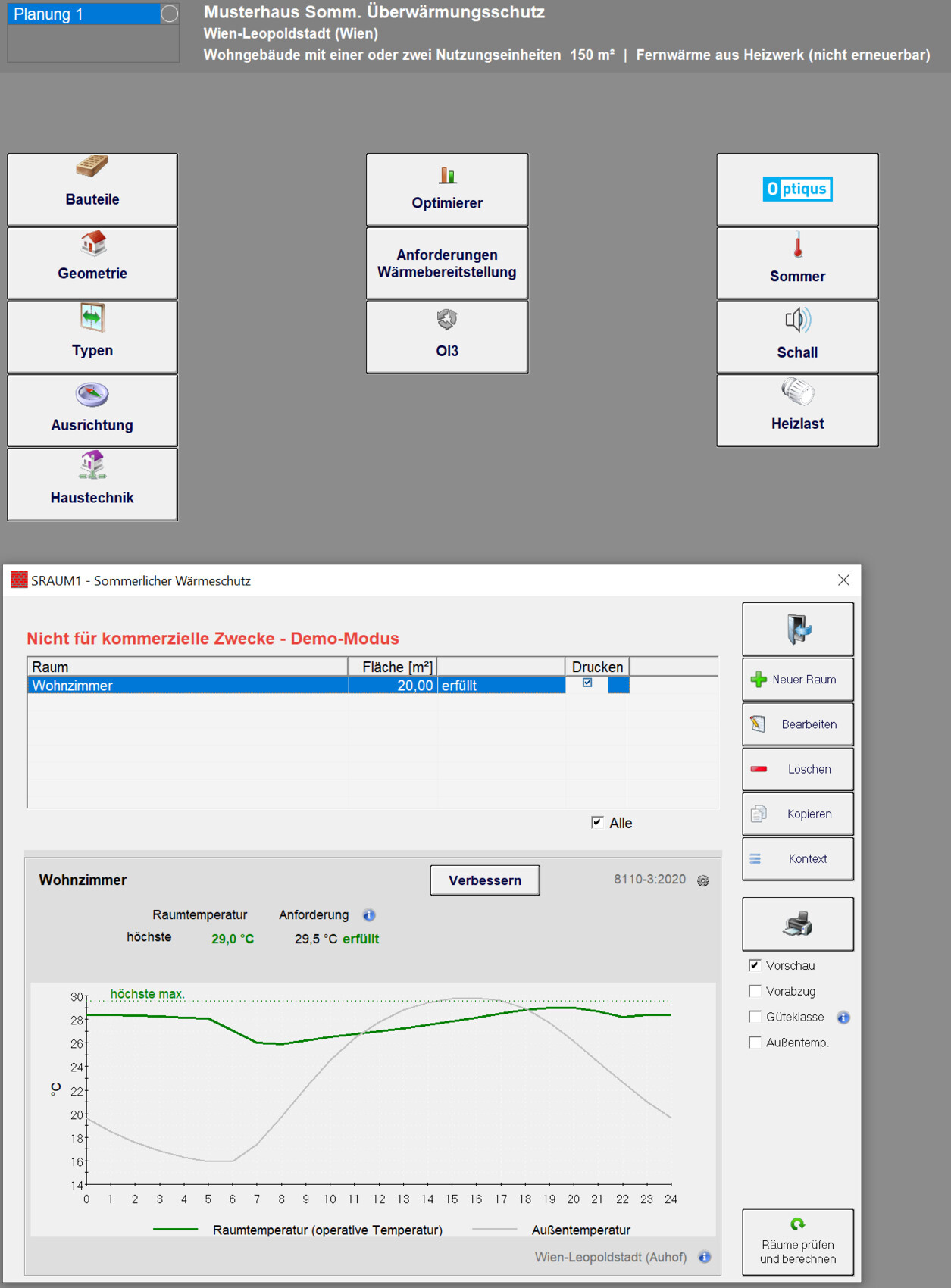
As an example, a tool similar to the GEQ shown in the screenshot, but designed for the German market and local climate zones.
The "generous process energy" used to dissipate heat from individual rooms is also highly variable. Additionally, this can be offset neutrally in terms of primary energy demand, for example through a photovoltaic-coupled heat pump or a ground source heat exchanger. Therefore, I see no fundamental contradiction with the concept or idea of a passive house.
My modeling is not intended to experiment with different floor plans. Rather, it focuses on questions such as how much influence varying window sizes and orientations, their proportion of shading, or the specific choice of glazing have.
As an example, a tool similar to the GEQ shown in the screenshot, but designed for the German market and local climate zones.
Similar topics