
ᐅ Floor Plan Design for a Single-Family Home of Approximately 150 m²
Created on: 12 Feb 2018 18:09
C
chrisw81
Hello,
After a long search, we signed the notarized contract for the land purchase at the end of December. We are now actively planning the floor plan. Unfortunately, the plot is somewhat awkwardly shaped (not rectangular), which creates some limitations for the layout from our perspective. We already have a first draft, but there are several areas we don’t like and are unsure how to improve. Maybe you have some ideas; we would appreciate your input.
Development Plan / Restrictions
Plot size: 601 m² (6465 sq ft)
Building envelope, building line, boundary: Building line with the house on the west side
Peripheral setbacks: 7 m (23 ft) from the street (north), otherwise the usual 3 m (10 ft)
Number of parking spaces: 2 desired
Number of floors: 1 full story allowed
Roof style: Gable roof
Design style: open construction method
Orientation: South
Maximum heights / limits: Ridge height max. 8.5 m (28 ft)
Additional requirements: Max. 100 m² (1076 sq ft) of built-up area
Client Requirements
Style, roof form, building type: Solid construction house, rectangular, no bay windows, no projections, etc., gable roof
Basement, floors: no basement; 1.5 stories
Number and age of residents: 2 people, age between 30 and 40, possibly children later
Space needs on ground floor and upper floor: Ground floor – living/dining room, kitchen, guest toilet, utility room, office
Office: family use or home office?: family use
Guest stays per year: 20 days
Open or closed architecture: open living area, closed hallway
Conservative or modern style: conservative
Open kitchen, kitchen island: open kitchen, island without cooktop
Number of dining seats: 2-4
Fireplace: yes, chimney planned
Music/stereo wall: no
Balcony, roof terrace: no
Garage, carport: carport
Utility garden, greenhouse: no
Further wishes, special features, daily routine, and reasons for preferences:
- A wardrobe area on the ground floor is important where coats can be stored relatively out of sight.
- On the upper floor, it would be nice to have an open gallery with a desk or similar (not a must and not necessarily next to the stairs).
- A walk-in closet would be nice but not essential.
- A storage room on the upper floor is very important since we do not have a basement.
House Design
Who created the design:
- Basic design by the construction company (FIBAV Stadthaus Vision Studio)
- DIY modifications based on online floor plans (especially Viebrockhaus Maxime 330)
What do you particularly like? Why?:
- Layout of the living/dining area and the narrowing kitchen reduces the hallway effect a bit
- Many windows in the living/dining area
- Wide hallway on the ground floor
What do you dislike? Why?:
- Few options to place furniture (dresser, wardrobe) in the ground floor hallway due to many doors
- Very large hallway upstairs, considered wasted space
- Bedroom is quite small; should be the largest room upstairs (preferably 16 m² (172 sq ft), children’s rooms rather 14 m² (151 sq ft))
- Stair placement limited by chimney location
- Door placement upstairs limited by chimney
- A staircase rotated 90 degrees (entrance next to front door) would appeal more
- Difficult to align windows upstairs and downstairs on the gable end vertically
- Floor-to-ceiling windows upstairs; wider windows with a sill height around 100 cm (40 inches) would be preferred
Price estimate by architect/planner: 200,000 €
Personal price limit for the house including equipment: 210,000 €
Preferred heating technology: gas heating
What details or expansions could you give up?
- Can do without: gallery next to stairs upstairs. Living area could also be narrower (e.g., 4.20 m (14 ft) instead of 4.47 m (15 ft))
- Cannot do without: storage room upstairs, shower in guest toilet, extra natural light in the ground floor hallway (e.g., side panel on front door or window)
Why was the design made this way? For example, standard plan from planner?
- Since the house has very little space on the south side, the house should be very narrow in order not to waste more space to the south. It should be wider so that living, dining, and kitchen areas face south as much as possible.
Were corresponding wishes from the architect implemented? No architect meeting has taken place yet.
What is the most important/basic question about the floor plan summarized in 130 characters?
How can the ground floor hallway be better designed to fit a wardrobe? Can the stairs be positioned better or replaced? Should the hallway be enlarged and living space reduced? How can the upstairs hallway be better utilized? Can the bedroom be enlarged? Is it possible to swap the bedroom with another room, e.g., move it to the southeast to allow a walk-in closet?
Thank you very much in advance for your criticism and suggestions!
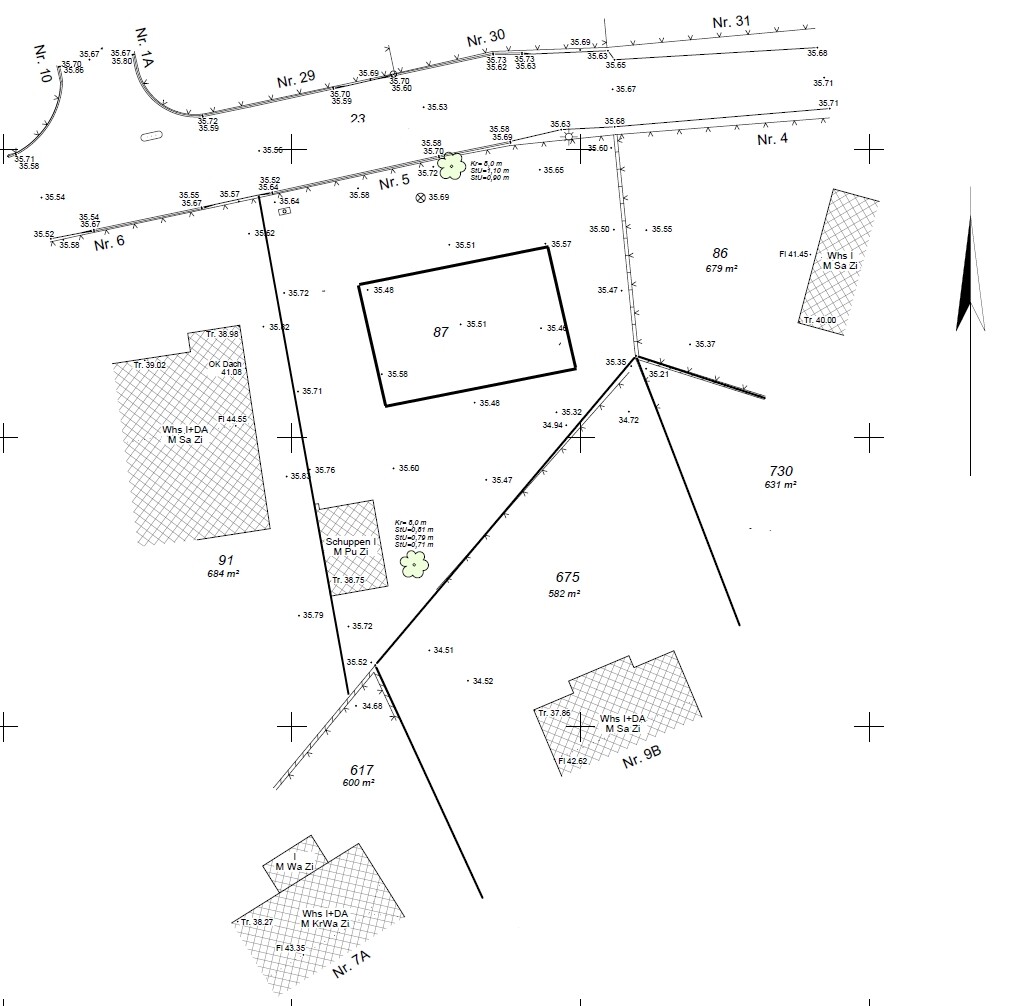
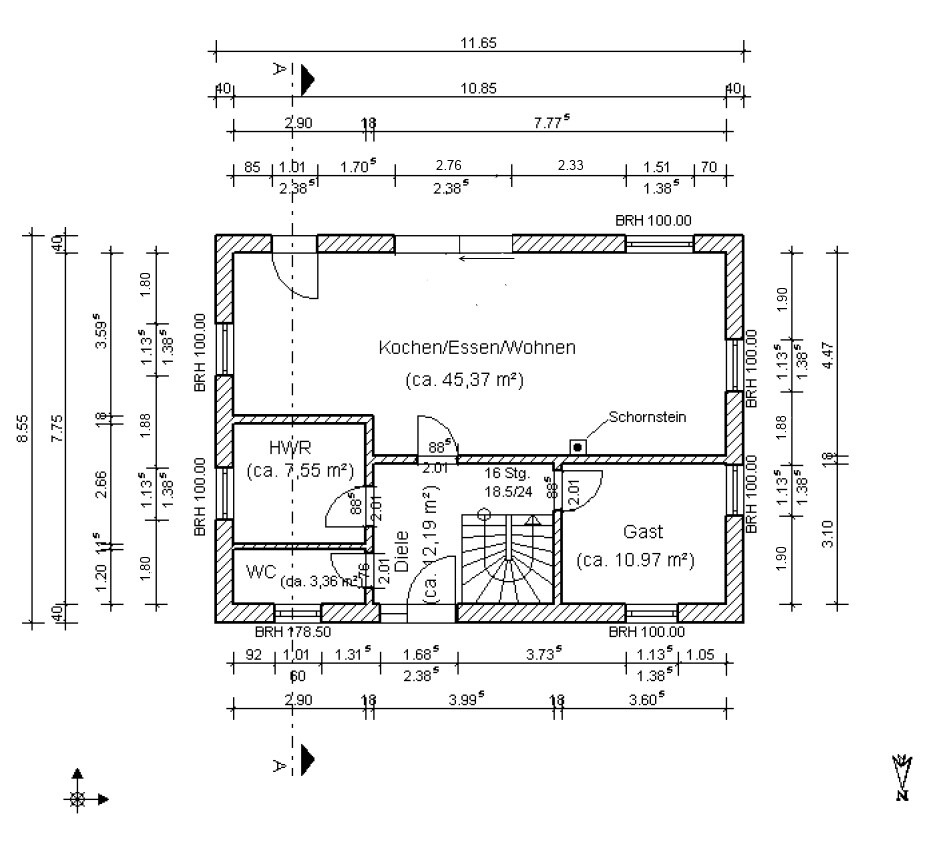
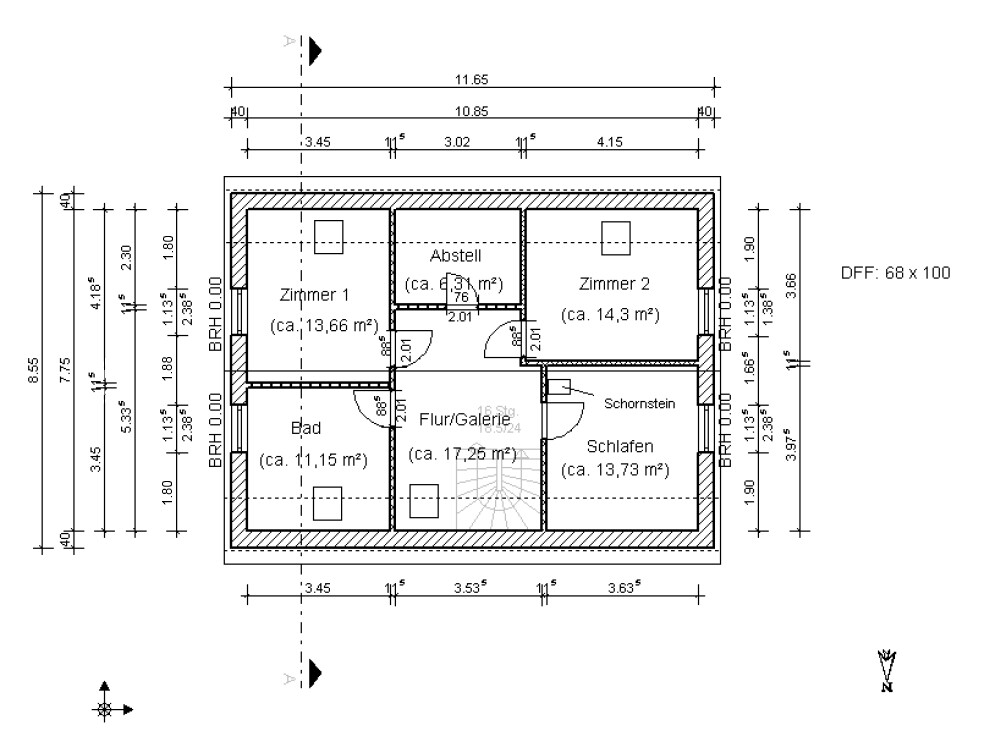
After a long search, we signed the notarized contract for the land purchase at the end of December. We are now actively planning the floor plan. Unfortunately, the plot is somewhat awkwardly shaped (not rectangular), which creates some limitations for the layout from our perspective. We already have a first draft, but there are several areas we don’t like and are unsure how to improve. Maybe you have some ideas; we would appreciate your input.
Development Plan / Restrictions
Plot size: 601 m² (6465 sq ft)
Building envelope, building line, boundary: Building line with the house on the west side
Peripheral setbacks: 7 m (23 ft) from the street (north), otherwise the usual 3 m (10 ft)
Number of parking spaces: 2 desired
Number of floors: 1 full story allowed
Roof style: Gable roof
Design style: open construction method
Orientation: South
Maximum heights / limits: Ridge height max. 8.5 m (28 ft)
Additional requirements: Max. 100 m² (1076 sq ft) of built-up area
Client Requirements
Style, roof form, building type: Solid construction house, rectangular, no bay windows, no projections, etc., gable roof
Basement, floors: no basement; 1.5 stories
Number and age of residents: 2 people, age between 30 and 40, possibly children later
Space needs on ground floor and upper floor: Ground floor – living/dining room, kitchen, guest toilet, utility room, office
Office: family use or home office?: family use
Guest stays per year: 20 days
Open or closed architecture: open living area, closed hallway
Conservative or modern style: conservative
Open kitchen, kitchen island: open kitchen, island without cooktop
Number of dining seats: 2-4
Fireplace: yes, chimney planned
Music/stereo wall: no
Balcony, roof terrace: no
Garage, carport: carport
Utility garden, greenhouse: no
Further wishes, special features, daily routine, and reasons for preferences:
- A wardrobe area on the ground floor is important where coats can be stored relatively out of sight.
- On the upper floor, it would be nice to have an open gallery with a desk or similar (not a must and not necessarily next to the stairs).
- A walk-in closet would be nice but not essential.
- A storage room on the upper floor is very important since we do not have a basement.
House Design
Who created the design:
- Basic design by the construction company (FIBAV Stadthaus Vision Studio)
- DIY modifications based on online floor plans (especially Viebrockhaus Maxime 330)
What do you particularly like? Why?:
- Layout of the living/dining area and the narrowing kitchen reduces the hallway effect a bit
- Many windows in the living/dining area
- Wide hallway on the ground floor
What do you dislike? Why?:
- Few options to place furniture (dresser, wardrobe) in the ground floor hallway due to many doors
- Very large hallway upstairs, considered wasted space
- Bedroom is quite small; should be the largest room upstairs (preferably 16 m² (172 sq ft), children’s rooms rather 14 m² (151 sq ft))
- Stair placement limited by chimney location
- Door placement upstairs limited by chimney
- A staircase rotated 90 degrees (entrance next to front door) would appeal more
- Difficult to align windows upstairs and downstairs on the gable end vertically
- Floor-to-ceiling windows upstairs; wider windows with a sill height around 100 cm (40 inches) would be preferred
Price estimate by architect/planner: 200,000 €
Personal price limit for the house including equipment: 210,000 €
Preferred heating technology: gas heating
What details or expansions could you give up?
- Can do without: gallery next to stairs upstairs. Living area could also be narrower (e.g., 4.20 m (14 ft) instead of 4.47 m (15 ft))
- Cannot do without: storage room upstairs, shower in guest toilet, extra natural light in the ground floor hallway (e.g., side panel on front door or window)
Why was the design made this way? For example, standard plan from planner?
- Since the house has very little space on the south side, the house should be very narrow in order not to waste more space to the south. It should be wider so that living, dining, and kitchen areas face south as much as possible.
Were corresponding wishes from the architect implemented? No architect meeting has taken place yet.
What is the most important/basic question about the floor plan summarized in 130 characters?
How can the ground floor hallway be better designed to fit a wardrobe? Can the stairs be positioned better or replaced? Should the hallway be enlarged and living space reduced? How can the upstairs hallway be better utilized? Can the bedroom be enlarged? Is it possible to swap the bedroom with another room, e.g., move it to the southeast to allow a walk-in closet?
Thank you very much in advance for your criticism and suggestions!

haydee schrieb:
This intermediate size is actually quite unusual for us. Why is that? Probably as a result of considering fall heights and aiming for equal floor heights between upper and ground floors.
https://www.instagram.com/11antgmxde/
https://www.linkedin.com/company/bauen-jetzt/
Würfel* schrieb:
@ypg Good taste, I have almost the same carpet 🙂Thank you. Then you have good taste too 😉
Würfel* schrieb:
I really can’t understand why someone would place the sofa in front of a floor-to-ceiling window, especially if it’s the main window overlooking the garden. And then always sit facing the wall with the ugly black hole (the TV) instead of looking out into the garden. Unless someone is a total TV addict and constantly watching. But hopefully, that’s the exception in families with children. When we watch TV, we always sit comfortably in the corner of our sofa, which gives us a perfect view of the TV. When we’re talking, we have the ideal view of the (evening-lit) garden and the fireplace. I also like to drink my morning coffee on the sofa while looking out at the trees. It’s simply nice.
Here’s a suggested arrangement for a corner sofa, TV, and fireplace.
[ATTACH alt="1634204381249.png"]66105[/ATTACH] Basically a good idea. But the TV would actually be at quite an awkward angle for my liking. And I wouldn’t want that one sofa arm sticking out into the room, I actually like it when you can always see each other between the dining table and the sofa, no matter where you sit.
And the fireplace placement depends on the house style; in a city villa you can position it like that, but with our house’s pitched roof, it had to be on an interior wall. So to have a direct view of it, the sofa really has to be placed opposite.
And honestly, I’m not sure if I’d want to be looking straight outside like that and exposing myself to the neighbors. I don’t know if I wouldn’t constantly be thinking about how I’m behaving, especially in the evenings. I’d rather prefer the option in front of the floor-to-ceiling window, where at least the backrest offers some privacy.

haydee schrieb:
Exactly 60 cm (24 inches)
Either there are floor-to-ceiling windows or 90 cm (35 inches)
Fall protection on the upper floor is certainly necessary. On the ground floor, probably not. In older houses, you often see a parapet height of 40–60 cm (16–24 inches). Back then, there were usually small, elongated radiators in front of them. We have 65 cm (26 inches) in all the "viewing" windows, and otherwise 45 cm (18 inches) (= seating windows) or 125 cm (49 inches) (= sightline). Our building authority is probably exceptionally cooperative and accommodating… in any case, the fall protections are neither visually nor financially particularly noticeable:
On the ground floor or over terraces/balconies, as well as for fixed glazing, it is not a problem anyway.
Similar topics