
ᐅ Floor Plan Design for a Single-Family Home of Approximately 150 m²
Created on: 12 Feb 2018 18:09
C
chrisw81
Hello,
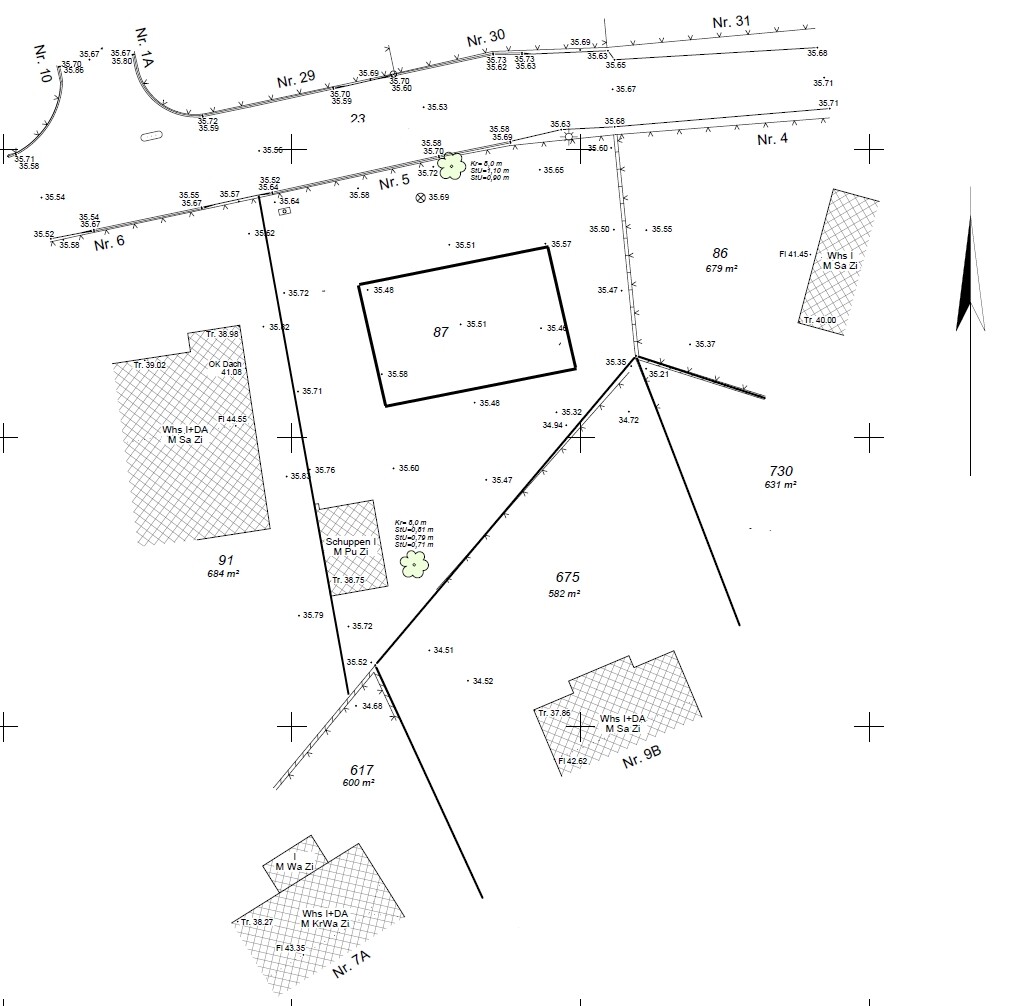
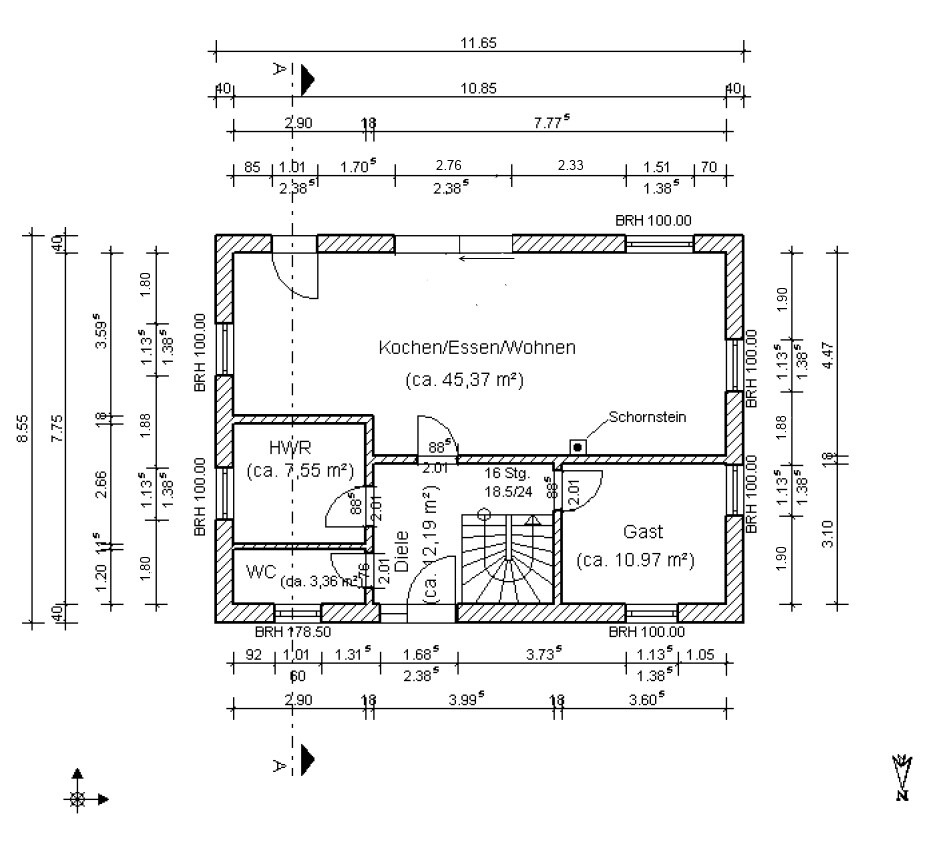
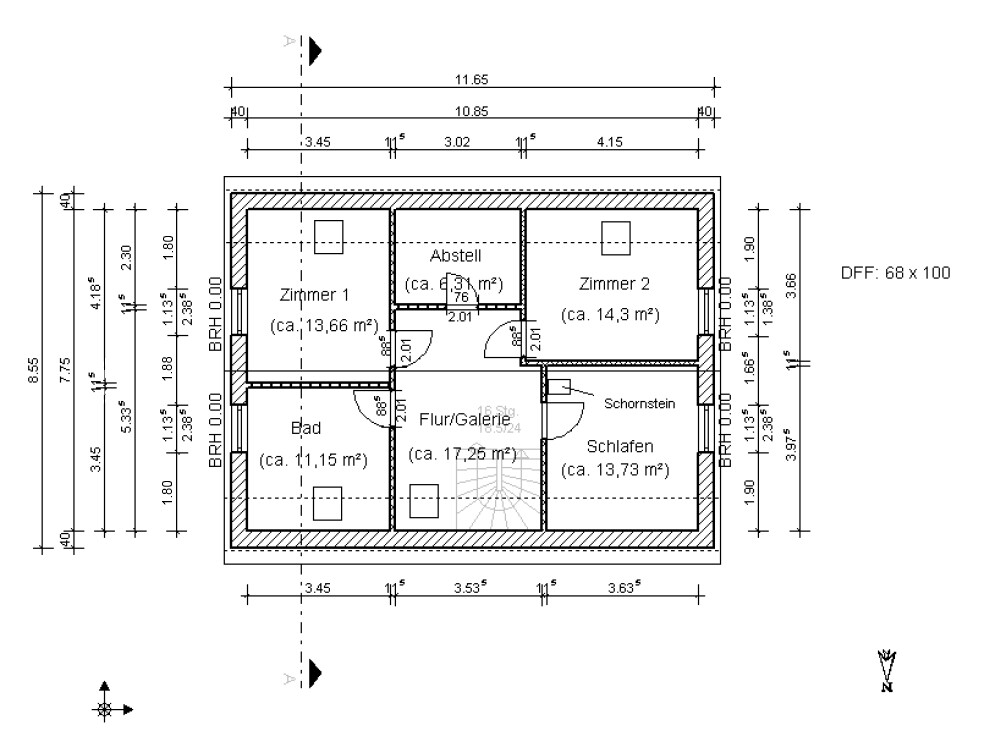
After a long search, we signed the notarized contract for the land purchase at the end of December. We are now actively planning the floor plan. Unfortunately, the plot is somewhat awkwardly shaped (not rectangular), which creates some limitations for the layout from our perspective. We already have a first draft, but there are several areas we don’t like and are unsure how to improve. Maybe you have some ideas; we would appreciate your input.
Development Plan / Restrictions
Plot size: 601 m² (6465 sq ft)
Building envelope, building line, boundary: Building line with the house on the west side
Peripheral setbacks: 7 m (23 ft) from the street (north), otherwise the usual 3 m (10 ft)
Number of parking spaces: 2 desired
Number of floors: 1 full story allowed
Roof style: Gable roof
Design style: open construction method
Orientation: South
Maximum heights / limits: Ridge height max. 8.5 m (28 ft)
Additional requirements: Max. 100 m² (1076 sq ft) of built-up area
Client Requirements
Style, roof form, building type: Solid construction house, rectangular, no bay windows, no projections, etc., gable roof
Basement, floors: no basement; 1.5 stories
Number and age of residents: 2 people, age between 30 and 40, possibly children later
Space needs on ground floor and upper floor: Ground floor – living/dining room, kitchen, guest toilet, utility room, office
Office: family use or home office?: family use
Guest stays per year: 20 days
Open or closed architecture: open living area, closed hallway
Conservative or modern style: conservative
Open kitchen, kitchen island: open kitchen, island without cooktop
Number of dining seats: 2-4
Fireplace: yes, chimney planned
Music/stereo wall: no
Balcony, roof terrace: no
Garage, carport: carport
Utility garden, greenhouse: no
Further wishes, special features, daily routine, and reasons for preferences:
- A wardrobe area on the ground floor is important where coats can be stored relatively out of sight.
- On the upper floor, it would be nice to have an open gallery with a desk or similar (not a must and not necessarily next to the stairs).
- A walk-in closet would be nice but not essential.
- A storage room on the upper floor is very important since we do not have a basement.
House Design
Who created the design:
- Basic design by the construction company (FIBAV Stadthaus Vision Studio)
- DIY modifications based on online floor plans (especially Viebrockhaus Maxime 330)
What do you particularly like? Why?:
- Layout of the living/dining area and the narrowing kitchen reduces the hallway effect a bit
- Many windows in the living/dining area
- Wide hallway on the ground floor
What do you dislike? Why?:
- Few options to place furniture (dresser, wardrobe) in the ground floor hallway due to many doors
- Very large hallway upstairs, considered wasted space
- Bedroom is quite small; should be the largest room upstairs (preferably 16 m² (172 sq ft), children’s rooms rather 14 m² (151 sq ft))
- Stair placement limited by chimney location
- Door placement upstairs limited by chimney
- A staircase rotated 90 degrees (entrance next to front door) would appeal more
- Difficult to align windows upstairs and downstairs on the gable end vertically
- Floor-to-ceiling windows upstairs; wider windows with a sill height around 100 cm (40 inches) would be preferred
Price estimate by architect/planner: 200,000 €
Personal price limit for the house including equipment: 210,000 €
Preferred heating technology: gas heating
What details or expansions could you give up?
- Can do without: gallery next to stairs upstairs. Living area could also be narrower (e.g., 4.20 m (14 ft) instead of 4.47 m (15 ft))
- Cannot do without: storage room upstairs, shower in guest toilet, extra natural light in the ground floor hallway (e.g., side panel on front door or window)
Why was the design made this way? For example, standard plan from planner?
- Since the house has very little space on the south side, the house should be very narrow in order not to waste more space to the south. It should be wider so that living, dining, and kitchen areas face south as much as possible.
Were corresponding wishes from the architect implemented? No architect meeting has taken place yet.
What is the most important/basic question about the floor plan summarized in 130 characters?
How can the ground floor hallway be better designed to fit a wardrobe? Can the stairs be positioned better or replaced? Should the hallway be enlarged and living space reduced? How can the upstairs hallway be better utilized? Can the bedroom be enlarged? Is it possible to swap the bedroom with another room, e.g., move it to the southeast to allow a walk-in closet?
Thank you very much in advance for your criticism and suggestions!
After a long search, we signed the notarized contract for the land purchase at the end of December. We are now actively planning the floor plan. Unfortunately, the plot is somewhat awkwardly shaped (not rectangular), which creates some limitations for the layout from our perspective. We already have a first draft, but there are several areas we don’t like and are unsure how to improve. Maybe you have some ideas; we would appreciate your input.
Development Plan / Restrictions
Plot size: 601 m² (6465 sq ft)
Building envelope, building line, boundary: Building line with the house on the west side
Peripheral setbacks: 7 m (23 ft) from the street (north), otherwise the usual 3 m (10 ft)
Number of parking spaces: 2 desired
Number of floors: 1 full story allowed
Roof style: Gable roof
Design style: open construction method
Orientation: South
Maximum heights / limits: Ridge height max. 8.5 m (28 ft)
Additional requirements: Max. 100 m² (1076 sq ft) of built-up area
Client Requirements
Style, roof form, building type: Solid construction house, rectangular, no bay windows, no projections, etc., gable roof
Basement, floors: no basement; 1.5 stories
Number and age of residents: 2 people, age between 30 and 40, possibly children later
Space needs on ground floor and upper floor: Ground floor – living/dining room, kitchen, guest toilet, utility room, office
Office: family use or home office?: family use
Guest stays per year: 20 days
Open or closed architecture: open living area, closed hallway
Conservative or modern style: conservative
Open kitchen, kitchen island: open kitchen, island without cooktop
Number of dining seats: 2-4
Fireplace: yes, chimney planned
Music/stereo wall: no
Balcony, roof terrace: no
Garage, carport: carport
Utility garden, greenhouse: no
Further wishes, special features, daily routine, and reasons for preferences:
- A wardrobe area on the ground floor is important where coats can be stored relatively out of sight.
- On the upper floor, it would be nice to have an open gallery with a desk or similar (not a must and not necessarily next to the stairs).
- A walk-in closet would be nice but not essential.
- A storage room on the upper floor is very important since we do not have a basement.
House Design
Who created the design:
- Basic design by the construction company (FIBAV Stadthaus Vision Studio)
- DIY modifications based on online floor plans (especially Viebrockhaus Maxime 330)
What do you particularly like? Why?:
- Layout of the living/dining area and the narrowing kitchen reduces the hallway effect a bit
- Many windows in the living/dining area
- Wide hallway on the ground floor
What do you dislike? Why?:
- Few options to place furniture (dresser, wardrobe) in the ground floor hallway due to many doors
- Very large hallway upstairs, considered wasted space
- Bedroom is quite small; should be the largest room upstairs (preferably 16 m² (172 sq ft), children’s rooms rather 14 m² (151 sq ft))
- Stair placement limited by chimney location
- Door placement upstairs limited by chimney
- A staircase rotated 90 degrees (entrance next to front door) would appeal more
- Difficult to align windows upstairs and downstairs on the gable end vertically
- Floor-to-ceiling windows upstairs; wider windows with a sill height around 100 cm (40 inches) would be preferred
Price estimate by architect/planner: 200,000 €
Personal price limit for the house including equipment: 210,000 €
Preferred heating technology: gas heating
What details or expansions could you give up?
- Can do without: gallery next to stairs upstairs. Living area could also be narrower (e.g., 4.20 m (14 ft) instead of 4.47 m (15 ft))
- Cannot do without: storage room upstairs, shower in guest toilet, extra natural light in the ground floor hallway (e.g., side panel on front door or window)
Why was the design made this way? For example, standard plan from planner?
- Since the house has very little space on the south side, the house should be very narrow in order not to waste more space to the south. It should be wider so that living, dining, and kitchen areas face south as much as possible.
Were corresponding wishes from the architect implemented? No architect meeting has taken place yet.
What is the most important/basic question about the floor plan summarized in 130 characters?
How can the ground floor hallway be better designed to fit a wardrobe? Can the stairs be positioned better or replaced? Should the hallway be enlarged and living space reduced? How can the upstairs hallway be better utilized? Can the bedroom be enlarged? Is it possible to swap the bedroom with another room, e.g., move it to the southeast to allow a walk-in closet?
Thank you very much in advance for your criticism and suggestions!
11ant schrieb:
It doesn’t look like a woman has been in charge here for long, it’s as bare as a bachelor pad.And that coming from a man - thankfully but I thought the same: with proper living room lighting and decoration, it definitely looks different
ypg schrieb:
You really wanted the toilets stacked... and to make the living room smaller...
I have to admit, it’s not my preference.
But I’m not planning for myself, but for the OP, and you already had the preliminary draft from the planner. The dimensions were somewhat fixed since you only wanted to spend 200,000 on the house.Yes, the windows were tricky because of the neighboring house, and I don’t like it when people can look inside. They could have at most made a window strip along the west side, maybe three windows each 0.76m (30 inches) wide, so the wall wouldn’t look so bare. But that idea didn’t come up back then.
The dimensions were not determined by the house price but by the lot shape (8.5m (28 feet) width was optimal, otherwise too much south-facing area would be lost) and by a 100 m² (1,076 sqft) maximum footprint set by the building authority (planning permission). I adhered exactly to those dimensions.
Also, if the house had been 1m (3 feet) wider, the living room would have felt even more like a narrow corridor. Then an L-shaped floor plan could have been done, which I actually like better in hindsight. That might have been the better choice. I liked many other layouts more, but you have to work with the lot you have.
Yes, I was fixed on 200,000, but with a great design I could have spent more. However, it also doesn’t need to be pointless...
ypg schrieb:
I rarely intervene on windows and exterior dimensions, especially when it’s clear that the 150 cm (59 inches) windows or the window sills are desired... to me, low sills feel confining and they are good for privacy, for example in upstairs rooms. And the exterior dimensions reflect the house price.The 150 cm (59 inches) height was not a wish but rather the maximum possible upstairs due to the narrow house width. You also want to have room for tall cabinets somewhere. By the way, in the living room the window sill height is 1.76m (69 inches).
We explicitly wanted the sill on the south side because I don’t want glass behind the sofa backrest. On the west side you could definitely have full-height windows (possibly wider), but that would conflict with the upstairs space again...
Besides, I like window sills to put things on.
ypg schrieb:
Money can make many things possible. I’d say you fully used your 200,000 budget... or what was the final cost? That would be interesting. If you had increased the size by 1 meter, that might have cost 20,000-30,000 more.Yes, I think it ended up costing 10,000-20,000 more, but as I said, for the reasons above it wasn’t possible. In the end, I invested more in upgrades... controlled ventilation, water softening, external blinds, excellent electrical and plumbing work, high-quality staircase — basically better quality in almost all trades. It ended up between 240,000 and 250,000 (without painter/flooring).
ypg schrieb:
I think many things definitely turned out great, which you might not even notice now. What if the hallway and utility room didn’t work out???
As they say: the first house is for the enemy, the second for the friend, and the third for yourself. Yes, that’s true, many corners turned out very nicely. Only the living area could have needed a bit more revision back then.11ant schrieb:
Good gracious, I would never have called that little thing a piano. It seems like a woman hasn’t been in charge for long either, it’s as bare as a bachelor pad.Yes, yes, it’s a digital piano… but it still takes up space. And yes, it’s still bare because we haven’t had much time to decorate yet. We’re also missing lamps, pictures, of course, and so on. But it’s not that easy to get all of that.ypg schrieb:
And that coming from a man—fortunately
but I thought so too: with proper living room lighting and decorations, it does look quite different I agree. And with a corner sofa, the corner will be more filled. Adding a wall lamp, pictures, etc., will cover the bare walls nicely and make the space cozier. A different paint color would surely help as well.
chrisw81 schrieb:
Yes, the windows were tricky because of the neighboring house, and I don’t like it when people can look inside. The fact that our neighbors aren’t so uptight is sometimes reason enough for me to drive to the Netherlands – even though that is on the other side of the river.
chrisw81 schrieb:
And yes, it’s still bare because we haven’t had much time to decorate yet. My partner’s wife would have spent enough time just thinking about the rafter replacements for the width of the roof windows to completely empty several home decor stores in no time.
https://www.instagram.com/11antgmxde/
https://www.linkedin.com/company/bauen-jetzt/
@11ant
Not every woman enjoys power-shopping for dust collectors.
@chrisw81
Move in properly first. It was already clear on page 2 or 3 that it wouldn’t be spacious. Well, it just didn’t work out. Other families of three or four live in less than 80 sqm (860 sq ft) and manage fine.
Regarding your west side, add greenery and it will look completely different. Very inexpensive—you can buy a packet of hollyhock seeds for about 3 euros and by autumn you’ll have flowering plants up to 2 m (6.5 ft) tall.
Self-climbing plants like ivy should be avoided on exterior insulation systems (EIFS / ETICS). There are supports available for climbers such as honeysuckle; whether you want that is up to you. You can also plant perennials and roses that grow tall without needing to cling directly to the wall.
Until they are fully grown, I would really work with one- or two-year-old flowers that grow taller, like hollyhocks or sunflowers.
Not every woman enjoys power-shopping for dust collectors.
@chrisw81
Move in properly first. It was already clear on page 2 or 3 that it wouldn’t be spacious. Well, it just didn’t work out. Other families of three or four live in less than 80 sqm (860 sq ft) and manage fine.
Regarding your west side, add greenery and it will look completely different. Very inexpensive—you can buy a packet of hollyhock seeds for about 3 euros and by autumn you’ll have flowering plants up to 2 m (6.5 ft) tall.
Self-climbing plants like ivy should be avoided on exterior insulation systems (EIFS / ETICS). There are supports available for climbers such as honeysuckle; whether you want that is up to you. You can also plant perennials and roses that grow tall without needing to cling directly to the wall.
Until they are fully grown, I would really work with one- or two-year-old flowers that grow taller, like hollyhocks or sunflowers.