
ᐅ Floor Plan Design for a Single-Family Home of Approximately 150 m²
Created on: 12 Feb 2018 18:09
C
chrisw81
Hello,
After a long search, we signed the notarized contract for the land purchase at the end of December. We are now actively planning the floor plan. Unfortunately, the plot is somewhat awkwardly shaped (not rectangular), which creates some limitations for the layout from our perspective. We already have a first draft, but there are several areas we don’t like and are unsure how to improve. Maybe you have some ideas; we would appreciate your input.
Development Plan / Restrictions
Plot size: 601 m² (6465 sq ft)
Building envelope, building line, boundary: Building line with the house on the west side
Peripheral setbacks: 7 m (23 ft) from the street (north), otherwise the usual 3 m (10 ft)
Number of parking spaces: 2 desired
Number of floors: 1 full story allowed
Roof style: Gable roof
Design style: open construction method
Orientation: South
Maximum heights / limits: Ridge height max. 8.5 m (28 ft)
Additional requirements: Max. 100 m² (1076 sq ft) of built-up area
Client Requirements
Style, roof form, building type: Solid construction house, rectangular, no bay windows, no projections, etc., gable roof
Basement, floors: no basement; 1.5 stories
Number and age of residents: 2 people, age between 30 and 40, possibly children later
Space needs on ground floor and upper floor: Ground floor – living/dining room, kitchen, guest toilet, utility room, office
Office: family use or home office?: family use
Guest stays per year: 20 days
Open or closed architecture: open living area, closed hallway
Conservative or modern style: conservative
Open kitchen, kitchen island: open kitchen, island without cooktop
Number of dining seats: 2-4
Fireplace: yes, chimney planned
Music/stereo wall: no
Balcony, roof terrace: no
Garage, carport: carport
Utility garden, greenhouse: no
Further wishes, special features, daily routine, and reasons for preferences:
- A wardrobe area on the ground floor is important where coats can be stored relatively out of sight.
- On the upper floor, it would be nice to have an open gallery with a desk or similar (not a must and not necessarily next to the stairs).
- A walk-in closet would be nice but not essential.
- A storage room on the upper floor is very important since we do not have a basement.
House Design
Who created the design:
- Basic design by the construction company (FIBAV Stadthaus Vision Studio)
- DIY modifications based on online floor plans (especially Viebrockhaus Maxime 330)
What do you particularly like? Why?:
- Layout of the living/dining area and the narrowing kitchen reduces the hallway effect a bit
- Many windows in the living/dining area
- Wide hallway on the ground floor
What do you dislike? Why?:
- Few options to place furniture (dresser, wardrobe) in the ground floor hallway due to many doors
- Very large hallway upstairs, considered wasted space
- Bedroom is quite small; should be the largest room upstairs (preferably 16 m² (172 sq ft), children’s rooms rather 14 m² (151 sq ft))
- Stair placement limited by chimney location
- Door placement upstairs limited by chimney
- A staircase rotated 90 degrees (entrance next to front door) would appeal more
- Difficult to align windows upstairs and downstairs on the gable end vertically
- Floor-to-ceiling windows upstairs; wider windows with a sill height around 100 cm (40 inches) would be preferred
Price estimate by architect/planner: 200,000 €
Personal price limit for the house including equipment: 210,000 €
Preferred heating technology: gas heating
What details or expansions could you give up?
- Can do without: gallery next to stairs upstairs. Living area could also be narrower (e.g., 4.20 m (14 ft) instead of 4.47 m (15 ft))
- Cannot do without: storage room upstairs, shower in guest toilet, extra natural light in the ground floor hallway (e.g., side panel on front door or window)
Why was the design made this way? For example, standard plan from planner?
- Since the house has very little space on the south side, the house should be very narrow in order not to waste more space to the south. It should be wider so that living, dining, and kitchen areas face south as much as possible.
Were corresponding wishes from the architect implemented? No architect meeting has taken place yet.
What is the most important/basic question about the floor plan summarized in 130 characters?
How can the ground floor hallway be better designed to fit a wardrobe? Can the stairs be positioned better or replaced? Should the hallway be enlarged and living space reduced? How can the upstairs hallway be better utilized? Can the bedroom be enlarged? Is it possible to swap the bedroom with another room, e.g., move it to the southeast to allow a walk-in closet?
Thank you very much in advance for your criticism and suggestions!
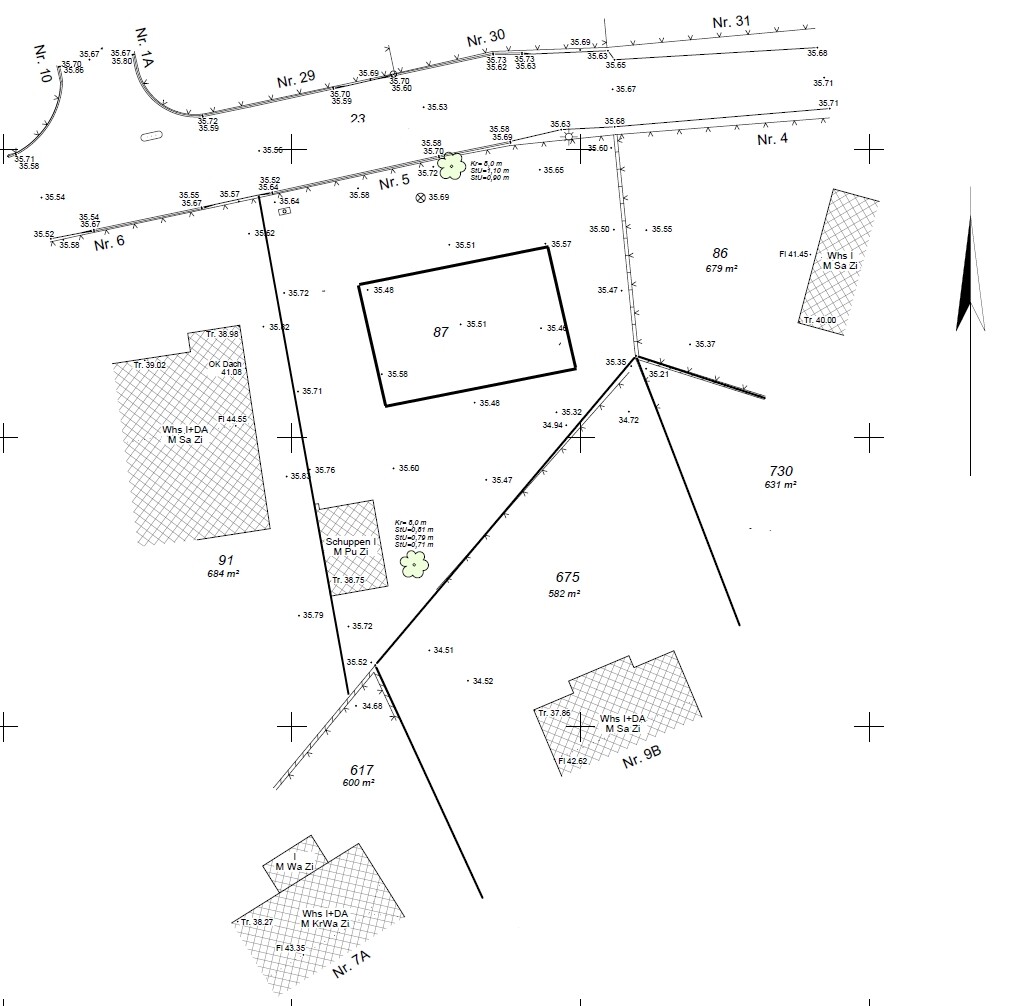
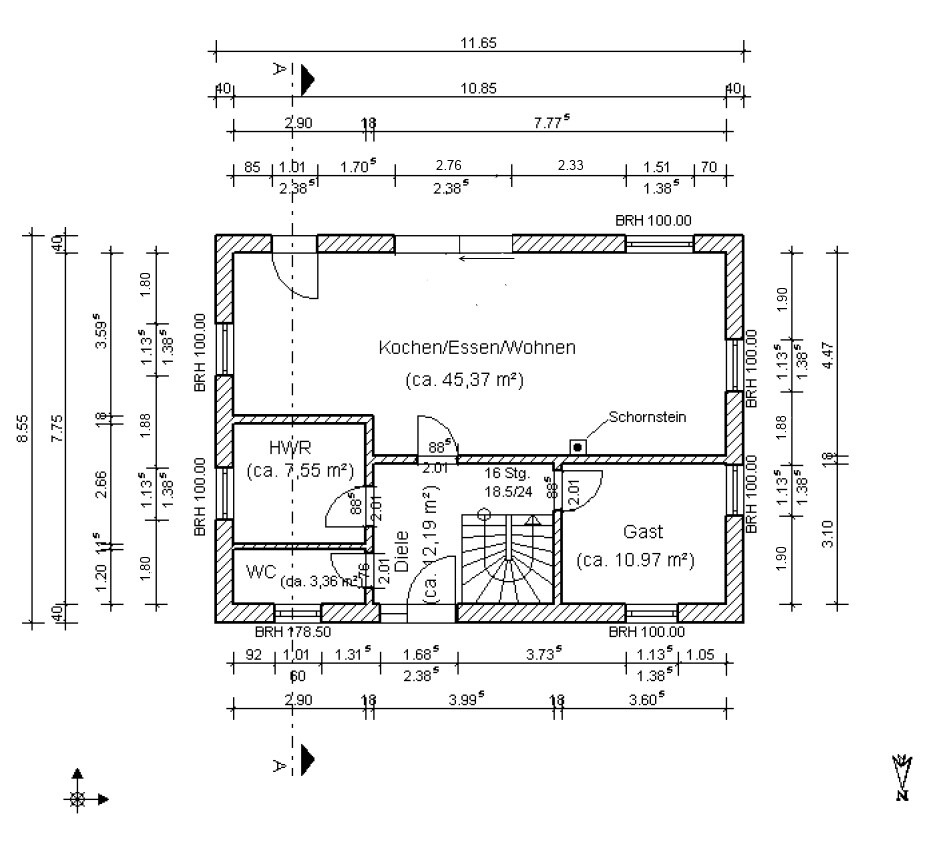
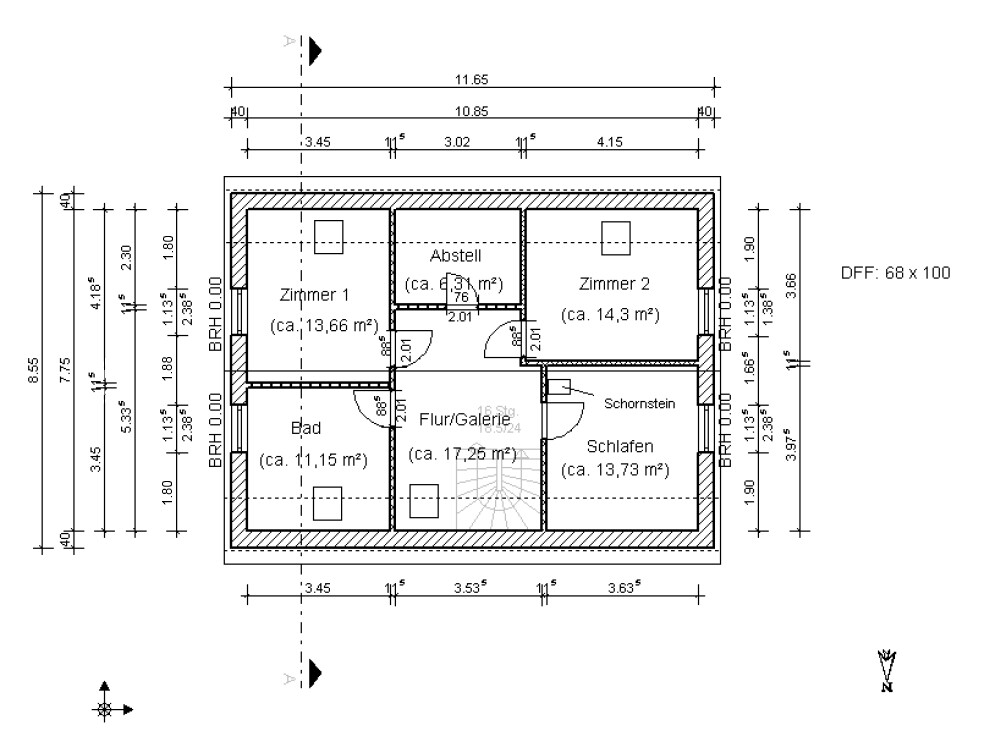
After a long search, we signed the notarized contract for the land purchase at the end of December. We are now actively planning the floor plan. Unfortunately, the plot is somewhat awkwardly shaped (not rectangular), which creates some limitations for the layout from our perspective. We already have a first draft, but there are several areas we don’t like and are unsure how to improve. Maybe you have some ideas; we would appreciate your input.
Development Plan / Restrictions
Plot size: 601 m² (6465 sq ft)
Building envelope, building line, boundary: Building line with the house on the west side
Peripheral setbacks: 7 m (23 ft) from the street (north), otherwise the usual 3 m (10 ft)
Number of parking spaces: 2 desired
Number of floors: 1 full story allowed
Roof style: Gable roof
Design style: open construction method
Orientation: South
Maximum heights / limits: Ridge height max. 8.5 m (28 ft)
Additional requirements: Max. 100 m² (1076 sq ft) of built-up area
Client Requirements
Style, roof form, building type: Solid construction house, rectangular, no bay windows, no projections, etc., gable roof
Basement, floors: no basement; 1.5 stories
Number and age of residents: 2 people, age between 30 and 40, possibly children later
Space needs on ground floor and upper floor: Ground floor – living/dining room, kitchen, guest toilet, utility room, office
Office: family use or home office?: family use
Guest stays per year: 20 days
Open or closed architecture: open living area, closed hallway
Conservative or modern style: conservative
Open kitchen, kitchen island: open kitchen, island without cooktop
Number of dining seats: 2-4
Fireplace: yes, chimney planned
Music/stereo wall: no
Balcony, roof terrace: no
Garage, carport: carport
Utility garden, greenhouse: no
Further wishes, special features, daily routine, and reasons for preferences:
- A wardrobe area on the ground floor is important where coats can be stored relatively out of sight.
- On the upper floor, it would be nice to have an open gallery with a desk or similar (not a must and not necessarily next to the stairs).
- A walk-in closet would be nice but not essential.
- A storage room on the upper floor is very important since we do not have a basement.
House Design
Who created the design:
- Basic design by the construction company (FIBAV Stadthaus Vision Studio)
- DIY modifications based on online floor plans (especially Viebrockhaus Maxime 330)
What do you particularly like? Why?:
- Layout of the living/dining area and the narrowing kitchen reduces the hallway effect a bit
- Many windows in the living/dining area
- Wide hallway on the ground floor
What do you dislike? Why?:
- Few options to place furniture (dresser, wardrobe) in the ground floor hallway due to many doors
- Very large hallway upstairs, considered wasted space
- Bedroom is quite small; should be the largest room upstairs (preferably 16 m² (172 sq ft), children’s rooms rather 14 m² (151 sq ft))
- Stair placement limited by chimney location
- Door placement upstairs limited by chimney
- A staircase rotated 90 degrees (entrance next to front door) would appeal more
- Difficult to align windows upstairs and downstairs on the gable end vertically
- Floor-to-ceiling windows upstairs; wider windows with a sill height around 100 cm (40 inches) would be preferred
Price estimate by architect/planner: 200,000 €
Personal price limit for the house including equipment: 210,000 €
Preferred heating technology: gas heating
What details or expansions could you give up?
- Can do without: gallery next to stairs upstairs. Living area could also be narrower (e.g., 4.20 m (14 ft) instead of 4.47 m (15 ft))
- Cannot do without: storage room upstairs, shower in guest toilet, extra natural light in the ground floor hallway (e.g., side panel on front door or window)
Why was the design made this way? For example, standard plan from planner?
- Since the house has very little space on the south side, the house should be very narrow in order not to waste more space to the south. It should be wider so that living, dining, and kitchen areas face south as much as possible.
Were corresponding wishes from the architect implemented? No architect meeting has taken place yet.
What is the most important/basic question about the floor plan summarized in 130 characters?
How can the ground floor hallway be better designed to fit a wardrobe? Can the stairs be positioned better or replaced? Should the hallway be enlarged and living space reduced? How can the upstairs hallway be better utilized? Can the bedroom be enlarged? Is it possible to swap the bedroom with another room, e.g., move it to the southeast to allow a walk-in closet?
Thank you very much in advance for your criticism and suggestions!
ypg schrieb:
You don’t understand me [emoji2]
Just because walls are moved doesn’t mean the chimney will be moved as well... etc. If I shift the interior wall to the south, I inevitably end up behind the chimney... the chimney can’t run inside the load-bearing wall. Since the chimney is about 40cm (16 inches) deep, the wall would have to be moved at least 60cm (24 inches) if the chimney isn’t relocated... if I move the chimney north at the same time, then I have to move the wall less far to the south...
11ant schrieb:
The floor plan already includes a 1m (3.3 ft) knee wall, and the roof windows shown have their lower edges at about 1.5m (5 ft), even around 1.9m (6.2 ft) in the bathroom – practically, these function more as skylights than as windows offering a view. Here, it’s less about the view (otherwise, I would have designed dormers) and more about providing an additional source of light or ventilation. Since the rooms on the upper floor are quite narrow, only a small floor-to-ceiling window or a slim regular double casement window would fit there. So, we thought having some extra light would be quite nice.
11ant schrieb:
The fuss over the chimney for the cozy fireplace strikes me as somewhat odd, considering that no such provision seems to be planned for the heating system. With today’s energy standards, a fireplace can only produce excess heating power anyway, at least in a relatively small house. It doesn’t really match the budget either, in my opinion. Yes, it’s just for comfort. Since we have the option, we wanted to include one. Because the house is quite affordable, this is budget-wise manageable. Of course, only on the condition that the rest of the house does not suffer as a result.
11ant schrieb:
I still say: dare to sketch your own floor plans instead of tweaking a standard design that really doesn’t match your desired profile in any significant way. The staircase can still be rotated, but the cloakroom remains undone on the wish list, without any our-house details appearing anywhere else. I really like the kitchen and living area and would prefer to keep it as it is—it matches our vision exactly. I’ve been working on the rest for weeks, but something always seems off. I could try adjusting the exterior dimensions a little (for example, making the house deeper), but that’s limited because then I’d need to shorten the length again, as I don’t want to increase the total floor area. The house should be as small as possible while still including everything we want.

chrisw81 schrieb:
So we thought an additional light source would be quite pleasant. I would probably find a roof lantern in a sloped ceiling of a living space rather distracting. But that might just be a matter of personal preference.
chrisw81 schrieb:
And I’ve been working on the rest for weeks, but somehow it never fits anymore. For me, that would be the decisive reason to boldly discard the design and start fresh without any preconceptions. Any rectangle where you only keep three corners from the previous one will end up the same again.
https://www.instagram.com/11antgmxde/
https://www.linkedin.com/company/bauen-jetzt/
11ant schrieb:
I would find a skylight in the sloped roof of a living space rather distracting. But I guess that’s a matter of personal preference. Yes, it’s really hard to say. If it turns out too dark afterwards, you’ll regret it as well.
11ant schrieb:
That would be the main reason for me to boldly discard the design and start fresh without any preconceptions. Any shape where you only keep three corners from the previous design will end up the same again. I’ll try that. Maybe I just need to tackle the parts I was hesitant to approach before.
Maybe someone still has a good idea on how to improve it or has seen a similar floor plan that looks better.
chrisw81 schrieb:
Maybe I just need to tackle the parts I've been avoiding so far. You have favorable conditions:
1) Your own modesty in being satisfied with a simple rectangular shape and a pitched roof
2) The plot of land with elevation differences within the range of ten centimeters (4 inches)
3) The shed, estimated at around 25 square meters (270 square feet) or more, serving as a fully functional basement replacement
4) A building authority that does not oppose a generous knee wall, and a height restriction that can be met without any tricks
5) Your basic understanding of coordinating features like the chimney and ridge beam
That should be enough to get started.
chrisw81 schrieb:
what might be improved or if anyone has seen a similar floor plan that works better. Other standard floor plans only shift the issues to different areas, not reduce them. What could be improved is on your wish list.
What you want is straightforward, solid construction – any family-run builder can deliver that just as reliably as the better-known providers.
https://www.instagram.com/11antgmxde/
https://www.linkedin.com/company/bauen-jetzt/
So, dear community, I find that you always complain about floor plans. My opinion on this one is that it’s good. Simple, clear, functional, livable rooms, no awkward corners or angles. Why discard it? I don’t find any argument convincing enough to say that it’s bad. Karsten
Similar topics