
ᐅ Floor Plan Design for a Single-Family House, Solid Wood Construction, 140 sqm in Lower Saxony
Created on: 2 Jan 2023 15:30
-
-LotteS-
Hello dear house building forum!
Here are some details—based on our best knowledge and judgment—about our house construction project...
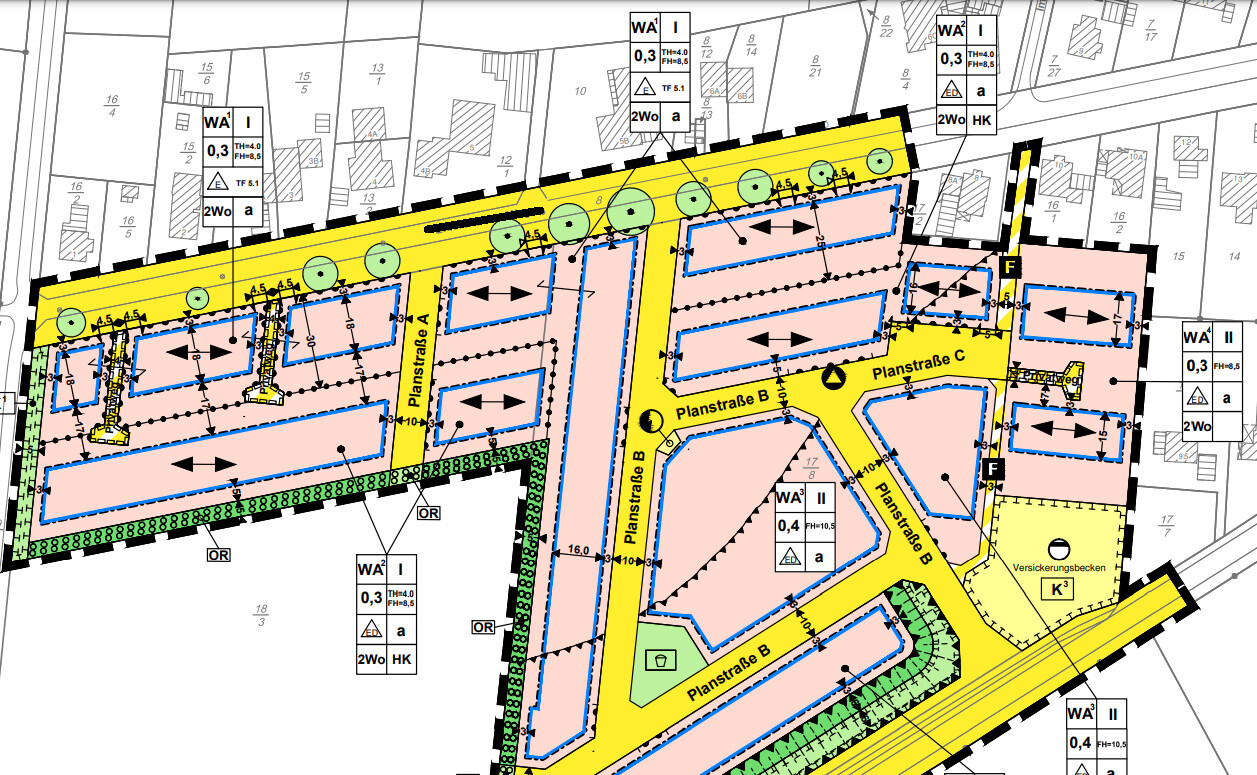
Development Plan/Restrictions
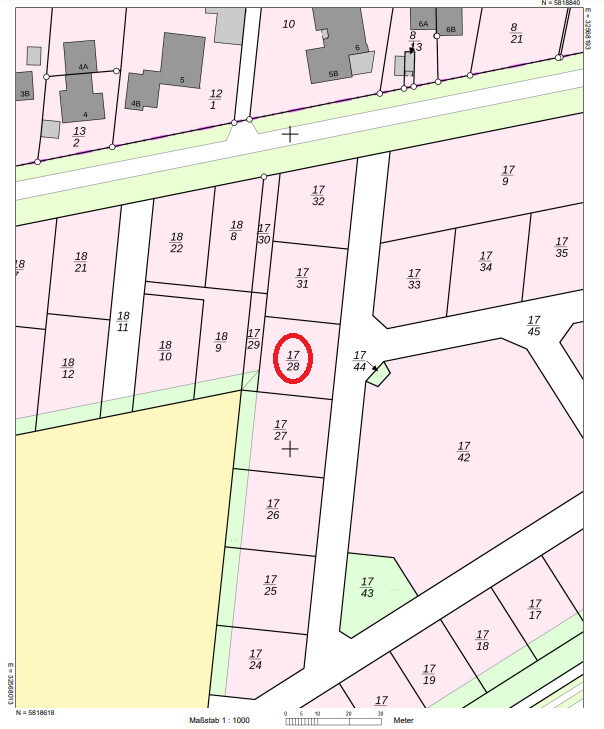
Plot size 576 sqm (approx. 6195 sq ft) - parcel 17/28 (see cadastral map)
Slope no – the plot has only a few centimeters (inches) of elevation difference
Floor area ratio (FAR) 0.3 = 172.8 sqm (1861 sq ft)
Plot ratio not defined
Building envelope, building line and boundary 24x24 meter (79x79 feet) plot = N-E-S-W 16x18x16x18 meter (52x59x52x59 feet) building envelope
Edge development no, exceptions possibly according to Lower Saxony Building Regulations
Required number of parking spaces not specified
Number of floors single storey
Roof shape gable/hip/half-hip with 35-50 degree pitch
Architectural style classic detached house
Ridge direction specified = ridge line running west-east
Max height limits ridge height 4.0 m (13 ft), eaves height 8.5 m (28 ft)
Additional rules no oil heating, 50% of the south-facing roof must have solar panels, no building allowed between house and street (e.g., no parking or similar in front yard)
The plot has been purchased and the utility infrastructure in the new development area is already completed (our plot is even located on a pre-asphalted road).
Homeowner Requirements
Style, roof shape, building type solid wooden house made of massive log beams inside, blown insulation, and exterior cladding
Basement, floors no basement – only ground floor + upper floor
Number of occupants, ages three, aged 36, 29, and five and a half
Space requirements on ground and upper floors standard single-family home with 3 bedrooms plus bathroom upstairs, open-plan living area downstairs, guest WC, and large utility/housekeeping room
Office: family use or home office? One room currently usable as office/guest room (backup for future child needs), currently neither of us have jobs with home office option
Open or closed layout living/dining/kitchen preferably open
Conservative or modern construction style conservative
Open kitchen, kitchen island open kitchen yes, kitchen island currently not planned
Number of dining seats daily use for 3, but dining nook should be sufficient for more people
Fireplace planned is a masonry stove
Music/stereo wall no
Balcony, roof terrace no
Garage, carport carport with workshop
Utility garden, greenhouse no
Other wishes/special features/daily routine, including reasons why some things are included or excluded
House Design
Who designed the plan: plan based on our principles, then optimized with the manufacturer’s in-house architect
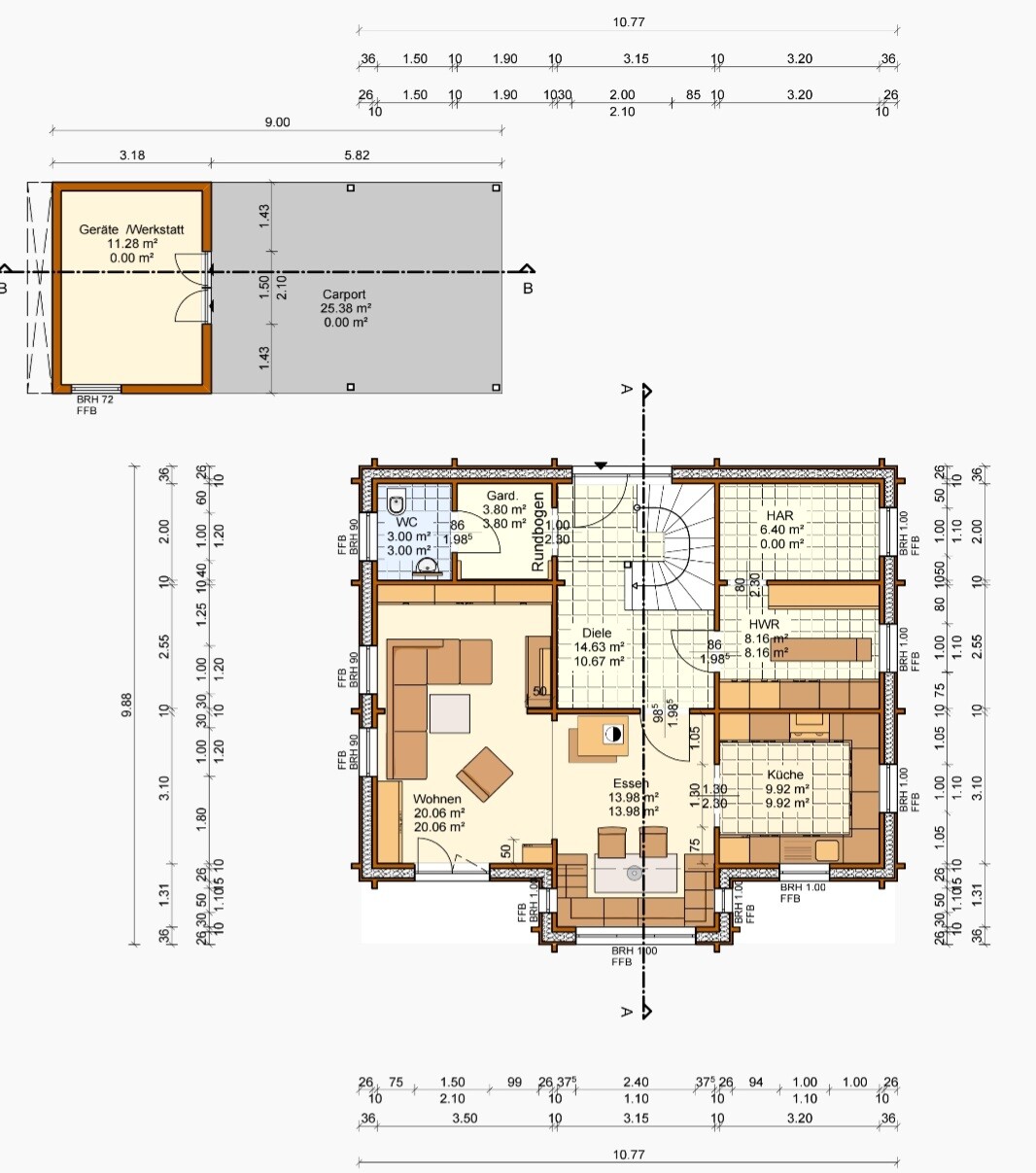
What do you particularly like? Why? We really like the extended dining nook with the surrounding bench; overall, our ideas about room sizes have been well implemented – whether everything will really work as we imagine, we would like to ask here.
What do you dislike? Why? The chimney’s position might be bothersome in the children's room? Or is that negligible in daily life? We are still not satisfied with the kitchen and bathroom upstairs and are currently looking for a good furnishing/decorating solution.
Price estimate according to architect/planner: Since we are not working with a general contractor but will handle contracts ourselves after the shell is built and do a lot of work ourselves, we don’t have all numbers yet. The following trades are currently being costed.
Personal price limit for the house including fittings: 400,000 up to move-in ready, excluding everything outside the building itself, plot is paid
Preferred heating technology: heat pump with underfloor heating plus photovoltaics with possible storage
If you have to give up something, which details/extensions
- can you do without: We have tried to adapt our demands to the budget as much as possible – does anyone see further savings potential?
- can you not do without: As an absolute last resort, we would remove the dining nook and redesign the ground floor – also, the masonry stove is fixed for us (we just love this cozy atmosphere).
Why is the design the way it is now?
Standard plan from planner? The manufacturer does not offer standard houses; everything is individually designed
Which of your wishes were implemented by the architect? The current plan reflects our wishes quite well. Now we just need fine-tuning, and we hope for your assessments, ideas, and experiences.
A mix of many examples from various magazines... Of course, our inspirations come from many different sources (good and bad…) 😀
What makes it particularly good or bad in your opinion? It feels good to us so far – all our furniture fits, and the things that bother us in our current rented house have been eliminated in the design.
What is the most important/basic question about the layout, summarized in 130 characters?
- Does the layout work as it is, or are there specific arrangements that don’t work?
- Is the position and number of windows sufficient?
- Do the children's rooms upstairs need two roof windows or is one enough each?
- Have we missed or overlooked anything important?
- Can a U-shaped kitchen be sensibly planned in the existing space, or do we need to adjust walls downstairs first?
- Are the door positions appropriate regarding width, wall distance, and opening direction?
- Is the utility room (unfurnished room behind the laundry on the north/east side of the ground floor) dimensionally adequate?
- What knee wall height is recommended upstairs? Currently at 40 cm (16 in), we plan to raise it because otherwise, especially the upstairs bathroom will be problematic (though we don’t want a large bathroom, just “as big as necessary” – we would probably place the bathtub in the northeast corner of the room – would that fit?
- We’d like to add a laundry chute from the upstairs bathroom to the utility room – does anyone have a good idea for the best location?
One final note on our general concept:
We intend to buy the house from the manufacturer including insulation, cladding, and roof structure. Assembly will follow the “master carpenter assembly” principle (the company provides two experienced workers, plus 4-5 helpers from us – full warranty and savings of around 15,000-20,000 euros, about three to four weeks of hard work). The manufacturer’s “basic package” also includes windows and the front door, as they must be specially installed due to the house settling.
We plan to contract the foundation slab, roofing, and plumbing work separately. Electrical work (in consultation with the local master electrician), interior finishing (room doors, screed, underfloor heating, floor covering), and small tasks can be done by my partner (trained electrician, highly interested in almost everything, skilled and experienced with wood). I work professionally in an office of a building materials supplier, so I have access to good conditions, storage capacity, and established contacts in the industry. We also have great friends and a large family who are all enthusiastic about our project and willing to support us. We know this will require a lot of work, strain our time, nerves, and budget—but we want to give it a try.
We are now looking forward to suggestions, critical comments, and anything that can help us avoid as many mistakes as possible during the process.
Thank you very much in advance!

Here are some details—based on our best knowledge and judgment—about our house construction project...
Development Plan/Restrictions
Plot size 576 sqm (approx. 6195 sq ft) - parcel 17/28 (see cadastral map)
Slope no – the plot has only a few centimeters (inches) of elevation difference
Floor area ratio (FAR) 0.3 = 172.8 sqm (1861 sq ft)
Plot ratio not defined
Building envelope, building line and boundary 24x24 meter (79x79 feet) plot = N-E-S-W 16x18x16x18 meter (52x59x52x59 feet) building envelope
Edge development no, exceptions possibly according to Lower Saxony Building Regulations
Required number of parking spaces not specified
Number of floors single storey
Roof shape gable/hip/half-hip with 35-50 degree pitch
Architectural style classic detached house
Ridge direction specified = ridge line running west-east
Max height limits ridge height 4.0 m (13 ft), eaves height 8.5 m (28 ft)
Additional rules no oil heating, 50% of the south-facing roof must have solar panels, no building allowed between house and street (e.g., no parking or similar in front yard)
The plot has been purchased and the utility infrastructure in the new development area is already completed (our plot is even located on a pre-asphalted road).
Homeowner Requirements
Style, roof shape, building type solid wooden house made of massive log beams inside, blown insulation, and exterior cladding
Basement, floors no basement – only ground floor + upper floor
Number of occupants, ages three, aged 36, 29, and five and a half
Space requirements on ground and upper floors standard single-family home with 3 bedrooms plus bathroom upstairs, open-plan living area downstairs, guest WC, and large utility/housekeeping room
Office: family use or home office? One room currently usable as office/guest room (backup for future child needs), currently neither of us have jobs with home office option
Open or closed layout living/dining/kitchen preferably open
Conservative or modern construction style conservative
Open kitchen, kitchen island open kitchen yes, kitchen island currently not planned
Number of dining seats daily use for 3, but dining nook should be sufficient for more people
Fireplace planned is a masonry stove
Music/stereo wall no
Balcony, roof terrace no
Garage, carport carport with workshop
Utility garden, greenhouse no
Other wishes/special features/daily routine, including reasons why some things are included or excluded
House Design
Who designed the plan: plan based on our principles, then optimized with the manufacturer’s in-house architect
What do you particularly like? Why? We really like the extended dining nook with the surrounding bench; overall, our ideas about room sizes have been well implemented – whether everything will really work as we imagine, we would like to ask here.
What do you dislike? Why? The chimney’s position might be bothersome in the children's room? Or is that negligible in daily life? We are still not satisfied with the kitchen and bathroom upstairs and are currently looking for a good furnishing/decorating solution.
Price estimate according to architect/planner: Since we are not working with a general contractor but will handle contracts ourselves after the shell is built and do a lot of work ourselves, we don’t have all numbers yet. The following trades are currently being costed.
Personal price limit for the house including fittings: 400,000 up to move-in ready, excluding everything outside the building itself, plot is paid
Preferred heating technology: heat pump with underfloor heating plus photovoltaics with possible storage
If you have to give up something, which details/extensions
- can you do without: We have tried to adapt our demands to the budget as much as possible – does anyone see further savings potential?
- can you not do without: As an absolute last resort, we would remove the dining nook and redesign the ground floor – also, the masonry stove is fixed for us (we just love this cozy atmosphere).
Why is the design the way it is now?
Standard plan from planner? The manufacturer does not offer standard houses; everything is individually designed
Which of your wishes were implemented by the architect? The current plan reflects our wishes quite well. Now we just need fine-tuning, and we hope for your assessments, ideas, and experiences.
A mix of many examples from various magazines... Of course, our inspirations come from many different sources (good and bad…) 😀
What makes it particularly good or bad in your opinion? It feels good to us so far – all our furniture fits, and the things that bother us in our current rented house have been eliminated in the design.
What is the most important/basic question about the layout, summarized in 130 characters?
- Does the layout work as it is, or are there specific arrangements that don’t work?
- Is the position and number of windows sufficient?
- Do the children's rooms upstairs need two roof windows or is one enough each?
- Have we missed or overlooked anything important?
- Can a U-shaped kitchen be sensibly planned in the existing space, or do we need to adjust walls downstairs first?
- Are the door positions appropriate regarding width, wall distance, and opening direction?
- Is the utility room (unfurnished room behind the laundry on the north/east side of the ground floor) dimensionally adequate?
- What knee wall height is recommended upstairs? Currently at 40 cm (16 in), we plan to raise it because otherwise, especially the upstairs bathroom will be problematic (though we don’t want a large bathroom, just “as big as necessary” – we would probably place the bathtub in the northeast corner of the room – would that fit?
- We’d like to add a laundry chute from the upstairs bathroom to the utility room – does anyone have a good idea for the best location?
One final note on our general concept:
We intend to buy the house from the manufacturer including insulation, cladding, and roof structure. Assembly will follow the “master carpenter assembly” principle (the company provides two experienced workers, plus 4-5 helpers from us – full warranty and savings of around 15,000-20,000 euros, about three to four weeks of hard work). The manufacturer’s “basic package” also includes windows and the front door, as they must be specially installed due to the house settling.
We plan to contract the foundation slab, roofing, and plumbing work separately. Electrical work (in consultation with the local master electrician), interior finishing (room doors, screed, underfloor heating, floor covering), and small tasks can be done by my partner (trained electrician, highly interested in almost everything, skilled and experienced with wood). I work professionally in an office of a building materials supplier, so I have access to good conditions, storage capacity, and established contacts in the industry. We also have great friends and a large family who are all enthusiastic about our project and willing to support us. We know this will require a lot of work, strain our time, nerves, and budget—but we want to give it a try.
We are now looking forward to suggestions, critical comments, and anything that can help us avoid as many mistakes as possible during the process.
Thank you very much in advance!

-LotteS- schrieb:
The provider might also offer a completely different wall structure – but then it wouldn’t really be a log house anymore... That explains a lot. Timber house builders need to make a clear “religious” choice for one method (log/solid log, massive timber, or similar) – otherwise, they risk not being able to adapt their systems convincingly to current standards.
-LotteS- schrieb:
The main issue here is the zoning plan or the eaves height. No, a zoning plan or building permit / planning permission is not meant to compensate for weaknesses in the system design of individual house suppliers. Eaves height requirements are generally reasonable, and in your case, they are basically not inappropriate, even though nearly every builder wishes for more.
-LotteS- schrieb:
There are some good manufacturers who could build what we have in mind – however, we don’t have 500,000 just for the house in the budget. So unfortunately, some options are ruled out from the start. I also have a catalog from Stommel, but I had them on my “too expensive” list. Am I wrong? As I said, I don’t personally know if they offer shell houses; at least @neo-sciliar convinced me that they now build quite respectable houses that fit well even in small villages in the Westerwald area. @Holzhäuschen (I’ve found out myself now, they use Fullwood) mentioned in post #20 that this manufacturer also has some detail weaknesses. Within the timber construction community, though, it should not be too hard to find another supplier who can connect compatibly.
https://www.instagram.com/11antgmxde/
https://www.linkedin.com/company/bauen-jetzt/

Especially the "insulation only between rafters" combined with "only 4.0m (13 feet) eave height," then deliberately choosing a valuable 24–30cm (9.5–12 inches) of insulation between rafters and thus giving up additional headroom, is just nonsensical – isn’t it?
Maybe he doesn’t like the extremely tedious work of installing insulation between rafters? But that can easily be done by a team of around 7 players in a weekend with DIY effort ;-) Maybe THIS is the alternative?
Maybe he doesn’t like the extremely tedious work of installing insulation between rafters? But that can easily be done by a team of around 7 players in a weekend with DIY effort ;-) Maybe THIS is the alternative?

i_b_n_a_n schrieb:
Especially the "only insulation between rafters" combined with "only 4.0m (13 feet) eave height"—then deliberately giving up valuable 24–30cm (9.5–12 inches) of insulation thickness between rafters and thus extra ceiling height—seems completely illogical, doesn’t it?These issues only emerged one after another during the planning process, and we tried to find a solution with the manufacturer. The construction options and limitations of this manufacturer define the parameters mentioned above, at least if we want to stick with the log plank construction, which is our preference. We really like the charm of the exposed roof truss—and when we first fell for it, all these problems that came up during the planning phase were still far away...
We like the basic concept, but of course, it has some unfavorable constraints for us—and as @11ant already said: the zoning plan cannot be blamed for the manufacturer’s limitations.
@WilderSueden The “extra cost” for KfW40 standard (although I don’t know what the reference value is exactly) is around 10,000 euros. They would even be NH certified.
I just read today that funding of up to 100,000 euros should also be available for KfW40 without NH certification? Does anyone have more detailed information? I haven’t found anything yet... It might be worth calculating this in case.
@11ant
I looked up the Stommel catalog... For example, the house model Blaufichte 01 (142 m² [1,527 ft²]) is listed on an insert with prices from June 2022: $241,000 as a shell house, $343,000 almost turnkey (whatever that means), and $400,000 fully turnkey. The floor plan is similar in size to ours, just with a different interior layout. Although they don’t use log beams, they work with cork insulation and exposed beams – so we will definitely take a closer look at that. The catalog doesn’t provide much detailed information, so a personal conversation is probably the only way to get more clarity – let’s see if I can reach someone on the phone tomorrow. I’m stuck at home anyway at the moment, so I have some time. Thanks for the suggestion to take a closer look at it.
I looked up the Stommel catalog... For example, the house model Blaufichte 01 (142 m² [1,527 ft²]) is listed on an insert with prices from June 2022: $241,000 as a shell house, $343,000 almost turnkey (whatever that means), and $400,000 fully turnkey. The floor plan is similar in size to ours, just with a different interior layout. Although they don’t use log beams, they work with cork insulation and exposed beams – so we will definitely take a closer look at that. The catalog doesn’t provide much detailed information, so a personal conversation is probably the only way to get more clarity – let’s see if I can reach someone on the phone tomorrow. I’m stuck at home anyway at the moment, so I have some time. Thanks for the suggestion to take a closer look at it.

I see a conceptually stuck floor plan here, in my opinion. It is difficult to achieve complete satisfaction as long as the relationship between knee wall height and floor area is not fully understood. The lower the knee wall, the larger the ground floor needs to be in order to design usable rooms on the upper floor. This often leads to the realization that sometimes it is more cost-effective to include some rooms, such as the bedroom, on the ground floor. Otherwise, the house becomes unnecessarily oversized. Alternatively, you would have to implement expensive workarounds like dormers, which overall tend to be more costly than simply increasing the floor area.
K a t j a schrieb:
In my opinion, this is a conceptually stuck floor plan. It is difficult to achieve 100% satisfaction as long as the relationship between knee wall height and floor area is not internalized. The lower the knee wall, the larger the ground floor must be to design functional rooms on the upper floor. This often leads to the realization that sometimes it is more cost-effective to place certain rooms, like the bedroom, on the ground floor. Otherwise, the house becomes unnecessarily oversized. Alternatively, you have to implement expensive compromises like dormers, which end up costing more than simply increasing the floor area.We have just come up with an idea about this... but my son needs to go to bed. It’s a great idea that is still feasible within the building envelope. We would need to recalculate carefully for the exterior landscaping.
Roughly sketched in writing: enlarge the house by 2.00m (6 ft 7 in) along the north-south axis, so that the guest WC can be moved to the east side at the northeast corner, leaving the staircase in place to avoid the dirty zone. Under the stairs, there could even still be a utility room door. Then create a roughly 4 x 3.70m (13 ft 1 in x 12 ft 2 in) room on the northwest side using the gained 2 meters plus the 2 meters without the guest WC—the rest of the ground floor could remain the same. On the upper floor, one of the two extra meters in the bathroom could be used as a storage space (eaves area), allowing the main bathroom layout to start at a height of 1.30m (4 ft 3 in). The southeast room could be extended to the corridor wall (which is the extended bedroom wall), and the actual children’s room would then run the entire north-south length with a width of 3.70m (12 ft 2 in). In the southeast room, as originally suggested by Elefant, the dining area could be assigned to a room as a captain’s gable.
I wouldn’t need Velux windows this way, since I can realize enough window area on the gable sides.
Is this roughly what you had in mind? Or did I misunderstand you? In this variant, we would have to check whether the additional 20 square meters (215 sq ft) of floor area would actually be more cost-effective than multiple gables and roof windows.
Similar topics