
ᐅ Floor Plan Design for a Single-Family House, Solid Wood Construction, 140 sqm in Lower Saxony
Created on: 2 Jan 2023 15:30
-
-LotteS-
Hello dear house building forum!
Here are some details—based on our best knowledge and judgment—about our house construction project...
Development Plan/Restrictions
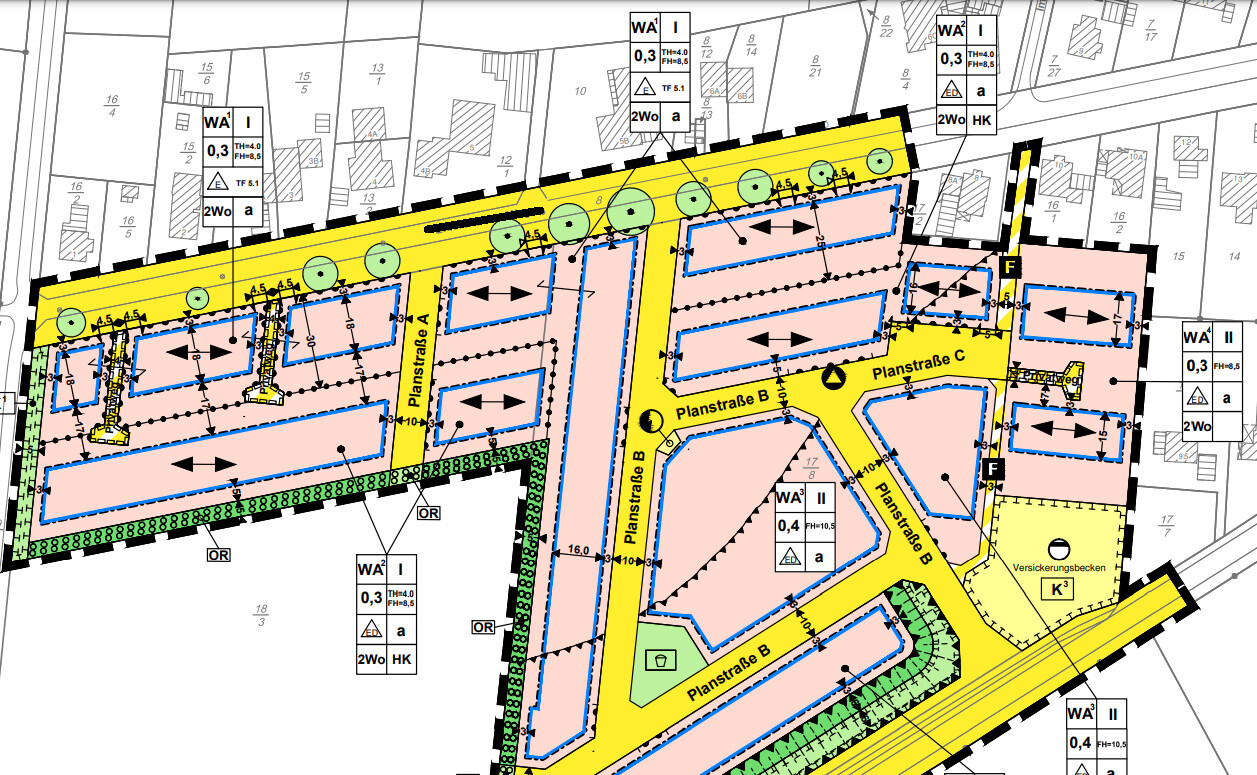
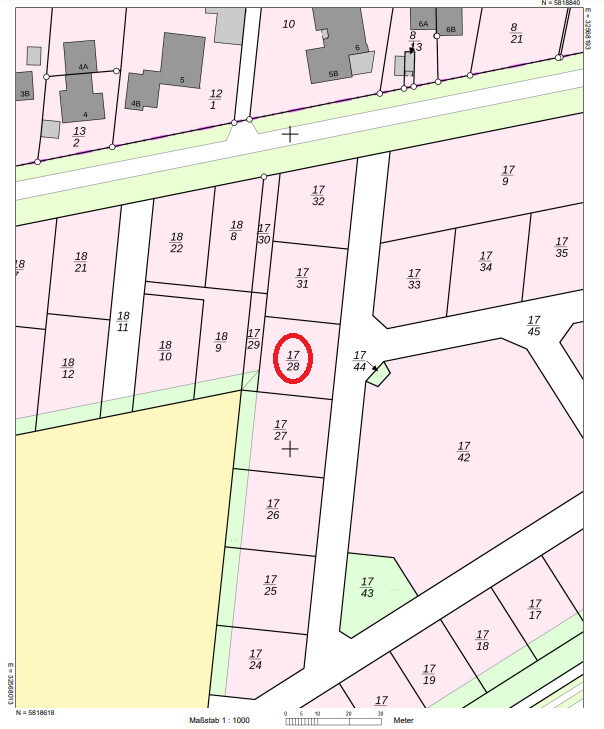
Plot size 576 sqm (approx. 6195 sq ft) - parcel 17/28 (see cadastral map)
Slope no – the plot has only a few centimeters (inches) of elevation difference
Floor area ratio (FAR) 0.3 = 172.8 sqm (1861 sq ft)
Plot ratio not defined
Building envelope, building line and boundary 24x24 meter (79x79 feet) plot = N-E-S-W 16x18x16x18 meter (52x59x52x59 feet) building envelope
Edge development no, exceptions possibly according to Lower Saxony Building Regulations
Required number of parking spaces not specified
Number of floors single storey
Roof shape gable/hip/half-hip with 35-50 degree pitch
Architectural style classic detached house
Ridge direction specified = ridge line running west-east
Max height limits ridge height 4.0 m (13 ft), eaves height 8.5 m (28 ft)
Additional rules no oil heating, 50% of the south-facing roof must have solar panels, no building allowed between house and street (e.g., no parking or similar in front yard)
The plot has been purchased and the utility infrastructure in the new development area is already completed (our plot is even located on a pre-asphalted road).
Homeowner Requirements
Style, roof shape, building type solid wooden house made of massive log beams inside, blown insulation, and exterior cladding
Basement, floors no basement – only ground floor + upper floor
Number of occupants, ages three, aged 36, 29, and five and a half
Space requirements on ground and upper floors standard single-family home with 3 bedrooms plus bathroom upstairs, open-plan living area downstairs, guest WC, and large utility/housekeeping room
Office: family use or home office? One room currently usable as office/guest room (backup for future child needs), currently neither of us have jobs with home office option
Open or closed layout living/dining/kitchen preferably open
Conservative or modern construction style conservative
Open kitchen, kitchen island open kitchen yes, kitchen island currently not planned
Number of dining seats daily use for 3, but dining nook should be sufficient for more people
Fireplace planned is a masonry stove
Music/stereo wall no
Balcony, roof terrace no
Garage, carport carport with workshop
Utility garden, greenhouse no
Other wishes/special features/daily routine, including reasons why some things are included or excluded
House Design
Who designed the plan: plan based on our principles, then optimized with the manufacturer’s in-house architect
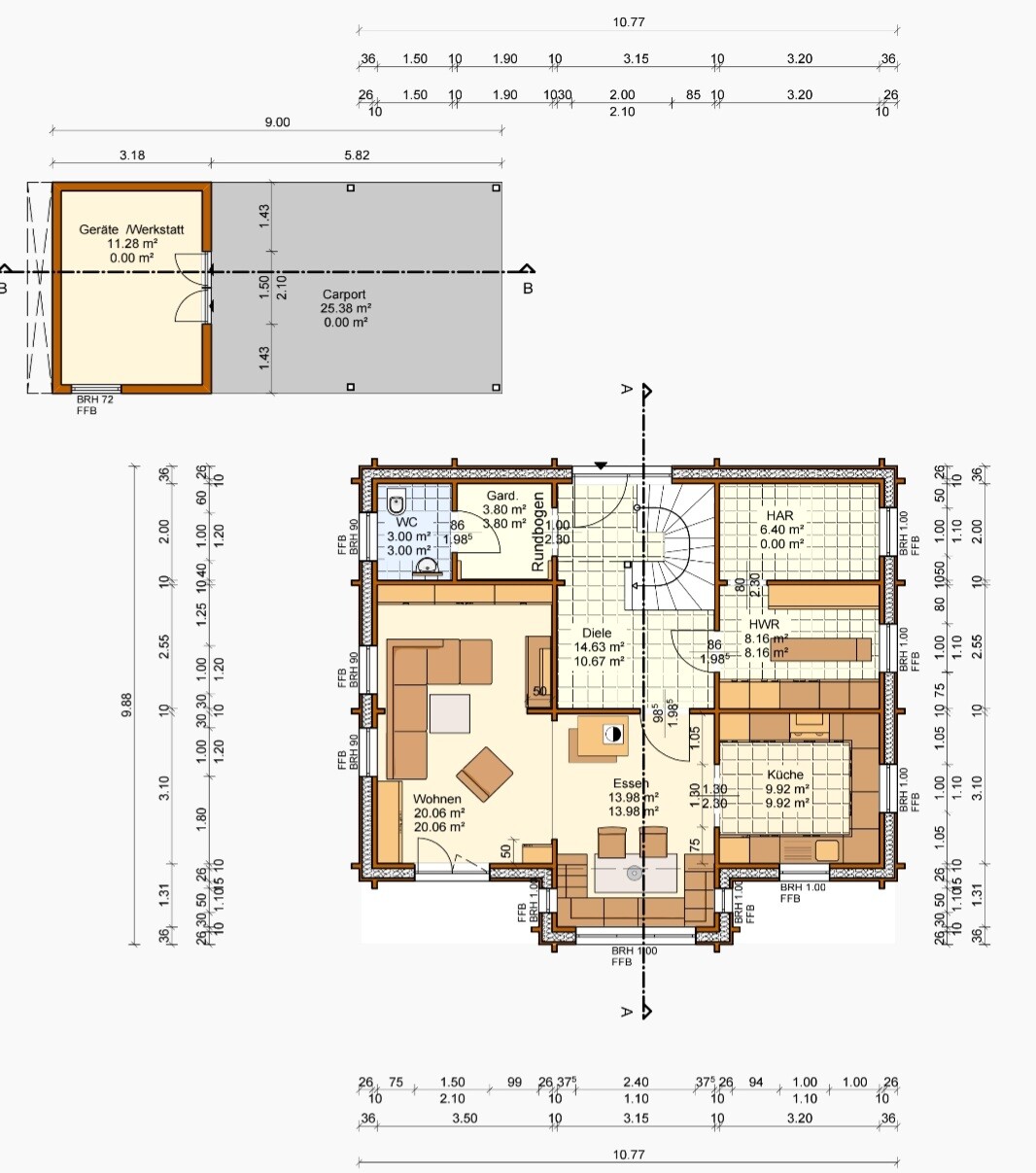
What do you particularly like? Why? We really like the extended dining nook with the surrounding bench; overall, our ideas about room sizes have been well implemented – whether everything will really work as we imagine, we would like to ask here.
What do you dislike? Why? The chimney’s position might be bothersome in the children's room? Or is that negligible in daily life? We are still not satisfied with the kitchen and bathroom upstairs and are currently looking for a good furnishing/decorating solution.
Price estimate according to architect/planner: Since we are not working with a general contractor but will handle contracts ourselves after the shell is built and do a lot of work ourselves, we don’t have all numbers yet. The following trades are currently being costed.
Personal price limit for the house including fittings: 400,000 up to move-in ready, excluding everything outside the building itself, plot is paid
Preferred heating technology: heat pump with underfloor heating plus photovoltaics with possible storage
If you have to give up something, which details/extensions
- can you do without: We have tried to adapt our demands to the budget as much as possible – does anyone see further savings potential?
- can you not do without: As an absolute last resort, we would remove the dining nook and redesign the ground floor – also, the masonry stove is fixed for us (we just love this cozy atmosphere).
Why is the design the way it is now?
Standard plan from planner? The manufacturer does not offer standard houses; everything is individually designed
Which of your wishes were implemented by the architect? The current plan reflects our wishes quite well. Now we just need fine-tuning, and we hope for your assessments, ideas, and experiences.
A mix of many examples from various magazines... Of course, our inspirations come from many different sources (good and bad…) 😀
What makes it particularly good or bad in your opinion? It feels good to us so far – all our furniture fits, and the things that bother us in our current rented house have been eliminated in the design.
What is the most important/basic question about the layout, summarized in 130 characters?
- Does the layout work as it is, or are there specific arrangements that don’t work?
- Is the position and number of windows sufficient?
- Do the children's rooms upstairs need two roof windows or is one enough each?
- Have we missed or overlooked anything important?
- Can a U-shaped kitchen be sensibly planned in the existing space, or do we need to adjust walls downstairs first?
- Are the door positions appropriate regarding width, wall distance, and opening direction?
- Is the utility room (unfurnished room behind the laundry on the north/east side of the ground floor) dimensionally adequate?
- What knee wall height is recommended upstairs? Currently at 40 cm (16 in), we plan to raise it because otherwise, especially the upstairs bathroom will be problematic (though we don’t want a large bathroom, just “as big as necessary” – we would probably place the bathtub in the northeast corner of the room – would that fit?
- We’d like to add a laundry chute from the upstairs bathroom to the utility room – does anyone have a good idea for the best location?
One final note on our general concept:
We intend to buy the house from the manufacturer including insulation, cladding, and roof structure. Assembly will follow the “master carpenter assembly” principle (the company provides two experienced workers, plus 4-5 helpers from us – full warranty and savings of around 15,000-20,000 euros, about three to four weeks of hard work). The manufacturer’s “basic package” also includes windows and the front door, as they must be specially installed due to the house settling.
We plan to contract the foundation slab, roofing, and plumbing work separately. Electrical work (in consultation with the local master electrician), interior finishing (room doors, screed, underfloor heating, floor covering), and small tasks can be done by my partner (trained electrician, highly interested in almost everything, skilled and experienced with wood). I work professionally in an office of a building materials supplier, so I have access to good conditions, storage capacity, and established contacts in the industry. We also have great friends and a large family who are all enthusiastic about our project and willing to support us. We know this will require a lot of work, strain our time, nerves, and budget—but we want to give it a try.
We are now looking forward to suggestions, critical comments, and anything that can help us avoid as many mistakes as possible during the process.
Thank you very much in advance!

Here are some details—based on our best knowledge and judgment—about our house construction project...
Development Plan/Restrictions
Plot size 576 sqm (approx. 6195 sq ft) - parcel 17/28 (see cadastral map)
Slope no – the plot has only a few centimeters (inches) of elevation difference
Floor area ratio (FAR) 0.3 = 172.8 sqm (1861 sq ft)
Plot ratio not defined
Building envelope, building line and boundary 24x24 meter (79x79 feet) plot = N-E-S-W 16x18x16x18 meter (52x59x52x59 feet) building envelope
Edge development no, exceptions possibly according to Lower Saxony Building Regulations
Required number of parking spaces not specified
Number of floors single storey
Roof shape gable/hip/half-hip with 35-50 degree pitch
Architectural style classic detached house
Ridge direction specified = ridge line running west-east
Max height limits ridge height 4.0 m (13 ft), eaves height 8.5 m (28 ft)
Additional rules no oil heating, 50% of the south-facing roof must have solar panels, no building allowed between house and street (e.g., no parking or similar in front yard)
The plot has been purchased and the utility infrastructure in the new development area is already completed (our plot is even located on a pre-asphalted road).
Homeowner Requirements
Style, roof shape, building type solid wooden house made of massive log beams inside, blown insulation, and exterior cladding
Basement, floors no basement – only ground floor + upper floor
Number of occupants, ages three, aged 36, 29, and five and a half
Space requirements on ground and upper floors standard single-family home with 3 bedrooms plus bathroom upstairs, open-plan living area downstairs, guest WC, and large utility/housekeeping room
Office: family use or home office? One room currently usable as office/guest room (backup for future child needs), currently neither of us have jobs with home office option
Open or closed layout living/dining/kitchen preferably open
Conservative or modern construction style conservative
Open kitchen, kitchen island open kitchen yes, kitchen island currently not planned
Number of dining seats daily use for 3, but dining nook should be sufficient for more people
Fireplace planned is a masonry stove
Music/stereo wall no
Balcony, roof terrace no
Garage, carport carport with workshop
Utility garden, greenhouse no
Other wishes/special features/daily routine, including reasons why some things are included or excluded
House Design
Who designed the plan: plan based on our principles, then optimized with the manufacturer’s in-house architect
What do you particularly like? Why? We really like the extended dining nook with the surrounding bench; overall, our ideas about room sizes have been well implemented – whether everything will really work as we imagine, we would like to ask here.
What do you dislike? Why? The chimney’s position might be bothersome in the children's room? Or is that negligible in daily life? We are still not satisfied with the kitchen and bathroom upstairs and are currently looking for a good furnishing/decorating solution.
Price estimate according to architect/planner: Since we are not working with a general contractor but will handle contracts ourselves after the shell is built and do a lot of work ourselves, we don’t have all numbers yet. The following trades are currently being costed.
Personal price limit for the house including fittings: 400,000 up to move-in ready, excluding everything outside the building itself, plot is paid
Preferred heating technology: heat pump with underfloor heating plus photovoltaics with possible storage
If you have to give up something, which details/extensions
- can you do without: We have tried to adapt our demands to the budget as much as possible – does anyone see further savings potential?
- can you not do without: As an absolute last resort, we would remove the dining nook and redesign the ground floor – also, the masonry stove is fixed for us (we just love this cozy atmosphere).
Why is the design the way it is now?
Standard plan from planner? The manufacturer does not offer standard houses; everything is individually designed
Which of your wishes were implemented by the architect? The current plan reflects our wishes quite well. Now we just need fine-tuning, and we hope for your assessments, ideas, and experiences.
A mix of many examples from various magazines... Of course, our inspirations come from many different sources (good and bad…) 😀
What makes it particularly good or bad in your opinion? It feels good to us so far – all our furniture fits, and the things that bother us in our current rented house have been eliminated in the design.
What is the most important/basic question about the layout, summarized in 130 characters?
- Does the layout work as it is, or are there specific arrangements that don’t work?
- Is the position and number of windows sufficient?
- Do the children's rooms upstairs need two roof windows or is one enough each?
- Have we missed or overlooked anything important?
- Can a U-shaped kitchen be sensibly planned in the existing space, or do we need to adjust walls downstairs first?
- Are the door positions appropriate regarding width, wall distance, and opening direction?
- Is the utility room (unfurnished room behind the laundry on the north/east side of the ground floor) dimensionally adequate?
- What knee wall height is recommended upstairs? Currently at 40 cm (16 in), we plan to raise it because otherwise, especially the upstairs bathroom will be problematic (though we don’t want a large bathroom, just “as big as necessary” – we would probably place the bathtub in the northeast corner of the room – would that fit?
- We’d like to add a laundry chute from the upstairs bathroom to the utility room – does anyone have a good idea for the best location?
One final note on our general concept:
We intend to buy the house from the manufacturer including insulation, cladding, and roof structure. Assembly will follow the “master carpenter assembly” principle (the company provides two experienced workers, plus 4-5 helpers from us – full warranty and savings of around 15,000-20,000 euros, about three to four weeks of hard work). The manufacturer’s “basic package” also includes windows and the front door, as they must be specially installed due to the house settling.
We plan to contract the foundation slab, roofing, and plumbing work separately. Electrical work (in consultation with the local master electrician), interior finishing (room doors, screed, underfloor heating, floor covering), and small tasks can be done by my partner (trained electrician, highly interested in almost everything, skilled and experienced with wood). I work professionally in an office of a building materials supplier, so I have access to good conditions, storage capacity, and established contacts in the industry. We also have great friends and a large family who are all enthusiastic about our project and willing to support us. We know this will require a lot of work, strain our time, nerves, and budget—but we want to give it a try.
We are now looking forward to suggestions, critical comments, and anything that can help us avoid as many mistakes as possible during the process.
Thank you very much in advance!

-LotteS- schrieb:
Doesn’t every custom floor plan need to be built 50 times first to see if it works? A shot from an architect without quotation marks should hit the mark on the first try since there is a preliminary design phase (and a degree after all). Maybe you could also show or name the model house ;- )
-LotteS- schrieb:
I can’t quite imagine in my head what exactly you want to rotate… Could you try explaining that more precisely? Within the scope of fee-exempt manageable effort: see sketch (scale fitting not checked in detail). There you can also see in the rotated house in red the change in the wall alignment between the children’s and spare rooms, as well as the captain’s gable. So you’re also on the wrong track—I would want to move the bay window.
-LotteS- schrieb:
Is there a rule of thumb for window sizes based on room sizes or wall widths? As a minimum standard, about one eighth of the floor area as window area.
https://www.instagram.com/11antgmxde/
https://www.linkedin.com/company/bauen-jetzt/

11ant schrieb:
With an architect—no quotation marks needed—the first attempt should already hit the mark, after all, there is the preliminary design phase (and a degree). Maybe you could also show or name the model house ;-) I certainly have no intention of discrediting the profession; my response was meant more humorously in reply to your side comment—sorry if it came across differently. 🙂
“Model house” is a bit of an exaggeration, since this is also a custom floor plan. However, we really liked some elements from the visit that we adapted. Am I even allowed to mention the manufacturer’s name here?
11ant schrieb:
Within the scope of free effort: see sketch (scale fitting not checked in detail). In the rotated house you can also see in red the change in the wall layout between the children’s room and the spare room, as well as the captain’s gable. So you’re also on the wrong track—I would want to move the bay window. Oh, I didn’t expect that. I will have to take a closer look and check whether this is even structurally possible for our building method and how to properly integrate the chimney there. Thanks for the interesting suggestion 🙂

-LotteS- schrieb:
The arch ... seemed quite fitting and charming to us – I didn’t really perceive it as deliberately 70s or old-fashioned. Maybe that’s because I hardly ever enter new-build houses and obviously I’m not up to date. We currently live in a 200-year-old half-timbered house, ....
What exactly distinguishes a 1980s kitchen from a 2020s kitchen?...
However, I have never worked at one of those kitchen islands with four sides (doesn’t stuff constantly fall off all around?) and that bar counter solution really isn’t for me. -LotteS- schrieb:
The idea of a window seat is interesting, but I had to look it up. I’ve never seen that anywhere before. Does anyone actually use it in everyday life?-LotteS- schrieb:
I was just mentally going through the floor plans of our families and friends. None of them have direct access to the main terrace from the kitchen
...Reading this, one can’t help but smile a little. It sounds somewhat like the little wooden house in the forest behind the seven mountains with the seven dwarfs, who hardly experience any Real Life. That’s fine, but for me, modern housebuilding is not a matter of fashion. Of course, tastes vary, but dark traditional farmhouses with small windows and low ceilings just aren’t up to date in new builds. The same goes for impractical dining corners, kitchens that are hard to plan, arched doors, or missing connections from main rooms to the terrace. You can certainly build like that, but you forgo decades of experience and developments made by the industry. I want to stress that I’m deliberately exaggerating here – this isn’t a huge problem or a game changer, but possibly a little unfortunate somewhere.-LotteS- schrieb:
In real life, we won’t be sitting at the table daily with a large family and nine children. However, without this extended dining corner in a 140sqm (1507 sq ft) house, we probably wouldn’t be able to invite more than 6 to 8 guests for dinner – otherwise you face the same problems: the big uncle sits right at the bottleneck, if someone wants to get through everyone has to shuffle, and eventually someone stumbles and spills the potatoes all over the table. In everyday life, the child doesn’t push the chair back properly and I stub my little toe on it because everything is too narrow. Here I’d like to disagree. It is definitely possible to plan a proper dining area for 8 people in a 140sqm (1507 sq ft) house. Of course, it’s always a matter of priorities, but nowadays(!) it’s not an issue. No one gets stuck on chairs or trips over potatoes. The built-in corner bench with U-shape can’t compare to a more open dining area. But I understand the longing for the nostalgic dining bench from grandparents...-LotteS- schrieb:
For me, though, it was always very cozy and really sociable, not annoying at all. I just hope you’re not rebuilding your childhood memories and later getting disappointed at how annoying it actually was for the adults.-LotteS- schrieb:
Are my expectations for a new build just too low, so I see essential improvements as a success, even though, viewed objectively, they are still awkward and impractical?I would honestly answer that with “yes, a bit.” Around 50 to 100 years of development seems to have passed you by. One should not confuse coziness with practicality or taste. There are newly built country houses that, together with their interior, would warm even my grandmother’s heart and yet are absolutely cozy, practical, and—above all—bright. For that reason, I want to repeat Yvonne’s points because I consider them very important so it doesn’t turn into a dark cave:ypg schrieb:
The terrace door definitely needs to be wider, otherwise you can hardly go outside. I would also personally choose bigger windows, meaning deeper or wider ones everywhere, so that light comes into the house. Keep in mind that you have spruce inside and no white walls like most people. The wood won’t reflect any daylight but will absorb a lot of light.11ant schrieb:
You can see it in the rotated houseI don’t quite understand the point of the visual rotation here. Or did you forget that the ridge position is fixed?-LotteS- schrieb:
Window noted. Your argument makes sense... What size would you recommend?It can be small, it can have a higher sill, and it should fit nicely next to the WC window. But I would place the carport against the house wall… maybe offset a bit… then that window can stand alone.-LotteS- schrieb:
Five meters (16 feet) of straight path without obstacles is really nice, though.I also prefer the 5 meters (16 feet) on our property rather than 2 meters (6.5 feet) near the kitchen. But I wouldn’t cut straight through the house, not across the open-plan area. So, I can understand 5 meters (16 feet), but not going right through the house or past the sofa. The chill zone should be free of traffic, when possible and appropriate.-LotteS- schrieb:
But basically, I don’t want or need an island,Good. Then that’s settled! And a U-shaped kitchen is also a great option. Or an L-shaped one.-LotteS- schrieb:
What distinguishes a 1980s kitchen from a 2020s kitchen?A kitchen from the 1980s had a door so that the housewife wouldn’t disturb her husband with housework after he came home from work. It’s worth noting that until 1979, women legally needed permission from their husbands to work for pay. However, kitchens from the 60s and 70s can appear more modern than some current kitchens. There’s, for example, the farmhouse style, which can be modern too.
But that’s all beside the point: nowadays, thanks to psychology and ergonomics, we know more about room design than before. It’s not just about silk wallpaper and fancy carpets; natural daylight and colors influence mental wellbeing, and thoughtful arrangement of furniture and appliances can save you visits to an orthopedist.
-LotteS- schrieb:
making the kitchen itself a bit more invitingNot too dark, avoid bulky floor-to-ceiling cabinets, a friendly backsplash, tidy layout and overall order. That would probably make it inviting.-LotteS- schrieb:
Do you have a suggestion on how to design the kitchen better?There’s a kitchen forum and a general forum… both are easy to find online 😉-LotteS- schrieb:
The idea of a window seat is interesting, but I had to google itIt’s basically like your bay window, but without a table in front. That way, it’s used more often instead of people having to squeeze in. For a child, it might all seem like play, but I just can’t understand a blocked-off bench.-LotteS- schrieb:
Does anyone actually use this in everyday life?That, too, I wonder about. I’m more of a sofa person myself 😉 probably old-fashioned 😀By the way, if you’re old-fashioned, you wouldn’t choose a solid wood house. You’d more likely go for red-brown brickwork.
I see it more like you prefer a different style. I’m more into rustic. That doesn’t have to look outdated – take @Holzhäuschen’s house as an example: it’s also a timber house with no knee wall. Just look at the gable ends; they’re more modern than some houses here where owners think they have a “modern house” just because it’s white plastered or lacks roof slopes. Or check out the kitchen at @Holzhäuschen’s: a semi-circular base cabinet, stylishly highlighted by a white countertop. That could easily inspire someone to copy a modern detail, even if many people wouldn’t call it modern.
By the way, Holzhäuschen has also replied here in the thread. Their profile picture shows their homepage or Instagram handle. Worth having a look 😉
-LotteS- schrieb:
I have no intention of discrediting the profession, [...]
Calling it a "show home" is an exaggeration, as this is also a custom floor plan. However, we really liked some elements during the viewing, which we adapted. Am I even allowed to mention the manufacturer’s name here? Which profession did you think was being discredited?
I hope you haven’t made any adopted elements smaller than where they originally worked. I think it’s long overdue to name the manufacturer. You aren’t saying anything negative about them, and after all, they are publicly operating as a business.
-LotteS- schrieb:
Oh, I didn’t expect that. I’ll have to take a closer look and ask whether that is even possible from a structural perspective with our building method, and how the chimney could be reasonably integrated there. Thanks for the interesting suggestion. ypg schrieb:
I don’t understand the purpose of rotating the house visually here? Or did you forget that the ridge direction is predetermined? I didn’t make any “interesting” suggestion; at most, I simply rotated the house 90°. I did not change anything structurally. In the sketch, I only included clarification regarding the misunderstanding about the asymmetrical (non-)division of the captain’s gable. I did not adjust the relative ridge direction of the floor plan, as the effort of my response was intended to remain without a fee. I did, however, previously suggest rotating the relative ridge direction. If both the relative ridge direction and the house as a whole are rotated, the absolute ridge direction remains the same. I considered the chimney in my proposal, but I assume there will be a redesign of the plan anyway — enough suggestions have already been made. I strongly recommend avoiding any mere patchwork or fiddling. Approaching it with an attitude of “please tell us that everything before the comma can stay as is” would have made consulting the forum pointless; that would have been a wishful thought. I even maintain questioning the finality of the provider’s decision. @i_b_n_a_n has already offered to bring his builder into the discussion (for the foundation carpenter, the building site might be too far).
https://www.instagram.com/11antgmxde/
https://www.linkedin.com/company/bauen-jetzt/
Hello everyone! 🙂
Thanks again for all your many responses so far!
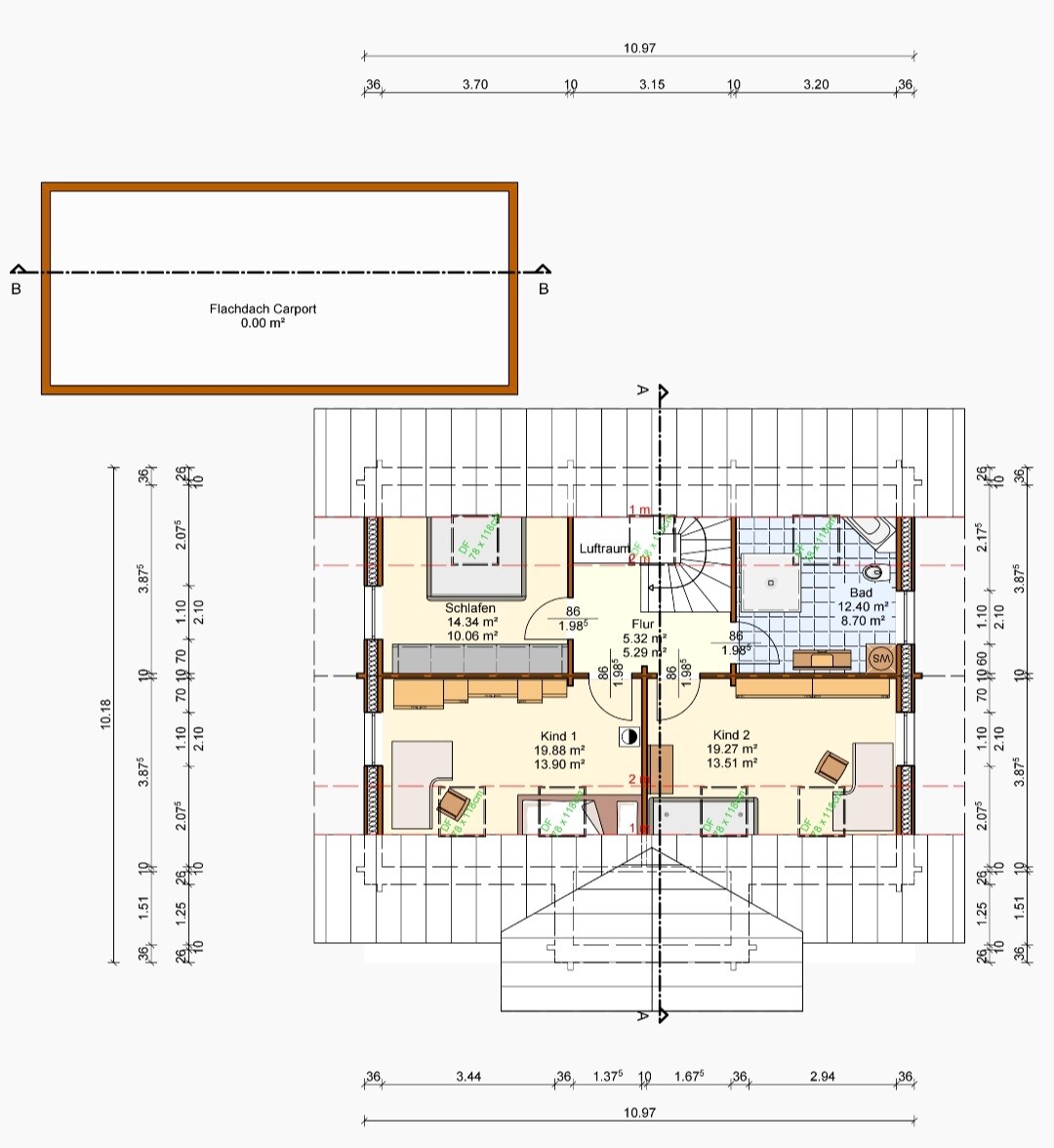
We have now developed a revised design with the manufacturer. The windows on the ground floor (GF) are larger, and the cloakroom now has a window as well. A door from the kitchen to the utility room has been planned, and the kitchen layout has been adjusted. The wall extensions between the kitchen and dining room have also been shortened so the kitchen doesn’t feel so cramped. The "arches" are not finalized yet, so they remain as is for now 😉 We have included the carport in the drawings for now, but if it happens, it will be much later...
The dining bay has been slightly enlarged to allow for more window area and potentially more flexible use of the space... The house was widened by 20cm (8 inches) towards the west, adding that space to the living room and the rooms above. Although the furniture in the ground floor plan is not exactly to scale, we have measured everything again, so it should fit. On the upper floor (UF), nothing is set yet, as we are still looking for a solution to make the upper floor more usable. For better visualization, I left the furniture in the plan...
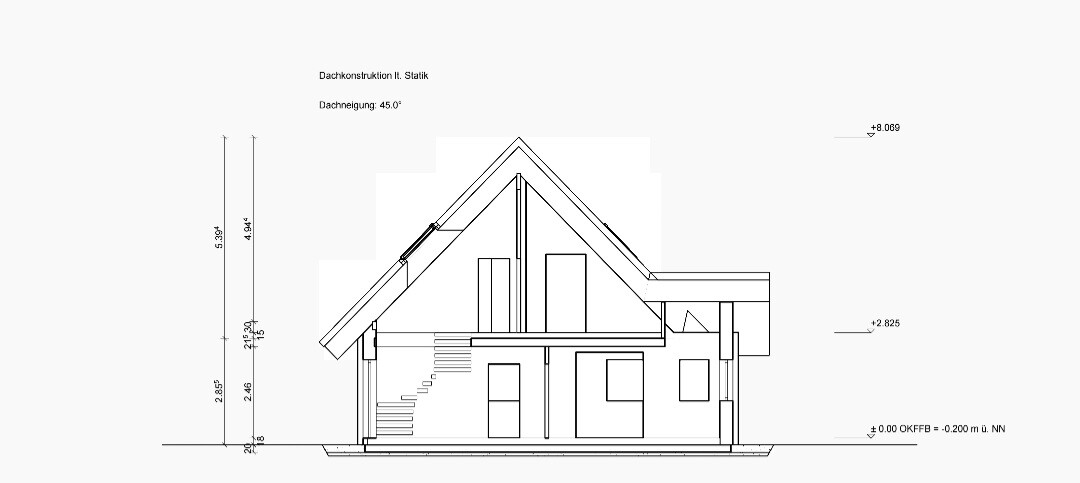
Now we come to the main problem: the building height limit of 4.00m (13 ft 1 in) is fixed. My partner did a rough height survey – if I understood the building authority correctly, the reference point is the natural ground level from the center of my property to the center of the top edge of the finished roadway. Is this standard practice? This reference point on our property is about 10cm (4 inches) above the current road level (the road exists but the final surface layer is still missing). This probably means that the knee wall cannot be enlarged here because the roof construction leaves no room. So, we would end up with a 45° roof pitch and a 30cm (12 inch) calcium silicate block wall, although it should be noted that the 30cm refers to the exposed beam, which means you actually have 190mm (7.5 inches) of additional headroom between the 90mm (3.5 inch) wide beams. Also, the 30cm does not refer to the top edge of the ground floor ceiling but to the top edge of the installed floor covering.
So now we are considering how to make the upper floor more usable... So far, the ideas have been that the two knee walls get large dormers with about two meters (6.5 feet) of usable interior space each, and the walls under the ridge are extended 50cm (20 inches) southwards so that a bed can be placed in the bedroom, and the bathroom shower (currently partially outside the 2.00m (6.5 feet) height line) and bathtub no longer cause issues. However, this would make the floor-to-ceiling windows in the knee walls very narrow. Four dormers – one for each room – are actually not within budget (the development plan allows for 50% of the eaves sides), but maybe the manufacturer could help us here... We have also considered completely reworking the upper floor layout, possibly using a gable with a dormer, then placing a room behind it and rearranging the rest, but so far no good idea has come up. It is not mandatory for both knee walls to be 20sqm (215 sq ft) – currently, we have only one child, and no more are planned at this point. We are flexible in that regard, although we want at least three separate rooms. We have also talked about using climate floor panels to gain another 20cm (8 inches) of height, but the manufacturer had bad experiences with those because the joints did not work well when planning in a log construction that requires high precision.
Does anyone have any ideas or suggestions on how to improve the upper floor without making us unhappy? Are we now better off in terms of brightness compared to the previous plan? (At least on the ground floor – the upstairs is still problematic...)
We have booked a time slot for "Full-scale Floorplan" for the Saturday after next. I’m not sure if it will be possible to try out different options there… but it should at least give a good impression. Has anyone done something like this before? I find the idea very exciting...
Thank you very much 🙂


Thanks again for all your many responses so far!
We have now developed a revised design with the manufacturer. The windows on the ground floor (GF) are larger, and the cloakroom now has a window as well. A door from the kitchen to the utility room has been planned, and the kitchen layout has been adjusted. The wall extensions between the kitchen and dining room have also been shortened so the kitchen doesn’t feel so cramped. The "arches" are not finalized yet, so they remain as is for now 😉 We have included the carport in the drawings for now, but if it happens, it will be much later...
The dining bay has been slightly enlarged to allow for more window area and potentially more flexible use of the space... The house was widened by 20cm (8 inches) towards the west, adding that space to the living room and the rooms above. Although the furniture in the ground floor plan is not exactly to scale, we have measured everything again, so it should fit. On the upper floor (UF), nothing is set yet, as we are still looking for a solution to make the upper floor more usable. For better visualization, I left the furniture in the plan...
Now we come to the main problem: the building height limit of 4.00m (13 ft 1 in) is fixed. My partner did a rough height survey – if I understood the building authority correctly, the reference point is the natural ground level from the center of my property to the center of the top edge of the finished roadway. Is this standard practice? This reference point on our property is about 10cm (4 inches) above the current road level (the road exists but the final surface layer is still missing). This probably means that the knee wall cannot be enlarged here because the roof construction leaves no room. So, we would end up with a 45° roof pitch and a 30cm (12 inch) calcium silicate block wall, although it should be noted that the 30cm refers to the exposed beam, which means you actually have 190mm (7.5 inches) of additional headroom between the 90mm (3.5 inch) wide beams. Also, the 30cm does not refer to the top edge of the ground floor ceiling but to the top edge of the installed floor covering.
So now we are considering how to make the upper floor more usable... So far, the ideas have been that the two knee walls get large dormers with about two meters (6.5 feet) of usable interior space each, and the walls under the ridge are extended 50cm (20 inches) southwards so that a bed can be placed in the bedroom, and the bathroom shower (currently partially outside the 2.00m (6.5 feet) height line) and bathtub no longer cause issues. However, this would make the floor-to-ceiling windows in the knee walls very narrow. Four dormers – one for each room – are actually not within budget (the development plan allows for 50% of the eaves sides), but maybe the manufacturer could help us here... We have also considered completely reworking the upper floor layout, possibly using a gable with a dormer, then placing a room behind it and rearranging the rest, but so far no good idea has come up. It is not mandatory for both knee walls to be 20sqm (215 sq ft) – currently, we have only one child, and no more are planned at this point. We are flexible in that regard, although we want at least three separate rooms. We have also talked about using climate floor panels to gain another 20cm (8 inches) of height, but the manufacturer had bad experiences with those because the joints did not work well when planning in a log construction that requires high precision.
Does anyone have any ideas or suggestions on how to improve the upper floor without making us unhappy? Are we now better off in terms of brightness compared to the previous plan? (At least on the ground floor – the upstairs is still problematic...)
We have booked a time slot for "Full-scale Floorplan" for the Saturday after next. I’m not sure if it will be possible to try out different options there… but it should at least give a good impression. Has anyone done something like this before? I find the idea very exciting...
Thank you very much 🙂
Similar topics