
ᐅ Floor Plan Design for a Single-Family Home with Approximately 170 m² of Living Space
Created on: 7 Dec 2025 08:54
F
FlynooM
Hello,
We have been planning our own home for a long time now and finally see the start of construction at the end of the tunnel. I actually have an urgent question about the bathrooms, but I thought you could also take a look at the rest of the floor plan to make sure we don't overlook any details during the detailed planning phase.
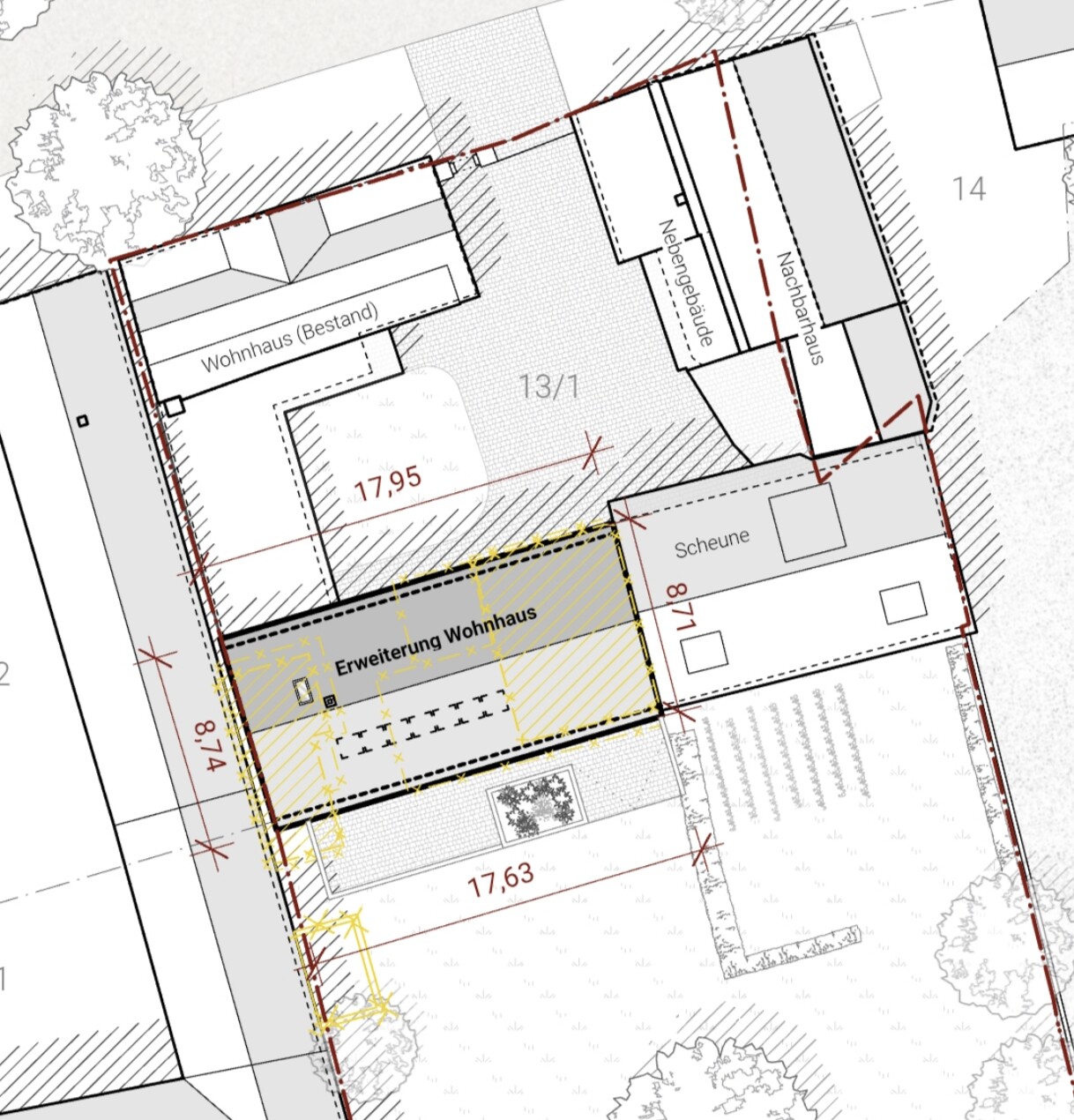
We are building on a family property in a “gap” within a four-sided courtyard.
Unfortunately, I can’t provide all the requested information. If something crucial is missing, I would have to look through the documents again.
Development Plan / Restrictions
Plot size: approx. 2000 m2 (0.5 acres)
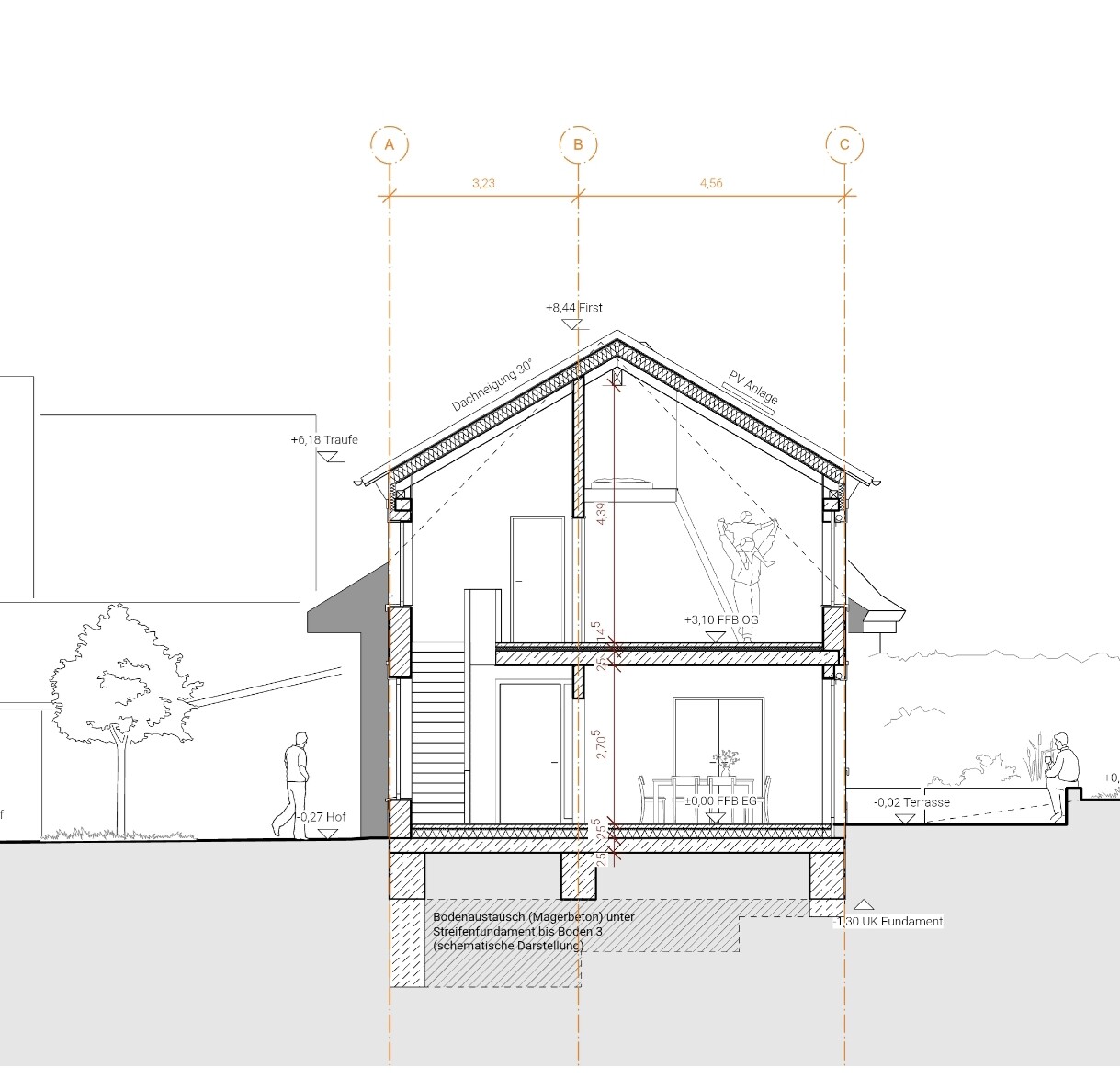
Slope: slight elevation difference between courtyard and garden (approx. 0.5–1 m (1.5–3 ft)), but the house will be built at courtyard level, and only the passage to the garden will have a rise; the terrace will then be about 0.5 m (1.5 ft) lower than the rest of the garden.
Site coverage ratio (floor area ratio): approx. 157 m2 (1690 sq ft)
Stories: 2.5 (2 full floors plus a raised bed level and attic above the bathroom)
Boundary construction: up to the neighbor (but with a narrow passage to the neighbor’s house); otherwise integrated into the four-sided courtyard
Roof type: gable roof, very flat
Style: farmhouse with brick veneer on the facade
Orientation: north-south
House design
Planner: independent architect
Why does the design look like this?
The final design is the result of many compromises and multiple revisions, with which everyone is satisfied. Unfortunately, due to closing the gap in the courtyard and building regulations aimed at preserving the village’s character, we are somewhat restricted, but most issues could still be resolved satisfactorily.
My main question concerns the bathrooms on the upper floor and basement.
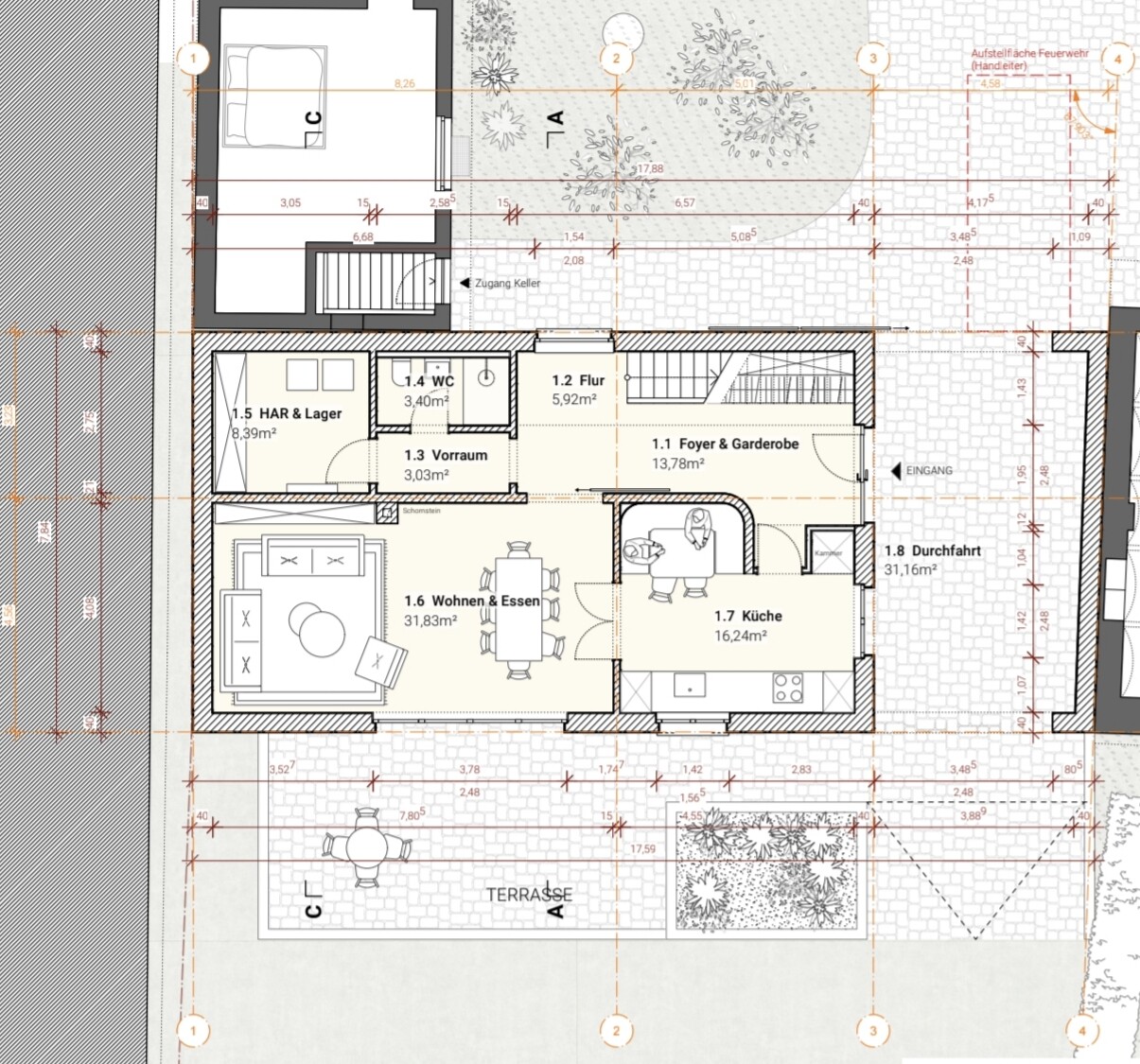
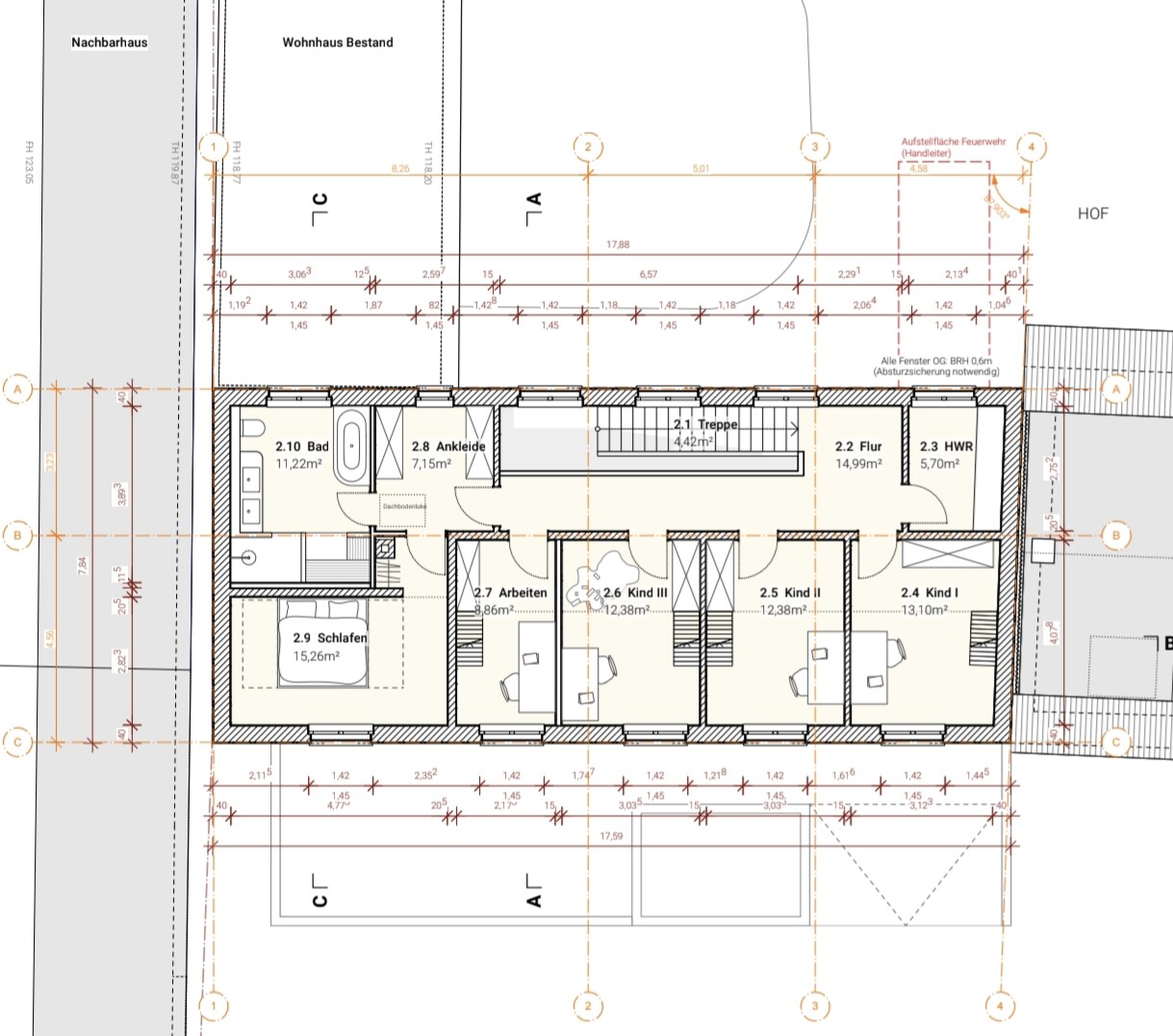
I want a masonry walk-in shower in both bathrooms, with a 1 to 2 cm (0.4–0.8 inch) step down to prevent water from running out. The current design is still incorrect: the sauna and shower on the upper floor were switched for better plumbing layout.
The architects recommend a shower entrance at least 60 cm (24 inches) wide and strongly advise a door to prevent water splashing out.
In the basement bathroom: shower length is 143 cm (56 inches) minus 60 cm (24 inches) entrance = 83 cm (33 inches) wall segment
On the upper floor: shower length is about 153 cm (60 inches) minus 60 cm (24 inches) entrance = 93 cm (37 inches) wall segment
I actually don’t want a door. Is the remaining wall enough to act as a splash guard? Do you have experience with how long such a wall must be at minimum to prevent flooding the bathroom? And how narrow can the entrance be? Is it possible to make the sauna smaller?
And regarding the kitchen: do you think the space will be sufficient? We don’t need a huge kitchen, but it should have room for the usual appliances, like a toaster and kettle, and enough countertop workspace.
Thank you very much for your help!
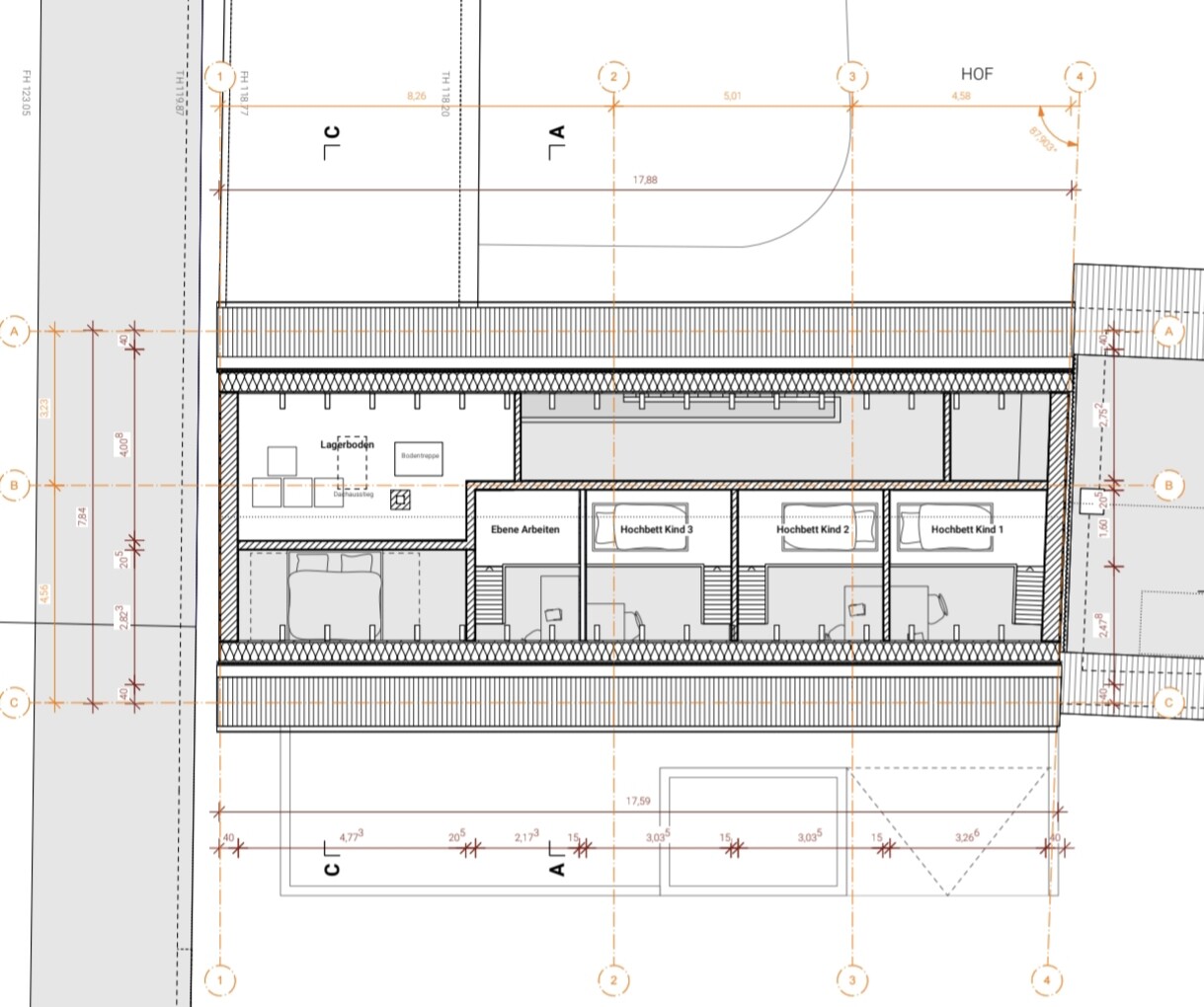
We have been planning our own home for a long time now and finally see the start of construction at the end of the tunnel. I actually have an urgent question about the bathrooms, but I thought you could also take a look at the rest of the floor plan to make sure we don't overlook any details during the detailed planning phase.
We are building on a family property in a “gap” within a four-sided courtyard.
Unfortunately, I can’t provide all the requested information. If something crucial is missing, I would have to look through the documents again.
Development Plan / Restrictions
Plot size: approx. 2000 m2 (0.5 acres)
Slope: slight elevation difference between courtyard and garden (approx. 0.5–1 m (1.5–3 ft)), but the house will be built at courtyard level, and only the passage to the garden will have a rise; the terrace will then be about 0.5 m (1.5 ft) lower than the rest of the garden.
Site coverage ratio (floor area ratio): approx. 157 m2 (1690 sq ft)
Stories: 2.5 (2 full floors plus a raised bed level and attic above the bathroom)
Boundary construction: up to the neighbor (but with a narrow passage to the neighbor’s house); otherwise integrated into the four-sided courtyard
Roof type: gable roof, very flat
Style: farmhouse with brick veneer on the facade
Orientation: north-south
House design
Planner: independent architect
Why does the design look like this?
The final design is the result of many compromises and multiple revisions, with which everyone is satisfied. Unfortunately, due to closing the gap in the courtyard and building regulations aimed at preserving the village’s character, we are somewhat restricted, but most issues could still be resolved satisfactorily.
My main question concerns the bathrooms on the upper floor and basement.
I want a masonry walk-in shower in both bathrooms, with a 1 to 2 cm (0.4–0.8 inch) step down to prevent water from running out. The current design is still incorrect: the sauna and shower on the upper floor were switched for better plumbing layout.
The architects recommend a shower entrance at least 60 cm (24 inches) wide and strongly advise a door to prevent water splashing out.
In the basement bathroom: shower length is 143 cm (56 inches) minus 60 cm (24 inches) entrance = 83 cm (33 inches) wall segment
On the upper floor: shower length is about 153 cm (60 inches) minus 60 cm (24 inches) entrance = 93 cm (37 inches) wall segment
I actually don’t want a door. Is the remaining wall enough to act as a splash guard? Do you have experience with how long such a wall must be at minimum to prevent flooding the bathroom? And how narrow can the entrance be? Is it possible to make the sauna smaller?
And regarding the kitchen: do you think the space will be sufficient? We don’t need a huge kitchen, but it should have room for the usual appliances, like a toaster and kettle, and enough countertop workspace.
Thank you very much for your help!
At the time, our architect said the gallery was a waste of money. His three children don’t use it at all. First, it was too small to sleep upstairs, then they lost interest, then it became uncool. He wouldn’t do it again and advises against it.
Actually, everything essential has already been said.
Write down your room requirements precisely. Not just “kitchen,” “bathroom,” or “bedroom,” but what each space needs to accommodate or contain. Note the dimensions of the furniture you want and make sure they fit into the floor plan.
Also, I keep special occasion dishes in the living room cabinet. Porcelain from my grandmother for 30 people, hand wash only. I use it 3-4 times a year. I don’t have that much everyday tableware.
Actually, everything essential has already been said.
Write down your room requirements precisely. Not just “kitchen,” “bathroom,” or “bedroom,” but what each space needs to accommodate or contain. Note the dimensions of the furniture you want and make sure they fit into the floor plan.
Also, I keep special occasion dishes in the living room cabinet. Porcelain from my grandmother for 30 people, hand wash only. I use it 3-4 times a year. I don’t have that much everyday tableware.

haydee schrieb:
At the time, our architect said the gallery was a waste of money. His three children never used it. First, they were too young to sleep upstairs, then they lost interest, and finally, it became uncool. He wouldn’t do it again and advises against it.Having a treehouse-style area for free play in the room might be cool. But using it as a fixed sleeping level—especially if mom has to climb up to make the beds—is nonsense.https://www.instagram.com/11antgmxde/
https://www.linkedin.com/company/bauen-jetzt/
Architects can’t really dictate how you or “one” should live; maybe the issue is that you haven’t clearly and specifically communicated your needs to them.
Such a separation can also be only partial, using nice, waist-high shelves or room dividers (storage for games, for example), which keeps things flexible.
There is no “one size fits all.” Good houses match the individual needs and wishes of their occupants. If you seem to like the concept and function of an open-plan kitchen/living area, then go for it consistently. It’s also possible (we did this later, for example) to have a stylish, long dining table directly connected to a kitchen island. This saves space and reduces unnecessary movement. Try setting this up at home, even simulate the distances to get a feel for it.
Of course you can, but it’s still not clear if that fits your personal needs. You’re probably five people living together, and the younger ones barely fit through the door. One switches to vegan, another always needs cold smoothies in the morning, a third fresh meatloaf—and then there’s waffle iron, raclette grill, tabletop grill, all kinds of pans, cookbooks, spice grinders, pitchers, and who knows what else. Just the number of people shows you won’t share one unified way of eating or cooking. In the past (when everything was supposedly better), nobody asked and there were no special requests; less space was enough, and special devices and containers were rare.
So — if I were planning for five people, including growing baking enthusiasts or fruit dryers, I would want a large kitchen. Of course, you don’t have to accommodate every single gadget, but a simple straight kitchen unit with such limited cabinetry would be a poor choice in my opinion.
Exactly why you shouldn’t design an open staircase like that.
Children always find room; I wouldn’t worry about that. Usually, it’s those corners, spots, or situations that we adults would never have expected.
Do you want to have one again and now design it comfortably and individually for FIVE people?
I understand you live on a farm with space for guests. There should be room for the two or so celebrations you have each year; I would never waste already limited living space for just one or two parties per year. These usually take place in warmer weather and use the terrace. People don’t usually sit stiffly at a long table in a row nowadays; they find space and spread out—at least in my experience.
Sorry, but where would that even stand? Also, with underfloor heating, a fireplace makes little sense or at least conflicts with the system and would need to be carefully checked if you still want one. A fireplace requires considerable clearances and it should be visible from a bit of a distance, which will never work here. Unnecessarily high costs. Consider putting a nice one on the terrace or as a grill or something similar; but inside here, there is neither space nor reason for it.
With five (soon to be adult) people, I would make sure to have two comfortable bathrooms with walk-in showers (without glass). Glass needs maintenance, and with five people you have 25 different tubes, bottles, makeup items, or gel trays... all that needs at least some room. I would even consider a small extra toilet.
@FlynooM Somehow, it seems you don’t really want to answer all these questions here, leaving them hanging... maybe the architects feel the same way?
Such a separation can also be only partial, using nice, waist-high shelves or room dividers (storage for games, for example), which keeps things flexible.
FlynooM schrieb:
Two questions about the kitchen: would it be better not to plan any seating there at all?
There is no “one size fits all.” Good houses match the individual needs and wishes of their occupants. If you seem to like the concept and function of an open-plan kitchen/living area, then go for it consistently. It’s also possible (we did this later, for example) to have a stylish, long dining table directly connected to a kitchen island. This saves space and reduces unnecessary movement. Try setting this up at home, even simulate the distances to get a feel for it.
FlynooM schrieb:
And can the “pantry” make up for the lack of space? The kitchen planner said you could install two narrow tall cabinets there and a wall cabinet above them.
Of course you can, but it’s still not clear if that fits your personal needs. You’re probably five people living together, and the younger ones barely fit through the door. One switches to vegan, another always needs cold smoothies in the morning, a third fresh meatloaf—and then there’s waffle iron, raclette grill, tabletop grill, all kinds of pans, cookbooks, spice grinders, pitchers, and who knows what else. Just the number of people shows you won’t share one unified way of eating or cooking. In the past (when everything was supposedly better), nobody asked and there were no special requests; less space was enough, and special devices and containers were rare.
So — if I were planning for five people, including growing baking enthusiasts or fruit dryers, I would want a large kitchen. Of course, you don’t have to accommodate every single gadget, but a simple straight kitchen unit with such limited cabinetry would be a poor choice in my opinion.
FlynooM schrieb:
How can you work if children are basically playing in an open staircase area?
Exactly why you shouldn’t design an open staircase like that.
FlynooM schrieb:
We currently have two children. They’re still small and mostly play in the living room instead of their small children’s room. Our kitchen currently consists roughly of that one single kitchen unit (without the planned pantry). However, we store our “good” dishes in the living room cupboard.
Children always find room; I wouldn’t worry about that. Usually, it’s those corners, spots, or situations that we adults would never have expected.
FlynooM schrieb:
We have an open-plan kitchen/living area.
Do you want to have one again and now design it comfortably and individually for FIVE people?
FlynooM schrieb:
A closed kitchen that can be opened for celebrations, maybe.
I understand you live on a farm with space for guests. There should be room for the two or so celebrations you have each year; I would never waste already limited living space for just one or two parties per year. These usually take place in warmer weather and use the terrace. People don’t usually sit stiffly at a long table in a row nowadays; they find space and spread out—at least in my experience.
FlynooM schrieb:
Fireplace: build the chimney flue first, but no fireplace yet.
Sorry, but where would that even stand? Also, with underfloor heating, a fireplace makes little sense or at least conflicts with the system and would need to be carefully checked if you still want one. A fireplace requires considerable clearances and it should be visible from a bit of a distance, which will never work here. Unnecessarily high costs. Consider putting a nice one on the terrace or as a grill or something similar; but inside here, there is neither space nor reason for it.
With five (soon to be adult) people, I would make sure to have two comfortable bathrooms with walk-in showers (without glass). Glass needs maintenance, and with five people you have 25 different tubes, bottles, makeup items, or gel trays... all that needs at least some room. I would even consider a small extra toilet.
@FlynooM Somehow, it seems you don’t really want to answer all these questions here, leaving them hanging... maybe the architects feel the same way?
I stayed up late last night reading here, taking notes, and trying to respond to everything.
Thank you very much for the comments and ideas.
However, some of the comments make me feel like a defendant in a courtroom.
We have been planning this house for three years, and it took many long discussions with the architects to move away from the currently popular fully open-concept designs with wooden slats—favored by architects nowadays—towards a much more enclosed brick design, because we do NOT want an open concept.
We now have an open kitchen-living area and find it terrible. The table in the living room is not meant to be the main dining table, but rather a place to leave board games to continue playing after meals, or where one of the children, when they are older, can sit with friends without all the siblings and parents constantly walking through the room.
On the other hand, when we do have a large party, in our experience everything tends to end up in the kitchen anyway; then we can open the double doors and easily connect the two rooms.
So if the kitchen is indeed too small—as I feared and you have confirmed—we will have to reduce or alter the size of the windows, especially the ones on the east side.
Why is a cooktop by the window not practical?
And why can’t a small fireplace fit in the living room, or what does that have to do with the underfloor heating?
For us, a fireplace is more of a luxury for coziness than a primary heat source for the entire house (although that would be possible, of course).
Thank you very much for the comments and ideas.
However, some of the comments make me feel like a defendant in a courtroom.
We have been planning this house for three years, and it took many long discussions with the architects to move away from the currently popular fully open-concept designs with wooden slats—favored by architects nowadays—towards a much more enclosed brick design, because we do NOT want an open concept.
We now have an open kitchen-living area and find it terrible. The table in the living room is not meant to be the main dining table, but rather a place to leave board games to continue playing after meals, or where one of the children, when they are older, can sit with friends without all the siblings and parents constantly walking through the room.
On the other hand, when we do have a large party, in our experience everything tends to end up in the kitchen anyway; then we can open the double doors and easily connect the two rooms.
So if the kitchen is indeed too small—as I feared and you have confirmed—we will have to reduce or alter the size of the windows, especially the ones on the east side.
Why is a cooktop by the window not practical?
And why can’t a small fireplace fit in the living room, or what does that have to do with the underfloor heating?
For us, a fireplace is more of a luxury for coziness than a primary heat source for the entire house (although that would be possible, of course).
N
nordanney8 Dec 2025 18:03A brief opinion on your process up to the design phase:
FlynooM schrieb:Honestly? If it required many long discussions, you might have forced an architect who wants to do "their own thing" into a design they don’t like. That explains the long process. It’s a warning sign right from the start. Someone who is supposed to work for you but needs to be persuaded over a long time about your plan is always the wrong choice. You wouldn’t want to hire employees for your company who work reluctantly. They will never be fully committed or engaged.
and it took many long discussions with the architects for us to move away from the nowadays popular fully open concepts with wooden slats—which are currently very trendy among architects—towards a much more closed clinker brick design,
Similar topics