
ᐅ Floor Plan Design Single-Family House, 1.5 Stories, No Basement, Approximately 160 sqm
Created on: 31 Aug 2023 17:22
H
heamer1
Development Plan / Restrictions
Plot size: 648m² (6969 sq ft)
Site coverage ratio: 0.3
Floor area ratio: 0.3
Building window, building line, and boundary: See site plan
Edge development
Number of parking spaces: 1
Number of floors: 1
Roof style: Gable roof 42-46°
Architectural style
Orientation
Maximum heights / limits
Other requirements
Client Requirements
Architectural style, roof type, building type
Basement, number of floors
Number of occupants, ages 4 30,29,0,0
Space requirements on ground floor and upper floor
Office: family use or home office? Hobby
Number of overnight guests per year: 1
Open or closed architecture: closed
Traditional or modern design: traditional
Open kitchen, kitchen island: does not matter
Number of dining seats: 8-10
Fireplace: No
Music/stereo wall
Balcony, roof terrace
Garage, carport: wooden carport
Utility garden, greenhouse
Additional wishes / special features / daily routine, including reasons for choices or exclusions
House Design
Designed by:
-Do-it-yourself, drafter
What do you particularly like? Why?
What do you dislike? Why?
Price estimate according to architect/planner:
Personal price limit for the house, including fittings: 500k
Preferred heating system:
If you have to give up something, which details / extensions
-you can give up:
-you cannot give up:
Why is the design the way it is now?
We wanted a closed kitchen and a staircase that does not lead directly upstairs from the front door.
Additionally, a small office should fit on the ground floor.
Based on the building window requirements, we aimed for a larger main garden at the front and a small cozy retreat area behind the house, both accessible from the living/dining room.
Furthermore, a second entrance through the utility room was planned as a mudroom.
The plot to the west belongs to my parents, so the driveway is also planned in that direction.
What is the most important/basic question about the floor plan summarized in 130 characters?
Please provide feedback on our design.
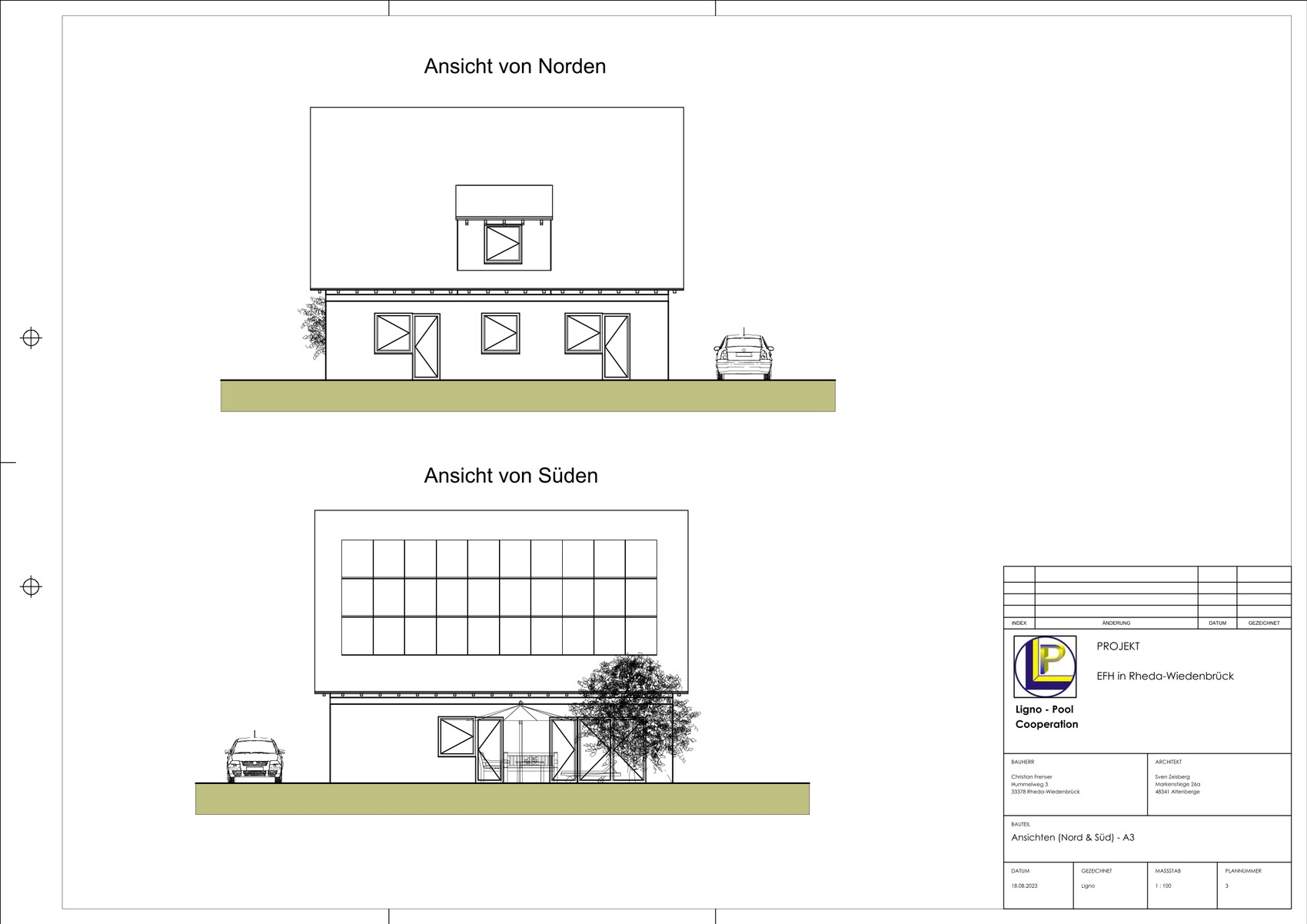
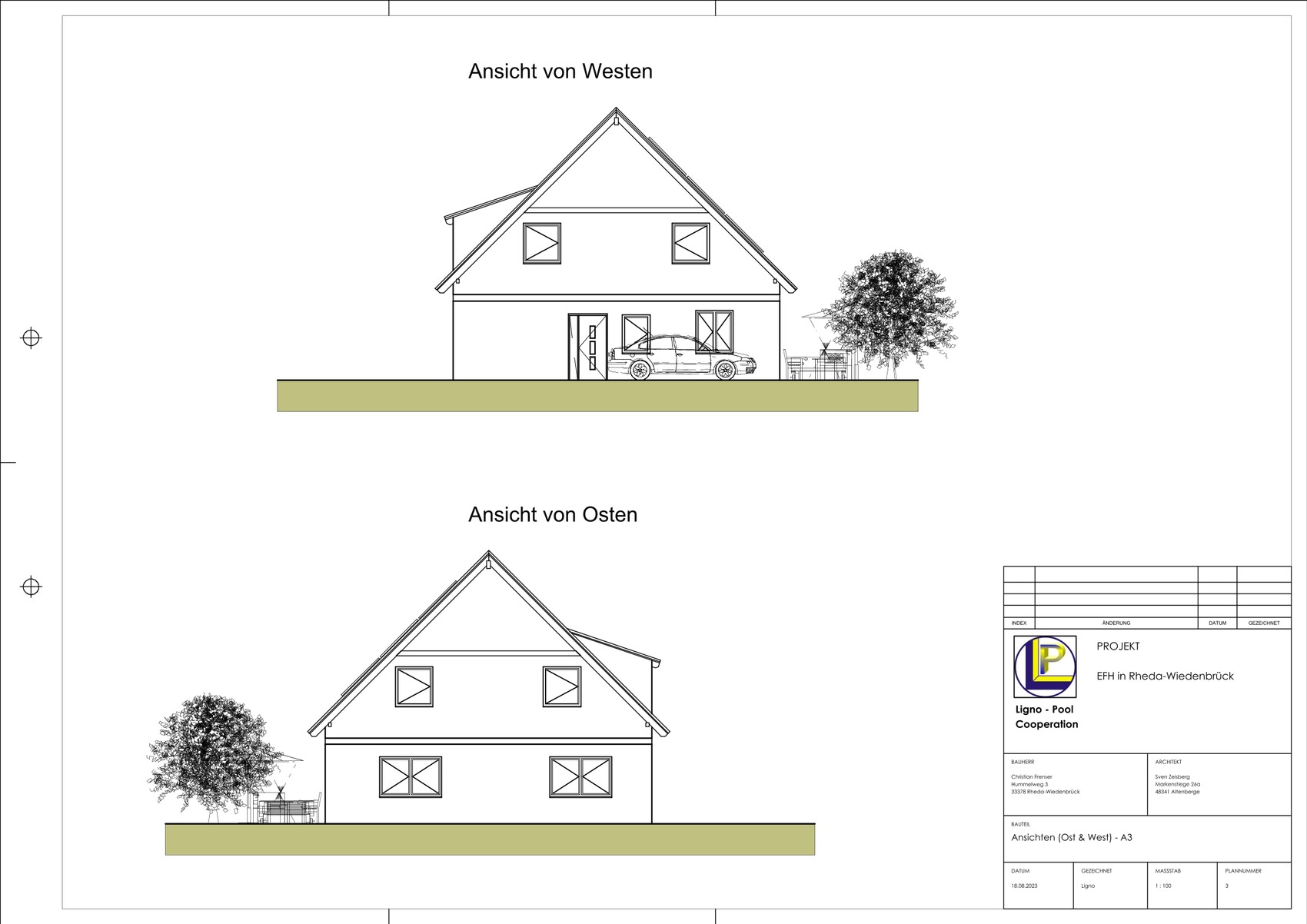
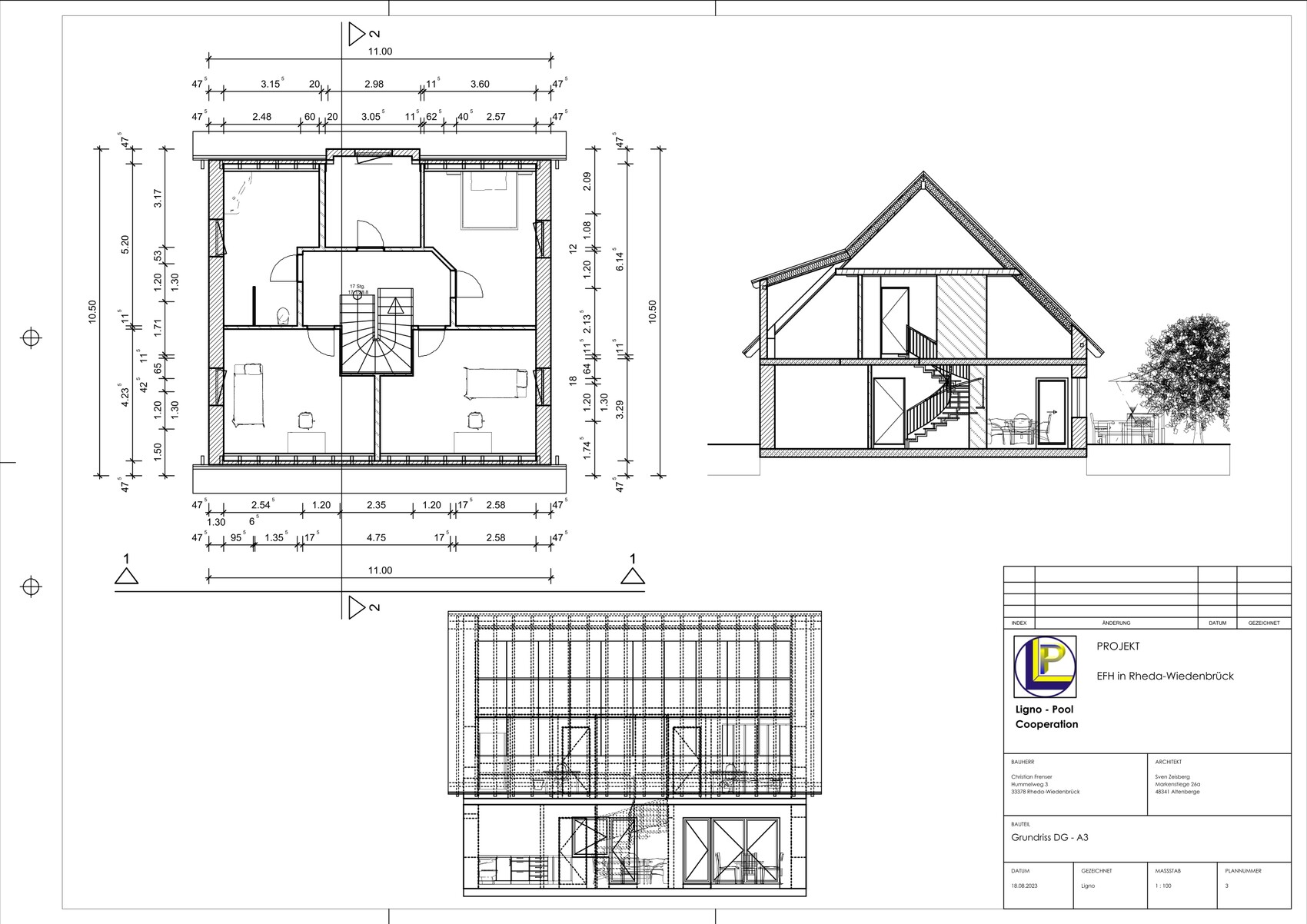
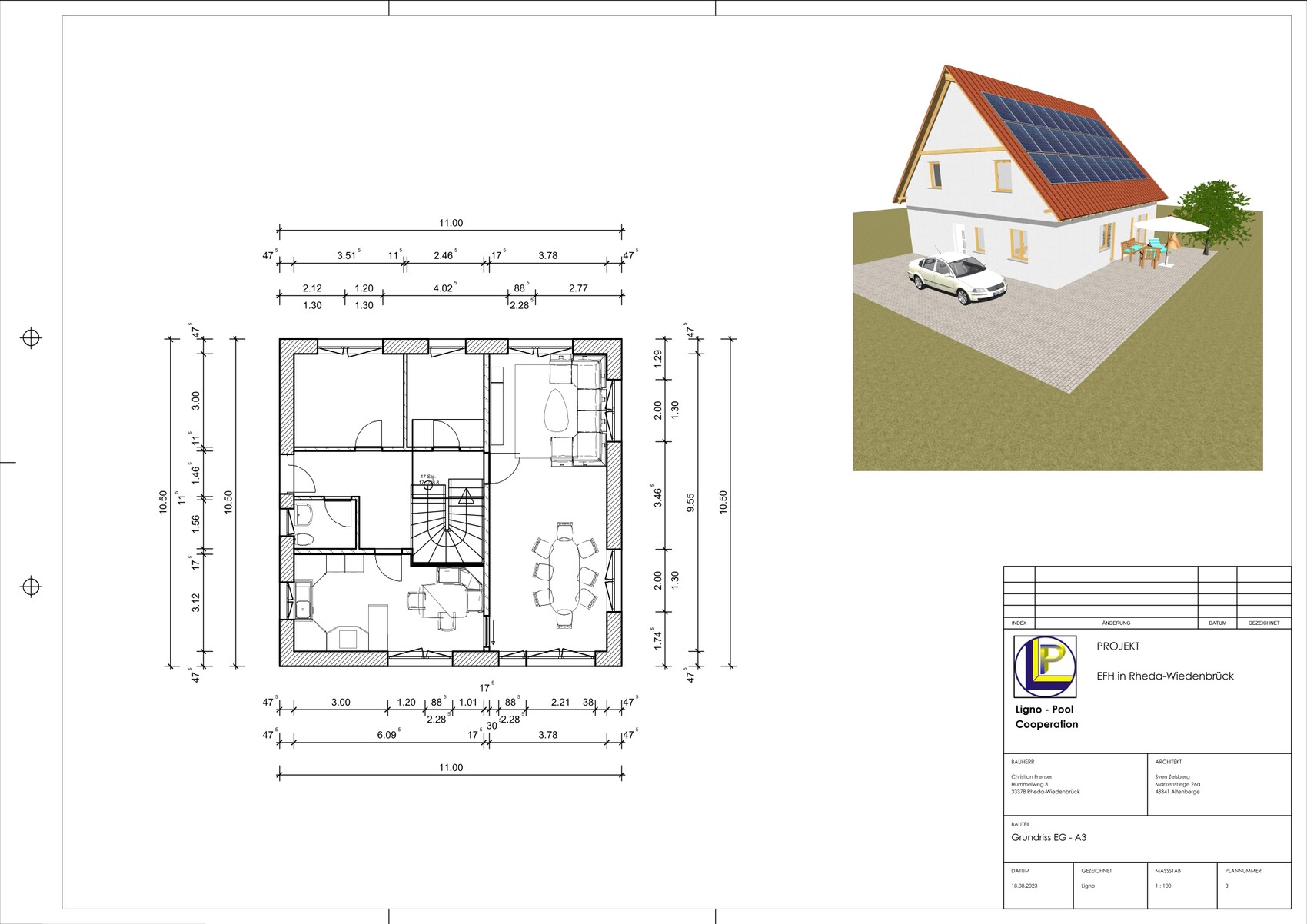
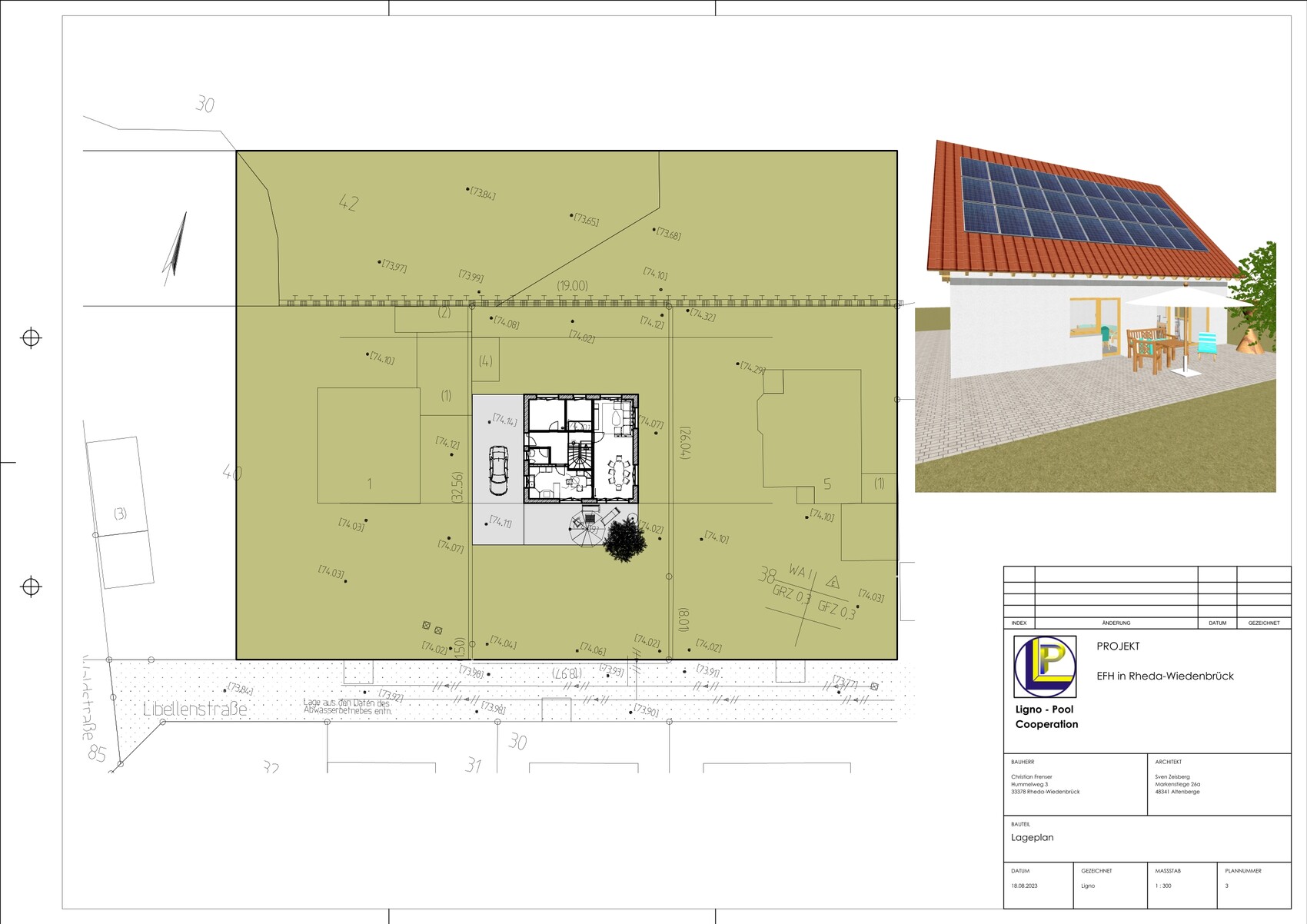
Plot size: 648m² (6969 sq ft)
Site coverage ratio: 0.3
Floor area ratio: 0.3
Building window, building line, and boundary: See site plan
Edge development
Number of parking spaces: 1
Number of floors: 1
Roof style: Gable roof 42-46°
Architectural style
Orientation
Maximum heights / limits
Other requirements
Client Requirements
Architectural style, roof type, building type
Basement, number of floors
Number of occupants, ages 4 30,29,0,0
Space requirements on ground floor and upper floor
Office: family use or home office? Hobby
Number of overnight guests per year: 1
Open or closed architecture: closed
Traditional or modern design: traditional
Open kitchen, kitchen island: does not matter
Number of dining seats: 8-10
Fireplace: No
Music/stereo wall
Balcony, roof terrace
Garage, carport: wooden carport
Utility garden, greenhouse
Additional wishes / special features / daily routine, including reasons for choices or exclusions
House Design
Designed by:
-Do-it-yourself, drafter
What do you particularly like? Why?
What do you dislike? Why?
Price estimate according to architect/planner:
Personal price limit for the house, including fittings: 500k
Preferred heating system:
If you have to give up something, which details / extensions
-you can give up:
-you cannot give up:
Why is the design the way it is now?
We wanted a closed kitchen and a staircase that does not lead directly upstairs from the front door.
Additionally, a small office should fit on the ground floor.
Based on the building window requirements, we aimed for a larger main garden at the front and a small cozy retreat area behind the house, both accessible from the living/dining room.
Furthermore, a second entrance through the utility room was planned as a mudroom.
The plot to the west belongs to my parents, so the driveway is also planned in that direction.
What is the most important/basic question about the floor plan summarized in 130 characters?
Please provide feedback on our design.
First of all, it’s worth praising that there are still house designs that are affordable and therefore rather modest. I mean this positively. I’m quite tired of seeing all those crammed-in must-haves like kids’ bathrooms, pantries, walk-ins, and dressing rooms in abundance, almost like a lucky dip.
However, I am also disappointed by how matter-of-fact people are about the whole “building a house” process, to the extent that even the simple emotional questions like “do you like it or not” go unanswered. Recently, someone here refused to fill out the questionnaire and accused the advisors of not knowing anything about the builders and their needs despite well-intentioned answers… Well then!
..................
I also consider that price limit moderate for a functional house of compact size.
I have an issue with the term “planning” here. Because I don’t see a plan. What we have is simply the rooms outlined in a very basic way, without consideration for ergonomics or circulation paths. The living areas are elongated to the point that they don’t feel like pleasant rooms. The living room is simply too long at less than 4 meters (13 feet) wide. The kitchen is also long, and split into two parts. Because the staircase is pushed a bit into the kitchen, there is a bottleneck both for seating and for passage. The dining space is next to the dining area in the living room...
I want to emphasize the criticism by @11ant of the term draftsperson as well as the “fantasy measurements” that I often overlook because a) it’s a cost issue that no architect was hired, b) working with a general contractor means hoping you get a good architect on staff, and c) many here show fairly clean amateur plans that still require a professional to refine. But here I must underline:
It’s clear that the person in charge doesn’t have aesthetics, design, or interior planning as part of their education. However, I expect an engineer, if they take on such a project, to also provide consulting—not just on energy technology—but to make the most of a single-family house! This applies to window shapes and placement, room volumes, and a rough but feasible and sensible furnishing of bathrooms and kitchens. In other words, what is not functional (not to be confused with personal taste) should not be included at all. A professional should question this and, if necessary, revise the design until they can identify with the work.
That’s rare these days, but of course, it’s legitimate.
Well then... I’ll start with feedback on the orientation: I see no logical reason to align your driveway with that of relatives. Your house will stand alone, so it should be positioned for the best orientation on the plot. The west side should therefore be used to illuminate the living area with windows, as the west sun is more enjoyable in the late afternoon than east sun.
As for the kitchen: It’s too narrow at the dining table and too wide at the work surface. You could fix this quite well by switching the functions: a double-row layout by the sliding door and a nice dining area in the wide space. Still, the narrow living area remains.
I think the staircase is incorrectly placed right in the middle!
Also, I would recommend at least an 80 cm (31 inches) knee wall, better yet a 1-meter (39 inches) high dwarf wall, to allow better interior furnishings. The bathroom issue has already been mentioned: in compact bathrooms with sloping ceilings, the bathtub and toilet should be placed under the slope, so there’s standing height for the washbasin and shower.
Conservative windows can be charming. However, the window-door combination reminded me of 1970s houses and, occasionally, a design faux pas. It’s neither here nor there. The windows on the upper floor are insufficient for the rooms and could be placed somewhat more centrally. I know the drawing program you use, and it can also provide window dimensions!
Since your enclosed hallway on both ground and upper floors plays a major role, I would suggest giving it some daylight.
There is no space for a generous wardrobe.
My tip: Since your requirements are fairly modest, I suggest you simply look up compact gable roof houses online and pick a design you find there. You can then modify a few details to your wishes, for example, a larger, closed kitchen to fit a dining area. But fundamentally, a dining area already takes up a significant amount of space—your 18 m² (193 sq ft) is quite tight.
They usually have architects they work with.
However, I am also disappointed by how matter-of-fact people are about the whole “building a house” process, to the extent that even the simple emotional questions like “do you like it or not” go unanswered. Recently, someone here refused to fill out the questionnaire and accused the advisors of not knowing anything about the builders and their needs despite well-intentioned answers… Well then!
heamer1 schrieb:
House design
Who prepared the plan:
-Do-it-Yourself, Draftsperson
What do you particularly like? Why?
What do you dislike? Why?
Price estimate according to architect/planner:
Personal price limit for the house, including fittings: 500k
Preferred heating technology:
If you have to give up something, which details/additions
-can you give up:
-can you not give up:
..................
heamer1 schrieb:
Personal price limit for the house, including fittings: 500k
I also consider that price limit moderate for a functional house of compact size.
heamer1 schrieb:
I am still figuring out how the sloping roof and washbasin will work out in the bathroom.
The cabinets don’t mean anything, the software apparently glitched while creating the PDF, according to colleagues.
My main concern here is whether there are any major errors in the plan.
Once we have everything finally planned through
I have an issue with the term “planning” here. Because I don’t see a plan. What we have is simply the rooms outlined in a very basic way, without consideration for ergonomics or circulation paths. The living areas are elongated to the point that they don’t feel like pleasant rooms. The living room is simply too long at less than 4 meters (13 feet) wide. The kitchen is also long, and split into two parts. Because the staircase is pushed a bit into the kitchen, there is a bottleneck both for seating and for passage. The dining space is next to the dining area in the living room...
I want to emphasize the criticism by @11ant of the term draftsperson as well as the “fantasy measurements” that I often overlook because a) it’s a cost issue that no architect was hired, b) working with a general contractor means hoping you get a good architect on staff, and c) many here show fairly clean amateur plans that still require a professional to refine. But here I must underline:
11ant schrieb:
For a draftsperson, this is a fairly sloppy dimensioning. Has he even completed training?
It’s clear that the person in charge doesn’t have aesthetics, design, or interior planning as part of their education. However, I expect an engineer, if they take on such a project, to also provide consulting—not just on energy technology—but to make the most of a single-family house! This applies to window shapes and placement, room volumes, and a rough but feasible and sensible furnishing of bathrooms and kitchens. In other words, what is not functional (not to be confused with personal taste) should not be included at all. A professional should question this and, if necessary, revise the design until they can identify with the work.
heamer1 schrieb:
Open or closed architecture: closed
Conservative or modern building style: conservative
That’s rare these days, but of course, it’s legitimate.
heamer1 schrieb:
Please provide feedback on our design.
Well then... I’ll start with feedback on the orientation: I see no logical reason to align your driveway with that of relatives. Your house will stand alone, so it should be positioned for the best orientation on the plot. The west side should therefore be used to illuminate the living area with windows, as the west sun is more enjoyable in the late afternoon than east sun.
As for the kitchen: It’s too narrow at the dining table and too wide at the work surface. You could fix this quite well by switching the functions: a double-row layout by the sliding door and a nice dining area in the wide space. Still, the narrow living area remains.
I think the staircase is incorrectly placed right in the middle!
Also, I would recommend at least an 80 cm (31 inches) knee wall, better yet a 1-meter (39 inches) high dwarf wall, to allow better interior furnishings. The bathroom issue has already been mentioned: in compact bathrooms with sloping ceilings, the bathtub and toilet should be placed under the slope, so there’s standing height for the washbasin and shower.
Conservative windows can be charming. However, the window-door combination reminded me of 1970s houses and, occasionally, a design faux pas. It’s neither here nor there. The windows on the upper floor are insufficient for the rooms and could be placed somewhat more centrally. I know the drawing program you use, and it can also provide window dimensions!
Since your enclosed hallway on both ground and upper floors plays a major role, I would suggest giving it some daylight.
There is no space for a generous wardrobe.
My tip: Since your requirements are fairly modest, I suggest you simply look up compact gable roof houses online and pick a design you find there. You can then modify a few details to your wishes, for example, a larger, closed kitchen to fit a dining area. But fundamentally, a dining area already takes up a significant amount of space—your 18 m² (193 sq ft) is quite tight.
heamer1 schrieb:
Local timber construction companies
They usually have architects they work with.

ypg schrieb:
I think the staircase is simply positioned incorrectly in the center! "Incorrect" seems a bit too harsh to me. Having the entry and exit points, rather than the entire staircase position, more centrally located would be ideal.
ypg schrieb:
Also, I would plan for at least an 80 cm (31 inch) knee wall, preferably a one-meter (39 inch) high dwarf wall, Knee wall of 80 cm (31 inch), yes, but here that would only be about 10 cm (4 inch) more. And what would be the purpose of a dwarf wall if there is already a knee wall?
ypg schrieb:
I want to emphasize the criticism by @11ant regarding the term draftsman and the "imaginary dimensions" that I often overlook, because a) it’s a cost issue when you don’t hire an architect, b) when building with a general contractor where you have to be lucky with the employed architect, and c) many here show a fairly clean amateur plan, which of course still needs to be finalized by a professional: I did not criticize the term draftsman, but expressed surprise at the choice of a draftsman instead of an architect. Forgoing an architect is acceptable for a straightforward plot and only a cost issue in that deficiencies show up after design phase 5 and beyond – so it doesn’t really pay off if you only hired an independent architect from design phases 1 to 4 anyway (which I repeatedly warn against). Your phrase "having to be lucky" with the general contractor’s in-house architect was well put. For a preliminary design intended solely for an initial inquiry, even a draftsman is not necessary – a scaled sketch using a triangle ruler, like one for a preliminary planning application, is sufficient. Imaginary or “fantasy” dimensions are a real problem in masonry construction, but negligible in timber construction.
Only after deciding on the construction method does coordinating the dimensions with the material become important (but that was not clear from the start here—the drawings could also have been candidates for submissions). At the preliminary design stage (and therefore for initial inquiries), I recommend simply thinking in whole double decimeters in general.
https://www.instagram.com/11antgmxde/
https://www.linkedin.com/company/bauen-jetzt/
11ant schrieb:
And why have a knee wall with a dwarf wall?Read carefully! One replaces the other.Similar topics