
ᐅ Floor Plan Design for a Single-Family Home with Garage and Roof Terrace
Created on: 8 Oct 2025 20:00
L
leah1003
Hello everyone,
We are a young couple (26 and 28 years old) currently planning to build our single-family home. Two children are planned for the future. We have already purchased the suitable plot – it is located on the edge of a field in a small village, so it is a very quiet location.
At the moment, we are about to commit to a construction company that will handle both the building permit (planning permission) and most of the construction as general contractor. However, we would like to carry out some trades as self-performed work.
We designed the floor plan together with a friend who is studying for a Master’s degree in architecture. So far, these are still draft drawings, which we now want to turn into permit-ready plans. However, we have reached a point where we feel “stuck” – we literally can’t see the forest for the trees. Unfortunately, we don’t like the floor plan 100%, some rooms are missing, and we are unsure how to proceed.
Therefore, we would appreciate any input, ideas, or suggestions for improvements – but first, here is an overview following the question checklist:
Plot & Development
Our Preferences & Requirements
Building Style & Construction
Rooms & Layout Concept
Building Services (planned)
Special Features & Current Challenges
What we like about the draft:
We were uncertain for a long time whether the gable or the eaves should face the field. The current plan has the eaves facing the field – this seems more generous towards the garden. We are open to opinions on this!
What currently bothers us:
Garage idea:
Budget & Self-performed Work
What could we possibly do without?
What we do not want to give up:
About the development of the draft
Our main question(s) to you:
Final summary
We are trying to create a modern, well-thought-out, and suitable home for our needs – with a realistic budget and self-performed work where it makes sense. It is important to us that the house is special but not excessive or “over the top.”
We look forward to any feedback – whether on room layout, building services, facade design, roof terrace, or details.
Thank you very much in advance!
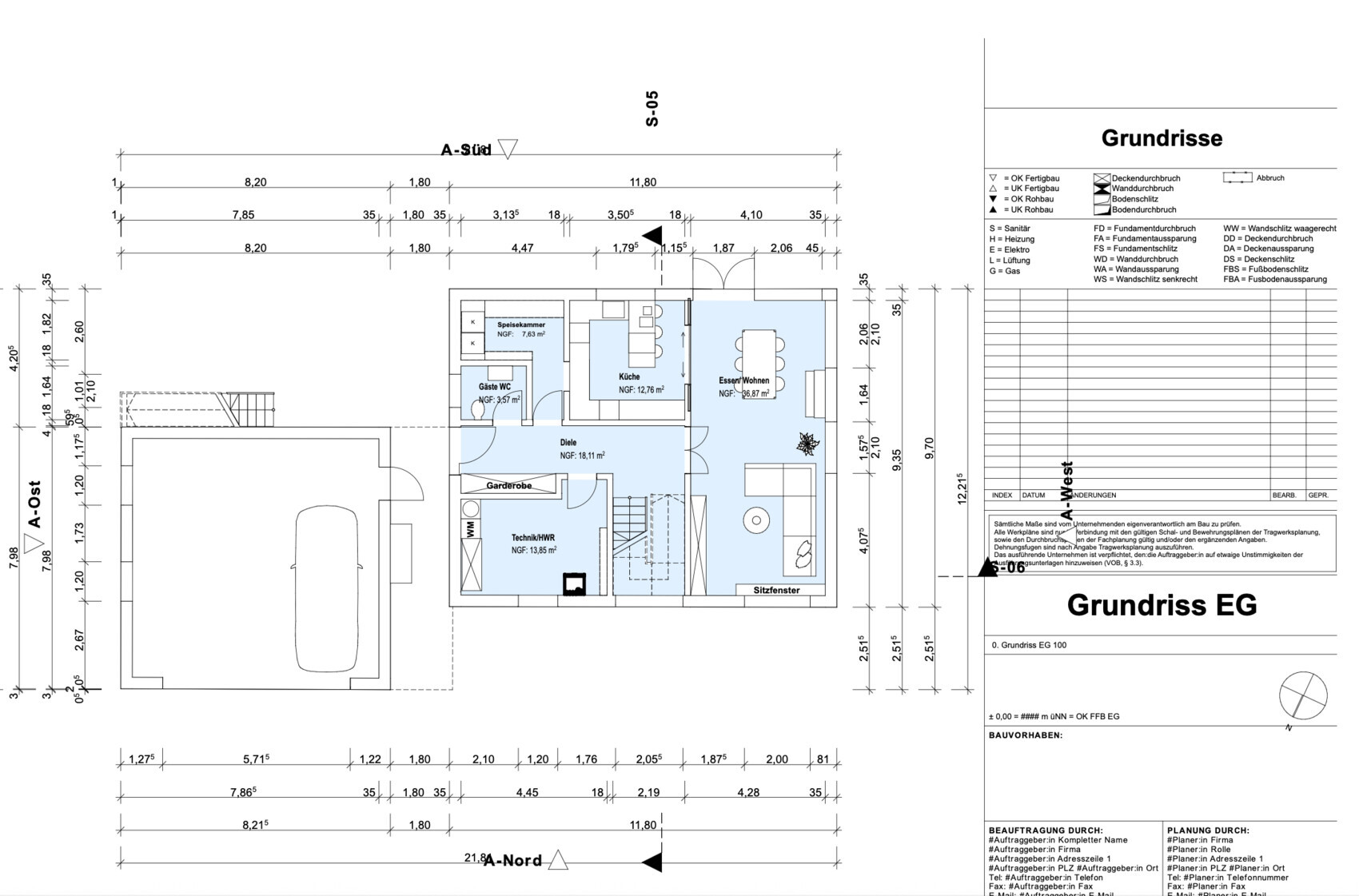
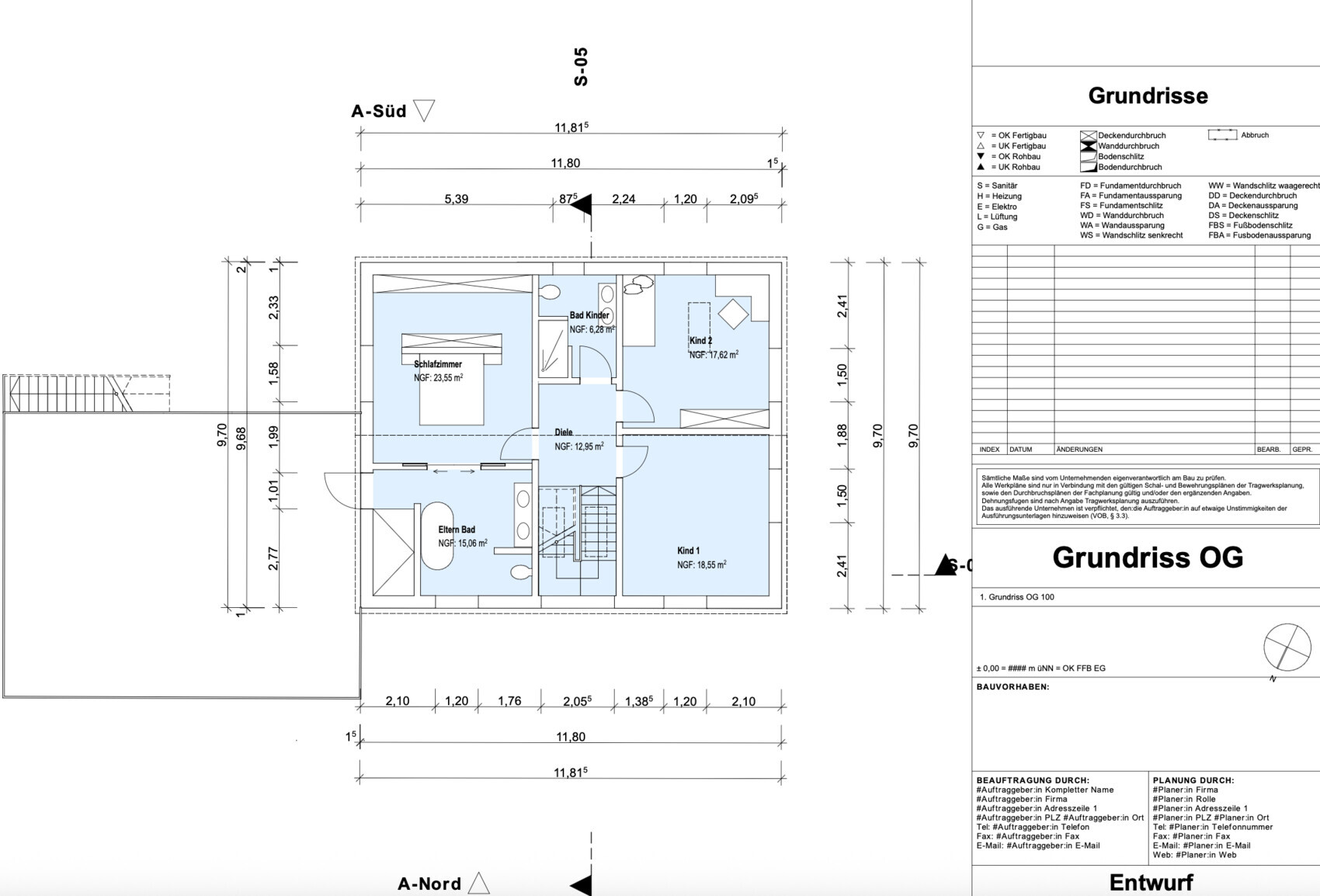
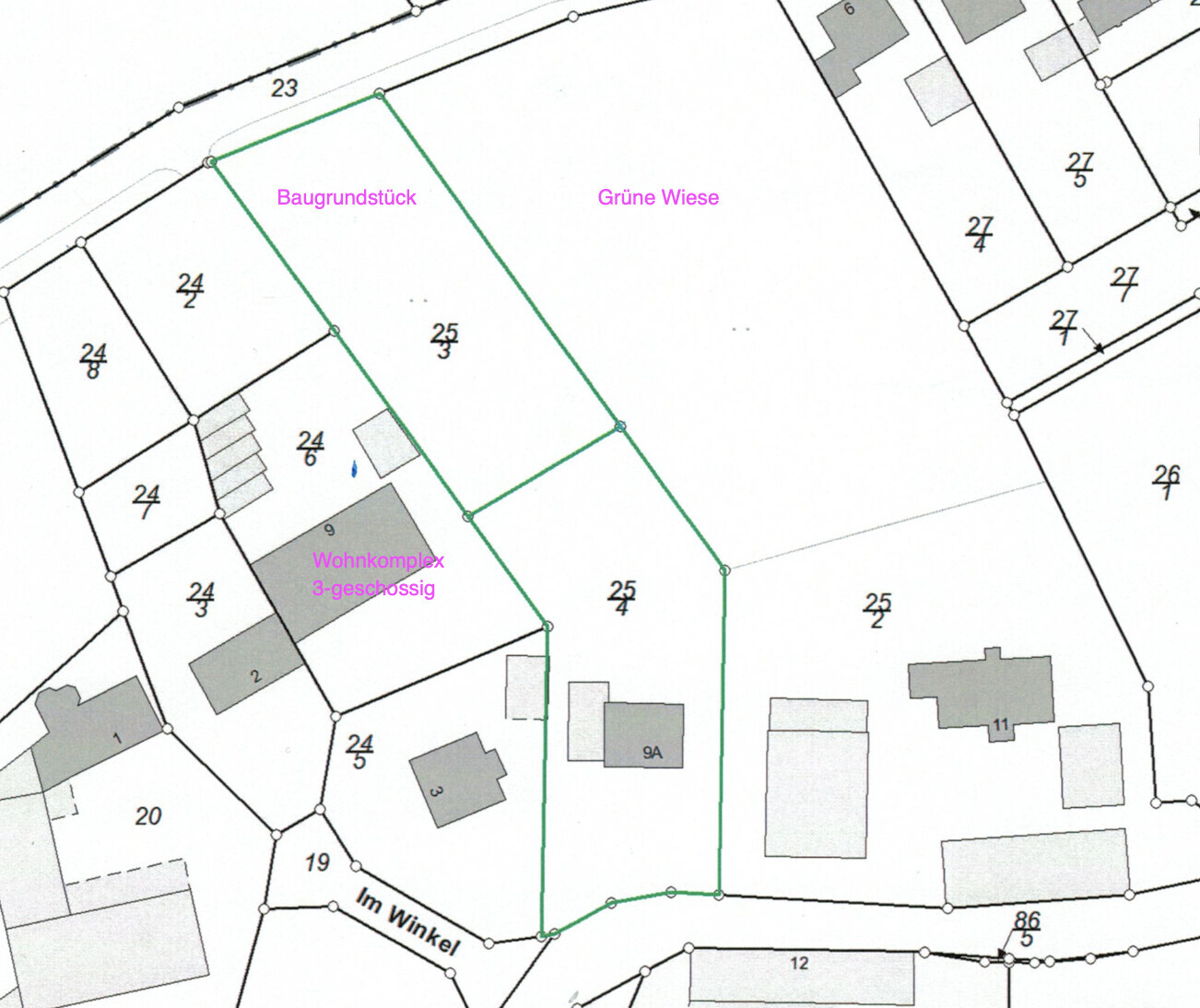
We are a young couple (26 and 28 years old) currently planning to build our single-family home. Two children are planned for the future. We have already purchased the suitable plot – it is located on the edge of a field in a small village, so it is a very quiet location.
At the moment, we are about to commit to a construction company that will handle both the building permit (planning permission) and most of the construction as general contractor. However, we would like to carry out some trades as self-performed work.
We designed the floor plan together with a friend who is studying for a Master’s degree in architecture. So far, these are still draft drawings, which we now want to turn into permit-ready plans. However, we have reached a point where we feel “stuck” – we literally can’t see the forest for the trees. Unfortunately, we don’t like the floor plan 100%, some rooms are missing, and we are unsure how to proceed.
Therefore, we would appreciate any input, ideas, or suggestions for improvements – but first, here is an overview following the question checklist:
Plot & Development
- Size: approx. 1,600 m² (17,220 sq ft)
- Dimensions: approx. 26 m (85 ft) wide × 60 m (197 ft) deep
- Topography: flat plot, no slope
- Location: edge of field in a small village
- Neighboring buildings:
- Northwest: Residential complex with two full stories + converted attic
- Northeast: large open meadow
- Development plan: none
- Requirements from building pre-application (preliminary enquiry):
- No explicit restrictions
- Recommendation to build towards the front (street side)
Our Preferences & Requirements
Building Style & Construction
- Two full stories
- Attic space used for storage
- Gable roof
- Timber frame construction
- Facade: combination of wood cladding and brickwork
- Style: modern, “clean”, clear lines – rather simple than ornate
- Basement: not planned
Rooms & Layout Concept
- Kitchen:
- Open, but separable with glass sliding door
- Pantry directly adjacent to the kitchen, ideally integrated into the kitchen cabinet front
- Dining/Living area:
- Open and spacious
- Dining table for 6 people, extendable to 10–12 people
- Master area:
- Bedroom with direct access to walk-in closet and separate bathroom
- Children’s rooms:
- Two equivalent children’s bedrooms
- Bathrooms:
- Children’s bathroom on upper floor
- Guest toilet on ground floor, ideally with shower
- Office/guest room (currently not included in the draft)
- Utility room:
- For washing, drying, and hanging laundry
- Technical room:
- Housing building services, possibly integrated into garage
- Garage:
- Simple design
- Technical room + separate toilet as an “external WC” can be integrated (as an idea, not yet part of the plan)
- Roof terrace over the garage desired (to enjoy unobstructed views of the sunset and the field)
Building Services (planned)
- Heat pump
- Photovoltaic system
- Ventilation system
- Smart home technology
- KfW-40 standard (energy efficiency standard)
Special Features & Current Challenges
What we like about the draft:
- Good orientation of rooms according to cardinal directions
- Simple, modern design without bay windows or building projections
- Long side of the house facing the garden = more openness to the south
We were uncertain for a long time whether the gable or the eaves should face the field. The current plan has the eaves facing the field – this seems more generous towards the garden. We are open to opinions on this!
What currently bothers us:
- The office/guest room is completely missing
- The laundry area is not ideally planned yet – e.g., where exactly do we dry clothes in winter?
- Covered entrance area – but will it be too dark there?
- Children’s bathroom vs. office/laundry room: We are considering giving up the separate children’s bathroom to instead integrate the office or laundry/ironing room there. On the ground floor, the guest toilet could be made slightly larger and include a shower – in case mornings get busy or guests want to shower on the ground floor.
Garage idea:
- Relatively simple garage, only the technical room should be insulated and have a concrete floor slab
- The rest of the garage could remain paved and uninsulated
- Roof terrace on the garage with views over the fields – our heartfelt wish
Budget & Self-performed Work
- Total house cost including garage: €550,000–600,000 (without landscaping)
- Self-performed work:
- Earthworks
- Roofing
- Flooring
- Electrical work
- Painting
- Landscaping: currently approx. €15,000 planned for basic paving
- Overall budget including fixtures: €650,000–700,000
What could we possibly do without?
- If necessary, we could do without the separate children’s bathroom – although of course that would reduce comfort.
- Instead, a larger guest toilet with shower on the ground floor, and use the upper floor room as laundry space.
What we do not want to give up:
- Generous, well-equipped kitchen – we love cooking.
- The roof terrace on the garage – the view is really unique and very important to us.
About the development of the draft
- Currently, we are probably on the fourth draft
- Originally, the house was larger and had a gallery and open staircase – but that was not affordable
- The garage was initially attached directly to the house – now it is detached with a covered walkway
Our main question(s) to you:
- Do you have any ideas on how to integrate the missing office without losing the spaciousness of the design?
- Could the covered entrance become too dark?
- What do you think about orienting the eaves side to the field instead of the gable?
- Are there sensible alternatives for better positioning the laundry/drying area?
- Do you see ways to better tailor the room program to our needs without exceeding the budget?
Final summary
We are trying to create a modern, well-thought-out, and suitable home for our needs – with a realistic budget and self-performed work where it makes sense. It is important to us that the house is special but not excessive or “over the top.”
We look forward to any feedback – whether on room layout, building services, facade design, roof terrace, or details.
Thank you very much in advance!
GeraldG schrieb:
We had a similar situation, so as an amateur I spent some time working on it. For your plot, I would divide the sides into two "types": good sides and bad sides. Good would be facing the meadow and garden, bad would be facing the neighbor and the street.
Personally, I would place the living room, dining room, kitchen, and office on the good sides. At the corners adjacent to the bad sides, I’d locate the kitchen and office, since the bad side bothers me less there. On the bad sides, I’d put things like the guest bathroom, staircase, and technical rooms.
What I learned is that the shape of the staircase is very important, as it affects the entire floor plan. I would try different stair configurations on the bad side and see how the upper floor turns out. The ground floor, in turn, develops based on the good and bad sides. Personally, I would assign the good side on the upper floor to the children, since they spend a lot of time there during the day and like to look outside occasionally. The parents’ bedroom is usually used mostly in the evening, so having a view is less important there.
One more thing, since I dealt with this more than I wanted to: a U-shaped kitchen often isn’t the best option because you’re basically enclosed by the kitchen. If you have a pantry, you need much less storage space in the kitchen. A high-end layout requires at least three tall units (dishwasher, refrigerator, and oven). Ideally, the sink and cooktop should be positioned so that when you use them, you’re looking in a “pleasant direction” (usually towards the garden or living room). Hello GeraldG,
thank you for the advice and the great tips!
We have basically taken the good and bad sides into account, as I described in a previous post: the green meadow is currently a good side, but it could also turn into a bad side.
The note about the U-shaped kitchen is also a good point!
W
wiltshire11 Oct 2025 13:46leah1003 schrieb:
This way you have direct access and can quickly place the bags inside. I think that’s a very good idea, especially since it seems possible to have some kind of pass-through to put groceries directly from the pantry into the kitchen. The most efficient layout depends on what exactly you want to store in the pantry. If you keep items there that you frequently need while working in the kitchen, a connection to the kitchen makes sense. If you store things that you carry in one go to the kitchen for cooking, placing the pantry near the main entrance is more convenient. I like the solution you’ve come up with in principle. I would call the room “pantry.”
leah1003 schrieb:
We also thought a lot about the access from the upper floor to the roof terrace. But since there will also be an external access via an outdoor staircase, we figured that if you’re sitting on the terrace, you’d have a quick way to go to the toilet. Having outside access to the roof terrace is useful so that not everyone who visits the terrace has to go through the private bathroom area. The small bridge to the house is a nice touch that adds more aesthetic value to the overall design than practical function. The outdoor terrace tends to be quite a “dirty zone,” while the master bathroom is almost the opposite. I speak from experience: our bathroom has an exterior door leading into the woods. We also have a parallel exterior door from the living area directly to the woods. When you use these exits, you inevitably bring in dirt from outside. It’s not very practical. We manage well and don’t have real everyday issues with it. Still, this is one of the few details we would have worded more clearly for the architect, such as: “We want our dogs to be able to play in the woods from the upper level every morning and evening, year-round. We want to be able to let them in and out without moving far from our living area, while limiting dirt tracking from outside to an easy-to-clean zone.”
(Before anyone objects to dogs running freely in the woods — we have a fenced area at the edge of the forest; the rest of the woods, which cover most of our property, are accessible only to wildlife and protected from human visitors. The reserve works well; we even have a shy pair of kites nesting on our property.)
leah1003 schrieb:
The circulation paths in the master bedroom are a good point—then a layout of bedroom -> walk-in closet -> bathroom is probably more practical? leah1003 schrieb:
The spatial arrangement bedroom–bathroom–walk-in closet is a very good suggestion! I will take that on board. A walk-in closet only makes sense if it is actually used for dressing and undressing. Often these rooms are planned so tightly that they are basically just a narrow corridor with wardrobe doors, making them cramped and uncomfortable. If the layout must include a passage through one of these rooms for space reasons, the choice depends on lifestyle. If the occupants have differing sleep schedules, it’s not ideal to pass through the bedroom to get to the closet, as every movement causes disturbance. If they have similar bedtimes, it makes sense to arrange the flow according to morning routines, bedtime, and occasionally checking on children. Then having the closet accessible through the bedroom works well. Different lifestyles call for different layouts.
leah1003 schrieb:
The space under the stairs will be storage, that is, a full-area lower flight with drawers. That sounds like a good idea.
leah1003 schrieb:
It wouldn’t fit at all into the small village, where almost every house is brick-faced. When designing the exterior facade, it’s important to set your own priorities and weigh various factors. Blending in with the village is one of several aspects; affinity for a particular material is another, as is personal preference—plus durability and maintenance requirements.
We also built a timber frame house because we like the material. We added a cladding layer of coarse larch wood, untreated, so it naturally ages like a traditional barn over the years. Larch is almost maintenance-free and professionally done, it lasts many decades—likely longer than our own lifetimes. I advocate for cladding a timber house with wood—not only is it beautiful and fitting for a rural setting, but also consistent as a material combination. But this isn’t about “right” or “wrong.”
leah1003 schrieb:
The window seat doesn’t face north but more northwest—that’s the direction where you can see the sunset from the property. The position of the window seat depends on its intended use and design. Someone who wants to sit comfortably reading there will want natural light. If the window seat is mainly a built-in seating area for socializing in the living room, then it’s important to consider when people will use it and how much warmth from sun exposure is desirable at those times. There is no single “right” position for a window seat. Its suitability depends on the preferences and daily routines of the household. A wintertime view of the sunset can be a wonderful feature for those who appreciate moments of contemplation but a complete waste of money for others.
It’s nice to read that you are thinking about these aspects for your family. That wasn’t clear from the initial post. With the additional information you provide, I understand the floor plan better. The architecture of a home supports the life of its residents and must consider how they live. Standards are useful for building quality and energy efficiency. Layout standards serve as a starting point for your own ideas and work well for many people. But building a home for your own life is a complex challenge.
wiltshire schrieb:
I think that’s a very good idea, especially since it seems possible to occasionally place groceries directly from the pantry into the kitchen through a kind of pass-through. The most efficient layout depends on exactly what you want to store in the pantry. If it contains items you frequently need while working in the kitchen, connecting it to the kitchen makes sense. If you store things there that you bring into the kitchen in one go for cooking, a location near the front door is more convenient. I like the solution you found in principle. I would call the space a "pantry."
Having external access to the roof terrace is practical so that not everyone who wants to use the terrace needs to pass through the private bathroom area. The small bridge to the house is a nice feature that adds more aesthetic value to the overall design than practical function. The outdoor terrace tends to be a fairly “dirty” area, while the master bathroom is the opposite. I speak from experience, as our bathroom has an exterior door leading into the forest. We also have another external door next to it, which leads directly from the living area into the forest. Whenever these exits are used, there is some outdoor debris brought inside. This is not very practical. We manage well with it and don’t have major everyday issues. Still, it’s one of the few details we should have been clearer about when giving requirements to the architect. For example: “We want our dogs to be able to play in the forest from the upper floor every morning and evening, throughout the year. We want to let them out and bring them in without having to leave our living space far, while limiting debris brought inside to an easily cleanable area.” (Before anyone objects, our dogs do not run freely in the forest—we have a fenced area at the forest edge. The rest of the forest, which makes up most of our property, is reserved for wildlife and protected from human visitors. The reserve works well; we even have a shy pair of kites nesting on our property.)
A walk-in closet is only truly useful if it can be used for dressing and undressing. These rooms are often planned so narrowly that they essentially become just a corridor lined with closet doors. The space between is narrow and uncomfortable. If space constraints force one of the rooms to be a passageway, the question is how your daily routine works to determine the ideal layout. If the sleeping times differ, it doesn’t make sense to go through the bedroom to access the closet, since any passage disrupts the other person. If bedtimes coincide, it makes sense to organize the flow according to getting up, going to bed, and occasionally checking on the kids. In that case, access through the bedroom is a good option. Different lifestyles require different layouts.
That sounds like a good idea.
When it comes to the exterior facade design, it’s about setting your priorities and weighing options. Fitting into the neighborhood is one aspect; affinity for a material is another; personal taste yet another, along with durability and maintenance requirements. We also built with a timber frame structure because we like the material. We added a rain screen with rough larch wood cladding. We left it untreated so it ages naturally over the years to look like an old barn. Larch wood requires almost no maintenance. Professionally done, it lasts many decades—in our case, longer than we will. I advocate for cladding a wood house with wood—I find it not only very attractive and fitting for a rural setting but also a harmonious material combination. But this is not about “right” or “wrong.”
The position of the seating bay window depends on its future use and design. Those who want to sit comfortably reading will want plenty of light. Those who primarily want to use the bay window as a built-in seat for socializing in the living room will consider when they usually sit there and what sun exposure and warmth are desired at those times. There is no single “correct” seat bay window location. How good it is depends on the needs and lifestyle habits of the people living in the house. A winter view of the sunset can be a fantastic feature for those who regularly take time for contemplation but a total waste of money for others.
It’s nice to read that you are considering these things for your family. This wasn’t clear from the initial post. With the additional information you provide, I understand the floor plan better. The architecture of a home supports the lives of its residents and must consider how they live. Standards are good for construction quality and energy efficiency. Layout standards are useful as a benchmark for your own ideas. They work very well for many people. Building a house tailored to your own life is a complex challenge.Hello Wiltshire,
Thank you very much for your kind words!
Regarding the walk-in closet–bathroom–bedroom arrangement: this layout was actually chosen for another reason as well. We go to bed and get up at the same times, and the bathroom is very important to us as a wellness space. The sliding door offers a nice view of the bathroom from the bed and also through the window onto the field.
I think we will keep this arrangement because it creates a connection when one person is already in bed and the other is still getting ready—the open spatial feeling remains, allowing communication. Based on the bathroom planning, we received advice to separate the toilet area to control odors. For example, it could be enclosed with a frosted glass door (to keep the space from being completely dark). What do you think about that?
The seating bay window is mainly intended for relaxing, reading, and so on. I believe the view of the field is lovely at any time of year, whether during the summer harvest or in winter. It is a place to linger, gaze, and read.
Thank you also for the note about the wooden cladding—we plan to do exactly that: let it weather naturally without treatment.

wiltshire schrieb:
Access to the roof terrace from the outside makes sense so that not everyone who wants to go onto the terrace has to walk through the private bathroom area. The small bridge to the house is a nice touch,The roof terrace with bridge and stairs are, in my guess, the first three notes of the string quartet ;-)https://www.instagram.com/11antgmxde/
https://www.linkedin.com/company/bauen-jetzt/
W
wiltshire12 Oct 2025 08:28leah1003 schrieb:
As a result of the bathroom planning, we were advised to really separate the toilet to prevent odors. For example, you could use a frosted glass door (to avoid completely darkening the space) to enclose the WC.
What do you think about that? Odors: Your design can remain as is and still be nearly odor-free if you install an odor extraction system. It might even be cheaper than a physical partition. You will need electricity and the installation of the ventilation duct. We have this in our camper van, and it works perfectly.
leah1003 schrieb:
The window seat is mainly for relaxing, reading, etc. Invest time in the size and design to achieve your goal, because a window seat and comfort do not automatically go together.
11ant schrieb:
The rooftop terrace with a bridge and stairs are, in my opinion, the first three notes of the string concert ;-) Where there’s a will, there’s a way. Structural preparation and later construction cost little extra. Instead of “yes” or “no,” there is the option of “now” or “later.” This also applies to the entire garage and parts of the so-called “outdoor area.”
wiltshire schrieb:
Where there’s a will, there’s a way. In this case, you don’t need to worry about obtaining a building permit / planning permission.
ypg schrieb:
The entire structure, including the garage, is just under 22 meters (72 feet) wide. Depending on the state or region, you have to maintain a setback of 2.5 or 3 meters (8 feet 2 inches or 9 feet 10 inches) from the property boundary. It’s always easy to get caught up mentally in minor details and plan everything perfectly around them when you’re stuck on the important issues.
Similar topics