
ᐅ Floor Plan Design for a Gable Roof House Measuring 9x13 m with an Attached 6x9 m Loft Extension
Created on: 24 Oct 2024 12:46
B
Biker99
Hello,
I came across this interesting forum yesterday and would like to take the opportunity to present my first floor plan draft here in the hope of receiving valuable advice. Often, being too focused on one direction limits ideas, so fresh eyes and new inspiration from others are always very helpful.
The general idea is to have the house built completely turnkey by a prefab house company, without any DIY efforts on our part. So far, no architect has been hired because I first wanted to try putting my own wishes and ideas on paper. I believe that with this DIY preliminary planning, there might be a better basis to go directly to an architect or even several prefab home providers to obtain feasible implementations and corresponding cost estimates.
I look forward to your feedback (and I’m already bracing myself...).
Development Plan / Restrictions
Currently, paragraph 34 applies. However, a design guideline is expected next year. The house has already been initially designed within the preliminary framework of this guideline.
The plot size is about 650 m² (7000 sq ft). It is a flat lot on a road with through traffic. Floor area ratio is 1.5. A detached garage will be attached to an existing building with two full floors plus an attic conversion on the right side, and next to the garage will be the new house.
The existing building is oriented with the eaves side to the street. The new house is planned to be positioned with the gable end facing the street.
The neighboring house on the other side (directly on the street) also has its gable end facing the street. Parking spaces: 2 (in front of the garage) plus a double garage (6 x 9 m (20 x 30 ft)). Number of floors: 1.5. Roof type: pitched roof, 25 to max 35 degrees. Style: conventional. Orientation: northeast to southwest.
Maximum heights/limits
The planned maximum height is about 8.5 m (28 ft).
The house must be set back 3 m (10 ft) from the front property line. The double garage should/setback 5 m (16 ft) from the front property line (unfortunately, no more was allowed in the planning approval inquiry, so from my view, only a front entrance to the house is currently feasible).
A direct connection from the double garage to the house is desired.
A corresponding positively approved preliminary building permit is available.
Homeowners’ Requirements
We want a modern house with a pitched roof.
A basement (possibly a partial basement) is desired and unfortunately required due to space constraints (not for living purposes; the basement should only serve as storage or a hobby/craft room).
For the knee wall height of the 1.5-story building, we envision 1.60 to 1.80 m (5’3” to 6’0”).
Number of occupants: 2 persons, 60 years old.
The house should be designed to be barrier-free as much as possible and should allow living only on the ground floor at an advanced age.
The total required area on the ground floor and upper floor should be around 180 m² (1937 sq ft).
The office will be used privately only.
We expect about 5 guest stays per year.
The living/dining area should be spacious and as open as possible.
A storage room between the double garage and the house (which also allows access from the garage to the house) is required.
The kitchen should be open with a cooking island or peninsula.
A central fireplace in the living/dining area is planned/desired.
A balcony with access from the gallery and the office is also desired. Alternatively, a loggia (either one-sided or spanning the width of the house) could be considered.
It is important for us to have an open gallery over the dining area where you can stay and where fitness equipment will also be placed.
The double garage measuring 6 x 9 m (20 x 30 ft) is fixed, as several vehicles need to be accommodated.
House Design
A first preliminary plan created using a 3D program is available.
What I like about the initial plan are the open sight lines, the gallery, and the large living/dining area facing the garden (southwest).
I especially struggled with the staircase design. Initially, I wanted a straight staircase with access from the living/dining area, but I discarded this for various reasons (also because a cellar staircase is still needed “underneath,” which makes a straight staircase less visually appealing).
After initially planning bathroom access from the sleeping area (which also leads to the dressing room), I eventually decided for an access from the hallway to allow a wider shower, a large double washbasin in front of the window, and a toilet with at least 90 cm (35 inches) clearance to the side.
What I don’t like yet is the gable side area between the open space and the office with the 90-degree angle.
In the (probably too) narrow utility room, the washing machine and dryer are to be accommodated.
Why did the design turn out this way?
For example, only about 18 m (59 ft) of plot width is available, which limits the house width to a maximum of 9 m (30 ft) with a set double garage width of 6 m (20 ft).
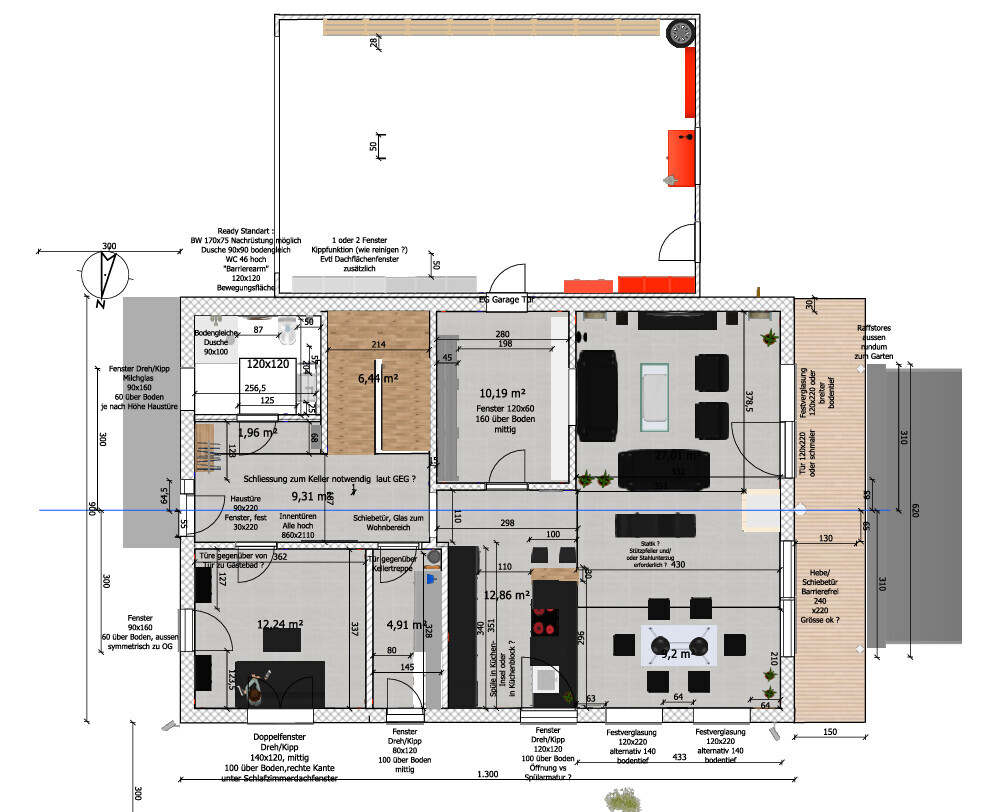
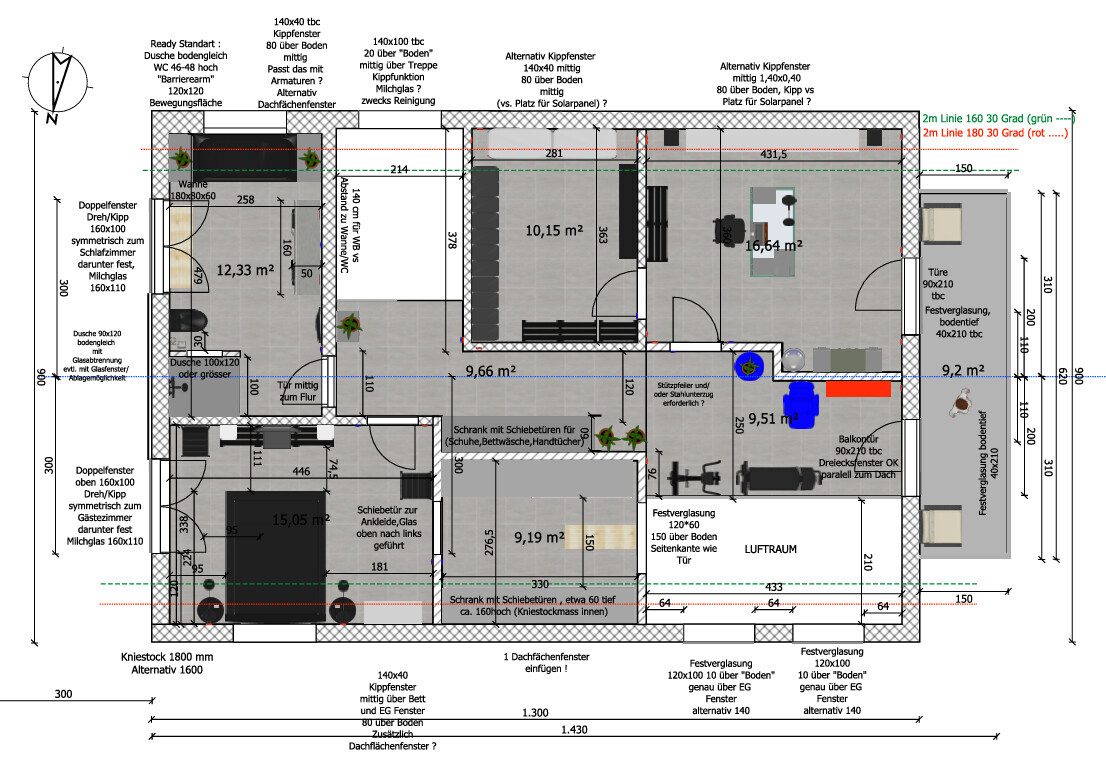
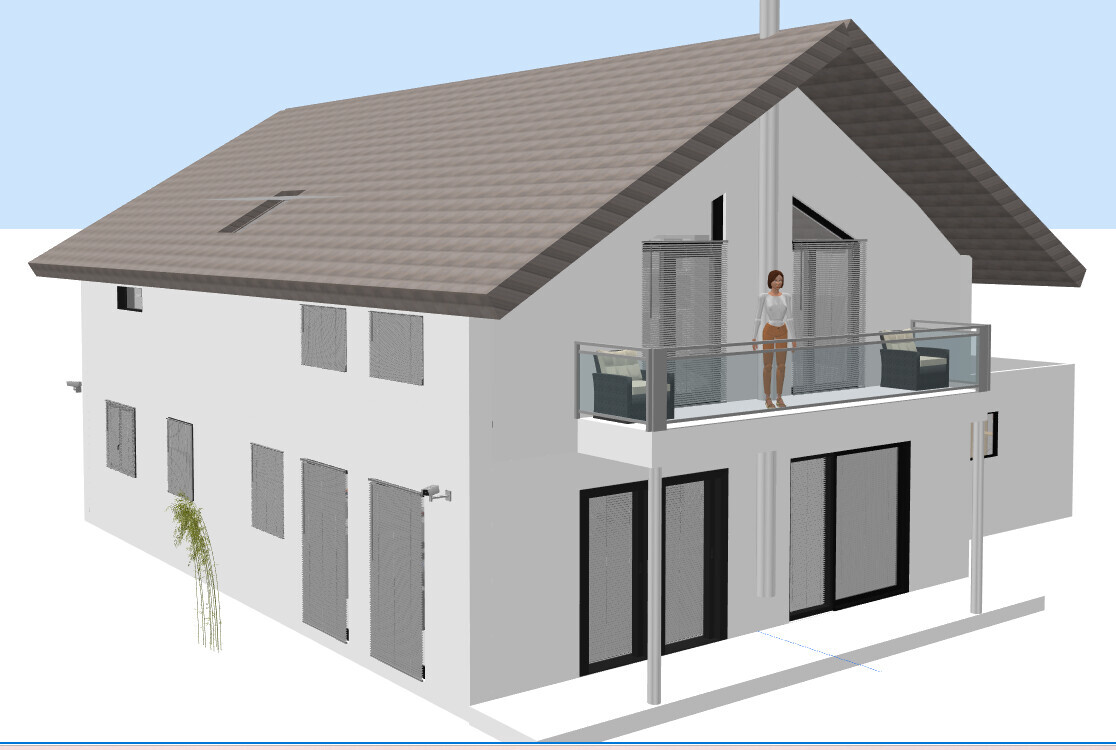
I came across this interesting forum yesterday and would like to take the opportunity to present my first floor plan draft here in the hope of receiving valuable advice. Often, being too focused on one direction limits ideas, so fresh eyes and new inspiration from others are always very helpful.
The general idea is to have the house built completely turnkey by a prefab house company, without any DIY efforts on our part. So far, no architect has been hired because I first wanted to try putting my own wishes and ideas on paper. I believe that with this DIY preliminary planning, there might be a better basis to go directly to an architect or even several prefab home providers to obtain feasible implementations and corresponding cost estimates.
I look forward to your feedback (and I’m already bracing myself...).
Development Plan / Restrictions
Currently, paragraph 34 applies. However, a design guideline is expected next year. The house has already been initially designed within the preliminary framework of this guideline.
The plot size is about 650 m² (7000 sq ft). It is a flat lot on a road with through traffic. Floor area ratio is 1.5. A detached garage will be attached to an existing building with two full floors plus an attic conversion on the right side, and next to the garage will be the new house.
The existing building is oriented with the eaves side to the street. The new house is planned to be positioned with the gable end facing the street.
The neighboring house on the other side (directly on the street) also has its gable end facing the street. Parking spaces: 2 (in front of the garage) plus a double garage (6 x 9 m (20 x 30 ft)). Number of floors: 1.5. Roof type: pitched roof, 25 to max 35 degrees. Style: conventional. Orientation: northeast to southwest.
Maximum heights/limits
The planned maximum height is about 8.5 m (28 ft).
The house must be set back 3 m (10 ft) from the front property line. The double garage should/setback 5 m (16 ft) from the front property line (unfortunately, no more was allowed in the planning approval inquiry, so from my view, only a front entrance to the house is currently feasible).
A direct connection from the double garage to the house is desired.
A corresponding positively approved preliminary building permit is available.
Homeowners’ Requirements
We want a modern house with a pitched roof.
A basement (possibly a partial basement) is desired and unfortunately required due to space constraints (not for living purposes; the basement should only serve as storage or a hobby/craft room).
For the knee wall height of the 1.5-story building, we envision 1.60 to 1.80 m (5’3” to 6’0”).
Number of occupants: 2 persons, 60 years old.
The house should be designed to be barrier-free as much as possible and should allow living only on the ground floor at an advanced age.
The total required area on the ground floor and upper floor should be around 180 m² (1937 sq ft).
The office will be used privately only.
We expect about 5 guest stays per year.
The living/dining area should be spacious and as open as possible.
A storage room between the double garage and the house (which also allows access from the garage to the house) is required.
The kitchen should be open with a cooking island or peninsula.
A central fireplace in the living/dining area is planned/desired.
A balcony with access from the gallery and the office is also desired. Alternatively, a loggia (either one-sided or spanning the width of the house) could be considered.
It is important for us to have an open gallery over the dining area where you can stay and where fitness equipment will also be placed.
The double garage measuring 6 x 9 m (20 x 30 ft) is fixed, as several vehicles need to be accommodated.
House Design
A first preliminary plan created using a 3D program is available.
What I like about the initial plan are the open sight lines, the gallery, and the large living/dining area facing the garden (southwest).
I especially struggled with the staircase design. Initially, I wanted a straight staircase with access from the living/dining area, but I discarded this for various reasons (also because a cellar staircase is still needed “underneath,” which makes a straight staircase less visually appealing).
After initially planning bathroom access from the sleeping area (which also leads to the dressing room), I eventually decided for an access from the hallway to allow a wider shower, a large double washbasin in front of the window, and a toilet with at least 90 cm (35 inches) clearance to the side.
What I don’t like yet is the gable side area between the open space and the office with the 90-degree angle.
In the (probably too) narrow utility room, the washing machine and dryer are to be accommodated.
Why did the design turn out this way?
For example, only about 18 m (59 ft) of plot width is available, which limits the house width to a maximum of 9 m (30 ft) with a set double garage width of 6 m (20 ft).
The other version without a long hallway, with a side entrance, is still in progress.
A basic question about structural engineering: How flexible are prefab house manufacturers regarding the positioning of interior walls on the upper floor relative to the interior walls on the ground floor? Specifically, when designing the upper floor, do walls (beyond those enclosing the staircase, which naturally align) have to be placed directly above the walls on the ground floor, or is there some planning freedom in this regard?
I assume that for large living/dining areas and large ceiling spans without supporting walls below, steel beams may need to be installed anyway.
In most floor plans you see in home catalogs, the walls on the upper floor at least partly align over the walls on the ground floor.
A basic question about structural engineering: How flexible are prefab house manufacturers regarding the positioning of interior walls on the upper floor relative to the interior walls on the ground floor? Specifically, when designing the upper floor, do walls (beyond those enclosing the staircase, which naturally align) have to be placed directly above the walls on the ground floor, or is there some planning freedom in this regard?
I assume that for large living/dining areas and large ceiling spans without supporting walls below, steel beams may need to be installed anyway.
In most floor plans you see in home catalogs, the walls on the upper floor at least partly align over the walls on the ground floor.
Biker99 schrieb:
After consulting with a staircase specialist, I have now installed a staircase that is a bit less deep and redesigned the kitchen into a U-shape. The main reason was to make the living and ground floor sleeping areas somewhat wider. At the same time, I shortened the house by 30 cm (12 inches).
I initially did not recess the entrance area inward. If it were possible to set the house back by 1 meter (3 ft 3 in), this might be useful (even though it reduces interior space) to create a 1-meter-deep (3 ft 3 in) covered area flush with the garage.
In the relatively wide hallway, you could install a wardrobe with a bench seating area (then make the utility room narrower). Alternatively, a wardrobe wall could be integrated into the utility room, as shown in the sketch.
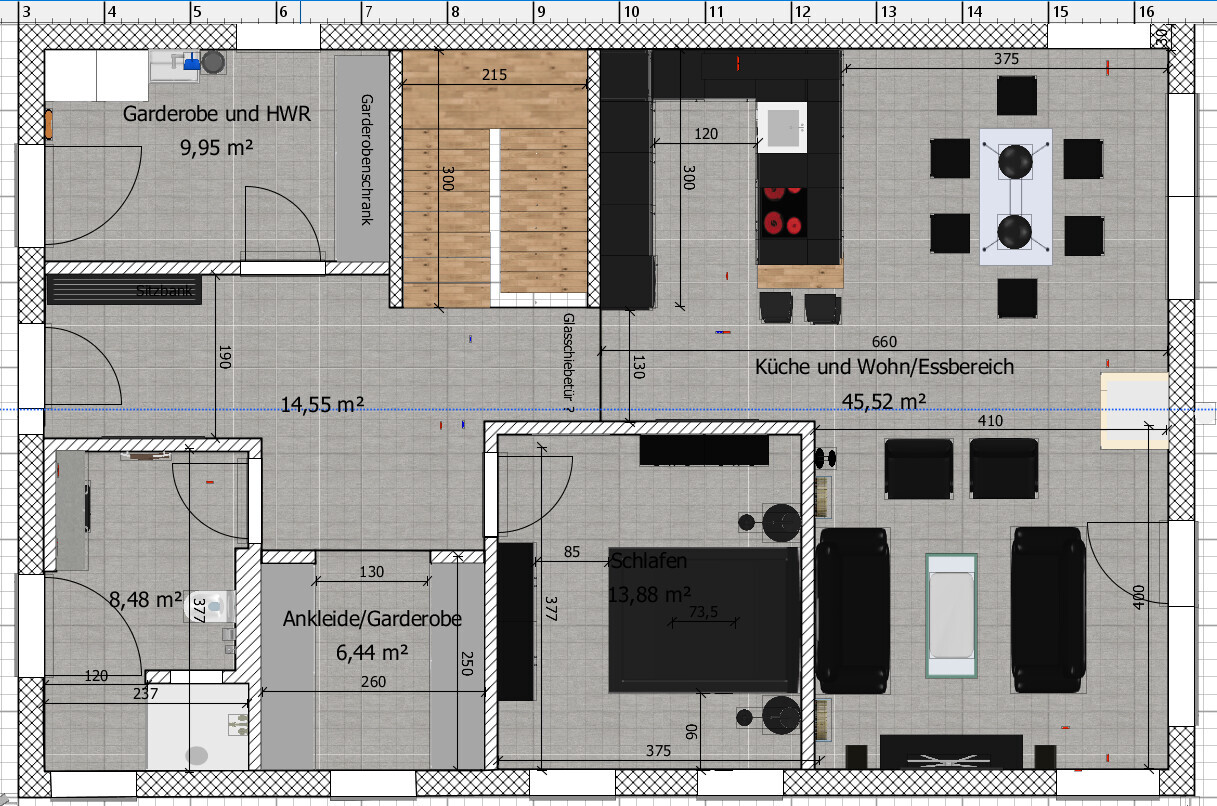
Here is the version with the entrance on the left side (house length not yet reduced here, entrance area recessed inward, slightly wider staircase, and minor differences in the dimensions of the bathroom and dressing room).
In principle, I think that a side entrance causes even more loss of space due to the large, wide corridor, so currently I tend to prefer the more central entrance (despite the long hallway).
What do you think?
It would be great if the experts here could comment on this again.
Thank you very much!

Biker99 schrieb:
A somewhat naive question about structural engineering: How flexible are prefab house manufacturers regarding the position of interior walls on the upper floor in relation to the interior walls on the ground floor? In other words, when designing the upper floor, do walls (even more than the stairwell walls, which are usually aligned) have to be positioned directly above the walls on the ground floor, or is there some initial freedom in planning? An experienced planner derives the ground floor layout from the upper floor, which I regularly point out. The extent of your freedom on the upper floor can be influenced, among other things, by the choice of the floor structure there. See also "The upper floor takes priority" and "Non-load-bearing partitions in solid construction?"
Biker99 schrieb:
I assume that with large living/dining areas and large ceiling spans without supporting walls underneath, steel beams might have to be installed. Most prefab manufacturers build with wood frame panels, so steel beams are generally not used, and even in solid construction, steel beams are used sparingly.
https://www.instagram.com/11antgmxde/
https://www.linkedin.com/company/bauen-jetzt/
Biker99 schrieb:
At times, I felt like I was in an oriental bazaar, at the mercy of local planners and heritage protection authorities (the half-timbered house on the right is a listed building).
They didn’t want to accept more than a 50cm (20 inches) roof overhang until I provided photos of the neighboring houses, some of which have roof overhangs up to 1m (39 inches). Then the colleagues were okay with 1m as well. What do you expect? You have to accept that your building project just doesn’t fit into the old street area, which also falls under heritage protection. It’s a balance of give and take with the conservative building authority.
But I think that’s fine. It prevents abuse.
Biker99 schrieb:
Currently, I have a clear height of 2.65 m (8 ft 8 in) in my 3D program for both the ground floor and the upper floor. What is 2.65 m (8 ft 8 in) good for? That’s an amateur program used for interior planning; it doesn’t replace professional design. That’s why I always recommend planning with a lot of extra margin, otherwise the structural engineer or architect won’t be able to deliver what you want. Such programs usually have no ceiling or screed planning.
Biker99 schrieb:
In most floor plans seen in house catalogues, the upper-floor walls partly line up with the ground-floor walls. I always wonder what you mean by “prefabricated house.” Many people generalize that term.
Prefab manufacturers build mostly with timber frame construction or panelized systems, using wood or prefabricated wall panels.
Many walls often align because the rooms are simply planned efficiently. Generally, there is no reason to offset a wall by 30cm (12 inches) if you make sure all rooms can be used flexibly for a family of four (the main target group for manufacturers).
Biker99 schrieb:
A naive question about structural engineering: How flexible are prefab builders regarding the position of interior walls on the upper floor compared to those on the ground floor? In other words, when designing the upper floor, do walls (especially more than just those enclosing the staircase, which usually align) have to be positioned exactly above the ground-floor walls, or is there some freedom in planning? It’s not the walls that matter structurally, but posts and beams. These are then connected to the walls. Where the structural posts are located, you won’t see them later.
By the way, the corner on the ground floor from the open space or ceiling recess will probably also need to be supported by a post.
Biker99 schrieb:
Or is there some freedom in planning here? Yes, you can be somewhat flexible.
However, architect-designed houses from these companies (Schwörerhaus, Weberhaus, etc.) tend to be expensive. Ultimately, it’s about customization that occupies the entire production line because individual dimensions have to be specially input and manufactured.
I recommend either modifying a standard model from the manufacturer or commissioning a small local company and an external architect. Carpenter workshops often work with an architect as well. The most flexible option is naturally a solid house (masonry construction), where the bricks or blocks are laid directly on site.
Prefab manufacturers mostly build with glued laminated timber (Glulam). However, they usually don’t offer basements, which means you end up with two separate contractors.
But you probably already know all that?!
Personally, I see some issues you should clarify for yourself now, including waiting times for production and erection of prefab houses.
How is the garage going to be built?
Now I have to quote myself because I searched for your budget and only found my own summary.
ypg schrieb:
Costs: €540,000 for 180 sqm (1,938 sq ft) of living space, plus a basement at €120,000–150,000,
double garage €40,000
That’s €700,000–750,000
… 3,000 €/sqm (279 $/sq ft) refers to average standard with common DIY work included.
Adjust that for open spaces, stair landings, some construction extras, and an individual prefab house to at least 3,500 €/sqm (326 $/sq ft).
Honestly, I would first check with a few companies whether they could build a house within the budget you have in mind. Also, how the garage and basement and customization would affect the house price.
Because I suspect you are orienting yourself to list prices, which are basic and do not include foundations or detailed specifications.
And now you are happily drawing your 180 sqm and may later find no one who will build it—or only start addressing substantial matters then.
ypg schrieb:
What’s the point of using 2.65? That’s an amateur program for setting things up; it can’t replace professional planning. That’s why I always say to build in plenty of margin everywhere, otherwise the professional planner won’t be able to achieve what you want. Such a program basically doesn’t include ceiling or screed planning.
I always wonder what you mean by “prefab house.” Many people generalize this term.
Prefab house manufacturers build using timber frame construction / prefabricated construction methods, often with wood or panel elements.
Many walls are often aligned vertically because the spaces are usually planned quite efficiently. There’s usually no reason to offset a wall by 30cm (12 inches) if you ensure that all rooms for a family of four (the manufacturers’ main target group) can be used flexibly.
It’s not the walls that are structurally significant but rather posts and beams. These are then connected to the walls. You won’t see the load-bearing post later on.
By the way: the corner on the ground floor of the void/opening in the ceiling will likely also need to be supported by a post.
Yes, you have some freedom of movement.
However, the architect-designed houses from these companies (Schwörerhaus, Weberhaus, etc.) are quite expensive. Ultimately, it’s about customization that requires the entire production line to handle complex individual dimensions.
I recommend either modifying a standard design of the manufacturer or hiring a small local company and an external architect. Carpentry companies often have an architect on hand too. Of course, the most flexible option is a masonry house. The bricks are laid directly on site.
Prefab manufacturers almost exclusively work with Glatthaar. However, they generally don’t offer basements, which means you have two contract partners in that case.
But you probably already know all this?!
Personally, I see some issues you need to clarify for yourself now, also regarding the waiting times for production and installation times of prefab houses.
How is the garage supposed to be built?
Now I have to quote myself because I was looking for your budget and only stumbled upon my own breakdown.
3,000€/sqm (square meter) refers to an average standard with typical owner-contributed work.
Correct that to at least 3,500€ with a void, staircase landing, some structural extras, and a customized prefab house.
Honestly, I would first check with a few companies whether they can build a house within the price range you have in mind. Also, ask how the garage and basement and the customization options affect the final price.
Because I fear you are basing your expectations on starting prices from catalogs, which are bare and lack a foundation slab and come with a basic construction description.
And now you are confidently drawing 180 sqm (1,938 sq ft) and later won’t find anyone willing to build it or you only start to clarify substantial matters then. Regarding the preliminary building inquiry: I had three pre-meetings with the building authority where I outlined my plans, and in none of these meetings—called “citizen building consultations”—were concerns raised about my plans. I fully understand that a building project must comply with Para 34, but I have less understanding that there appear to be no clear and transparent criteria publicly available within which one can create a plan that is then valid. If there are freshly built houses in the same neighborhood that clearly do not “fit in” with regard to external dimensions, roof overhangs, or the size of paved areas—and these parameters are precisely the ones that were objected to in my project—it unfortunately creates the impression that double standards are often applied. But that doesn’t help.
I have already included 3,500€ per square meter in my budget, plus basement and garage.
My idea was to approach some providers with a floor plan concept and the external dimensions (both “brick by brick” masonry and timber panel or timber frame construction) to obtain tailored offers. I’ve already had discussions with four providers. It’s possible that standard house models exist that could be suitably adapted. I have also created an Excel-based catalog comparing the building service descriptions of about ten manufacturers. I would use this both to select suitable providers from my perspective (“all-in-one package” is a must) and to be able to compare the offers reasonably well.
Many manufacturers now offer house, basement, and garage as a package (although, as you correctly said, they often work with Glatthaar), which ideally means you would have only one contract partner.
Regarding the garage, I am leaning towards a precast concrete garage since it requires slightly less space and should also be cheaper. However, I am also open to a timber garage if it doesn’t take up too much width. A slightly narrower garage (e.g., 5.50 meters (18 feet)) in favor of a slightly wider house is also conceivable if that offers advantages in terms of potentially using a standard house model.
However, after reviewing many catalogs and visiting prefab house exhibitions, I am somewhat skeptical that I will find something fitting my desired layout, which is tailored to two people, with a gable-end entrance and the given dimensions.
It is important for me to gain some initial reassurance that the floor plans you/you all helped create make sense.
I have another meeting with the local planner at the building authority in two weeks. There I can clarify how much flexibility exists to shift the house and/or garage by about plus or minus 1 meter (3 feet) relative to each other if this would improve the floor plan.
It would be great to have the following three questions answered:
Do the two proposed ground floor plans make sense in terms of room sizes, room layouts, and corridor widths?
Which of the two ground floor plans would you favor?
What potential advantages do you see if the house or garage could be shifted relative to each other by about 1 to a maximum of 2 meters (3 to 6 feet) longitudinally?
Thank you very much.
Similar topics