
ᐅ Floor Plan Design for a Bungalow with Basement – 140 sqm – Gentle Slope
Created on: 11 Apr 2021 22:08
B
Bike975
Hello everyone,
I have been a silent reader here for some time, but now our building project is becoming more concrete. That’s why I would like to share our floor plan here to get feedback from others. After days of drawing, discussing, etc. within a small group, you tend to become somewhat “blind” and might miss “the essentials” sometimes. Just a note: the furniture, kitchen, shower, toilet, etc., shown on the plan are only symbolic placeholders and do not reflect our actual planning.
Development Plan / Restrictions
Plot size: 644 sqm (6,930 sq ft) – 23 m x 28 m (75 ft x 92 ft)
Slope: yes, descending from south to north. Approximately 2 m (6.5 ft) height difference.
Floor area ratio (FAR): 0.4
Site coverage ratio: 0.4
Building envelope, building line and boundary: 5 m (16 ft) to the north, 3 m (10 ft) to the south
Edge development: -
Number of parking spaces: -
Number of floors: single-story
Roof type: gable roof, hip roof, flat roof
Architectural style: -
Orientation: ridge line east-west – parallel to the street
Maximum height / limits: 5.5 m (18 ft)
Other requirements:
Owners’ Requirements
Style, roof type, building type: bungalow with hip roof
Basement, floors: ground floor with basement
Number of occupants, ages: 3 people (45 / 40 / 5)
Space requirement for ground floor, upper floor: approx. 140 sqm (1,507 sq ft)
Office: family use or home office? Home office
Guest bedrooms per year: 4-6 times/year
Kitchen type, cooking island: closed kitchen, no island
Number of dining seats: 6
Fireplace: no
Music/stereo wall: no
Balcony, roof terrace: no
Garage, carport: double garage
Utility garden, greenhouse: no
House Design
Who created the design: We made the initial draft, and the builder performed numerous changes according to our wishes.
What do you like most? All our wishes have been implemented so far.
What do you dislike? Actually, we like everything so far.
Price estimate according to the architect/planner: €560,000 (approx.) – including special requests (sanitary, electrical, sunshades, etc.)
Personal price limit for the house including fittings: €600,000 (approx.), excluding ancillary building costs, garden, etc.
Preferred heating technology: ground-source heat pump / air-to-water heat pump
If you had to forego something, which details/extras would they be?
- Could give up: actually nothing
- Could not give up: closed kitchen
Why did the design turn out like it is now?
Our requirements regarding room sizes and layout have been implemented as we wished.
What is the most important/basic question about the floor plan summarized in 130 characters?
- We want to use the forum discussion to identify any “weaknesses” in the floor plan in advance.
- Has anything important been forgotten?
- What concerns do you have?
- What can still be improved?
- Suggestions/criticism are very welcome.
Thanks in advance.
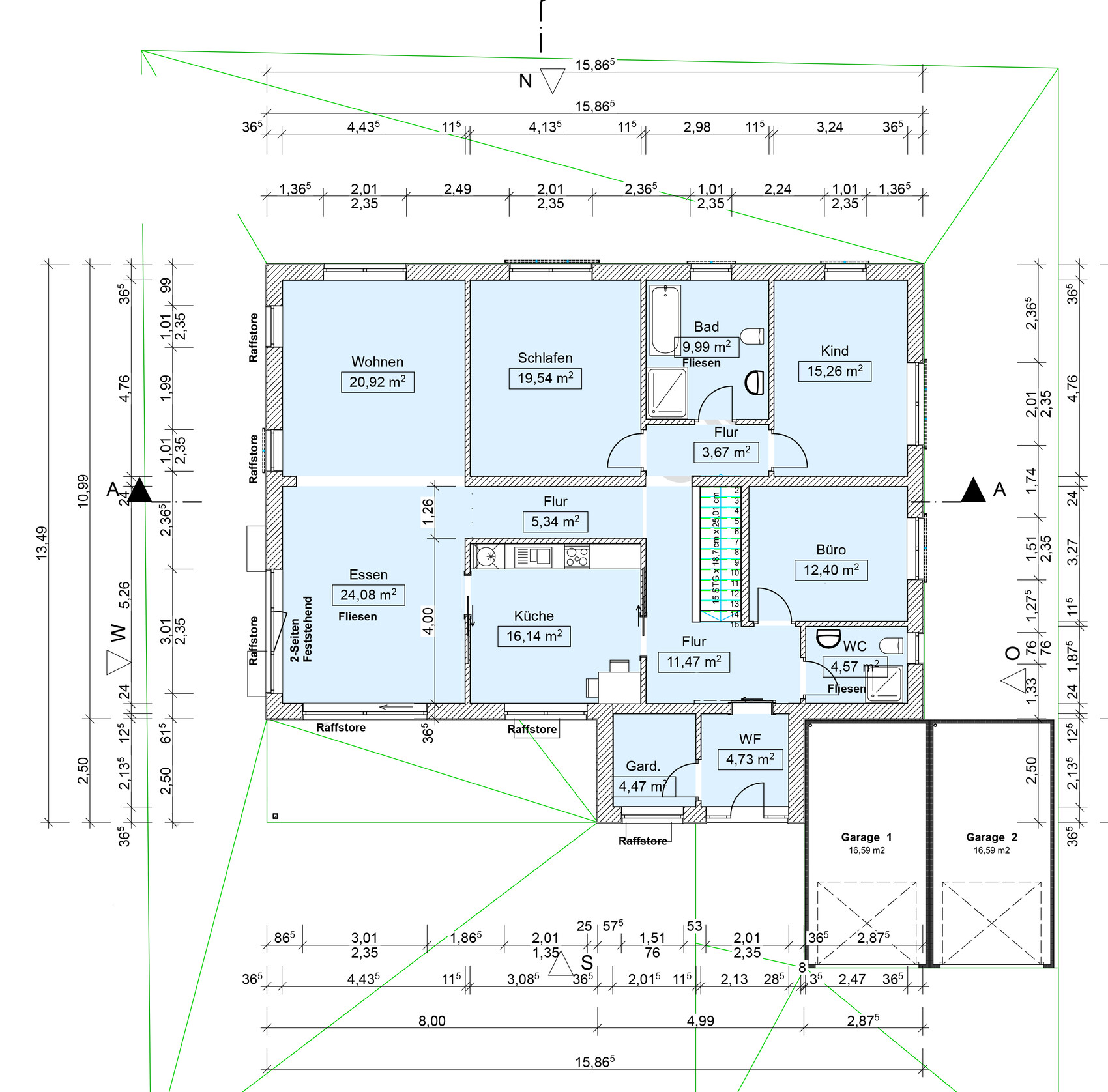
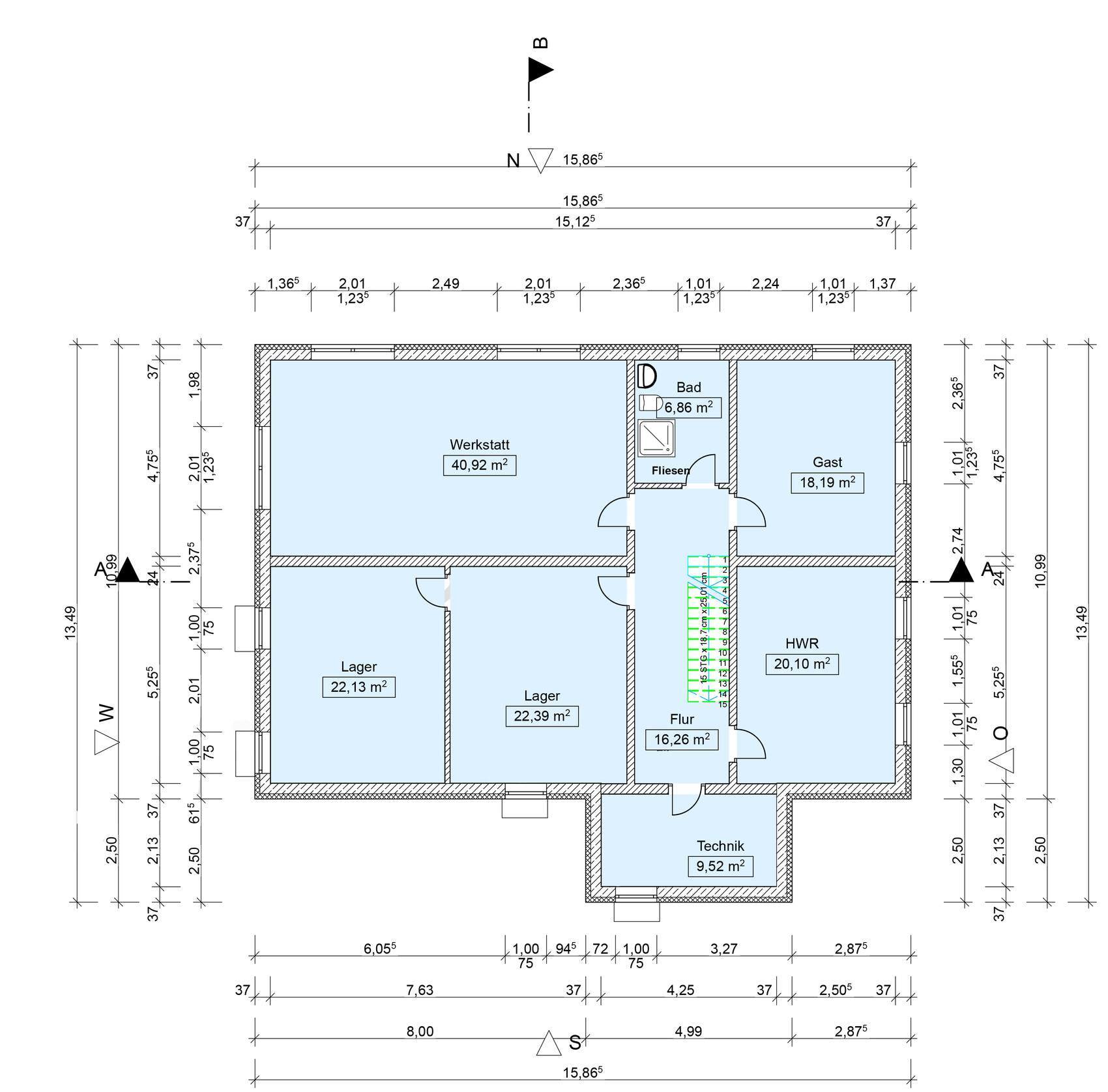
I have been a silent reader here for some time, but now our building project is becoming more concrete. That’s why I would like to share our floor plan here to get feedback from others. After days of drawing, discussing, etc. within a small group, you tend to become somewhat “blind” and might miss “the essentials” sometimes. Just a note: the furniture, kitchen, shower, toilet, etc., shown on the plan are only symbolic placeholders and do not reflect our actual planning.
Development Plan / Restrictions
Plot size: 644 sqm (6,930 sq ft) – 23 m x 28 m (75 ft x 92 ft)
Slope: yes, descending from south to north. Approximately 2 m (6.5 ft) height difference.
Floor area ratio (FAR): 0.4
Site coverage ratio: 0.4
Building envelope, building line and boundary: 5 m (16 ft) to the north, 3 m (10 ft) to the south
Edge development: -
Number of parking spaces: -
Number of floors: single-story
Roof type: gable roof, hip roof, flat roof
Architectural style: -
Orientation: ridge line east-west – parallel to the street
Maximum height / limits: 5.5 m (18 ft)
Other requirements:
Owners’ Requirements
Style, roof type, building type: bungalow with hip roof
Basement, floors: ground floor with basement
Number of occupants, ages: 3 people (45 / 40 / 5)
Space requirement for ground floor, upper floor: approx. 140 sqm (1,507 sq ft)
Office: family use or home office? Home office
Guest bedrooms per year: 4-6 times/year
Kitchen type, cooking island: closed kitchen, no island
Number of dining seats: 6
Fireplace: no
Music/stereo wall: no
Balcony, roof terrace: no
Garage, carport: double garage
Utility garden, greenhouse: no
House Design
Who created the design: We made the initial draft, and the builder performed numerous changes according to our wishes.
What do you like most? All our wishes have been implemented so far.
What do you dislike? Actually, we like everything so far.
Price estimate according to the architect/planner: €560,000 (approx.) – including special requests (sanitary, electrical, sunshades, etc.)
Personal price limit for the house including fittings: €600,000 (approx.), excluding ancillary building costs, garden, etc.
Preferred heating technology: ground-source heat pump / air-to-water heat pump
If you had to forego something, which details/extras would they be?
- Could give up: actually nothing
- Could not give up: closed kitchen
Why did the design turn out like it is now?
Our requirements regarding room sizes and layout have been implemented as we wished.
What is the most important/basic question about the floor plan summarized in 130 characters?
- We want to use the forum discussion to identify any “weaknesses” in the floor plan in advance.
- Has anything important been forgotten?
- What concerns do you have?
- What can still be improved?
- Suggestions/criticism are very welcome.
Thanks in advance.
M
Myrna_Loy13 Apr 2021 08:38haydee schrieb:
I know both. Both are extremely impractical. I don’t want a closed kitchen, nor a bathroom overlooking the courtyard.
Open kitchens aren’t that new. They used to be called eat-in kitchens. They had a dining table, a couch, and the only radio and television in the house. The living room was dusted more often than it was used. But that’s actually not an open kitchen, it’s an eat-in kitchen. To me, a kitchen is a workspace. And the question “who’s cooking?” in our family is often answered by who needs a break from the child, who is tearing apart the living room out of afternoon tiredness. 🙂
It was called a kitchen-living room, but all daily activities took place in that space. The living room was hardly ever used, if it existed at all. Homework, cooking, eating, guests, and watching TV—all happened in the kitchen-living room. The function remained the same; only the term has changed.
Living rooms were unused spaces during my childhood. This only changed in the 1980s when new houses featured separate rooms for living, dining, and cooking.
Living rooms were unused spaces during my childhood. This only changed in the 1980s when new houses featured separate rooms for living, dining, and cooking.
M
Myrna_Loy13 Apr 2021 09:44You are comparing a poor or rural lifestyle with a modern middle- or upper-class lifestyle. Middle- and upper-class families did not live in the kitchen. Cooking smells, the noise from cooking utensils, and dirty dishes remained confined to the kitchen and did not spread towards the sofa, television, carpets, or the open staircase. A Bora extractor integrated into the stove cannot remove cooking odors coming from the oven (pizza, cake, roast, casserole?) in the living area. Additionally, the sound-reflecting acoustics created by the tendency to use tiles throughout the entire living space and to forgo curtains...
We had an open-plan kitchen and living area in our terraced house—the kitchen was open to the living and dining space, and the living room was moved upstairs, with a sofa on the ground floor instead... this didn’t really work out. Constantly going downstairs in the evening to get something was inconvenient. Occasionally lounging there wasn’t really comfortable either... the “cooking-sofa” idea fell short.
If you choose an open layout, it’s important to design it so that you’re not looking directly into a working kitchen that looks like one from the sofa. If someone is very untidy or regularly runs noisy appliances, it’s better to have a closed design. Running one appliance, like a grinder or chopper, doesn’t usually last more than half an hour, so you can coordinate or communicate briefly. Our plot is very quiet.
Odors are rarely a problem for us; more often, the house smells pleasantly of spices, which can spread when doors are opened. Fish, cabbage, and fondue smells go everywhere, too. A short cross-ventilation helps, but it doesn’t solve everything—even not with closed kitchens.
If you choose an open layout, it’s important to design it so that you’re not looking directly into a working kitchen that looks like one from the sofa. If someone is very untidy or regularly runs noisy appliances, it’s better to have a closed design. Running one appliance, like a grinder or chopper, doesn’t usually last more than half an hour, so you can coordinate or communicate briefly. Our plot is very quiet.
Odors are rarely a problem for us; more often, the house smells pleasantly of spices, which can spread when doors are opened. Fish, cabbage, and fondue smells go everywhere, too. A short cross-ventilation helps, but it doesn’t solve everything—even not with closed kitchens.
M
motorradsilke13 Apr 2021 09:53Myrna_Loy schrieb:
That wouldn’t be an open kitchen, but rather a kitchen-living area. To me, a kitchen is a workspace. And in our family, the question “Who’s cooking?” is often answered by whoever needs a break from the child who’s tearing up the living room due to afternoon tiredness. 🙂 But that is only a short phase in life. In 2, 3, or 4 years, the child will be playing alone or with friends in their own room, Paw Patrol will be out of fashion, the child will watch TV in their own space, and you will arrange your life again according to your own needs.... I wouldn’t plan a house based on that phase when I might be living there for 40 to 50 years.
P
pagoni202013 Apr 2021 10:03Myrna_Loy schrieb:
For me, a kitchen is a workspace. And the question "who is cooking?" in our family is often answered by who needs a break from the child, who is wrecking the living room because of afternoon tiredness. Okay, but that mostly describes family-specific and therefore different situations. Do you really have to lock yourselves away from the child or do you prefer to escape to the kitchen to work? 😀 Even that is only temporary, though.......
Myrna_Loy schrieb:
who is wrecking the living room because of afternoon tiredness. 🤨 🤨 🤨 🤨 🤨
Myrna_Loy schrieb:
But you’re comparing a poor/ rural way of life with the modern middle- to upper-class lifestyle. Middle and upper classes didn’t live in the kitchen. That is true. However, I think it was mostly related back then to the larger family sizes and multi-generational living. I know people from the so-called upper middle class who like having an eat-in kitchen, especially in elegant older city apartments where that is quite popular.
Myrna_Loy schrieb:
The necessary cooking tools and dirty dishes stayed in the kitchen and did not spread toward the sofa, TV, carpets, or the open staircase. Well... that really depends on the individual, whether cold pizza ends up on the stair railing or spaghetti on the decorative antlers on the living room wall.
Myrna_Loy schrieb:
Plus the sound-amplifying acoustics caused by the tendency to install tiles throughout the living area and to forgo curtains... I understand that, and whether you like it or not, it should fit your own lifestyle. In such a case, I would definitely have a small, enclosed "media room"! You’re describing exactly what I often point out. People should build precisely what suits their own lives, and since individual lives differ, I would expect much more variety in the details.
Similar topics