
ᐅ Floor Plan Design for a Single-Family Home for a Young Family
Created on: 30 Jun 2015 20:43
S
SciurusHello fellow homebuilders,
my wife and I plan to start building our own home next year, so we are already busy planning. We own the plot of land, which is 900 m² (about 9,700 sq ft), inherited. The northwest boundary of the plot is a small stream (one reason not to build a basement), with large trees up to the building zone. The southeast boundary is a street (a quiet dead-end). The two neighboring lots are still vacant, but a multifamily house will soon be built to the northeast. The southwest neighboring plot (500 m² / about 5,400 sq ft) belongs to my parents and is not expected to be developed or sold (we can use it as a garden). Therefore, the living areas should face southwest.
The house should accommodate 2 adults and 3 children but also work if there are only 2 or even 4 children. When the children have grown up and moved out, it should be possible to use the upper floor as a separate apartment.
We have now received the first drafts from our architect and would like to hear some opinions before we go too far into details and then notice fundamental issues.
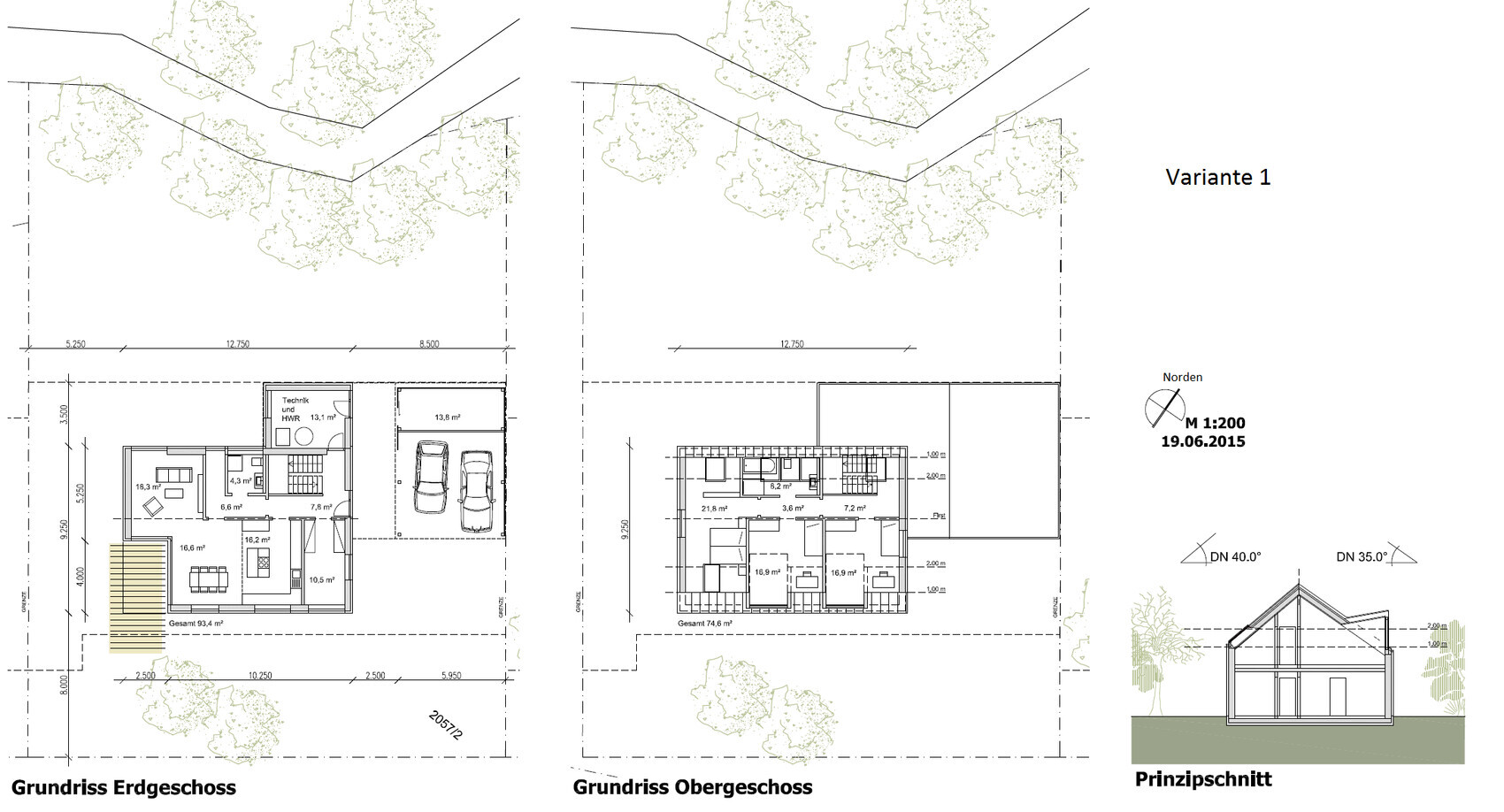
Variant 1: The architect aimed to reduce costs by keeping the roof as low as possible, using roof windows and dormers instead. We like the look, but I am not a big fan of this solution (“holes” in the roof, difficult to clean, poorer insulation). As for the ground floor, the room near the entrance feels a bit too small, and the separate exit to the garden between the living room and bathroom could be removed. On the upper floor, we miss a storage room or at least space for a large closet (for bed linen, towels, possibly a vacuum cleaner, etc.). What we particularly like is the large covered passage to the garden by the front door and the recessed corner with the terrace.
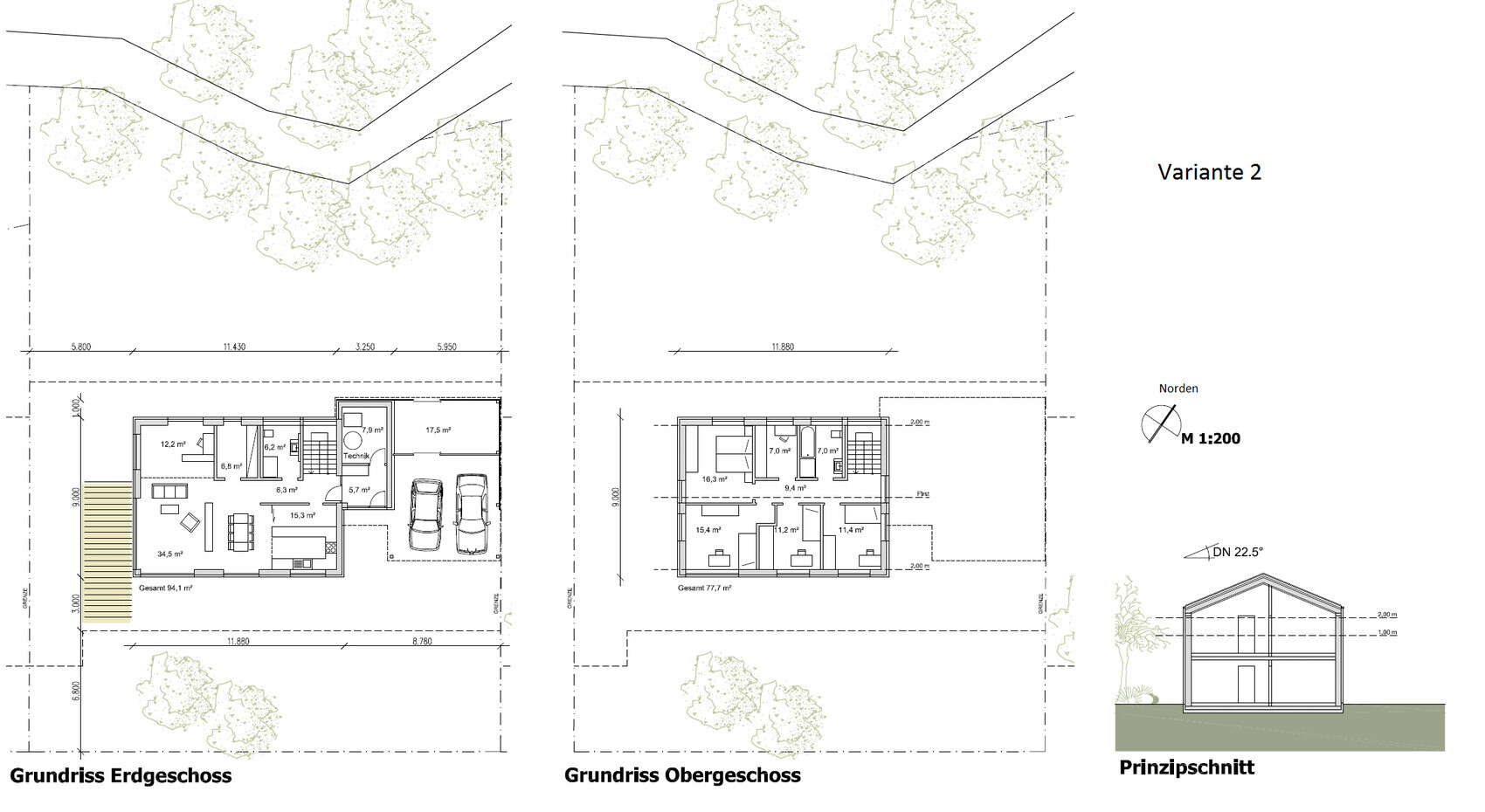
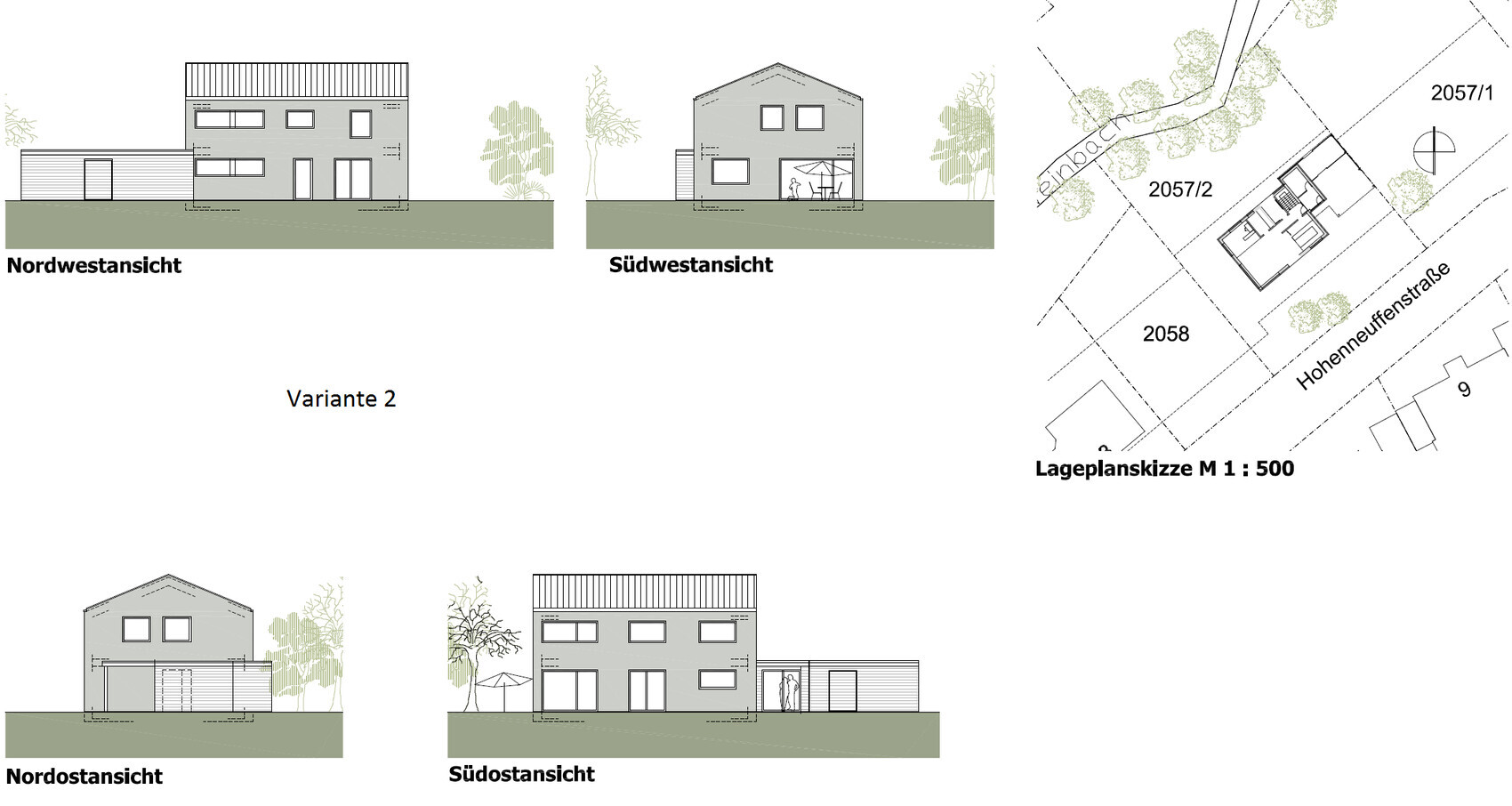
Variant 2: The upper floor is much more flexible due to the higher roof, but the estimated price is also roughly $15,000 higher. At first glance, we thought there were too many small rooms, but on second thought, we actually like it very much. The small room left of the bathroom could be a guest room, office, bedroom for one or two children, or later a kitchen. Some fine-tuning is definitely needed here, but we like the concept. What we don’t like about Variant 2 is the path from the carport to the garden only being possible through the shed.
Besides general ideas and suggestions for improving the floor plan, we are particularly interested in your opinion on dormers and roof windows versus a 1 m (3 ft) higher knee wall: how much money can be saved this way, and what real disadvantages come with having many roof windows and dormers?
Development Plan / Restrictions
Plot size: 900 m² (about 9,700 sq ft) or 1,400 m² (about 15,100 sq ft) (see text)
Slope: no
Site coverage ratio: 0.4
Floor area ratio: 0.8
Number of floors permitted: 2 full stories
Roof type: gable roof, 25°–38°
Orientation: ridge line parallel to the street, i.e., northeast to southwest
Client Requirements
Style, building type: modern wooden house
Basement, floors: no basement, 1.5 to 2 stories, upper floor later separable
Number of occupants, ages: 2 adults, 3 children (first is 1 year old, second on the way, third planned)
Spaces needed on ground floor: kitchen, living, dining, shower bath, utility & technical rooms, 1 room or possibility to separate one later depending on upper floor
Spaces needed on upper floor: bathroom, 3–4 rooms
Office: small workspace for PC etc. desired
Guest stay per year: no separate guest room needed
Open or closed layout: open
Conservative or modern style: indifferent, rather modern
Open kitchen, cooking island: yes and yes
Number of dining seats: 8
Garage, carport: carport for 2 cars with shed for bicycles and garden tools
House Design
Planner: architect
What we like especially:
V1: covered corner terrace, arrangement of technical room - shed - carport - front door, light in living room from 2 opposite sides
V2: layout of the upper floor
What we dislike?
V1: many roof windows and dormers
V2: passage from the carport side to the garden only through the shed
Estimated price according to architect/designer: V1 $430,000, V2 $445,000 (all included except kitchen and land development)
Personal price limit for the house including fittings: $500,000
Preferred heating technology: heat pump
If you had to compromise, which details or additions
-could you do without: second covered parking space
-could you not do without: large bike/tool shed


my wife and I plan to start building our own home next year, so we are already busy planning. We own the plot of land, which is 900 m² (about 9,700 sq ft), inherited. The northwest boundary of the plot is a small stream (one reason not to build a basement), with large trees up to the building zone. The southeast boundary is a street (a quiet dead-end). The two neighboring lots are still vacant, but a multifamily house will soon be built to the northeast. The southwest neighboring plot (500 m² / about 5,400 sq ft) belongs to my parents and is not expected to be developed or sold (we can use it as a garden). Therefore, the living areas should face southwest.
The house should accommodate 2 adults and 3 children but also work if there are only 2 or even 4 children. When the children have grown up and moved out, it should be possible to use the upper floor as a separate apartment.
We have now received the first drafts from our architect and would like to hear some opinions before we go too far into details and then notice fundamental issues.
Variant 1: The architect aimed to reduce costs by keeping the roof as low as possible, using roof windows and dormers instead. We like the look, but I am not a big fan of this solution (“holes” in the roof, difficult to clean, poorer insulation). As for the ground floor, the room near the entrance feels a bit too small, and the separate exit to the garden between the living room and bathroom could be removed. On the upper floor, we miss a storage room or at least space for a large closet (for bed linen, towels, possibly a vacuum cleaner, etc.). What we particularly like is the large covered passage to the garden by the front door and the recessed corner with the terrace.
Variant 2: The upper floor is much more flexible due to the higher roof, but the estimated price is also roughly $15,000 higher. At first glance, we thought there were too many small rooms, but on second thought, we actually like it very much. The small room left of the bathroom could be a guest room, office, bedroom for one or two children, or later a kitchen. Some fine-tuning is definitely needed here, but we like the concept. What we don’t like about Variant 2 is the path from the carport to the garden only being possible through the shed.
Besides general ideas and suggestions for improving the floor plan, we are particularly interested in your opinion on dormers and roof windows versus a 1 m (3 ft) higher knee wall: how much money can be saved this way, and what real disadvantages come with having many roof windows and dormers?
Development Plan / Restrictions
Plot size: 900 m² (about 9,700 sq ft) or 1,400 m² (about 15,100 sq ft) (see text)
Slope: no
Site coverage ratio: 0.4
Floor area ratio: 0.8
Number of floors permitted: 2 full stories
Roof type: gable roof, 25°–38°
Orientation: ridge line parallel to the street, i.e., northeast to southwest
Client Requirements
Style, building type: modern wooden house
Basement, floors: no basement, 1.5 to 2 stories, upper floor later separable
Number of occupants, ages: 2 adults, 3 children (first is 1 year old, second on the way, third planned)
Spaces needed on ground floor: kitchen, living, dining, shower bath, utility & technical rooms, 1 room or possibility to separate one later depending on upper floor
Spaces needed on upper floor: bathroom, 3–4 rooms
Office: small workspace for PC etc. desired
Guest stay per year: no separate guest room needed
Open or closed layout: open
Conservative or modern style: indifferent, rather modern
Open kitchen, cooking island: yes and yes
Number of dining seats: 8
Garage, carport: carport for 2 cars with shed for bicycles and garden tools
House Design
Planner: architect
What we like especially:
V1: covered corner terrace, arrangement of technical room - shed - carport - front door, light in living room from 2 opposite sides
V2: layout of the upper floor
What we dislike?
V1: many roof windows and dormers
V2: passage from the carport side to the garden only through the shed
Estimated price according to architect/designer: V1 $430,000, V2 $445,000 (all included except kitchen and land development)
Personal price limit for the house including fittings: $500,000
Preferred heating technology: heat pump
If you had to compromise, which details or additions
-could you do without: second covered parking space
-could you not do without: large bike/tool shed
Hmm, I’m not really satisfied with either option.
Option 1 clearly has the nicer bedrooms upstairs. With option 2, you have to consider how the windows will look on the inside with a knee wall height of 200 cm (6 ft 7 in). Especially if a roller shutter box is integrated there. Then, you only have glass up to about 155 to 160 cm (5 ft 1 in to 5 ft 3 in) high. I’d find it annoying to walk through the rooms without any window views.
In both options, the upstairs bathroom seems quite tight and not very suitable for a family of four to six people.
In option 2, I don’t yet see how you would spatially separate the areas. And if you want to separate the space, how is the upstairs intended to be used? As a rental unit? If so, then there should at least be a room on the ground floor that meets the criteria of a bedroom with enough closet space for two adults. I don’t see any of that here.
So, first, you should reconsider this request to separate the floors. Then the staircase could also be positioned much more attractively.
Option 1 clearly has the nicer bedrooms upstairs. With option 2, you have to consider how the windows will look on the inside with a knee wall height of 200 cm (6 ft 7 in). Especially if a roller shutter box is integrated there. Then, you only have glass up to about 155 to 160 cm (5 ft 1 in to 5 ft 3 in) high. I’d find it annoying to walk through the rooms without any window views.
In both options, the upstairs bathroom seems quite tight and not very suitable for a family of four to six people.
In option 2, I don’t yet see how you would spatially separate the areas. And if you want to separate the space, how is the upstairs intended to be used? As a rental unit? If so, then there should at least be a room on the ground floor that meets the criteria of a bedroom with enough closet space for two adults. I don’t see any of that here.
So, first, you should reconsider this request to separate the floors. Then the staircase could also be positioned much more attractively.
Hello Sciurus,
I’ll keep it brief today:
Considering your statement that you could also imagine separating the ground floor and upper floor later on, I prefer version 2 because the work nook can be converted into a bedroom without sacrificing comfort in the living room.
However, it should be planned now with the possibility that mobility might decrease with age, especially regarding accessibility (no unnecessary corners and doors not too narrow). This concerns the future bedroom on the ground floor.
The kitchen passage will need to be reviewed—should it be moved? The kitchen is probably a placeholder; I would position the island vertically in the plan.
I see problems with the current bedroom...
Wouldn’t it be more logical to plan an office/bedroom downstairs right away and have only three children’s rooms plus a bedroom upstairs?
Best regards,
Yvonne
I’ll keep it brief today:
Considering your statement that you could also imagine separating the ground floor and upper floor later on, I prefer version 2 because the work nook can be converted into a bedroom without sacrificing comfort in the living room.
However, it should be planned now with the possibility that mobility might decrease with age, especially regarding accessibility (no unnecessary corners and doors not too narrow). This concerns the future bedroom on the ground floor.
The kitchen passage will need to be reviewed—should it be moved? The kitchen is probably a placeholder; I would position the island vertically in the plan.
I see problems with the current bedroom...
Wouldn’t it be more logical to plan an office/bedroom downstairs right away and have only three children’s rooms plus a bedroom upstairs?
Best regards,
Yvonne
@kbt09: We’re not really satisfied with either option, which is why I created this post. Thanks for the note about the window heights with a 2m (6 ft 7 in) knee wall; I think a solution could be found there. For example, flattening the roof even more (although the development plan doesn’t allow much more), while keeping everything else compliant, and instead raising the knee wall.
The bathrooms really shouldn’t be any smaller, but in principle, that’s fine—we don’t need that much space there. There is one on each floor anyway.
@kbt09, ypg: The idea of being able to use the two floors separately later on comes from wanting to still make full use of the house when the kids are no longer living at home. Especially with several children and a corresponding number of rooms, it would be a shame otherwise. Our architect designed the drafts based on our requirement to be able to separate the floors. The staircase in the corner, which practically results from this, doesn’t really appeal to us either—it takes up a lot of hallway/circulation space and severely limits the layout possibilities. Where would you place the staircase instead? Centrally at the top rather than in the upper right corner?
@ypg: All the furniture, including the kitchen, is more or less just decorative and placed by the architect. I don’t like the kitchen in version 2 at all. I think having one room downstairs definitely makes sense; maybe make the room from version 1 a bit wider—that I quite like. But in the current upstairs design, I still miss a small room; with a higher knee wall, it should be possible to include one.
The bathrooms really shouldn’t be any smaller, but in principle, that’s fine—we don’t need that much space there. There is one on each floor anyway.
@kbt09, ypg: The idea of being able to use the two floors separately later on comes from wanting to still make full use of the house when the kids are no longer living at home. Especially with several children and a corresponding number of rooms, it would be a shame otherwise. Our architect designed the drafts based on our requirement to be able to separate the floors. The staircase in the corner, which practically results from this, doesn’t really appeal to us either—it takes up a lot of hallway/circulation space and severely limits the layout possibilities. Where would you place the staircase instead? Centrally at the top rather than in the upper right corner?
@ypg: All the furniture, including the kitchen, is more or less just decorative and placed by the architect. I don’t like the kitchen in version 2 at all. I think having one room downstairs definitely makes sense; maybe make the room from version 1 a bit wider—that I quite like. But in the current upstairs design, I still miss a small room; with a higher knee wall, it should be possible to include one.
The 22.5° roof pitch in option 2 and the 40° in option 1 are already outside the permissible roof pitch range.
If two full floors are allowed, why not plan for two full floors?
Also, bathrooms don’t have to be huge rooms, but the individual fixtures should be usable. Imagine the bathroom in option 1: the bathtub is placed under the sloping roof where the ceiling height is between 1 to 2 meters (3 to 6.5 feet), and right next to it is probably a shower about 100 cm (40 inches) on each side. This shower also starts where the ceiling height is only 200 cm (79 inches). Okay, there is a skylight above the bathtub and toilet… but it’s not really comfortable to get into the tub there.
The bedroom in option 1… what kind of wardrobes would you put in there? There’s hardly space for a 200 cm (79 inches) tall wardrobe of standard depth. Even in option 2, it doesn’t get much better.
The 11 sq meters (118 sq feet) children’s room in option 2 is difficult to furnish, and by the time they are teenagers and want a 140 cm (55 inches) bed—this is something I recently experienced with friends and family—it becomes very hard to plan with these rooms.
Conceptually, I would probably approach it like this: on the ground floor provide
- living room
- dining/kitchen area
- bathroom with a large walk-in shower
- a room suitable as the master bedroom
- utility/technical room.
Upstairs I would plan for
- 3 roughly equal-sized bedrooms where wardrobes can be placed comfortably
- a convenient bathroom
- possibly a small additional room for a walk-in closet, office, or similar use.
This way, parents could currently sleep upstairs; when a third child arrives, maybe the first child could sleep downstairs initially, as parents want to stay close to the youngest child’s room. After around two years, the parents could move downstairs, leaving the upper floor as the children’s area.
This would at least make the ground-floor layout suitable for separation. Then you would have to experiment with where and how to position the staircase.
If two full floors are allowed, why not plan for two full floors?
Also, bathrooms don’t have to be huge rooms, but the individual fixtures should be usable. Imagine the bathroom in option 1: the bathtub is placed under the sloping roof where the ceiling height is between 1 to 2 meters (3 to 6.5 feet), and right next to it is probably a shower about 100 cm (40 inches) on each side. This shower also starts where the ceiling height is only 200 cm (79 inches). Okay, there is a skylight above the bathtub and toilet… but it’s not really comfortable to get into the tub there.
The bedroom in option 1… what kind of wardrobes would you put in there? There’s hardly space for a 200 cm (79 inches) tall wardrobe of standard depth. Even in option 2, it doesn’t get much better.
The 11 sq meters (118 sq feet) children’s room in option 2 is difficult to furnish, and by the time they are teenagers and want a 140 cm (55 inches) bed—this is something I recently experienced with friends and family—it becomes very hard to plan with these rooms.
Conceptually, I would probably approach it like this: on the ground floor provide
- living room
- dining/kitchen area
- bathroom with a large walk-in shower
- a room suitable as the master bedroom
- utility/technical room.
Upstairs I would plan for
- 3 roughly equal-sized bedrooms where wardrobes can be placed comfortably
- a convenient bathroom
- possibly a small additional room for a walk-in closet, office, or similar use.
This way, parents could currently sleep upstairs; when a third child arrives, maybe the first child could sleep downstairs initially, as parents want to stay close to the youngest child’s room. After around two years, the parents could move downstairs, leaving the upper floor as the children’s area.
This would at least make the ground-floor layout suitable for separation. Then you would have to experiment with where and how to position the staircase.
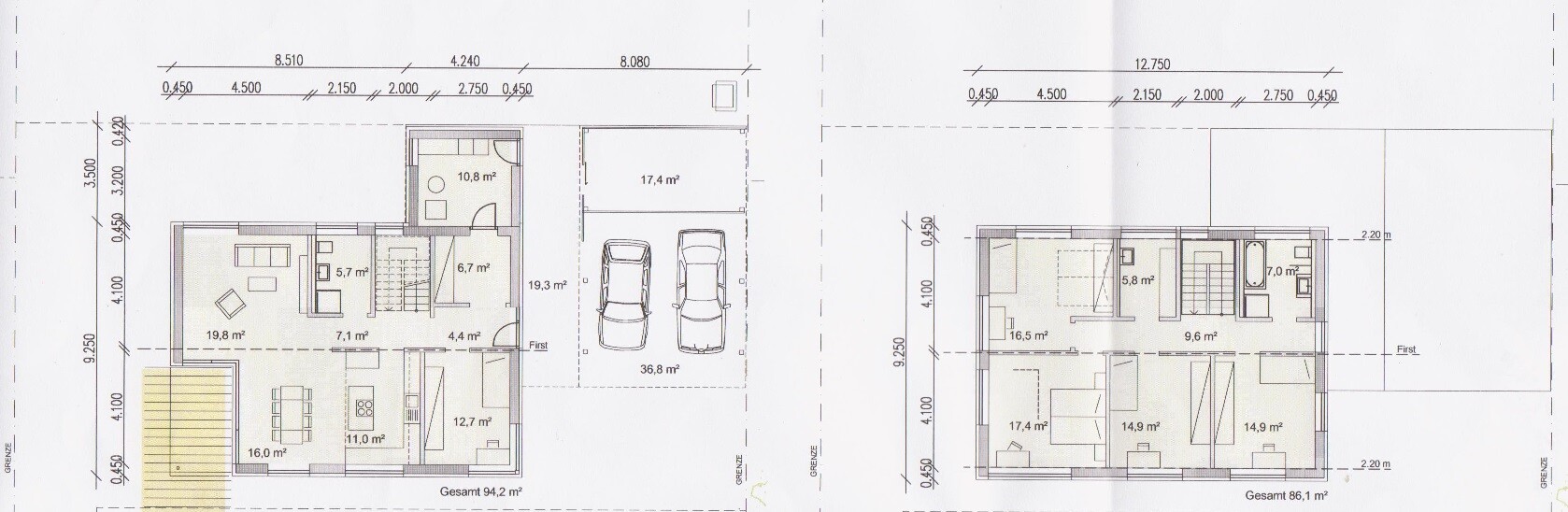
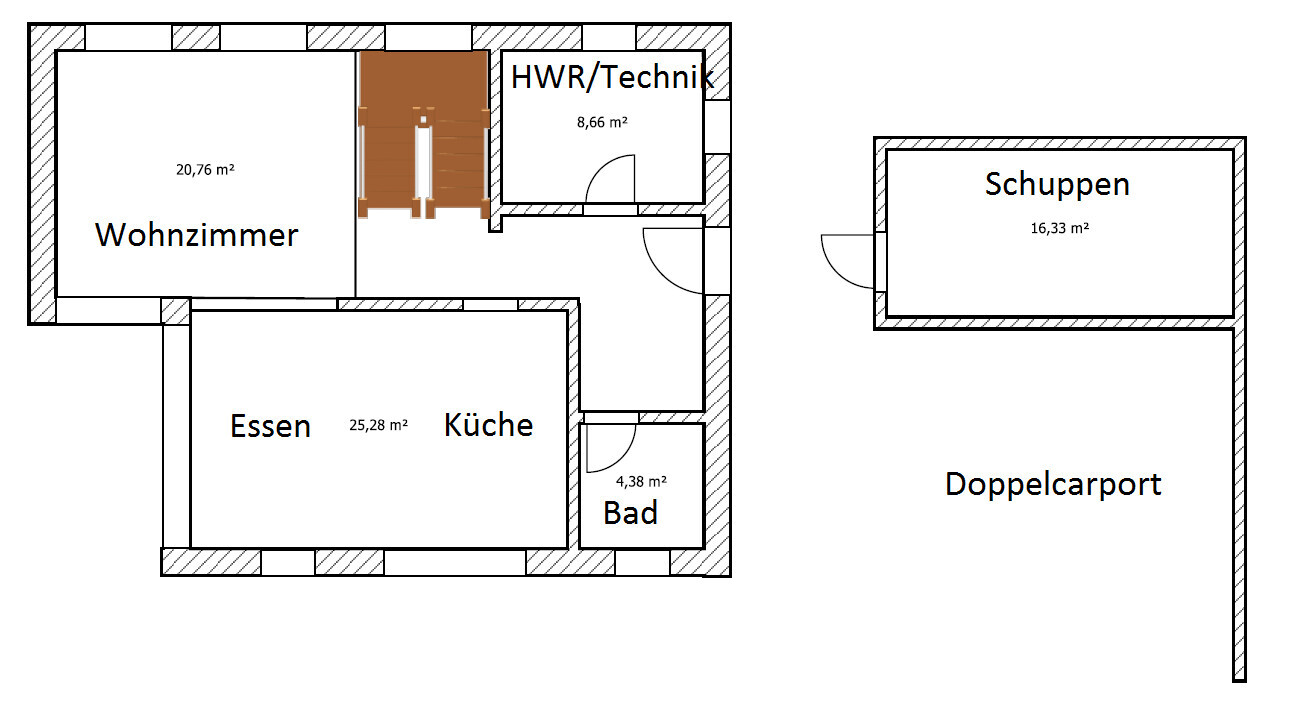
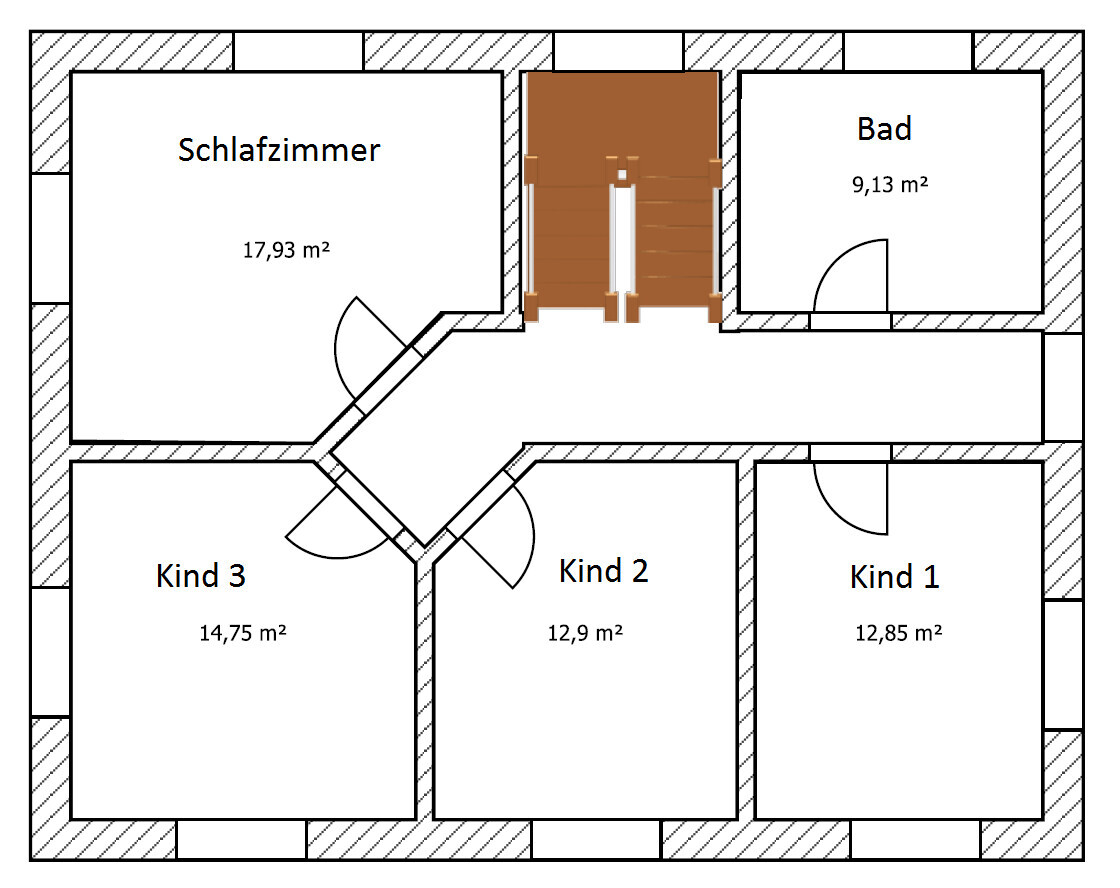
Finally, there is some news again! Our architect has presented us with a new design, which unfortunately still has a few issues and would also be by far the most expensive so far. I have attached the floor plan. The design includes a full second floor with 4.5 rooms, as well as 1 room on the ground floor. That is at least one room more than we need. After much consideration, we have come to the following conclusion: since we are not planning on separate use of the ground floor and upper floor later anyway, we might also do without the room on the ground floor. This would allow us to include the utility/technical room inside the house, reduce the overall size slightly, and still have 4 rooms upstairs. I have attached a sketch showing roughly how we imagine this— we took the external dimensions from our architect’s design and only reduced the width of the house by 1 meter (about 3 feet).
A few words about the individual rooms:
Ground floor:
- Entrance area: We made this a bit more generous to create space for a nice cloakroom, located below the front door
- Bathroom: The bathroom will be converted into a guest toilet with an "emergency shower," since now the whole family will be using the upper floor bathroom as the main one
- Utility/technical room: We are not sure if the size will be sufficient; this will probably depend on which systems are installed later
- Stairs: The space under the stairs can be used for vacuum cleaners and similar items
- Kitchen: A kitchen similar to the one we currently use would fit here, with 1-2 extra cabinets for the larger family
- Dining area: A 1 x 2 meter (3 x 6.5 feet) table should fit here
- Living room: A sofa corner with TV plus a piano should fit comfortably here
Upper floor:
- 3 children’s rooms: They should not be smaller, but since they all have a ceiling height of at least 2.20 m (7.2 feet), they are flexible for furnishing
- Large master bedroom with possible space for a small desk
- Bathroom slightly larger than in the architect’s design
If anyone can suggest a better arrangement of the upper floor rooms that reduces hallway space or eliminates the awkward corner, please share!
We might also have overlooked something major in our own design?
We would appreciate any feedback. Our architect is currently on vacation, and to get things moving, we would like to be well prepared when he returns!
A few words about the individual rooms:
Ground floor:
- Entrance area: We made this a bit more generous to create space for a nice cloakroom, located below the front door
- Bathroom: The bathroom will be converted into a guest toilet with an "emergency shower," since now the whole family will be using the upper floor bathroom as the main one
- Utility/technical room: We are not sure if the size will be sufficient; this will probably depend on which systems are installed later
- Stairs: The space under the stairs can be used for vacuum cleaners and similar items
- Kitchen: A kitchen similar to the one we currently use would fit here, with 1-2 extra cabinets for the larger family
- Dining area: A 1 x 2 meter (3 x 6.5 feet) table should fit here
- Living room: A sofa corner with TV plus a piano should fit comfortably here
Upper floor:
- 3 children’s rooms: They should not be smaller, but since they all have a ceiling height of at least 2.20 m (7.2 feet), they are flexible for furnishing
- Large master bedroom with possible space for a small desk
- Bathroom slightly larger than in the architect’s design
If anyone can suggest a better arrangement of the upper floor rooms that reduces hallway space or eliminates the awkward corner, please share!
We might also have overlooked something major in our own design?
We would appreciate any feedback. Our architect is currently on vacation, and to get things moving, we would like to be well prepared when he returns!
Similar topics