
ᐅ Floor Plan Design for a Single-Family Home for Four People on a 390 sqm Plot
Created on: 5 Apr 2021 17:44
C
Crixton
Hello House Building Forum,
What do you think about the floor plan (see attachment)? This is a first draft, and I am open to any feedback!
Thank you in advance!
Development Plan / Restrictions
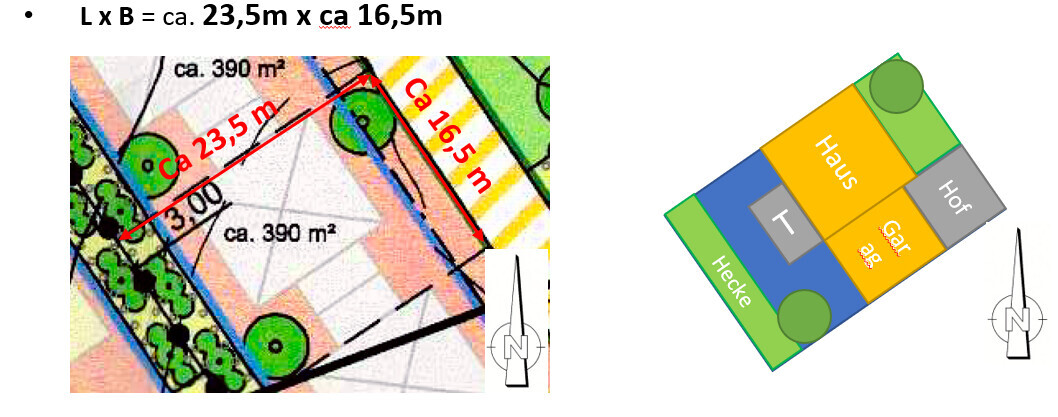
Plot size: 390 sqm (approx. 4200 sq ft) with 16.5 m (54 ft) width x 23.5 m (77 ft) depth
Slope: none
Site coverage ratio: 0.4
Floor space index: 0.8
Building envelope, building line and boundary: minimum 3 m (10 ft) setback from the street, linked building in a continuous row. Boundary building allowed.
Edge development: Grouped houses are required: house, garage, house, garage…
Windows: On the ground floor, windows are only allowed on the southwest and northeast sides due to the house grouping. On the upper floor, windows are allowed on the southwest, southeast and northeast sides.
Number of parking spaces: 2 in carport/garage + 2 in front
Number of floors: minimum 2 full stories
Roof shape: hipped roof with max 25° pitch (hence square floor plan)
Orientation: southwest-facing
Maximum heights / limits: max wall height 6.5 m (21 ft). Knee walls not allowed.
Other requirements: A tree must be planted in front and behind the house. This may affect the distance of the house to the street. According to the development plan, minimum 3 m (10 ft) setback is required; I am not sure if this is sufficient for the tree. A free-growing hedge with 3 m (10 ft) depth must be planned behind the house.
Client Requirements
Style, roof shape, building type: city villa with 2 full stories
Basement, floors: no basement planned for now, possibly if really needed
Number of people, age: Currently 2 (male 28, female 25), planning 2 children soon
Space requirements ground floor, upper floor:
Office: several home office days per week, small office (around 9 sqm (97 sq ft)) sufficient
Guests per year: 5
Open or closed architecture
Conservative or modern design
Open kitchen, kitchen island: open kitchen, kitchen island if space permits
Number of dining seats: at least 5
Fireplace: if space and budget allow
Balcony, roof terrace: possibly on top of the garage, but not mandatory
Garage, carport: double garage planned with 6.5 m x 8 m (21 ft x 26 ft). Max length allowed 9 m (30 ft). Only flat roof allowed on garage.
House Design
Who designed it: Do-it-yourself, with some floor plans as templates
Cost estimate according to architect/planner: not yet determined
Personal price limit for house including fixtures: 350k € plus garage and landscaping
Preferred heating technology: If not KfW 40plus standard, connection to district heating is mandatory. If KfW 40plus standard is met, connection is voluntary.
If you have to give up something, on which details/extensions
- can you forgo: straight staircase (if other staircase types are better suited for 10 x 10 m), roof terrace
- cannot forgo: office, guest WC + shower on ground floor, bedroom not directly adjacent to children’s room, pantry, access from garage to house, children’s rooms at least 15 sqm (160 sq ft)
Why did the design turn out this way?
What is the most important/fundamental question about the floor plan in 130 characters?
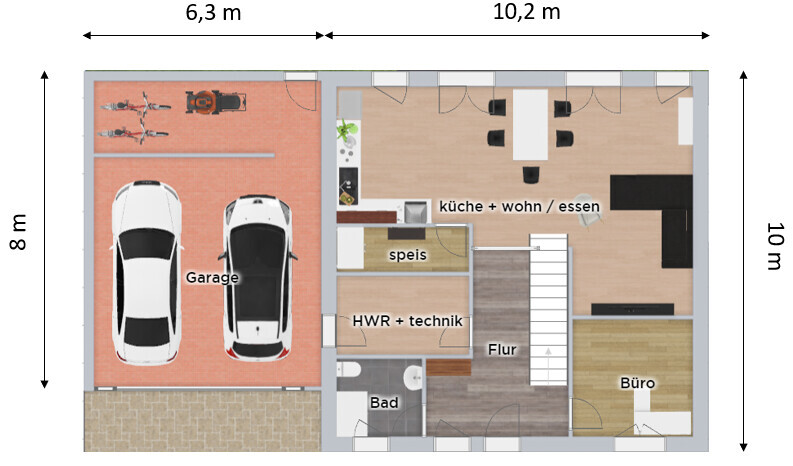
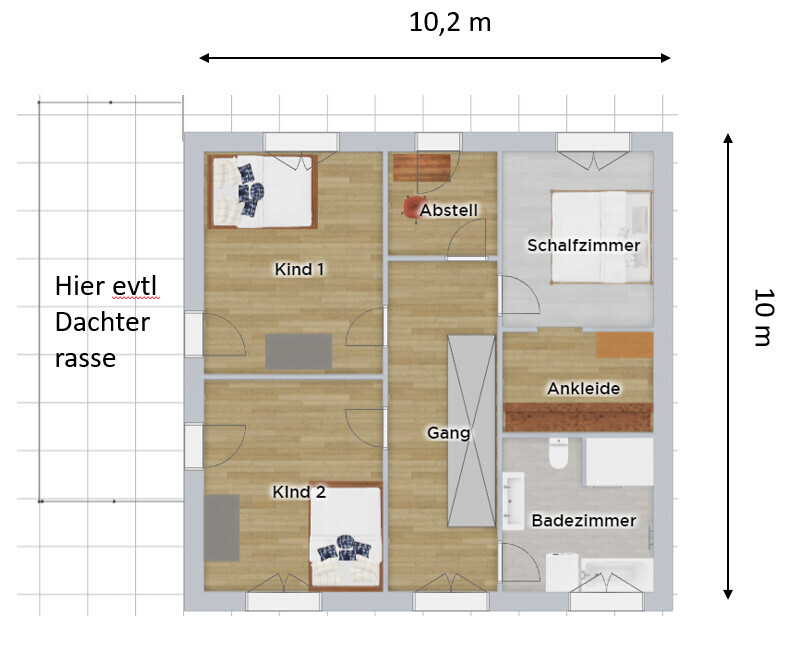
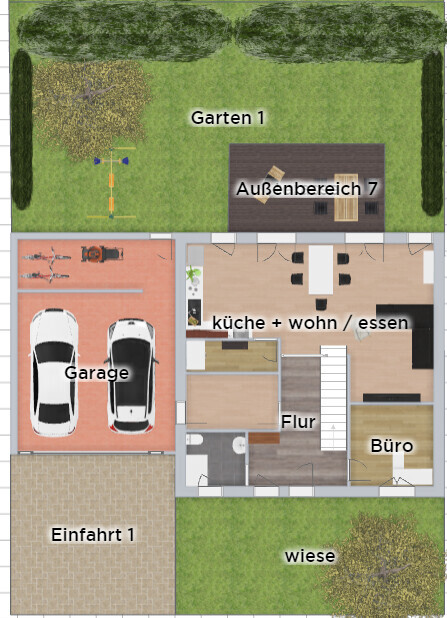
What do you think about the floor plan (see attachment)? This is a first draft, and I am open to any feedback!
Thank you in advance!
Development Plan / Restrictions
Plot size: 390 sqm (approx. 4200 sq ft) with 16.5 m (54 ft) width x 23.5 m (77 ft) depth
Slope: none
Site coverage ratio: 0.4
Floor space index: 0.8
Building envelope, building line and boundary: minimum 3 m (10 ft) setback from the street, linked building in a continuous row. Boundary building allowed.
Edge development: Grouped houses are required: house, garage, house, garage…
Windows: On the ground floor, windows are only allowed on the southwest and northeast sides due to the house grouping. On the upper floor, windows are allowed on the southwest, southeast and northeast sides.
Number of parking spaces: 2 in carport/garage + 2 in front
Number of floors: minimum 2 full stories
Roof shape: hipped roof with max 25° pitch (hence square floor plan)
Orientation: southwest-facing
Maximum heights / limits: max wall height 6.5 m (21 ft). Knee walls not allowed.
Other requirements: A tree must be planted in front and behind the house. This may affect the distance of the house to the street. According to the development plan, minimum 3 m (10 ft) setback is required; I am not sure if this is sufficient for the tree. A free-growing hedge with 3 m (10 ft) depth must be planned behind the house.
Client Requirements
Style, roof shape, building type: city villa with 2 full stories
Basement, floors: no basement planned for now, possibly if really needed
Number of people, age: Currently 2 (male 28, female 25), planning 2 children soon
Space requirements ground floor, upper floor:
Office: several home office days per week, small office (around 9 sqm (97 sq ft)) sufficient
Guests per year: 5
Open or closed architecture
Conservative or modern design
Open kitchen, kitchen island: open kitchen, kitchen island if space permits
Number of dining seats: at least 5
Fireplace: if space and budget allow
Balcony, roof terrace: possibly on top of the garage, but not mandatory
Garage, carport: double garage planned with 6.5 m x 8 m (21 ft x 26 ft). Max length allowed 9 m (30 ft). Only flat roof allowed on garage.
House Design
Who designed it: Do-it-yourself, with some floor plans as templates
Cost estimate according to architect/planner: not yet determined
Personal price limit for house including fixtures: 350k € plus garage and landscaping
Preferred heating technology: If not KfW 40plus standard, connection to district heating is mandatory. If KfW 40plus standard is met, connection is voluntary.
If you have to give up something, on which details/extensions
- can you forgo: straight staircase (if other staircase types are better suited for 10 x 10 m), roof terrace
- cannot forgo: office, guest WC + shower on ground floor, bedroom not directly adjacent to children’s room, pantry, access from garage to house, children’s rooms at least 15 sqm (160 sq ft)
Why did the design turn out this way?
- The maximum width of the house of 10.2 m (33 ft) is based on the plot width of 16.5 m (54 ft). 6.3 m (20 ft) is allocated for the double garage. The house depth is therefore 10 m (33 ft) (hipped roof: square floor plan is advantageous + if deeper than 10 m, the floor space index would be exceeded + hardly any garden space would remain)
- The office on the ground floor could be used as a third children’s room if needed (not currently planned) and later as a care room
- Bedroom is not adjacent to the children’s rooms
- Both children’s rooms have access to the roof terrace on the garage
- Direct access from the garage to the house
- Open living and dining area
- Large children’s rooms (approx. 17 sqm (183 sq ft))
What is the most important/fundamental question about the floor plan in 130 characters?
- Is the straight staircase suitable for a 10 x 10 m layout, or are there better options?
- Is the space sufficient for 4 people, or would you recommend a basement?
- Open to all comments
K1300S schrieb:
On one hand, honestly, on the other hand, I’m not sure I would trust a bricklayer who obviously shows so little passion for his craft with this build. Our house is made of insulated bricks, and although there were some issues during the shell construction—such as the constantly empty beer crates on site—covering the walls was never a problem.I will at least double-check with him whether the house can actually grow by 6cm (2.4 inches) in every direction for the extra 10,000 for the jump from 36cm (14 inches) to 42.5cm (17 inches) bricks. That means about a 5 square meter (54 square feet) loss of floor area over both floors. From experience, the masonry work has been carried out well. This is also not the only general contractor who would avoid using the insulated blocks here.
hampshire schrieb:
I would design the bay window seating to allow sitting exactly between indoors and outdoors during summer. So, consider the opening mechanism—perhaps a sliding system upwards like they use in England...
A stove requires much more space than its footprint. In a small house, it easily takes up 20-30% of the living area. If that is the priority, fine. A stove is interesting for me because we will use district heating as the primary heating source, and the price development over the next few years is uncertain. With a stove, you can simply add extra heat in winter, and we have free access to wood from our own forest.
Würfel* schrieb:
I would solve it like this. That way, the seating window wouldn’t be “hidden” behind the sofa backrest, and you could create a cozy gathering area when you have more people. The chimney flue could be placed above, between the two children's room doors. This way, from the sofa you have a view of the fireplace, TV, and garden. The kitchen wall is shortened, and the living room wall straightened. The last 1.5 stairs are already within the ceiling, so they can be built over. The wardrobe would go under the stairs?
[ATTACH alt="1627466568375.png"]64176[/ATTACH]
Also a good idea. I actually don’t mind having a separated living area like that. I just have concerns that the dining area and kitchen might lose too much light as a result. Because of the boundary construction and the attached garage, there aren’t more windows than in the sketch. The distance from the 3m (10 feet) sliding door to the next window in the kitchen is almost 8m (26 feet), so the daylight from the seating window might still be quite beneficial.

Crixton schrieb:
The masonry work seems to have been done well, based on experience. This is also not the only general contractor who wouldn’t use the filled block here.That may be true, but if the regular covering of the fresh masonry is already being questioned, that would definitely worry me. You don’t even need to be a skilled mason for that.H
hampshire30 Jul 2021 06:44Crixton schrieb:
A stove is interesting to me because we will use district heating as our primary heat source, and the price development over the next few years is uncertain. With a stove, you can simply add extra heat in winter, and we get wood for free since we have our own forest.I’m familiar with this setup; we primarily heat with a stove and live right next to our own forest (see picture). Have you planned space for a masonry heater? If the stove is meant to provide comfortable, consistent heat, it requires a large thermal mass, which is quite expensive to install. It’s important how you integrate the systems to ensure they work well together.
If other general contractors (GCs) in the area have the same approach to the bricks, they might subcontract the same structural builder (?)
https://www.instagram.com/11antgmxde/
https://www.linkedin.com/company/bauen-jetzt/
https://www.instagram.com/11antgmxde/
https://www.linkedin.com/company/bauen-jetzt/
Similar topics