
ᐅ Floor Plan Design for a Single-Family Home of 230-235 m² on Two Full Stories
Created on: 11 Jul 2021 16:11
H
Hausbauer4747
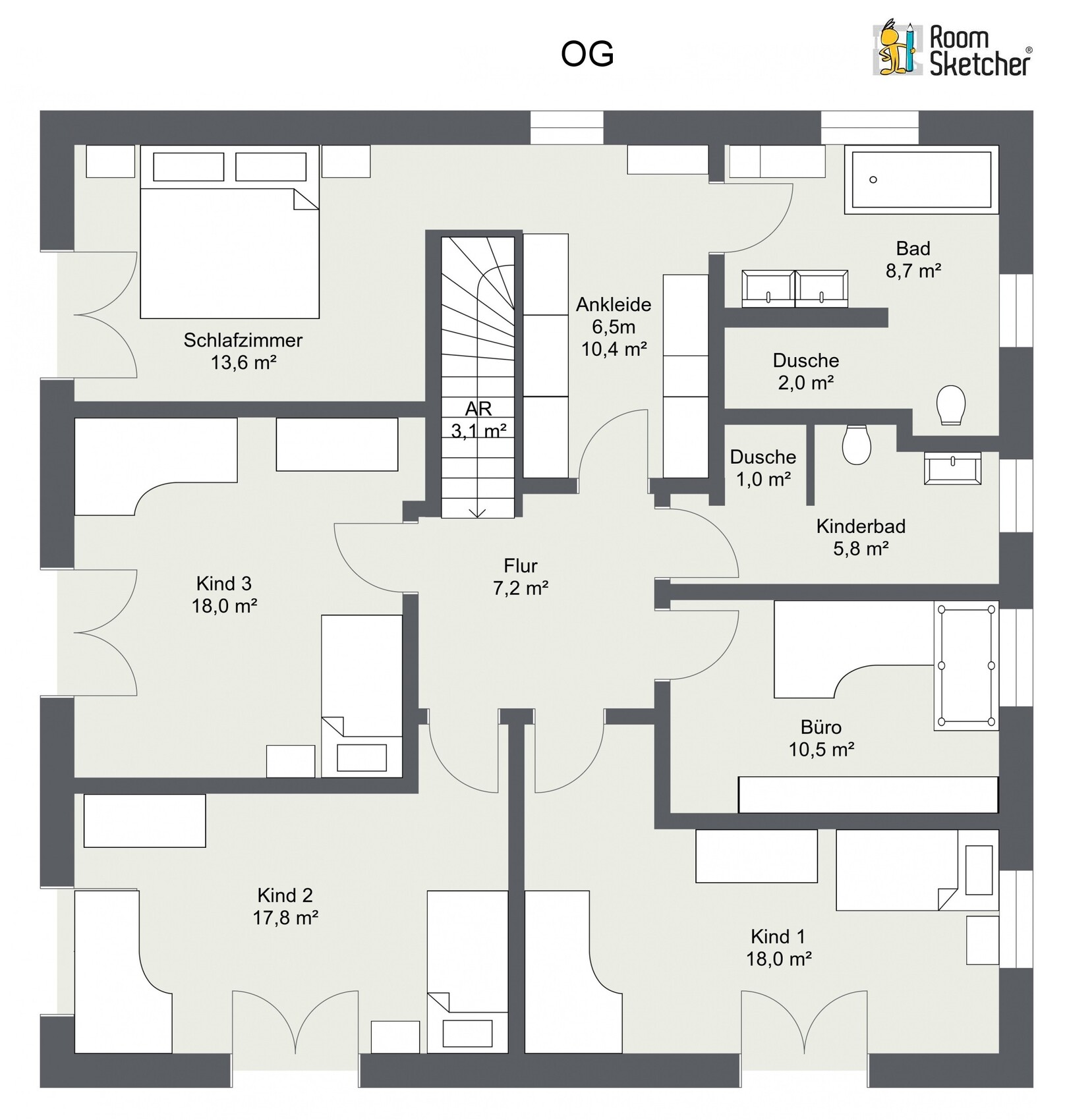
By now, we have put quite a lot of thought into a practical, well-usable, and hopefully attractive floor plan, and we would like to reach a final decision fairly soon. We look forward to your feedback and thank you in advance for any tips or suggestions. 🙂
Development Plan / Restrictions
Plot size: 2,600 m² (approximately 0.64 acres), completely flat
Site coverage ratio / floor area ratio: 0.4 / 0.8
Number of floors: two full stories
Roof type: hip roof or pyramid roof with 22-25° pitch
Architectural style: modern
Orientation: the floor plans are always aligned with north at the top; the street side is on the east
Maximum heights / limits: the eave height is somewhat tight at 6 meters (approximately 20 feet), otherwise there is plenty of space. Building envelope and setbacks are sufficiently large, so we do not need to apply for any exceptions from the development plan.
Homeowners’ Requirements
Style, roof type, building type: “urban villa,” hip or pyramid roof with 22-25°
No basement, two full stories
Two adults, three children currently under 3 years old
Room needs on ground floor and upper floor: three children’s bedrooms with a children’s shower bathroom, guest room and office as two separate rooms
Ground floor with rather open architecture
A gas fireplace is an option, but we are likely to forgo it due to the effort of connecting gas and chimney costs
Both garage and carport planned (approx. 6x9 m (20x30 feet) garage and carport about 4x7 m (13x23 feet) located between the house and garage)
House Design
Planning origin: self-designed based on a discussed external dimension of about 12x12 meters (approximately 39x39 feet)
What do you particularly like and why? The house is relatively large and accommodates all room concepts (3 children’s bedrooms with children’s shower bathroom, separate guest room and office, etc.). We like the orientation by cardinal directions (living room southwest, children’s rooms south or southwest, master and guest bedrooms west facing the garden, bathrooms to the east, and front door facing north).
What do you dislike and why? The design focuses primarily on usability rather than aesthetics. For example, representative hallways with little practical use were avoided. However, it is difficult for us to achieve symmetrical and visually pleasing window alignment between the ground and upper floors. This is visible, for example, in the window of the children’s shower bathroom and the utility room below it.
Preferred heating technology: ground source heat pump, but for cost reasons, it will probably be an air-to-water heat pump.
If you have to give up, which features or additions could you do without
- What can you give up: KfW40+ with large photovoltaic system (instead opting for KfW55 with medium photovoltaic system), brick cladding, underfloor cooling, en-suite guest bathroom, showers could possibly be smaller if costs get too high
- What you cannot do without: children’s shower bathroom, (preferably) controlled ventilation system (mechanical supply and exhaust)
What is the most important/fundamental question about the floor plan in 130 characters?
Are we overlooking anything in this floor plan that would annoy us daily later because it is poorly or very impractically planned? Can we find a visual trick to achieve exterior symmetry?
Many thanks!

Development Plan / Restrictions
Plot size: 2,600 m² (approximately 0.64 acres), completely flat
Site coverage ratio / floor area ratio: 0.4 / 0.8
Number of floors: two full stories
Roof type: hip roof or pyramid roof with 22-25° pitch
Architectural style: modern
Orientation: the floor plans are always aligned with north at the top; the street side is on the east
Maximum heights / limits: the eave height is somewhat tight at 6 meters (approximately 20 feet), otherwise there is plenty of space. Building envelope and setbacks are sufficiently large, so we do not need to apply for any exceptions from the development plan.
Homeowners’ Requirements
Style, roof type, building type: “urban villa,” hip or pyramid roof with 22-25°
No basement, two full stories
Two adults, three children currently under 3 years old
Room needs on ground floor and upper floor: three children’s bedrooms with a children’s shower bathroom, guest room and office as two separate rooms
Ground floor with rather open architecture
A gas fireplace is an option, but we are likely to forgo it due to the effort of connecting gas and chimney costs
Both garage and carport planned (approx. 6x9 m (20x30 feet) garage and carport about 4x7 m (13x23 feet) located between the house and garage)
House Design
Planning origin: self-designed based on a discussed external dimension of about 12x12 meters (approximately 39x39 feet)
What do you particularly like and why? The house is relatively large and accommodates all room concepts (3 children’s bedrooms with children’s shower bathroom, separate guest room and office, etc.). We like the orientation by cardinal directions (living room southwest, children’s rooms south or southwest, master and guest bedrooms west facing the garden, bathrooms to the east, and front door facing north).
What do you dislike and why? The design focuses primarily on usability rather than aesthetics. For example, representative hallways with little practical use were avoided. However, it is difficult for us to achieve symmetrical and visually pleasing window alignment between the ground and upper floors. This is visible, for example, in the window of the children’s shower bathroom and the utility room below it.
Preferred heating technology: ground source heat pump, but for cost reasons, it will probably be an air-to-water heat pump.
If you have to give up, which features or additions could you do without
- What can you give up: KfW40+ with large photovoltaic system (instead opting for KfW55 with medium photovoltaic system), brick cladding, underfloor cooling, en-suite guest bathroom, showers could possibly be smaller if costs get too high
- What you cannot do without: children’s shower bathroom, (preferably) controlled ventilation system (mechanical supply and exhaust)
What is the most important/fundamental question about the floor plan in 130 characters?
Are we overlooking anything in this floor plan that would annoy us daily later because it is poorly or very impractically planned? Can we find a visual trick to achieve exterior symmetry?
Many thanks!
N
nordanney13 Jul 2021 15:16K1300S schrieb:
This example is only somewhat helpful here, as not all requirements are covered in these two floors. Would the original poster also want or accept an attic/loft?I have no idea, but he was also looking for suggestions or ideas that might be a bit different.H
Hausbauer474713 Jul 2021 22:41Personally, I also quite like the second Schwörer house, but in our household, I am the more open-minded one, while my partner has grown quite fond of the two full floors. We discussed the details today, and we both like the proportions of the rectangular urban villa. Yesterday and today, as suggested, I experimented with elongated floor plans, and we talked about the situation within the building permit / planning permission area today.
Despite the understandable weakness in the center of the building, the rectangle is the best combination of appearance and placement within the building permit / planning permission area for us (even though it might seem surprising given the size of the plot, this is actually a factor worth considering in the overall context).
Today, I tried to incorporate the feedback into a new design. I will also look for a version with daylight in the upper floor, but this is not a particular priority for us (we are aware that we might not be in the majority on this). Regarding structural engineering, I found out that spans of up to just over 7 meters (23 feet) can be covered with standard ceilings.
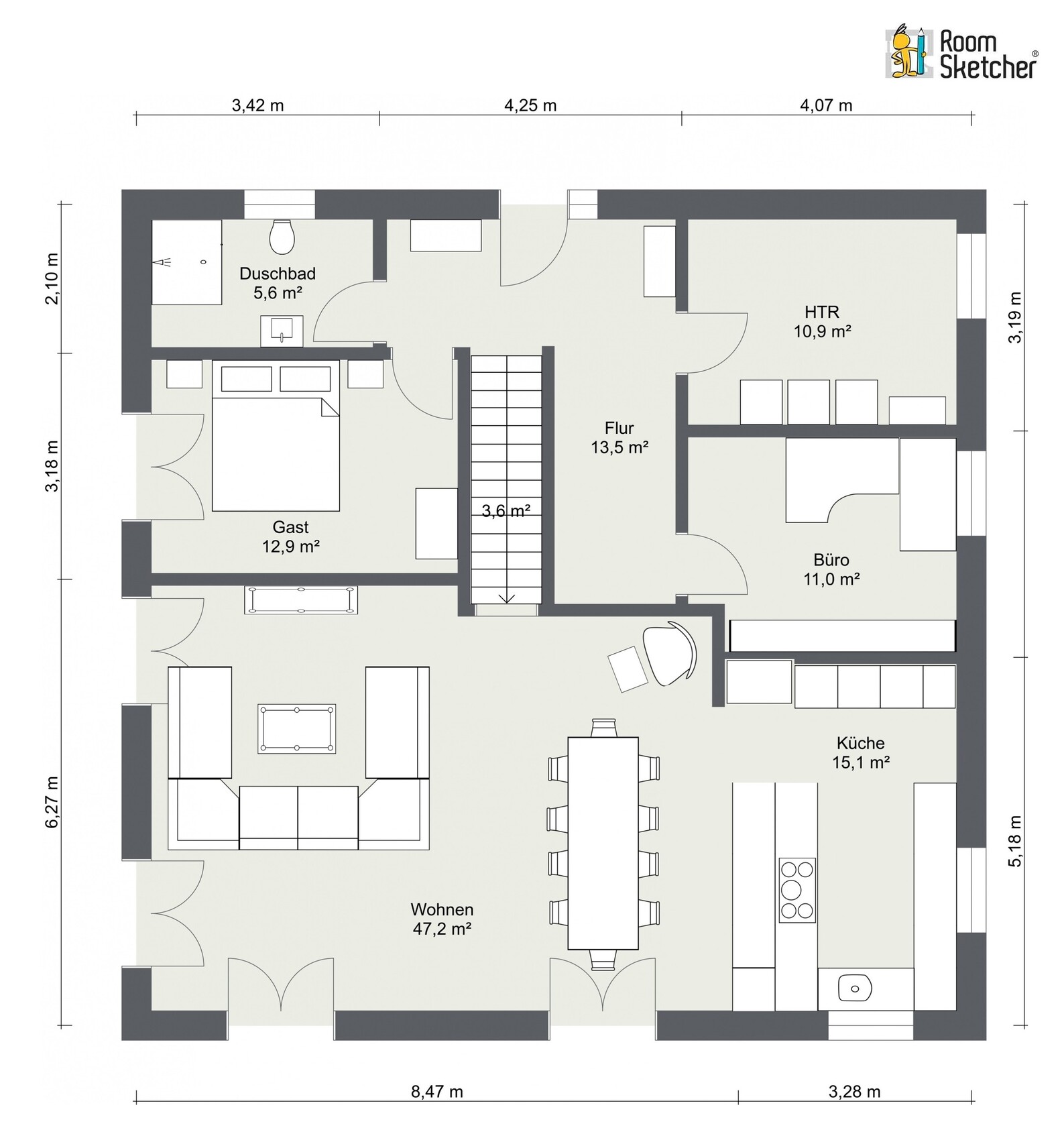
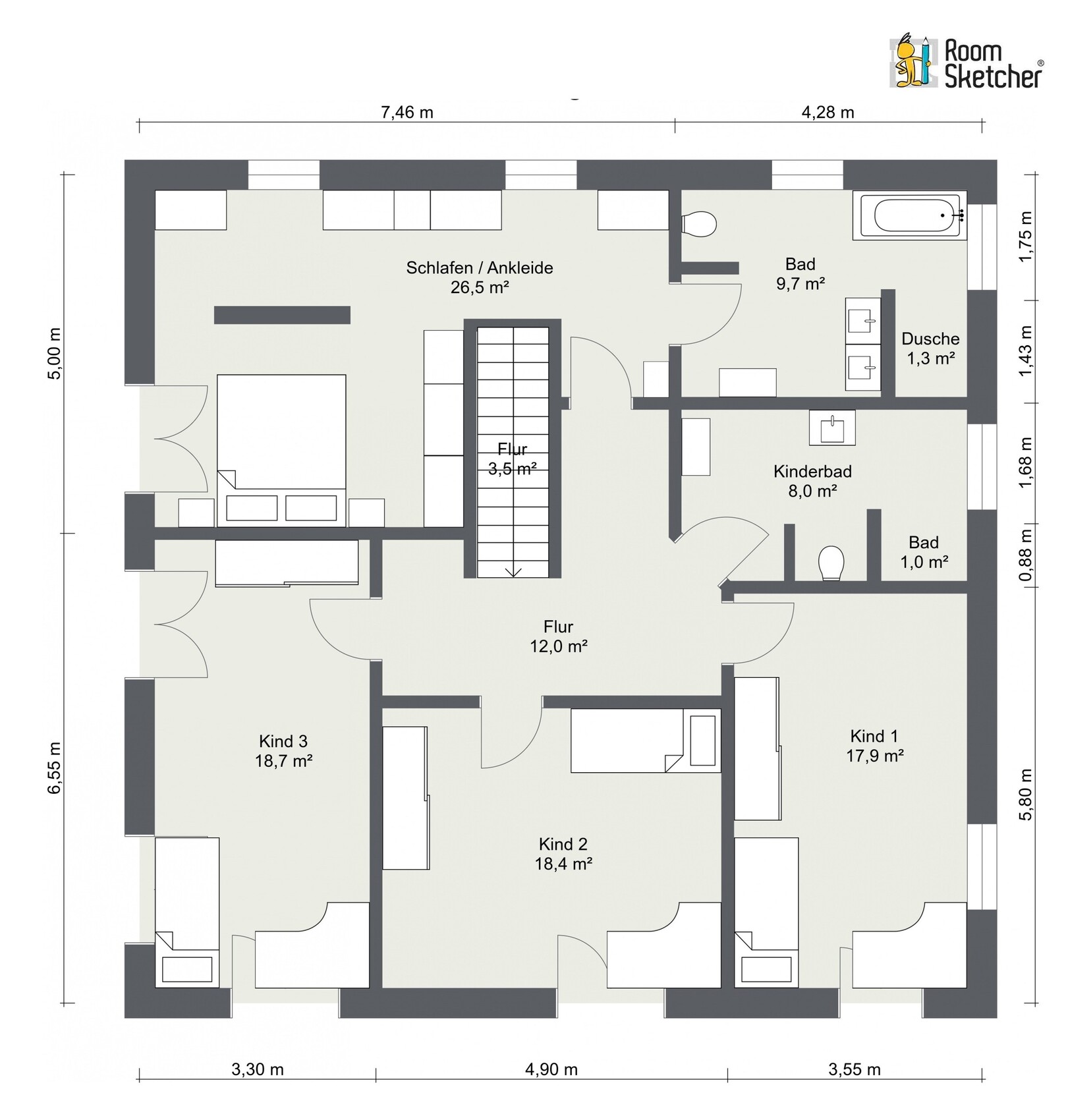
Despite the understandable weakness in the center of the building, the rectangle is the best combination of appearance and placement within the building permit / planning permission area for us (even though it might seem surprising given the size of the plot, this is actually a factor worth considering in the overall context).
Today, I tried to incorporate the feedback into a new design. I will also look for a version with daylight in the upper floor, but this is not a particular priority for us (we are aware that we might not be in the majority on this). Regarding structural engineering, I found out that spans of up to just over 7 meters (23 feet) can be covered with standard ceilings.

Hausbauer4747 schrieb:
Despite the understandable weakness in the center of the building, the rectangle is the best combination of appearance and positioning within the building plot for us. Both floor plans are rectangular. You mean your targeted square shape. 😉 Only forms with more corners up to a circle offer a less favorable ratio of facade area to living space. Since you usually want a lot of facade area, and thus wall space, to install windows and place furniture, a square is not ideal and regularly leads to the problem of poorly usable space in room centers. Hausbauer4747 schrieb:
Today I tried to incorporate the feedback into a new draft. Your dedication is commendable, but since time is somewhat pressing for you: when do you plan to hand this over to professionals? Not every sketch is a design; otherwise, it would probably not take several semesters at universities to learn how to design properly. Hausbauer4747 schrieb:
Regarding the structural engineering, I found out that spans of just over 7 meters (about 23 feet) can be achieved with standard ceilings. Whatever “standard ceilings” are supposed to mean. Many parameters can vary, such as concrete mix, amount, quality and arrangement of reinforcement steel, beams and girders, total thickness, and so on.H
Hausbauer474714 Jul 2021 07:57That's correct, by rectangle I actually meant square. We are currently scheduling an appointment; I don't want to rigidly build a house I designed myself, but rather prepare for a meeting with an architect with a rough idea. 🙂
Unfortunately, I can't say exactly how the ceiling is planned. The draft shows a thickness of 18cm (7 inches), and when I asked, the ceiling was described as "standard," meaning it won't lead to additional costs.
Unfortunately, I can't say exactly how the ceiling is planned. The draft shows a thickness of 18cm (7 inches), and when I asked, the ceiling was described as "standard," meaning it won't lead to additional costs.
Hausbauer4747 schrieb:
but rather prepare myself for a meeting with the architect with an idea.Preparing is good, but I would strongly advise against presenting your "design" to the architect/planner and saying that this is how you imagine it. State your requirements and wishes clearly, and then let them take it from there. You might be surprised by the proposals you receive.In my opinion, this kind of "sketching" is mainly useful for identifying points you don’t like or for learning which details require special attention to ensure all requirements are met. Still, the architect should have the freedom to work independently. For example, we spoke with three different architects and received three very different designs, none of which exactly matched what we had initially considered, but all were perfectly suitable.
The issue with the “clump problem” (I don’t even know that word 😀) is that hardly any natural light reaches the center of the house, so you’re always dependent on a light switch. Even the rooms themselves are dark near the door area because daylight doesn’t penetrate far enough inside.
It may not seem like a big problem to you, but in everyday living, constantly switching lights on and off can be really annoying. We even have motion detectors in the utility room, and I want to install them in the cloakroom as well. It’s just frustrating to have to operate a light switch with your hands full (laundry, bag, etc).
There are plenty of reasons not to build square beyond a certain size – your experiments bring all those reasons together 😉
It may not seem like a big problem to you, but in everyday living, constantly switching lights on and off can be really annoying. We even have motion detectors in the utility room, and I want to install them in the cloakroom as well. It’s just frustrating to have to operate a light switch with your hands full (laundry, bag, etc).
There are plenty of reasons not to build square beyond a certain size – your experiments bring all those reasons together 😉
Similar topics