
ᐅ Floor Plan Design for a Single-Family Home of 230-235 m² on Two Full Stories
Created on: 11 Jul 2021 16:11
H
Hausbauer4747
By now, we have put quite a lot of thought into a practical, well-usable, and hopefully attractive floor plan, and we would like to reach a final decision fairly soon. We look forward to your feedback and thank you in advance for any tips or suggestions. 🙂
Development Plan / Restrictions
Plot size: 2,600 m² (approximately 0.64 acres), completely flat
Site coverage ratio / floor area ratio: 0.4 / 0.8
Number of floors: two full stories
Roof type: hip roof or pyramid roof with 22-25° pitch
Architectural style: modern
Orientation: the floor plans are always aligned with north at the top; the street side is on the east
Maximum heights / limits: the eave height is somewhat tight at 6 meters (approximately 20 feet), otherwise there is plenty of space. Building envelope and setbacks are sufficiently large, so we do not need to apply for any exceptions from the development plan.
Homeowners’ Requirements
Style, roof type, building type: “urban villa,” hip or pyramid roof with 22-25°
No basement, two full stories
Two adults, three children currently under 3 years old
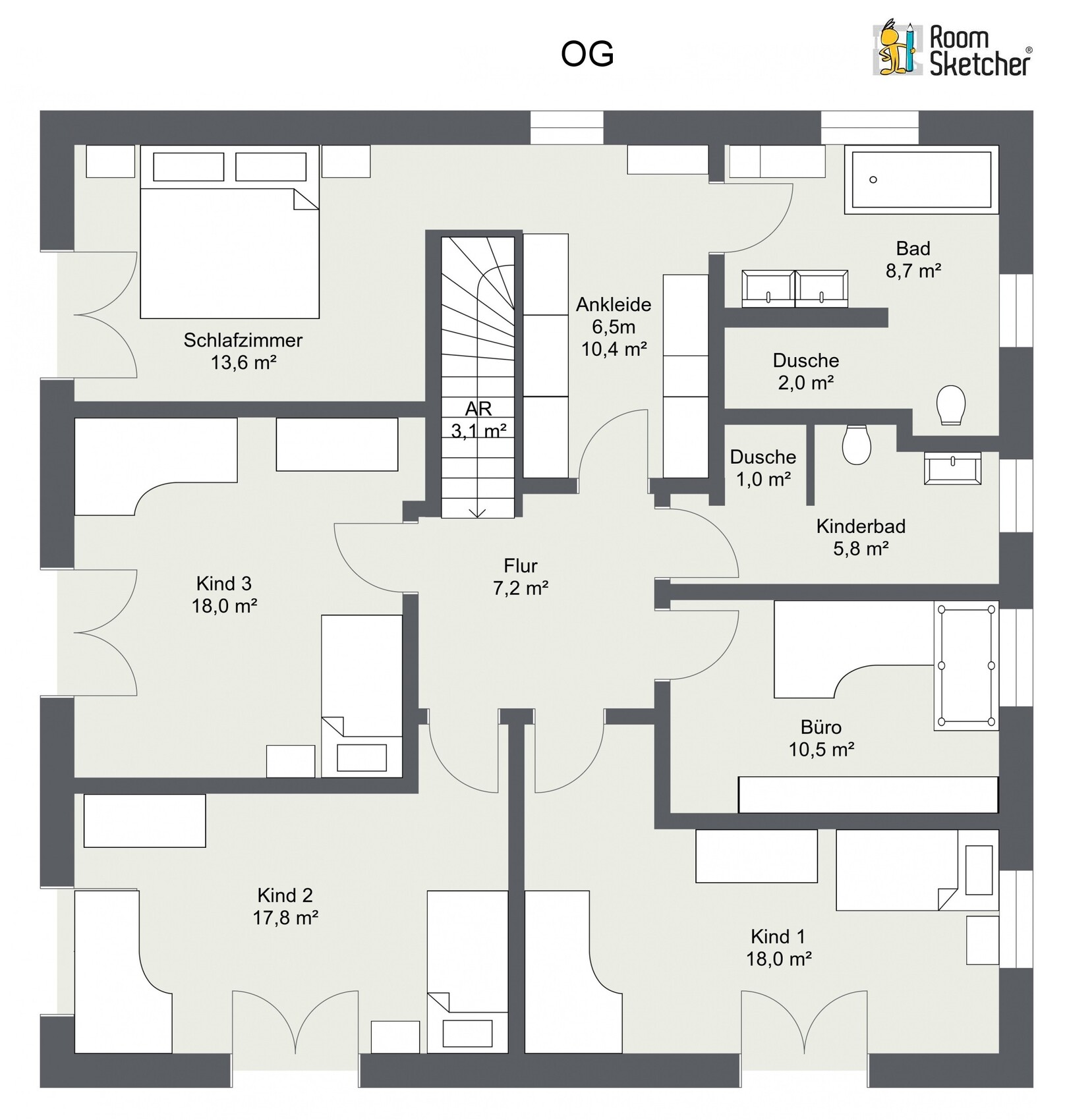
Room needs on ground floor and upper floor: three children’s bedrooms with a children’s shower bathroom, guest room and office as two separate rooms
Ground floor with rather open architecture
A gas fireplace is an option, but we are likely to forgo it due to the effort of connecting gas and chimney costs
Both garage and carport planned (approx. 6x9 m (20x30 feet) garage and carport about 4x7 m (13x23 feet) located between the house and garage)
House Design
Planning origin: self-designed based on a discussed external dimension of about 12x12 meters (approximately 39x39 feet)
What do you particularly like and why? The house is relatively large and accommodates all room concepts (3 children’s bedrooms with children’s shower bathroom, separate guest room and office, etc.). We like the orientation by cardinal directions (living room southwest, children’s rooms south or southwest, master and guest bedrooms west facing the garden, bathrooms to the east, and front door facing north).
What do you dislike and why? The design focuses primarily on usability rather than aesthetics. For example, representative hallways with little practical use were avoided. However, it is difficult for us to achieve symmetrical and visually pleasing window alignment between the ground and upper floors. This is visible, for example, in the window of the children’s shower bathroom and the utility room below it.
Preferred heating technology: ground source heat pump, but for cost reasons, it will probably be an air-to-water heat pump.
If you have to give up, which features or additions could you do without
- What can you give up: KfW40+ with large photovoltaic system (instead opting for KfW55 with medium photovoltaic system), brick cladding, underfloor cooling, en-suite guest bathroom, showers could possibly be smaller if costs get too high
- What you cannot do without: children’s shower bathroom, (preferably) controlled ventilation system (mechanical supply and exhaust)
What is the most important/fundamental question about the floor plan in 130 characters?
Are we overlooking anything in this floor plan that would annoy us daily later because it is poorly or very impractically planned? Can we find a visual trick to achieve exterior symmetry?
Many thanks!

Development Plan / Restrictions
Plot size: 2,600 m² (approximately 0.64 acres), completely flat
Site coverage ratio / floor area ratio: 0.4 / 0.8
Number of floors: two full stories
Roof type: hip roof or pyramid roof with 22-25° pitch
Architectural style: modern
Orientation: the floor plans are always aligned with north at the top; the street side is on the east
Maximum heights / limits: the eave height is somewhat tight at 6 meters (approximately 20 feet), otherwise there is plenty of space. Building envelope and setbacks are sufficiently large, so we do not need to apply for any exceptions from the development plan.
Homeowners’ Requirements
Style, roof type, building type: “urban villa,” hip or pyramid roof with 22-25°
No basement, two full stories
Two adults, three children currently under 3 years old
Room needs on ground floor and upper floor: three children’s bedrooms with a children’s shower bathroom, guest room and office as two separate rooms
Ground floor with rather open architecture
A gas fireplace is an option, but we are likely to forgo it due to the effort of connecting gas and chimney costs
Both garage and carport planned (approx. 6x9 m (20x30 feet) garage and carport about 4x7 m (13x23 feet) located between the house and garage)
House Design
Planning origin: self-designed based on a discussed external dimension of about 12x12 meters (approximately 39x39 feet)
What do you particularly like and why? The house is relatively large and accommodates all room concepts (3 children’s bedrooms with children’s shower bathroom, separate guest room and office, etc.). We like the orientation by cardinal directions (living room southwest, children’s rooms south or southwest, master and guest bedrooms west facing the garden, bathrooms to the east, and front door facing north).
What do you dislike and why? The design focuses primarily on usability rather than aesthetics. For example, representative hallways with little practical use were avoided. However, it is difficult for us to achieve symmetrical and visually pleasing window alignment between the ground and upper floors. This is visible, for example, in the window of the children’s shower bathroom and the utility room below it.
Preferred heating technology: ground source heat pump, but for cost reasons, it will probably be an air-to-water heat pump.
If you have to give up, which features or additions could you do without
- What can you give up: KfW40+ with large photovoltaic system (instead opting for KfW55 with medium photovoltaic system), brick cladding, underfloor cooling, en-suite guest bathroom, showers could possibly be smaller if costs get too high
- What you cannot do without: children’s shower bathroom, (preferably) controlled ventilation system (mechanical supply and exhaust)
What is the most important/fundamental question about the floor plan in 130 characters?
Are we overlooking anything in this floor plan that would annoy us daily later because it is poorly or very impractically planned? Can we find a visual trick to achieve exterior symmetry?
Many thanks!

We also have a concrete ceiling above the upper floor and still have an attic. Is the roof made of wood? That’s all possible. 😉
However, with your requirements regarding the room layout and number of floors, it might become challenging, as the discussion here already shows.
However, with your requirements regarding the room layout and number of floors, it might become challenging, as the discussion here already shows.
H
Hausbauer474713 Jul 2021 14:07That is possible, but we would prefer to avoid having a living space under a wooden gable roof. Gable roofs made of masonry are rare.

Hausbauer4747 schrieb:
I have no statistics on this, but I suspect that independent architect designs are not the majority in the market. Designs through developers and construction companies are probably more common, so the term conventional, which I put in quotation marks intentionally, refers to the quantity or majority proportions. Architect designs are currently not the majority, but they are not exactly a novelty either. The current trend is indeed toward custom designs by Zeichenknecht, both in masonry and carpentry main contractors alike. It is similar to agriculture, where "conventional" is often contrasted with "organic," even though organic has actually been conventional since the time of Emperor Barbarossa, whereas industrial agriculture only began its rise a little over sixty years ago.
Hausbauer4747 schrieb:
We prefer a concrete ceiling above the upper floor and would rather not have additional living space above it (even though I know that there are companies that build solid roofs without wood). Do you mean a solid (e.g., aerated concrete) roof, and that you would like such a roof with exposed undersides?
https://www.instagram.com/11antgmxde/
https://www.linkedin.com/company/bauen-jetzt/
H
Hausbauer474713 Jul 2021 14:14My experience with the temperatures in living spaces under sloping roofs has been rather poor, even in nearly new and very high-quality built houses, so we prefer not to plan that way. The main argument against it, however, is the additional stairs; we would like to limit ourselves to two floors. Perhaps in the end this is also better for the proportions than placing a "vertical" house with a smaller footprint on the large lot.
mh, Schwörerhaus again. Take a look at the E15-244.1.
A bungalow for you, and the kids would have their own space under the roof. It’s amazing how much attic space you get with a large bungalow.
(This doesn’t mean you have to build like this. Just an example of what’s possible, especially since a bungalow was once high on the wishlist.)
Modern attics aren’t actually bad. Instead of roof windows in the rooms, you have standard windows that can be shaded, like in the example above. Whether with or without sloped ceilings, you need shading. When a modern house heats up, it turns into a greenhouse.
Regarding your question: We built with a small general contractor who is also an architect. Your layout doesn’t fit the catalog, and for us, it’s the plot. Our house itself looks very standard. A functioning house can go wrong if you add a meter here or build onto something there.
It’s probably a combination of small details that turns the awkward “Tetris” into a cohesive whole in your case.
A bungalow for you, and the kids would have their own space under the roof. It’s amazing how much attic space you get with a large bungalow.
(This doesn’t mean you have to build like this. Just an example of what’s possible, especially since a bungalow was once high on the wishlist.)
Modern attics aren’t actually bad. Instead of roof windows in the rooms, you have standard windows that can be shaded, like in the example above. Whether with or without sloped ceilings, you need shading. When a modern house heats up, it turns into a greenhouse.
Regarding your question: We built with a small general contractor who is also an architect. Your layout doesn’t fit the catalog, and for us, it’s the plot. Our house itself looks very standard. A functioning house can go wrong if you add a meter here or build onto something there.
It’s probably a combination of small details that turns the awkward “Tetris” into a cohesive whole in your case.
H
HausTmMike13 Jul 2021 15:06Hausbauer4747 schrieb:
My experience with temperatures in living spaces under sloped roofs has been rather poor, even in nearly new and very well-built houses, so we prefer not to plan that way. The main reason is the additional stairs; we would rather limit ourselves to two floors. Perhaps that also results in better proportions than placing a "vertical" house with less floor area on a large plot. From my own experience, I can tell you that with 28cm (11 inches) of insulation (between rafters) with a thermal conductivity of 0.032 W/mK and Velux external acoustic shutters, comfortable to cool temperatures of 22–23°C (72–73°F) can be maintained even when it is 30°C (86°F) in midsummer. You cannot compare that with a 30-year-old house.
We also have a bungalow.
Ground floor with a separate parents’ area and all the living spaces including a guest room and guest shower room totaling about 160m² (1,722 sq ft).
And with a knee wall creating a separate apartment with 4 dormers in the attic, roughly 110m² (1,184 sq ft), housing a study and the children’s play area 😉
Similar topics