
ᐅ Floor Plan Design for a Gable Roof House (Knee Wall Height 2.20 m) Approximately 170 sqm
Created on: 2 Nov 2021 15:01
B
Bauwunsch85
Hello everyone,
We would appreciate your suggestions and ideas on our first floor plan draft.
Please excuse the unprofessional sketches, but we are still at the beginning and have our first meeting with a potential construction company next week.
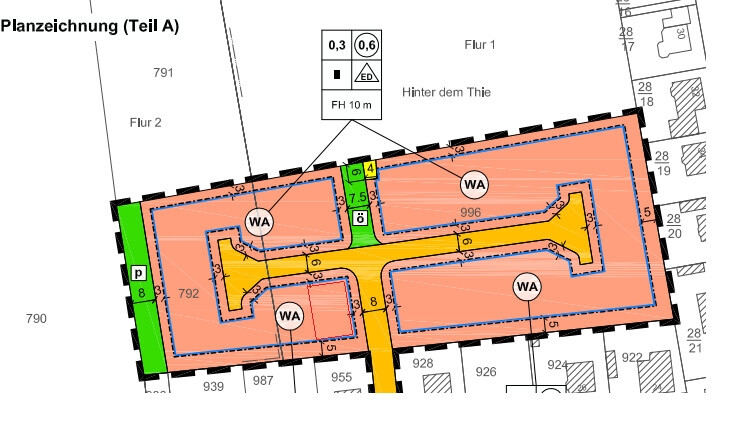
Zoning plan / restrictions
Plot size: 550 m² (5,920 sq ft)
Slope: no
Site coverage ratio (building coverage ratio): 0.3
Floor area ratio: 0.6
Building boundaries, building line, and setbacks: 3 m (10 ft)
Edge development
Number of parking spaces: 2
Number of floors: 2
Roof type: gable roof
Style: modern
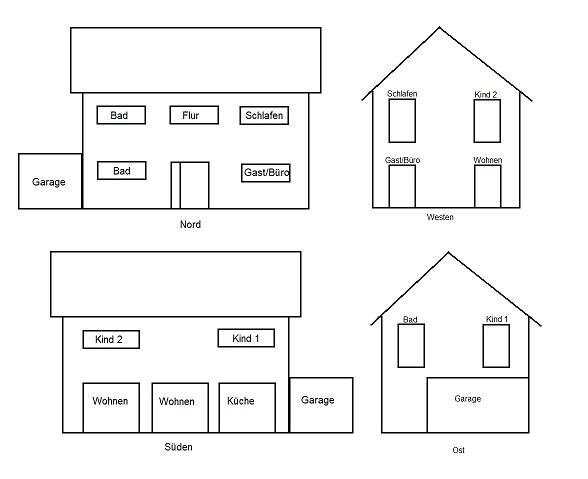
Orientation as shown in pictures (almost perfect north-south orientation)
Maximum heights / limits
Ridge height: 10 m (33 ft)
Eaves height at least 1.5 m (5 ft) lower than ridge height
Homeowners’ requirements
Style, roof type, building type: gable roof house with a high knee wall 2.20 m (7 ft 3 in)
Basement, floors: no
Number of occupants, age: 2 adults and 1 child planned
Space requirements on ground floor and upper floor
Office: family use or home office? Both home offices
Guests sleeping per year: negligible
Open or closed architecture
Conservative or modern construction style
Open kitchen, kitchen island
Number of dining seats: 6
Fireplace: yes
Music / stereo wall: no
Balcony, roof terrace: no
Garage, carport: yes, garage
Utility garden, greenhouse: no
Other wishes / special features / daily routine, including reasons why or why not for these elements
- Passage from garage to utility room for bringing dry groceries / beverage crates into the house
- 2 office options as both work from home
- Passage in front of the bed is sufficient for us; currently we only have 40 cm (16 inches) in front of a dresser with TV
- Wardrobe to be under the stairs (possibly enclosed)
- Child 2 room to serve as office / sports room
House design
Who created the planning:
- Do-it-yourself
What do you particularly like? Why?
What do you dislike? Why? Preferably an additional storage room
Cost estimate according to architect/planner: €395,000
Personal price limit for house including fittings: €500,000
Preferred heating system: heat pump
If you have to give up something, which details / expansions can you do without?
- Can do without: fireplace
- Cannot do without: walk-in closet (storage for bed linen / towels for the house)
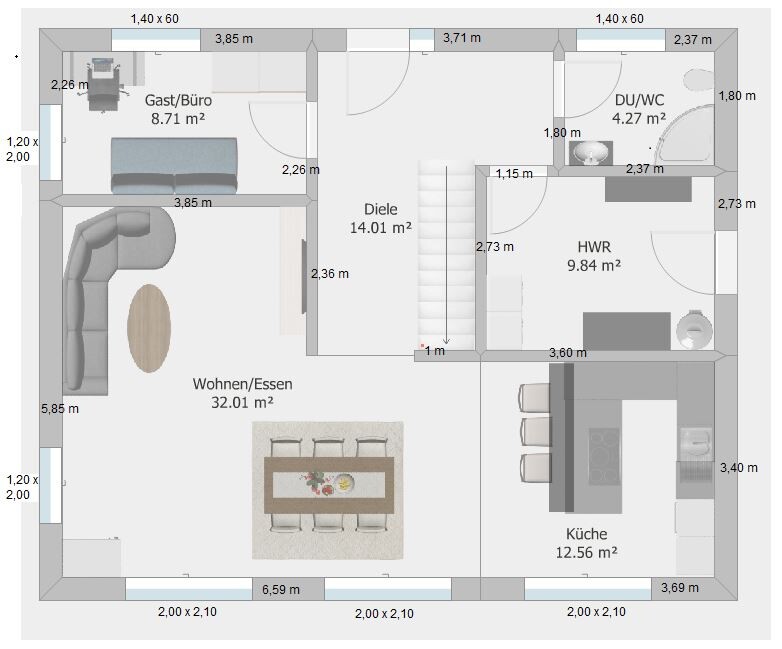
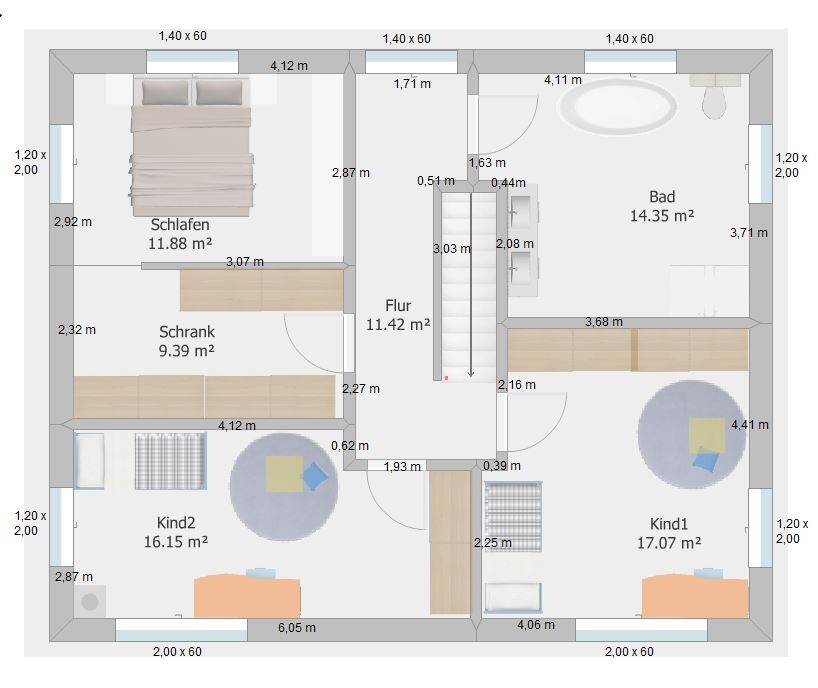
We would appreciate your suggestions and ideas on our first floor plan draft.
Please excuse the unprofessional sketches, but we are still at the beginning and have our first meeting with a potential construction company next week.
Zoning plan / restrictions
Plot size: 550 m² (5,920 sq ft)
Slope: no
Site coverage ratio (building coverage ratio): 0.3
Floor area ratio: 0.6
Building boundaries, building line, and setbacks: 3 m (10 ft)
Edge development
Number of parking spaces: 2
Number of floors: 2
Roof type: gable roof
Style: modern
Orientation as shown in pictures (almost perfect north-south orientation)
Maximum heights / limits
Ridge height: 10 m (33 ft)
Eaves height at least 1.5 m (5 ft) lower than ridge height
Homeowners’ requirements
Style, roof type, building type: gable roof house with a high knee wall 2.20 m (7 ft 3 in)
Basement, floors: no
Number of occupants, age: 2 adults and 1 child planned
Space requirements on ground floor and upper floor
Office: family use or home office? Both home offices
Guests sleeping per year: negligible
Open or closed architecture
Conservative or modern construction style
Open kitchen, kitchen island
Number of dining seats: 6
Fireplace: yes
Music / stereo wall: no
Balcony, roof terrace: no
Garage, carport: yes, garage
Utility garden, greenhouse: no
Other wishes / special features / daily routine, including reasons why or why not for these elements
- Passage from garage to utility room for bringing dry groceries / beverage crates into the house
- 2 office options as both work from home
- Passage in front of the bed is sufficient for us; currently we only have 40 cm (16 inches) in front of a dresser with TV
- Wardrobe to be under the stairs (possibly enclosed)
- Child 2 room to serve as office / sports room
House design
Who created the planning:
- Do-it-yourself
What do you particularly like? Why?
What do you dislike? Why? Preferably an additional storage room
Cost estimate according to architect/planner: €395,000
Personal price limit for house including fittings: €500,000
Preferred heating system: heat pump
If you have to give up something, which details / expansions can you do without?
- Can do without: fireplace
- Cannot do without: walk-in closet (storage for bed linen / towels for the house)
M
Myrna_Loy2 Nov 2021 19:22Or floor plan Edition 600. Take a look at such floor plans and the room layouts on the upper floor. This will give you a better understanding of staircases and corridors.

Bauwunsch85 schrieb:
An alternative for us would still be a traditional townhouse, but these often have floor plans that feel uninspired, and are probably more expensive than gable roofs due to the hip roof design. [...] L-shaped living/dining/kitchen areas are rare, allowing space on the ground floor for a home office or guest room. Firstly, the uninspired area in a "traditional" townhouse is exactly what is called the “office/guest room,” located in the same place and having the same size as in your custom design. Secondly, the hip roof on the “townhouse” is not a fixed rule. If the square footprint is changed to an asymmetrical rectangle, as you have planned, you can visually achieve the intended gable roof—this is significantly more affordable if the roof only starts above the ceiling of the upper floor.
https://www.instagram.com/11antgmxde/
https://www.linkedin.com/company/bauen-jetzt/
Just the fact that the staircase is at least one meter (3 feet) too short should give you some reassurance when it comes to other issues that don’t fit or could have been planned better.
Of course, you can turn a walk-in closet into a storage room, but wouldn’t it make more sense to use a room as it was intended? And if you need a storage room, shouldn’t it be located where you actually need it?
When I search on house websites for 4 bedrooms or 5 rooms, most of the houses that show up have an office on the ground floor. You can also try to look at the many recent floor plan discussions, where home office spaces are now commonly included. What you want is nothing new. Almost every second home has a similar layout; it just looks different because it works — unlike your design: if the staircase is longer, then so is the hallway. If the dining area needs to be wider, then the rest shifts, and everything looks different, similar, but more appropriate. In theory.
It’s not about taste, it’s about correct dimensions: take the mentioned 2.87 meters (9 feet 5 inches) in the bedroom. If the builder constructs it exactly like this because it’s your “preference,” you’ll get 2.80 meters (9 feet 2 inches) after plastering. Then the bed will have to be placed 10 cm (4 inches) away from the exterior wall, leaving you 50 cm (20 inches) on one side. Fifty centimeters (20 inches) means one person barely has enough space to get onto their side of the bed. With a child in your arms, it’s impossible—only stubbed toes and knees and awkward falling into bed. Going to the bathroom at night in the dark: no chance and frustrating. At the latest, when minor aches and pains start after 40+, you’ll prefer to sleep on the sofa. Great “matter of personal taste,” indeed.
Then give that room the space it needs and take space away where it is wasted.
Yes, you can do that, and it’s fun. But if bottlenecks are pointed out here, take them seriously — this is your chance now. I have some general observations:
- A knee wall height of 2.20 meters (7 feet 3 inches) is neither fish nor fowl.
- The floor-to-ceiling windows in the gable areas are visually spaced too far apart.
- The staircase should be at least 3.70 meters (12 feet 2 inches), better 3.90 meters (12 feet 10 inches). A non-expert should add some extra length everywhere to compensate for realistic wall thicknesses.
- There is no cloakroom.
- Space-saving showers like those—do they even still exist? Who are they for?
- The sofa in the office does not have enough space to unfold.
- An 8 sqm (86 sq ft) office is officially too small for two people working side-by-side from home—8 sqm (86 sq ft) per person, if the employer cares.
- Kitchen: There is no clear working space. No tall cabinet. Oven door or dishwasher door cannot be fully opened.
- Dining area is quite tight, making constant passage to the living room difficult.
For most of the year, you can manage this even without a side entrance. It rarely rains continuously right when you come home. And when it does rain, it rains all around the house anyway. The door costs valuable space inside the house. You have some buffer in the sports room for putting things down, but even that 2.80 meters (9 feet 2 inches) layout is not ideal. Still, it works.
Of course, you can turn a walk-in closet into a storage room, but wouldn’t it make more sense to use a room as it was intended? And if you need a storage room, shouldn’t it be located where you actually need it?
Bauwunsch85 schrieb:
Open-plan living/dining/kitchen areas in an L-shape are rare when there is still space for an office/guest room on the ground floor.
When I search on house websites for 4 bedrooms or 5 rooms, most of the houses that show up have an office on the ground floor. You can also try to look at the many recent floor plan discussions, where home office spaces are now commonly included. What you want is nothing new. Almost every second home has a similar layout; it just looks different because it works — unlike your design: if the staircase is longer, then so is the hallway. If the dining area needs to be wider, then the rest shifts, and everything looks different, similar, but more appropriate. In theory.
Bauwunsch85 schrieb:
Otherwise, such a room is of course a matter of personal taste.
It’s not about taste, it’s about correct dimensions: take the mentioned 2.87 meters (9 feet 5 inches) in the bedroom. If the builder constructs it exactly like this because it’s your “preference,” you’ll get 2.80 meters (9 feet 2 inches) after plastering. Then the bed will have to be placed 10 cm (4 inches) away from the exterior wall, leaving you 50 cm (20 inches) on one side. Fifty centimeters (20 inches) means one person barely has enough space to get onto their side of the bed. With a child in your arms, it’s impossible—only stubbed toes and knees and awkward falling into bed. Going to the bathroom at night in the dark: no chance and frustrating. At the latest, when minor aches and pains start after 40+, you’ll prefer to sleep on the sofa. Great “matter of personal taste,” indeed.
Bauwunsch85 schrieb:
And we know that an 11 sqm (118 sq ft) bedroom is enough for us.
Then give that room the space it needs and take space away where it is wasted.
Bauwunsch85 schrieb:
Yes, that’s certainly true, but when listing what’s important to us, you quickly start to test if things could work.
Yes, you can do that, and it’s fun. But if bottlenecks are pointed out here, take them seriously — this is your chance now. I have some general observations:
- A knee wall height of 2.20 meters (7 feet 3 inches) is neither fish nor fowl.
- The floor-to-ceiling windows in the gable areas are visually spaced too far apart.
- The staircase should be at least 3.70 meters (12 feet 2 inches), better 3.90 meters (12 feet 10 inches). A non-expert should add some extra length everywhere to compensate for realistic wall thicknesses.
- There is no cloakroom.
- Space-saving showers like those—do they even still exist? Who are they for?
- The sofa in the office does not have enough space to unfold.
- An 8 sqm (86 sq ft) office is officially too small for two people working side-by-side from home—8 sqm (86 sq ft) per person, if the employer cares.
- Kitchen: There is no clear working space. No tall cabinet. Oven door or dishwasher door cannot be fully opened.
- Dining area is quite tight, making constant passage to the living room difficult.
Bauwunsch85 schrieb:
Passage from garage to utility room to bring groceries and beverage crates dry into the house.
For most of the year, you can manage this even without a side entrance. It rarely rains continuously right when you come home. And when it does rain, it rains all around the house anyway. The door costs valuable space inside the house. You have some buffer in the sports room for putting things down, but even that 2.80 meters (9 feet 2 inches) layout is not ideal. Still, it works.
However, with the Edition 600, there isn’t any more space in the walk-in closet and bedroom. If you choose a bed with a compact headboard and end up with a 70cm (28 inches) clearance, I would find that perfectly fine. Reading through all this, I sometimes wonder how people even manage to live in average apartments 😉 I would definitely include a window in the walk-in closet. It might be worth considering a second door in the bedroom for direct access to the bathroom. The hallway downstairs is too wide; try aligning the left wall in the floor plan exactly under the wall above. That will also benefit the structural integrity. I find a coat rack under the stairs sufficient, plus space for jackets or a narrow shoe cabinet towards the WC. But first, draw a proper staircase, and then you can figure out the rest!
Würfel* schrieb:
Reading all of this, I sometimes wonder how people manage to live in average apartments at all 😉Well.. I can comfortably live in a small space, I’m not disabled, slow, or pampered.. but I have actually broken my little toe twice in the kind of situation I mentioned. It’s not pleasant. When I build, I make sure that everyday pathways are not apartment-size, where every saved centimeter brings money to the investor but creates barriers in my own property that I shouldn’t have to face with my own house. I can “include” them, but if I have to excuse them with poor house design, then something is wrong.A
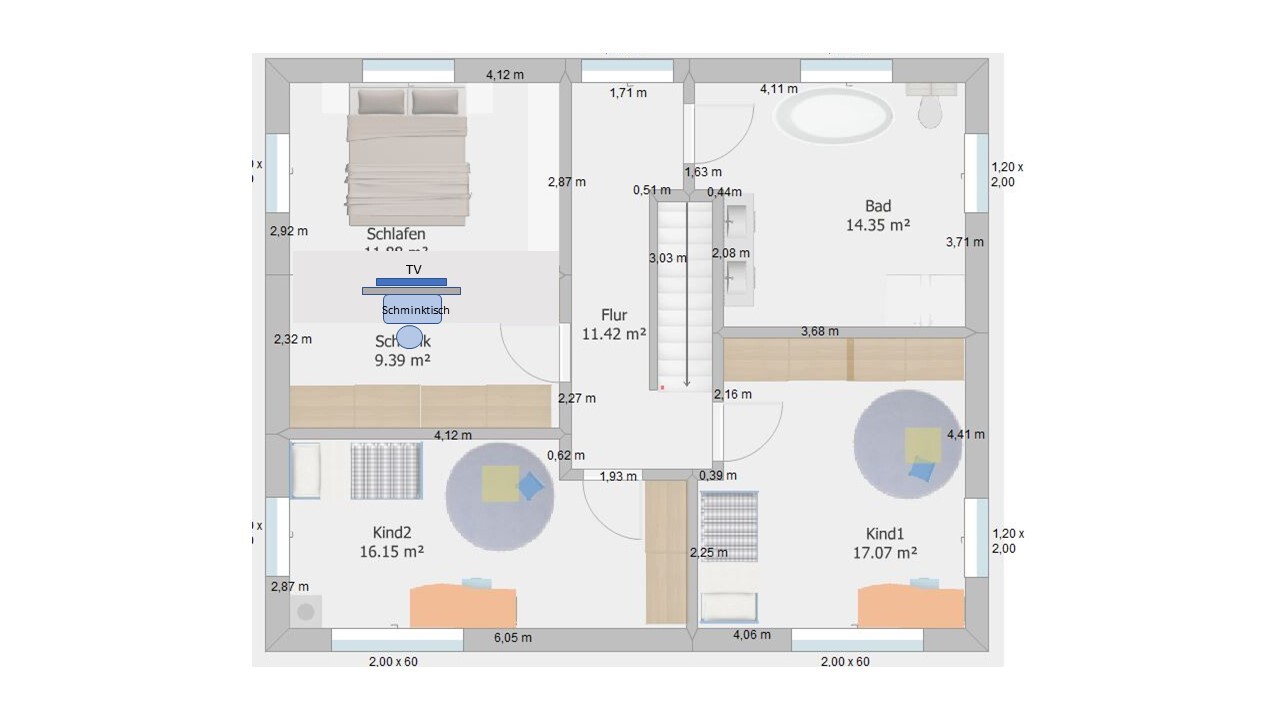
Alessandro4 Nov 2021 08:34A 4m (13 feet) wardrobe is more than enough for two people. I would arrange it like this:
Similar topics