
ᐅ Floor Plan Design for Urban Villa 140-150 sqm with 2 Children – Feedback
Created on: 28 Dec 2022 21:46
D
dupsischnupsi
Development Plan / Restrictions
Plot size 580sqm (6250 sq ft)
Slope no
Site coverage ratio
Floor area ratio
Building envelope, building line, and boundary
Edge development
Number of parking spaces 1
Number of floors 2 full stories
Roof type hipped roof
Architectural style urban villa
Orientation south
Maximum heights/restrictions none
Other requirements none
Client Requirements
Style, roof type, building type urban villa, hipped roof
Basement, floors no basement, 2 floors
Number of occupants, ages 4 people 37, 33, 4, 1
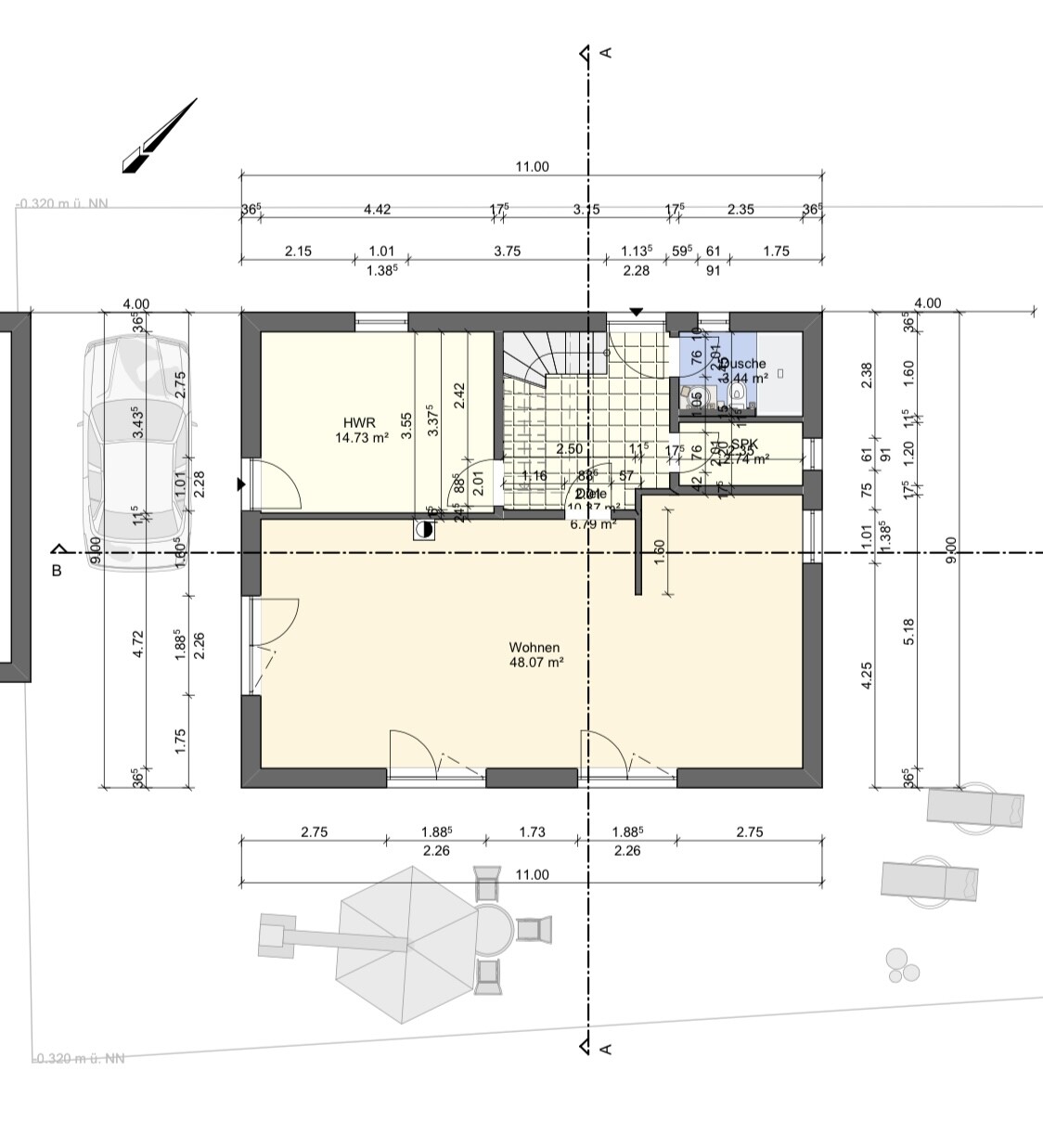
Space requirements on ground and upper floors see floor plan
Office: family use or home office? rarely home office, mostly storage room
Overnight guests per year 0
Open or closed architecture open
Conservative or modern construction modern
Open kitchen, kitchen island
Number of dining seats 6
Fireplace no
Music/stereo wall no
Balcony, roof terrace no
Garage, carport preferably garage directly connected to utility room, possibly carport for budget reasons
Utility garden, greenhouse no
Additional wishes/special features/daily routine, including reasons why certain features are wanted or not
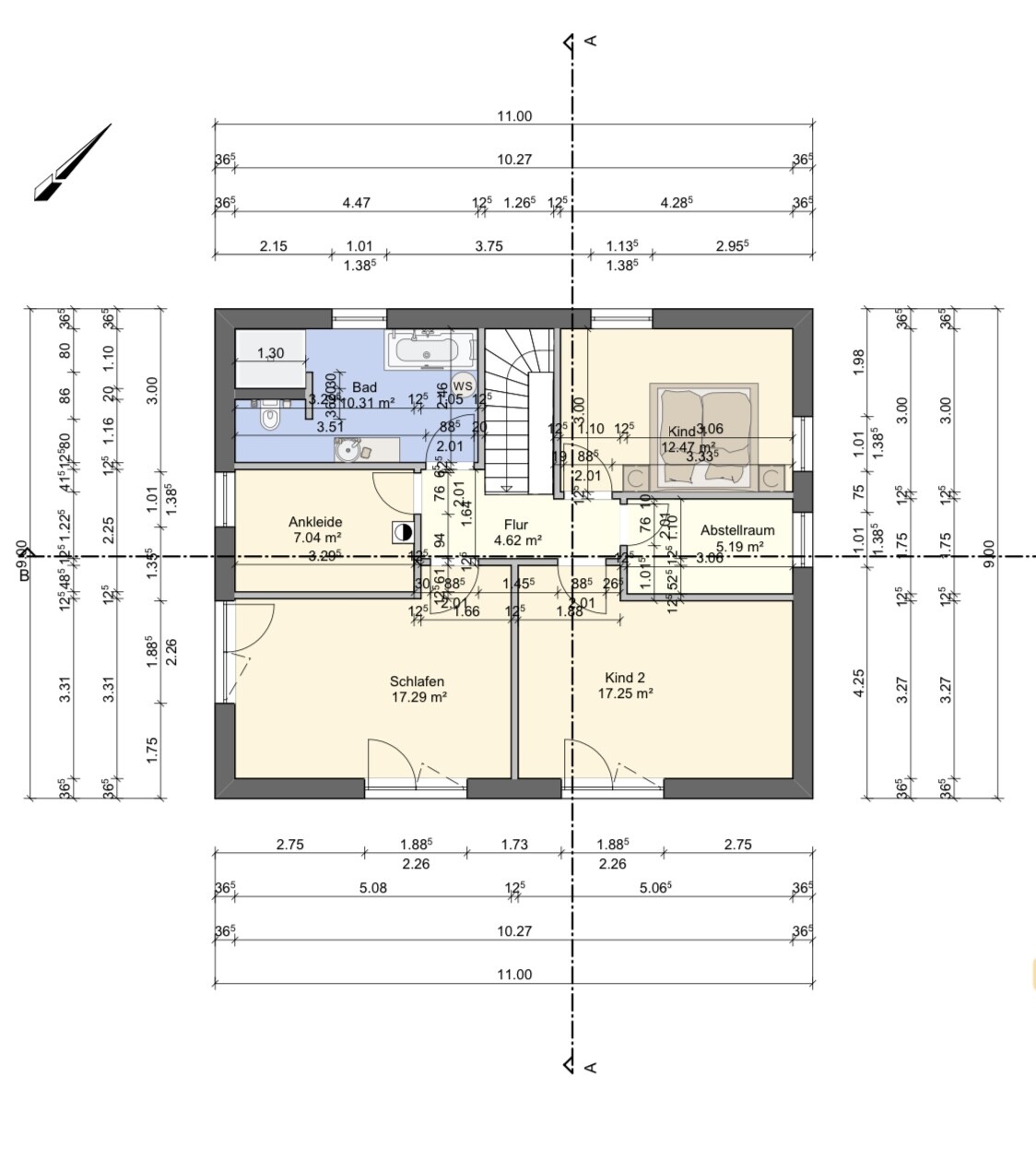
Children’s rooms should preferably be on the south side; bathroom and bedroom will be swapped upstairs to better use natural daylight in the bathroom
House Design
Design by:
- First draft by the architect
What do you particularly like? Why?
The size of the rooms
What do you dislike? Why?
Bathroom and bedroom will be swapped
We would like more and larger windows
Door to pantry from kitchen
Cost estimate according to architect/designer:
Personal budget limit for house including fixtures:
Preferred heating system: air-source heat pump
If You Have to Give Up Something, which details/finishes
- Can give up: garage
- Cannot give up: large windows
Why is the design the way it is now? For example:
Standard design from the planner? This is the architect’s first draft
Which wishes from you did the architect implement?
Almost all of them
What do you think makes it particularly good or bad?
What is the most important/basic question about the floor plan in 130 characters?
We are interested in experienced builders' opinions on our floor plan. We already have some change requests noted but would really value this expertise for our home building process.
We are also unsure whether to build with a general contractor or manage the trades ourselves. Are there any experiences on whether this actually saves money, and if so, how much?
Thank you very much in advance for your input!
Best regards, dupsischnupsi
Plot size 580sqm (6250 sq ft)
Slope no
Site coverage ratio
Floor area ratio
Building envelope, building line, and boundary
Edge development
Number of parking spaces 1
Number of floors 2 full stories
Roof type hipped roof
Architectural style urban villa
Orientation south
Maximum heights/restrictions none
Other requirements none
Client Requirements
Style, roof type, building type urban villa, hipped roof
Basement, floors no basement, 2 floors
Number of occupants, ages 4 people 37, 33, 4, 1
Space requirements on ground and upper floors see floor plan
Office: family use or home office? rarely home office, mostly storage room
Overnight guests per year 0
Open or closed architecture open
Conservative or modern construction modern
Open kitchen, kitchen island
Number of dining seats 6
Fireplace no
Music/stereo wall no
Balcony, roof terrace no
Garage, carport preferably garage directly connected to utility room, possibly carport for budget reasons
Utility garden, greenhouse no
Additional wishes/special features/daily routine, including reasons why certain features are wanted or not
Children’s rooms should preferably be on the south side; bathroom and bedroom will be swapped upstairs to better use natural daylight in the bathroom
House Design
Design by:
- First draft by the architect
What do you particularly like? Why?
The size of the rooms
What do you dislike? Why?
Bathroom and bedroom will be swapped
We would like more and larger windows
Door to pantry from kitchen
Cost estimate according to architect/designer:
Personal budget limit for house including fixtures:
Preferred heating system: air-source heat pump
If You Have to Give Up Something, which details/finishes
- Can give up: garage
- Cannot give up: large windows
Why is the design the way it is now? For example:
Standard design from the planner? This is the architect’s first draft
Which wishes from you did the architect implement?
Almost all of them
What do you think makes it particularly good or bad?
What is the most important/basic question about the floor plan in 130 characters?
We are interested in experienced builders' opinions on our floor plan. We already have some change requests noted but would really value this expertise for our home building process.
We are also unsure whether to build with a general contractor or manage the trades ourselves. Are there any experiences on whether this actually saves money, and if so, how much?
Thank you very much in advance for your input!
Best regards, dupsischnupsi
X
xMisterDx28 Dec 2022 23:56Do you really want to have to go through two doors and walk around several corners, carrying cans and jars, just to get to the pantry?
The utility room (HAR) is at least 4m² (43 sq ft) too large, more like 6m² (65 sq ft). But then there’s no space for coats in the hallway. Do you want to hang them all in the utility room?
Also keep in mind, everything in the utility room has to go against the walls. That leaves you with an open space in the middle that’s basically useless.
Upstairs, I’m not convinced by the dressing room being located across the hallway. To me, a dressing room should be accessible directly from the bedroom.
In the bathroom, the distance between the sink and the partition wall for the toilet seems very narrow. Because of the window on the north side, the toilet nook will probably feel dark—as dark as a cave.
In the children’s room, the two floor-to-ceiling double windows look nice but significantly limit the usable space of this otherwise large room. Bed, desk, wardrobe, shelf—where is there room for all of that?
In the end, the desk will probably end up in front of a floor-to-ceiling window. Such a shame.
Are you sure a home office will never be needed? Because 5m² (54 sq ft) is very small for that.
You could also build the dressing room instead.
Put the bed against the north wall, use the 5m² (54 sq ft) room as a dressing room, and use the old dressing room as an office or guest room.
Because of the window and the chimney in the current dressing room, you can only fit a wardrobe that is 3m 60cm (11 ft 10 in) deep, and opposite it, only dressers because of the window.
That’s not much... for such a large space.
The utility room (HAR) is at least 4m² (43 sq ft) too large, more like 6m² (65 sq ft). But then there’s no space for coats in the hallway. Do you want to hang them all in the utility room?
Also keep in mind, everything in the utility room has to go against the walls. That leaves you with an open space in the middle that’s basically useless.
Upstairs, I’m not convinced by the dressing room being located across the hallway. To me, a dressing room should be accessible directly from the bedroom.
In the bathroom, the distance between the sink and the partition wall for the toilet seems very narrow. Because of the window on the north side, the toilet nook will probably feel dark—as dark as a cave.
In the children’s room, the two floor-to-ceiling double windows look nice but significantly limit the usable space of this otherwise large room. Bed, desk, wardrobe, shelf—where is there room for all of that?
In the end, the desk will probably end up in front of a floor-to-ceiling window. Such a shame.
Are you sure a home office will never be needed? Because 5m² (54 sq ft) is very small for that.
You could also build the dressing room instead.
Put the bed against the north wall, use the 5m² (54 sq ft) room as a dressing room, and use the old dressing room as an office or guest room.
Because of the window and the chimney in the current dressing room, you can only fit a wardrobe that is 3m 60cm (11 ft 10 in) deep, and opposite it, only dressers because of the window.
That’s not much... for such a large space.

First of all, congratulations on the non-square floor plan – now take the next bold step and completely let go of the idea of symmetry. Another compliment goes to the patio doors – you wisely resisted the trend that sliding patio doors are an absolute must. But I also see quite a few flaws: unrealistic dimensions (which notoriously lead to patchwork solutions), including an absurd 11.5cm (4.5 inches) segment within the 17.5cm (7 inches) wall in the middle of the ground floor; also in the utility room and the bedroom on the wall to the dressing room, for example, I would like the architect to demonstrate where light switches or roller shutter controls are supposed to be placed. The stair width is designed for shoe sizes 36/38 (European sizes), and you can only carry the laundry basket lengthwise there. I can well understand the doubts about the architect’s professional experience (are you sure that’s not sarcasm?). Lightweight partition walls on the upper floor are generally a good choice, but I miss considerations for installations in the bathroom, for example; also, a laundry chute in the bathroom does not reappear in the utility room (?). I notice a chimney at this point in the living room, which suggests a desire for a fireplace – I have already expressed my thoughts on that topic several times here. Is the plot really perfectly level at 32.0cm (12.6 inches) below sea level? The cross-sections A_A and B_B would not have hurt to include, along with a more detailed view of the plot. The hatch to the attic is certainly not the only element missing at the design stage – overall, I see a typical “preliminary draft with deceptively ‘precise’ dimensions.”
https://www.instagram.com/11antgmxde/
https://www.linkedin.com/company/bauen-jetzt/
https://www.instagram.com/11antgmxde/
https://www.linkedin.com/company/bauen-jetzt/
H
hanghaus202329 Dec 2022 10:28Why does the architect make so many mistakes? Drawing the north arrow correctly really shouldn’t be that difficult. The plotted plot of land doesn’t even match your layout.
According to your sketch, there is a building envelope. So presumably, there is also a zoning plan. Please show it.
According to your sketch, there is a building envelope. So presumably, there is also a zoning plan. Please show it.

I think you should take another look at your budget and your plot of land before going into details. Please don’t be fooled by special offers. With a budget of 400,000 (currency), I currently only see a house up to about 140 square meters (1,507 square feet). Since you’re already doubting your budget regarding the garage, you might want to plan smaller overall. It always ends up costing more than expected.
If you have never built a house or have no related experience, I hardly trust anyone to manage the project on their own. House building experience is not something you can just learn quickly by reading online and doing it alongside other tasks. No, a general contractor (GC) or architect charges accordingly for their services—and that is worth it! In my opinion, GCs are somewhat cheaper and often offer a fixed price, which makes budgeting easier. I am somewhat skeptical about architects when it comes to accurate cost estimation; it is not uncommon for the price to end up higher in the end—but these are subjective experiences and can vary greatly in individual cases. However, architects almost always offer better overall design concepts.
If you want to do a lot of the work yourself or like organizing the project yourself, so-called shell or turnkey homes might be an option if you can get used to the concept. In general, you can only save money if you know exactly what you’re doing and could basically build your own house. That applies to very few people and is not recommended for beginners.
So far, I understand you have a standard plot with an almost optimal orientation and no slope. With such plots, you can basically buy a “off-the-shelf” house. Many floor plans from catalogues of prefab home suppliers could suit you. Although the days of huge savings are over, they still offer the great advantage of almost 100% planning certainty (for the house alone, of course!). Have the catalogues sent to you until your mailbox is overflowing. But be careful—the magic word is building specifications, and these differ in every case! In addition, you get a whole bunch of proposals and gradually get closer to your preferred floor plan.
If you have never built a house or have no related experience, I hardly trust anyone to manage the project on their own. House building experience is not something you can just learn quickly by reading online and doing it alongside other tasks. No, a general contractor (GC) or architect charges accordingly for their services—and that is worth it! In my opinion, GCs are somewhat cheaper and often offer a fixed price, which makes budgeting easier. I am somewhat skeptical about architects when it comes to accurate cost estimation; it is not uncommon for the price to end up higher in the end—but these are subjective experiences and can vary greatly in individual cases. However, architects almost always offer better overall design concepts.
If you want to do a lot of the work yourself or like organizing the project yourself, so-called shell or turnkey homes might be an option if you can get used to the concept. In general, you can only save money if you know exactly what you’re doing and could basically build your own house. That applies to very few people and is not recommended for beginners.
So far, I understand you have a standard plot with an almost optimal orientation and no slope. With such plots, you can basically buy a “off-the-shelf” house. Many floor plans from catalogues of prefab home suppliers could suit you. Although the days of huge savings are over, they still offer the great advantage of almost 100% planning certainty (for the house alone, of course!). Have the catalogues sent to you until your mailbox is overflowing. But be careful—the magic word is building specifications, and these differ in every case! In addition, you get a whole bunch of proposals and gradually get closer to your preferred floor plan.
X
xMisterDx29 Dec 2022 14:04Oh, I just noticed now. Is the budget 350,000 to 400,000 EUR all-in, excluding the land?
At the lower end, I’m already at that price with my standard house of 152 m² (1,637 sq ft) from a well-known discounted general contractor, and that’s at 2021 prices.
With this budget and the desired house size, there’s really no chance for custom design by an architect or even individual contracts.
The Flair 152 from Town & Country currently starts at around 300,000 EUR in the cheapest sales region. Including additional building-related costs, you’re already at 350,000 EUR if you don’t add any extras. Then, once you include furnishings, you quickly reach 400,000 EUR, which is the upper limit of your budget.
Choose a nice standard house that you like, where you don’t have to make too many changes, and build that.
Advantage:
These houses are built hundreds of times and are usually optimized both in terms of cost and everyday usability.
Oh, and get used to the idea that at this budget, you probably won’t get 150 m² (1,615 sq ft), more likely around 125 m² (1,345 sq ft).
At the lower end, I’m already at that price with my standard house of 152 m² (1,637 sq ft) from a well-known discounted general contractor, and that’s at 2021 prices.
With this budget and the desired house size, there’s really no chance for custom design by an architect or even individual contracts.
The Flair 152 from Town & Country currently starts at around 300,000 EUR in the cheapest sales region. Including additional building-related costs, you’re already at 350,000 EUR if you don’t add any extras. Then, once you include furnishings, you quickly reach 400,000 EUR, which is the upper limit of your budget.
Choose a nice standard house that you like, where you don’t have to make too many changes, and build that.
Advantage:
These houses are built hundreds of times and are usually optimized both in terms of cost and everyday usability.
Oh, and get used to the idea that at this budget, you probably won’t get 150 m² (1,615 sq ft), more likely around 125 m² (1,345 sq ft).
K a t j a schrieb:
If you have never built a house or have other relevant experience, I hardly trust self-managing the construction yourself. [...] I’m somewhat skeptical about architects when it comes to their actual cost estimates; often it ends up being more expensive in the end. Bargain hunting or being a “frugal homeowner” is not enough when drawing up contracts; especially first-time builders can easily end up paying twenty percent more simply due to poorly worded agreements, particularly with so-called lump-sum contracts. The accuracy of architects’ cost estimates depends directly on their current practical experience—outdated knowledge is worthless. There’s no absolute sure sign to identify architects who significantly deviate from budget estimates, but a strong hint is when the architect only offers design phases 1 to 4 (in which case, at least for a flat and otherwise straightforward site, he is not measurably better than a draftsman). If saving twenty percent is not enough, you can easily increase your extra expenses to thirty percent by self-managing the construction as individual contracts as well ;-).
K a t j a schrieb:
If you want to contribute a lot of your own work or prefer to organize the project yourself, then so-called shell or semi-finished homes might be suitable. xMisterDx schrieb:
Pick a standard model house that you like, one that doesn’t require too many adjustments, and build that. The advantage: These houses are built hundreds of times and are generally well optimized, both in terms of cost and daily usability. Exactly, I or other independent building consultants can support you in managing this process.
K a t j a schrieb:
Order all the catalogs you can get, let your mailbox overflow. But be careful – the magic word is scope of work description, and this differs with every provider! Also, you will quickly have a large number of proposals and move closer to your preferred floor plan. Well, yes and no! For laypeople this can be risky (similar to visiting model home centers); it often leads to overloading plans with too many wishes disproportionate to the house and budget size and to floor plans being misunderstood as basic templates to mix and match. It is actually highly counterproductive to implement a design proposal from Huberbau’s catalog with the scope of work description from Meierbau or Schulzebau: this would be more expensive than a proper individual design and would create many — usually already assessed — potential issues. By the way, the largest catalogs come from the big-name companies, while regional owner-operated builders are usually the better choice. What you can really learn from the budget builders is their pricing: under ideal circumstances, you will never be able to beat those prices.
https://www.instagram.com/11antgmxde/
https://www.linkedin.com/company/bauen-jetzt/