
ᐅ Floor Plan Conversion: Part of a Barn into a Single-Family Home with the Option to Convert into a Two-Family Home
Created on: 8 Jun 2021 21:40
S
Scheune20
Hello everyone,
Thank you to all who are active in this informative forum!
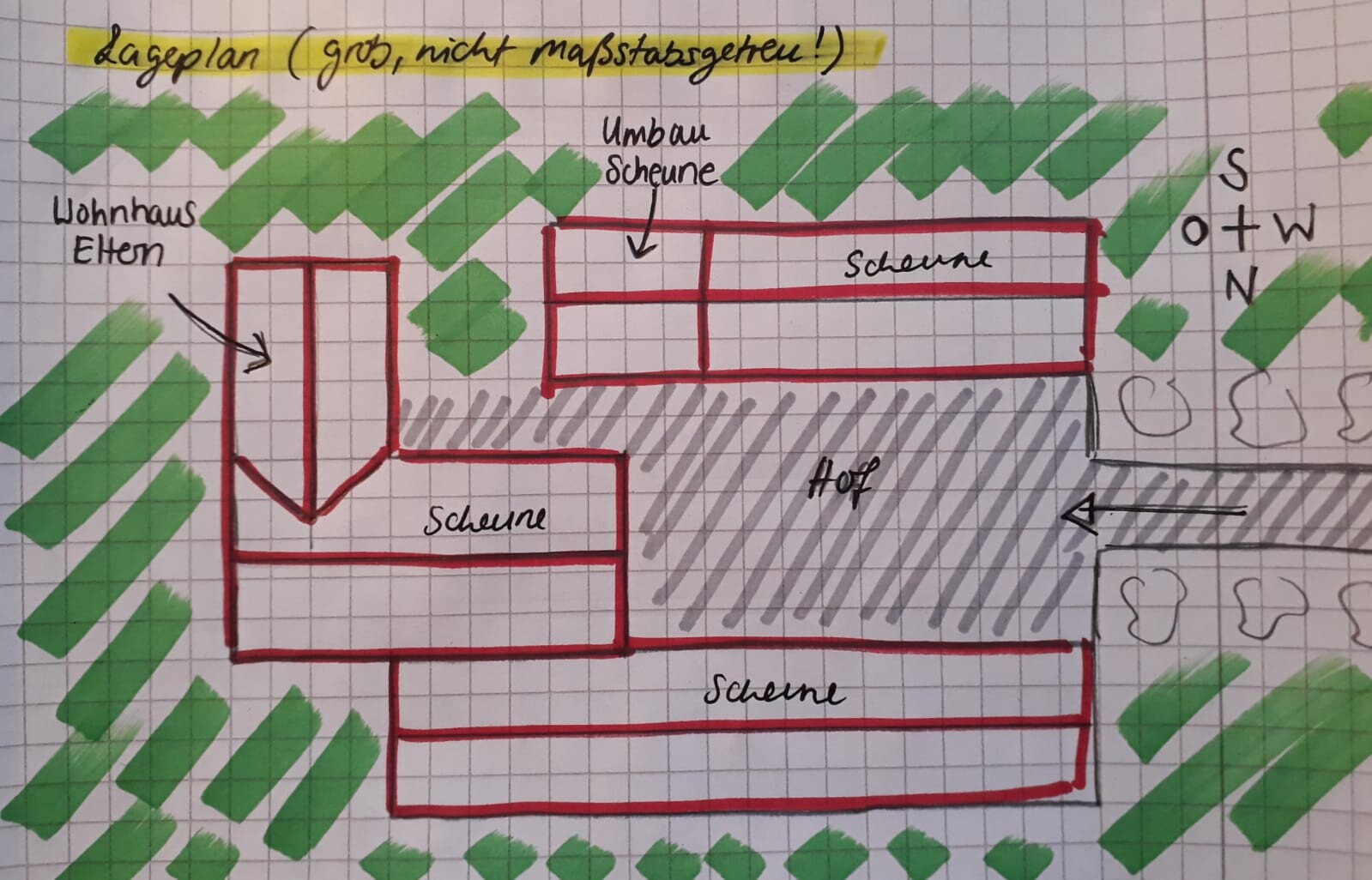
Now I’d like to give it a try as well. Just a brief introduction: My partner and I would like to convert part of the barn on his parents’ farm into a residential home. This means we are not as free in terms of dimensions, style, design, etc. as with a new build and have to work with the existing conditions. The goal is to convert the barn section into a single-family house for a family with presumably three children. However, the house should later, if needed, also be rentable as two separate apartments. The reason is that the existing farmhouse, where my partner’s parents currently live, is not very suitable for rental, so a move there in the future is not excluded. The potential for later rental, along with the constraints of the existing building, imposes further limitations.
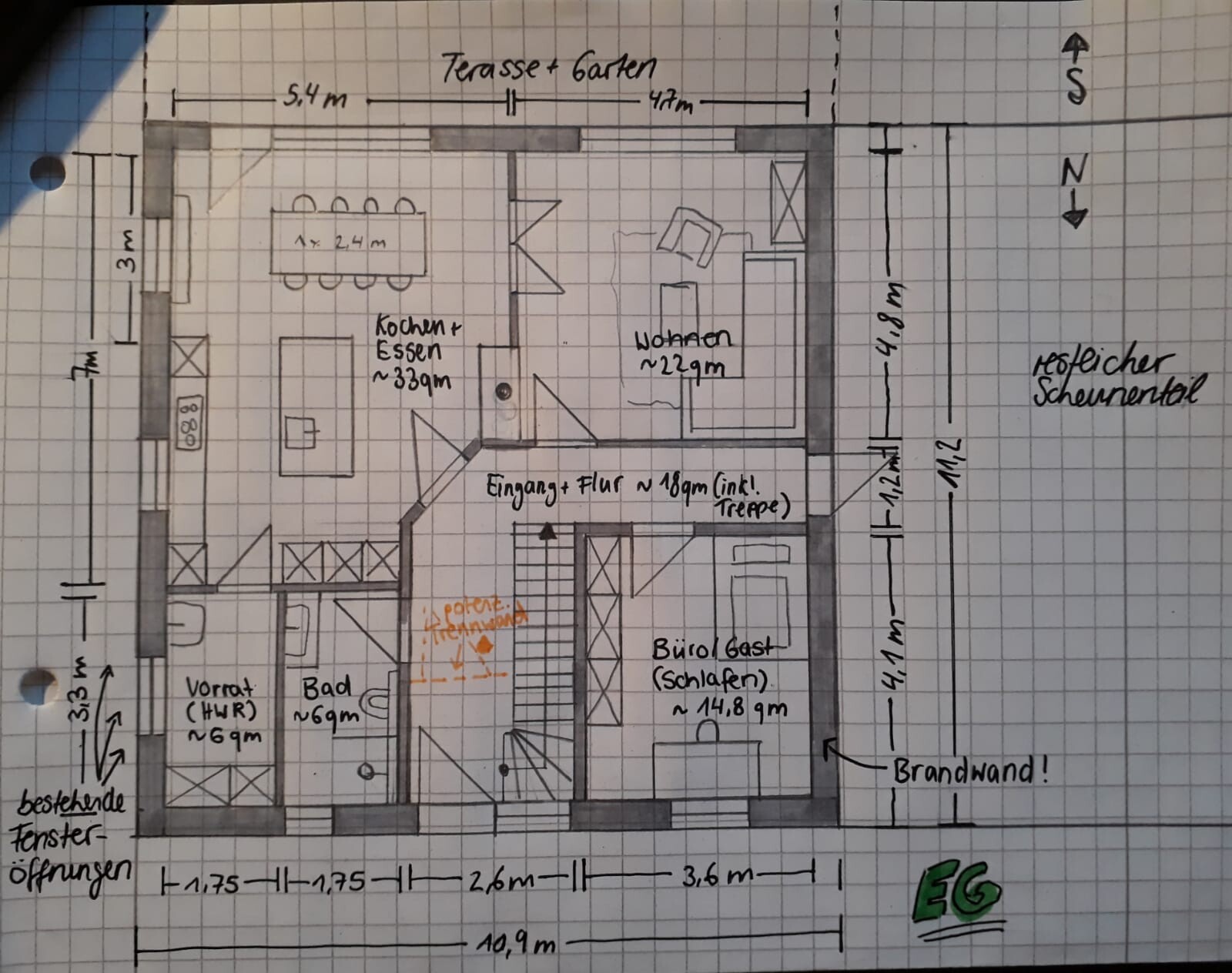
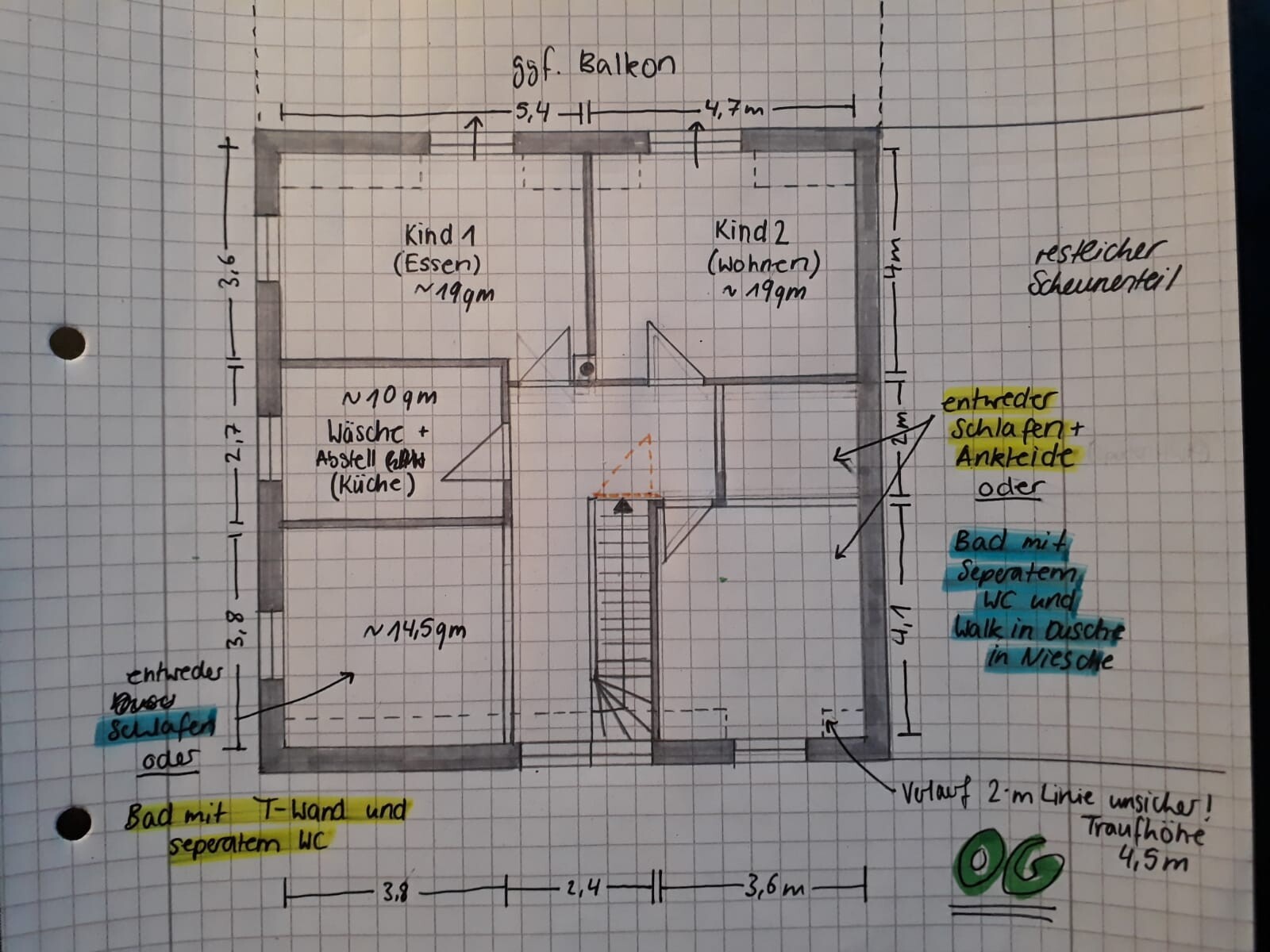
We are therefore looking for the best and most practical compromise. Our first ideas are shown in the attached floor plans. Please excuse the hand-drawn nature and the partly missing dimensions, etc. Our main focus is on the general layout of the rooms! We welcome criticism and suggestions that maybe we haven’t thought of yet. Thank you very much!
Questionnaire Regarding Your Floor Plan
Building plan / restrictions
Plot size: /
Slope: No
Site coverage ratio: Not applicable
Floor area ratio: Not applicable
Building envelope, building line, and boundaries: Existing
Adjacent building: None
Number of parking spaces: Sufficient space available on the farm
Number of stories: Oriented to existing building (2 full floors plus attic)
Roof type: Gable roof
Style: Oriented to existing building
Orientation: Defined by existing building
Maximum height/limits: Existing ridge height 9.2m (30 ft), eaves height 4.5m (15 ft)
Additional requirements:
Client Requirements
Style, roof shape, building type: dictated by existing structure
Stories: Ground floor (GF), first floor (FF), attic
Number of occupants, ages 28, 25, desired: approximately 3 children
Room requirements:
GF: Living room, kitchen + dining, pantry (utility room if rented), office / guest room (bedroom if rented), bathroom
FF: Bedroom (dressing room if possible), family bathroom with separate toilet, 2 children’s rooms (dining and living if rented), laundry room (kitchen if rented)
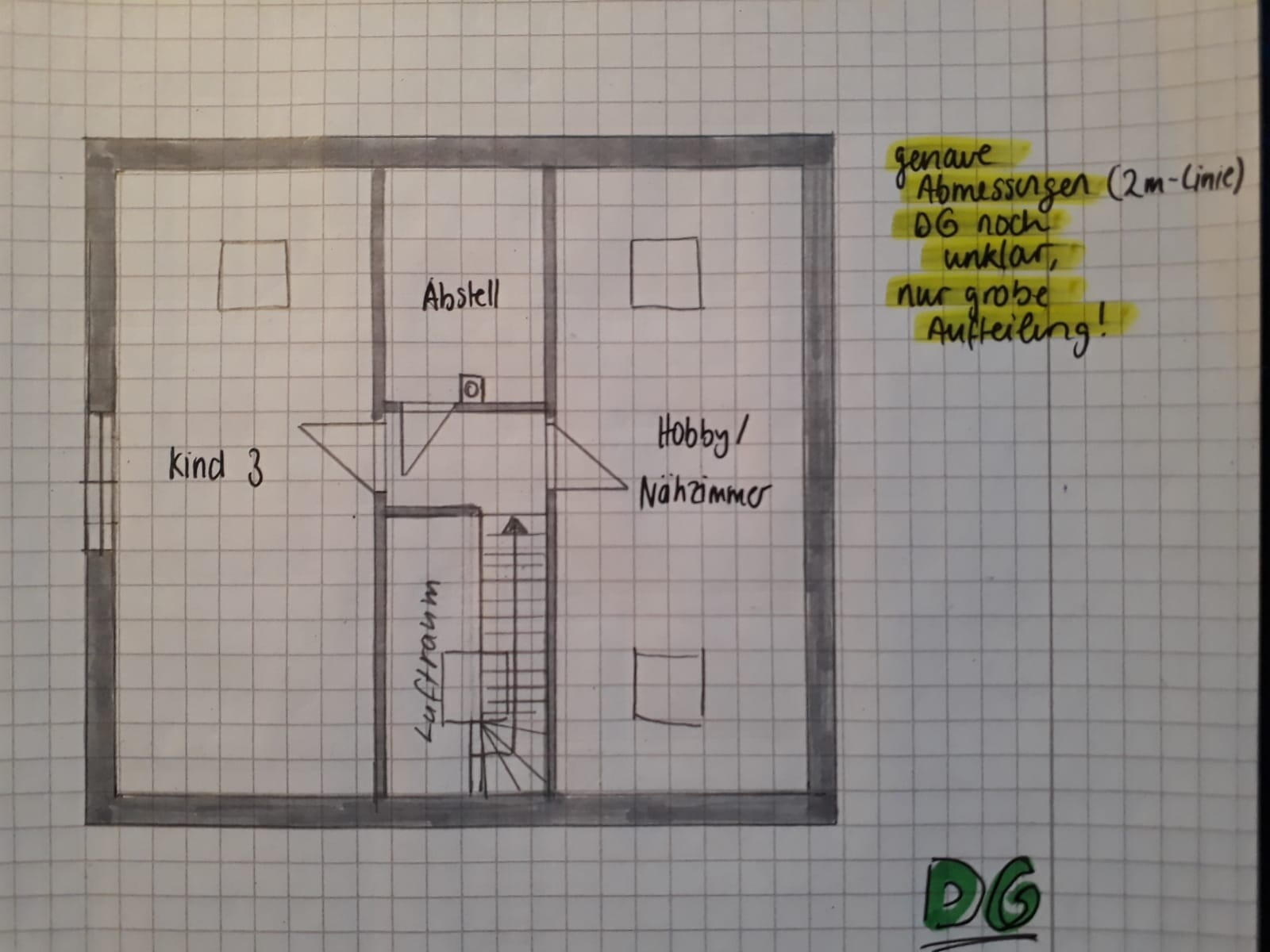
Attic: small storage room, children’s room, hobby room
→ Rooms can also be arranged differently if a better proposal arises (e.g., additional child’s room in attic, hobby room on FF, utility room on GF, etc.)
Office: partial home office for both
Guest sleepers per year: 5
Open or closed architecture: rather closed
Traditional or modern construction: preferably as modern as possible but with traditional elements due to the existing building and closed floor plan
Open kitchen, kitchen island: island preferred, probably setup as a cleaning/prep island
Number of dining seats: 8 expandable to at least 10 (preferably more, large families on both sides)
Fireplace: yes
Music/sound wall: no
Balcony, roof terrace: balcony planned on FF
Garage, carport: no
Utility garden, greenhouse: no
Other wishes / special features / daily routine, also reasons why some things should or should not be:
- Direct access to the rest of the barn is strongly desired (both of us are used to this at home; it is the main entrance we use there, where lots of work clothes, a mudroom, etc. are stored – extremely valuable on the farm)
- Open-plan living area is not desired (a door between dining and living room) but visual connection wanted (double door)
- Heating and other technical installations will be centralized in another barn for both houses, so no need to house them in the building itself (only necessary utility boxes etc., also for future rental)
House Design
Who designed it:
- Do-it-yourself
What do you like most? Why?
- All elements included, large kitchen/dining/living area
- Tunnel fireplace
- Large children’s rooms
- All rooms with windows (challenge due to fire wall)
What do you dislike? Why?
- Narrow entrance?
- Wardrobe only possible under the stairs
- Staircase start unfortunately right at the entrance due to future rental considerations
- Slanted wall as kitchen entrance may not be very contemporary?
- Bathroom and guest room (later bedroom) on the ground floor not next to each other
- Dressing room not always available (two variants on FF)
Cost estimate according to architect/planner: /
Personal upper budget limit for house including fittings: /
Preferred heating technology: /
If you had to give up, which features/rooms could you live without?
- Could do without: dressing room, hobby room
- Cannot do without: minimum 3 children’s rooms + 1 office
Why is the design as it is now?
For example:
We have planned the design ourselves so far, based on the many existing conditions and our wishes, trying to find the best possible compromise.
What is the most important/basic question about the floor plan in 130 characters?
Less direct questions but rather a wish for independent feedback. We feel the space could be used more effectively/better or that more creative/modern solutions exist despite our constraints.
Thank you to all who are active in this informative forum!
Now I’d like to give it a try as well. Just a brief introduction: My partner and I would like to convert part of the barn on his parents’ farm into a residential home. This means we are not as free in terms of dimensions, style, design, etc. as with a new build and have to work with the existing conditions. The goal is to convert the barn section into a single-family house for a family with presumably three children. However, the house should later, if needed, also be rentable as two separate apartments. The reason is that the existing farmhouse, where my partner’s parents currently live, is not very suitable for rental, so a move there in the future is not excluded. The potential for later rental, along with the constraints of the existing building, imposes further limitations.
We are therefore looking for the best and most practical compromise. Our first ideas are shown in the attached floor plans. Please excuse the hand-drawn nature and the partly missing dimensions, etc. Our main focus is on the general layout of the rooms! We welcome criticism and suggestions that maybe we haven’t thought of yet. Thank you very much!
Questionnaire Regarding Your Floor Plan
Building plan / restrictions
Plot size: /
Slope: No
Site coverage ratio: Not applicable
Floor area ratio: Not applicable
Building envelope, building line, and boundaries: Existing
Adjacent building: None
Number of parking spaces: Sufficient space available on the farm
Number of stories: Oriented to existing building (2 full floors plus attic)
Roof type: Gable roof
Style: Oriented to existing building
Orientation: Defined by existing building
Maximum height/limits: Existing ridge height 9.2m (30 ft), eaves height 4.5m (15 ft)
Additional requirements:
Client Requirements
Style, roof shape, building type: dictated by existing structure
Stories: Ground floor (GF), first floor (FF), attic
Number of occupants, ages 28, 25, desired: approximately 3 children
Room requirements:
GF: Living room, kitchen + dining, pantry (utility room if rented), office / guest room (bedroom if rented), bathroom
FF: Bedroom (dressing room if possible), family bathroom with separate toilet, 2 children’s rooms (dining and living if rented), laundry room (kitchen if rented)
Attic: small storage room, children’s room, hobby room
→ Rooms can also be arranged differently if a better proposal arises (e.g., additional child’s room in attic, hobby room on FF, utility room on GF, etc.)
Office: partial home office for both
Guest sleepers per year: 5
Open or closed architecture: rather closed
Traditional or modern construction: preferably as modern as possible but with traditional elements due to the existing building and closed floor plan
Open kitchen, kitchen island: island preferred, probably setup as a cleaning/prep island
Number of dining seats: 8 expandable to at least 10 (preferably more, large families on both sides)
Fireplace: yes
Music/sound wall: no
Balcony, roof terrace: balcony planned on FF
Garage, carport: no
Utility garden, greenhouse: no
Other wishes / special features / daily routine, also reasons why some things should or should not be:
- Direct access to the rest of the barn is strongly desired (both of us are used to this at home; it is the main entrance we use there, where lots of work clothes, a mudroom, etc. are stored – extremely valuable on the farm)
- Open-plan living area is not desired (a door between dining and living room) but visual connection wanted (double door)
- Heating and other technical installations will be centralized in another barn for both houses, so no need to house them in the building itself (only necessary utility boxes etc., also for future rental)
House Design
Who designed it:
- Do-it-yourself
What do you like most? Why?
- All elements included, large kitchen/dining/living area
- Tunnel fireplace
- Large children’s rooms
- All rooms with windows (challenge due to fire wall)
What do you dislike? Why?
- Narrow entrance?
- Wardrobe only possible under the stairs
- Staircase start unfortunately right at the entrance due to future rental considerations
- Slanted wall as kitchen entrance may not be very contemporary?
- Bathroom and guest room (later bedroom) on the ground floor not next to each other
- Dressing room not always available (two variants on FF)
Cost estimate according to architect/planner: /
Personal upper budget limit for house including fittings: /
Preferred heating technology: /
If you had to give up, which features/rooms could you live without?
- Could do without: dressing room, hobby room
- Cannot do without: minimum 3 children’s rooms + 1 office
Why is the design as it is now?
For example:
We have planned the design ourselves so far, based on the many existing conditions and our wishes, trying to find the best possible compromise.
What is the most important/basic question about the floor plan in 130 characters?
Less direct questions but rather a wish for independent feedback. We feel the space could be used more effectively/better or that more creative/modern solutions exist despite our constraints.
M
Myrna_Loy9 Jun 2021 14:08You do realize that converting a barn typically costs around €3000 per square meter (approximately $280 per square foot)?
M
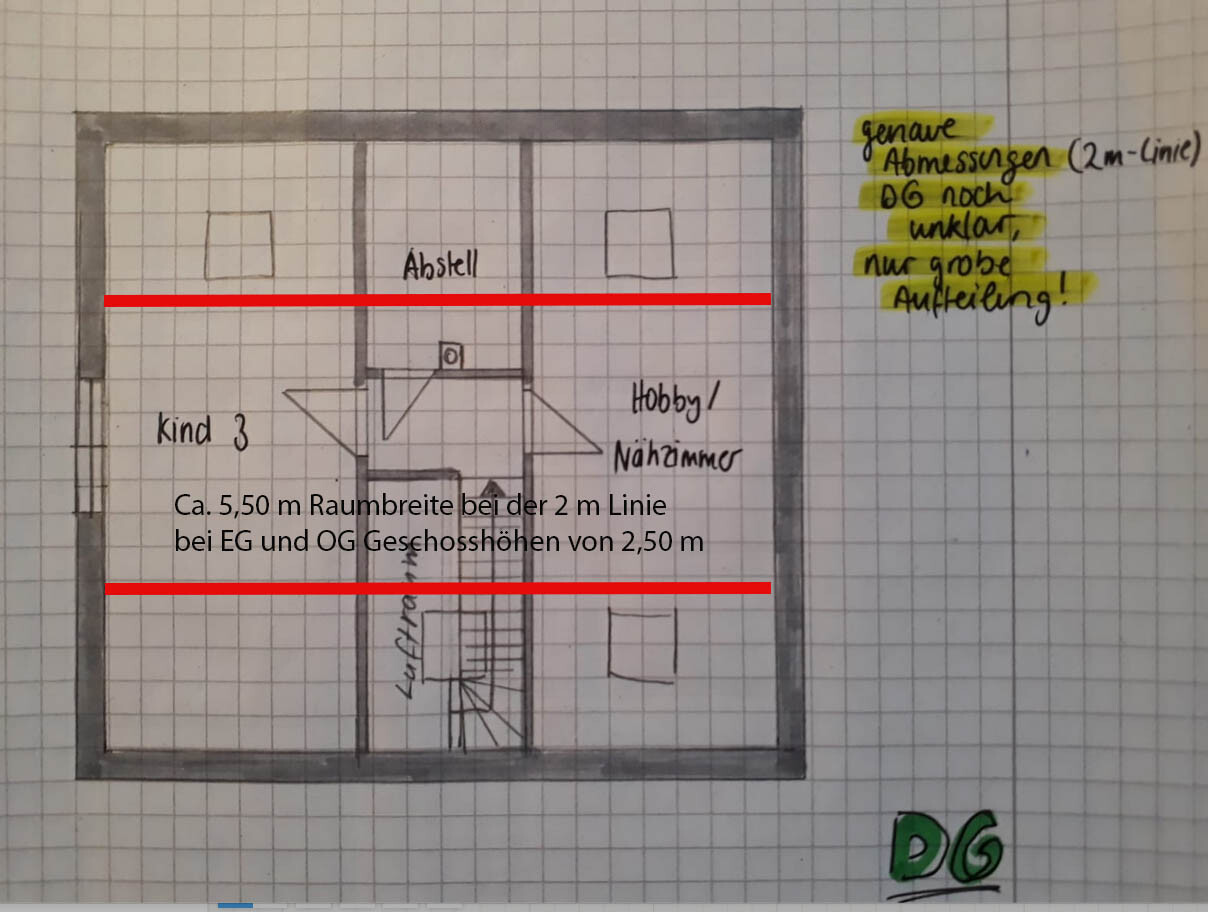
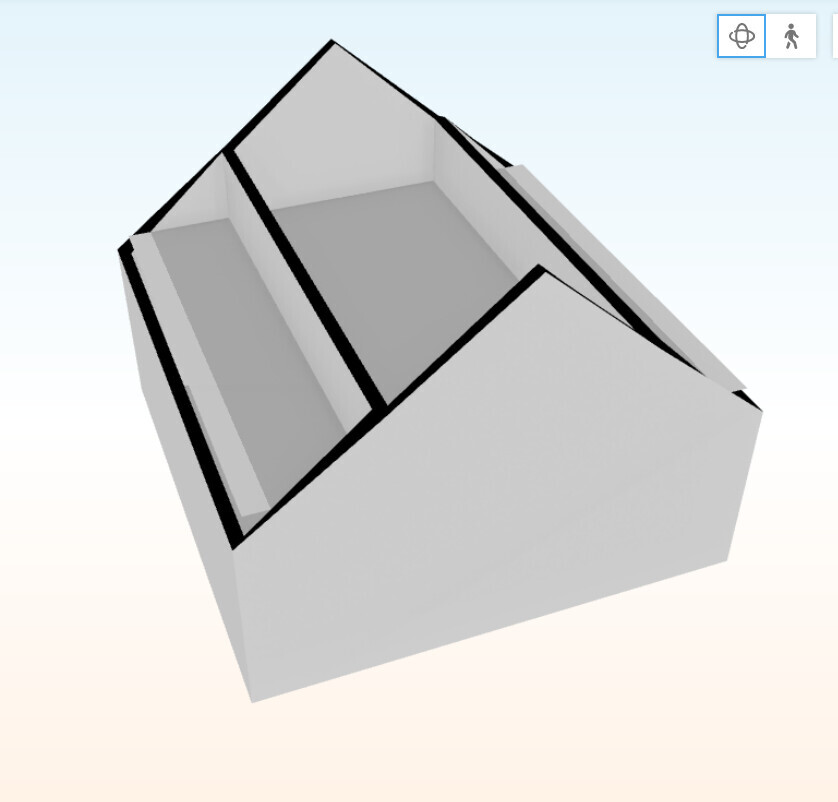
Myrna_Loy9 Jun 2021 14:53The attic conversion will have to make do with less space than shown in your sketch. If you want ceiling heights of 2.40 m (7 ft 10 in), it will be even tighter—more like a usable width with 2 m (6 ft 7 in) standing height of 3.50 m (11 ft 6 in).
I have sketched with a ceiling height of 2.25 m (7 ft 5 in).
I have sketched with a ceiling height of 2.25 m (7 ft 5 in).
S
Scheune209 Jun 2021 14:54Myrna_Loy schrieb:
You do realize that converting a barn costs around €3000 per square meter, right?We are aware that converting a barn involves high costs. However, as mentioned, we will be doing most of the work ourselves, which will save a considerable amount of money. I know this argument is often met with skepticism here, but in this case the conditions are favorable (equipment, skills, time, etc.) and we have successfully completed all previous building projects this way. Our architect will therefore primarily be involved up to work phase 4, although I am not categorically ruling out involvement beyond that.
S
Scheune209 Jun 2021 14:57Myrna_Loy schrieb:
The attic conversion will have to make do with less space than shown in your sketch. Thank you very much, Myrna_Loy, for the calculation and visualization! Unfortunately, that was what I had already expected. We will take this into account in our planning and possibly design just one large room in the attic.
M
Myrna_Loy9 Jun 2021 15:10Scheune20 schrieb:
We are aware that converting the barn involves significant costs. However, as mentioned, we will do the majority of the work ourselves, which will save us a considerable amount. I know this argument is often viewed critically here, but the conditions for this are favorable in our case (equipment, skills, time, etc.), and we have always been able to complete all previous construction projects this way. Our architect will therefore mainly be involved up to design phase 4, although I do not completely rule out involvement beyond that. We are also doing almost everything ourselves and have the appropriate vehicle fleet plus our own timber. However, you will still not get below 300,000 euros. Unless the roof is in excellent condition and you build to the most basic standard. But if you say the timber framing on the north side is in poor condition, expect that internal beams will need to be replaced as well. If you want to keep the beams, you will still have to consider thermal treatment – unless you want to accept the invisible risk of ongoing woodworm or beetle infestation in the finished house. Even as a self-builder with a lot of craft skills in the family, I can only advise: have structurally critical elements done by a professional company, especially if you are considering rental use.
You are bound by the energy-saving regulations. You must expect to use large amounts of materials. And with current construction material prices, get good advice.
S
Scheune209 Jun 2021 15:29All right, thanks Myrna_Loy!
For now, I understand that we will first have a thorough consultation with our architect to develop a “battle plan” and put the floor plan on hold. After we have done this, I will reach out to the forum again and, of course, share our findings with you. Please excuse us for having to take a step back and leaving you hanging a bit here, but this seems to be the best approach. I’ll get back to you as soon as I know more 🙂
For now, I understand that we will first have a thorough consultation with our architect to develop a “battle plan” and put the floor plan on hold. After we have done this, I will reach out to the forum again and, of course, share our findings with you. Please excuse us for having to take a step back and leaving you hanging a bit here, but this seems to be the best approach. I’ll get back to you as soon as I know more 🙂